


Matthew Trueblood
-
Posts
1,964 -
Joined
-
Last visited
-
Days Won
10
Content Type
Profiles
Forums
Blogs
Events
News
2026 Milwaukee Brewers Top Prospects Ranking
Milwaukee Brewers Videos
2022 Milwaukee Brewers Draft Picks
Milwaukee Brewers Free Agent & Trade Rumors, Notes, & Tidbits
Guides & Resources
2023 Milwaukee Brewers Draft Picks
2024 Milwaukee Brewers Draft Picks
The Milwaukee Brewers Players Project
2025 Milwaukee Brewers Draft Pick Tracker
2026 Milwaukee Brewers Draft Tracker: Picks & Bonuses
Store
Downloads
Gallery
Everything posted by Matthew Trueblood
-
Image courtesy of © Sam Navarro-Imagn Images Admittedly, Joey Ortiz hasn't gotten a perfect set of chances in the majors. He was blocked when he was first ready for the big leagues, during his final season with the Orioles organization. He was displaced for a year after being traded to the Brewers, when he slid to third base to play alongside Willy Adames. He's hit at the bottom of the batting order most of the time over the last year-plus, where you often get one fewer plate appearance than players at the top of the card; see the starting pitcher one fewer time; and hit with fewer runners on base in front of you. He's battled a few nagging injuries. Since the start of last August, during which time teammate Brice Turang has over 350 plate appearances across all competitions, Ortiz has just 165. Unfortunately, it's impossible to justify giving him more than that. In fact, he probably ought to have fewer. Ortiz is batting .200/.255/.227 since Aug. 1, 2025, including regular-season, playoff and World Baseball Classic games. He hit one home run during Cactus League play this spring, but that's the only one he's hit since the second game after last year's All-Star break, at any level. Ortiz is, fundamentally, broken. Hitters go through phases during which their timing is badly off, or when the ball doesn't carry for them or during which line drives always seem to find gloves. This is something different, and worse. Ortiz is simply overmatched, in a way no other hitter in the league is. To understand how true this is, you first need to know the following: Ortiz has a relatively flat swing. His swing path tilt has slightly increased in each year of his career, from 27° in 2024 to 29° this season, but the league averages between 32° and 33°. The flatter your swing is, the more important it is for you to catch the ball out in front of your body. Steeper swings can hit the ball sharply even deep in the hitting zone, but a flat one can only produce a ball with a good chance to be a hit (or any chance to be an extra-base hit) if the batter's intercept point—the place where the bat and the ball meet, or would have met, in the case of a whiff—is at least 27 inches in front of a hitter's center of mass. The league's average intercept point is closer to 31 inches in front of the body, and again, a flat swing usually does better in that range or slightly farther in front. Some steep swings can work with a contact point in the mid-20s, but the lower your tilt, the farther out front you must catch the ball to be productive. Ortiz has always let the ball travel pretty deep. Often accused of being passive at the plate, he's trying to be selective and to see the ball well before making a swing decision—but therefore, he lives life on the edge of being late to the hitting zone. He runs one of the lowest attack angles in the league, even when going well, which means that he barely gets through the process of slashing his bat down into the hitting zone before meeting the pitch; he's not working upward with the barrel nearly as much as most hitters are. Since the start of the second half last year, though, this has all gone to an extreme at which having success as a big-league batter is no longer possible. Ortiz's average intercept point, relative to his center of mass, has receded month by month: April 2025: 29.4 in. May 2025: 31.2 June 2025: 28.7 July 2025: 29.6 August 2025: 28.8 September 2025: 26.5 April 2026: 23.7 The ball is, as they say, in Ortiz's kitchen. He's no waterbug, but no one is strong enough to hit the ball hard—especially to the areas of the field where that can pay off best—when catching it that deep. Looking at the intercept point relative to his stance (and relative to the same visual for last year) illustrates the problem tidily: He's tried opening his stride, as the ball gets on top of him, to square his barrel to the pitch earlier in his swing and fight it off. As the numbers tell you, it's not working. Few hitters in the league have an average intercept point deeper than the front edge of home plate, where Ortiz was even last year. No one else in the league has one 9 inches past the front edge, as Ortiz has so far this season. The second-deepest intercept point in the league belongs to the Rays' Chandler Simpson, the slap-hitting super-speedster. Simpson's sheer speed allows him to survive with an intercept point 6.8 inches past the front edge of the plate, but hitting for power is out of the question for him. Right now, it's out of the question for Ortiz, too, even though the Brewers shortstop has about three scouting grades of bat speed on the Tampa outfielder. Simpson offers a good següe to the obvious alternative to Ortiz at shortstop, though, and therein lies (arguably) a dilemma. David Hamilton isn't hitting much better than Ortiz this season—just .178/.339/.178—but the fundamentals of his profile are much stronger. He needs to make some significant adjustments, and he doesn't have Ortiz's bat speed, either, but he can drive the ball a bit and has made much better swing decisions than Ortiz has. His own intercept point is dangerously close to being too deep, but he has a much steeper swing than Ortiz's, and if he wants to create more space to catch the ball out front, he has a simple means of doing so: get deeper in the batter's box. As ugly as the batting average is (and despite the lack of an extra-base hit by either player), there's no question that Hamilton is a better hitter than Ortiz, right now. The question, instead, is whether the Brewers will ever feel comfortable eschewing Ortiz's defensive brilliance in favor of the upside Hamilton provides in the batter's box. That question is complicated, and its answer might simply be 'no'. Pat Murphy and the Brewers coaching staff trust Ortiz at shortstop to a unique degree. They like everything about the way he plays the position, including the ways he's improved since coming to the club. He's sure-handed and smart, in addition to having a quick first step and plus range. He makes all the plays a team can ask a shortstop to make, and he never seems to make a glaring mistake. Hamilton is more spectacular, but less consistent. He has better range than Ortiz, and perhaps a stronger arm. He's creative, and his ceiling at the position might be higher. However, there are occasions on which he speeds up too much in the effort to make a play, leading to bobbles or outright drops of playable grounders. Rushing that way can also lead to bad throws, which are compound errors: they nearly always give a runner an extra base. With the game on the line, the Brewers absolutely (and rightly) trust Ortiz more than they trust Hamilton at short, even though the latter is a better athlete and can make a wider array of plays. So far this year, the magnitude of Ortiz's brokenness at bat has led to Hamilton getting six of the 21 starts at shortstop, but for that raio to flip—for the lefty-batting Hamilton to take on the majority of the playing time at the position—one of a few things will have to change. More stability from third baseman Luis Rengifo would nudge things in that direction; it would mean the team needs Hamilton at third base less. More of Hamilton's offensive skills translating to results would create more momentum for a change, too. Most of all, though, the team needs to see Hamilton make the routine play routinely, even in non-routine moments. If his steadiness with the glove catches up to Ortiz's, he'll become the starting shortstop immediately (if briefly; Cooper Pratt, Jesus Made and more are on the way). For now, though, Ortiz remains a part of the team's daily plans, despite his utter inability to muster any offense. Hamilton needs things to break his way, but he also has a chance to make his own breaks, by slowing down ever so slightly in the field. View full article
-
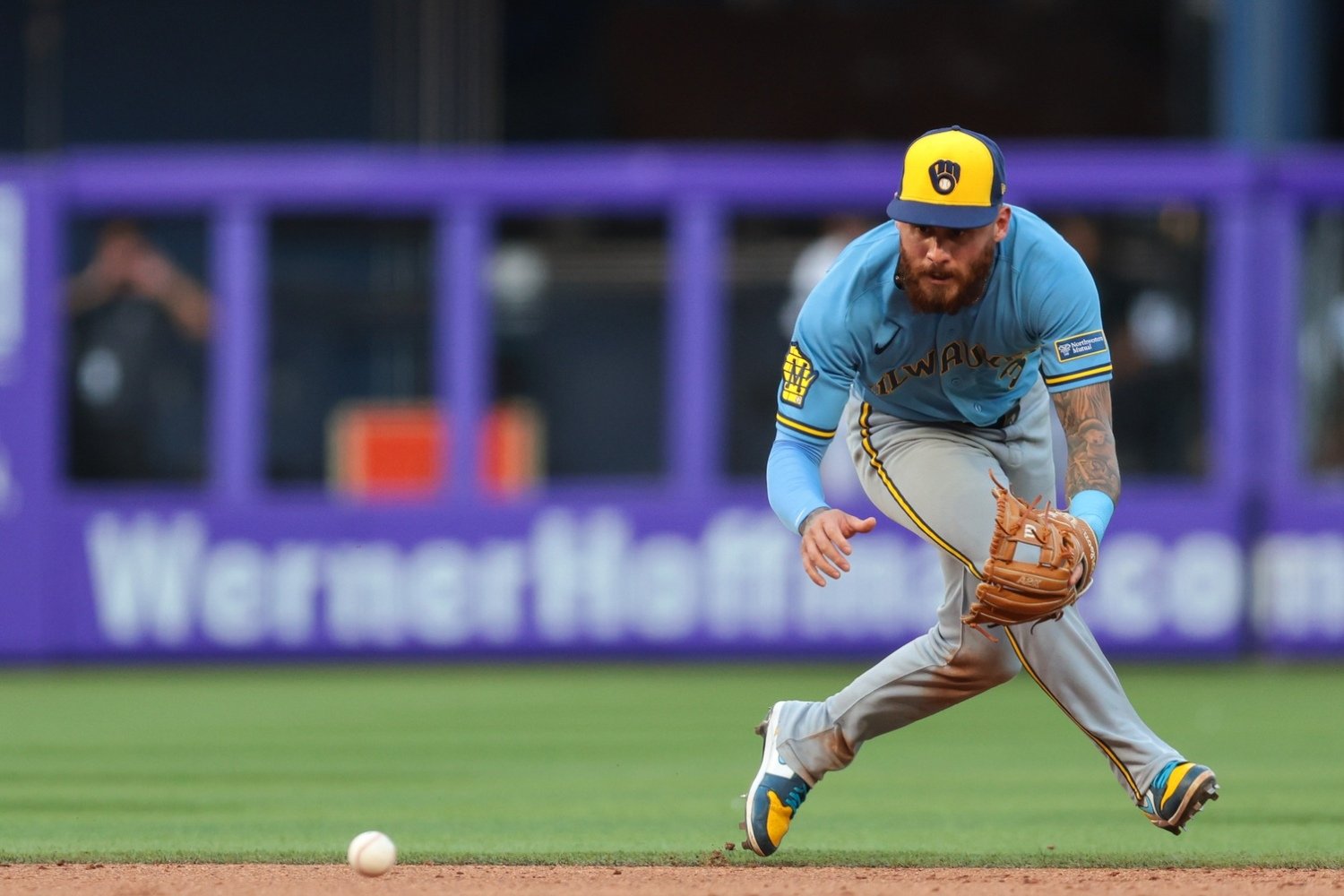 Admittedly, Joey Ortiz hasn't gotten a perfect set of chances in the majors. He was blocked when he was first ready for the big leagues, during his final season with the Orioles organization. He was displaced for a year after being traded to the Brewers, when he slid to third base to play alongside Willy Adames. He's hit at the bottom of the batting order most of the time over the last year-plus, where you often get one fewer plate appearance than players at the top of the card; see the starting pitcher one fewer time; and hit with fewer runners on base in front of you. He's battled a few nagging injuries. Since the start of last August, during which time teammate Brice Turang has over 350 plate appearances across all competitions, Ortiz has just 165. Unfortunately, it's impossible to justify giving him more than that. In fact, he probably ought to have fewer. Ortiz is batting .200/.255/.227 since Aug. 1, 2025, including regular-season, playoff and World Baseball Classic games. He hit one home run during Cactus League play this spring, but that's the only one he's hit since the second game after last year's All-Star break, at any level. Ortiz is, fundamentally, broken. Hitters go through phases during which their timing is badly off, or when the ball doesn't carry for them or during which line drives always seem to find gloves. This is something different, and worse. Ortiz is simply overmatched, in a way no other hitter in the league is. To understand how true this is, you first need to know the following: Ortiz has a relatively flat swing. His swing path tilt has slightly increased in each year of his career, from 27° in 2024 to 29° this season, but the league averages between 32° and 33°. The flatter your swing is, the more important it is for you to catch the ball out in front of your body. Steeper swings can hit the ball sharply even deep in the hitting zone, but a flat one can only produce a ball with a good chance to be a hit (or any chance to be an extra-base hit) if the batter's intercept point—the place where the bat and the ball meet, or would have met, in the case of a whiff—is at least 27 inches in front of a hitter's center of mass. The league's average intercept point is closer to 31 inches in front of the body, and again, a flat swing usually does better in that range or slightly farther in front. Some steep swings can work with a contact point in the mid-20s, but the lower your tilt, the farther out front you must catch the ball to be productive. Ortiz has always let the ball travel pretty deep. Often accused of being passive at the plate, he's trying to be selective and to see the ball well before making a swing decision—but therefore, he lives life on the edge of being late to the hitting zone. He runs one of the lowest attack angles in the league, even when going well, which means that he barely gets through the process of slashing his bat down into the hitting zone before meeting the pitch; he's not working upward with the barrel nearly as much as most hitters are. Since the start of the second half last year, though, this has all gone to an extreme at which having success as a big-league batter is no longer possible. Ortiz's average intercept point, relative to his center of mass, has receded month by month: April 2025: 29.4 in. May 2025: 31.2 June 2025: 28.7 July 2025: 29.6 August 2025: 28.8 September 2025: 26.5 April 2026: 23.7 The ball is, as they say, in Ortiz's kitchen. He's no waterbug, but no one is strong enough to hit the ball hard—especially to the areas of the field where that can pay off best—when catching it that deep. Looking at the intercept point relative to his stance (and relative to the same visual for last year) illustrates the problem tidily: He's tried opening his stride, as the ball gets on top of him, to square his barrel to the pitch earlier in his swing and fight it off. As the numbers tell you, it's not working. Few hitters in the league have an average intercept point deeper than the front edge of home plate, where Ortiz was even last year. No one else in the league has one 9 inches past the front edge, as Ortiz has so far this season. The second-deepest intercept point in the league belongs to the Rays' Chandler Simpson, the slap-hitting super-speedster. Simpson's sheer speed allows him to survive with an intercept point 6.8 inches past the front edge of the plate, but hitting for power is out of the question for him. Right now, it's out of the question for Ortiz, too, even though the Brewers shortstop has about three scouting grades of bat speed on the Tampa outfielder. Simpson offers a good següe to the obvious alternative to Ortiz at shortstop, though, and therein lies (arguably) a dilemma. David Hamilton isn't hitting much better than Ortiz this season—just .178/.339/.178—but the fundamentals of his profile are much stronger. He needs to make some significant adjustments, and he doesn't have Ortiz's bat speed, either, but he can drive the ball a bit and has made much better swing decisions than Ortiz has. His own intercept point is dangerously close to being too deep, but he has a much steeper swing than Ortiz's, and if he wants to create more space to catch the ball out front, he has a simple means of doing so: get deeper in the batter's box. As ugly as the batting average is (and despite the lack of an extra-base hit by either player), there's no question that Hamilton is a better hitter than Ortiz, right now. The question, instead, is whether the Brewers will ever feel comfortable eschewing Ortiz's defensive brilliance in favor of the upside Hamilton provides in the batter's box. That question is complicated, and its answer might simply be 'no'. Pat Murphy and the Brewers coaching staff trust Ortiz at shortstop to a unique degree. They like everything about the way he plays the position, including the ways he's improved since coming to the club. He's sure-handed and smart, in addition to having a quick first step and plus range. He makes all the plays a team can ask a shortstop to make, and he never seems to make a glaring mistake. Hamilton is more spectacular, but less consistent. He has better range than Ortiz, and perhaps a stronger arm. He's creative, and his ceiling at the position might be higher. However, there are occasions on which he speeds up too much in the effort to make a play, leading to bobbles or outright drops of playable grounders. Rushing that way can also lead to bad throws, which are compound errors: they nearly always give a runner an extra base. With the game on the line, the Brewers absolutely (and rightly) trust Ortiz more than they trust Hamilton at short, even though the latter is a better athlete and can make a wider array of plays. So far this year, the magnitude of Ortiz's brokenness at bat has led to Hamilton getting six of the 21 starts at shortstop, but for that raio to flip—for the lefty-batting Hamilton to take on the majority of the playing time at the position—one of a few things will have to change. More stability from third baseman Luis Rengifo would nudge things in that direction; it would mean the team needs Hamilton at third base less. More of Hamilton's offensive skills translating to results would create more momentum for a change, too. Most of all, though, the team needs to see Hamilton make the routine play routinely, even in non-routine moments. If his steadiness with the glove catches up to Ortiz's, he'll become the starting shortstop immediately (if briefly; Cooper Pratt, Jesus Made and more are on the way). For now, though, Ortiz remains a part of the team's daily plans, despite his utter inability to muster any offense. Hamilton needs things to break his way, but he also has a chance to make his own breaks, by slowing down ever so slightly in the field.
 -
For that matter, there was buzz about Garrett Mitchell near the top of the first round early in the 2020 draft cycle.
-
Image courtesy of © Sam Navarro-Imagn Images Strictly speaking, we've seen Brewers hitters quite a bit hotter than Brice Turang is right now. After 22 games, the second baseman is batting .300/.437/.571, which is mightily impressive, but during his bid to win back-to-back National League MVP Awards, Christian Yelich had stretches of this length during which his OPS eclipsed 1.500. It's not just Yelich (or famously raucous runs like the Linsanity version of Eric Thames), either. Keston Hiura had a stretch this long that was hotter. So did Yasmani Grandal. So did Gerardo Parra, way back in 2015. Try not to let yourself forget that this is still only three and a half weeks of baseball, and that Turang has been great, but human. That said: how long has it been since you felt as good watching a Brewers hitter at bat as you do when watching Turang right now? You probably do have to drift back to the pre-pandemic edition of Yelich. It's not just results, right now. Turang's process feels immaculate, and incorruptible. That's not quite the reality; baseball will always humble you. But that's how it feels. Turang's game has gotten better each year of his career, and this season, the improvements are more pronounced than ever. First, of course, there's the bat path. No hitter in baseball has increased the average tilt of their swing more from 2025 to 2026 than has Turang—who had also increased his average tilt from 2023 to 2024, and from 2024 to 2025. He came into the league as a flat swinger, according to Statcast (29°, against a league average of roughly 32°), but he's now quite steep in his average approach to the ball (36°). It's a subtle-sounding difference, and it can be hard to see from one swing to the next, because hitters naturally adjust their swings based on what they're trying to do; what pitch type they anticipate, and what type they see out of the hand; and where the pitch is. To isolate it, then, let's look at four swings Turang has put on 1-0 four-seam fastballs in the middle vertical band of the zone, from right-handed pitchers with roughly average velocity—one each from 2023 through this year. Here's the 2023 case for study. QVlCenhfWGw0TUFRPT1fVWdZRVVRVUdVMVFBWEFFRFZBQUFCZ0pRQUFOWEFWY0FDMUpYVkZFTUFBcFdWZ1pY.mp4 I picked one of the rare times that Turang let it eat that year. Partially, that's because he didn't see that many pitches that fit these criteria that year, and partially, it's so we can all marvel at what a wandering babe he was back then. This really feels like looking at home movies of your kid, already, doesn't it? That version of Turang got beaten pretty easily by even pedestrian heat; there's a reason he hit .218/.285/.300 that season. Ok, here's 2024. YUs5TkFfWGw0TUFRPT1fRDFRRVZRZFdYbE1BQ2dOUVV3QUFCZ0FDQUZnREFnSUFVMU1NVVFVRVZBWURCQU5U.mp4 This ia a version of Turang that has learned to take an assertive hack without finding himself off-balance, but the limitations on his power are obvious here. He gets a better piece of this pitch, but still fouls off something hittable, in an advantage count. On to 2025. Nnk5ajJfWGw0TUFRPT1fRHdaWEJWRUNBQXNBQUFNQkJ3QUhDVlFIQUFNTld3TUFWZ0VDVWdGV1VGVUJCUVJl.mp4 I hope you can see some differences between those two clips. They're small, to be sure, but they're there. Turang found more bat speed in 2025, and took a more dangerous hack. He still fouled the ball off to the left side, but it was less because he was late and more because he was slashing through the ball, if you will, missing it slightly off the upper and outer side of the barrel. Now, let's look at a similar pitch earlier this year. TkFObmJfWGw0TUFRPT1fRGdrRkFnWlNWMVFBV2dGVUJBQUhCUWNIQUFBQkIxY0FWZ0JVVkFjRkFRRUFWRllE.mp4 Admittedly, choosing a homer for comparison serves my argument well, but it's part of the point I'm making. Turang has gotten much more efficient with the barrel this season, thanks to his improved bat path. At every level of the zone height-wise, his swing is steeper than it was even late last year, when he was starting to generate power. He's making a meaningfully different move to the baseball than he used to. To help you see that better, I've taken still frames of the moment just before his bat gets to the ball on each of the pitches above. I've also highlighted his bat position in each. Notice that the lines get both steeper (more tilt in the swing) and longer (he's getting the barrel out more before the ball arrives) as we move from the past to the present. Turang's raw, Statcast-reported bat speed is not meaningfully up this year, but the fact that it's almost exactly where it's been in the past with a steeper plane amounts to a boost in bat speed. He's not pulling the ball very much this season, but when you swing with a steeper bat path, you leave yourself more ways to make solid contact to the opposite field, if you don't get around the ball and yank it to the pull field. That's especially true for left-handed hitters, and it's something Pat Murphy and Brewers coaches have been nudging Turang toward understanding since this time last year. Selectivity has also paid off for Turang. The strike zone is a bit smaller this year, which has contributed to a drop in the share of pitches he sees being in the zone. Last season, 52.7% of opponents' pitches to Turang were in the zone. This year, that number is down to 46.4%. Accordingly. Turang's swing rate (which was just under 48% in 2023 and 2024) has dropped, from 44.3% in 2025 to 36.7%. Thence come his incredible 17 walks in 88 trips to the plate, with both that total and his walks-inflated .437 OBP ranking second in the National League. Meanwhile, the Brewers are doing exactly what they did last year with their infield defense, funneling as many balls into Turang's sphere of influence as possible, and he's continued to justify their faith. You can pick nits with his game—his speed is slightly diminished, and he's gotten more conservative on the bases; he has yet to utilize the ABS challenge system, missing a few chances to better his position within an at-bat—but it would seem ungrateful to do so. Turang has made a series of adjustments that make him one of the toughest outs in baseball, partially because he's also gotten more dangerous at the plate. Unlike hitters who have been similarly hot in recent memory, though, Turang also delivers baserunning and defensive value. He's carrying the Brewers offense, during a stretch in which the team is missing three of the five hitters on whom they were most relying coming into the season. He had one star turn when he suddenly launched 13 homers after August began last summer. He enjoyed another in the World Baseball Classic. In total, going back to the start of August, Turang is batting .297/.384/.538, in over half a season's worth of playing time. That's giving him credit for his showing in the WBC, but it also folds in his disastrously bad 2025 playoff stats. He's hit like an elite corner outfielder for the last nine months, coming out of an offseason even hotter than he was before it. Concrete changes tell us he's genuinely maturing into that dangerous a hitter, and he's still a plus defender at an up-the-middle position. The Brewers are watching as yet another player blossoms from solidity to stardom on their watch. View full article
-
You Can Spell 'Brice Turang' Without 'MVP', But Why Bother?
Matthew Trueblood posted an article in Brewers
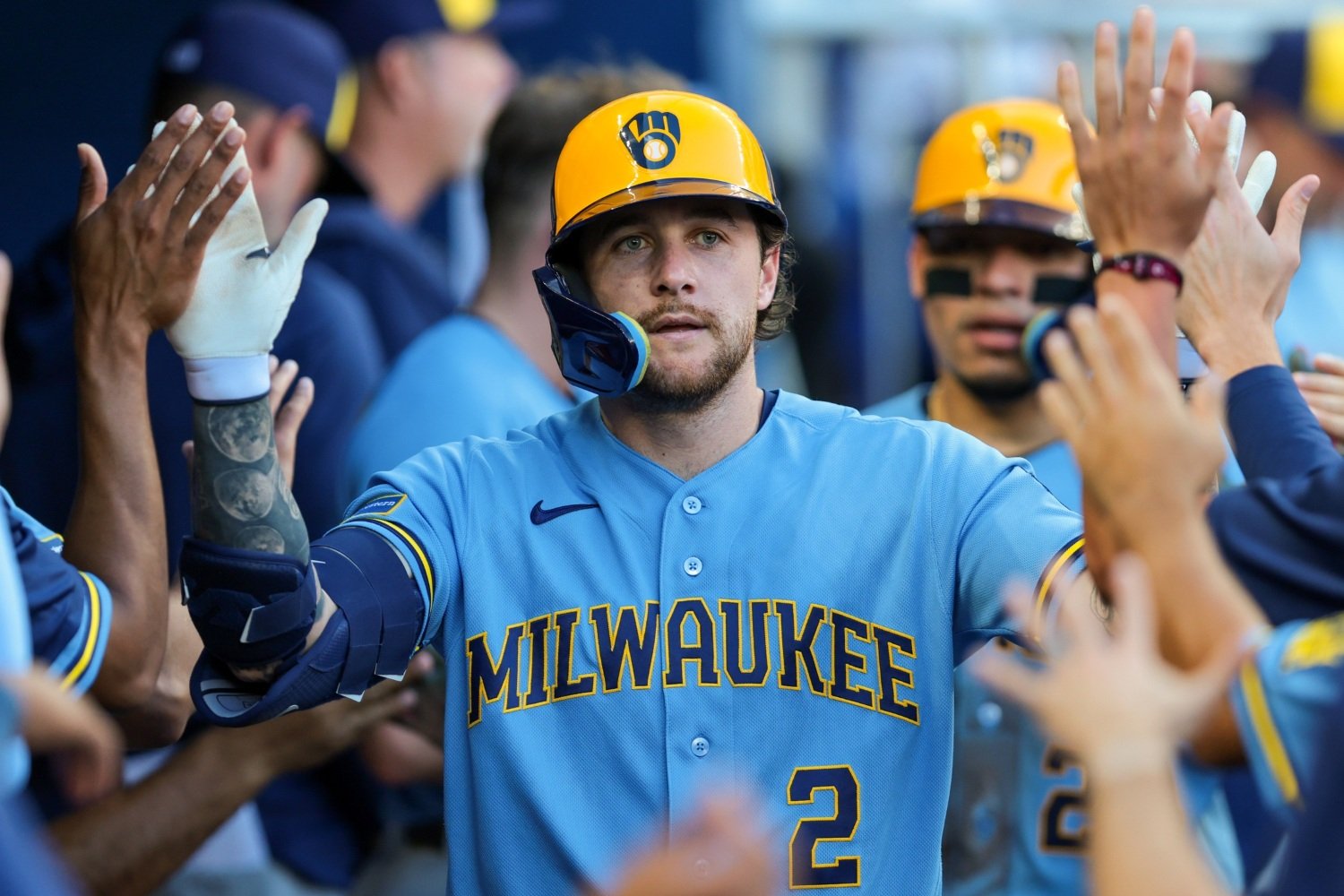 Strictly speaking, we've seen Brewers hitters quite a bit hotter than Brice Turang is right now. After 22 games, the second baseman is batting .300/.437/.571, which is mightily impressive, but during his bid to win back-to-back National League MVP Awards, Christian Yelich had stretches of this length during which his OPS eclipsed 1.500. It's not just Yelich (or famously raucous runs like the Linsanity version of Eric Thames), either. Keston Hiura had a stretch this long that was hotter. So did Yasmani Grandal. So did Gerardo Parra, way back in 2015. Try not to let yourself forget that this is still only three and a half weeks of baseball, and that Turang has been great, but human. That said: how long has it been since you felt as good watching a Brewers hitter at bat as you do when watching Turang right now? You probably do have to drift back to the pre-pandemic edition of Yelich. It's not just results, right now. Turang's process feels immaculate, and incorruptible. That's not quite the reality; baseball will always humble you. But that's how it feels. Turang's game has gotten better each year of his career, and this season, the improvements are more pronounced than ever. First, of course, there's the bat path. No hitter in baseball has increased the average tilt of their swing more from 2025 to 2026 than has Turang—who had also increased his average tilt from 2023 to 2024, and from 2024 to 2025. He came into the league as a flat swinger, according to Statcast (29°, against a league average of roughly 32°), but he's now quite steep in his average approach to the ball (36°). It's a subtle-sounding difference, and it can be hard to see from one swing to the next, because hitters naturally adjust their swings based on what they're trying to do; what pitch type they anticipate, and what type they see out of the hand; and where the pitch is. To isolate it, then, let's look at four swings Turang has put on 1-0 four-seam fastballs in the middle vertical band of the zone, from right-handed pitchers with roughly average velocity—one each from 2023 through this year. Here's the 2023 case for study. QVlCenhfWGw0TUFRPT1fVWdZRVVRVUdVMVFBWEFFRFZBQUFCZ0pRQUFOWEFWY0FDMUpYVkZFTUFBcFdWZ1pY.mp4 I picked one of the rare times that Turang let it eat that year. Partially, that's because he didn't see that many pitches that fit these criteria that year, and partially, it's so we can all marvel at what a wandering babe he was back then. This really feels like looking at home movies of your kid, already, doesn't it? That version of Turang got beaten pretty easily by even pedestrian heat; there's a reason he hit .218/.285/.300 that season. Ok, here's 2024. YUs5TkFfWGw0TUFRPT1fRDFRRVZRZFdYbE1BQ2dOUVV3QUFCZ0FDQUZnREFnSUFVMU1NVVFVRVZBWURCQU5U.mp4 This ia a version of Turang that has learned to take an assertive hack without finding himself off-balance, but the limitations on his power are obvious here. He gets a better piece of this pitch, but still fouls off something hittable, in an advantage count. On to 2025. Nnk5ajJfWGw0TUFRPT1fRHdaWEJWRUNBQXNBQUFNQkJ3QUhDVlFIQUFNTld3TUFWZ0VDVWdGV1VGVUJCUVJl.mp4 I hope you can see some differences between those two clips. They're small, to be sure, but they're there. Turang found more bat speed in 2025, and took a more dangerous hack. He still fouled the ball off to the left side, but it was less because he was late and more because he was slashing through the ball, if you will, missing it slightly off the upper and outer side of the barrel. Now, let's look at a similar pitch earlier this year. TkFObmJfWGw0TUFRPT1fRGdrRkFnWlNWMVFBV2dGVUJBQUhCUWNIQUFBQkIxY0FWZ0JVVkFjRkFRRUFWRllE.mp4 Admittedly, choosing a homer for comparison serves my argument well, but it's part of the point I'm making. Turang has gotten much more efficient with the barrel this season, thanks to his improved bat path. At every level of the zone height-wise, his swing is steeper than it was even late last year, when he was starting to generate power. He's making a meaningfully different move to the baseball than he used to. To help you see that better, I've taken still frames of the moment just before his bat gets to the ball on each of the pitches above. I've also highlighted his bat position in each. Notice that the lines get both steeper (more tilt in the swing) and longer (he's getting the barrel out more before the ball arrives) as we move from the past to the present. Turang's raw, Statcast-reported bat speed is not meaningfully up this year, but the fact that it's almost exactly where it's been in the past with a steeper plane amounts to a boost in bat speed. He's not pulling the ball very much this season, but when you swing with a steeper bat path, you leave yourself more ways to make solid contact to the opposite field, if you don't get around the ball and yank it to the pull field. That's especially true for left-handed hitters, and it's something Pat Murphy and Brewers coaches have been nudging Turang toward understanding since this time last year. Selectivity has also paid off for Turang. The strike zone is a bit smaller this year, which has contributed to a drop in the share of pitches he sees being in the zone. Last season, 52.7% of opponents' pitches to Turang were in the zone. This year, that number is down to 46.4%. Accordingly. Turang's swing rate (which was just under 48% in 2023 and 2024) has dropped, from 44.3% in 2025 to 36.7%. Thence come his incredible 17 walks in 88 trips to the plate, with both that total and his walks-inflated .437 OBP ranking second in the National League. Meanwhile, the Brewers are doing exactly what they did last year with their infield defense, funneling as many balls into Turang's sphere of influence as possible, and he's continued to justify their faith. You can pick nits with his game—his speed is slightly diminished, and he's gotten more conservative on the bases; he has yet to utilize the ABS challenge system, missing a few chances to better his position within an at-bat—but it would seem ungrateful to do so. Turang has made a series of adjustments that make him one of the toughest outs in baseball, partially because he's also gotten more dangerous at the plate. Unlike hitters who have been similarly hot in recent memory, though, Turang also delivers baserunning and defensive value. He's carrying the Brewers offense, during a stretch in which the team is missing three of the five hitters on whom they were most relying coming into the season. He had one star turn when he suddenly launched 13 homers after August began last summer. He enjoyed another in the World Baseball Classic. In total, going back to the start of August, Turang is batting .297/.384/.538, in over half a season's worth of playing time. That's giving him credit for his showing in the WBC, but it also folds in his disastrously bad 2025 playoff stats. He's hit like an elite corner outfielder for the last nine months, coming out of an offseason even hotter than he was before it. Concrete changes tell us he's genuinely maturing into that dangerous a hitter, and he's still a plus defender at an up-the-middle position. The Brewers are watching as yet another player blossoms from solidity to stardom on their watch.
 -
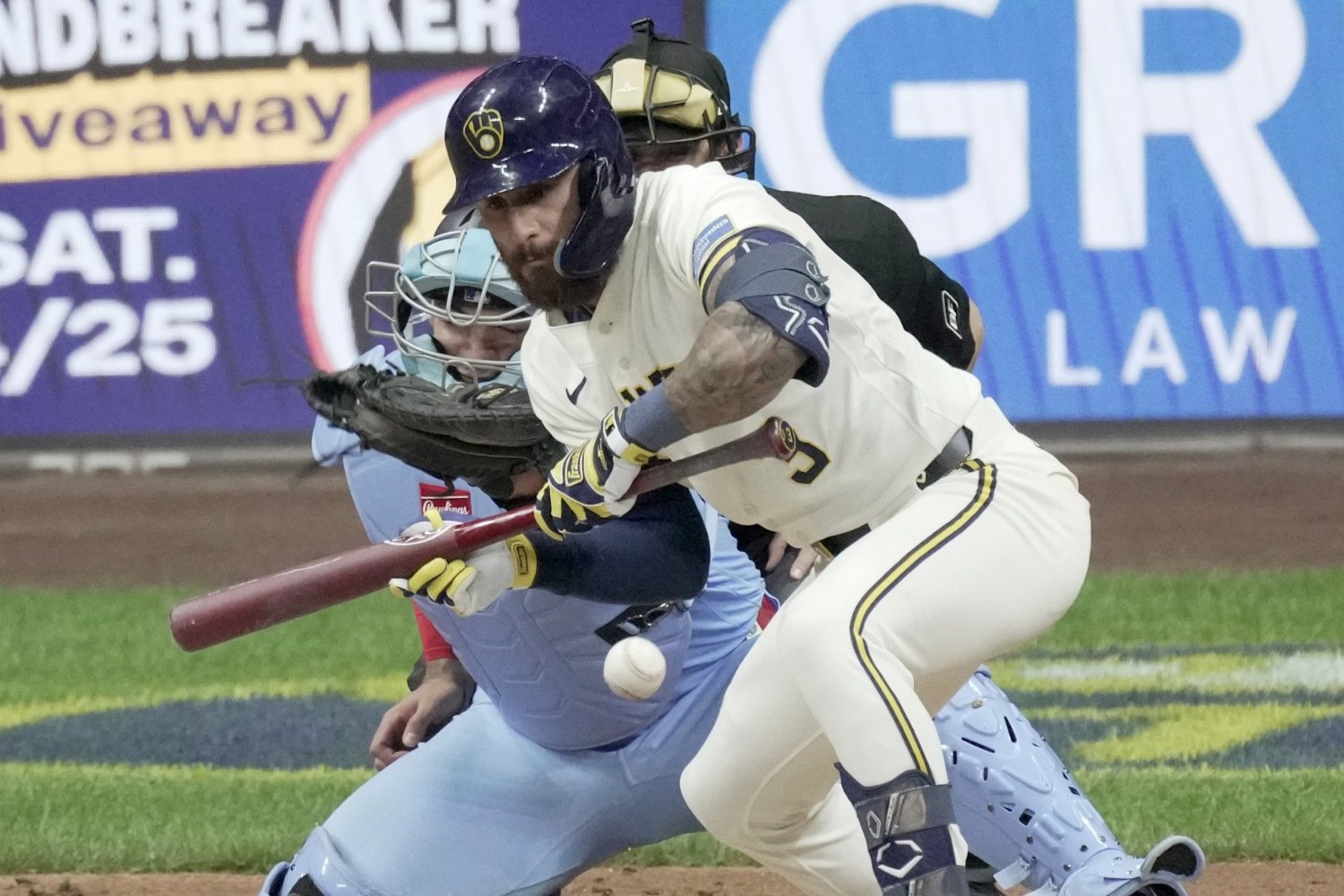 Execution and fundamentals get a bad rap, in modern baseball. When present, they're too simple to earn much praise. The league is too chock-full of talent for fundamentals and execution to win games for you, on their own. When absent, they;re too easy to grieve and bemoan. The truth is that you can't win a big-league game with fundamentals and execution, but failures of execution inevitably beget an unfair burden of expectations for instances of successful execution. Fans see when a lack of fundamentals hurt you, and they get the mistaken idea that good fundamentals could win you games on their own. It's been a joy to watch the Brewers for the past two-plus years, because under Pat Murphy, they often execute and do the fundamental things better than anyone. That's not why they win games. They win because they pair those elements with better talent than most fans and many opponents recognize; excellent preparation and situational decision-making; and team chemistry that keeps them engaged when things are bad and can snowball in a good way when things are good. That said, we saw some faltering fundamentals from the team during their six-game losing streak, so it was a relief when those elements nudged them over the top and earned them a win Thursday afternoon. It was a taut 1-1 game going into the bottom of the seventh, but Garrett Mitchell drew a leadoff walk. That sparked the sequence that decided the game, and it happened in remarkable fashion. First, Greg Jones put down a relatively routine sacrifice bunt. That play is uninteresting, in most respects. Jones does everything well, though. He doesn't give away that the bunt is happening too soon, but he does give himself ample time to get into the proper position, so he's not moving his head or poking at the ball with the bat when it arrives. Laying down a bunt in the big leagues is much harder than it looks, and arguably, that first bunt was a bad call by Pat Murphy and the Brewers. A real risk of failing to get it down existed, because pitchers in the majors are so good; that includes Toronto's Tommy Nance. Jones is clearly an experienced and highly competent bunter, though, which was probably one factor in the Brewers' decision-making. Knowing that Jones was more likely than the typical batter to get the bunt down made calling for it more viable, even though statistically, laying down that bunt ahead of David Hamilton and Joey Ortiz didn't increase the team's chances of scoring a run. This play did. The Jays bringing in lefty Joe Mantiply was a clever response to the Brewers' gambit. Hamilton has a future with the team as a glove-first infielder who can handle right-handed pitchers, but left-on-left, he's not the guy you want at the plate with the game on the line. Rather than take him down for a pinch-hitter, though, the team asked Hamilton, too, to get down a bunt. As a sacrifice, this would have been an atrocious idea, but that's not what it ever was. Here's where fundamentals meet extraordinary talent, to make a victory. Hamilton doesn't wait any longer to show bunt than Jones did, but he doesn't give it away so soon that the third baseman can be well in front of the bag by the time he bunts the ball. He adroitly puts himself into nearly an identical bunting position as the one Jones adopted, but unlike Jones, he's putting on the jailbreak, too. There might be five faster runners in the majors than Hamilton; there aren't 10. His raw speed is great, but with the jailbreak coming out of the left-handed batter's box, his time from touching the ball to touching first base is downright elite. It helps, here, that Mantiply isn't a guy who falls off the mound much with the effort of his delivery. Had his momentum carried him toward the foul line more in the first place, he would have had a play on Hamilton. As it was, Ernie Clement had to make the play, and he never really had one. That left it up to Ortiz to get the run in, with runners on the corners and one out. Technically, of course, the Brewers had two chances, at that point. Hamilton's speed had created a marvelous opportunity. In practice, though, it felt very important to get the run home there, before it came down to needing a hit from Brandon Lockridge. Ortiz, unlike Jones and Hamilton, didn't get the bunt down on either of the first two pitches, working the count to 1-1. It's a bit surprising that the Jays weren't more committed to the bunt than they were, in terms of positioning, but the risk of Ortiz pulling the bat back and poking the ball into the corner was real. Ultimately, the Crew had the safety squeeze on, rather than the suicide squeeze, so Toronto didn't need their corner guys crashing toward the plate. It was all going to come down to how good a bunt Ortiz put down. He put down a perfect one. Some of this, of course, is luck. Bunt placement is a skill, but it's a skill bounded by the quality of the opposing pitcher and the nature of a bouncing ball. Ortiz read a changeup from Mantiply well, lowering the bat to catch it but staying on top of it as it dipped toward the ground. It's a pretty easy pitch to bunt, but it's easy to push it foul or to hit it too hard. Ortiz did neither. The ball he dribbled into the dirt in front of home plate died pretty quickly, in a patch of the playing surface that has been very slow all week. It was enough to force Jays catcher Tyler Heineman into a dilemma: Should he set up to receive a flip from Mantiply on a play at the plate, attempting to thwart the go-ahead run, or should he chase the ball all the way to its spot and retire Ortiz? There's even a third choice there, in some cases, where he could snatch the ball soon enough to twist and dive backward himself, trying to tag Mitchell out unassisted. Mantiply was charging hard, and only veered away to let Heineman take the ball at the last instant. Watching the replay, it looks like he might have had a play, and Heineman should have held his ground just in front of the dish. Certainly, if Ortiz had touched the ball any harder, the Jays would have made the attempt on Mitchell, and probably been successful. If he'd pushed it with any less pace, Heineman would have been able to tag Mitchell himself. This ball was perfect, though. In the heat of the moment, trying to forestall a big inning and not feeling confident enough of a try on the lead runner, Heineman simply picked the ball up and fired to first, taking the out the Brewers were giving. The game wasn't over in that instant, and the way the Crew played that frame denied them much chance for a bigger lead and an easier top of the ninth. Happily, though Ángel Zerpa retired the Jays relatively easily, to lock down the win. It wasn't simply a product of fundamental play. Brandon Sproat showed what a stud he has the potential to be in the starting rotation. Mitchell's and Hamilton's speed made the winning rally possible, as much as the excellent execution of the three bunts themselves. That's what good fundamentals really do, though: put you in full contact with the value of your talent. The Brewers are back on track after a brutal week, and they used their combination of subtle skills and good fundamentals to get there.
-
- 1
-

-
- greg jones
- david hamilton
- (and 2 more)
-
Image courtesy of © Mark Hoffman/Milwaukee Journal Sentinel-Imagn Image Execution and fundamentals get a bad rap, in modern baseball. When present, they're too simple to earn much praise. The league is too chock-full of talent for fundamentals and execution to win games for you, on their own. When absent, they;re too easy to grieve and bemoan. The truth is that you can't win a big-league game with fundamentals and execution, but failures of execution inevitably beget an unfair burden of expectations for instances of successful execution. Fans see when a lack of fundamentals hurt you, and they get the mistaken idea that good fundamentals could win you games on their own. It's been a joy to watch the Brewers for the past two-plus years, because under Pat Murphy, they often execute and do the fundamental things better than anyone. That's not why they win games. They win because they pair those elements with better talent than most fans and many opponents recognize; excellent preparation and situational decision-making; and team chemistry that keeps them engaged when things are bad and can snowball in a good way when things are good. That said, we saw some faltering fundamentals from the team during their six-game losing streak, so it was a relief when those elements nudged them over the top and earned them a win Thursday afternoon. It was a taut 1-1 game going into the bottom of the seventh, but Garrett Mitchell drew a leadoff walk. That sparked the sequence that decided the game, and it happened in remarkable fashion. First, Greg Jones put down a relatively routine sacrifice bunt. That play is uninteresting, in most respects. Jones does everything well, though. He doesn't give away that the bunt is happening too soon, but he does give himself ample time to get into the proper position, so he's not moving his head or poking at the ball with the bat when it arrives. Laying down a bunt in the big leagues is much harder than it looks, and arguably, that first bunt was a bad call by Pat Murphy and the Brewers. A real risk of failing to get it down existed, because pitchers in the majors are so good; that includes Toronto's Tommy Nance. Jones is clearly an experienced and highly competent bunter, though, which was probably one factor in the Brewers' decision-making. Knowing that Jones was more likely than the typical batter to get the bunt down made calling for it more viable, even though statistically, laying down that bunt ahead of David Hamilton and Joey Ortiz didn't increase the team's chances of scoring a run. This play did. The Jays bringing in lefty Joe Mantiply was a clever response to the Brewers' gambit. Hamilton has a future with the team as a glove-first infielder who can handle right-handed pitchers, but left-on-left, he's not the guy you want at the plate with the game on the line. Rather than take him down for a pinch-hitter, though, the team asked Hamilton, too, to get down a bunt. As a sacrifice, this would have been an atrocious idea, but that's not what it ever was. Here's where fundamentals meet extraordinary talent, to make a victory. Hamilton doesn't wait any longer to show bunt than Jones did, but he doesn't give it away so soon that the third baseman can be well in front of the bag by the time he bunts the ball. He adroitly puts himself into nearly an identical bunting position as the one Jones adopted, but unlike Jones, he's putting on the jailbreak, too. There might be five faster runners in the majors than Hamilton; there aren't 10. His raw speed is great, but with the jailbreak coming out of the left-handed batter's box, his time from touching the ball to touching first base is downright elite. It helps, here, that Mantiply isn't a guy who falls off the mound much with the effort of his delivery. Had his momentum carried him toward the foul line more in the first place, he would have had a play on Hamilton. As it was, Ernie Clement had to make the play, and he never really had one. That left it up to Ortiz to get the run in, with runners on the corners and one out. Technically, of course, the Brewers had two chances, at that point. Hamilton's speed had created a marvelous opportunity. In practice, though, it felt very important to get the run home there, before it came down to needing a hit from Brandon Lockridge. Ortiz, unlike Jones and Hamilton, didn't get the bunt down on either of the first two pitches, working the count to 1-1. It's a bit surprising that the Jays weren't more committed to the bunt than they were, in terms of positioning, but the risk of Ortiz pulling the bat back and poking the ball into the corner was real. Ultimately, the Crew had the safety squeeze on, rather than the suicide squeeze, so Toronto didn't need their corner guys crashing toward the plate. It was all going to come down to how good a bunt Ortiz put down. He put down a perfect one. Some of this, of course, is luck. Bunt placement is a skill, but it's a skill bounded by the quality of the opposing pitcher and the nature of a bouncing ball. Ortiz read a changeup from Mantiply well, lowering the bat to catch it but staying on top of it as it dipped toward the ground. It's a pretty easy pitch to bunt, but it's easy to push it foul or to hit it too hard. Ortiz did neither. The ball he dribbled into the dirt in front of home plate died pretty quickly, in a patch of the playing surface that has been very slow all week. It was enough to force Jays catcher Tyler Heineman into a dilemma: Should he set up to receive a flip from Mantiply on a play at the plate, attempting to thwart the go-ahead run, or should he chase the ball all the way to its spot and retire Ortiz? There's even a third choice there, in some cases, where he could snatch the ball soon enough to twist and dive backward himself, trying to tag Mitchell out unassisted. Mantiply was charging hard, and only veered away to let Heineman take the ball at the last instant. Watching the replay, it looks like he might have had a play, and Heineman should have held his ground just in front of the dish. Certainly, if Ortiz had touched the ball any harder, the Jays would have made the attempt on Mitchell, and probably been successful. If he'd pushed it with any less pace, Heineman would have been able to tag Mitchell himself. This ball was perfect, though. In the heat of the moment, trying to forestall a big inning and not feeling confident enough of a try on the lead runner, Heineman simply picked the ball up and fired to first, taking the out the Brewers were giving. The game wasn't over in that instant, and the way the Crew played that frame denied them much chance for a bigger lead and an easier top of the ninth. Happily, though Ángel Zerpa retired the Jays relatively easily, to lock down the win. It wasn't simply a product of fundamental play. Brandon Sproat showed what a stud he has the potential to be in the starting rotation. Mitchell's and Hamilton's speed made the winning rally possible, as much as the excellent execution of the three bunts themselves. That's what good fundamentals really do, though: put you in full contact with the value of your talent. The Brewers are back on track after a brutal week, and they used their combination of subtle skills and good fundamentals to get there. View full article
-
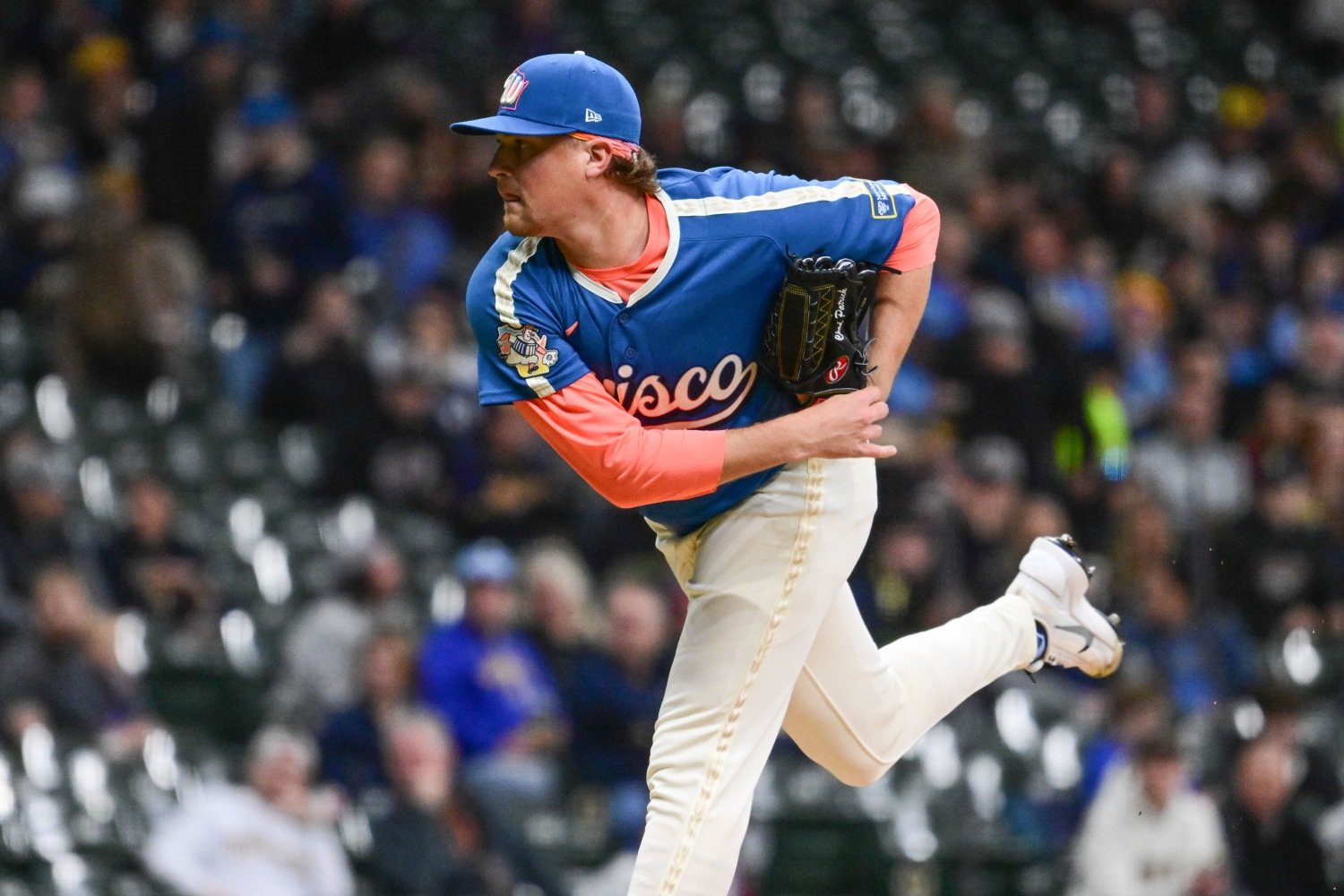 The sinker is there to work to the arm side of the pitcher who throws it. It's there to force a same-handed batter not to dive over the plate, so they can't reach your four-seamer on the far corner or your breaking ball. It's there to control that arm-side half of the plate; that's what it does. For Chad Patrick, though, it does something else. Patrick uses the sinker strangely. Of the 58 sinkers he's thrown so far this season, 30 of them were on the glove-side (that is, the first-base-side) third of the plate or farther that direction—in on lefties, and away from fellow righties. Most pitchers struggle mightily to command that pitch, so they don't bother throwing it. The sinker runs to the arm side. If you try to aim it toward the glove side but miss, you're likely to leave a meatball in the heart of the zone. Much of the time, the reward for getting it right there just isn't rich enough to justify the risks of that. Patrick, however, has pretty good command of the pitch, and has gotten good mileage from it. Here's how those 30 pitches have broken down: 12 called strikes 11 balls 1 swinging strike 2 foul balls 2 outs on balls in play 2 singles That doesn't add up to a lot of value in a vacuum, but let's discuss some nuances here. Firstly, using FanGraphs's new Pitch Pairing tool, we can take a look at the way Patrick attacks hitters and the interactions between his pitches. Here, for instance, is his profile against right-handed batters, with his signature pitch—the cutter—as the anchor pitch off which the others are considered to be working. When Patrick is executing well, his cutter forces hitters to sit on it, and his new slurve can be a bat-missing strike-to-ball offering. His four-seamer is nothing special, on its own, but if a hitter is sitting cutter, the four-seamer can induce pop-ups and weak contact, as long as he gets it high enough. Ah, but graphics like these assume the same "start line"—that's what the Brewers, at least, call the point they want a pitcher to target as they release a given pitch, letting it move from there to its real destination—for all pitches. By now, you know that Patrick isn't using the same start line for his sinker that he is for his cutter and the others. He starts that pitch off the outside edge by so much that if he threw the cutter the same way, it would end up in the left-handed batter's box. Instead, he's using the middle of the plate as his start line for the cutter and the slurve. For the sinker, he's starting outside. Tunneling pitches is only one way to generate deception. Sometimes, you want to get hitters looking for the tunneled set (in this case, the cutter-slurve-four-seam tunnel) of pitches, so you can freeze them with a pitch that would be non-competitive if it were part of that tunneled set. That doesn't always work, but when it does, it works gorgeously. Check out this sequence against Maikel García of the Royals, on April 4. This encounter came in the fifth inning. It was the third time García was seeing Patrick, so the hurler started him by landing a sluve in the zone for a called strike. That's conventional: catch a batter by surprise by showing them something unexpected at the front end of a third or fourth look within a game. He next went up to the top of the zone (above it, really) for a swinging strike on the cutter; he was way ahead of García. On his third pitch, though, he just got lucky. He tried to throw one of those strike-to-ball slurves, but got stuck in his own tunnel. The pitch broke off the line of the previous cutter, instead of one more typical of what Patrick throws to righties, and it ended up in the middle of the zone again. With two strikes, García wasn't going to be frozen and beaten so easily. It was still 0-2, but Patrick needed something new to show to a dangerous hitter who was right on him, now. Thus, the backdoor sinker. MDRYNk5fWGw0TUFRPT1fVUFSU1Z3SlNWUXNBWFZGV1Z3QUhDUVVGQUZnRFZ3SUFBMUZXQlFwVUNRWldVUUpW.mp4 Yes, technically, this pitch missed the zone. It didn't matter, though. Patrick had shaped it well and hit his spot. William Contreras framed the pitch well. Most importantly, García was fooled, badly. He was so unready to see that pitch, coming from that angle and landing where it did, that he was in no position to risk Kansas City's second challenge of the game on it. That's the ideal way for the backdoor sinker to work. It's a different thing if you first fall behind in the count. Here's a third-inning showdown with Chase Meidroth back on March 28. You can see what Patrick was thinking, here. He'd missed low with two of his first three offerings, but a front-door cutter had frozen Meidroth, so he was hoping that a hitter in an advantageous count would be sitting on another pitch on the inner half, on which he could turn and burn. Having thrown him the slurve on the previous pitch, he hoped he had Meidroth looking in that same tunnel, and that starting the sinker off the outside edge would freeze him and get Patrick back into the count at 2-2. Instead, Meidroth stayed on the ball and flicked it neatly into right field. TUFYMmRfWGw0TUFRPT1fVTFCWEFsUlhCMU1BV1FRQkJ3QUhDVkJVQUZoV1VnVUFVUVFCQkZBTUJBVlhVbEFB.mp4 With any pitch on which you're hoping for lots of called strikes, sequencing is paramount. Patrick wants righties to sit on the four-seamer and the cutter and the slurve, but he needs count leverage and/or perfect execution to win with the sinker just by violating those expectations. Because he throws the pitch so well to that side of the plate, though, Patrick's sinker is much better against lefties than most right-handed pitchers' sinkers are. Let's take a look at a couple more of those FanGraphs images. First, here's what his arsenal looks like when anchored to the four-seamer. You can see, pretty easily, how a lefty will experience the four-seamer, the cutter and the slurve as a tunnel and struggle to differentiate them. The key to the front-door sinker, then, is that it moves so differently than the rest of the arsenal that given the start line Patrick uses, it'll look to a batter like it's going to hit him, if the batter thinks it's either the cutter or the slurve. To a lefty, the pitch can tunnel a bit with the four-seamer, but it has to be set up in a different way. Here's a glance at the arsenal if we use the sinker as the anchor. So, let's look at one more way the pitch actually worked in a real matchup. In a showdown with the Nationals' Jorbit Vivas on Friday, Patrick started him with a more traditionally located two-seamer, hitting the outside edge of the zone for strike one. (It was initially called a ball, but Contreras got it back with a challenge via ABS.) Next, he dropped a fantastic slurve into the bottom, inner quadrant of the zone, getting ahead 0-2. The question was how to put Vivas away from there. Patrick guessed that Vivas would be looking for the cutter or the four-seamer, upstairs. He was right. Instead of giving Vivas that, though, he threw him a high, front-door sinker. As you can see above, it wasn't pinpoint location, but it worked, because Vivas hit the inside of the ball. He was trying to get his barrel around and through a four-seamer or cutter; the sinker ran off the side of the stick and produced an easy fly ball. NnlNcW9fWGw0TUFRPT1fQlZWUUFsQUdYd1VBREFaUUFnQUhBbFVEQUZnTkFsRUFVMUVEQ0FJSEFRQlVCd2Rl.mp4 Throwing the glove-side sinker takes some fearlessness and guile, as well as tactile command. Patrick has shown all of that this spring. This pitch is one more way in which he frustrates batters, despite his apparent lack of a swing-and-miss out pitch. He works in a three-pitch tunnel with the rest of his arsenal, but when it comes to the sinker, the tunnel isn't the point. Rather, Patrick is inviting batters to hone in on that tunnel—then working beyond it, forcing them to reconceptualize their approach and (if nothing else) be less locked in when he goes back to his tunneled set.
 -
Image courtesy of © Benny Sieu-Imagn Images The sinker is there to work to the arm side of the pitcher who throws it. It's there to force a same-handed batter not to dive over the plate, so they can't reach your four-seamer on the far corner or your breaking ball. It's there to control that arm-side half of the plate; that's what it does. For Chad Patrick, though, it does something else. Patrick uses the sinker strangely. Of the 58 sinkers he's thrown so far this season, 30 of them were on the glove-side (that is, the first-base-side) third of the plate or farther that direction—in on lefties, and away from fellow righties. Most pitchers struggle mightily to command that pitch, so they don't bother throwing it. The sinker runs to the arm side. If you try to aim it toward the glove side but miss, you're likely to leave a meatball in the heart of the zone. Much of the time, the reward for getting it right there just isn't rich enough to justify the risks of that. Patrick, however, has pretty good command of the pitch, and has gotten good mileage from it. Here's how those 30 pitches have broken down: 12 called strikes 11 balls 1 swinging strike 2 foul balls 2 outs on balls in play 2 singles That doesn't add up to a lot of value in a vacuum, but let's discuss some nuances here. Firstly, using FanGraphs's new Pitch Pairing tool, we can take a look at the way Patrick attacks hitters and the interactions between his pitches. Here, for instance, is his profile against right-handed batters, with his signature pitch—the cutter—as the anchor pitch off which the others are considered to be working. When Patrick is executing well, his cutter forces hitters to sit on it, and his new slurve can be a bat-missing strike-to-ball offering. His four-seamer is nothing special, on its own, but if a hitter is sitting cutter, the four-seamer can induce pop-ups and weak contact, as long as he gets it high enough. Ah, but graphics like these assume the same "start line"—that's what the Brewers, at least, call the point they want a pitcher to target as they release a given pitch, letting it move from there to its real destination—for all pitches. By now, you know that Patrick isn't using the same start line for his sinker that he is for his cutter and the others. He starts that pitch off the outside edge by so much that if he threw the cutter the same way, it would end up in the left-handed batter's box. Instead, he's using the middle of the plate as his start line for the cutter and the slurve. For the sinker, he's starting outside. Tunneling pitches is only one way to generate deception. Sometimes, you want to get hitters looking for the tunneled set (in this case, the cutter-slurve-four-seam tunnel) of pitches, so you can freeze them with a pitch that would be non-competitive if it were part of that tunneled set. That doesn't always work, but when it does, it works gorgeously. Check out this sequence against Maikel García of the Royals, on April 4. This encounter came in the fifth inning. It was the third time García was seeing Patrick, so the hurler started him by landing a sluve in the zone for a called strike. That's conventional: catch a batter by surprise by showing them something unexpected at the front end of a third or fourth look within a game. He next went up to the top of the zone (above it, really) for a swinging strike on the cutter; he was way ahead of García. On his third pitch, though, he just got lucky. He tried to throw one of those strike-to-ball slurves, but got stuck in his own tunnel. The pitch broke off the line of the previous cutter, instead of one more typical of what Patrick throws to righties, and it ended up in the middle of the zone again. With two strikes, García wasn't going to be frozen and beaten so easily. It was still 0-2, but Patrick needed something new to show to a dangerous hitter who was right on him, now. Thus, the backdoor sinker. MDRYNk5fWGw0TUFRPT1fVUFSU1Z3SlNWUXNBWFZGV1Z3QUhDUVVGQUZnRFZ3SUFBMUZXQlFwVUNRWldVUUpW.mp4 Yes, technically, this pitch missed the zone. It didn't matter, though. Patrick had shaped it well and hit his spot. William Contreras framed the pitch well. Most importantly, García was fooled, badly. He was so unready to see that pitch, coming from that angle and landing where it did, that he was in no position to risk Kansas City's second challenge of the game on it. That's the ideal way for the backdoor sinker to work. It's a different thing if you first fall behind in the count. Here's a third-inning showdown with Chase Meidroth back on March 28. You can see what Patrick was thinking, here. He'd missed low with two of his first three offerings, but a front-door cutter had frozen Meidroth, so he was hoping that a hitter in an advantageous count would be sitting on another pitch on the inner half, on which he could turn and burn. Having thrown him the slurve on the previous pitch, he hoped he had Meidroth looking in that same tunnel, and that starting the sinker off the outside edge would freeze him and get Patrick back into the count at 2-2. Instead, Meidroth stayed on the ball and flicked it neatly into right field. TUFYMmRfWGw0TUFRPT1fVTFCWEFsUlhCMU1BV1FRQkJ3QUhDVkJVQUZoV1VnVUFVUVFCQkZBTUJBVlhVbEFB.mp4 With any pitch on which you're hoping for lots of called strikes, sequencing is paramount. Patrick wants righties to sit on the four-seamer and the cutter and the slurve, but he needs count leverage and/or perfect execution to win with the sinker just by violating those expectations. Because he throws the pitch so well to that side of the plate, though, Patrick's sinker is much better against lefties than most right-handed pitchers' sinkers are. Let's take a look at a couple more of those FanGraphs images. First, here's what his arsenal looks like when anchored to the four-seamer. You can see, pretty easily, how a lefty will experience the four-seamer, the cutter and the slurve as a tunnel and struggle to differentiate them. The key to the front-door sinker, then, is that it moves so differently than the rest of the arsenal that given the start line Patrick uses, it'll look to a batter like it's going to hit him, if the batter thinks it's either the cutter or the slurve. To a lefty, the pitch can tunnel a bit with the four-seamer, but it has to be set up in a different way. Here's a glance at the arsenal if we use the sinker as the anchor. So, let's look at one more way the pitch actually worked in a real matchup. In a showdown with the Nationals' Jorbit Vivas on Friday, Patrick started him with a more traditionally located two-seamer, hitting the outside edge of the zone for strike one. (It was initially called a ball, but Contreras got it back with a challenge via ABS.) Next, he dropped a fantastic slurve into the bottom, inner quadrant of the zone, getting ahead 0-2. The question was how to put Vivas away from there. Patrick guessed that Vivas would be looking for the cutter or the four-seamer, upstairs. He was right. Instead of giving Vivas that, though, he threw him a high, front-door sinker. As you can see above, it wasn't pinpoint location, but it worked, because Vivas hit the inside of the ball. He was trying to get his barrel around and through a four-seamer or cutter; the sinker ran off the side of the stick and produced an easy fly ball. NnlNcW9fWGw0TUFRPT1fQlZWUUFsQUdYd1VBREFaUUFnQUhBbFVEQUZnTkFsRUFVMUVEQ0FJSEFRQlVCd2Rl.mp4 Throwing the glove-side sinker takes some fearlessness and guile, as well as tactile command. Patrick has shown all of that this spring. This pitch is one more way in which he frustrates batters, despite his apparent lack of a swing-and-miss out pitch. He works in a three-pitch tunnel with the rest of his arsenal, but when it comes to the sinker, the tunnel isn't the point. Rather, Patrick is inviting batters to hone in on that tunnel—then working beyond it, forcing them to reconceptualize their approach and (if nothing else) be less locked in when he goes back to his tunneled set. View full article
-
Image courtesy of © Jeff Hanisch-Imagn Images A crisis continues to brew in the Milwaukee bullpen. The offense continues to produce, but is stretched thin now that three of its four or five most accomplished hitters are on the injured list. It's not easy to win games for the Brewers right now. In fact, it hasn't been this hard in quite some time. Pat Murphy's previous two Brewers teams never lost more than four games in a row. Tuesday night's heartbreaking double-collapse loss to the Blue Jays made six straight 'L's. When you're in a funk like that—when the bullpen seems exhausted and there are creeping questions about the depth pieces in the rotation and the injury bug won't stop biting—a great team turns to its playmakers. That term is more often used in football and basketball, but baseball has playmakers, too. Over the last few seasons, the Brewers have seen the differences those players can make. Sometimes, it's an incredible feat of sheer athleticism, but often, too, it's a coalescence of skill and great baseball IQ—being aware of space and situation and making the play another player or team might not even think of. This is the team that twice killed the would-be tying run at the plate to end games because of perfectly executed throws and tags. This is the team that seemed to seal up holes and make impossible plays. This is the team that turned a 405-foot fly ball into a ground-ball double play. That team is broken right now, and no play made that clearer than the final one of the top of the ninth inning Tuesday night. Here it is. Already, of course, the Blue Jays had scored one run in the eighth inning and two in the ninth, against Abner Uribe and Trevor Megill. Already, they led 5-4, after the Brewers seemed to have a relatively comfortable lead for most of the contest. It was a moment of frustration and resignation for many fans in attendance, and unfortunately, that same dark cloud fell over the players, too. You saw the clip, so you already understand the problem, but let's break it down for better diagnosis. Ernie Clement hit a sharp two-out single to left field. Kazuma Okamoto had been on second base when the play began, and he took off for third base, where he got the wave. That was a fine play on Toronto's part, given that they already had the lead. There were two outs in the inning; another success at the plate was unlikely. To make sending the runner a sensible decision there, you only have to think there's about a 25% chance that he's safe. Here's the problem—or, from the Brewers' perspective, the golden opportunity: Okamoto is slow. His average sprint speed so far this year, according to Statcast, is a woeful 25.4 feet per second. Maybe he's really a bit faster than that, and will show as much as the weather warms up, but so far, Okamoto has shown markedly below-average speed in his first season in the United States. That's what he showed on this play, too. Here's a frame just after Brandon Lockridge gets to the ball in left field. He's already secured it, and Okamoto isn't even at third base yet. A late stop sign would have posed an unnecessary risk, though. Why do something that might lead to a hamstring pull, at this point in the play? Okamoto continued home, and Lockridge cut loose a strong throw—albeit one a bit toward first base, as has been his wont. Initially, William Contreras does track the ball from a position where he can try to retire Okamoto once the throw comes home, but pretty quickly, he starts moving out into the dirt in front of home plate: Contreras might have been having a flashback to Sunday, when Lockridge threw a ball with similar verve (though from farther away) and missed well up the first-base line, allowing a trailing Nationals runner to take third base and losing any chance of an out on a medium-depth sacrifice fly. NXk5VjBfWGw0TUFRPT1fQjFOVEFGWUNCd2NBQ2xNRlZnQUhBd0JmQUZnRFZWZ0FWd1lIQWxZSEFGZFZCVkJX.mp4 Unlike the play Sunday, though, this one could have resulted in an easy out at the plate. Lockridge's throw was better; Contreras had a better angle on the throw and the incoming runner; and, again, Okamoto is very slow. Alas, Contreras had been out there right along with the Brewers pitchers who had stumbled through the final two frames of this game. He was frustrated, and he hasn't been through a week quite like this one in at least three years. In that moment, he was a little bit feral; he got outside himself and lost the command of the situation that usually makes him and his team so great. He turned his back on the runner—literally and figuratively—to field the throw, and turned his eyes toward second base, where Clement was trying to advance. Look at all this real estate, though. Contreras chose the wrong way to receive the throw for the best chance of tagging Okamoto out, but even if he'd done nothing differently up through the moment captured above, he could easily have wheeled and slapped down a tag in time. If that runner is Byron Buxton or Pete Crow-Armstrong, it's a tougher and riskier task, but Okamoto wasn't moving all that fast as he got close to the plate, either. Contreras had an ocean of time, but not the awareness of it that makes all our time work for us. He snared the ball, took a step to load up, transferred the ball to his throwing hand and let it fly to second—all before Okamoto touched home plate. Megill (and/or first baseman Jake Bauers) should have been yelling to Contreras to make the tag, instead of throwing toward Clement. Maybe they were, but it doesn't sound like it. He could have had better help. A catcher is meant to make this kind of decision themselves, though, and it's not a 50/50 call that gets answered as if without a preconception on every such play. The run coming home has clear precedence. Just as the Jays sending Okamoto home only required about a 1-in-4 chance to be the right call, Contreras should have tried to tag the runner even if he felt he had only a 1-in-4 chance to get him. In truth, he should have felt at least like he had the better side of a coin flip, even before the ball got to him. It wasn't even going to be a terribly close play. Contreras's poor read or mental lapse gave the Blue Jays a run. In the bottom of the inning, the Brewers rallied for the two tallies they needed to tie the game and force extras, against Toronto closer Jeff Hoffman. It was a terrific comeback, but who knows? The visitors might have managed that frame differently, with just a one-run edge. It might be that the extra run in the top half wasn't as decisive as it now appears. It didn't need to score, though. When things are going against you, in baseball, it's often beyond your control. The game is hard; the other guys have big houses, too. For two years, the Brewers have maintained primacy in the NL Central by being the team who doesn't let bad get worse. They don't let runs score or losses pile up when, through the blessings of the game, they do gain momentary control and can prevent it. That was the most unsettling thing about Tuesday night's loss. With a chance to get some momentum going for the bottom half of the inning and keep the defiicit manageable, Contreras made a boneheaded play. It was very un-Brewerslike. We're going on a week and a half of that, now. View full article
-
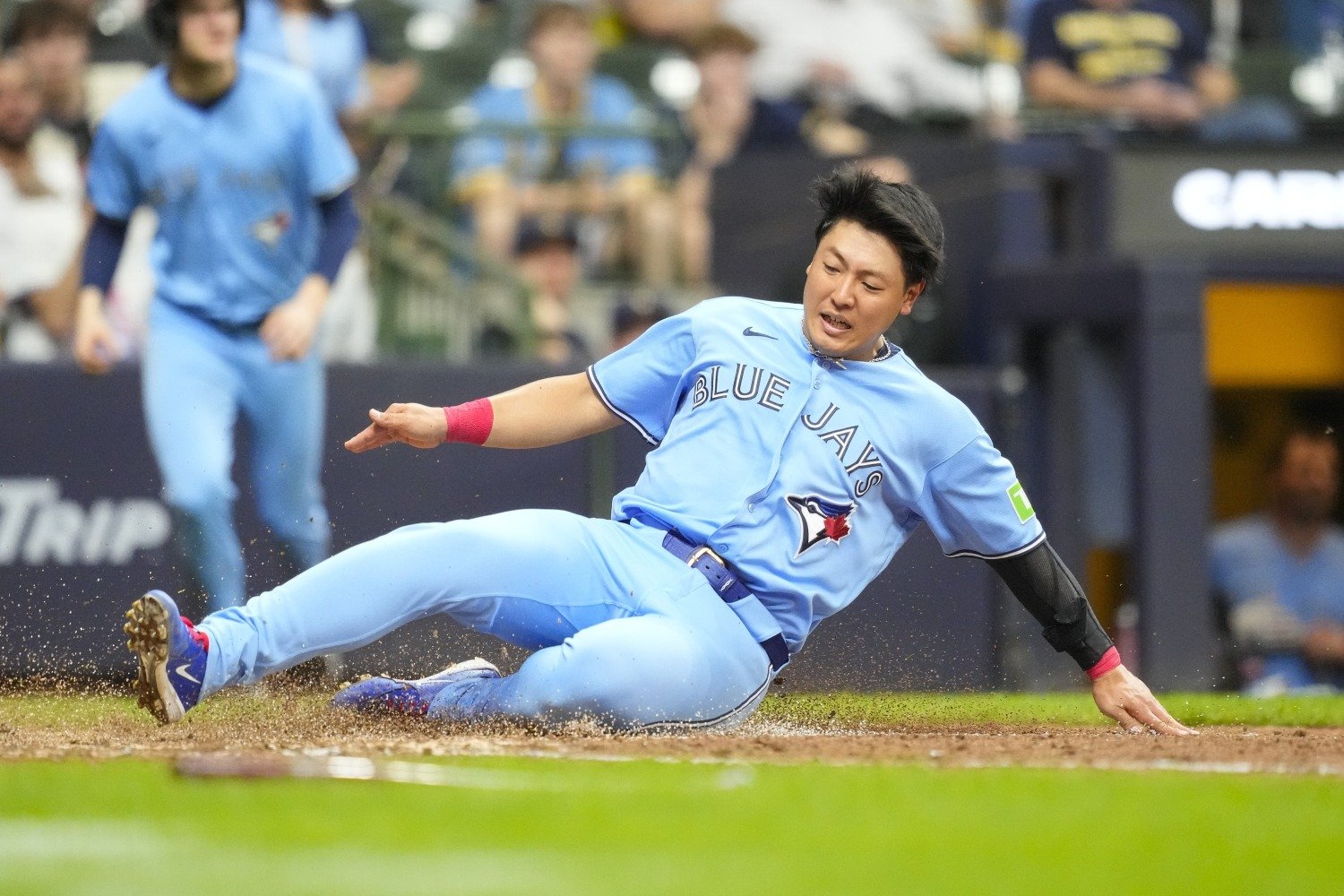 A crisis continues to brew in the Milwaukee bullpen. The offense continues to produce, but is stretched thin now that three of its four or five most accomplished hitters are on the injured list. It's not easy to win games for the Brewers right now. In fact, it hasn't been this hard in quite some time. Pat Murphy's previous two Brewers teams never lost more than four games in a row. Tuesday night's heartbreaking double-collapse loss to the Blue Jays made six straight 'L's. When you're in a funk like that—when the bullpen seems exhausted and there are creeping questions about the depth pieces in the rotation and the injury bug won't stop biting—a great team turns to its playmakers. That term is more often used in football and basketball, but baseball has playmakers, too. Over the last few seasons, the Brewers have seen the differences those players can make. Sometimes, it's an incredible feat of sheer athleticism, but often, too, it's a coalescence of skill and great baseball IQ—being aware of space and situation and making the play another player or team might not even think of. This is the team that twice killed the would-be tying run at the plate to end games because of perfectly executed throws and tags. This is the team that seemed to seal up holes and make impossible plays. This is the team that turned a 405-foot fly ball into a ground-ball double play. That team is broken right now, and no play made that clearer than the final one of the top of the ninth inning Tuesday night. Here it is. Already, of course, the Blue Jays had scored one run in the eighth inning and two in the ninth, against Abner Uribe and Trevor Megill. Already, they led 5-4, after the Brewers seemed to have a relatively comfortable lead for most of the contest. It was a moment of frustration and resignation for many fans in attendance, and unfortunately, that same dark cloud fell over the players, too. You saw the clip, so you already understand the problem, but let's break it down for better diagnosis. Ernie Clement hit a sharp two-out single to left field. Kazuma Okamoto had been on second base when the play began, and he took off for third base, where he got the wave. That was a fine play on Toronto's part, given that they already had the lead. There were two outs in the inning; another success at the plate was unlikely. To make sending the runner a sensible decision there, you only have to think there's about a 25% chance that he's safe. Here's the problem—or, from the Brewers' perspective, the golden opportunity: Okamoto is slow. His average sprint speed so far this year, according to Statcast, is a woeful 25.4 feet per second. Maybe he's really a bit faster than that, and will show as much as the weather warms up, but so far, Okamoto has shown markedly below-average speed in his first season in the United States. That's what he showed on this play, too. Here's a frame just after Brandon Lockridge gets to the ball in left field. He's already secured it, and Okamoto isn't even at third base yet. A late stop sign would have posed an unnecessary risk, though. Why do something that might lead to a hamstring pull, at this point in the play? Okamoto continued home, and Lockridge cut loose a strong throw—albeit one a bit toward first base, as has been his wont. Initially, William Contreras does track the ball from a position where he can try to retire Okamoto once the throw comes home, but pretty quickly, he starts moving out into the dirt in front of home plate: Contreras might have been having a flashback to Sunday, when Lockridge threw a ball with similar verve (though from farther away) and missed well up the first-base line, allowing a trailing Nationals runner to take third base and losing any chance of an out on a medium-depth sacrifice fly. NXk5VjBfWGw0TUFRPT1fQjFOVEFGWUNCd2NBQ2xNRlZnQUhBd0JmQUZnRFZWZ0FWd1lIQWxZSEFGZFZCVkJX.mp4 Unlike the play Sunday, though, this one could have resulted in an easy out at the plate. Lockridge's throw was better; Contreras had a better angle on the throw and the incoming runner; and, again, Okamoto is very slow. Alas, Contreras had been out there right along with the Brewers pitchers who had stumbled through the final two frames of this game. He was frustrated, and he hasn't been through a week quite like this one in at least three years. In that moment, he was a little bit feral; he got outside himself and lost the command of the situation that usually makes him and his team so great. He turned his back on the runner—literally and figuratively—to field the throw, and turned his eyes toward second base, where Clement was trying to advance. Look at all this real estate, though. Contreras chose the wrong way to receive the throw for the best chance of tagging Okamoto out, but even if he'd done nothing differently up through the moment captured above, he could easily have wheeled and slapped down a tag in time. If that runner is Byron Buxton or Pete Crow-Armstrong, it's a tougher and riskier task, but Okamoto wasn't moving all that fast as he got close to the plate, either. Contreras had an ocean of time, but not the awareness of it that makes all our time work for us. He snared the ball, took a step to load up, transferred the ball to his throwing hand and let it fly to second—all before Okamoto touched home plate. Megill (and/or first baseman Jake Bauers) should have been yelling to Contreras to make the tag, instead of throwing toward Clement. Maybe they were, but it doesn't sound like it. He could have had better help. A catcher is meant to make this kind of decision themselves, though, and it's not a 50/50 call that gets answered as if without a preconception on every such play. The run coming home has clear precedence. Just as the Jays sending Okamoto home only required about a 1-in-4 chance to be the right call, Contreras should have tried to tag the runner even if he felt he had only a 1-in-4 chance to get him. In truth, he should have felt at least like he had the better side of a coin flip, even before the ball got to him. It wasn't even going to be a terribly close play. Contreras's poor read or mental lapse gave the Blue Jays a run. In the bottom of the inning, the Brewers rallied for the two tallies they needed to tie the game and force extras, against Toronto closer Jeff Hoffman. It was a terrific comeback, but who knows? The visitors might have managed that frame differently, with just a one-run edge. It might be that the extra run in the top half wasn't as decisive as it now appears. It didn't need to score, though. When things are going against you, in baseball, it's often beyond your control. The game is hard; the other guys have big houses, too. For two years, the Brewers have maintained primacy in the NL Central by being the team who doesn't let bad get worse. They don't let runs score or losses pile up when, through the blessings of the game, they do gain momentary control and can prevent it. That was the most unsettling thing about Tuesday night's loss. With a chance to get some momentum going for the bottom half of the inning and keep the defiicit manageable, Contreras made a boneheaded play. It was very un-Brewerslike. We're going on a week and a half of that, now.
 -
Christian Yelich Lands on Injured List with Groin Strain
Matthew Trueblood posted an article in Brewers
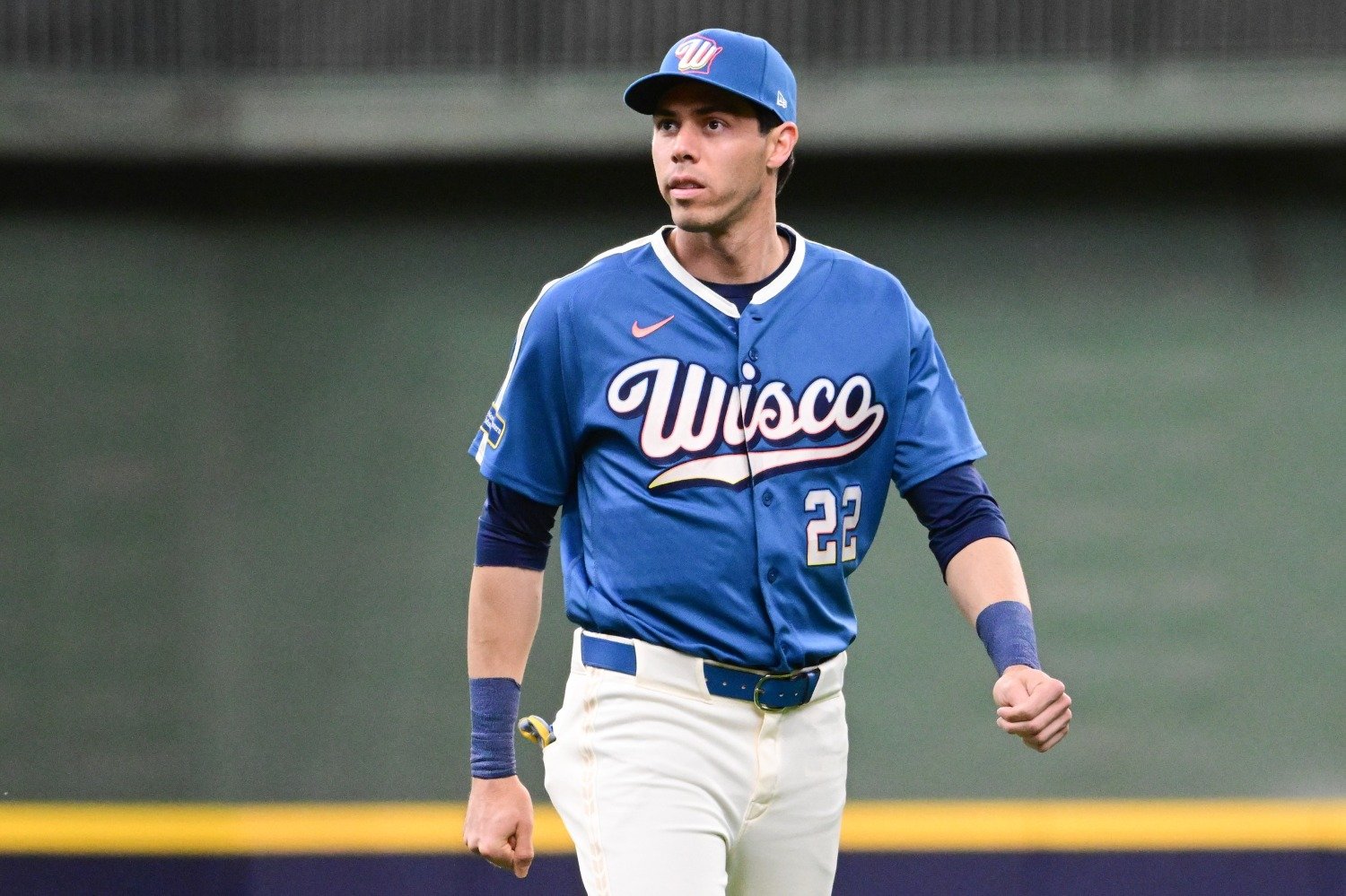 After departing the Brewers' loss to the Nationals Sunday in the fifth inning, Christian Yelich landed on the 10-day injured list Tuesday with a groin strain. For much of the last seven years, Yelich's career has been a question of health. He can help the team whenever he's on the field, but he missed 45 games with multiple injuries in 2021. In 2024, his season was cut short by a back injury that finally required surgery. He's only played 69 games in the outfield since the start of 2024, which is one way the team has shielded him from injury risk, but even as a designated hitter, he's spent considerable time on the shelf. That makes it worrisome any time something crops up for Yelich. He's not as available as you might wish even at the best of times, so every injury seems to threaten weeks of scrambling for offense, without the team's most consistent hitter. This time, however, the data says we can be a bit more optimistic than that. Over the last 10 seasons, Baseball Prospectus has logged 100 groin strains suffered by position players. Those players have returned, on average, in just under four weeks, and the median number of days missed is a not-so-bad 20. Of those 100 injuries, 71 saw the player return to play within four weeks, and only seven stretched beyond eight weeks. The Brewers indicated that the injury is significant, but not severe, which indicates that Yelich probably won't fall into that long-term injury bucket. Yelich's age and his track record are reasons not to expect him back within two weeks, but the fact that he's the team's DH works in his favor. Without the need to prepare for explosive lateral movements or sudden changes of speed and/or direction in the field, he should be able to get back into the mix relatively quickly. The Brewers need him back as soon as possible, since they're still without Jackson Chourio and Andrew Vaughn and have been inconsistent in run production so far this year. They won't want to rush him back, but Yelich's return-to-play timeline should be relatively short. In the meantime, the team called up Greg Jones, who will complement the existing outfield corps of Sal Frelick, Garrett Mitchell, Brandon Lockridge, Luis Matos and Blake Perkins. So far this season, none of those players (save Mitchell) has been as good as the team hoped, so some of the extra available playing time might accrue to Gary Sánchez, William Contreras and Jake Bauers. The team needs Yelich, but their depth is better than that of most teams would be if they were facing three early losses of the same magnitude as Yelich, Chourio and Vaughn. This should be a short-term absence, and though the waters are choppy for the Crew right now, a time at which they might be back to full strength isn't far away.
 -
Image courtesy of © Benny Sieu-Imagn Images After departing the Brewers' loss to the Nationals Sunday in the fifth inning, Christian Yelich landed on the 10-day injured list Tuesday with a groin strain. For much of the last seven years, Yelich's career has been a question of health. He can help the team whenever he's on the field, but he missed 45 games with multiple injuries in 2021. In 2024, his season was cut short by a back injury that finally required surgery. He's only played 69 games in the outfield since the start of 2024, which is one way the team has shielded him from injury risk, but even as a designated hitter, he's spent considerable time on the shelf. That makes it worrisome any time something crops up for Yelich. He's not as available as you might wish even at the best of times, so every injury seems to threaten weeks of scrambling for offense, without the team's most consistent hitter. This time, however, the data says we can be a bit more optimistic than that. Over the last 10 seasons, Baseball Prospectus has logged 100 groin strains suffered by position players. Those players have returned, on average, in just under four weeks, and the median number of days missed is a not-so-bad 20. Of those 100 injuries, 71 saw the player return to play within four weeks, and only seven stretched beyond eight weeks. The Brewers indicated that the injury is significant, but not severe, which indicates that Yelich probably won't fall into that long-term injury bucket. Yelich's age and his track record are reasons not to expect him back within two weeks, but the fact that he's the team's DH works in his favor. Without the need to prepare for explosive lateral movements or sudden changes of speed and/or direction in the field, he should be able to get back into the mix relatively quickly. The Brewers need him back as soon as possible, since they're still without Jackson Chourio and Andrew Vaughn and have been inconsistent in run production so far this year. They won't want to rush him back, but Yelich's return-to-play timeline should be relatively short. In the meantime, the team called up Greg Jones, who will complement the existing outfield corps of Sal Frelick, Garrett Mitchell, Brandon Lockridge, Luis Matos and Blake Perkins. So far this season, none of those players (save Mitchell) has been as good as the team hoped, so some of the extra available playing time might accrue to Gary Sánchez, William Contreras and Jake Bauers. The team needs Yelich, but their depth is better than that of most teams would be if they were facing three early losses of the same magnitude as Yelich, Chourio and Vaughn. This should be a short-term absence, and though the waters are choppy for the Crew right now, a time at which they might be back to full strength isn't far away. View full article
-
Image courtesy of © Denny Medley-Imagn Images How brave are you? That's a question we all ought to ask ourselves now and then, because often, bravery is merely the equanimity that comes with premeditation, so the more we assess our inventory of fortitude, the more it grows. You might not be able to prepare yourself for the moment when you have a chance to save a baby from a burning building, but you can strengthen your resolve to do what's needed by reflecting on past moments in which that paralytic knot of fear and nausea built within you. Fear is an obstacle, but it's surmountable. You just can't let it sneak up on you. Of course, it's not quite that simple. There are times when the costs and the benefits of attempting something daring are almost in parity. There are other times when, if you slow down enough to let your rational brain talk your sympathetic nervous system out of its freakout, you won't be quick enough to respond to a fast-moving situation. We're always training and teaching ourselves to be braver. We're also always learning about the immensity and the limits of our own courage, through experiences we can't fully intellectualize until later. Sports are ways we can test and observe bravery—measure and celebrate and long for it. Most often, when it comes to baseball, we think about this in terms of the pitcher and the batter staring each other down with the game on the line, trying to outguess and outdo one another. Really, though, those aren't the best tests of bravery the sport offers, because the competitiveness and the cerebralness of each player takes over in those moments. Fear loves to pounce on us when our frontal lobes are relatively inactive, because the parts of our brains that are more instinctive and fast-moving are also more susceptible to the pressure of fear. A batter isn't afraid when they have a chance to come up with the winning hit; they're locked in and switched-on. A pitcher with a chance to slay a rally and start the happy handshake line is equally full of intensity and self-belief. It takes bravery to play the outfield, though, and while it's a trainable type of bravery, it's not an easy one to achieve. Some of us are wired to see every split-second moment as an opportunity; some of us are better at perceiving the threat and the danger behind that opportunity. Thus, while being a great outfielder has a lot to do with athleticism, it also requires a good balance between fearlessness and discretion. Brandon Lockridge has all the athleticism he needs to be a plus defender in the outfield. His speed is better than that of most of his teammates, even in a highly athletic group of outfielders. His body control isn't bad, either. He didn't quite make this catch in Kansas City, but he made a marvelous effort on it. Most outfielders don't even get a glove on this drive, but he could very well catch the next ball like it. QXc3ZEtfVjBZQUhRPT1fQjFKUUJsUlNVRmNBRDFSVVZRQUhBbElIQUFBSEJWQUFDMUZVVlZJRlVGWUdCd2RS.mp4 Unfortunately, so far, Lockridge hasn't been a great defender, overall. It's not because he couldn't finish that all-or-nothing play, though. It's because when the proposition is something other than all-or-nothing—when there's a potential cost to going all-out for a ball and not getting it—Lockridge doesn't quite have the instinctive bravery to match his talent. That sounds like an indictment of character, but as I've already suggested, what we're talking about here is a matter of acuity and/or subconscious reaction, not self-aware cowardice. The best way to illustrate the point might be to show you, rather than further explain it verbally. Here's a play from that same series, against the Royals, on which Lockridge was in left field instead of center. b0d3bERfWGw0TUFRPT1fVjFJQUFBY0ZVUU1BV1FBRkFBQUhCZ1VFQUZnQlZsQUFBRk5XQWxWWEFsWlRBUVVF.mp4 This doesn't look much more catchable than the ball Lockridge almost ran down in the gap, and indeed, it would have been a dazzling play. However, let's break it down into a few key moments. Here's the first frame after the TV feed stabilized in tracking the flight of the ball and the pursuing Lockridge. (in each of these images, I've highlighted the ball in red.) Unlike last year's unlikely outfield defense breakout (Isaac Collins), Lockridge doesn't rate well on Statcast's leaderboard for outfield jumps. He got a good read and a good start on this one, though. It's very well-struck, and hooking away from him, but Lockridge is fast and the ball is hit high. There's a chance, here. Here's the last moment at which catching the ball was possible. Lockridge has taken a good angle, and he's at full gallop. To have a chance to make this play—saving at least one run and ending the inning—he has to keep that flat angle toward the line, and he's likely to have to dive. Again, though: the ball is still up there. He's closing ground. Greatness is possible. This is Lockridge choosing not to attempt that greatness. He turns his hips slightly and lets his stride carry him backward, just a bit, toward the foul pole. He's decided he can't get to the ball, and he knows that the bounce will be big and disastrous if he tries and fails. By giving ground, he can get around the ball and cut it off on one long hop. In fact, he'll do just that. By the time the ball lands, he's in good position, and only one run will score on what could have been a two-run double. It's still a double, though. Lockridge's brain didn't let him believe he had any chance to catch this ball, though the truth is that he (briefly) did. That one's far from an obvious example, though. It's a long run on a long hit. The baserunner at first base, able to go with the crack of the bat because there were two outs, lurked in the back of his mind. Let's look at a play on which he more clearly had a chance. Off to Boston! YVl4djdfWGw0TUFRPT1fQlFWWlVBQldBQVVBQ3dBSFVRQUhDUUpSQUZnQlZGWUFDMU5RQWxkV0FBc0RCQVZR.mp4 This time, the ball isn't in the air nearly as long. Lockridge needs a good first read and a quick first step to have his best chance at catching it, and he doesn't really get that. Playing left field at Fenway Park is complicated, man. You feel as though you're covering a much longer lateral space, and the temptation to play deep enough to at least take going back on the ball out of the set of possibilities is powerful. Lockridge is starting pretty far from a sinking line drive, so he has to cover some ground. Fortunately, he has elite speed. That's Lockridge bearing down on the ball and accelerating—but it's also the last stride with which he'll do so. His mind is about to throw up a stop sign. He's going to hit the air brakes, because his center fielder is far away and Ceddanne Rafaela is fast; he doesn't want the ball skipping past him. The camera angle makes things a bit tricky, but hopefully, you can see the problem here. Lockridge thought the ball was sinking faster than it was; he pulled his parachute cord too soon. He's pulling up to play the ball in front of him, but by the time it lands, we'll see that another two of those high-speed strides could have brought him underneath it in time. Take any kind of fear into the outfield with you, and opportunities will be missed. It's possible to chase opportunities too aggressively, too, of course, and Lockridge has occasionally been guilty of that in the past. This spring, his mistakes in the grass have followed a pattern: he's ever-so-slightly too wary of giving up an extra base to make the most of his exceptional potential as a defender. One more example, and perhaps the most glaring one of the young campaign. WERaME5fWGw0TUFRPT1fQndoU1ZRQUFYMUVBWEZzR0JRQUhVbEpmQUFOVVV3QUFWQVFHVVFKWEFBSUFDUVJY.mp4 Unlike the sharp liner off the righty Rafaela's bat, this fly from CJ Abrams was floated toward Lockridge in left. With two outs and nobody on, there was every incentive to be aggressive, and the ball was in the air for a little while. Lockridge's jump wasn't perfect, but he had time. Admittedly, last year, Collins would have been two yards closer to this ball by the same point in its flight. Lockridge's not-so-great first step costs him something real. He has plenty of recovery speed, though, and about a second later, he's already in a winning position to get to the ball. One variable here (other than gumption and general derring-do) is the willingness of a player to run flat-out and sacrifice a bit of stability in their ball-tracking, during the middle part of the hit's flight. Lockridge is fast, and he was going hard after this ball at first, but he's not one for letting anything shake his lock on the ball as he chases it. If he were a bit freer with his movement, he could have gotten a half-step farther by this point, too, but he's working to read the ball. Sometimes, too, that desire to read it perfectly ends up making you default to the conservative approach if it's not fully clear you can get there. Here come the air brakes again. He had a lot more time to close on this ball, but Lockridge wants a manageable bounce, too. Pat Murphy talks often about great fielders' facility when the ball gets close to them—about how effortlessly Joey Ortiz redirects the ball, or how deftly Brice Turang can handle an inaccurate throw or tircky hop. Unsurprisingly, perhaps, Lockridge isn't as comfortable in close quarters with the fast-moving ball. When he senses that a high or a hard bounce might be coming, he tries to create extra space in which to work with it. On the infield, that's one of several viable solutions to get an out at first base. In the outfield, it means letting balls fall in front of you sometimes, and turning possible outs into hits. Sometimes, Lockridge does go all the way and make the play. He's not without the ability to dive or to dare. It's just the exception, right now, rather than the rule. b0d3bERfWGw0TUFRPT1fVlZkUkIxZFNCMVFBWGdOUVhnQUhCUUZWQUZnQ0J3QUFCd0FHQlFzRUJsQURCUUpS.mp4 Again, this is partially trainable (and, in this case, fixable), but it's partially innate. It's one thing that separates infielders from outfielders; it's one thing that separates great outfielders from merely solid ones. Lockridge is trying not to make costly mistakes with his glove, but when they've been at their best over the last two years, the Brewers have been so bold and so good that they take should-be hits away from other teams, rather than letting any could-be outs turn into hits in the name of preventing the loss of a runner or two advancing. It might be that Lockridge will never quite be the defender his raw talent could allow him to be. He might make some highlight-reel catches on balls like that near-snag on the warning track at Kauffman Stadium, but never be the guy who can snatch away a single with a charging shoestring grab. On the other hand, he might be able to turn a corner quickly, thanks to what the Brewers believe is superb makeup and some time with the league's best coaching and development infrastructure. Consciously, Lockridge longs and dares to be great. Subconsciously, perhaps, that bravery eludes him on the occasional hooking liner. It eludes us all sometimes, doesn't it? View full article
-
I understand all of those feelings. I invite you to consider that, even though they're paid mostly by their MLB teams, players need not automatically allot all (or even most!) of their loyalty to those teams. I think the WBC is more important than the MLB season, just as the World Cup is more important than the Premier League. The PL is played every year and players get most of their money from their PL clubs, but those facts don't make the PL as joyous or as actually important as the Cup, It only makes them more financially important, and in the end, what are we here to watch: baseball, or moneymaking? Like many soccer fans, I'm sure you feel a stronger loyalty to your league team than to a country's baseball federation, which is totally fine. I guess I'd just say that you're right to say it's not going anywhere, so making peace with it is the wisest course of action. Also, my own bottom line for this piece: I think Zerpa will be COMPLETELY fine, and basically his full-strength self, very soon. Could be wrong but I don't even think his WBC participation is what's led to a wobbly start. I think it just happens.
-
 How brave are you? That's a question we all ought to ask ourselves now and then, because often, bravery is merely the equanimity that comes with premeditation, so the more we assess our inventory of fortitude, the more it grows. You might not be able to prepare yourself for the moment when you have a chance to save a baby from a burning building, but you can strengthen your resolve to do what's needed by reflecting on past moments in which that paralytic knot of fear and nausea built within you. Fear is an obstacle, but it's surmountable. You just can't let it sneak up on you. Of course, it's not quite that simple. There are times when the costs and the benefits of attempting something daring are almost in parity. There are other times when, if you slow down enough to let your rational brain talk your sympathetic nervous system out of its freakout, you won't be quick enough to respond to a fast-moving situation. We're always training and teaching ourselves to be braver. We're also always learning about the immensity and the limits of our own courage, through experiences we can't fully intellectualize until later. Sports are ways we can test and observe bravery—measure and celebrate and long for it. Most often, when it comes to baseball, we think about this in terms of the pitcher and the batter staring each other down with the game on the line, trying to outguess and outdo one another. Really, though, those aren't the best tests of bravery the sport offers, because the competitiveness and the cerebralness of each player takes over in those moments. Fear loves to pounce on us when our frontal lobes are relatively inactive, because the parts of our brains that are more instinctive and fast-moving are also more susceptible to the pressure of fear. A batter isn't afraid when they have a chance to come up with the winning hit; they're locked in and switched-on. A pitcher with a chance to slay a rally and start the happy handshake line is equally full of intensity and self-belief. It takes bravery to play the outfield, though, and while it's a trainable type of bravery, it's not an easy one to achieve. Some of us are wired to see every split-second moment as an opportunity; some of us are better at perceiving the threat and the danger behind that opportunity. Thus, while being a great outfielder has a lot to do with athleticism, it also requires a good balance between fearlessness and discretion. Brandon Lockridge has all the athleticism he needs to be a plus defender in the outfield. His speed is better than that of most of his teammates, even in a highly athletic group of outfielders. His body control isn't bad, either. He didn't quite make this catch in Kansas City, but he made a marvelous effort on it. Most outfielders don't even get a glove on this drive, but he could very well catch the next ball like it. QXc3ZEtfVjBZQUhRPT1fQjFKUUJsUlNVRmNBRDFSVVZRQUhBbElIQUFBSEJWQUFDMUZVVlZJRlVGWUdCd2RS.mp4 Unfortunately, so far, Lockridge hasn't been a great defender, overall. It's not because he couldn't finish that all-or-nothing play, though. It's because when the proposition is something other than all-or-nothing—when there's a potential cost to going all-out for a ball and not getting it—Lockridge doesn't quite have the instinctive bravery to match his talent. That sounds like an indictment of character, but as I've already suggested, what we're talking about here is a matter of acuity and/or subconscious reaction, not self-aware cowardice. The best way to illustrate the point might be to show you, rather than further explain it verbally. Here's a play from that same series, against the Royals, on which Lockridge was in left field instead of center. b0d3bERfWGw0TUFRPT1fVjFJQUFBY0ZVUU1BV1FBRkFBQUhCZ1VFQUZnQlZsQUFBRk5XQWxWWEFsWlRBUVVF.mp4 This doesn't look much more catchable than the ball Lockridge almost ran down in the gap, and indeed, it would have been a dazzling play. However, let's break it down into a few key moments. Here's the first frame after the TV feed stabilized in tracking the flight of the ball and the pursuing Lockridge. (in each of these images, I've highlighted the ball in red.) Unlike last year's unlikely outfield defense breakout (Isaac Collins), Lockridge doesn't rate well on Statcast's leaderboard for outfield jumps. He got a good read and a good start on this one, though. It's very well-struck, and hooking away from him, but Lockridge is fast and the ball is hit high. There's a chance, here. Here's the last moment at which catching the ball was possible. Lockridge has taken a good angle, and he's at full gallop. To have a chance to make this play—saving at least one run and ending the inning—he has to keep that flat angle toward the line, and he's likely to have to dive. Again, though: the ball is still up there. He's closing ground. Greatness is possible. This is Lockridge choosing not to attempt that greatness. He turns his hips slightly and lets his stride carry him backward, just a bit, toward the foul pole. He's decided he can't get to the ball, and he knows that the bounce will be big and disastrous if he tries and fails. By giving ground, he can get around the ball and cut it off on one long hop. In fact, he'll do just that. By the time the ball lands, he's in good position, and only one run will score on what could have been a two-run double. It's still a double, though. Lockridge's brain didn't let him believe he had any chance to catch this ball, though the truth is that he (briefly) did. That one's far from an obvious example, though. It's a long run on a long hit. The baserunner at first base, able to go with the crack of the bat because there were two outs, lurked in the back of his mind. Let's look at a play on which he more clearly had a chance. Off to Boston! YVl4djdfWGw0TUFRPT1fQlFWWlVBQldBQVVBQ3dBSFVRQUhDUUpSQUZnQlZGWUFDMU5RQWxkV0FBc0RCQVZR.mp4 This time, the ball isn't in the air nearly as long. Lockridge needs a good first read and a quick first step to have his best chance at catching it, and he doesn't really get that. Playing left field at Fenway Park is complicated, man. You feel as though you're covering a much longer lateral space, and the temptation to play deep enough to at least take going back on the ball out of the set of possibilities is powerful. Lockridge is starting pretty far from a sinking line drive, so he has to cover some ground. Fortunately, he has elite speed. That's Lockridge bearing down on the ball and accelerating—but it's also the last stride with which he'll do so. His mind is about to throw up a stop sign. He's going to hit the air brakes, because his center fielder is far away and Ceddanne Rafaela is fast; he doesn't want the ball skipping past him. The camera angle makes things a bit tricky, but hopefully, you can see the problem here. Lockridge thought the ball was sinking faster than it was; he pulled his parachute cord too soon. He's pulling up to play the ball in front of him, but by the time it lands, we'll see that another two of those high-speed strides could have brought him underneath it in time. Take any kind of fear into the outfield with you, and opportunities will be missed. It's possible to chase opportunities too aggressively, too, of course, and Lockridge has occasionally been guilty of that in the past. This spring, his mistakes in the grass have followed a pattern: he's ever-so-slightly too wary of giving up an extra base to make the most of his exceptional potential as a defender. One more example, and perhaps the most glaring one of the young campaign. WERaME5fWGw0TUFRPT1fQndoU1ZRQUFYMUVBWEZzR0JRQUhVbEpmQUFOVVV3QUFWQVFHVVFKWEFBSUFDUVJY.mp4 Unlike the sharp liner off the righty Rafaela's bat, this fly from CJ Abrams was floated toward Lockridge in left. With two outs and nobody on, there was every incentive to be aggressive, and the ball was in the air for a little while. Lockridge's jump wasn't perfect, but he had time. Admittedly, last year, Collins would have been two yards closer to this ball by the same point in its flight. Lockridge's not-so-great first step costs him something real. He has plenty of recovery speed, though, and about a second later, he's already in a winning position to get to the ball. One variable here (other than gumption and general derring-do) is the willingness of a player to run flat-out and sacrifice a bit of stability in their ball-tracking, during the middle part of the hit's flight. Lockridge is fast, and he was going hard after this ball at first, but he's not one for letting anything shake his lock on the ball as he chases it. If he were a bit freer with his movement, he could have gotten a half-step farther by this point, too, but he's working to read the ball. Sometimes, too, that desire to read it perfectly ends up making you default to the conservative approach if it's not fully clear you can get there. Here come the air brakes again. He had a lot more time to close on this ball, but Lockridge wants a manageable bounce, too. Pat Murphy talks often about great fielders' facility when the ball gets close to them—about how effortlessly Joey Ortiz redirects the ball, or how deftly Brice Turang can handle an inaccurate throw or tircky hop. Unsurprisingly, perhaps, Lockridge isn't as comfortable in close quarters with the fast-moving ball. When he senses that a high or a hard bounce might be coming, he tries to create extra space in which to work with it. On the infield, that's one of several viable solutions to get an out at first base. In the outfield, it means letting balls fall in front of you sometimes, and turning possible outs into hits. Sometimes, Lockridge does go all the way and make the play. He's not without the ability to dive or to dare. It's just the exception, right now, rather than the rule. b0d3bERfWGw0TUFRPT1fVlZkUkIxZFNCMVFBWGdOUVhnQUhCUUZWQUZnQ0J3QUFCd0FHQlFzRUJsQURCUUpS.mp4 Again, this is partially trainable (and, in this case, fixable), but it's partially innate. It's one thing that separates infielders from outfielders; it's one thing that separates great outfielders from merely solid ones. Lockridge is trying not to make costly mistakes with his glove, but when they've been at their best over the last two years, the Brewers have been so bold and so good that they take should-be hits away from other teams, rather than letting any could-be outs turn into hits in the name of preventing the loss of a runner or two advancing. It might be that Lockridge will never quite be the defender his raw talent could allow him to be. He might make some highlight-reel catches on balls like that near-snag on the warning track at Kauffman Stadium, but never be the guy who can snatch away a single with a charging shoestring grab. On the other hand, he might be able to turn a corner quickly, thanks to what the Brewers believe is superb makeup and some time with the league's best coaching and development infrastructure. Consciously, Lockridge longs and dares to be great. Subconsciously, perhaps, that bravery eludes him on the occasional hooking liner. It eludes us all sometimes, doesn't it?
 -
Image courtesy of © Eric Canha-Imagn Images New Brewers infielder David Hamilton is a pest, once he's on base. He's dangerous there. He's already stolen four bases this year, an extension of a long track record of aggressiveness in that department. The last thing you should ever want to do is put Hamilton on base for free. He doesn't hit for much power, and he swings and misses a fair amount, so the thing to do is to just go right after him. Fortunately for the Brewers, pitchers aren't doing that this year. They used to do it; they did it all last season. But they've stopped. Here's a scatter plot of hitters by the percentage of pitches seen that were in the strike zone and the rate at which they swung in 2025. Here's the same chart for 2026. From 52% last year, the percentage of pitches that have been in the zone to Hamilton has plummeted to 44% so far in 2026. It's a huge difference, and although he's reduced his swing rate accordingly, he's not being meaningfully more patient in the zone or any better at not chasing. He's just had a lot more junk at which to not swing. As a result, in 36 plate appearances, he's walked a whopping nine times. His on-base percentage is .485. It's hard to figure out why the league isn't being more aggressive with Hamilton. He's actually reduced his bat speed this year, and he's letting the ball travel about 3 extra inches into the hitting zone. A deeper contact point makes him less likely to whiff, all else equal, and his slashing style and speed do make him feel a bit dangerous. Sixteen of his 36 plate appearances have come with runners on base, which somewhat reinforces the newish notion that protection—the influence of teammates on the way a given batter is pitched—comes from in front of you in the batting order, rather than behind you. On the other hand, Hamilton has already faced left-handed pitchers in 10 plate appearances. Last season, he only saw a southpaw 20 times, in 194 trips to the dish. If nothing else, you'd think a fellow lefty would be comfortable going right after Hamilton, both because he's unlikely to punish you with power left-on-left and because a speed demon is a bit less of a threat once on base when the pitcher on the mound is able to stare right at them during their set. Nonetheless, the numbers are right in front of us. The sample is tiny, but Hamilton is seeing a lot of pitches miss the zone, and he's not helping hurlers out. They'll have to show him, instead, that they can throw strikes, and once they do, he's likely to punish them a bit more, after all. The Brewers have a dynamic offensive weapon on their hands, in the person of their versatile and lightning-fast utility infielder. View full article
-
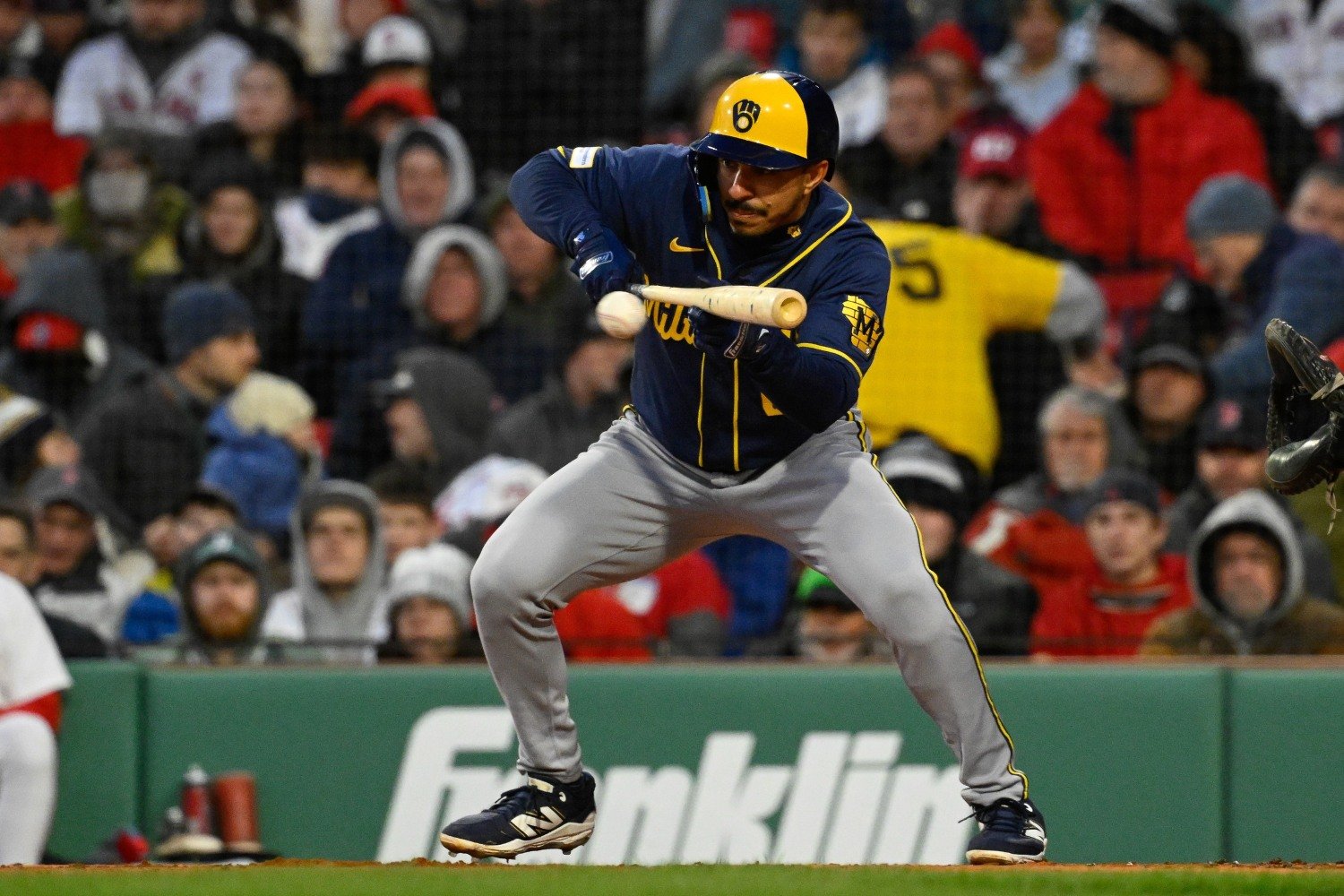 New Brewers infielder David Hamilton is a pest, once he's on base. He's dangerous there. He's already stolen four bases this year, an extension of a long track record of aggressiveness in that department. The last thing you should ever want to do is put Hamilton on base for free. He doesn't hit for much power, and he swings and misses a fair amount, so the thing to do is to just go right after him. Fortunately for the Brewers, pitchers aren't doing that this year. They used to do it; they did it all last season. But they've stopped. Here's a scatter plot of hitters by the percentage of pitches seen that were in the strike zone and the rate at which they swung in 2025. Here's the same chart for 2026. From 52% last year, the percentage of pitches that have been in the zone to Hamilton has plummeted to 44% so far in 2026. It's a huge difference, and although he's reduced his swing rate accordingly, he's not being meaningfully more patient in the zone or any better at not chasing. He's just had a lot more junk at which to not swing. As a result, in 36 plate appearances, he's walked a whopping nine times. His on-base percentage is .485. It's hard to figure out why the league isn't being more aggressive with Hamilton. He's actually reduced his bat speed this year, and he's letting the ball travel about 3 extra inches into the hitting zone. A deeper contact point makes him less likely to whiff, all else equal, and his slashing style and speed do make him feel a bit dangerous. Sixteen of his 36 plate appearances have come with runners on base, which somewhat reinforces the newish notion that protection—the influence of teammates on the way a given batter is pitched—comes from in front of you in the batting order, rather than behind you. On the other hand, Hamilton has already faced left-handed pitchers in 10 plate appearances. Last season, he only saw a southpaw 20 times, in 194 trips to the dish. If nothing else, you'd think a fellow lefty would be comfortable going right after Hamilton, both because he's unlikely to punish you with power left-on-left and because a speed demon is a bit less of a threat once on base when the pitcher on the mound is able to stare right at them during their set. Nonetheless, the numbers are right in front of us. The sample is tiny, but Hamilton is seeing a lot of pitches miss the zone, and he's not helping hurlers out. They'll have to show him, instead, that they can throw strikes, and once they do, he's likely to punish them a bit more, after all. The Brewers have a dynamic offensive weapon on their hands, in the person of their versatile and lightning-fast utility infielder.
 -
Ehh. I mean I see what you mean but it's a distinct blue-and-orange that has its own feel. And they're right that it hearkens a little to the American Assoc. Brewers and the Braves. I actually really like the shades of each that they picked; it feels right to me in that sense.
-
Yep. That's the world, ever since Fanatics took control of the league's merch shops. I haven't bought any team-branded stuff since 2011; I just will not pay what they demand these days.
-
 The Brewers will open a homestand this weekend against the Nationals by donning their second edition of City Connect uniforms for the first time. In preparation for that, the team rolled out the new look in an elaborate multi-platform social media announcement. The base color of the threads will be blue, though lighter than the team's standard navy and less bright than the blue that defined their glove-and-ball logo era. Although the comparison often feels trite, the choice of tone does genuinely evoke a lake or river. The accents (including nifty piping down the sleeves) are cream-colored, a well-measured nod to the Cream City. There will be a good amount of orange, too, bringing together a smart color scheme that doesn't bend so far from the tradition of the team, the city or the state as to feel jarring. It's new, but not alien. There's a new patch designed to look like a fishing bobber, but with baseball stitches. It's not prominently featured on the uniform, but it's nice. Even better is the redesigned Barrelman logo on the sleeve patch, which has the mascot superimposed on a many-colored outline of Wisconsin, pursuing a ground ball. The explanations and rollouts of these are always a bit overdone. Neither the league nor Nike does a very good job of making one forget that the point of having the new threads is to sell merchandise. On balance, though, this uniform does a lot of things right. It's almost really, really great. But. The team didn't just splash 'Wisco" across the front of the jersey, as became clear when the uniforms leaked last month. They leaned all the way into it. Their tagline for the unveiling is "If you're from Wisco, you know the way," and they're referring to the overall vibe as the "Wisco Way." There, of course, they have a problem, because no one is from Wisco. That diminutive reference is only used by people from elsewhere, and usually, it's not used flatteringly. At various points over the last quarter-century, people from the rest of the Midwest have tried on Wisco as a way to refer to the state (with its burdensome three-syllable name) and "Sconnies" as a demonym for people who live there, and some of that lingo has stuck, in Iowa and Minnesota and Illinois. But for Wisconsinites, it's simply not a thing. It will never be. It's always a downer when an advertising or marketing campaign hits a note this far from the proper key, but when it comes to the City Connect program, it cuts even deeper. Insofar as this program is anything real—any earnest effort to tie together team and community, be that by deepening the relationship between the team and a part of that community or by reaching out to a new segment of the community altogether—it has to be undertaken after serious research. It should be done by someone local. It should, in short, never come anywhere near calling the Brewers' home state "Wisco". Instead, these very pretty uniforms will largely remind us all of how commercial, transactional and hollow a relationship teams want with their fans. They're well-executed, but you can't connect (or Connect) to a community that doesn't exist. By letting a consultant with insufficient real intimacy with the city or state create such an out-of-touch theme for the uniform, Nike and the Brewers forfeited their chance to deepen their connection with fans. This organization does so many things well that they should easily survive the error, but it was an unforced one, and a disappointing one.
 -
Image courtesy of Milwaukee Brewers/MLB The Brewers will open a homestand this weekend against the Nationals by donning their second edition of City Connect uniforms for the first time. In preparation for that, the team rolled out the new look in an elaborate multi-platform social media announcement. The base color of the threads will be blue, though lighter than the team's standard navy and less bright than the blue that defined their glove-and-ball logo era. Although the comparison often feels trite, the choice of tone does genuinely evoke a lake or river. The accents (including nifty piping down the sleeves) are cream-colored, a well-measured nod to the Cream City. There will be a good amount of orange, too, bringing together a smart color scheme that doesn't bend so far from the tradition of the team, the city or the state as to feel jarring. It's new, but not alien. There's a new patch designed to look like a fishing bobber, but with baseball stitches. It's not prominently featured on the uniform, but it's nice. Even better is the redesigned Barrelman logo on the sleeve patch, which has the mascot superimposed on a many-colored outline of Wisconsin, pursuing a ground ball. The explanations and rollouts of these are always a bit overdone. Neither the league nor Nike does a very good job of making one forget that the point of having the new threads is to sell merchandise. On balance, though, this uniform does a lot of things right. It's almost really, really great. But. The team didn't just splash 'Wisco" across the front of the jersey, as became clear when the uniforms leaked last month. They leaned all the way into it. Their tagline for the unveiling is "If you're from Wisco, you know the way," and they're referring to the overall vibe as the "Wisco Way." There, of course, they have a problem, because no one is from Wisco. That diminutive reference is only used by people from elsewhere, and usually, it's not used flatteringly. At various points over the last quarter-century, people from the rest of the Midwest have tried on Wisco as a way to refer to the state (with its burdensome three-syllable name) and "Sconnies" as a demonym for people who live there, and some of that lingo has stuck, in Iowa and Minnesota and Illinois. But for Wisconsinites, it's simply not a thing. It will never be. It's always a downer when an advertising or marketing campaign hits a note this far from the proper key, but when it comes to the City Connect program, it cuts even deeper. Insofar as this program is anything real—any earnest effort to tie together team and community, be that by deepening the relationship between the team and a part of that community or by reaching out to a new segment of the community altogether—it has to be undertaken after serious research. It should be done by someone local. It should, in short, never come anywhere near calling the Brewers' home state "Wisco". Instead, these very pretty uniforms will largely remind us all of how commercial, transactional and hollow a relationship teams want with their fans. They're well-executed, but you can't connect (or Connect) to a community that doesn't exist. By letting a consultant with insufficient real intimacy with the city or state create such an out-of-touch theme for the uniform, Nike and the Brewers forfeited their chance to deepen their connection with fans. This organization does so many things well that they should easily survive the error, but it was an unforced one, and a disappointing one. View full article
-
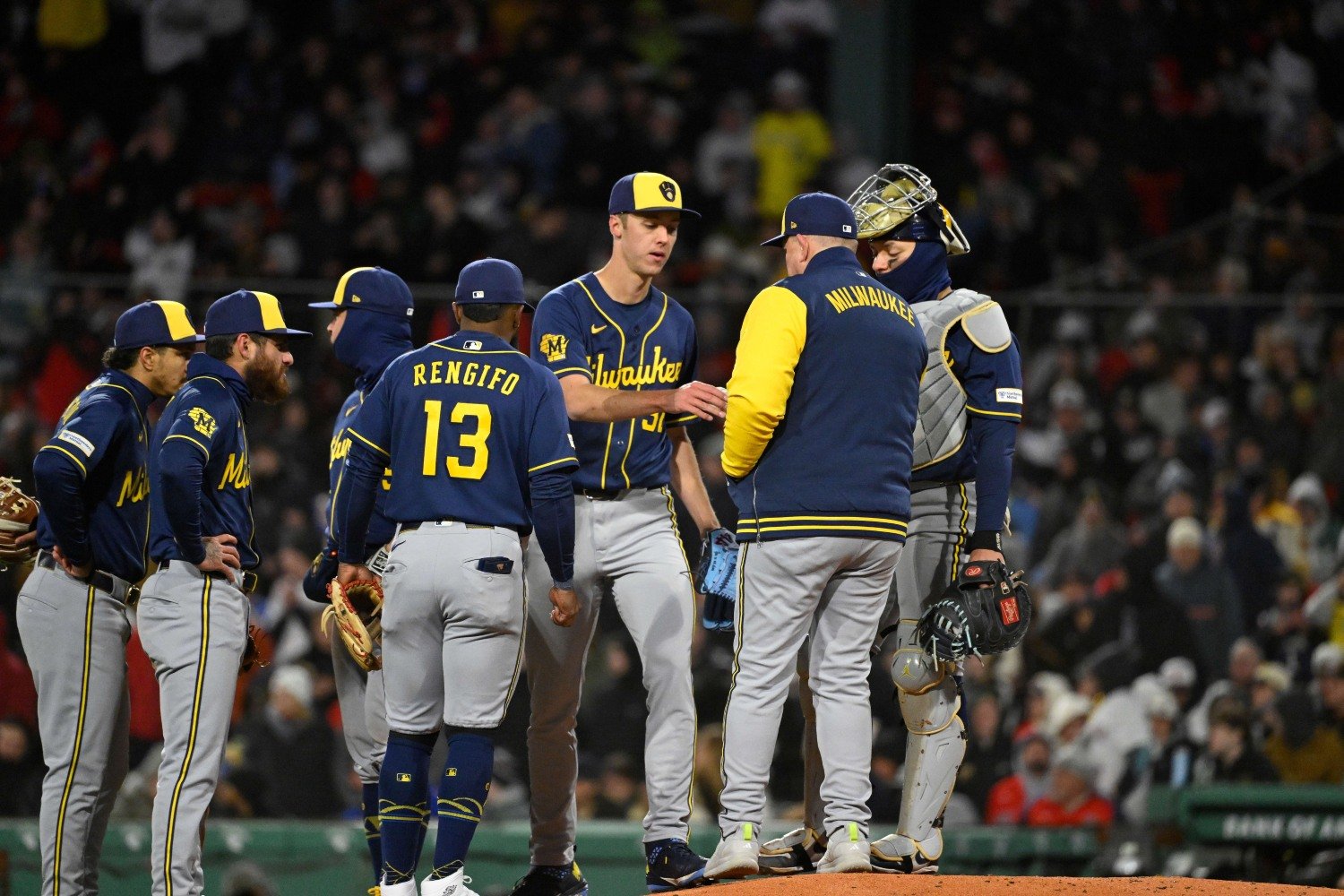 The way it happened was excruciating. Jacob Misiorowski was cruising, overpowering Red Sox batters and (if anything) outpitching fellow Cy Young Award candidate Garrett Crochet. When he lost control in the sixth inning, though, it was simply gone; he couldn't find his release point again. Normally, with the bases loaded but the game still scoreless when Misiorowski departed, Pat Murphy would have gone to one of his most trusted relievers, but plainly, the plan on Tuesday night was to give back a bit to the baseball gods. Murphy has used Aaron Ashby, Abner Uribe, Trevor Megill, Ángel Zerpa and Grant Anderson as heavily as anyone involved is comfortable with, this spring—if not more than that. He needed to let them each get a day off Tuesday night, so in a high-leverage spot that might normally have called for Ashby or Zerpa, Murphy went to DL Hall. Unfortunately, Hall let all three runners Misiorowski had bequeathed come home, which turned out to be decisive. Even in defeat, the Brewers offense was delightfully tenacious. They chased Crochet from the game in the very next half-inning, and patched together a two-run rally made up of two singles, a walk, a hit batsman and an RBI fielder's choice. They couldn't quite cash in their chance, though, and it turned out to be their last one. That raises the other reason (besides Murphy's desire to give his relievers some relief) why Boston had the upper hand on the Crew in this game: Crochet, and the lineup the visitors were forced to field against him. Murphy used the occasion (a top-flight lefty starter who's especially tough on lefties) to give both Brice Turang and Christian Yelich a rest. That part's fine. It was necessary, and didn't deprive the club of anyone who was likely to do much against Crochet. The real problem is that, with Jackson Chourio and Andrew Vaughn on the injured list, this team is not as dangerous against lefties as it would be at full strength. William Contreras is a legitimate star slugger, and can mash lefties when he's going well. With Chourio and Vaughn sidelined, though, Murphy wrote in Brandon Lockridge as his leadoff man Tuesday night, and placed Joey Ortiz fifth on the card. Those guys are fine complementary players, especially against lefties. They have athleticism and defensive value, as well as the platoon advantage on southpaws. Pressed into what were essentially the third- and fourth-most important roles in the offense, though, they were a bit stretched. The bottom third of the order included Sal Frelick, Blake Perkins and David Hamilton. Though Frelick is a full-time player, the three of them weren't in the lineup because Murphy thinks they're good matchups for the likes of Crochet. They weren't even there for their defense, per se. It was just the right night for Muprhy to give two regulars a night off, in addition to staying away from his highest-volume relievers. Winning that game was unlikely, and the way Murphy managed it didn't make it more likely. That wasn't his goal. 'Win Tonight' is a wonderful and massively successful paradigm. Murphy has made the Brewers the envy of every other team in the league with it. However, he's also learning to notice when the time is right to accept a loss. No team in baseball history has won more than 116 games in a regular season. Trying to be the first team to reach 120 is not only impractical; it's self-defeating. More even than in the NBA, in baseball, one has to occasionally accept a loss, to make wins on other days more likely. The Brewers are 8-3. They're off to a sizzling start. They just can't afford—especially now, while two of their best hitters are down and some of their pitchers are still getting up to speed—to try so relentlessly to win every game that they risk hurting their chances to keep winning over the long haul.
-
- 2
-
-
- jackson chourio
- dl hall
- (and 1 more)
-
Image courtesy of © Eric Canha-Imagn Images The way it happened was excruciating. Jacob Misiorowski was cruising, overpowering Red Sox batters and (if anything) outpitching fellow Cy Young Award candidate Garrett Crochet. When he lost control in the sixth inning, though, it was simply gone; he couldn't find his release point again. Normally, with the bases loaded but the game still scoreless when Misiorowski departed, Pat Murphy would have gone to one of his most trusted relievers, but plainly, the plan on Tuesday night was to give back a bit to the baseball gods. Murphy has used Aaron Ashby, Abner Uribe, Trevor Megill, Ángel Zerpa and Grant Anderson as heavily as anyone involved is comfortable with, this spring—if not more than that. He needed to let them each get a day off Tuesday night, so in a high-leverage spot that might normally have called for Ashby or Zerpa, Murphy went to DL Hall. Unfortunately, Hall let all three runners Misiorowski had bequeathed come home, which turned out to be decisive. Even in defeat, the Brewers offense was delightfully tenacious. They chased Crochet from the game in the very next half-inning, and patched together a two-run rally made up of two singles, a walk, a hit batsman and an RBI fielder's choice. They couldn't quite cash in their chance, though, and it turned out to be their last one. That raises the other reason (besides Murphy's desire to give his relievers some relief) why Boston had the upper hand on the Crew in this game: Crochet, and the lineup the visitors were forced to field against him. Murphy used the occasion (a top-flight lefty starter who's especially tough on lefties) to give both Brice Turang and Christian Yelich a rest. That part's fine. It was necessary, and didn't deprive the club of anyone who was likely to do much against Crochet. The real problem is that, with Jackson Chourio and Andrew Vaughn on the injured list, this team is not as dangerous against lefties as it would be at full strength. William Contreras is a legitimate star slugger, and can mash lefties when he's going well. With Chourio and Vaughn sidelined, though, Murphy wrote in Brandon Lockridge as his leadoff man Tuesday night, and placed Joey Ortiz fifth on the card. Those guys are fine complementary players, especially against lefties. They have athleticism and defensive value, as well as the platoon advantage on southpaws. Pressed into what were essentially the third- and fourth-most important roles in the offense, though, they were a bit stretched. The bottom third of the order included Sal Frelick, Blake Perkins and David Hamilton. Though Frelick is a full-time player, the three of them weren't in the lineup because Murphy thinks they're good matchups for the likes of Crochet. They weren't even there for their defense, per se. It was just the right night for Muprhy to give two regulars a night off, in addition to staying away from his highest-volume relievers. Winning that game was unlikely, and the way Murphy managed it didn't make it more likely. That wasn't his goal. 'Win Tonight' is a wonderful and massively successful paradigm. Murphy has made the Brewers the envy of every other team in the league with it. However, he's also learning to notice when the time is right to accept a loss. No team in baseball history has won more than 116 games in a regular season. Trying to be the first team to reach 120 is not only impractical; it's self-defeating. More even than in the NBA, in baseball, one has to occasionally accept a loss, to make wins on other days more likely. The Brewers are 8-3. They're off to a sizzling start. They just can't afford—especially now, while two of their best hitters are down and some of their pitchers are still getting up to speed—to try so relentlessly to win every game that they risk hurting their chances to keep winning over the long haul. View full article
-
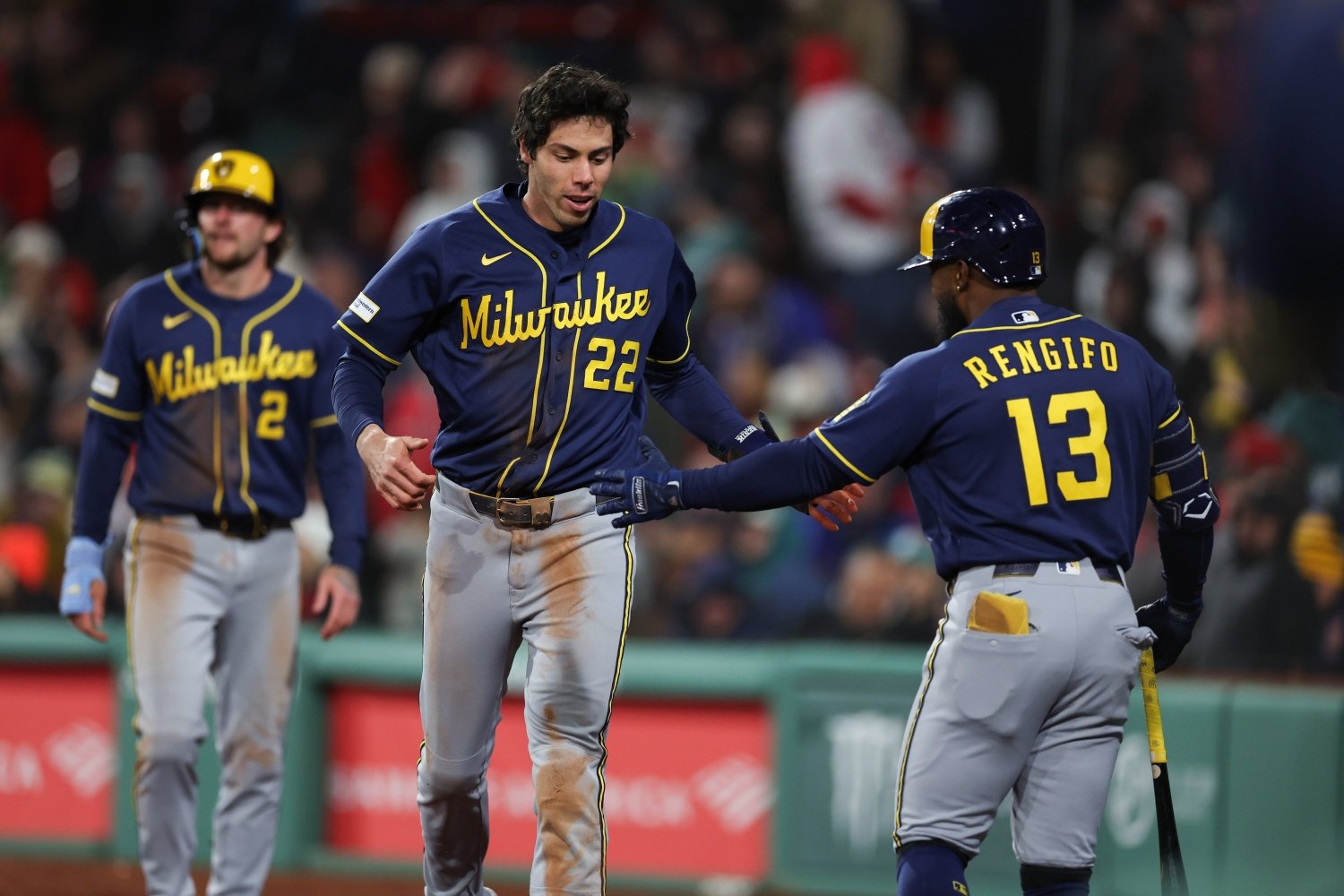 Christian Yelich turned 34 years old in December. He's in his mid-30s now. This is a man who was an old enough boy to spike his hair or dye his tips during the peak of *NSync's popularity. When that Taco Bell commercial featuring Sum 41's "In Too Deep" comes on, he might start mouthing or shouting the lyrics, or not, but something stirs within him. When he dubbed Pat Murphy 'Patches O'Houlihan' upon Murphy's promotion to manager in 2024, it wasn't something a coach mentioned or a reference he first experienced via scrolling through YouTube shorts. That came from his soul. He saw Dodgeball in a movie theater, which is a building where you used to go and see movies on a huge screen, in the dark. Such a person can't be up in the (35-inch contact point) club, with the kids. A '90s kid can't be swinging with catching the ball way out front in mind. It's unseemly, like a divorced dad hitting on a coed at a college bar. That unseemliness just manifests differently: instead of cringeworthy conversation and striking out, it's—ok, actually, some things about it are the same. Every player loses bat speed as they age. Yelich is not an exception. Although the sample is limited, his bat speed is down so far this year, from 73.4 miles per hour in 2025 to 72.3 MPH. It's a minor miracle that his bat speed stayed as strong as it did last year, as he returned from the back surgery that ended his 2024 campaign, but some of that was the buoying effect of having addressed the problem that compelled him to have that surgery in the first place. He's losing bat speed, and that's not a crisis. It is, however, part of what drives most hitters to decline. Some of that decline is self-induced, though. How much a hitter's production is affected by their diminishing ability to flick the stick depends on how one reacts to it. If you change nothing, you'll simply get worse. If you try to compensate for it by starting earlier, you can run into the ball just as often, but when you miss, you'll miss by more. You'll make poorer decisions and pay higher costs for them than in the past. This really isn't so different from a 30-something refusing to age gracefully out in the rest of the world, right? The other option is to make easygoing concessions to age, and the limitations that come with it. It's a voluntary way to pay many of the same costs, but in addition to preserving your dignity, you maintain more control of the process. Which strategy for adapting to the ravages of time best suits a player depends in large measure on what kind of player they were at their peak, but all else equal, the best way to adjust as you age is to accept that the ball will get deeper on you. If you let your contact point drift farther into the hitting zone and closer to your body (but get the bat up to speed nearly as well, in the process), you can sustain a balanced attack with less bat speed than you had before. That's what Yelich is doing. Here are the breakdowns of his intercept point (whether or not contact was made) relative to the center of his body on fastballs, for 2024, 2025 and 2026, in three ranges. Contact Point Range Season Under 20" 20-25" Over 25" 2024 39.4 27.9 32.7 2025 51 25.2 23.9 2026 55.8 30.2 14 The trend is clear, and sensible. Yelich is ok with his gradual shift into dadcore; he's switched from cheap beer and designer cocktails to a tasty but sensible IPA without complaint. He's letting the fastball travel more, and lo, he's raking. He's actually swinging more so far this year, and whiffing about as often as he did last year. He's also hitting the ball hard as much as he did last year, though, and his OPS is over 1.000 through 10 games. Though he hit a mammoth home run in the first series—early, in a good way, on a splitter—this version of Yelich is unlikely to hit nearly as many as the 29 home runs he cracked in 2025. That's ok. He's adjusting to (so far) less bat speed, and doing it gracefully. He's not going out and getting the ball the way he did in the past; he's becoming a radical let-it-travel guy. It's the right move. Let other 34-year-olds embarrass themselves. This one is comfortable in his skin, and in his batting stance.

