Jake McKibbin
-
Posts
2,395 -
Joined
-
Last visited
-
Days Won
6
Content Type
Profiles
Forums
Blogs
Events
News
2026 Milwaukee Brewers Top Prospects Ranking
Milwaukee Brewers Videos
2022 Milwaukee Brewers Draft Picks
Milwaukee Brewers Free Agent & Trade Rumors, Notes, & Tidbits
Guides & Resources
2023 Milwaukee Brewers Draft Picks
2024 Milwaukee Brewers Draft Picks
The Milwaukee Brewers Players Project
2025 Milwaukee Brewers Draft Pick Tracker
2026 Milwaukee Brewers Draft Tracker: Picks & Bonuses
Store
Downloads
Gallery
Everything posted by Jake McKibbin
-
The more I watch Bryce Meccage the more impressed I become. So polished, such depth in his arsenal for a high school arm and completely at home throwing his three major offerings in any count with all getting pretty strong swing and miss. I'd love to see the kick changeup coming through more and more but even so, he looks a class above. More so than Knoth and Letson managed last season for my money
-
Hey guys! So those of you who've read my stuff know that I love going into depth in the statistical world, but I'm always aware that I'm constantly learning myself. I thought I'd make a little thread where, when fantastic articles are written deconstructing the nuances of baseball in a brilliant way that we might have a place to share such pieces. Here's the first one. Covering the pronation and supination bias that you've possibly heard about and with some fantastic explanations of the effects of those biases in terms of how to spot them, the pitches they pair best with and some nuances around the discussion. For example, if you ever wondered why Corbin Burnes four seam fastball got lit up but the cutter was a perfect development for him, look no further. He also breaks down the importance of learning into seam effects (like a kick changeup for instance) to compensate for a lack of wrist mobility. For example a supinator may struggle to throw a change, and a pronator struggles to throw a sweeper but by adjusting the seams they can fill out their arsenal. A truly fascinating read if you've got a few minutes https://medium.com/@remibunikiewicz/what-you-dont-know-about-pronation-and-supination-4bf1e6e33aa2
-
Notably on the downturn after a 100 mph buzzed the tower high and tights on him
-
Myers touched 97 mph for his final pitch last night, an impressive feat. Velocity was up and down all night, sitting 95-96 for a few batters and then sitting more 90-92 with others. Fascinating again, only one changeup thrown. The pitch is a bit of a unicorn, with high IVB but massive velocity differential to his four seamers, a little like Drew Thorpe. I don't know if he's lost the feel for it, but I'm curious if he's working through some mechanical changes to unlock a little more velo and they're coming at the expense of some of his feel for the changeup. His five highest velocities came in his final 15 pitches, and look at the IVB on those bad boys!

-
There's logic to Bricks intrigue too, especially when considering the specifics of the Brewers and their beleaguered bullpen. Priester's heavy platoon splits and Halls ability to go 50 ISH pitches allows Hall to attempt to get to 11/12 batters and let Priester still go the distance from there. Best of both worlds occuring in yesterday's game, but it's a tactic that's now turned a completely shattered bullpen into an incredibly fresh one over the last week
-
When the "finished" product is a HS arm with room to grow stuff wise, I think you'd edge that way, whereas Bauers fastball is legit but I'd be concerned about the rest of it.
-
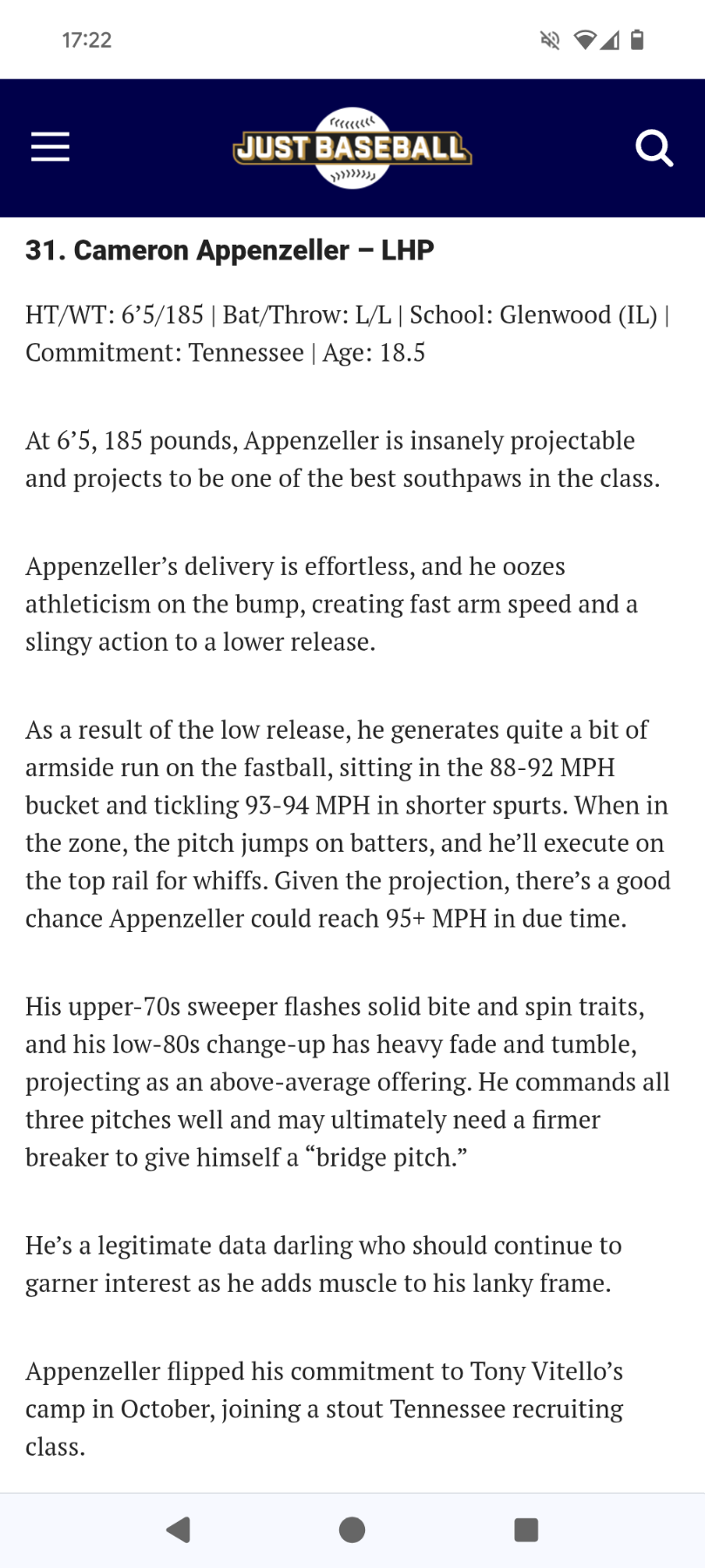
This also screams Brewers:
-
https://www.justbaseball.com/mlb-draft/2025-mlb-draft-top-300-prospects/ Just baseball have an interesting, high upside outfielder dropping to pick 20 👀
-
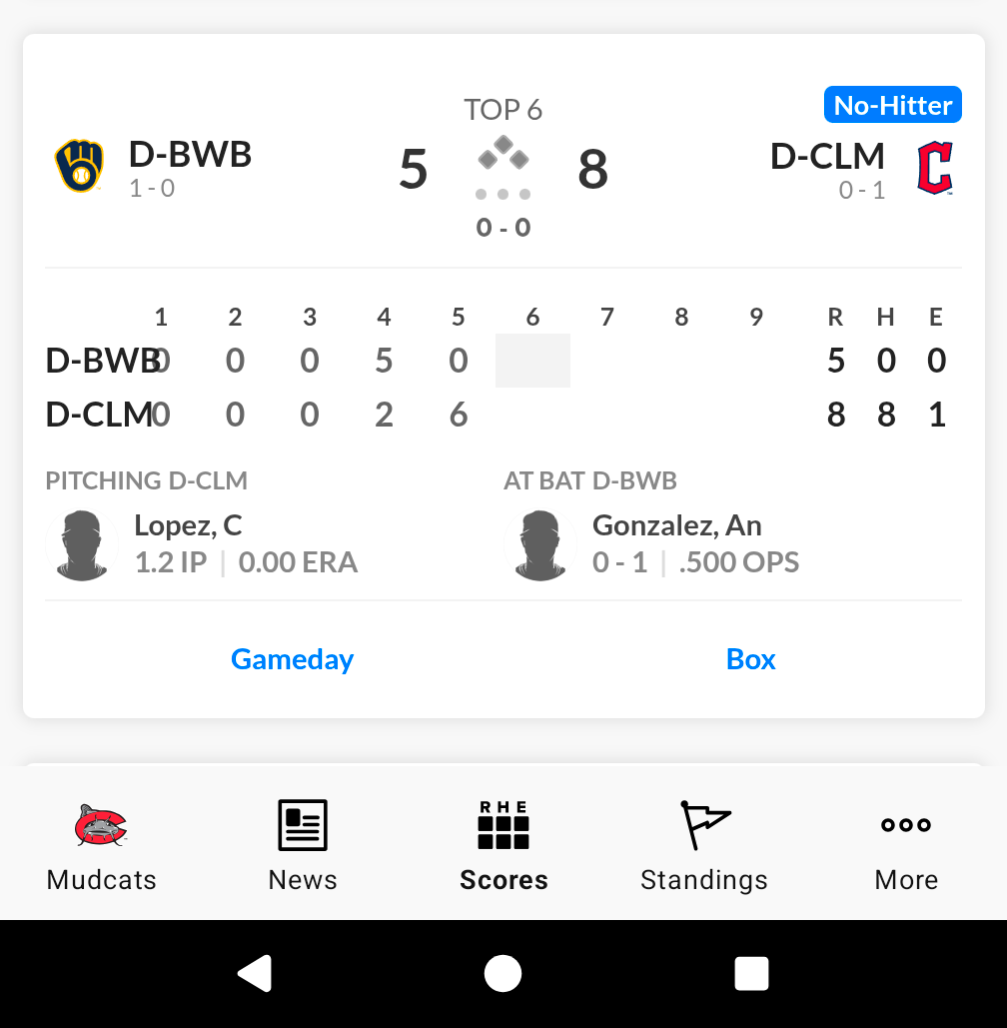
The no hitter icon just popped up at 8-5 😂
-
2025 Minor League Transaction Thread
Jake McKibbin replied to Jim Goulart's topic in Brewers Minor League Talk
In addition to this, per Adam McCalvy, Josh Adamczewski has been struggling with Sacroiliac joint irritation. He's set to see a specialist. A little extra info: The SI joint is at risk in sports that have a repetitive, asymmetrical loading pattern which fits in with baseball. It sounds complex but a lot of lower back pain is linked to this joint being worn down. there is the possibility of rheumatoid arthritis or auto-immune conditions increasing the susceptibility here, meaning it may be liable to wear down again in future. Physiotherapy has been shown to be highly effective at treating SI pain while you can also use injections for direct pain relief. Steroid injections help with the pain, PRP attempt to speed up the body's natural healing process. Surgery is usually only recommended after six months of failed conservative treatments, and they fuse the spine with the SIJ Successful return to play can be achieved in most athletes with accurate and timely diagnosis followed by appropriate pain management and rehabilitation.
-
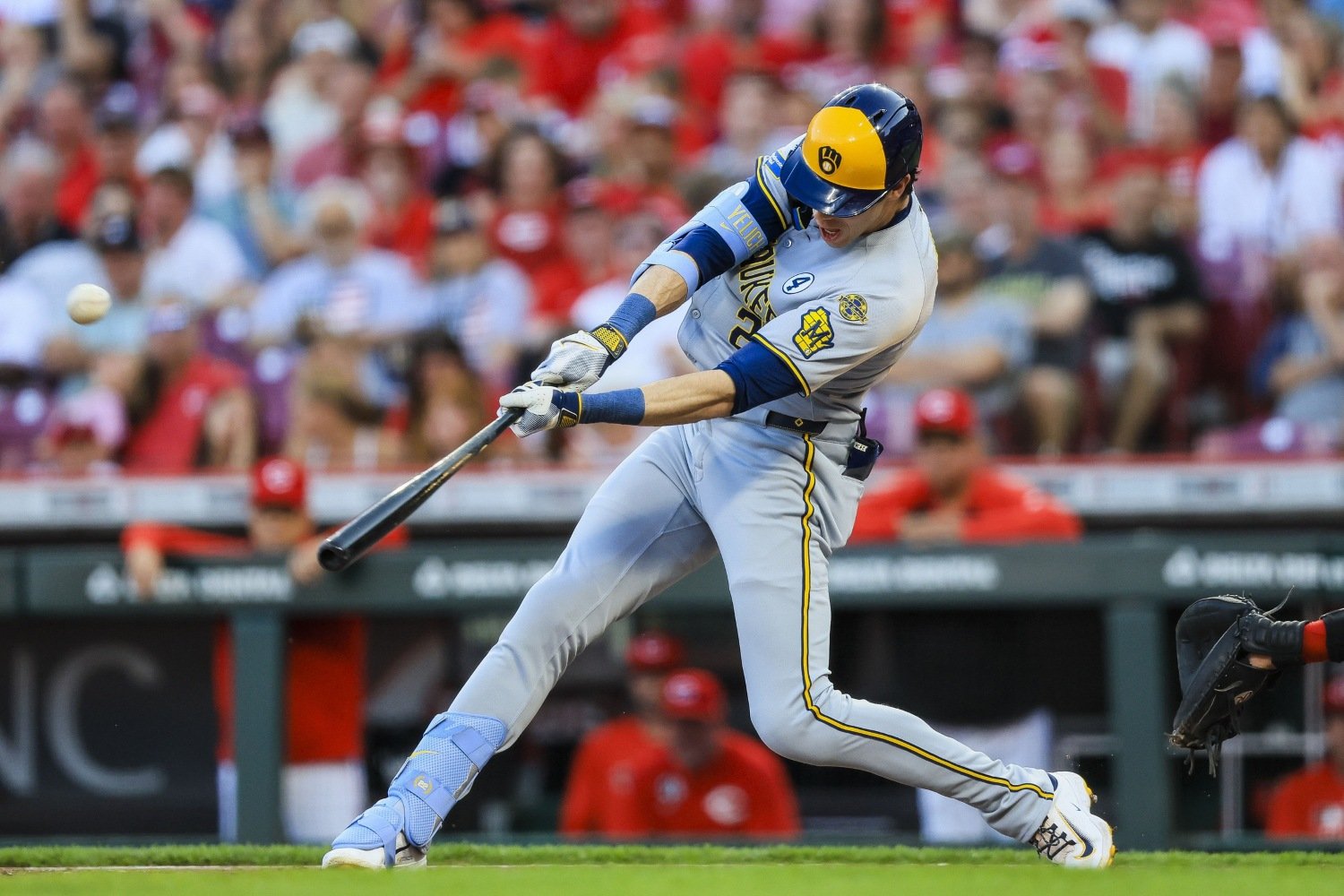 Christian Yelich has tantalized the Milwaukee Brewers fan base in the 2020s with two- to three-week spurts of his 2018 and 2019 self—before reverting to a more slap-and-dash hitting production, reminiscent of his time with the Miami Marlins. In 2024, pre-injury, Yelich produced his most consistent stretch of powerful baseball, producing a .910 OPS and 3.0 WAR in just 73 games. He looked "back". Then the back injury struck again. To begin 2025, Yelich's timing seemed off. He was consistently late to the ball, resulting in numerous ground balls and far higher whiff rates than we usually see from the Brewers' star. After the surgery to remove tissue in his back, Yelich was showing some worrying signs of regression. As our Milwaukee Tailgate Partners would say, "there's no such thing as "used" to have a back injury" and surgeries in this area are always tricky. That being said, all the underlying metrics around swing speed and sprint speed looked nearly identical to past versions of Yelich. If he was swinging the bat as hard, then surely the issue must be something else? Well, thanks to Baseball Savant's swing path data, we can actually chronicle how Yelich's timing was off. I did so a week ago, here. Looking at the last week of games compared with the earlier part of the season, some clear differences jump out: Over the last week (above) Yelich's contact point is 30.3" in front of his center of mass, and 1.8" in front of home plate. Catching it out in front, put into numbers. Now, let's see the results from the rest of May for him. Catching the ball on average 25.8" in front of his center of mass, and 2.2" behind home plate is a completely different contact point altogether, leaving Yelich unable to extend through the baseball or gain a feel for the natural flow of the bat through contact. He was late, and it caused him no end of problems. If we isolate it to just his eight swings in June, there are even more stark differences compared to the prior months. It is a small sample size, but his bat speed is increased, the contact point is even more extreme over the front of the plate, and he's pulling the ball more than ever in his last two games. How does this compare to his 2023 and 2024 seasons? We know that Yelich showed glimpses in 2023, but it was 2024 where his production really took off. Lo and behold, the biggest change is in two areas. His attack direction (the horizontal angle at which the bat impacts the ball, where 0° would be directly at the center of the field) and the distance of his contact point compared to his center of mass both stand out. He's contacting the ball further forward, and is more pull-oriented as a result. There's one other reason for real optimism. Yelich's biggest weakness since 2020 has been an inability to hit and do damage on breaking balls down and in. Sliders, curveballs, you name it, and it's been whiff central for the Brewers star. Over the last four days, Yelich has crushed two monstrous home runs off such pitches. against Carlos Hernandez and Brady Singer. V0FkOW9fWGw0TUFRPT1fVkFGWlYxTU5Cd0lBQUFCV1V3QUhWMVZTQUFOVVYxUUFVVnhUQXdvRlZRWmRVZ1pT.mp4 From 2021 through 2024, Yelich only hit one home run in gameday zones 9 and 14 (down and in) against a breaking ball way back in 2022 against Locke St John of the Cubs. Even then, the contact was slightly different, with a slight inside out on the contact and just clearing the center field wall: Nk8xcllfWGw0TUFRPT1fQmdGVlZseFdWUWNBRFZkWEJ3QUFDQWRVQUFNRFVsa0FWbE1CQkFRQkFsZFZWUUZU (1).mp4 From 2021 onward, Yelich ranks 14th among left-handed hitters in whiff rate from these strike zones with a 64.9% miss rate when he swings. Being able to do damage in this area will force hitters to attack him in different ways and could open up a whole new level of success in this decade for Yelich. It's something he was known for in his heyday, doing damage across all areas of the zone. Pitchers have pummelled him down and in since and gotten a large level of success to the point that, by giving them doubt and forcing them to be pinpoint if they do attack him down and in, Yelich could see his walk rate spike on top of more mistake pitches as a result of the pressure. So he's catching the ball out in front. He's pulling it in the air. Over the last week, he's hit six home runs. When Christian Yelich goes nuclear, this is what it looks like. I'm not saying Yelich is back to his 2018/19 form. We need a far larger sample size to even contemplate a comparison. However, the ascending pull rate and bat speed that have linked into his ability to do damage on breaking balls down and in is a remarkable change from the last few years. There's also hope that his back can hold the strain longer than usual with the volume of inflamed tissue they removed during his surgery. Over the last week, Christian Yelich has been the prime provider of runs, He's stepped up when his team needed him most, and he's doing it with a swing very similar to that which held up throughout 2024. He is prone to streakiness, but there is a very real possibility that if Yelich can remain healthy, his bat will continue to be a source of extreme comfort, and perhaps increasing excitement, for this beleaguered Brewers offense.
 -
Image courtesy of © Katie Stratman-Imagn Images Christian Yelich has tantalized the Milwaukee Brewers fan base in the 2020s with two- to three-week spurts of his 2018 and 2019 self—before reverting to a more slap-and-dash hitting production, reminiscent of his time with the Miami Marlins. In 2024, pre-injury, Yelich produced his most consistent stretch of powerful baseball, producing a .910 OPS and 3.0 WAR in just 73 games. He looked "back". Then the back injury struck again. To begin 2025, Yelich's timing seemed off. He was consistently late to the ball, resulting in numerous ground balls and far higher whiff rates than we usually see from the Brewers' star. After the surgery to remove tissue in his back, Yelich was showing some worrying signs of regression. As our Milwaukee Tailgate Partners would say, "there's no such thing as "used" to have a back injury" and surgeries in this area are always tricky. That being said, all the underlying metrics around swing speed and sprint speed looked nearly identical to past versions of Yelich. If he was swinging the bat as hard, then surely the issue must be something else? Well, thanks to Baseball Savant's swing path data, we can actually chronicle how Yelich's timing was off. I did so a week ago, here. Looking at the last week of games compared with the earlier part of the season, some clear differences jump out: Over the last week (above) Yelich's contact point is 30.3" in front of his center of mass, and 1.8" in front of home plate. Catching it out in front, put into numbers. Now, let's see the results from the rest of May for him. Catching the ball on average 25.8" in front of his center of mass, and 2.2" behind home plate is a completely different contact point altogether, leaving Yelich unable to extend through the baseball or gain a feel for the natural flow of the bat through contact. He was late, and it caused him no end of problems. If we isolate it to just his eight swings in June, there are even more stark differences compared to the prior months. It is a small sample size, but his bat speed is increased, the contact point is even more extreme over the front of the plate, and he's pulling the ball more than ever in his last two games. How does this compare to his 2023 and 2024 seasons? We know that Yelich showed glimpses in 2023, but it was 2024 where his production really took off. Lo and behold, the biggest change is in two areas. His attack direction (the horizontal angle at which the bat impacts the ball, where 0° would be directly at the center of the field) and the distance of his contact point compared to his center of mass both stand out. He's contacting the ball further forward, and is more pull-oriented as a result. There's one other reason for real optimism. Yelich's biggest weakness since 2020 has been an inability to hit and do damage on breaking balls down and in. Sliders, curveballs, you name it, and it's been whiff central for the Brewers star. Over the last four days, Yelich has crushed two monstrous home runs off such pitches. against Carlos Hernandez and Brady Singer. V0FkOW9fWGw0TUFRPT1fVkFGWlYxTU5Cd0lBQUFCV1V3QUhWMVZTQUFOVVYxUUFVVnhUQXdvRlZRWmRVZ1pT.mp4 From 2021 through 2024, Yelich only hit one home run in gameday zones 9 and 14 (down and in) against a breaking ball way back in 2022 against Locke St John of the Cubs. Even then, the contact was slightly different, with a slight inside out on the contact and just clearing the center field wall: Nk8xcllfWGw0TUFRPT1fQmdGVlZseFdWUWNBRFZkWEJ3QUFDQWRVQUFNRFVsa0FWbE1CQkFRQkFsZFZWUUZU (1).mp4 From 2021 onward, Yelich ranks 14th among left-handed hitters in whiff rate from these strike zones with a 64.9% miss rate when he swings. Being able to do damage in this area will force hitters to attack him in different ways and could open up a whole new level of success in this decade for Yelich. It's something he was known for in his heyday, doing damage across all areas of the zone. Pitchers have pummelled him down and in since and gotten a large level of success to the point that, by giving them doubt and forcing them to be pinpoint if they do attack him down and in, Yelich could see his walk rate spike on top of more mistake pitches as a result of the pressure. So he's catching the ball out in front. He's pulling it in the air. Over the last week, he's hit six home runs. When Christian Yelich goes nuclear, this is what it looks like. I'm not saying Yelich is back to his 2018/19 form. We need a far larger sample size to even contemplate a comparison. However, the ascending pull rate and bat speed that have linked into his ability to do damage on breaking balls down and in is a remarkable change from the last few years. There's also hope that his back can hold the strain longer than usual with the volume of inflamed tissue they removed during his surgery. Over the last week, Christian Yelich has been the prime provider of runs, He's stepped up when his team needed him most, and he's doing it with a swing very similar to that which held up throughout 2024. He is prone to streakiness, but there is a very real possibility that if Yelich can remain healthy, his bat will continue to be a source of extreme comfort, and perhaps increasing excitement, for this beleaguered Brewers offense. View full article
-
Always intriguing to see lineup construction and pitching length in the early games as a sign of who the Brewers are high on. Bravo going 5 innings with 7 K's in his second DSL stint is notable. More so Carlos Doñe who missed all of 2024 with an injury hitting second behind Antuñez. He went 3-4 with a double and two stolen bases. Colmenarez getting 5 innings under his belt but he is 19 now so perhaps more expectations there as a 2023 draftee
-
In stateside ball, absolutely. In DSL it can mean glitches or storms
-
Sun. 6/1 - Seeking Shuckers Offense
Jake McKibbin replied to Jim Goulart's topic in Brewers Minor League Talk
Bitonti Bomb, looked slightly off the barrel but caught it out in front and pulled over the big signs in right field. Great signs for the BIG man -
Sun. 6/1 - Seeking Shuckers Offense
Jake McKibbin replied to Jim Goulart's topic in Brewers Minor League Talk
A swinging strike rate of just 8.6% in 2025 is just not going to cut it given his age and the level. It's 8.3% in Low A -
Sun. 6/1 - Seeking Shuckers Offense
Jake McKibbin replied to Jim Goulart's topic in Brewers Minor League Talk
Oof. 108 mph homer to the first batter of the day of Chandler Welch. Safe to say this season isnt going to plan for the 2024 draftee early doors -
Happy talking about this now after hopefully most of you have listened to the call up, but it seems Wisconsin is the placeholder for hitters developing their ball/strike recognition. Blake Burke and Jadher Areinamo have both talked about/been talked about this exact thing. Certainly something to tail in on, along with Cooper Pratt in two stroke counts, as we continue to watch closely
-
Sat. 5/31 - It's a Misiorowski Night. Enough Said.
Jake McKibbin replied to Jim Goulart's topic in Brewers Minor League Talk
Luke Adams scratched, hopefully nothing to worry about. Zavier Warren starting now at first base -
Caleb Durbin Is Finding His Short King Swing
Jake McKibbin replied to Jason Wang's topic in Brewer Fanatic Front Page News
So good. Top reference -
Sat. 5/31 - It's a Misiorowski Night. Enough Said.
Jake McKibbin replied to Jim Goulart's topic in Brewers Minor League Talk
I cannot stress this enough (and I won't repeat the highlights to take away from the callup podcasts awesome work) but the episode with Brenton Del Chiaro is must listen, covering Made, Peña, Bitonti, Adamczewski, Dinges, Zamora, Wilken, Pratt and more. It is rivetting listening material, you'll find the link in @Jim Goulart's daily media updates. It's totally worth 45 minutes of your time for us nerds in this chat -
Caleb Durbin Is Finding His Short King Swing
Jake McKibbin replied to Jason Wang's topic in Brewer Fanatic Front Page News
Bro 😂😂😂😂 -
Did DL go into any of the mechanics he was working on to unlock it? Was there anything specific he thought he'd gotten into bad habits around? Excellent piece!
-
Jackson Chourio Needs Another June Breakout. Is One on the Horizon?
Jake McKibbin posted an article in Brewers
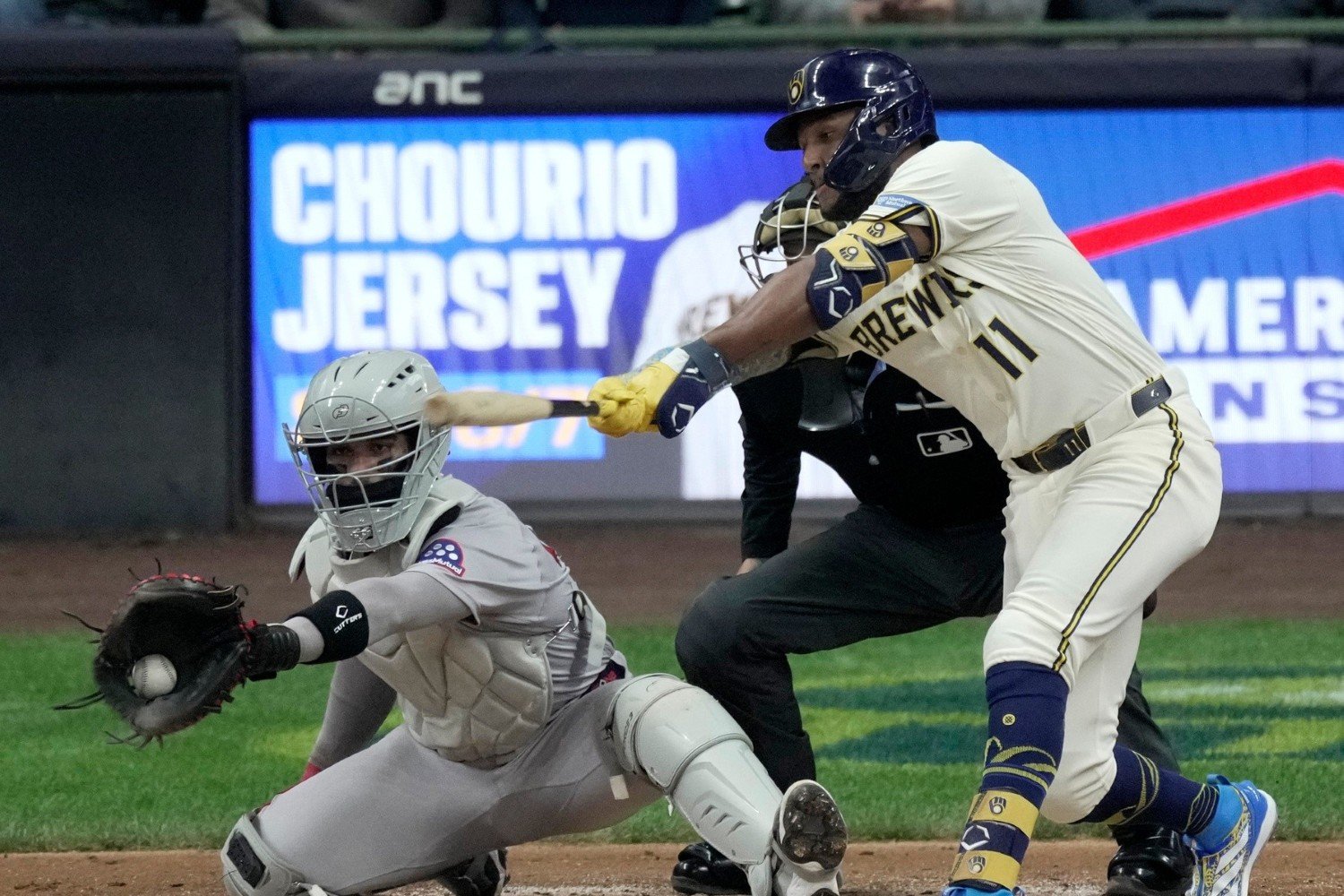 Jackson Chourio's start to 2025 has been underwhelming. Losing all plate discipline and struggling to pick up breaking pitches, he's looked lost at the plate, despite his eight home runs. He's still running into occasional bombs, as he did against Garrett Crochet this week, but his OPS is steadily trending down. The problem, again, is chasing too much. His rolling chase rates (by a 50-plate appearance sample) have regularly been above the 40% mark and have regressed there again recently. The problem is that these haven't always correlated with his production, because of how effectively he punished mistakes earlier in the season (although there is still some correlation). Of course, if Chourio can force pitchers inside the strike zone, he should be able to do more damage with more hittable pitches. That would make sense, but it also seems like his confidence is just shot at the moment. Despite a period of improved swing decisions recently, his hard-hit rates have plummeted over his last 90-plus batted balls, to a 10th percentile range. He's lost all confidence and conviction at the plate, meaning that even when pitchers give him something to hit, he's struggling to punish it. There's nothing in his offensive skill set that's materially changed, other than his approach. His setup and swing are almost identical to 2024, but he's not meting out hit swings judiciously. It all points toward a player forcing it, in search of becoming the superstar Milwaukee craves. He got a taste of it in the postseason, and he has all the talent to perform at those levels again. With an under-confident player feeling that level of pressure, he'll be prone to overthinking—perhaps even a state of panic in the box. A short hot streak, or some Brewers wins will take some of the burden off him and perhaps allow him to relax and let the game come to him once more. A new month brings a fresh slate, and with that, Chourios has a chance of repeating his scorching June of last year. He isn't showing signs of breaking out, but then, he didn't show many at this time last year, either. It just clicked, and nothing has changed (outside of his mind) to indicate that the exact same thing can't happen once again. That being said, his results are showing clear decline and the confidence drop is more embedded than a mere dip. Chourio isn't able to slow the game down at the moment, even though his rapid hands should allow him all the time he needs to make good swing decisions. It's there. He'll likely be all the better for this experience in the future. And he might just go nuclear once more, just when the Brewers really need his bat. However, right now, he isn't showing any signs of busting this long, drawn-out slump, save the occasional blast.