Jake McKibbin
-
Posts
2,395 -
Joined
-
Last visited
-
Days Won
6
Content Type
Profiles
Forums
Blogs
Events
News
2026 Milwaukee Brewers Top Prospects Ranking
Milwaukee Brewers Videos
2022 Milwaukee Brewers Draft Picks
Milwaukee Brewers Free Agent & Trade Rumors, Notes, & Tidbits
Guides & Resources
2023 Milwaukee Brewers Draft Picks
2024 Milwaukee Brewers Draft Picks
The Milwaukee Brewers Players Project
2025 Milwaukee Brewers Draft Pick Tracker
2026 Milwaukee Brewers Draft Tracker: Picks & Bonuses
Store
Downloads
Gallery
Everything posted by Jake McKibbin
-
Very much so. He should still be rangey as first basemen go, but whole some issues were to be expected the lack of home run production is slightly concerning. Like we probably should have expected he'd face issues at a point with his zone coverage but not to this extent in Low A
-
The mudcats did have a chance to give Bitonti an opportunity at third base as a replacement for Peña but have done a few switcheroos to keep him at first base. I'm guessing they don't see him at third going forward
-
Peña had a horrible looking collision at first, I THINK he may have caught an elbow to the face and is now being replaced by bitonti. I think it'll be concussion checks but hopefully nothing more sinister.
-
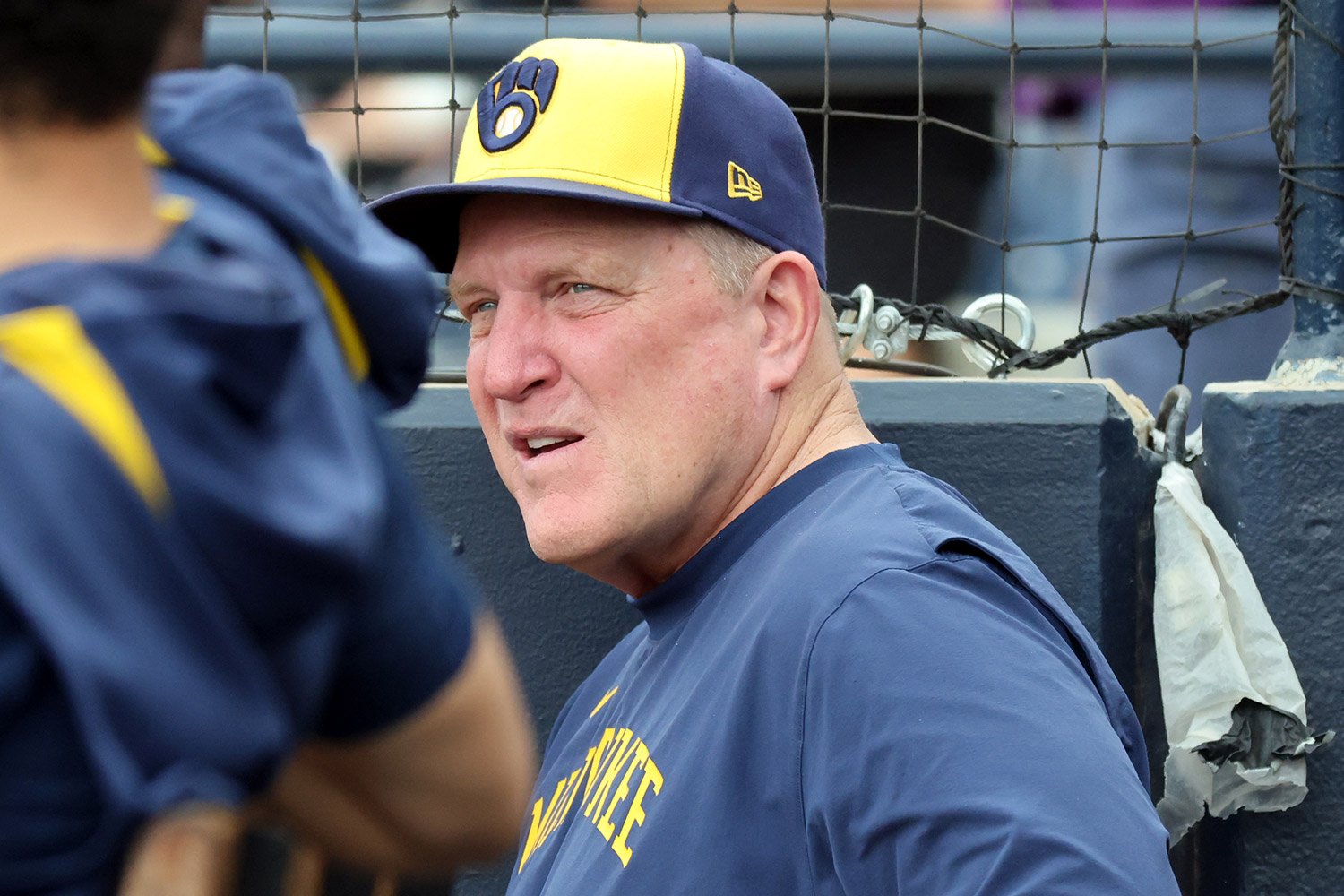 The mental acuity to compete day in and day out is a difficult mindset to attain. A 162-game season. 6,170 plate appearances in the batter's box. 6,076 hitters faced down on the mound. The Brewers created success in 2024 by being more involved in each and every one of those plate appearances than any other team in baseball. It's easy to say, and far harder to demonstrate with the intensity that is required from one plate appearance to the next and the myriad of decisions each of those plate appearances requires. Pat Murphy said it best, last season they got off to a hot start (assisted by some aggressive management on his part) and rode that wave through to October. They had some down periods throughout the season, but their ability to continually bounce back and avoid prolonged stretches of losing, poor baseball was key to their success last season. An initial injection of confidence made all the difference, enabling the team to proceed with confidence that their approach would continue to pay off in the long run. When a team lacks confidence, every decision made on each of those thousands of plate appearances becomes second-guessed, creating an insular "don't make mistakes" mentality. The problem is, from a psychological standpoint, the brain doesn't process negatives in such internal thoughts, making you more prone to making the aforementioned errors. The Brewers' success is predicated on their ability to maintain maximum intensity from one play to the next without overexerting that intensity to the point of overthinking the results. It requires an enjoyment of the grind, one that comes from knowing you're outworking your counterpart and succeeding because of it. It's an attitude the Brewers don't seem to have had, often appearing lethargic or overburdened, rather than free, focused, and aggressive in the same style they were at their peak in 2024. If you've read my previous writings, you may have come across my mention of the carrot-and-stick approach. One of the key things to being a manager is to understand the needs of your players and which approach will get the best out of them. Some players need a kick in the backside, others need an arm around the shoulder, and some supportive words, but each individual will feel these needs differently. In an ideal world, each player would be able to self-motivate; however, in practice, that isn't the case. It's a point where Pat Murphy will certainly earn his salt. He has a diverse, young group of players, with one of their pivotal leaders of 2024 absent. Perhaps the return of Brandon Woodruff or an injection of confidence could create the spark that helps them find that balance, but how Murphy manages his players with the carrot and the stick will be fascinating to observe. We've already seen some of the latter in his treatment of Sal Frelick, Tobias Myers, and Caleb Durbin. The tone in the most recent meeting belied more confidence and optimism. How he manages the next few weeks will go a long way in determining the course of the Brewers' season. If he can get them back to enjoying the individual battles and out of their heads, there is time to turn this season around. There's enough talent in this team to create their success rather than wait for a lucky stretch of baseball, and enough quality to seize the bull by the horns. After a potentially momentum-setting win against the Guardians on Wednesday night, the home series against the Twins feels like an opportunity to put down a marker.
 -
Image courtesy of © Kim Klement Neitzel-Imagn Images The mental acuity to compete day in and day out is a difficult mindset to attain. A 162-game season. 6,170 plate appearances in the batter's box. 6,076 hitters faced down on the mound. The Brewers created success in 2024 by being more involved in each and every one of those plate appearances than any other team in baseball. It's easy to say, and far harder to demonstrate with the intensity that is required from one plate appearance to the next and the myriad of decisions each of those plate appearances requires. Pat Murphy said it best, last season they got off to a hot start (assisted by some aggressive management on his part) and rode that wave through to October. They had some down periods throughout the season, but their ability to continually bounce back and avoid prolonged stretches of losing, poor baseball was key to their success last season. An initial injection of confidence made all the difference, enabling the team to proceed with confidence that their approach would continue to pay off in the long run. When a team lacks confidence, every decision made on each of those thousands of plate appearances becomes second-guessed, creating an insular "don't make mistakes" mentality. The problem is, from a psychological standpoint, the brain doesn't process negatives in such internal thoughts, making you more prone to making the aforementioned errors. The Brewers' success is predicated on their ability to maintain maximum intensity from one play to the next without overexerting that intensity to the point of overthinking the results. It requires an enjoyment of the grind, one that comes from knowing you're outworking your counterpart and succeeding because of it. It's an attitude the Brewers don't seem to have had, often appearing lethargic or overburdened, rather than free, focused, and aggressive in the same style they were at their peak in 2024. If you've read my previous writings, you may have come across my mention of the carrot-and-stick approach. One of the key things to being a manager is to understand the needs of your players and which approach will get the best out of them. Some players need a kick in the backside, others need an arm around the shoulder, and some supportive words, but each individual will feel these needs differently. In an ideal world, each player would be able to self-motivate; however, in practice, that isn't the case. It's a point where Pat Murphy will certainly earn his salt. He has a diverse, young group of players, with one of their pivotal leaders of 2024 absent. Perhaps the return of Brandon Woodruff or an injection of confidence could create the spark that helps them find that balance, but how Murphy manages his players with the carrot and the stick will be fascinating to observe. We've already seen some of the latter in his treatment of Sal Frelick, Tobias Myers, and Caleb Durbin. The tone in the most recent meeting belied more confidence and optimism. How he manages the next few weeks will go a long way in determining the course of the Brewers' season. If he can get them back to enjoying the individual battles and out of their heads, there is time to turn this season around. There's enough talent in this team to create their success rather than wait for a lucky stretch of baseball, and enough quality to seize the bull by the horns. After a potentially momentum-setting win against the Guardians on Wednesday night, the home series against the Twins feels like an opportunity to put down a marker. View full article
-
Birchard looking sharp and locating nicely through the first two innings. Got a little lucky on a hanging breaker, but a superb play by Daniel Guilarte bailed him out. Impressive continuance of the starting pitching dominance of recent days
-
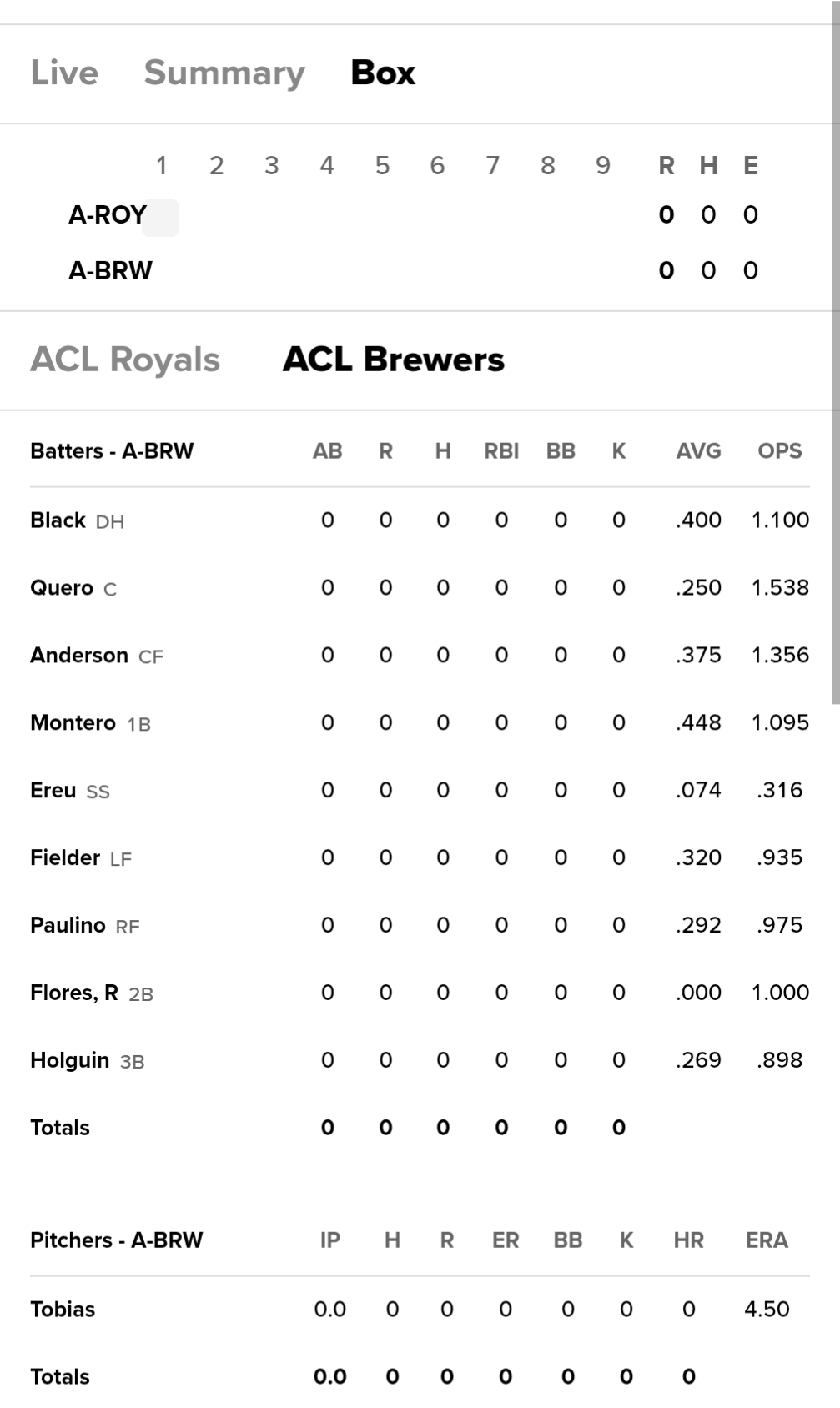
ACL Brewers with Quero catching once more, perhaps more than we expected in the early stages Kevin Ereu has certainly struggled but the rest of that lineup has MASHED
-
Perfect BA, apparently Ethan Dorchies has seen a solid velo bump. Up from sitting 91 to sitting 95 mph with impressive horizontal movement on his fastball Also mention for Jose Anderson and has strike zone recognition plus the pull side lift he generates
-
Posts like this are just why I write, and I really appreciate the compliment! I completely agree, the balance here is much more in that middle ground. Yes he has changed to become more defensive in a two stroke count, but I still think the 107-108 mph EV's are in there if he can find the timing when he gambles on a mistake pitch in a hitters count. Some of the foul balls he's hit have been absolutely roped
-
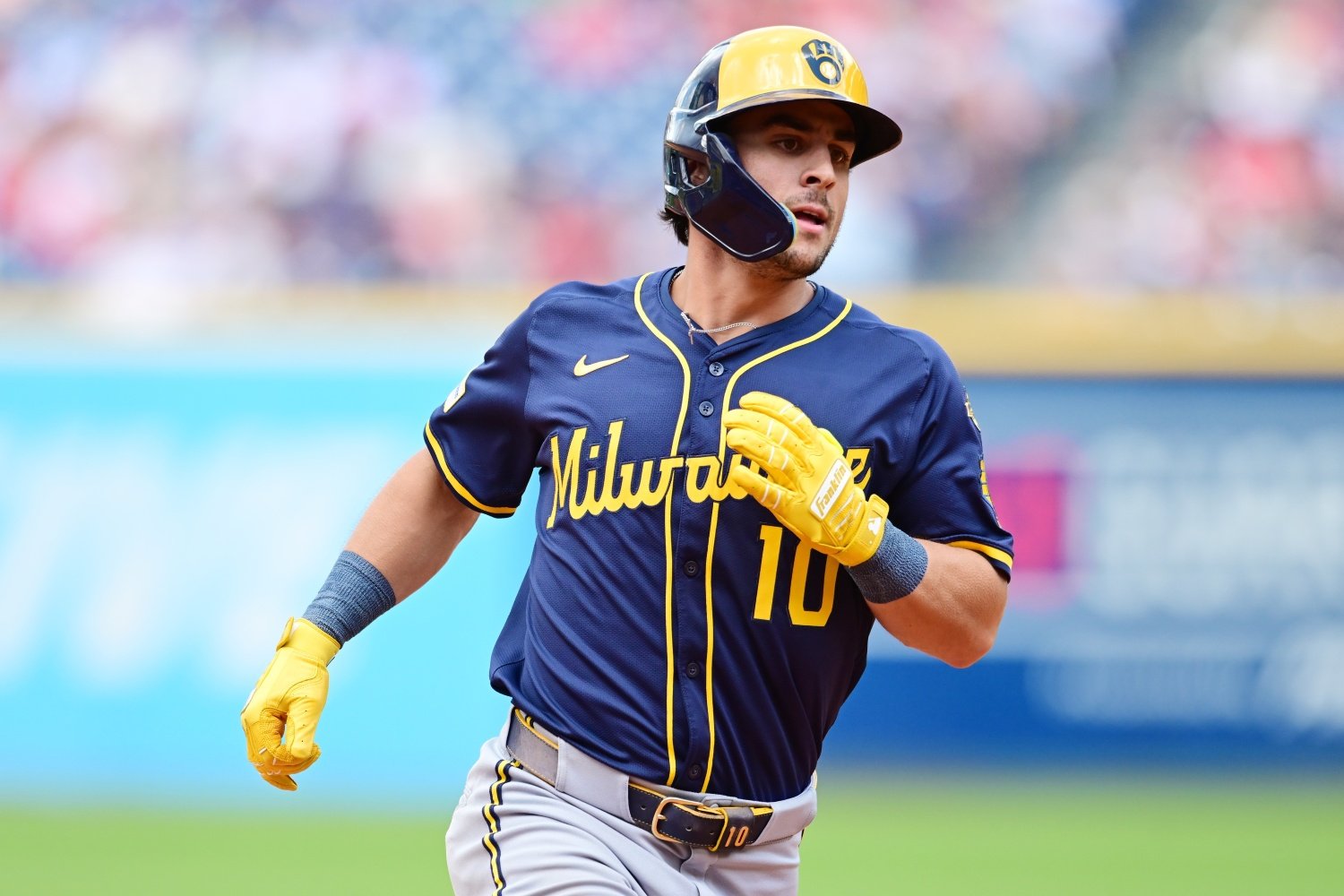 Sal Frelick is a gritty, fiery competitor—the type of individual who can be a sparkplug for a struggling team. On Wednesday afternoon in Cleveland, Frelick was just that, launching a home run over 400 feet and returning to the dugout all guns blazing. The emotional energy he plays with is second to none, but he came into this year knowing that he needed to impact the ball with more of that intensity. Having provided a tantalizing glimpse of his capability in Game 3 of last year's Wild Card Series, there was hope that Frelick might try and lean into that more this season. So far, it seems he's attempting to do just that. While his Baseball Savant page still doesn't blush with the quality of contact metrics, Frelick is averaging 86.1 mph on his batted balls (up 3 mph on 2204), and boasts a hard-hit rate up from 19.5% to 30.3% and a bat speed up from 66.3 mph to 68 mph. He's doing this with a similar set of changes to the ones made by Brice Turang this offseason. Frelick's batting stance is less spread out, in an effort to gain more power from his legs and torso. His feet are 3 inches closer together, while he's also opened up his stance to try and pull the ball more frequently. His pull rate is up from 29.3% to 40% in 2025, but it's come at the cost (early on) of an increase in ground balls. The changes he's made are working, but they aren't being maximized yet. He's swinging harder and hitting the ball harder, but there are signs he's still finding some timing issues when he does swing fast. The graph below shows that in 2025, Frelick is swinging the bat at speeds of 75-80 mph noticeably more often, while avoiding those uncomfortable swings in the 55-60 mph bat speed range almost entirely. Frelick spoke about this in spring training, naming a desire to see balls he can attack and do damage on early in counts while still preserving his essence as a hitter in putting balls in play and avoiding strikeouts. Plate discipline and contact skills will always be his bread and butter, but it's also safe to say that Frelick's timing on his efforts to do damage isn't quite there. The graph above does highlight a similar overall range of bat speeds, just with an increase in the number of fast swings when he feels he can hone in on a mistake. He might not be picking his spots well enough yet, though. So far this season, Frelick has swung the bat over 73 mph on 22 occasions. Of those, he's put the ball in play six times, and only one had an expected ISO of over .100, meaning the expected extra-base hits output just isn't there. Only once did he have an expected batting average over .220. In layman's terms, Sal Frelick isn't managing to marry increased offensive output with the increased violence of the swing. Let's take a look at some of the higher bat speeds he's produced to see why that may be: vs. Carson Spiers 4/5/25 - 82.5 mph eUxXVkdfWGw0TUFRPT1fRGxSVkFBQUNVd0lBQ2xvQ1hnQUhBMUpXQUFNQlZsQUFVVkFEVlFVR0NBcFRBUU1I (1).mp4 Frelick's biggest bat speed of the year, he saw this pitch from Carson Spiers in a 1-0 count and gambled heavily on a four-seam/sinker over the heart of the plate. Frelick was caught miles in front of the pitch, and remember, Spiers uses his cutter quite frequently. It's absolutely fine for Frelick to gamble in hitter's counts and get caught out in front—that's a tradeoff he's admitted to accepting—but this may become a common theme. Frelick was evidently feeling good in that series against the Royals, following up the next day with two more swings in excess of 78 mph. Still, though, he didn't quite time them up. Michael Lorenzen 4/1/25 - 77.8 mph MTZXMjhfWGw0TUFRPT1fVndoWkFWUUFYd3NBQ3dCUlhnQUhDRkJRQUZoUlVBVUFBMWNHQndWUkJ3TlFVd0VE.mp4 Here we can see Frelick gambling on a four seam fastball, and it comes in right over the middle of the plate. Yet again, he's trying to pull the ball, but he gets far underneath the ball and misses a premium chance to do some damage. We have one more example; Keider Montero 4/16/25 - 77.8 mph NHlXcmpfWGw0TUFRPT1fVTFWUlhGUUJBMVFBRDFVQlZBQUhCMVVGQUFBR0FBUUFDMVFGVkZJQUNBdFNWbFpS.mp4 Here again, Frelick gets a pitch over the heart of the plate to drive. It's a non-fastball, so perhaps some leeway could be granted here, but again, he seems to recognize and adjust to that—before getting caught out in front once more and rolling over a ball about as much as anyone can roll over any pitch. Frelick is entirely correct in his approach. He should be trying to access the pull side when he's looking to do damage, and he should be targeting these specific pitches. His issue, as it was early in the season, is that he's been getting caught out in front. Perhaps adjusting to the increased bat speed, he just hasn't quite found his timing. He managed to on Wednesday afternoon, on a swing of 72.9 mph (his previous home run came on a 69 mph swing). If he can lock into the feel of squaring up balls with the higher bat speeds as consistently and effectively as he does at the lower end of his spectrum, there is most certainly more juice in Frelick's bat. He just needs to find that sweet spot. Is the summer of Sal to become a real thing? Let us know your thoughts in the comments below!
 -
Image courtesy of © Ken Blaze-Imagn Images Sal Frelick is a gritty, fiery competitor—the type of individual who can be a sparkplug for a struggling team. On Wednesday afternoon in Cleveland, Frelick was just that, launching a home run over 400 feet and returning to the dugout all guns blazing. The emotional energy he plays with is second to none, but he came into this year knowing that he needed to impact the ball with more of that intensity. Having provided a tantalizing glimpse of his capability in Game 3 of last year's Wild Card Series, there was hope that Frelick might try and lean into that more this season. So far, it seems he's attempting to do just that. While his Baseball Savant page still doesn't blush with the quality of contact metrics, Frelick is averaging 86.1 mph on his batted balls (up 3 mph on 2204), and boasts a hard-hit rate up from 19.5% to 30.3% and a bat speed up from 66.3 mph to 68 mph. He's doing this with a similar set of changes to the ones made by Brice Turang this offseason. Frelick's batting stance is less spread out, in an effort to gain more power from his legs and torso. His feet are 3 inches closer together, while he's also opened up his stance to try and pull the ball more frequently. His pull rate is up from 29.3% to 40% in 2025, but it's come at the cost (early on) of an increase in ground balls. The changes he's made are working, but they aren't being maximized yet. He's swinging harder and hitting the ball harder, but there are signs he's still finding some timing issues when he does swing fast. The graph below shows that in 2025, Frelick is swinging the bat at speeds of 75-80 mph noticeably more often, while avoiding those uncomfortable swings in the 55-60 mph bat speed range almost entirely. Frelick spoke about this in spring training, naming a desire to see balls he can attack and do damage on early in counts while still preserving his essence as a hitter in putting balls in play and avoiding strikeouts. Plate discipline and contact skills will always be his bread and butter, but it's also safe to say that Frelick's timing on his efforts to do damage isn't quite there. The graph above does highlight a similar overall range of bat speeds, just with an increase in the number of fast swings when he feels he can hone in on a mistake. He might not be picking his spots well enough yet, though. So far this season, Frelick has swung the bat over 73 mph on 22 occasions. Of those, he's put the ball in play six times, and only one had an expected ISO of over .100, meaning the expected extra-base hits output just isn't there. Only once did he have an expected batting average over .220. In layman's terms, Sal Frelick isn't managing to marry increased offensive output with the increased violence of the swing. Let's take a look at some of the higher bat speeds he's produced to see why that may be: vs. Carson Spiers 4/5/25 - 82.5 mph eUxXVkdfWGw0TUFRPT1fRGxSVkFBQUNVd0lBQ2xvQ1hnQUhBMUpXQUFNQlZsQUFVVkFEVlFVR0NBcFRBUU1I (1).mp4 Frelick's biggest bat speed of the year, he saw this pitch from Carson Spiers in a 1-0 count and gambled heavily on a four-seam/sinker over the heart of the plate. Frelick was caught miles in front of the pitch, and remember, Spiers uses his cutter quite frequently. It's absolutely fine for Frelick to gamble in hitter's counts and get caught out in front—that's a tradeoff he's admitted to accepting—but this may become a common theme. Frelick was evidently feeling good in that series against the Royals, following up the next day with two more swings in excess of 78 mph. Still, though, he didn't quite time them up. Michael Lorenzen 4/1/25 - 77.8 mph MTZXMjhfWGw0TUFRPT1fVndoWkFWUUFYd3NBQ3dCUlhnQUhDRkJRQUZoUlVBVUFBMWNHQndWUkJ3TlFVd0VE.mp4 Here we can see Frelick gambling on a four seam fastball, and it comes in right over the middle of the plate. Yet again, he's trying to pull the ball, but he gets far underneath the ball and misses a premium chance to do some damage. We have one more example; Keider Montero 4/16/25 - 77.8 mph NHlXcmpfWGw0TUFRPT1fVTFWUlhGUUJBMVFBRDFVQlZBQUhCMVVGQUFBR0FBUUFDMVFGVkZJQUNBdFNWbFpS.mp4 Here again, Frelick gets a pitch over the heart of the plate to drive. It's a non-fastball, so perhaps some leeway could be granted here, but again, he seems to recognize and adjust to that—before getting caught out in front once more and rolling over a ball about as much as anyone can roll over any pitch. Frelick is entirely correct in his approach. He should be trying to access the pull side when he's looking to do damage, and he should be targeting these specific pitches. His issue, as it was early in the season, is that he's been getting caught out in front. Perhaps adjusting to the increased bat speed, he just hasn't quite found his timing. He managed to on Wednesday afternoon, on a swing of 72.9 mph (his previous home run came on a 69 mph swing). If he can lock into the feel of squaring up balls with the higher bat speeds as consistently and effectively as he does at the lower end of his spectrum, there is most certainly more juice in Frelick's bat. He just needs to find that sweet spot. Is the summer of Sal to become a real thing? Let us know your thoughts in the comments below! View full article
-
Brewers prospect analysis: Is Brock Wilken's breakout legitimate? I would encourage anyone thinking about this to se Curt Hogg's latest on him. The slider down and away is a chess game, if he can continue developing and doing damage to right center against it when they leave it in zone, that's a big win. But it all comes down to can he lay off the good ones. Not the finished product yet, and may get a cup of coffee if he's firing and the Brewers are out of contention in September but otherwise I'd let the development take its natural course. Triple A, and the more experienced, command focused pitchers there could be a barrier but time will tell.
- 5 replies
-
- 1
-

-
- anthony seigler
- marco dinges
- (and 3 more)
-
The problem is if Perkins comes up, that would require Daz Cameron to be DFA'd and potentially lost. If that happened, they wouldn't want Hall/Herron to be the reserves. Collins should be safe for now
-
Completely. It did look an amazing shape to begin with, but his arm angle has risen from where it was, plus he was sitting 96-97 mph with 16017" of IVB from a funky angle when he got that grade. I think (and this is purely from recall) that some scouts were very high on the fastball based on results, others uncertain and more in the above average camp? Or there were a few questions about that grade at least. If he can remotely hold that shape he showed in the first and second innings, we're cooking. If not... it just won't function as starter
-
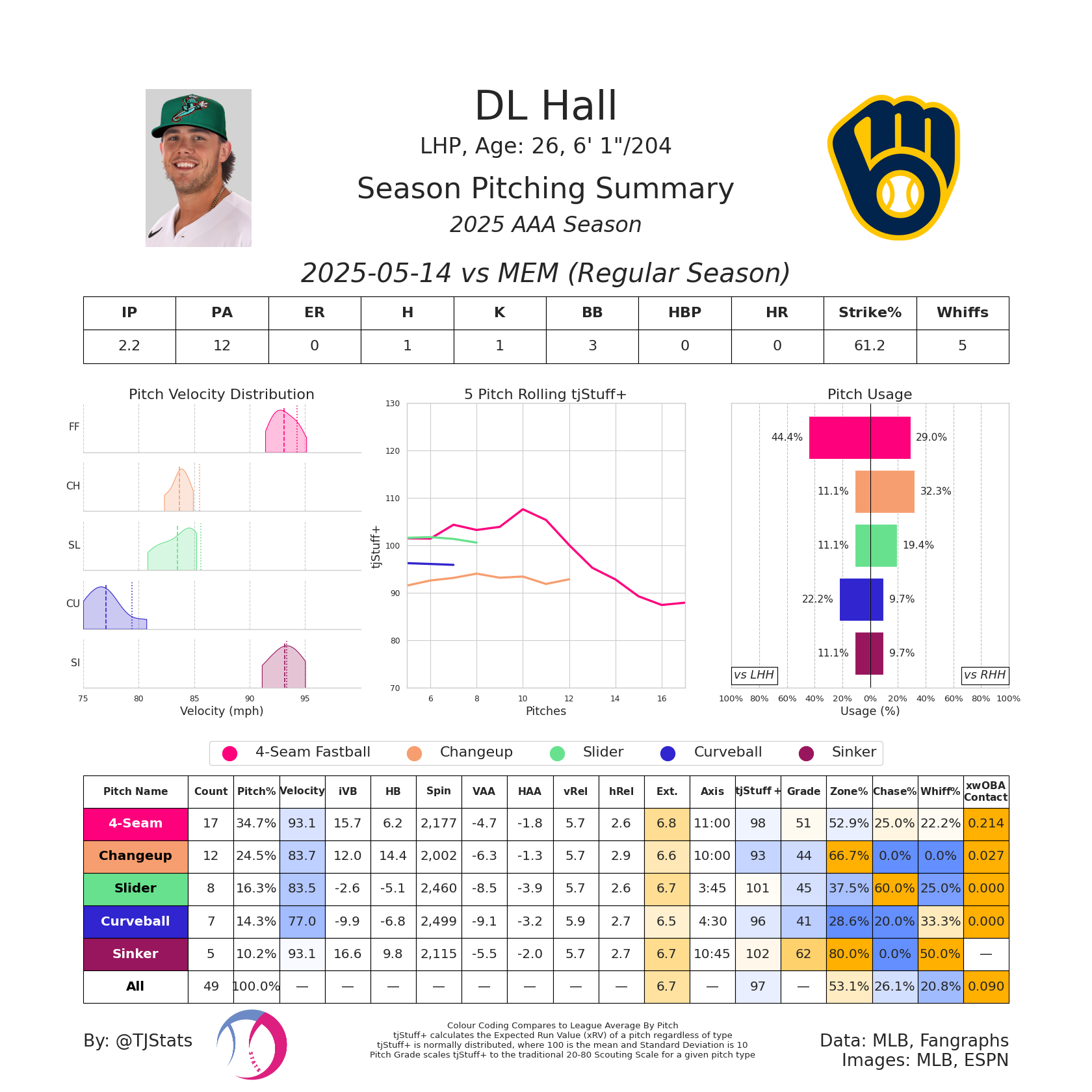
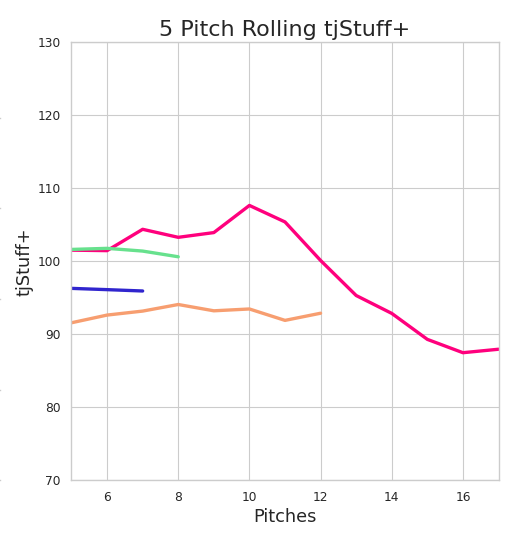
Couple of nuggets on Hall's start, early on the fastball looked excellent, sitting 94-95 and at one point topping 20" of induced vertical break. that's big time rising action. It did fade a little in the third inning, dropping down to the 91-92 mph range (some were misclassified as sinkers too) but on the whole a nice start for him in terms of pitch shapes. He was finding his groove with command, and threw everything in his arsenal with the apparent goal of just testing his stuff and command that targeting outs. You can see the rolling stuff+ from TJstats dip off quite severely in the third inning, but I've never seen Hall with a grade on the fastball as high as 108 over any rolling sample. If he can build up some stamina and longevity, this is the arm we hoped for in the Burnes trade. The questions odes remain whether this will dip if he's stretched out to go 70+ pitches, but certainly an encouraging start from a stuff perspective on the fastball which seems so key to his fortunes The bad news, the slider and curveball velocity were down by a few ticks. Hopefuly we'll see these sharpen up as he builds up, remember he didn't have a spring training and has been trying to replicate that in Arizona.
-
Image courtesy of © David Richard-Imagn Images Quinn Priester is a fascinating figure. A former top prospect with the Pittsburgh Pirates who hasn't yet found success in the major leagues, he also presents an interesting profile. Priester had pitched almost 100 innings in the majors before joining the Brewers, recording just 69 strikeouts and a whopping 41 walks in that time. He had an ERA of 6.23. Nonetheless, the Brewers felt comfortable trading one of the organization's top 10 prospects (Yophery Rodriguez); the 33rd pick in the 2025 MLB Draft; and their fifth-round pick from last year, pitcher John Holobetz, to get ahold of Priester. On the Milwaukee Journal-Sentinel Brewers podcast with host JR Radcliffe, guest and Brewers Weekly host Dom Cotroneo indicated the Brewers weren't as high on Rodriguez as some of the prospect rankings might suggest, but even so, that's a substantial outlay for a player yet to even establish himself as a bona fide big-league hurler. So what exactly did the Brewers see in Priester? Was it the improvements made within the Red Sox organization? Did they see some mechanical issues they felt they could smooth over, to unlock further potential? Let's take a look: The Red Sox Pitching Lab The Boston Red Sox acquired Priester for another former first-round pick, Nick Yorke, in 2024. Their primary focus was to add velocity to his fastballs, and they succeeded in doing so during the offseason: During the spring, that velocity showed up, adding a tick and a half to his entire arsenal—with corresponding boosts to his Stuff+ grades. The sinker, his primary pitch, is the most important beneficiary. There was also lots of talk about Priester developing a new cutter, but actually, it seems like more of a classification change from what was previously a very straight four-seam fastball. Since the trade, the Brewers have slowly reduced the cutter usage, leaning heavily on the sinker and its ground ball tendencies. They've made it clear that sinker is one of the main reasons for their interest in Priester, and I'll get to why in a moment. Comparing Priester's velocity in Triple A with the Red Sox to his more recent numbers, it seems the Red Sox also saw the cutter as more of a "get off the sinker" offering than a primary fastball. Whatever the reason, the velocity has steadily come back to the sort of range Priester was roaming in during 2023-24. Without that added gas, what exactly do the Brewers find so attractive? Is the sinker better than advertised? The cutter has been crushed, and they've adapted, primarily using the sinker and slider in recent starts (which have been his best)—as Brewer Fanatic beat reporter Jack Stern pointed out last night: The slider has returned some solid whiff rates, but the sinker, not so much. he hasn't been locating it well to get ahead in the count, and by Stuff+ metrics, it doesn't grade out well. Why, then, do the Brewers love it? Well, if you listened to the Brewer Fanatic Podcast last week, you may have a hint: The Dead Zone Jeremy Maschino has recently compiled a model that looks at the spin rate, direction and Magnus acceleration of a pitch. He's been able to assess the expected Magnus effect and movement of a pitch based on release point, extension, pitch type and initial trajectory, and use that as a basis to compare with the actual Magnus effect and movement of the pitch. A dead-zone pitch would be one that moves exactly as expected. To use Jeremy's words: I'll leave the nerdiness behind now. In this case, Quinn Priester's sinker is an absolute outlier: The shaded circles are the expected movement profile, while the clear circles are the actual movement. His sinker drops 3.6 ft/sec more than expected, giving him an extremely high possibility of keeping the ball on the ground if he can command it effectively. He also gets some additional drop on his gyro slider—another reason why Priester has a ground ball rate of 57.6%, something that should play up with the Brewers' stout defensive middle infield. There are two limiting factors for Priester at this point. His command, and the lack of a third pitch. There is, however, a blueprint for shoring up those weaknesses in a similar pitcher, and he's an elite arm. Is Logan Webb A Basis For Comparison? Logan Webb has a lower arm angle, but the expected movement on his sinker is similar to Priester's. He gets a little more added drop on the offering, but overall, you can see the potential here. The differentiating factors between Webb and hurlers like Priester are the very ones we named above: he's found a good third pitch, and he commands his whole arsenal well. Webb has perhaps the best command in the major leagues, pounding the strike zone with both his sinker and his sweeper to great effect. He can live in the heart of the zone with his sinker, unlike Priester, because of how his sweeper and changeup combine to keep hitters off balance, Both of those offerings generate strong whiff rates. A pitcher whose primary fastball is a sinker often finds a sweeper easier to pick up, due to the natural arm angle many sinkerballers throw from. That's also a reason why Logan Webb's induced vertical break on his sinker is a lot lower than Priester's, despite similar results. With Priester's higher arm slot, it could be argued that his slider is a viable alternative to the sweeper that Webb possesses, generating even slightly higher swing-and-miss rates (although he doesn't hit the strike zone as often). The big difference, then, is the changeup. If well-located, the changeup can coexist very well with the sinker, tunneling off it with similar initial trajectories but different speeds and eventual movement. The combination of the two leaves hitters in two minds, no longer able to sit on the fastball so easily, and can generate good chase and whiff rates as a result. The change is a fantastic put-away pitch for Webb, something Priester could certainly use (given his low strikeout rate). More importantly, it might mean he wouldn't have to nibble the edges of the strike zone, and could attack hitters more directly. The problem with Priester's changeup is the inconsistent delivery. At times, he's able to garner some really effective late drop on the pitch—more than expected, given the release, which suggests he's highly capable of throwing a strong off-speed pitch. There are other times, though, when it comes out hard and flat, with minimal break, and that's liable to run into damage. If he gets it right, you can see how far out in front the hitters are when targeting his sinker but getting the change: OTdXUmdfWGw0TUFRPT1fRGxCUkFWVUdVUVlBV2xFRlZBQUhCQWNBQUFOVVZWWUFCRlJVVVFJRFZ3UldVUUVG.mp4 So far, the movement is inconsistent, and Priester struggles both to kill spin and to sustain a sound differential between the velocities of his heater and his changeup. If he can eventually shore those weaknesses up, though, he could start using the whole zone better and give left-handed batters a much harder time. I mention this because left-handers crush Priester, with a .400 on-base percentage and .509 slugging average in 2025. Having that third offering that either allows his sinker to start on the inner third or middle of the plate and bore onto the outer third more effectively, or a slider that can generate called strikes at the bottom of the zone, could transform how Priester's pitch mix plays. Webb is just one template on whom the Brewers could model a remade Priester. One way or another, he needs to make some changes, but the trail he might follow has already been blazed. Many thanks to Thomas Nestico and Jeremy Maschino for allowing me to use their models. If you're a stats nerd like me, their subscriptions are entirely worthwhile via Patreon, at TJStats and Pitchprofiler. What do you think of the comparison for Logan Webb? Can you see the similarities in the profile? Or is it further away than one capable pitch in his arsenal? Let me know your thoughts in the comments below! View full article
-
 Quinn Priester is a fascinating figure. A former top prospect with the Pittsburgh Pirates who hasn't yet found success in the major leagues, he also presents an interesting profile. Priester had pitched almost 100 innings in the majors before joining the Brewers, recording just 69 strikeouts and a whopping 41 walks in that time. He had an ERA of 6.23. Nonetheless, the Brewers felt comfortable trading one of the organization's top 10 prospects (Yophery Rodriguez); the 33rd pick in the 2025 MLB Draft; and their fifth-round pick from last year, pitcher John Holobetz, to get ahold of Priester. On the Milwaukee Journal-Sentinel Brewers podcast with host JR Radcliffe, guest and Brewers Weekly host Dom Cotroneo indicated the Brewers weren't as high on Rodriguez as some of the prospect rankings might suggest, but even so, that's a substantial outlay for a player yet to even establish himself as a bona fide big-league hurler. So what exactly did the Brewers see in Priester? Was it the improvements made within the Red Sox organization? Did they see some mechanical issues they felt they could smooth over, to unlock further potential? Let's take a look: The Red Sox Pitching Lab The Boston Red Sox acquired Priester for another former first-round pick, Nick Yorke, in 2024. Their primary focus was to add velocity to his fastballs, and they succeeded in doing so during the offseason: During the spring, that velocity showed up, adding a tick and a half to his entire arsenal—with corresponding boosts to his Stuff+ grades. The sinker, his primary pitch, is the most important beneficiary. There was also lots of talk about Priester developing a new cutter, but actually, it seems like more of a classification change from what was previously a very straight four-seam fastball. Since the trade, the Brewers have slowly reduced the cutter usage, leaning heavily on the sinker and its ground ball tendencies. They've made it clear that sinker is one of the main reasons for their interest in Priester, and I'll get to why in a moment. Comparing Priester's velocity in Triple A with the Red Sox to his more recent numbers, it seems the Red Sox also saw the cutter as more of a "get off the sinker" offering than a primary fastball. Whatever the reason, the velocity has steadily come back to the sort of range Priester was roaming in during 2023-24. Without that added gas, what exactly do the Brewers find so attractive? Is the sinker better than advertised? The cutter has been crushed, and they've adapted, primarily using the sinker and slider in recent starts (which have been his best)—as Brewer Fanatic beat reporter Jack Stern pointed out last night: The slider has returned some solid whiff rates, but the sinker, not so much. he hasn't been locating it well to get ahead in the count, and by Stuff+ metrics, it doesn't grade out well. Why, then, do the Brewers love it? Well, if you listened to the Brewer Fanatic Podcast last week, you may have a hint: The Dead Zone Jeremy Maschino has recently compiled a model that looks at the spin rate, direction and Magnus acceleration of a pitch. He's been able to assess the expected Magnus effect and movement of a pitch based on release point, extension, pitch type and initial trajectory, and use that as a basis to compare with the actual Magnus effect and movement of the pitch. A dead-zone pitch would be one that moves exactly as expected. To use Jeremy's words: I'll leave the nerdiness behind now. In this case, Quinn Priester's sinker is an absolute outlier: The shaded circles are the expected movement profile, while the clear circles are the actual movement. His sinker drops 3.6 ft/sec more than expected, giving him an extremely high possibility of keeping the ball on the ground if he can command it effectively. He also gets some additional drop on his gyro slider—another reason why Priester has a ground ball rate of 57.6%, something that should play up with the Brewers' stout defensive middle infield. There are two limiting factors for Priester at this point. His command, and the lack of a third pitch. There is, however, a blueprint for shoring up those weaknesses in a similar pitcher, and he's an elite arm. Is Logan Webb A Basis For Comparison? Logan Webb has a lower arm angle, but the expected movement on his sinker is similar to Priester's. He gets a little more added drop on the offering, but overall, you can see the potential here. The differentiating factors between Webb and hurlers like Priester are the very ones we named above: he's found a good third pitch, and he commands his whole arsenal well. Webb has perhaps the best command in the major leagues, pounding the strike zone with both his sinker and his sweeper to great effect. He can live in the heart of the zone with his sinker, unlike Priester, because of how his sweeper and changeup combine to keep hitters off balance, Both of those offerings generate strong whiff rates. A pitcher whose primary fastball is a sinker often finds a sweeper easier to pick up, due to the natural arm angle many sinkerballers throw from. That's also a reason why Logan Webb's induced vertical break on his sinker is a lot lower than Priester's, despite similar results. With Priester's higher arm slot, it could be argued that his slider is a viable alternative to the sweeper that Webb possesses, generating even slightly higher swing-and-miss rates (although he doesn't hit the strike zone as often). The big difference, then, is the changeup. If well-located, the changeup can coexist very well with the sinker, tunneling off it with similar initial trajectories but different speeds and eventual movement. The combination of the two leaves hitters in two minds, no longer able to sit on the fastball so easily, and can generate good chase and whiff rates as a result. The change is a fantastic put-away pitch for Webb, something Priester could certainly use (given his low strikeout rate). More importantly, it might mean he wouldn't have to nibble the edges of the strike zone, and could attack hitters more directly. The problem with Priester's changeup is the inconsistent delivery. At times, he's able to garner some really effective late drop on the pitch—more than expected, given the release, which suggests he's highly capable of throwing a strong off-speed pitch. There are other times, though, when it comes out hard and flat, with minimal break, and that's liable to run into damage. If he gets it right, you can see how far out in front the hitters are when targeting his sinker but getting the change: OTdXUmdfWGw0TUFRPT1fRGxCUkFWVUdVUVlBV2xFRlZBQUhCQWNBQUFOVVZWWUFCRlJVVVFJRFZ3UldVUUVG.mp4 So far, the movement is inconsistent, and Priester struggles both to kill spin and to sustain a sound differential between the velocities of his heater and his changeup. If he can eventually shore those weaknesses up, though, he could start using the whole zone better and give left-handed batters a much harder time. I mention this because left-handers crush Priester, with a .400 on-base percentage and .509 slugging average in 2025. Having that third offering that either allows his sinker to start on the inner third or middle of the plate and bore onto the outer third more effectively, or a slider that can generate called strikes at the bottom of the zone, could transform how Priester's pitch mix plays. Webb is just one template on whom the Brewers could model a remade Priester. One way or another, he needs to make some changes, but the trail he might follow has already been blazed. Many thanks to Thomas Nestico and Jeremy Maschino for allowing me to use their models. If you're a stats nerd like me, their subscriptions are entirely worthwhile via Patreon, at TJStats and Pitchprofiler. What do you think of the comparison for Logan Webb? Can you see the similarities in the profile? Or is it further away than one capable pitch in his arsenal? Let me know your thoughts in the comments below!
 -
Even more impressive, Mercedes home run was at least to a bona fide big name bat in that class. Emil Morales has an 1.169 OPS on the DSL last season with 14 home runs in 152 at bats
-
Looking at what the Angels have done, it very possibly could. Confidence is a huge thing at the big league level and a horrible start (which both are likely for and unprepared to face that level of competition) would likely set them back even from 2026 in reaching their peak performance. Barring a hot 6 weeks, it's tough to argue with this. I kind of feel the same, I'd rather it be a competitive year but there's not that much on the market and we can see the next wave coming through
-
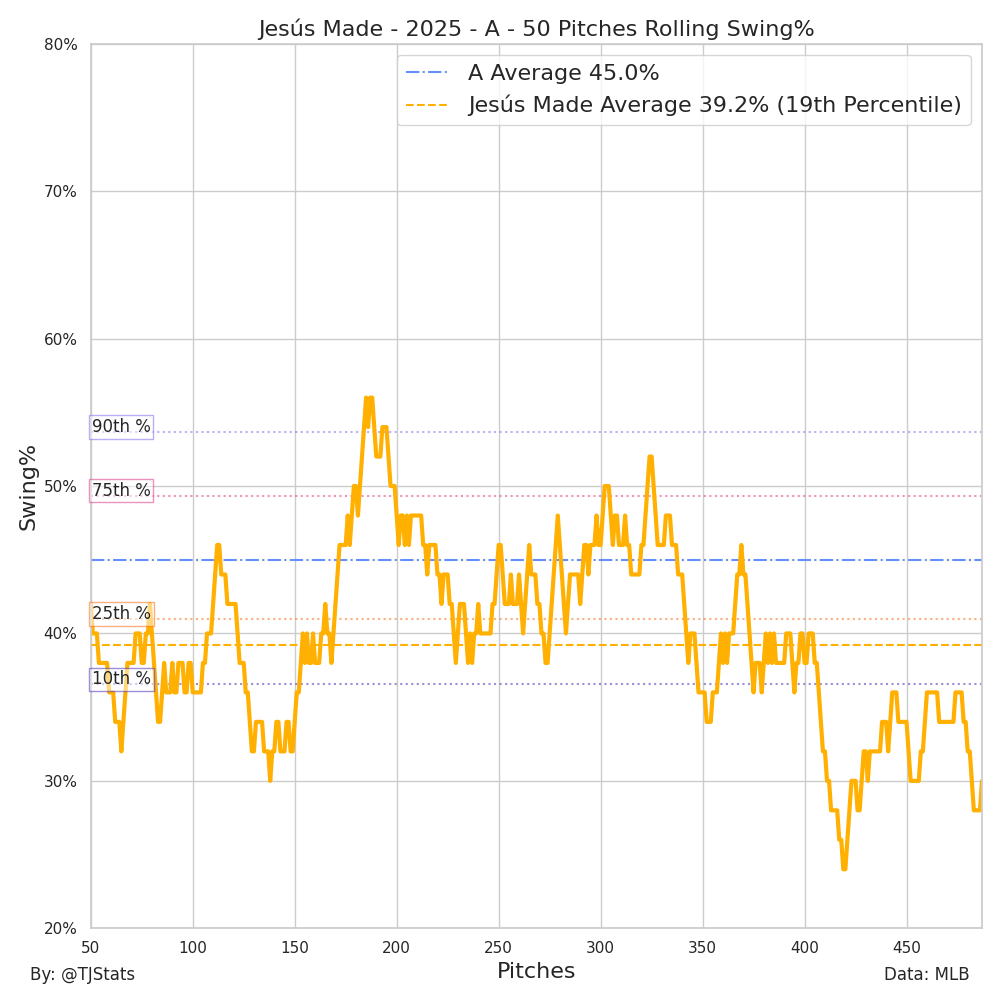
One thing to potentially watch for from Jesus Made is he hasn't been getting the bat off his shoulder an awful lot. He's not Luke Adams, but he hasn't been aggressive either and It's trending downwards of late towards that Adams/Wilken level
-
He actually may have gotten some playing time in the outfield as things stand, but unfortunately the broken hamate bone has kept him on the IL for a while to begin the season. He might be back in Triple A over the next couple of weeks all being well, but obviously isn;t in the conversation until then. He probably also needs to show a higher ceiling for offensive output in a team full of dinkers and dribblers when he returns, and being left handed when Yelich, Frelick and Chourio are the incumbent starters isn't ideal. That's the very short form version at least Sal Frelick currently grades as the 7th worst outfielder in baseball per defensive runs saved. Using savant metrics, which have him more on a level pegging: It seems like the initial jump hasn't been great with slow reactions compared to 2024. Likely to even out somewhat, but I don't think he's been as sharp to being this year either defensively

- 14 replies
-
- 1
-
-
- brock wilken
- cooper pratt
- (and 2 more)
-
Image courtesy of © Dave Kallmann / Milwaukee Journal Sentinel / USA TODAY NETWORK via Imagn Images The Milwaukee Brewers have a problem on the left side of their infield. It was an area of major concern coming into the season, where the front office hoped for a solid season from Joey Ortiz and passable offensive production from Oliver Dunn and Caleb Durbin to manage this season. That hasn't played out so far, with the Brewers placing dead last at a 26 WRC+ from third base, and 29th out of 30 teams with a 31 WRC+ at shortstop. Having two such black holes at the back of a lineup (that isn't blowing off the roof at the top, either) creates myriad offensive problems. It's beginning to look like the Brewers need some external help, if they want to compete in 2025. Internally, the next cab off the rank at Triple A is likely to be Bobby Dalbec, and while he has some thump, he hasn't been able to hit enough at the big-league level to make that count, with a slash line of .199/.272/.328 in 520 plate appearances since the start of 2022. The problem the Brewers have (perhaps it's just a "problem," really, but it's a thing) is that from Double-A Biloxi on down, the talent occupying the left side of the infield is tantalizing. Brock Wilken has rediscovered his form early this season, increasing his swing rate as the season has progressed and slashing .382/.476/.912 in May, with five home runs and a 23.8% strikeout rate. Note: all of this is occurring in one of the toughest offensive environments in pro baseball, the Southern League. Wilken's defensive action and range have improved markedly since entering the Brewers system, and after a lost season in 2024, he seems to be regaining some of his first-round draft pedigree. Pairing solid defense with on-base skills and some heavy raw thump would be a sight for sore eyes on this Brewers team. Even more highly coveted is shortstop Cooper Pratt. Defensively superb at shortstop, Pratt is just 20 years old and sporting a 13.4% strikeout rate to a 9% walk rate in Double A. A very young player for the level, Pratt hasn't shown the same thump as Wilken, but has considerable polish at the plate. He's demonstrated good swing decisions and an ability to get into his pull side for some power. Sporting a 109 WRC+, Pratt was recently rated as high at Baseball America's No. 28 prospect in all of baseball, with the chance of more power still to come from the 2023 draftee. The timeline for Wilken and Pratt is likely to be 2026, with both expected to reach Triple A at some point this season. It's possible Wilken could go on a tear and force his way into conversations by September, but 2026 seems a more realistic timeline for both. The real chance that at least one of these two, or possibly both, could be there next Opening Day leaves the Brewers in somewhat of a bind, especially when you consider that Mike Boeve and Luke Adams may also be at the highest level of the minors by that point. When you think of the emergency Willy Adames trade made in 2021, the Brewers didn't make a splash on a one-year rental. Mark Attanasio and Matt Arnold have both talked about the need to balance winning now and winning in the future, with an even priority between them. It's the same situation as the Quinn Priester trade, where the Brewers saw something they could mold and benefit from over a number of years. They don't make big trades for one-year rentals. If the Brewers are as high on Pratt as the rest of the league, while Wilken continues to flourish, they mightn't feel the need to upgrade significantly on the left side of their infield. They'll hope for some bounce-back from Joey Ortiz, who just shouldn't be producing at his current level with the sheer talent he possesses; and that one of their two infield talents can break with the team next season. The cost of acquiring another shortstop blocked or squeezed on their current depth chart—such as a Jordan Lawlar, Marcelo Mayer or Alex Freeland—would be extortionate. Instead, to make full use of the farm system coming through with Wilken and Pratt in 2026 (accompanied by a wave of talent, in Josh Adamczewski, Eric Bitonti, Jésus Made and Luis Peña the following year). the Brewers might deploy their resources elsewhere this trade deadline. In an ideal world, Brock Wilken would be at Triple A already, having never suffered a fractured orbital bone in his face and without the accompanying eyesight issues that followed. He would be closing in on a promotion, and the wave of talent behind would flow seamlessly in tow. Alas, that's not how it's panned out, and the question becomes whether the Brewers are tempted to throw some chips into this 2025 season, or if their poor start and general malaise have left the front office reluctant to spend on a rental bat that may have little-to-no impact on their overall ability to even reach the playoffs. Instead, Durbin (who looks more like a utility player than an everyday starter) is garnering a lot of reps at the hot corner, while Ortiz is working his way through timing issues with a shortened leg kick. For the production provided, both are being given a lot of leeway simply because there isn't anyone better to fill those roles. With a loaded farm system, the timeline for the Brewers has reached an awkward point. Consistently intent on competing year in and year out for the playoffs, their third base and shortstop positions have left much to be desired. Reinforcements are coming, but not rapidly enough to assist in 2025. How should the Brewers address the situation? let us know your thoughts in the comments below! View full article
-
 The Milwaukee Brewers have a problem on the left side of their infield. It was an area of major concern coming into the season, where the front office hoped for a solid season from Joey Ortiz and passable offensive production from Oliver Dunn and Caleb Durbin to manage this season. That hasn't played out so far, with the Brewers placing dead last at a 26 WRC+ from third base, and 29th out of 30 teams with a 31 WRC+ at shortstop. Having two such black holes at the back of a lineup (that isn't blowing off the roof at the top, either) creates myriad offensive problems. It's beginning to look like the Brewers need some external help, if they want to compete in 2025. Internally, the next cab off the rank at Triple A is likely to be Bobby Dalbec, and while he has some thump, he hasn't been able to hit enough at the big-league level to make that count, with a slash line of .199/.272/.328 in 520 plate appearances since the start of 2022. The problem the Brewers have (perhaps it's just a "problem," really, but it's a thing) is that from Double-A Biloxi on down, the talent occupying the left side of the infield is tantalizing. Brock Wilken has rediscovered his form early this season, increasing his swing rate as the season has progressed and slashing .382/.476/.912 in May, with five home runs and a 23.8% strikeout rate. Note: all of this is occurring in one of the toughest offensive environments in pro baseball, the Southern League. Wilken's defensive action and range have improved markedly since entering the Brewers system, and after a lost season in 2024, he seems to be regaining some of his first-round draft pedigree. Pairing solid defense with on-base skills and some heavy raw thump would be a sight for sore eyes on this Brewers team. Even more highly coveted is shortstop Cooper Pratt. Defensively superb at shortstop, Pratt is just 20 years old and sporting a 13.4% strikeout rate to a 9% walk rate in Double A. A very young player for the level, Pratt hasn't shown the same thump as Wilken, but has considerable polish at the plate. He's demonstrated good swing decisions and an ability to get into his pull side for some power. Sporting a 109 WRC+, Pratt was recently rated as high at Baseball America's No. 28 prospect in all of baseball, with the chance of more power still to come from the 2023 draftee. The timeline for Wilken and Pratt is likely to be 2026, with both expected to reach Triple A at some point this season. It's possible Wilken could go on a tear and force his way into conversations by September, but 2026 seems a more realistic timeline for both. The real chance that at least one of these two, or possibly both, could be there next Opening Day leaves the Brewers in somewhat of a bind, especially when you consider that Mike Boeve and Luke Adams may also be at the highest level of the minors by that point. When you think of the emergency Willy Adames trade made in 2021, the Brewers didn't make a splash on a one-year rental. Mark Attanasio and Matt Arnold have both talked about the need to balance winning now and winning in the future, with an even priority between them. It's the same situation as the Quinn Priester trade, where the Brewers saw something they could mold and benefit from over a number of years. They don't make big trades for one-year rentals. If the Brewers are as high on Pratt as the rest of the league, while Wilken continues to flourish, they mightn't feel the need to upgrade significantly on the left side of their infield. They'll hope for some bounce-back from Joey Ortiz, who just shouldn't be producing at his current level with the sheer talent he possesses; and that one of their two infield talents can break with the team next season. The cost of acquiring another shortstop blocked or squeezed on their current depth chart—such as a Jordan Lawlar, Marcelo Mayer or Alex Freeland—would be extortionate. Instead, to make full use of the farm system coming through with Wilken and Pratt in 2026 (accompanied by a wave of talent, in Josh Adamczewski, Eric Bitonti, Jésus Made and Luis Peña the following year). the Brewers might deploy their resources elsewhere this trade deadline. In an ideal world, Brock Wilken would be at Triple A already, having never suffered a fractured orbital bone in his face and without the accompanying eyesight issues that followed. He would be closing in on a promotion, and the wave of talent behind would flow seamlessly in tow. Alas, that's not how it's panned out, and the question becomes whether the Brewers are tempted to throw some chips into this 2025 season, or if their poor start and general malaise have left the front office reluctant to spend on a rental bat that may have little-to-no impact on their overall ability to even reach the playoffs. Instead, Durbin (who looks more like a utility player than an everyday starter) is garnering a lot of reps at the hot corner, while Ortiz is working his way through timing issues with a shortened leg kick. For the production provided, both are being given a lot of leeway simply because there isn't anyone better to fill those roles. With a loaded farm system, the timeline for the Brewers has reached an awkward point. Consistently intent on competing year in and year out for the playoffs, their third base and shortstop positions have left much to be desired. Reinforcements are coming, but not rapidly enough to assist in 2025. How should the Brewers address the situation? let us know your thoughts in the comments below!
- 14 comments
-
- 1
-
-
- brock wilken
- cooper pratt
- (and 2 more)
-
Image courtesy of © Kamil Krzaczynski-Imagn Images Right now, the Brewers could really use an arm like Shane Smith's. The Rule 5 Draft pick is dominating for the Chicago White Sox. His fastball was at the heart of the Crew's decision to leave him unprotected last fall, with its lack of "rise" culminating in a pitch many considered to be "dead-zone". It turns out that may not be the case, and the pitch shape is markedly different from what we expected. Rolling back to November 2024, the Brewers' 40-man roster had several arms that were just barely clinging onto their spots. Tyler Jay was perhaps in the most perilous position, as seen when he was later designated for assignment, while they left a 40-man spot open and eventually spent it on Connor Thomas, their own Rule 5 Draft selection. They also added Logan Henderson and Chad Patrick, two decisions that have proved astute—but they left Smith open to pilfering. Smith had only begun to stretch out as a starter in 2024, after some dominant relief outings in 2023. With injury woes to begin his professional career, the Brewers didn't have a lot of in-game action for Smith as an undrafted free agent signing out of Wake Forest in 2021. His mid-90s fastball was blowing past hitters, while his curveball was a wipeout offering. There was a suspicion that while Smith was performing well with Double-A Biloxi, perhaps the strangled offensive environment of the Southern League was prettying up his results—and that the fastball would get hit hard when he moved up levels. This was, after all, his first season stretching out with the Brewers. In fact, at Double A, many teams would have been wary of Smith's lack of track record and (at least on the surface) the absence of a strong primary offering. Perhaps the transfer of one Walker McKinven to the White Sox assisted them in this; perhaps they saw the mechanics that would allow them to develop the kick changeup that has been so pivotal to his success in the big leagues so far. Either way, the White Sox took him first in the Rule 5 and haven't looked back. Let's look below at just how well Smith's pitches have played (Including the fastball): As I alluded to, Smith's fastball was considered an offering that would struggle as he moved up the ranks. That hasn't quite proven to be the case. Although it has been squared up at times, the damage has been well contained. Sporting a 2.08 ERA and 3.05 FIP across 38 1/3 innings with 1.5 WAR early this season, Smith has been an unmitigated success for the White Sox, while the Brewers were forced to splurge on Quinn Priester, at the cost of some of their outfield depth in the farm system and their 33rd pick in the 2025 MLB Draft. We have a tendency with four-seam fastballs to look at the vertical profile of the pitch, and to ignore or downplay the horizontal break. It's in the latter dimension where Smith differentiates himself. His fastball cuts glove-side more than you would expect, which has been key in avoiding barrels in 2025: Let me explain the graph above a little. Jeremy Maschino of PitchProfiler.com has created a model that shows the expected movement profile of an arsenal (the shaded zones), compared to its actual movement (the clear circles) to assess how that movement deviates from expectation based on arm angle, release point, spin, etc., and if that has an impact on deceiving hitters. Smith has a slightly lower three-quarters arm slot at 34°, meaning that he's expected to generate more run than ride on his fastball naturally. While the ride is as expected, Smith's fastball actually doesn't break horizontally as much as expected, therefore staying in on the hands of lefties and just keeping off the barrel of the bat. It's more of a cut-ride fastball, in the mold of the Cubs' development with the likes of Justin Steele and Cade Horton. That shape is even more unusual, based on the arm angle. You can also see the rise he gets on his sweeper, as well as the increased drop on both his curveball and kick-change. That creates an interesting profile, wherein he can stay both above or below bats, compared to the expected movement. The key question was always whether the fastball could play in the major leagues, and it seems (thus far) that it can. It's not an elite offering, but it can survive and allow the rest of his arsenal to thrive in tandem with it. The other reason for his success is the supreme command Smith has of his primary offering. His location grade (again per the diagram from Pitch Profiler) is above average, and his overall mix accompanying that fastball has given it a proPitching+ grade of 107, where 100 is average. Despite not having the best movement profile on his fastball, the combination of his location and the full arsenal he has makes it a strong offering: The other factor the Brewers appear to have overlooked is the bulldog in Smith. He was an undrafted free agent recovering from Tommy John surgery when they brought him aboard. He went from a reliever to starting games for the Brewers in 2024 with aplomb. He had shown adaptability and success at every stage for the Brewers, despite some of the queries over his stuff. It seems the Brewers underestimated the extent and transferability of that resilience. The Brewers may have hoped that Smith went under the radar, given his limited time in a starting role and concern over his injury history, as well as some misjudgment over his fastball shape. It's unlikely they themselves missed this, but perhaps they hoped other organizations would. However their logic was formed, the results are currently speaking for themselves. It's becoming clearer with each start that the Brewers made a mistake with Smith. It may have cost them dearly in prospect capital, with John Holobetz added to Yophery Rodriguez and the No. 33 pick in the 2025 MLB Draft. Pitching depth has already been a minor problem for them this year, and if Smith continues pitching like this, the Brewers will rue the choice to spend a roster spot on Jay and/or Thomas instead of him for years to come. View full article
-
 Right now, the Brewers could really use an arm like Shane Smith's. The Rule 5 Draft pick is dominating for the Chicago White Sox. His fastball was at the heart of the Crew's decision to leave him unprotected last fall, with its lack of "rise" culminating in a pitch many considered to be "dead-zone". It turns out that may not be the case, and the pitch shape is markedly different from what we expected. Rolling back to November 2024, the Brewers' 40-man roster had several arms that were just barely clinging onto their spots. Tyler Jay was perhaps in the most perilous position, as seen when he was later designated for assignment, while they left a 40-man spot open and eventually spent it on Connor Thomas, their own Rule 5 Draft selection. They also added Logan Henderson and Chad Patrick, two decisions that have proved astute—but they left Smith open to pilfering. Smith had only begun to stretch out as a starter in 2024, after some dominant relief outings in 2023. With injury woes to begin his professional career, the Brewers didn't have a lot of in-game action for Smith as an undrafted free agent signing out of Wake Forest in 2021. His mid-90s fastball was blowing past hitters, while his curveball was a wipeout offering. There was a suspicion that while Smith was performing well with Double-A Biloxi, perhaps the strangled offensive environment of the Southern League was prettying up his results—and that the fastball would get hit hard when he moved up levels. This was, after all, his first season stretching out with the Brewers. In fact, at Double A, many teams would have been wary of Smith's lack of track record and (at least on the surface) the absence of a strong primary offering. Perhaps the transfer of one Walker McKinven to the White Sox assisted them in this; perhaps they saw the mechanics that would allow them to develop the kick changeup that has been so pivotal to his success in the big leagues so far. Either way, the White Sox took him first in the Rule 5 and haven't looked back. Let's look below at just how well Smith's pitches have played (Including the fastball): As I alluded to, Smith's fastball was considered an offering that would struggle as he moved up the ranks. That hasn't quite proven to be the case. Although it has been squared up at times, the damage has been well contained. Sporting a 2.08 ERA and 3.05 FIP across 38 1/3 innings with 1.5 WAR early this season, Smith has been an unmitigated success for the White Sox, while the Brewers were forced to splurge on Quinn Priester, at the cost of some of their outfield depth in the farm system and their 33rd pick in the 2025 MLB Draft. We have a tendency with four-seam fastballs to look at the vertical profile of the pitch, and to ignore or downplay the horizontal break. It's in the latter dimension where Smith differentiates himself. His fastball cuts glove-side more than you would expect, which has been key in avoiding barrels in 2025: Let me explain the graph above a little. Jeremy Maschino of PitchProfiler.com has created a model that shows the expected movement profile of an arsenal (the shaded zones), compared to its actual movement (the clear circles) to assess how that movement deviates from expectation based on arm angle, release point, spin, etc., and if that has an impact on deceiving hitters. Smith has a slightly lower three-quarters arm slot at 34°, meaning that he's expected to generate more run than ride on his fastball naturally. While the ride is as expected, Smith's fastball actually doesn't break horizontally as much as expected, therefore staying in on the hands of lefties and just keeping off the barrel of the bat. It's more of a cut-ride fastball, in the mold of the Cubs' development with the likes of Justin Steele and Cade Horton. That shape is even more unusual, based on the arm angle. You can also see the rise he gets on his sweeper, as well as the increased drop on both his curveball and kick-change. That creates an interesting profile, wherein he can stay both above or below bats, compared to the expected movement. The key question was always whether the fastball could play in the major leagues, and it seems (thus far) that it can. It's not an elite offering, but it can survive and allow the rest of his arsenal to thrive in tandem with it. The other reason for his success is the supreme command Smith has of his primary offering. His location grade (again per the diagram from Pitch Profiler) is above average, and his overall mix accompanying that fastball has given it a proPitching+ grade of 107, where 100 is average. Despite not having the best movement profile on his fastball, the combination of his location and the full arsenal he has makes it a strong offering: The other factor the Brewers appear to have overlooked is the bulldog in Smith. He was an undrafted free agent recovering from Tommy John surgery when they brought him aboard. He went from a reliever to starting games for the Brewers in 2024 with aplomb. He had shown adaptability and success at every stage for the Brewers, despite some of the queries over his stuff. It seems the Brewers underestimated the extent and transferability of that resilience. The Brewers may have hoped that Smith went under the radar, given his limited time in a starting role and concern over his injury history, as well as some misjudgment over his fastball shape. It's unlikely they themselves missed this, but perhaps they hoped other organizations would. However their logic was formed, the results are currently speaking for themselves. It's becoming clearer with each start that the Brewers made a mistake with Smith. It may have cost them dearly in prospect capital, with John Holobetz added to Yophery Rodriguez and the No. 33 pick in the 2025 MLB Draft. Pitching depth has already been a minor problem for them this year, and if Smith continues pitching like this, the Brewers will rue the choice to spend a roster spot on Jay and/or Thomas instead of him for years to come.