



Jake McKibbin
-
Posts
2,395 -
Joined
-
Last visited
-
Days Won
6
Content Type
Profiles
Forums
Blogs
Events
News
2026 Milwaukee Brewers Top Prospects Ranking
Milwaukee Brewers Videos
2022 Milwaukee Brewers Draft Picks
Milwaukee Brewers Free Agent & Trade Rumors, Notes, & Tidbits
Guides & Resources
2023 Milwaukee Brewers Draft Picks
2024 Milwaukee Brewers Draft Picks
The Milwaukee Brewers Players Project
2025 Milwaukee Brewers Draft Pick Tracker
2026 Milwaukee Brewers Draft Tracker: Picks & Bonuses
Store
Downloads
Gallery
Everything posted by Jake McKibbin
-
Sun. 5/11 - Do it for All the Mom's, Woody!
Jake McKibbin replied to Jim Goulart's topic in Brewers Minor League Talk
Really like how you've broken this down! Two fascinating things stand out. First of all, Wilken is both incredibly passive before two strikes with just a 32.2% swing rate, an a high whiff rate in those counts, swinging and missing almost a third of the time. He also seems to be very comfortable backing his two strike approach, cutting down the swing and miss to an 81.5% contact rate overall even with the increased swing rate -
Image courtesy of © Patrick Gorski-Imagn Images The Milwaukee Brewers' attendance figures have consistently been strong, ranking in the top half of baseball of occupancy rates in 2024 (13th, 75%) despite playing in the smallest market in the majors. The fanbase has maintained a strong connection to their club, heightened particularly in 2018 and 2019—wherein attendance surpassed 35,000 and 36,000 per game, respectively. The fans adored the offensive barrage produced by the likes of Mike Moustakas, Travis Shaw, Yasmani Grandal, and Lorenzo Cain, but most important was the appearance of a superstar: Christian Yelich. Yelich was undoubtedly the best player in the National League during that two-year stretch. I remember my first time visiting Milwaukee in 2019, seeing every other kid with a pinstriped 22 jersey on his back. Between Yelich And Giannis Antetokounmpo, the sports scene in Milwaukee was buzzing. The pandemic certainly had an impact on sporting numbers across the board, particularly in 2021. The Brewers rebounded somewhat in 2022-24, averaging a little under 31,000 per game in that time period. Competitive baseball was still front and center in Milwaukee, but they missed the offensive buzz and perhaps the superstar performances of Yelich in his prime. It was an era predicated on dominant pitching from the trio of Corbin Burnes, Brandon Woodruff and Freddy Peralta, alongside a shutdown relief corps led by Josh Hader and Devin Williams. As electric as the pitching was, fans perhaps craved the offensive firepower from the turn of the decade, and resented the tightening of purses that inevitably happened post-pandemic. This season has started alarmingly. Average attendance across 19 games so far this season has dipped to 26,517. That's a big loss, of almost 5,000 fans per game. For a team that operates in such a small market, gate receipts are a pivotal source of funds for the Brewers. Let's put that in the context of some financial outcomes. The average ticket is roughly $45, meaning the loss of ~5,000 seats per game over 81 games comes to over $18 million in possible lost revenue. That doesn't include the concessions purchased in the stadium, on which the Brewers would have a tidy markup as well, nor the effect this can have on all sorts of negotiations regarding advertising and stadium rights that occur in the future. Lower visibility equals lower revenue. The Brewers already operate with a tight payroll. To take what is possibly close to $20 million off of it would leave them close to the $90-million range (like the Pittsburgh Pirates and the Tampa Bay Rays), rather than the $115-million range with the Washington Nationals and Cincinnati Reds. It would be akin to taking Rhys Hoskins out of this lineup and replacing him internally on a pre-arbitration contract. That's not to say they can't replace things internally, but the Brewers can ill afford to lose their available funds of money to acquire free agents in their competitive windows. Above are the top 12 teams for lost attendance thus far in 2025. The Brewers rank 8th in average attendance per game lost, as well as the change in occupation rate (taking into account the overall size of the stadium). However, they actually rank, in terms of average attendance, exactly where they did in 2024. The company of those who have lost such high levels of fans is an ignominious one. Being associated with teams whose fanbases feel kicked in the teeth at the lack of investment they've had—such as the Minnesota Twins, St. Louis Cardinals (who have confessed to a rebuild year), Seattle Mariners, Colorado Rockies, Toronto Blue Jays, Pittsburgh Pirates and the Baltimore Orioles. The Tampa Bay Rays can be excused, as they've been hamstrung by a smaller stadium. Most of these teams' fanbases feel they have the ability to compete for the playoffs, but haven't had the investment and backing to make that final leap. The one who stands out is the Cleveland Guardians, who currently sit 20-14 in the AL Central and have tons of exciting players, from Emmanuel Clase, José Ramírez, Kyle Manzardo, and Steven Kwan to newer faces like Daniel Schneeman and late-blooming breakouts like Gabriel Arias. Yet, their success is predicated upon the strength of their bullpen, with starting pitching not going deep into games and no one really taking the league by storm offensively. They do have a disconnection with their ownership group, the Dolans being quite unpopular due to continual underinvestment in their franchise. They have opportunities to invest more on occasion and have rarely done so, leading to levels of apathy that far exceed what even the most fervent group of Mark Attanasio dissenters would conjure up. The Guardians are very similar to the Brewers' template, winning around the margins while bigger markets hunt the bigger, sexier fish in the pond. The truth is, winning games the ugly way by bunting, scrapping, fighting out infield singles and with limited home run output isn't sexy. It doesn't get fans out of their seats, until the latter innings of a tight game. Most of all, it's having an impact on attendance. This could be counteracted by a few things. First of all, Yelich can still hit dingers, although he is trying to rediscover consistent timing in his swing. Jackson Chourio, if he could learn to work his at-bats and be a more consistent threat to both get on base and force pitchers into his damage zones, could lift off. Several times in 2024, William Contreras went berserk for a month or more. These three hitters could ignite a fire in the Brewers' fandom if they can click, and marry that performance with wins. Winning baseball is truly the best way to bring fans to the stadium. It isn't the be-all and end-all, but it has a big impact, and the 2025 Brewers haven't been winning games as the fans have come to expect. One other potentially important factor is the weather in April. Far less of a factor in the LA teams, but certainly prevalent on the Northern border, cold temperatures, high winds and heavy rain are not the type of weather that encourages a fan to want to hang out at a baseball game, roof or no. The summer is key for the Brewers in this regard, and as an example, this is hitting the Chicago Cubs, too. Having the most explosive offense to date, bolstered by the signing of Kyle Tucker and Carson Kelly (alongside the breakout of the blue-haired freak, in Pete Crow-Armstrong), you would anticipate attendance to be on the rise for the Cubs early in April. They have a 22-14 record and are averaging over six runs per game. In fact, Wrigley Field has seen attendance slightly drop from its average numbers in 2025. They don't have a roof, and are completely exposed to the cold weather, which makes any rebound in the summer likely to be larger than that of the Brewers in American Family Field. They're also less than 1,000 per game down from their 2024 levels, a stark difference from the Brewers. You'll also note a northern theme in those cities with the biggest attendance drop vs. their full-season average of 2024. Toronto, Cleveland, Cincinnati, Seattle, Minnesota, Baltimore, Pittsburgh: These are not cities that are known for their glorious April weather. If the Brewers want to maximise their connection with the fans, and bring a greater atmosphere to the ballpark with the hordes, they're going to require something to put some spark into the team. There are several ways this may happen: An offensive outpouring from the heart of their lineup A big trade to sort the left side of their infield Young, high-ceiling talent from their farm system Some warm weather as we come into the summer Fans crave fresh. They crave new. They crave exciting. They crave success. And they adore a nice summer's day. The Brewers have lacked all five early on in 2025, and Mark Attanasio will be well aware of the financial repercussions should this continue. View full article
-
 The Milwaukee Brewers' attendance figures have consistently been strong, ranking in the top half of baseball of occupancy rates in 2024 (13th, 75%) despite playing in the smallest market in the majors. The fanbase has maintained a strong connection to their club, heightened particularly in 2018 and 2019—wherein attendance surpassed 35,000 and 36,000 per game, respectively. The fans adored the offensive barrage produced by the likes of Mike Moustakas, Travis Shaw, Yasmani Grandal, and Lorenzo Cain, but most important was the appearance of a superstar: Christian Yelich. Yelich was undoubtedly the best player in the National League during that two-year stretch. I remember my first time visiting Milwaukee in 2019, seeing every other kid with a pinstriped 22 jersey on his back. Between Yelich And Giannis Antetokounmpo, the sports scene in Milwaukee was buzzing. The pandemic certainly had an impact on sporting numbers across the board, particularly in 2021. The Brewers rebounded somewhat in 2022-24, averaging a little under 31,000 per game in that time period. Competitive baseball was still front and center in Milwaukee, but they missed the offensive buzz and perhaps the superstar performances of Yelich in his prime. It was an era predicated on dominant pitching from the trio of Corbin Burnes, Brandon Woodruff and Freddy Peralta, alongside a shutdown relief corps led by Josh Hader and Devin Williams. As electric as the pitching was, fans perhaps craved the offensive firepower from the turn of the decade, and resented the tightening of purses that inevitably happened post-pandemic. This season has started alarmingly. Average attendance across 19 games so far this season has dipped to 26,517. That's a big loss, of almost 5,000 fans per game. For a team that operates in such a small market, gate receipts are a pivotal source of funds for the Brewers. Let's put that in the context of some financial outcomes. The average ticket is roughly $45, meaning the loss of ~5,000 seats per game over 81 games comes to over $18 million in possible lost revenue. That doesn't include the concessions purchased in the stadium, on which the Brewers would have a tidy markup as well, nor the effect this can have on all sorts of negotiations regarding advertising and stadium rights that occur in the future. Lower visibility equals lower revenue. The Brewers already operate with a tight payroll. To take what is possibly close to $20 million off of it would leave them close to the $90-million range (like the Pittsburgh Pirates and the Tampa Bay Rays), rather than the $115-million range with the Washington Nationals and Cincinnati Reds. It would be akin to taking Rhys Hoskins out of this lineup and replacing him internally on a pre-arbitration contract. That's not to say they can't replace things internally, but the Brewers can ill afford to lose their available funds of money to acquire free agents in their competitive windows. Above are the top 12 teams for lost attendance thus far in 2025. The Brewers rank 8th in average attendance per game lost, as well as the change in occupation rate (taking into account the overall size of the stadium). However, they actually rank, in terms of average attendance, exactly where they did in 2024. The company of those who have lost such high levels of fans is an ignominious one. Being associated with teams whose fanbases feel kicked in the teeth at the lack of investment they've had—such as the Minnesota Twins, St. Louis Cardinals (who have confessed to a rebuild year), Seattle Mariners, Colorado Rockies, Toronto Blue Jays, Pittsburgh Pirates and the Baltimore Orioles. The Tampa Bay Rays can be excused, as they've been hamstrung by a smaller stadium. Most of these teams' fanbases feel they have the ability to compete for the playoffs, but haven't had the investment and backing to make that final leap. The one who stands out is the Cleveland Guardians, who currently sit 20-14 in the AL Central and have tons of exciting players, from Emmanuel Clase, José Ramírez, Kyle Manzardo, and Steven Kwan to newer faces like Daniel Schneeman and late-blooming breakouts like Gabriel Arias. Yet, their success is predicated upon the strength of their bullpen, with starting pitching not going deep into games and no one really taking the league by storm offensively. They do have a disconnection with their ownership group, the Dolans being quite unpopular due to continual underinvestment in their franchise. They have opportunities to invest more on occasion and have rarely done so, leading to levels of apathy that far exceed what even the most fervent group of Mark Attanasio dissenters would conjure up. The Guardians are very similar to the Brewers' template, winning around the margins while bigger markets hunt the bigger, sexier fish in the pond. The truth is, winning games the ugly way by bunting, scrapping, fighting out infield singles and with limited home run output isn't sexy. It doesn't get fans out of their seats, until the latter innings of a tight game. Most of all, it's having an impact on attendance. This could be counteracted by a few things. First of all, Yelich can still hit dingers, although he is trying to rediscover consistent timing in his swing. Jackson Chourio, if he could learn to work his at-bats and be a more consistent threat to both get on base and force pitchers into his damage zones, could lift off. Several times in 2024, William Contreras went berserk for a month or more. These three hitters could ignite a fire in the Brewers' fandom if they can click, and marry that performance with wins. Winning baseball is truly the best way to bring fans to the stadium. It isn't the be-all and end-all, but it has a big impact, and the 2025 Brewers haven't been winning games as the fans have come to expect. One other potentially important factor is the weather in April. Far less of a factor in the LA teams, but certainly prevalent on the Northern border, cold temperatures, high winds and heavy rain are not the type of weather that encourages a fan to want to hang out at a baseball game, roof or no. The summer is key for the Brewers in this regard, and as an example, this is hitting the Chicago Cubs, too. Having the most explosive offense to date, bolstered by the signing of Kyle Tucker and Carson Kelly (alongside the breakout of the blue-haired freak, in Pete Crow-Armstrong), you would anticipate attendance to be on the rise for the Cubs early in April. They have a 22-14 record and are averaging over six runs per game. In fact, Wrigley Field has seen attendance slightly drop from its average numbers in 2025. They don't have a roof, and are completely exposed to the cold weather, which makes any rebound in the summer likely to be larger than that of the Brewers in American Family Field. They're also less than 1,000 per game down from their 2024 levels, a stark difference from the Brewers. You'll also note a northern theme in those cities with the biggest attendance drop vs. their full-season average of 2024. Toronto, Cleveland, Cincinnati, Seattle, Minnesota, Baltimore, Pittsburgh: These are not cities that are known for their glorious April weather. If the Brewers want to maximise their connection with the fans, and bring a greater atmosphere to the ballpark with the hordes, they're going to require something to put some spark into the team. There are several ways this may happen: An offensive outpouring from the heart of their lineup A big trade to sort the left side of their infield Young, high-ceiling talent from their farm system Some warm weather as we come into the summer Fans crave fresh. They crave new. They crave exciting. They crave success. And they adore a nice summer's day. The Brewers have lacked all five early on in 2025, and Mark Attanasio will be well aware of the financial repercussions should this continue.
- 22 comments
-
- 2
-

-

-
- jackson chourio
- christian yelich
- (and 1 more)
-
Aaron Civale was scheduled to make this start in rehab, Henderson may come in for the long innings afterwards, but time will tell!
-
That sweeper could add so much to his arsenal. If Woodruff ever rediscovers his old velocity with the sweeper and cutter, it may be one of the most complete, deadly arsenals in all of baseball
-
2025 Minor League Transaction Thread
Jake McKibbin replied to Jim Goulart's topic in Brewers Minor League Talk
Thumb injury sliding I believe! He should be back in the next couple of days per @Joseph Zarr -
Made's hit on that up and in fastball at 1:23 was impressive. Lightning quick hands Letson's slider looks vicious as well
-
I'm not saying either will be stars, but both are showing passable-solid defensive skills with the ability to run into a ball and crush it. They should be apt replacements for an ailing Contreras, If compared to fully healthy William, absolutely. Yet this version is a shadow of that and maximising the quality over quantity when you have able deputies should be the priority. The most damning thing is that Murphy wouldn't put him on the IL because Contreras wouldn't allow it Some players need to have it forced upon them to rest
-
Image courtesy of © Michael McLoone-Imagn Images William Contreras and his tough approach to baseball have long been a point of pride for Pat Murphy. That goes back to last season, when Contreras started each of the Brewers' first 58 games alongside Willy Adames, 47 of which came at the catcher position. Despite the wear and tear from the position and some drop off toward the end of that stretch in his production at the plate, Contreras refused to take a day off. On June 2 last year, Murphy left both Adames and Contreras out of his Sunday lineup to give both a breather. They didn't take it well: Murphy may have a fondness for the tough, old-school approach demonstrated by Contreras in this situation, but allowing him to dictate when he does or doesn't play despite the recent results (which had tapered off from his dazzling start to an overall .218 batting average and .287 slugging rate in June) was an error. After the All-Star break, the Brewers made more of an effort to force Contreras to take days off, and it worked to an extent—although he flagged again down the stretch in September. We can't say for sure if this was workload-related, but it does look that way. He also jammed his finger several times during that stretch, something that could have been the cause of his current fracture. How To Treat A Broken Finger A quite painful injury, a broken finger impacts more from the sheer pain of certain movements than the mobility of the finger itself, as the other fingers can pick up the slack. The problem Contreras is facing is that one of those movements is swinging the bat. It's hard not to imagine that catching 101 mph sinkers from Abner Uribe is also painful if he catches the wrong spot, meaning the finger isn't getting the rest required to heal itself. Broken fingers can be healed by either a splint (to minimize the movement of the digit) or surgery, depending on the severity. The Brewers have indicated a desire to create a glove that allows Contreras to catch with his finger in a splint. That, however, won't assist him at the plate. A splint on his middle finger would prevent him from holding the bat properly, so the act giving Contreras the most pain is still going to occur over and over again. To heal properly, the finger needs to have minimized movement and stability in the joint. Complications can arise otherwise, and the healing process will be significantly delayed. The process usually takes six to eight weeks for recovery. So Why Isn't William Contreras On The Injured List? At his best, healthy and unencumbered, Contreras is an MVP candidate. He's shown explosive power, strong bat-to-ball skills and above-average defensive work at catcher. The version the Brewers have now, a .700 OPS player who struggles to impact the baseball while providing that defense, is a solid addition, but it's also a player they could afford to replace with the combination of big-league veterans Eric Haase and Jorge Alfaro, both of whom have shown an ability to crush baseballs this season. Haase's game-calling has drawn strong praise behind the plate as well, as a solid framer at the top of the strike zone. Contreras should be on the IL with the intention of coming back stronger and ready to make a real impact at the back end of the season. The only reason he isn't was made clear by Pat Murphy: Contreras won't "allow" himself to go on the IL. Even if Murphy thought it better for him and the team, perhaps, Contreras wouldn't allow it. Instead, the Brewers have to hope an injection for the pain makes the problem go away, as any sort of splint can't hold his finger rigid in the batter's box. It's incredibly brave of Contreras to fight through the pain he is in, but the Brewers have enough depth at catcher that they don't need him to. They can afford for him to get back to full health without endangering himself. Pat Murphy needs to stand up to William Contreras. At the end of the day, it's not Contreras's decision to make as to whether he should be on the IL. It would be better for the Brewers in the second half, and better for Contreras's long-term future (with a risk that the finger, if not treated quickly and protected in the meantime, doesn't repair correctly). View full article
-
 William Contreras and his tough approach to baseball have long been a point of pride for Pat Murphy. That goes back to last season, when Contreras started each of the Brewers' first 58 games alongside Willy Adames, 47 of which came at the catcher position. Despite the wear and tear from the position and some drop off toward the end of that stretch in his production at the plate, Contreras refused to take a day off. On June 2 last year, Murphy left both Adames and Contreras out of his Sunday lineup to give both a breather. They didn't take it well: Murphy may have a fondness for the tough, old-school approach demonstrated by Contreras in this situation, but allowing him to dictate when he does or doesn't play despite the recent results (which had tapered off from his dazzling start to an overall .218 batting average and .287 slugging rate in June) was an error. After the All-Star break, the Brewers made more of an effort to force Contreras to take days off, and it worked to an extent—although he flagged again down the stretch in September. We can't say for sure if this was workload-related, but it does look that way. He also jammed his finger several times during that stretch, something that could have been the cause of his current fracture. How To Treat A Broken Finger A quite painful injury, a broken finger impacts more from the sheer pain of certain movements than the mobility of the finger itself, as the other fingers can pick up the slack. The problem Contreras is facing is that one of those movements is swinging the bat. It's hard not to imagine that catching 101 mph sinkers from Abner Uribe is also painful if he catches the wrong spot, meaning the finger isn't getting the rest required to heal itself. Broken fingers can be healed by either a splint (to minimize the movement of the digit) or surgery, depending on the severity. The Brewers have indicated a desire to create a glove that allows Contreras to catch with his finger in a splint. That, however, won't assist him at the plate. A splint on his middle finger would prevent him from holding the bat properly, so the act giving Contreras the most pain is still going to occur over and over again. To heal properly, the finger needs to have minimized movement and stability in the joint. Complications can arise otherwise, and the healing process will be significantly delayed. The process usually takes six to eight weeks for recovery. So Why Isn't William Contreras On The Injured List? At his best, healthy and unencumbered, Contreras is an MVP candidate. He's shown explosive power, strong bat-to-ball skills and above-average defensive work at catcher. The version the Brewers have now, a .700 OPS player who struggles to impact the baseball while providing that defense, is a solid addition, but it's also a player they could afford to replace with the combination of big-league veterans Eric Haase and Jorge Alfaro, both of whom have shown an ability to crush baseballs this season. Haase's game-calling has drawn strong praise behind the plate as well, as a solid framer at the top of the strike zone. Contreras should be on the IL with the intention of coming back stronger and ready to make a real impact at the back end of the season. The only reason he isn't was made clear by Pat Murphy: Contreras won't "allow" himself to go on the IL. Even if Murphy thought it better for him and the team, perhaps, Contreras wouldn't allow it. Instead, the Brewers have to hope an injection for the pain makes the problem go away, as any sort of splint can't hold his finger rigid in the batter's box. It's incredibly brave of Contreras to fight through the pain he is in, but the Brewers have enough depth at catcher that they don't need him to. They can afford for him to get back to full health without endangering himself. Pat Murphy needs to stand up to William Contreras. At the end of the day, it's not Contreras's decision to make as to whether he should be on the IL. It would be better for the Brewers in the second half, and better for Contreras's long-term future (with a risk that the finger, if not treated quickly and protected in the meantime, doesn't repair correctly).
 -
Wed. 5/7: Matinee-Palooza!
Jake McKibbin replied to Jim Goulart's topic in Brewers Minor League Talk
That seems very impressive all things considered -
Wed. 5/7: Matinee-Palooza!
Jake McKibbin replied to Jim Goulart's topic in Brewers Minor League Talk
No clue, he had a 21 pitch first inning and 18 pitch second. Slightly concerning -
Wed. 5/7: Matinee-Palooza!
Jake McKibbin replied to Jim Goulart's topic in Brewers Minor League Talk
Payne on the other hand seems to be working through some breaking ball issues. three straight swinging strikes at outer edge sweepers Not uncommon given his age, just a note -
Wed. 5/7: Matinee-Palooza!
Jake McKibbin replied to Jim Goulart's topic in Brewers Minor League Talk
Pena looks so comfortable in the box. Quick 0-2 before lacing a ball just foul down the left field line. A few foul balls later and he just squares one up to right centre for a single Made has more pop in his bat, but Pena does look completely unflustered by Low A. Wouldn't be surprised if he got promoted first at all And yet another SB to follow For those who haven' listened to the just baseball podcast, you should! But Pena now has 11 balls in 14 games hit over 105 mph, after hitting only one in 2024 -
Wed. 5/7: Matinee-Palooza!
Jake McKibbin replied to Jim Goulart's topic in Brewers Minor League Talk
And he's got it back, he's pounding the zone with his four-seam now, a quick 0-2 before Dinges fires a dart to second base, perfect throw just a little late to miss the SB. Worked back to 3-2 before he gets him swinging with the high cheese -
Wed. 5/7: Matinee-Palooza!
Jake McKibbin replied to Jim Goulart's topic in Brewers Minor League Talk
Meccage's fastball command looks a little of early on, leaving it a little all over the place. A weak lineout to Made at shortstop followed by a walk. Dinges is looking smooth in trying to frame some sliders on the glove side however, and a 2-0 count is recovered to 2-2 before putting away the No. 3 hitter on a sharp slider -
Wed. 5/7: Matinee-Palooza!
Jake McKibbin replied to Jim Goulart's topic in Brewers Minor League Talk
Love this, Three games at watchable times for me -
Image courtesy of © Nick Turchiaro-Imagn Images The left side of the Brewers infield has been horrible to start 2025. Joey Ortiz has changed his leg kick, with disastrous results. Vinny Capra won't be long for the major-league roster, and might already be gone, but that Oliver Dunn has been optioned and hasn't even inspired confidence with his showing down in Nashville. Caleb Durbin doesn't appear to have the arm strength to cover the hot corner. If they want to contend, they need help—and perhaps their influx of pitching off the injured list will help with that. The Brewers rotation currently consists of Freddy Peralta, Tobias Myers, Quinn Priester, Chad Patrick and Jose Quintana. Soon to come off the IL, in about a week's time, is Brandon Woodruff, while DL Hall started his own rehab clock over the weekend for the Arizona Complex League Brewers. Aaron Ashby and Aaron Civale have both started pitching multiple innings of live bullpens and look ready for rehab starts to begin soon. Nestor Cortes is expected back sometime around the All-Star break. Throw into the mix the recent performances of Jacob Misiorowski and Logan Henderson, and the Brewers have depth coming out of their ears. Given health (a big "given," admittedly), they'll have Woodruff, Civale, Cortes and Quintana all on expiring contracts at the end of the year, while new names attempt to push their way into the rotation. If we assume that the Brewers wanting to win would exclude them from even considering a Woodruff trade, that leaves three names. Two are on the IL right now, but each could be attractive trade chips at the deadline. The Brewers aren't looking for long-term assistance just yet in their middle infield. They'll look at the volume of talent currently at Double-A Biloxi, such as Cooper Pratt, Mike Boeve and Brock Wilken. That means a one-year rental may be on the cards. Could an old-fashioned big leaguer-for-big leaguer trade be on the cards, between teams trying to contend over the next month? Toronto Blue Jays - Bo Bichette (SS/3B) for Aaron Civale + Joel Payamps The Blue Jays are currently in desperate need of help in the rotation and the bullpen. They have Easton Lucas (with a 7.41 ERA) in their rotation at present; Max Scherzer on the 60-day IL; and Bowden Francis experiencing a regression year, with an ERA of 5.66. José Ureña is making starts for them, which is always a cry for help. Yet, they have a 16-18 record at present, staying in touch in a clustered AL East. Having just signed Vlad Guerrero Jr to a $500-million long-term extension, the Jays will be desperate to make the playoffs in 2025. They have a strong top of the rotation, but limited depth, and Bo Bichette is expected to walk at the end of the season. They have Orelvis Martinez (No. 3 per MLB Pipeline, although he is off to a slow start), as well as John Kasevich (No. 7, per Pipeline), waiting at Triple A for a call if needed. Bichette has lost some of the speed that characterized him in his early years, and defensively, he has lost some range as a result. The surface numbers don't pop off the page, with just a .707 OPS. However, his Baseball Savant page is littered with red: Bichette has never walked much, but he makes enough contact that his chase rates aren't too detrimental to his profile. He's hitting the ball hard again, and has been a bit unlucky to begin 2025. Bichette's defense may be a concern, but the Brewers could potentially swing a trade for the shortstop if the Blue Jays remain in contention—or if they fall out of it, by using someone like a Mike Boeve or Wilken as a headliner. The Brewers have infield depth everywhere but Triple A right now, and they're not going to be too concerned with addressing the left side past 2026 unless Ortiz continues to deteriorate. A one-year deal would be the perfect accompaniment to their short- and long-term outlook. Joel Payamps was included to sweeten the offer based on his recent performances, which have been much more akin to the version the Brewers have seen over the last two seasons. Are There Other Options? Jordan Lawlar is sitting in Triple A, ready for the big leagues but with no opening on the Diamondbacks roster at present. Lawlar has put up impressive surface numbers, but his feel for the barrel is still slightly off and his average exit velocities are underpowered as a result. He's also boosted by the offense-heavy environment of the Pacific Coast League. However, if the Diamondbacks wanted to make space for Lawlar and upgrade their rotation (their staff ERA is currently 25th in baseball), they might consider trading Eugenio Suárez. Again, defensive contributions are not his forte, but one thing Suárez does do is slug. He takes his walks at an average clip, and the contact he makes is hard and loud. He's the type of powerful offensive contributor the Brewers would love, but they may not trust him defensively, given the importance they place on that side of the game. Suarez is a free agent after 2025 and with enough gaps in his profile that perhaps a one-for-one trade of Aaron Civale might make sense for both parties, but this could all depend on the fortunes of Lawlar in Triple A. Suárez might also be deemed too important to the fabric of the Arizona clubhouse; he's similar to Willy Adames in both offensive skill set and influence via personality. The reality is, the Brewers won't want to dig too deeply into their farm system with the hope of a lot of infield help to come by 2026. If they're only shopping for short-term help, they're unlikely to want to give up a lot of longer-term value to get it. If the Brewers intend to compete, a trade may be incoming soon. Could Bo Bichette be their missing piece? View full article
-
 The left side of the Brewers infield has been horrible to start 2025. Joey Ortiz has changed his leg kick, with disastrous results. Vinny Capra won't be long for the major-league roster, and might already be gone, but that Oliver Dunn has been optioned and hasn't even inspired confidence with his showing down in Nashville. Caleb Durbin doesn't appear to have the arm strength to cover the hot corner. If they want to contend, they need help—and perhaps their influx of pitching off the injured list will help with that. The Brewers rotation currently consists of Freddy Peralta, Tobias Myers, Quinn Priester, Chad Patrick and Jose Quintana. Soon to come off the IL, in about a week's time, is Brandon Woodruff, while DL Hall started his own rehab clock over the weekend for the Arizona Complex League Brewers. Aaron Ashby and Aaron Civale have both started pitching multiple innings of live bullpens and look ready for rehab starts to begin soon. Nestor Cortes is expected back sometime around the All-Star break. Throw into the mix the recent performances of Jacob Misiorowski and Logan Henderson, and the Brewers have depth coming out of their ears. Given health (a big "given," admittedly), they'll have Woodruff, Civale, Cortes and Quintana all on expiring contracts at the end of the year, while new names attempt to push their way into the rotation. If we assume that the Brewers wanting to win would exclude them from even considering a Woodruff trade, that leaves three names. Two are on the IL right now, but each could be attractive trade chips at the deadline. The Brewers aren't looking for long-term assistance just yet in their middle infield. They'll look at the volume of talent currently at Double-A Biloxi, such as Cooper Pratt, Mike Boeve and Brock Wilken. That means a one-year rental may be on the cards. Could an old-fashioned big leaguer-for-big leaguer trade be on the cards, between teams trying to contend over the next month? Toronto Blue Jays - Bo Bichette (SS/3B) for Aaron Civale + Joel Payamps The Blue Jays are currently in desperate need of help in the rotation and the bullpen. They have Easton Lucas (with a 7.41 ERA) in their rotation at present; Max Scherzer on the 60-day IL; and Bowden Francis experiencing a regression year, with an ERA of 5.66. José Ureña is making starts for them, which is always a cry for help. Yet, they have a 16-18 record at present, staying in touch in a clustered AL East. Having just signed Vlad Guerrero Jr to a $500-million long-term extension, the Jays will be desperate to make the playoffs in 2025. They have a strong top of the rotation, but limited depth, and Bo Bichette is expected to walk at the end of the season. They have Orelvis Martinez (No. 3 per MLB Pipeline, although he is off to a slow start), as well as John Kasevich (No. 7, per Pipeline), waiting at Triple A for a call if needed. Bichette has lost some of the speed that characterized him in his early years, and defensively, he has lost some range as a result. The surface numbers don't pop off the page, with just a .707 OPS. However, his Baseball Savant page is littered with red: Bichette has never walked much, but he makes enough contact that his chase rates aren't too detrimental to his profile. He's hitting the ball hard again, and has been a bit unlucky to begin 2025. Bichette's defense may be a concern, but the Brewers could potentially swing a trade for the shortstop if the Blue Jays remain in contention—or if they fall out of it, by using someone like a Mike Boeve or Wilken as a headliner. The Brewers have infield depth everywhere but Triple A right now, and they're not going to be too concerned with addressing the left side past 2026 unless Ortiz continues to deteriorate. A one-year deal would be the perfect accompaniment to their short- and long-term outlook. Joel Payamps was included to sweeten the offer based on his recent performances, which have been much more akin to the version the Brewers have seen over the last two seasons. Are There Other Options? Jordan Lawlar is sitting in Triple A, ready for the big leagues but with no opening on the Diamondbacks roster at present. Lawlar has put up impressive surface numbers, but his feel for the barrel is still slightly off and his average exit velocities are underpowered as a result. He's also boosted by the offense-heavy environment of the Pacific Coast League. However, if the Diamondbacks wanted to make space for Lawlar and upgrade their rotation (their staff ERA is currently 25th in baseball), they might consider trading Eugenio Suárez. Again, defensive contributions are not his forte, but one thing Suárez does do is slug. He takes his walks at an average clip, and the contact he makes is hard and loud. He's the type of powerful offensive contributor the Brewers would love, but they may not trust him defensively, given the importance they place on that side of the game. Suarez is a free agent after 2025 and with enough gaps in his profile that perhaps a one-for-one trade of Aaron Civale might make sense for both parties, but this could all depend on the fortunes of Lawlar in Triple A. Suárez might also be deemed too important to the fabric of the Arizona clubhouse; he's similar to Willy Adames in both offensive skill set and influence via personality. The reality is, the Brewers won't want to dig too deeply into their farm system with the hope of a lot of infield help to come by 2026. If they're only shopping for short-term help, they're unlikely to want to give up a lot of longer-term value to get it. If the Brewers intend to compete, a trade may be incoming soon. Could Bo Bichette be their missing piece?
 -
Funny I was just about to share Chris Cleggs report! Fascinating stuff
-
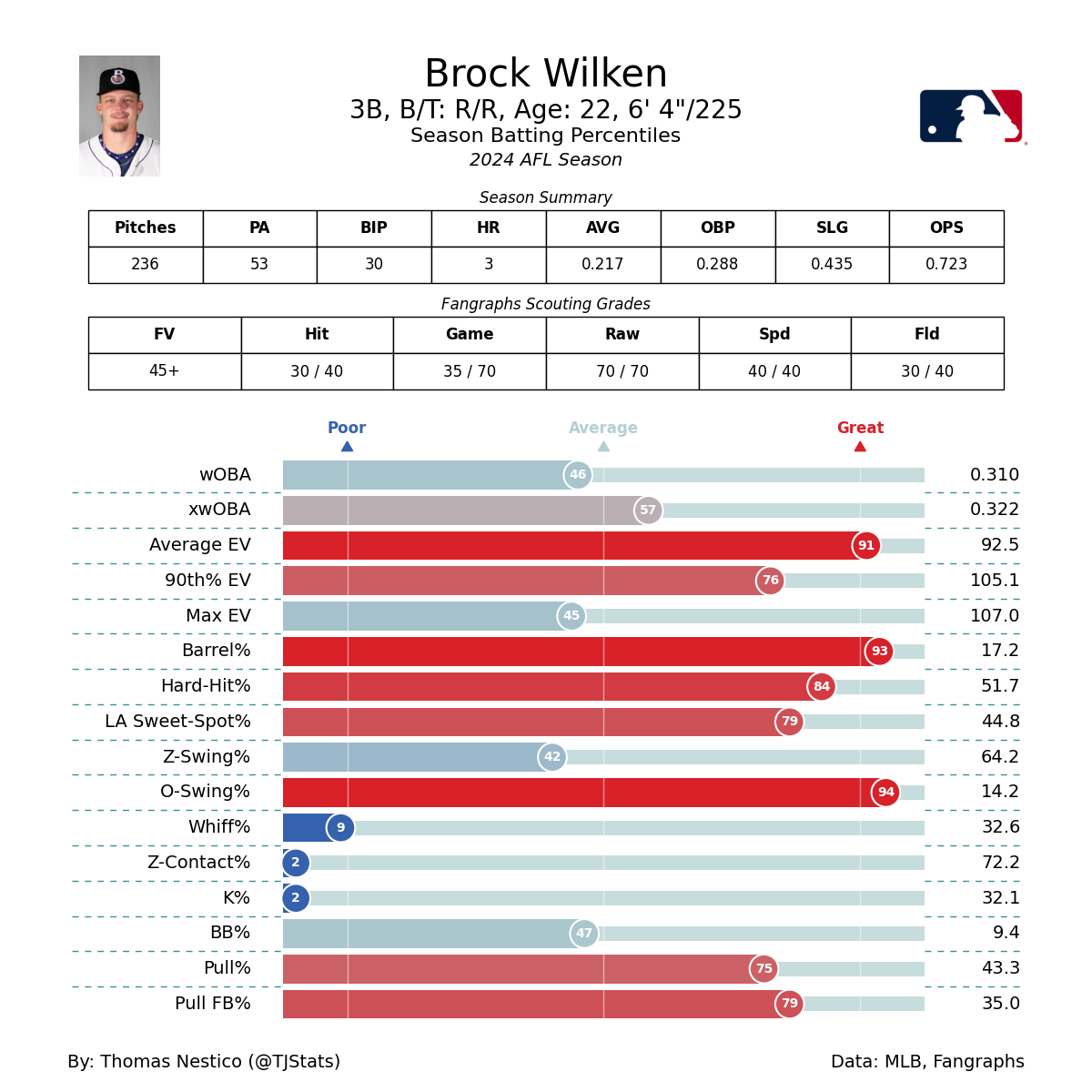
Interestingly, here are his AFL numbers: If I told you his zone-contact rate was over 80% this season, would you be intrigued more? The big question for Wilken is his swing rate. He swung at only 40% of in zone pitches for the first half of April, and is sitting more 50-55% now. If he can remain passive, but at 60% and retain that zone-contact, I think we'll see some big numbers. Since his final year in college, to cut down the strikeouts, he has had a quite passive approach. I think I'd like to see him jump on more pitches not just to the pull side, but even taking fastballs to straightaway center more often. He has the juice to do it. Currently he's pulling 60% of balls, a jump even on last seasons 50% rate. Just to clarify, I agree and I'm not in any rush, but if he starts swinging more and continuing to do damage, I'll be happy to see him in triple A by the end of June
-
Hahah that's one way to look at it!
-
This is going to be intriguing. Wesneski has pounded the zone, just a 3.6% walk rate on the year, but his sweeper looks effective. The fastballs can all be squared up, this'll be the game where the Brewers have to hit rather than walk their way to pressure on the bases. Need to see a step up in the quality of contact


