



Jake McKibbin
-
Posts
2,395 -
Joined
-
Last visited
-
Days Won
6
Content Type
Profiles
Forums
Blogs
Events
News
2026 Milwaukee Brewers Top Prospects Ranking
Milwaukee Brewers Videos
2022 Milwaukee Brewers Draft Picks
Milwaukee Brewers Free Agent & Trade Rumors, Notes, & Tidbits
Guides & Resources
2023 Milwaukee Brewers Draft Picks
2024 Milwaukee Brewers Draft Picks
The Milwaukee Brewers Players Project
2025 Milwaukee Brewers Draft Pick Tracker
2026 Milwaukee Brewers Draft Tracker: Picks & Bonuses
Store
Downloads
Gallery
Everything posted by Jake McKibbin
-
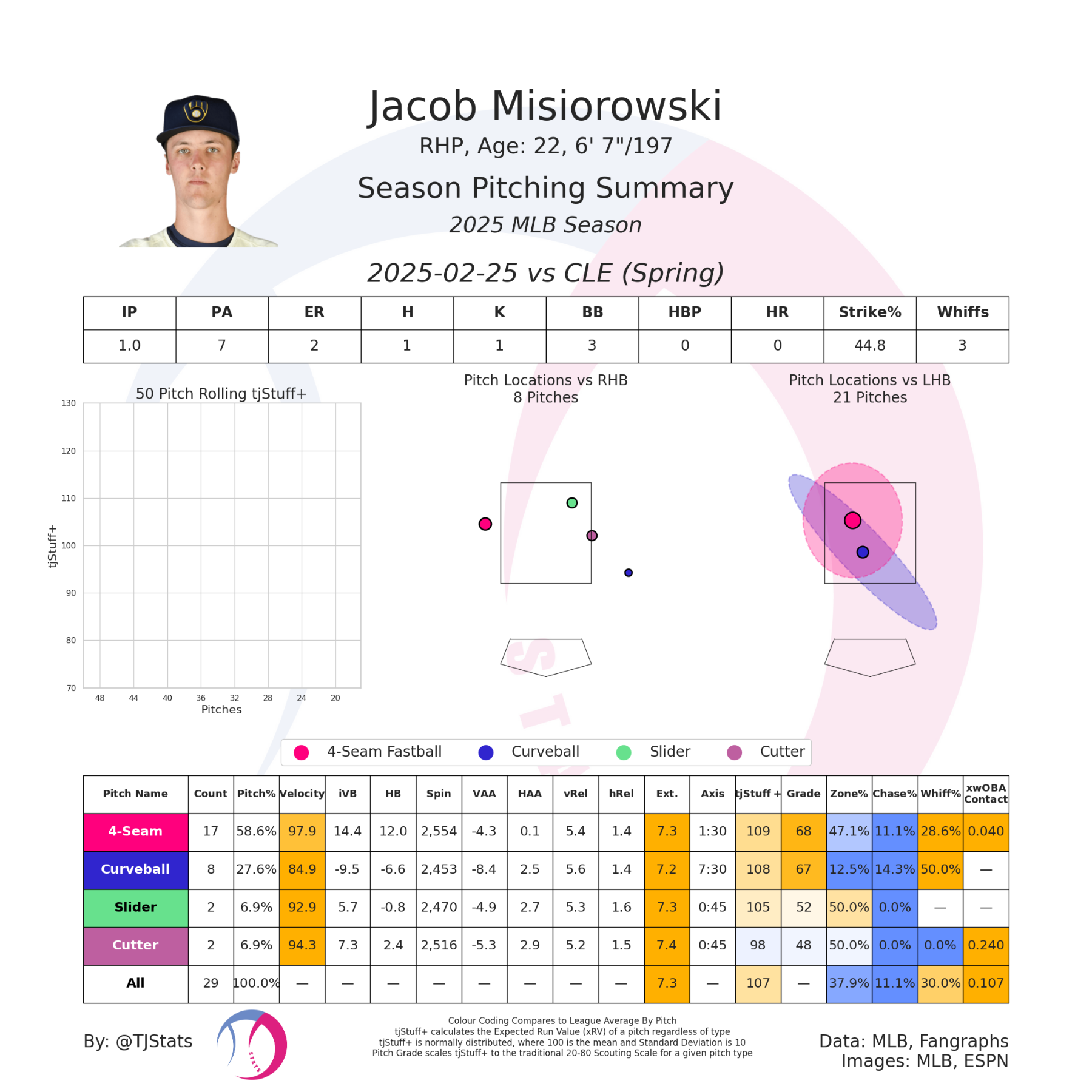
This is probably what will happen with Misiorowski in the majors. He doesn't even need command so much as just finding the strike zone, making hitters swing. Lots of swing and miss, lots of poor contact, just has to force them to get the bat off their shoulders (as you can see by the chase rates) I would expect the IVB to tick up somewhat as well based on last years numbers. One outing, especially one inning at the start of pre-season, doesn't say much but as he warms up there's obviously an expectation/hope he'll demonstrate more control
-
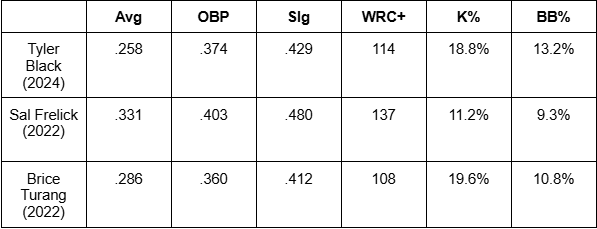
So here are the side by sides of Turang, Frelick and Black's last fullish seasons in Triple A Nashville: Turang is closest to Black's bat, albeit slightly below but does have the benefit of showing (what's now proven as) platinum glove defense. If you said Turang could play only average to below average 1B/LF/DH I think you'd all agree that his bat doesn't profile nearly well enough to get even regular playing time there. For reference Ty France has an OPS just .005 points above Turang's at first base and was DFA'd by the Seattle Mariners in the middle of 2024 Sal Frelick was leagues above both with the bat in Triple A, both in raw power and his contact skills. It's the main reason some of us are hopeful he has more in the tank for 2025.
-
The Brewers just played their first Statcast-tracked game this spring, giving us rare insight into some intriguing minor-leaguers. Who stood out from the crowd? Image courtesy of © Dave Kallmann / Milwaukee Journal Sentinel / USA TODAY NETWORK via Imagn Images Statcast ballparks bring a lot of entertainment for baseball nerds, especially in spring training. It gives an idea of who's feeling hot, who's not—and even more intriguingly, it lets us see metrics on minor-league pitchers that we may not get for the rest of the season. This could bring all kinds of fun, from Jesus Made's quality of contact, to Bishop Letson's fastball, Eric Bitonti's bat speed, Braylon Payne's sprint speed and more—if they can get playing time in publicly-distributed Statcast environments. While none of the above played in yesterday's game, it's worth keeping an eye on them, as well as the intriguing standouts below; Logan Henderson Logan Henderson's four-seam fastball was lurking in the 91-92 mph range throughout most of his 2024 season. It took a leap yesterday, surpassing 95 mph on several occasions, and with his electric combination of low release slot and high induced vertical break, it looked very effective. If he leaves it over the heart of the plate, it can see some hard contact, with hitters traditionally seeing it quite well. We don't have arm-angle data during spring, but the best comps for Henderson's fastball as he threw it yesterday would seem to be Christian Scott of the Mets and Bryan Woo of the Mariners. Those heaters find the dead zone a bit, movement-wise, so Henderson's command will be paramount. More interesting are the cutter and slider. Henderson has predominantly been a two-pitch pitcher in the minors, with his fastball/changeup pairing doing some heavy damage, but to succeed as a starter, he will need a third offering. The slider is a solid gyro option, while the cutter might be a variation to keep hitters off his main fastball—but I'm hoping to see him throw a lot more of these in his next spring training outings. Craig Yoho Yoho is a darling of the Brewers' 2023 draft class who looks poised to break into the bullpen during 2025 (health permitting). Yoho didn't use his slider, but showcased how deceptive and Wiffle Ball-like his changeup really is, coming away with two strikeouts. Yoho's arm angle is predisposed to horizontal movement profiles, and boy, does he make the most of that. That cutter could be an intriguing link pitch to boost the deception when his sinker, changeup and slider all boomerang away from each other; it bears monitoring. Chandler Welch Chandler Welch is another interesting profile, this time from the 2024 draft. Leaning on an 88-mph cutter/slider from a low arm slot, Welch got two whiffs (both on the slider) and prevented hard contact in his brief inning of work. The slider/cutter should work well, but he may need more out of his fastballs and sweeper to be more than a bullpen arm. The low arm slot gives both a chance to succeed, if he can find an extra tick or two of velocity as the season goes on. I'd expect to see him breeze through Low A and spend most of the year at High A and Double A this season. Tyson Hardin Tyson Hardin is another pick out of the 2024 draft, claimed in the 12th round out of Mississippi State. Showcasing a strong four-seamer/cutter mix that graded out exceptionally well in Jeremy Maschino's model, again due to a low arm slot and a real feel for generating spin on both offerings, Hardin worked out of a mess of his own making. We'll need to see more from his breaking balls, though his sole curveball did grade out nicely, and there was extreme horizontal break on his changeup. The stuff grades out better than you could have expected for a 12th-round pick, and is certainly exciting within the Brewers' pitching development system. Honorable mentions include: Ernesto Martinez Jr.: Showed off 83-mph bat speed (league average is around 74 mph) in launching a 104.4-mph flyout that he didn't even barrel (although he also had five whiffs in his eight swings). Oliver Dunn with three swings, no whiffs and two 100-mph+ lineouts (and with the same bat speed, which suggests his back issue is no longer a problem) Luis Lara with two hard-hit balls (95+ mph), against a sinker and a four-seam fastball Did you notice anything else in the Brewers' first statcast-tracked game of 2025? Let us know your thoughts in the comments below! View full article
-
Statcast Standouts From Brewers' Second Spring Training Game
Jake McKibbin posted an article in Brewers
 Statcast ballparks bring a lot of entertainment for baseball nerds, especially in spring training. It gives an idea of who's feeling hot, who's not—and even more intriguingly, it lets us see metrics on minor-league pitchers that we may not get for the rest of the season. This could bring all kinds of fun, from Jesus Made's quality of contact, to Bishop Letson's fastball, Eric Bitonti's bat speed, Braylon Payne's sprint speed and more—if they can get playing time in publicly-distributed Statcast environments. While none of the above played in yesterday's game, it's worth keeping an eye on them, as well as the intriguing standouts below; Logan Henderson Logan Henderson's four-seam fastball was lurking in the 91-92 mph range throughout most of his 2024 season. It took a leap yesterday, surpassing 95 mph on several occasions, and with his electric combination of low release slot and high induced vertical break, it looked very effective. If he leaves it over the heart of the plate, it can see some hard contact, with hitters traditionally seeing it quite well. We don't have arm-angle data during spring, but the best comps for Henderson's fastball as he threw it yesterday would seem to be Christian Scott of the Mets and Bryan Woo of the Mariners. Those heaters find the dead zone a bit, movement-wise, so Henderson's command will be paramount. More interesting are the cutter and slider. Henderson has predominantly been a two-pitch pitcher in the minors, with his fastball/changeup pairing doing some heavy damage, but to succeed as a starter, he will need a third offering. The slider is a solid gyro option, while the cutter might be a variation to keep hitters off his main fastball—but I'm hoping to see him throw a lot more of these in his next spring training outings. Craig Yoho Yoho is a darling of the Brewers' 2023 draft class who looks poised to break into the bullpen during 2025 (health permitting). Yoho didn't use his slider, but showcased how deceptive and Wiffle Ball-like his changeup really is, coming away with two strikeouts. Yoho's arm angle is predisposed to horizontal movement profiles, and boy, does he make the most of that. That cutter could be an intriguing link pitch to boost the deception when his sinker, changeup and slider all boomerang away from each other; it bears monitoring. Chandler Welch Chandler Welch is another interesting profile, this time from the 2024 draft. Leaning on an 88-mph cutter/slider from a low arm slot, Welch got two whiffs (both on the slider) and prevented hard contact in his brief inning of work. The slider/cutter should work well, but he may need more out of his fastballs and sweeper to be more than a bullpen arm. The low arm slot gives both a chance to succeed, if he can find an extra tick or two of velocity as the season goes on. I'd expect to see him breeze through Low A and spend most of the year at High A and Double A this season. Tyson Hardin Tyson Hardin is another pick out of the 2024 draft, claimed in the 12th round out of Mississippi State. Showcasing a strong four-seamer/cutter mix that graded out exceptionally well in Jeremy Maschino's model, again due to a low arm slot and a real feel for generating spin on both offerings, Hardin worked out of a mess of his own making. We'll need to see more from his breaking balls, though his sole curveball did grade out nicely, and there was extreme horizontal break on his changeup. The stuff grades out better than you could have expected for a 12th-round pick, and is certainly exciting within the Brewers' pitching development system. Honorable mentions include: Ernesto Martinez Jr.: Showed off 83-mph bat speed (league average is around 74 mph) in launching a 104.4-mph flyout that he didn't even barrel (although he also had five whiffs in his eight swings). Oliver Dunn with three swings, no whiffs and two 100-mph+ lineouts (and with the same bat speed, which suggests his back issue is no longer a problem) Luis Lara with two hard-hit balls (95+ mph), against a sinker and a four-seam fastball Did you notice anything else in the Brewers' first statcast-tracked game of 2025? Let us know your thoughts in the comments below!
- 7 comments
-
- 4
-

-

-
- logan henderson
- craig yoho
- (and 5 more)
-
-
Two members of the 2024 Milwaukee Brewers have a logistical advantage in the push for the final position-player spot on the active roster, come Opening Day. Could a non-roster invitee and two-time minor-league free agent overcome those obstacles? Image courtesy of © Dave Kallmann / Milwaukee Journal Sentinel / USA TODAY NETWORK via Imagn Images Ernesto Martinez Jr. hasn’t popped up on many prospect lists. He’s taken some time to live up to the potential in his frame, since signing with the Brewers out of his native Cuba. He passed through the Rule 5 Draft, unselected. He's become a minor-league free agent and re-signed with the Brewers, meaning no other team offered him even a 40-man roster spot. And yet, the man possesses some of the most freakish upside in camp this spring. Perhaps you’ve heard Joseph Zarr raving about his athleticism at first base, regularly including doing the splits to snag a throw faster on a close play. He’s covered center field admirably in the past. He’s 6-foot-7 and weighs 250 pounds. Then you see what he managed to put together in the final half of 2024, in the tough hitting environment that is the Southern League, not just in raw power but with a complete performance at the plate. To put what I’m about to say in context, you need to know just how horrible the hitting environment is. Here’s how Martinez Jr compared to the league average, examining both his full-season numbers, and his final three months: Those surface stats mean something, but they don’t tell the whole story, either. Martinez’s frame has historically created issues for hitters in controlling the strike zone and making strong contact. Giancarlo Stanton is a prime example; the long levers he possesses allow him to create massive bat speeds. Unfortunately, it comes with prolific in-zone swing-and-miss. Martinez somehow has the wham, without the whiff—at least in the minors. His 90th-percentile exit velocity for the Biloxi Shuckers last season was 109 mph. He repeatedly topped 115 mph on individual batted balls. Note in the below quote to Adam McCalvy that the blast motion sensors top out at 89.9 mph of swing speed: “He tops out the Blast sensor when we use it,” [Brewers hitting coordinator Brenton] Del Chiaro said. “He’s just continued to impact the baseball. The ‘damage’ components, the quality of contact components, have continued to improve. He’s progressively gotten better the more he’s matured. You come to the ballpark, you’re going to see him do something special, whether it’s the full-on splits, whether it’s stealing a bunch of bases, whether it’s hitting the ball out of the ballpark. It’s going to be entertaining.” What does this mean? Well, Stanton had far and away the greatest bat speed in the majors in 2024, averaging 81.3 mph, while exceeding 88 mph on his swings just 15 times. Martinez has shown himself capable of matching that while retaining a strikeout rate (in the worst hitting environment in minor league baseball) under 14%. Excited yet? When you have a frame as large as Martinez (who is also affectionately nicknamed “the show” and “the Cuban missile”) does, it takes time to work out how to synchronize the mechanics of your operations in the box. It seems that’s finally happened for the Brewers' talented infielder, and his ceiling is sky-high. He's hitting fewer infield fly balls and more line drives, while simultaneously tapping into more pull-side fly balls than in previous seasons. All of this fits the description of a player becoming more aware of how to create damage and more in-tune with his bat path. I am incredibly excited to see how this young man performs in 2025. With better defensive chops than both Jake Bauers and Tyler Black, alongside a higher ceiling and the stolen base threat, there's a real chance that Martinez is on the Brewers roster on Opening Day. It's more likely the Brewers will try those ahead of him in the pecking order first—particularly Bauers, who may have an opt-out on his minor-league deal if he isn't on the roster—so perhaps midseason is a more realistic goal for "El Espectaculo". Still, he has every chance to force their hand with a great Cactus League showing. View full article
- 10 replies
-
- 2
-
-
- tyler black
- jake bauers
- (and 1 more)
-
 Ernesto Martinez Jr. hasn’t popped up on many prospect lists. He’s taken some time to live up to the potential in his frame, since signing with the Brewers out of his native Cuba. He passed through the Rule 5 Draft, unselected. He's become a minor-league free agent and re-signed with the Brewers, meaning no other team offered him even a 40-man roster spot. And yet, the man possesses some of the most freakish upside in camp this spring. Perhaps you’ve heard Joseph Zarr raving about his athleticism at first base, regularly including doing the splits to snag a throw faster on a close play. He’s covered center field admirably in the past. He’s 6-foot-7 and weighs 250 pounds. Then you see what he managed to put together in the final half of 2024, in the tough hitting environment that is the Southern League, not just in raw power but with a complete performance at the plate. To put what I’m about to say in context, you need to know just how horrible the hitting environment is. Here’s how Martinez Jr compared to the league average, examining both his full-season numbers, and his final three months: Those surface stats mean something, but they don’t tell the whole story, either. Martinez’s frame has historically created issues for hitters in controlling the strike zone and making strong contact. Giancarlo Stanton is a prime example; the long levers he possesses allow him to create massive bat speeds. Unfortunately, it comes with prolific in-zone swing-and-miss. Martinez somehow has the wham, without the whiff—at least in the minors. His 90th-percentile exit velocity for the Biloxi Shuckers last season was 109 mph. He repeatedly topped 115 mph on individual batted balls. Note in the below quote to Adam McCalvy that the blast motion sensors top out at 89.9 mph of swing speed: “He tops out the Blast sensor when we use it,” [Brewers hitting coordinator Brenton] Del Chiaro said. “He’s just continued to impact the baseball. The ‘damage’ components, the quality of contact components, have continued to improve. He’s progressively gotten better the more he’s matured. You come to the ballpark, you’re going to see him do something special, whether it’s the full-on splits, whether it’s stealing a bunch of bases, whether it’s hitting the ball out of the ballpark. It’s going to be entertaining.” What does this mean? Well, Stanton had far and away the greatest bat speed in the majors in 2024, averaging 81.3 mph, while exceeding 88 mph on his swings just 15 times. Martinez has shown himself capable of matching that while retaining a strikeout rate (in the worst hitting environment in minor league baseball) under 14%. Excited yet? When you have a frame as large as Martinez (who is also affectionately nicknamed “the show” and “the Cuban missile”) does, it takes time to work out how to synchronize the mechanics of your operations in the box. It seems that’s finally happened for the Brewers' talented infielder, and his ceiling is sky-high. He's hitting fewer infield fly balls and more line drives, while simultaneously tapping into more pull-side fly balls than in previous seasons. All of this fits the description of a player becoming more aware of how to create damage and more in-tune with his bat path. I am incredibly excited to see how this young man performs in 2025. With better defensive chops than both Jake Bauers and Tyler Black, alongside a higher ceiling and the stolen base threat, there's a real chance that Martinez is on the Brewers roster on Opening Day. It's more likely the Brewers will try those ahead of him in the pecking order first—particularly Bauers, who may have an opt-out on his minor-league deal if he isn't on the roster—so perhaps midseason is a more realistic goal for "El Espectaculo". Still, he has every chance to force their hand with a great Cactus League showing.
- 10 comments
-
- 1
-
-
- tyler black
- jake bauers
- (and 1 more)
-
The diminutive former first-round pick had trouble keeping weight on his frame during his first full season in MLB. Can his rebuilt physique better withstand the grind? Image courtesy of © Dave Kallmann / Milwaukee Journal Sentinel / USA TODAY NETWORK via Imagn Images Sal Frelick finished last season at just 167 pounds. It’s completely normal for players' weights to decrease throughout a season (due to fluid loss, dietary variations, their movement within games and other factors), but that seems incredibly light for someone of his build. If we rely on the numbers on Baseball Reference (which comes with some margin of error, naturally, but is usually quite accurate for Brewers players), that would mean Frelick lost 15 pounds during the 2024 campaign. According to the MLB.com article about Frelick's hoped-for transformation from Brewers beat writer Adam McCalvy, the young outfielder put on 25 pounds of muscle over the offseason. Respectfully: poppycock. At the zenith of his boosting, Barry Bonds would have struggled to make that much headway in four months. A clean 25 pounds of muscle mass alone isn't humanly possible without illegal support, but it's far more likely that fluid loss contributed a lot to Frelick’s low weight at the end of 2024. Replenishing that, plus about 10 pounds of quality weight, is a much more achievable and realistic outcome for a professional athlete with an intense offseason regimen. That still leaves the mystery and vexation of the in-season weight loss to combat. A professional baseball player will have a high level of activity virtually every day, which means that maintaining weight requires strong intakes of calories and fluids. This could involve consuming 4,000 or more calories per day depending on body type and size, which isn’t easy—and might not be comfortable, given the aforementioned level of activity and the schedule ballplayers have to keep. It's even more daunting if you're aiming for nutrient-dense, clean foods to reach that goal. Frelick didn't even make a habit out of eating breakfast most days. The effect was obvious, and Frelick admitted it to McCalvy. Down the stretch, his body felt tired, an issue for someone who plays with the verve that defines the best of his game. His outfield coverage and moves on the basepaths would have slowed enough to make a difference. Indeed, he only stole four bases from Aug. 1 onward, though part of that was because he slumped to a .273 OBP over that stretch. We can also see it in his bat speed, which declined each month: On top of this, Frelick's hard-hit rate (over a rolling average of 50 balls in play) didn't top 20% in the last two months of the season. We should expect some sag within a season, but having it do so to this extent creates a clear issue—one he'll need to address in the coming season. The added weight isn’t going to bring Frelick to a league-average exit velocity on its own. It probably won’t impact his initial base rate much at all, without some more aggressive swing decisions. What it will do is allow him to be more durable as the grind of the season accumulates, but he has to be more disciplined with his water and nutritional intake. For a player who already doesn't drive the ball all that often, Frelick needs to tap into every little bit of help he can coming into 2025. What do you think of Sal Frelick’s comments? Did they give you cause for concern or optimism? Let us know your thoughts in the comments below! View full article
-
.png.9f92ee75b624990d07dc955e75ccdc29.png) Sal Frelick finished last season at just 167 pounds. It’s completely normal for players' weights to decrease throughout a season (due to fluid loss, dietary variations, their movement within games and other factors), but that seems incredibly light for someone of his build. If we rely on the numbers on Baseball Reference (which comes with some margin of error, naturally, but is usually quite accurate for Brewers players), that would mean Frelick lost 15 pounds during the 2024 campaign. According to the MLB.com article about Frelick's hoped-for transformation from Brewers beat writer Adam McCalvy, the young outfielder put on 25 pounds of muscle over the offseason. Respectfully: poppycock. At the zenith of his boosting, Barry Bonds would have struggled to make that much headway in four months. A clean 25 pounds of muscle mass alone isn't humanly possible without illegal support, but it's far more likely that fluid loss contributed a lot to Frelick’s low weight at the end of 2024. Replenishing that, plus about 10 pounds of quality weight, is a much more achievable and realistic outcome for a professional athlete with an intense offseason regimen. That still leaves the mystery and vexation of the in-season weight loss to combat. A professional baseball player will have a high level of activity virtually every day, which means that maintaining weight requires strong intakes of calories and fluids. This could involve consuming 4,000 or more calories per day depending on body type and size, which isn’t easy—and might not be comfortable, given the aforementioned level of activity and the schedule ballplayers have to keep. It's even more daunting if you're aiming for nutrient-dense, clean foods to reach that goal. Frelick didn't even make a habit out of eating breakfast most days. The effect was obvious, and Frelick admitted it to McCalvy. Down the stretch, his body felt tired, an issue for someone who plays with the verve that defines the best of his game. His outfield coverage and moves on the basepaths would have slowed enough to make a difference. Indeed, he only stole four bases from Aug. 1 onward, though part of that was because he slumped to a .273 OBP over that stretch. We can also see it in his bat speed, which declined each month: On top of this, Frelick's hard-hit rate (over a rolling average of 50 balls in play) didn't top 20% in the last two months of the season. We should expect some sag within a season, but having it do so to this extent creates a clear issue—one he'll need to address in the coming season. The added weight isn’t going to bring Frelick to a league-average exit velocity on its own. It probably won’t impact his initial base rate much at all, without some more aggressive swing decisions. What it will do is allow him to be more durable as the grind of the season accumulates, but he has to be more disciplined with his water and nutritional intake. For a player who already doesn't drive the ball all that often, Frelick needs to tap into every little bit of help he can coming into 2025. What do you think of Sal Frelick’s comments? Did they give you cause for concern or optimism? Let us know your thoughts in the comments below!
Sal Frelick finished last season at just 167 pounds. It’s completely normal for players' weights to decrease throughout a season (due to fluid loss, dietary variations, their movement within games and other factors), but that seems incredibly light for someone of his build. If we rely on the numbers on Baseball Reference (which comes with some margin of error, naturally, but is usually quite accurate for Brewers players), that would mean Frelick lost 15 pounds during the 2024 campaign. According to the MLB.com article about Frelick's hoped-for transformation from Brewers beat writer Adam McCalvy, the young outfielder put on 25 pounds of muscle over the offseason. Respectfully: poppycock. At the zenith of his boosting, Barry Bonds would have struggled to make that much headway in four months. A clean 25 pounds of muscle mass alone isn't humanly possible without illegal support, but it's far more likely that fluid loss contributed a lot to Frelick’s low weight at the end of 2024. Replenishing that, plus about 10 pounds of quality weight, is a much more achievable and realistic outcome for a professional athlete with an intense offseason regimen. That still leaves the mystery and vexation of the in-season weight loss to combat. A professional baseball player will have a high level of activity virtually every day, which means that maintaining weight requires strong intakes of calories and fluids. This could involve consuming 4,000 or more calories per day depending on body type and size, which isn’t easy—and might not be comfortable, given the aforementioned level of activity and the schedule ballplayers have to keep. It's even more daunting if you're aiming for nutrient-dense, clean foods to reach that goal. Frelick didn't even make a habit out of eating breakfast most days. The effect was obvious, and Frelick admitted it to McCalvy. Down the stretch, his body felt tired, an issue for someone who plays with the verve that defines the best of his game. His outfield coverage and moves on the basepaths would have slowed enough to make a difference. Indeed, he only stole four bases from Aug. 1 onward, though part of that was because he slumped to a .273 OBP over that stretch. We can also see it in his bat speed, which declined each month: On top of this, Frelick's hard-hit rate (over a rolling average of 50 balls in play) didn't top 20% in the last two months of the season. We should expect some sag within a season, but having it do so to this extent creates a clear issue—one he'll need to address in the coming season. The added weight isn’t going to bring Frelick to a league-average exit velocity on its own. It probably won’t impact his initial base rate much at all, without some more aggressive swing decisions. What it will do is allow him to be more durable as the grind of the season accumulates, but he has to be more disciplined with his water and nutritional intake. For a player who already doesn't drive the ball all that often, Frelick needs to tap into every little bit of help he can coming into 2025. What do you think of Sal Frelick’s comments? Did they give you cause for concern or optimism? Let us know your thoughts in the comments below! -
I've done some pieces on it recently, but it's less about ownership and more about local TV structures and general market that allow the Cubs to have larger financial power than the Brewers. It's unfortunate, but actually I'd say that, taking into account the size of revenue streams involved, I'd much rather have Attanasio than the Ricketts
-
I'm not too bothered on this. The Cubs would lose picks 2 & 5 in the 2025 draft and potentially he'd want an opt out after a year/maybe two. He's a great piece don't get me wrong, but he's not a Kyle Tucker level addition and has seen declining results in recent seasons and profiles not quite so well away from Houston EDIT: plus that year could cost $25m-$30m. I think it'd maybe hurt long term more than it helps them tbh
-
The 2024 Brewers rookie's changeup is unique, which is always a scary and exciting word. Can he begin to adjust its usage to reach even greater heights in 2025? Image courtesy of © Rafael Suanes-Imagn Images Tobias Myers was incredible for the 2024 iteration of the Milwaukee Brewers. A depth piece to start the year, shuttled back and forth from Nashville on one occasion, Myers stamped his mark on the season with improving results as the campaign went on. He led the Brewers' rotation (min 100 IP) with a 3.11 ERA as a starter, but his underlying metrics weren't so fluffy. Myers succeeded in missing barrels consistently, but to repeat the success he found, he'll need to create more swings and misses. Without them, it's likely we see more home-run problems (similar to how he struggled when he first came up from Triple A) and a more generic line. Happily, it's not terribly hard to see where more whiffs might come from. Myers's changeup is a true outlier pitch, albeit completely different from that of Devin Williams and Craig Yoho. While they try and create as much drop and side spin on the pitch as possible, Myers' version actually creates "rise". With strong horizontal movement to boot, it's more like an incredibly slow two-seam fastball, and it tunnels fantastically with his four-seamer because of that ride. The solid green dot is the movement Myers generates, while the shadowy area is what a hitter would expect from a changeup. Myers generates almost 6" of rise more than the average offering; it's a completely counterintuitive form of the changeup. Usually, pitchers want as much depth and dip as possible, but the induced vertical break created by pitchers like Drew Thorpe and Tobias Myers allows their changeups to hover in the strike zone longer, closer resemble their four-seam fastballs, and thus appear to fade later than your regular changeup. Late break and "not much break" turn out not to be contradictory ideas, but commingled ones, as baseball's most famous physicist once pointed out. When you factor in that Myers's changeup is roughly the same speed as a curveball, the velocity separation for a pitch that tunnels so well with his fastball is a nightmare to square up. This deception has created a highly effective offering: Hitters hit just .083 off Myers's changeup in 2025, while swinging and missing 44.4% of the time—and they didn't collect an extra-base hit. Those are absurd results for any pitch. The problem for Myers was that he had a problem locating the offering effectively, with some non-competitive misses and poor locations preventing it from being as impactful as possible. The spray of pitches below should highlight the struggles in command: Myers's changeup was barely in the zone for most of the year. Some might say that it's his "chase" pitch, and he should keep it out of the strike zone, but actually, it's the kind of offering he can survive and thrive with inside the strike zone with more regularity. The struggles of every hitter to square up his changeup show just how difficult the pitch is to handle on its own, and we have a month of data where he did find the strike zone more often: In July, Myers's changeup rose from an in-zone rate of 25.5% to one of 43.5%. You would think this created easier looks for hitters, but they registered a 40% whiff rate and not a single hit against it out of the 46 changeups he threw. For the whole season, Myers had a 41.7% whiff rate on all his changeups in the strike zone. It doesn't matter where Myers throws it; it’s going to be effective if he can elicit a swing. If he doesn't get a swing, then why not attack the strike zone to get ahead in the count on a pitch hitters find borderline unhittable? The more offerings a hitter has to cover that can live in the strike zone, the more issues a hitter will have in deciphering the pitches and making a swing decision. Allowing the changeup to eat inside the strike zone will complement the fastball and cutter that he already likes to locate over 50% of the time to get ahead in counts. The cutter doesn't get a lot of swing-and-miss, so adding the changeup in there would allow Myers to make a massive step forward in his underlying metrics, and should raise confidence in a repeat performance in 2025. Garnering control of his changeup, given it's relatively new to him, will be difficult, but in its second year of development, it's very possible that Myers can take strides forward with his command. Pulling it into the zone more often will enhance his entire arsenal markedly, and is something to watch as spring training begins. View full article
-
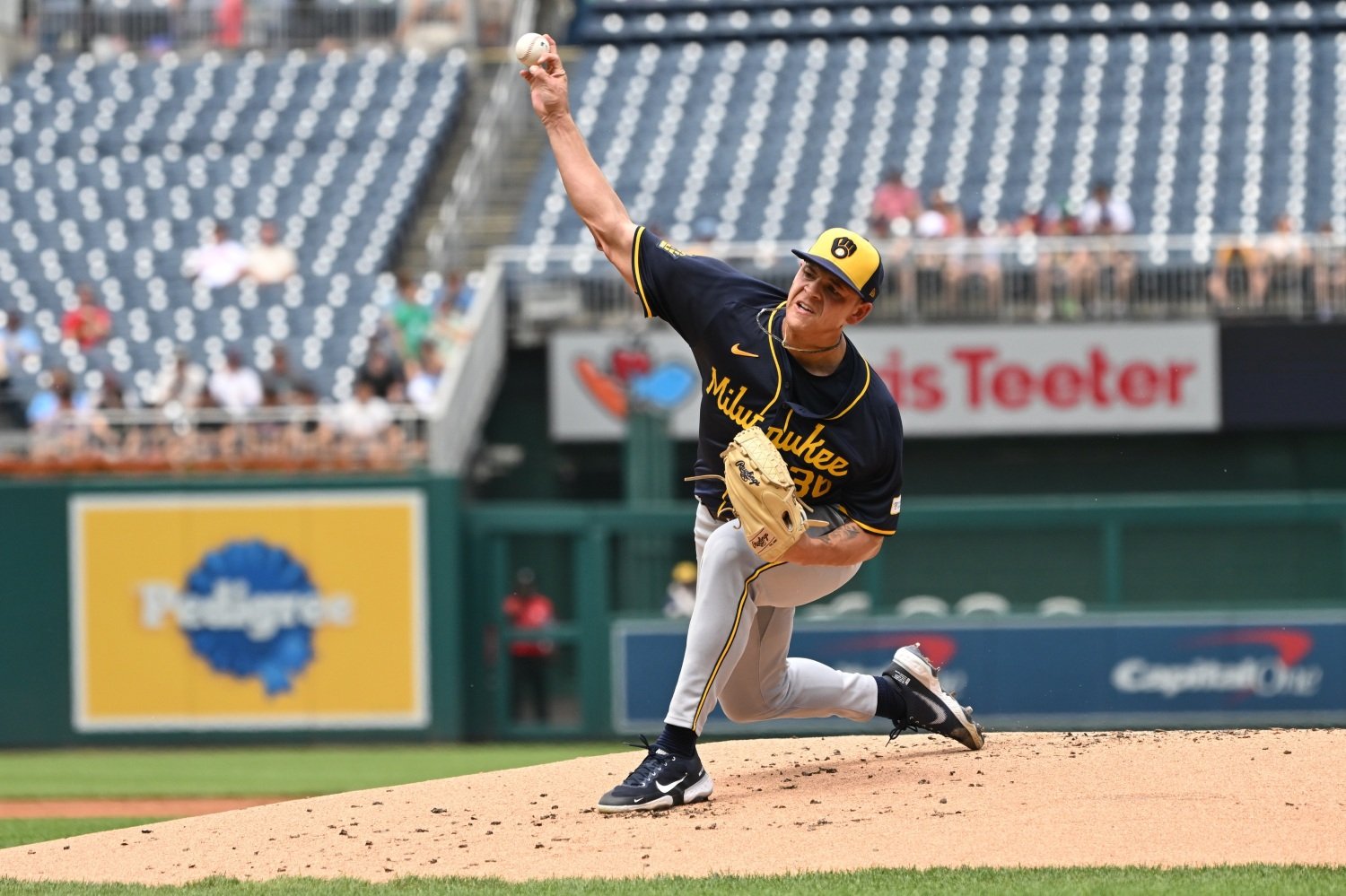 Tobias Myers was incredible for the 2024 iteration of the Milwaukee Brewers. A depth piece to start the year, shuttled back and forth from Nashville on one occasion, Myers stamped his mark on the season with improving results as the campaign went on. He led the Brewers' rotation (min 100 IP) with a 3.11 ERA as a starter, but his underlying metrics weren't so fluffy. Myers succeeded in missing barrels consistently, but to repeat the success he found, he'll need to create more swings and misses. Without them, it's likely we see more home-run problems (similar to how he struggled when he first came up from Triple A) and a more generic line. Happily, it's not terribly hard to see where more whiffs might come from. Myers's changeup is a true outlier pitch, albeit completely different from that of Devin Williams and Craig Yoho. While they try and create as much drop and side spin on the pitch as possible, Myers' version actually creates "rise". With strong horizontal movement to boot, it's more like an incredibly slow two-seam fastball, and it tunnels fantastically with his four-seamer because of that ride. The solid green dot is the movement Myers generates, while the shadowy area is what a hitter would expect from a changeup. Myers generates almost 6" of rise more than the average offering; it's a completely counterintuitive form of the changeup. Usually, pitchers want as much depth and dip as possible, but the induced vertical break created by pitchers like Drew Thorpe and Tobias Myers allows their changeups to hover in the strike zone longer, closer resemble their four-seam fastballs, and thus appear to fade later than your regular changeup. Late break and "not much break" turn out not to be contradictory ideas, but commingled ones, as baseball's most famous physicist once pointed out. When you factor in that Myers's changeup is roughly the same speed as a curveball, the velocity separation for a pitch that tunnels so well with his fastball is a nightmare to square up. This deception has created a highly effective offering: Hitters hit just .083 off Myers's changeup in 2025, while swinging and missing 44.4% of the time—and they didn't collect an extra-base hit. Those are absurd results for any pitch. The problem for Myers was that he had a problem locating the offering effectively, with some non-competitive misses and poor locations preventing it from being as impactful as possible. The spray of pitches below should highlight the struggles in command: Myers's changeup was barely in the zone for most of the year. Some might say that it's his "chase" pitch, and he should keep it out of the strike zone, but actually, it's the kind of offering he can survive and thrive with inside the strike zone with more regularity. The struggles of every hitter to square up his changeup show just how difficult the pitch is to handle on its own, and we have a month of data where he did find the strike zone more often: In July, Myers's changeup rose from an in-zone rate of 25.5% to one of 43.5%. You would think this created easier looks for hitters, but they registered a 40% whiff rate and not a single hit against it out of the 46 changeups he threw. For the whole season, Myers had a 41.7% whiff rate on all his changeups in the strike zone. It doesn't matter where Myers throws it; it’s going to be effective if he can elicit a swing. If he doesn't get a swing, then why not attack the strike zone to get ahead in the count on a pitch hitters find borderline unhittable? The more offerings a hitter has to cover that can live in the strike zone, the more issues a hitter will have in deciphering the pitches and making a swing decision. Allowing the changeup to eat inside the strike zone will complement the fastball and cutter that he already likes to locate over 50% of the time to get ahead in counts. The cutter doesn't get a lot of swing-and-miss, so adding the changeup in there would allow Myers to make a massive step forward in his underlying metrics, and should raise confidence in a repeat performance in 2025. Garnering control of his changeup, given it's relatively new to him, will be difficult, but in its second year of development, it's very possible that Myers can take strides forward with his command. Pulling it into the zone more often will enhance his entire arsenal markedly, and is something to watch as spring training begins.
 -
Absolutely no surprise to anyone who's followed the Brewers last two drafts
-
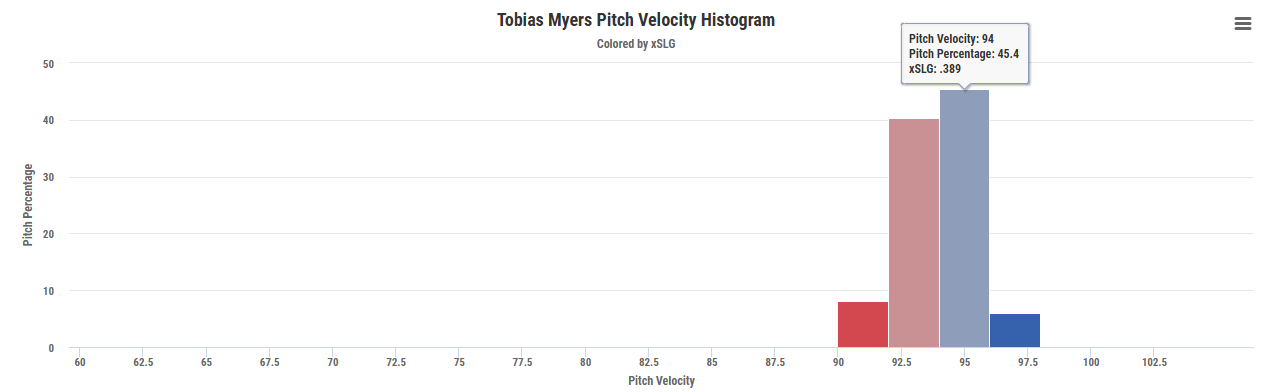
I'm glad you liked it! So I got this from baseball savant which categorized Myers average fastball as 92.9 mph throughout the year. I do think it ticked up as the year went on, especially in how he started games in the first/second innings, and was maybe closer to that 93.5-94 range as the season reached its close! Another big reason for the fascination is the above chart. Here's the expected slugging numbers against his fastball on different ranges: 89-91mph: .727 91-93mph: .592 93-95mph: .392 95+ mph: .137 Living more regularly in that 94 mph range marks a big difference in the damage done against Myers fastball, and I'm fascinated to see if he can reach and maintain that over the course of a season. I agree on Patrick, Henderson maybe needs another pitch to be a bona fide starter but Patrick's cutter was seriously impressive and as Joseph Zarr mentioned in his podcast with Spencer, the guy seems to have a really solid feel for his arsenal and how to vary and use it which should help in the big leagues.
- 9 replies
-
- 1
-
-
- tobias myers
- dl hall
- (and 1 more)
-
With pitchers and catchers reporting this week, some Brewers pitchers will look at this as a big season to make a name for themselves. Here are three particular pitchers to keep an eye on. Image courtesy of © Benny Sieu-Imagn Images It's been over four months since the Brewers played a baseball game of any form. In that time, it's easy to forget the form some players were in to finish the season, or the shoots of growth they found approaching the playoffs. There are three names, in particular, who have a fascinating year ahead of them—either due to offseason work or to address those flashes to finish 2024. Tobias Myers Finishing Straight Tobias Myers finished last season on an incredible high, pitching five shutout innings in Game 3 of the Wild Card Series while allowing just three baserunners and going through the order twice. In doing so, he capped off what had been a fascinating turnaround in his ability to generate swing-and-miss to finish the season. Myers's fastball in the playoffs graded out spectacularly, per Thomas Nestico's pitch-grading data, averaging 20" of induced vertical break while adding a tick in velo. This velocity range isn't uncommon from Myers, who was historically in the 93-95 range for the Rays back in 2021, but it has taken him a while to build it back up in the Brewers system after various injuries and adjustments. It gave him a 70-grade offering, and the whiff rate backed that up. During the season, his fastball wasn't generating a lot of swing and miss, at times getting hit hard in the air, but he mitigated the damage well. It doesn't take much additional velocity or movement to go from avoiding barrels on a fastball to having a hitter swing underneath the pitch, and that's exactly what Myers showed in the playoffs. An extra mile per hour and/or inch of IVB made all the difference. Myers showed this ability, not only in the playoffs, but also in September, before easing off as the Brewers hit the finish line. If he can hover in and around that 94-mph mark, rather than the 92.5-mph range he sat most of the season, then his underlying numbers would bring about a whole new projection for him. DL Hall's Knee Surgery Like Myers, Hall's fastball is his primary offering, and he'll need it to succeed in 2025. Plagued by a knee injury over the last few years, his pain got considerably worse in 2024. Hall's fastball never regained the characteristics it showed with the Baltimore Orioles out of the pen. Even after returning from his injury, Hall showed some progress for the Brewers, but not quite enough to make him the dominant stuff merchant he was advertised to be. During 2024, Hall's secondaries took real strides forward in terms of command and movement, to the point where his changeup and slider all looked highly effective. They posted above-average whiff rates and limited the quality of contact against them. If he can get close to the fastball shape he showed with the Orioles, then the arsenal begins to look deadly. The big change for Hall is that he underwent knee surgery to clean up scar tissue where the sprain occurred—an area in which Hall has felt discomfort dating back to 2021. We saw on his comeback how a healthier knee (if not perfect) aided his velocity somewhat, and another small bump on a clean bill of health could go a long way. Like Myers, Hall induced a lot of pop-ups and weak fly balls in August and September. He was struggling to put hitters away, though, because he couldn't miss bats with the fastball in the zone. Yet, he was a mere tick away from turning those pop-ups into whiffs and turning hard-hit balls into pop-ups. Here are his whiff rates when looking at fastballs by an IVB range: Staying in that 15-16" range with more regularity, or being back to sitting in the 95+ mph range (accounting for some loss of velocity, going from the Orioles' bullpen to the Brewers' rotation) would complete a pitch mix that could be deadly in 2025. If not, a bullpen role will likely be Hall's final landing spot. Bryan Hudson's Recovery Bryan Hudson went from a bona fide, unhittable All-Star candidate in 2024 to missing the Brewers' playoff roster entirely. Used heavily early in the season, Hudson pitched multiple innings in most of his appearances but struggled to recover from outings the way the Brewers would have liked. Hudson went from averaging 91 mph on his fastball in June and 83 on his sweeper, down to 89 mph and 78 mph, respectively, in August. He also saw reduced movement profiles on both of his main pitches, creating a problem. Despite showing good surface results, Hudson was approaching the type of metrics that didn't bode well for him and he couldn't recover fully even after significant layoffs in Nashville. A key question will be whether or not Hudson has managed to rediscover the life on his pitches from the first half of last season, and be alert to any indications as we move through spring training as to how the Brewers intend to deploy him differently this season. Have you got any arms you're curious about as pitchers and catchers turn up in Arizona? Let us know your thoughts in the comments below! As always, thanks to Thomas Nestico for the access to some truly brilliant graphics and models! View full article
- 9 replies
-
- 1
-
-
- tobias myers
- dl hall
- (and 1 more)
-
Three Pitchers to Watch at Milwaukee Brewers Spring Training
Jake McKibbin posted an article in Brewers
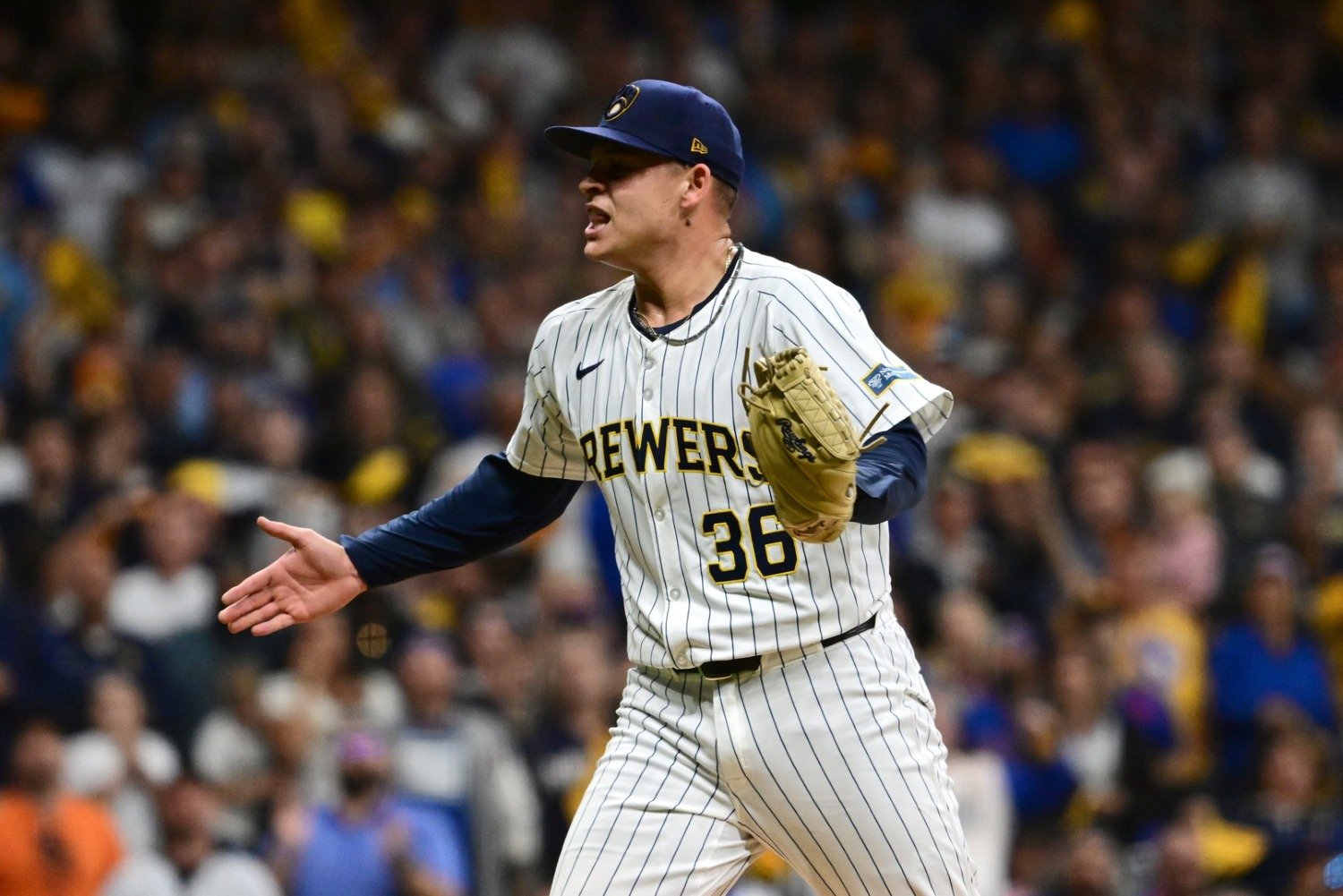 It's been over four months since the Brewers played a baseball game of any form. In that time, it's easy to forget the form some players were in to finish the season, or the shoots of growth they found approaching the playoffs. There are three names, in particular, who have a fascinating year ahead of them—either due to offseason work or to address those flashes to finish 2024. Tobias Myers Finishing Straight Tobias Myers finished last season on an incredible high, pitching five shutout innings in Game 3 of the Wild Card Series while allowing just three baserunners and going through the order twice. In doing so, he capped off what had been a fascinating turnaround in his ability to generate swing-and-miss to finish the season. Myers's fastball in the playoffs graded out spectacularly, per Thomas Nestico's pitch-grading data, averaging 20" of induced vertical break while adding a tick in velo. This velocity range isn't uncommon from Myers, who was historically in the 93-95 range for the Rays back in 2021, but it has taken him a while to build it back up in the Brewers system after various injuries and adjustments. It gave him a 70-grade offering, and the whiff rate backed that up. During the season, his fastball wasn't generating a lot of swing and miss, at times getting hit hard in the air, but he mitigated the damage well. It doesn't take much additional velocity or movement to go from avoiding barrels on a fastball to having a hitter swing underneath the pitch, and that's exactly what Myers showed in the playoffs. An extra mile per hour and/or inch of IVB made all the difference. Myers showed this ability, not only in the playoffs, but also in September, before easing off as the Brewers hit the finish line. If he can hover in and around that 94-mph mark, rather than the 92.5-mph range he sat most of the season, then his underlying numbers would bring about a whole new projection for him. DL Hall's Knee Surgery Like Myers, Hall's fastball is his primary offering, and he'll need it to succeed in 2025. Plagued by a knee injury over the last few years, his pain got considerably worse in 2024. Hall's fastball never regained the characteristics it showed with the Baltimore Orioles out of the pen. Even after returning from his injury, Hall showed some progress for the Brewers, but not quite enough to make him the dominant stuff merchant he was advertised to be. During 2024, Hall's secondaries took real strides forward in terms of command and movement, to the point where his changeup and slider all looked highly effective. They posted above-average whiff rates and limited the quality of contact against them. If he can get close to the fastball shape he showed with the Orioles, then the arsenal begins to look deadly. The big change for Hall is that he underwent knee surgery to clean up scar tissue where the sprain occurred—an area in which Hall has felt discomfort dating back to 2021. We saw on his comeback how a healthier knee (if not perfect) aided his velocity somewhat, and another small bump on a clean bill of health could go a long way. Like Myers, Hall induced a lot of pop-ups and weak fly balls in August and September. He was struggling to put hitters away, though, because he couldn't miss bats with the fastball in the zone. Yet, he was a mere tick away from turning those pop-ups into whiffs and turning hard-hit balls into pop-ups. Here are his whiff rates when looking at fastballs by an IVB range: Staying in that 15-16" range with more regularity, or being back to sitting in the 95+ mph range (accounting for some loss of velocity, going from the Orioles' bullpen to the Brewers' rotation) would complete a pitch mix that could be deadly in 2025. If not, a bullpen role will likely be Hall's final landing spot. Bryan Hudson's Recovery Bryan Hudson went from a bona fide, unhittable All-Star candidate in 2024 to missing the Brewers' playoff roster entirely. Used heavily early in the season, Hudson pitched multiple innings in most of his appearances but struggled to recover from outings the way the Brewers would have liked. Hudson went from averaging 91 mph on his fastball in June and 83 on his sweeper, down to 89 mph and 78 mph, respectively, in August. He also saw reduced movement profiles on both of his main pitches, creating a problem. Despite showing good surface results, Hudson was approaching the type of metrics that didn't bode well for him and he couldn't recover fully even after significant layoffs in Nashville. A key question will be whether or not Hudson has managed to rediscover the life on his pitches from the first half of last season, and be alert to any indications as we move through spring training as to how the Brewers intend to deploy him differently this season. Have you got any arms you're curious about as pitchers and catchers turn up in Arizona? Let us know your thoughts in the comments below! As always, thanks to Thomas Nestico for the access to some truly brilliant graphics and models!
 -
The Brewers' ace has a habit of starting strong in a season, but the wise way to live is to temper excitement about his stuff until the end of May or so. Image courtesy of © Benny Sieu-Imagn Images Last season, I (and many others) fell into the trap of seeing a Freddy Peralta fastball average over 18 inches of induced vertical break with his low release slot and an average velocity of over 95 miles per hour. Combining these three traits would create one of the best heaters in baseball. It's the type of fastball that makes one an ace. Fast-forward a few months, though, and Peralta’s fastball had declined to a more typical range for him—if not slightly below his normal metrics, when you account for a change in his arm angle. Let’s take a look at his TJStuff+ (courtesy of Thomas Nestico) during the 2024 season: The pink line represents his fastball. His slider is the green line; his changeup is in orange; and the curveball is in blue. With his slider and four-seam fastball as the dominant offerings, especially to right-handed batters, note the drop-offs from a 117/118 grade to start the season, a slow decline (with occasional rebounds), and an eventual settling into a 100-105 range in the second half of the year. The difference between these two marks is the difference between Mason Miller (119 TJstuff+ fastball) and Max Scherzer (102 TJstuff+) in 2024. The same happened with his slider as the year progressed: a sharp decline in the early months, and grading out below average in the second half. The volatility on display is part of what makes Peralta an infuriatingly talented arm, hinting at his capabilities but never maintaining the peaks of his success. If Peralta was able to find some way of retaining that early-season shape, he would be one of the best pitchers in all of baseball, but alas: this appears to be a common trend for him (albeit not quite to the same extent as we saw in 2024). 2023 Again, the four seam fastball starts out above 110 and drops to around 105 by the midpoint of the season. It’s a more consistent look than he found in 2024, for sure, but there is still that decline. The slider still dropped off really sharply as the season went on. 2021 This season comes with a bit of a caveat, given that the sticky stuff ban came in partway through the year. This was Peralta’s best season with the Brewers in terms of ERA, as he finished with a 2.81 mark in 144 ⅓ innings, but you can still see that fastball declining as the season went on. Interestingly, the slider retained its grading for the bulk of the season, which may be something to watch in 2025 as a marker for his success. Plainly, Peralta has a habit of starting out strong with his “stuff”, before fading as the season goes on. It’s a common trend that we need to be alert for as we start getting Statcast data in spring training, moving into the start of the season. View full article
-
How Not to Have Your Heart Broken By Freddy Peralta in 2025
Jake McKibbin posted an article in Brewers
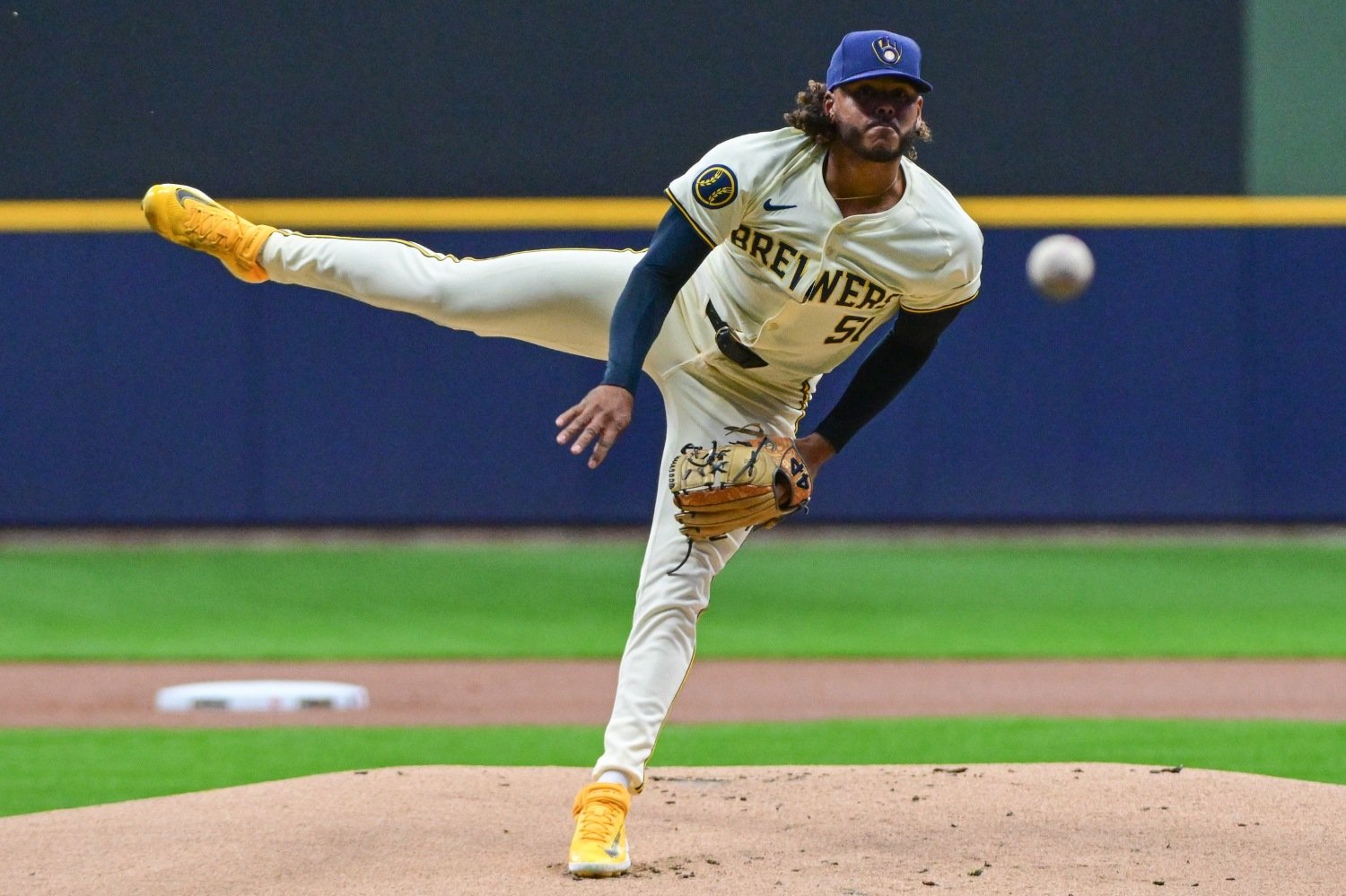 Last season, I (and many others) fell into the trap of seeing a Freddy Peralta fastball average over 18 inches of induced vertical break with his low release slot and an average velocity of over 95 miles per hour. Combining these three traits would create one of the best heaters in baseball. It's the type of fastball that makes one an ace. Fast-forward a few months, though, and Peralta’s fastball had declined to a more typical range for him—if not slightly below his normal metrics, when you account for a change in his arm angle. Let’s take a look at his TJStuff+ (courtesy of Thomas Nestico) during the 2024 season: The pink line represents his fastball. His slider is the green line; his changeup is in orange; and the curveball is in blue. With his slider and four-seam fastball as the dominant offerings, especially to right-handed batters, note the drop-offs from a 117/118 grade to start the season, a slow decline (with occasional rebounds), and an eventual settling into a 100-105 range in the second half of the year. The difference between these two marks is the difference between Mason Miller (119 TJstuff+ fastball) and Max Scherzer (102 TJstuff+) in 2024. The same happened with his slider as the year progressed: a sharp decline in the early months, and grading out below average in the second half. The volatility on display is part of what makes Peralta an infuriatingly talented arm, hinting at his capabilities but never maintaining the peaks of his success. If Peralta was able to find some way of retaining that early-season shape, he would be one of the best pitchers in all of baseball, but alas: this appears to be a common trend for him (albeit not quite to the same extent as we saw in 2024). 2023 Again, the four seam fastball starts out above 110 and drops to around 105 by the midpoint of the season. It’s a more consistent look than he found in 2024, for sure, but there is still that decline. The slider still dropped off really sharply as the season went on. 2021 This season comes with a bit of a caveat, given that the sticky stuff ban came in partway through the year. This was Peralta’s best season with the Brewers in terms of ERA, as he finished with a 2.81 mark in 144 ⅓ innings, but you can still see that fastball declining as the season went on. Interestingly, the slider retained its grading for the bulk of the season, which may be something to watch in 2025 as a marker for his success. Plainly, Peralta has a habit of starting out strong with his “stuff”, before fading as the season goes on. It’s a common trend that we need to be alert for as we start getting Statcast data in spring training, moving into the start of the season.
 -
The Future of Baseball (Probably) Doesn’t Include a Salary Cap and Floor - Cubs - North Side Baseball NORTHSIDEBASEBALL.COM As the Los Angeles Dodgers continue to gobble up the attention of the national media by bullying the rest of the league with their... You may like this piece!
-
 Hello and welcome! Today we’ll be taking a dive into the current revenue-sharing model in the game we all love, amid the ever growing disparity in spending between baseball’s big-market and small-market clubs. In doing so, we’ll review: The purpose of the revenue-sharing model, and its current status The loopholes within the current model Should additional sources of revenue be included within the model? Is it likely to change? I’ll probably get into the financial weeds in the rest of this article, but any and all questions in the comments about the finances or calculations, I’m more than happy to address! What Does The Current Revenue-Sharing Model Look Like, And Where Did It Originate? The initial revenue-sharing model for Major League Baseball was a method by which the league tried to share a portion of the local TV revenue brought in from the larger markets with those in smaller markets. The idea was, everyone would take 34% of their local revenue (TV rights, gate, concessions, and more) and put it into a pot, which would be evenly distributed among all teams. The reason for this is that local revenue is, at least in part, attributable to the brand of baseball. A portion of its value is inherently tied up in the financial success of other teams across the league, and as such, it made sense to distribute a portion of that (while still allowing big-market teams to function as big-market teams, with higher revenues). Providing a measure of stability to smaller-market clubs allows MLB to gradually increase the fandom of a team and improve its relationship with the area in which it operates, building a fan base and improving the product off the field, leading to larger TV deals across the board for all teams in both local and national media deals. The rate of pay was altered in 2017, increasing to 48% of all teams' local revenues, which seems a large number on the face of things—but as always, there are loopholes being exploited. This article is one in a four-piece collaboration across three DiamondCentric sites. For more on the current system's mechanics and viability, check out Matthew Lenz's piece today at Twins Daily. Meanwhile, at North Side Baseball, Brandon Glick writes about the viability, now or in the future, of a salary cap and floor system. Later this week, we'll share a roundtable between Lenz, Brandon Glick and McKibbin, about what they learned from this process and what they think ought to be done moving forward. The Two Big Loopholes Within The Current Model The first, and perhaps most fortunate one, is that of the LA Dodgers. In the early 2010s, with furor roiling over Frank McCourt siphoning off money, the sale to the Guggenheim group and the Dodgers being on the verge of bankruptcy, Major League Baseball cut them some slack. Before signing their new local TV deal, MLB said that for revenue sharing purposes, the value of the deal in 2013 would be capped at $84m, and increase by 4% year on year. The problem with that is that the Dodgers' TV deal with Spectrum Sportsnet LA has the potential to reach up to $8.5 billion over a 25-year period, depending on reach. That would have equated to $332 million per year. We know they made at least $196 million that way in 2022. There were struggles, and continue to be some to a lesser extent, for the Dodgers in getting the Spectrum product shared amongst other networks. The Spectrum cost per viewer was too high for other media sources to take on the coverage, so the deal is now more conservatively estimated at $7 billion over the 25-year period. In fairness to MLB, they did partially rectify their mistake and alter the starting point to $130m in 2013 after the deal was signed, however as you can see below, the Dodgers have saved almost $600m in the last 11 years: These are estimates, of course, but they give the gist. You can't blame the Dodgers for taking advantage of this scheme, but MLB most certainly gave them too much leeway, given that the deal extends over 25 years. It could be understood for the first two or three years to remove themselves from their borderline bankrupt status, but beyond that, it's contrary to the ethos of revenue sharing. The other loophole available is that revenue from local media deals can be manipulated if the club assumes part ownership of the broadcaster. While the value of local TV rights is still subject to revenue sharing, the profits made through part ownership of the network itself are not. The biggest exploiter of this is the New York Yankees with YES network, which rakes in about $500 million annually for them. Only around $200 million is estimated to have been included in the calculation for revenue sharing. Other clubs taking advantage of this are: Chicago Cubs (Marquee Sports) Boston Red Sox (New England Sports) Chicago White Sox (NBC Sports Chicago, and now CHSN) Atlanta Braves (Bally Sports South/South East) Detroit Tigers (Bally Sports Detroit) St Louis Cardinals (Bally Sports Midwest) Houston Astros (AT&T Sportsnet South West) Miami Marlins (Bally Sports Florida) Some of these teams have higher proportions of ownership than others, with the Marlins having less of a stake in BSF than the Cubs do with Marquee, as well as the wrinkle in how much success Bally Sports and the Sinclair Group are actually having as things currently stand. There is a risk factor attached to these teams in assuming part ownership, but in the bigger markets, that risk seems to be far smaller and the rewards more lucrative than in the smaller markets, and it’s allowing them to dodge significant revenue-sharing payments—particularly in the cases of the Yankees, the Cubs and the Red Sox. The biggest problem with both of these loopholes is not the added cash that your team would receive, which would be less than $10 million per annum in equal shares with the rest of the league, but the missed opportunity to reduce the cash available for big-market teams to splurge with. In doing so, the top-tier talent would have a greater chance to spread among the top 10 richest teams, rather than the top three or four. It’s allowing more monopolization to occur within the biggest markets. Going some of the way to close at least these loopholes would be positive steps for Major League Baseball as a whole. Can Other Forms Of Revenue Be Included In Revenue Sharing Agreements? Each team has a variety of revenue sources which can broadly be broken down into four categories: Ticket sales and concessions/game day experiences Local Media National Media Advertising and Sponsorship Local TV media being shared, as mentioned earlier, makes a lot of sense. You’re allowing teams to retain some of the advantage they’ve created from building a brand in their market, fielding competitive teams on a regular basis and showcasing a good product, while at the same time sending a portion of that to the other teams who have contributed to that product. Merchandise and advertising revenue doesn’t quite fall into the same category, with each team profiting off of their product and using the increased marketability of their stars to help cover the costs of those stars' salaries. In a way, it’s a natural offset, and sharing such revenue in greater proportion than they already do would feel heavily punitive. National Media is already shared equally among all 30 MLB teams, regardless of their time spent on screen in that particular year. The league distributes those fees after collecting them directly from national partners. That leaves us with ticket sales and other in-stadium revenue. This is a difficult topic, as it has a direct correlation to the product that a team puts on the field. For example, sharing the Dodgers' gate receipts in 2024 with the A’s arguably detracted from the point of revenue sharing, which is to allow more teams a capability of staying fiscally safe and creating competitive rosters. If an owner isn’t attempting to compete, then they shouldn’t be a recipient of additional funding. That being said, there is a disparity in the cost of tickets and stadium capacity of big-market teams, compared to their smaller counterparts. The Dodgers lead the league comfortably in average gameday attendance, while also charging a lot more than the MLB average per ticket: The league's average ticket price was around $38 in 2024, meaning the Brewers are significantly below the norm compared to the product they’ve put on the field, while the Dodgers' price of $54.22 on average blew that out of the water. As a result, they raked in over $130 million more than the Brewers did in 2024 from gate receipts. Bear in mind, the Brewers will have analytical models to pinpoint the ideal price point that will maximize profitability in any given year, so being on the cheaper end doesn’t mean you should treat it as a goodwill gesture (though they may have elected to slightly favor higher attendance, depending on the model's top 10 results). Given both sides spent between 50% and 52% of their overall revenue on payroll in 2024, you could argue that both teams spent largely within their means while attempting to remain competitive. Both teams reached the playoffs. I believe there is a strong argument for greater sharing of gate receipts among teams who meet certain criteria for attempted competition in a given year. Sharing 48% already makes it sound like the league is practically socialist as it is, but in truth, the yawning distance between their attendance revenues means that even after each chipped in their 48%, the Dodgers got $68 million more from ticket sales alone than the Brewers did last year. That's a big gap to leave. Maybe more should be shared to the pool, or maybe bigger-market teams should have to put a higher percentage of their revenues into the pot than smaller-market teams do. Let’s hypothesize, for a moment, that should a team: Spend 50% of its revenue on MLB payroll Achieve 78 wins or more in season Have an average capacity of 80% or higher Then such teams would be eligible to receive extra revenue sharing from the teams with the 10 highest game-day revenues, paid via a luxury tax on those revenues that goes beyond the flat 48%. Maybe that's 20% of the remaining 52%. Maybe it's less. Either way, more money would flow from rich teams to poor ones, providing the poorer teams were mounting a reasonable effort. Can the Revenue-Sharing Agreement Be Changed? As things stand, teams like the Yankees and Dodgers are unlikely to want to share more of their revenue with other teams. I firmly believe that either shutting down the Dodgers loophole based on a bankruptcy case that’s obviously no longer relevant today, sharing a proportion of local TV revenues (or losses, should they occur) that come from ownership of the network, or a second-level pool of gate receipts among teams meeting set criteria to determine an intent to compete would be beneficial in slightly hampering those in the biggest markets, while slightly improving the outlooks of those at the lower end of the market size spectrum. Any changes to revenue-sharing agreements would fall under the Collective Bargaining Agreements, the next of which will be negotiated in the 2026-27 offseason. The largest markets only have one vote per team, so it's possible that an attempt is made to rebalance the scales somewhat in the face of the growing gap between MLB’s smallest and largest markets. Any questions on any of the matters above, do feel free to ask in the comments below!
 -
The revenue-sharing model in MLB's collective bargaining agreement is designed to assist poorer teams and more evenly distribute wealth across all 30 clubs. Forged back in 2002 and oft-amended since, is the model flawed, or is it still serving its purpose? Image courtesy of © Jovanny Hernandez / Milwaukee Journal Sentinel / USA TODAY NETWORK Hello and welcome! Today we’ll be taking a dive into the current revenue-sharing model in the game we all love, amid the ever growing disparity in spending between baseball’s big-market and small-market clubs. In doing so, we’ll review: The purpose of the revenue-sharing model, and its current status The loopholes within the current model Should additional sources of revenue be included within the model? Is it likely to change? I’ll probably get into the financial weeds in the rest of this article, but any and all questions in the comments about the finances or calculations, I’m more than happy to address! What Does The Current Revenue-Sharing Model Look Like, And Where Did It Originate? The initial revenue-sharing model for Major League Baseball was a method by which the league tried to share a portion of the local TV revenue brought in from the larger markets with those in smaller markets. The idea was, everyone would take 34% of their local revenue (TV rights, gate, concessions, and more) and put it into a pot, which would be evenly distributed among all teams. The reason for this is that local revenue is, at least in part, attributable to the brand of baseball. A portion of its value is inherently tied up in the financial success of other teams across the league, and as such, it made sense to distribute a portion of that (while still allowing big-market teams to function as big-market teams, with higher revenues). Providing a measure of stability to smaller-market clubs allows MLB to gradually increase the fandom of a team and improve its relationship with the area in which it operates, building a fan base and improving the product off the field, leading to larger TV deals across the board for all teams in both local and national media deals. The rate of pay was altered in 2017, increasing to 48% of all teams' local revenues, which seems a large number on the face of things—but as always, there are loopholes being exploited. This article is one in a four-piece collaboration across three DiamondCentric sites. For more on the current system's mechanics and viability, check out Matthew Lenz's piece today at Twins Daily. Meanwhile, at North Side Baseball, Brandon Glick writes about the viability, now or in the future, of a salary cap and floor system. Later this week, we'll share a roundtable between Lenz, Brandon Glick and McKibbin, about what they learned from this process and what they think ought to be done moving forward. The Two Big Loopholes Within The Current Model The first, and perhaps most fortunate one, is that of the LA Dodgers. In the early 2010s, with furor roiling over Frank McCourt siphoning off money, the sale to the Guggenheim group and the Dodgers being on the verge of bankruptcy, Major League Baseball cut them some slack. Before signing their new local TV deal, MLB said that for revenue sharing purposes, the value of the deal in 2013 would be capped at $84m, and increase by 4% year on year. The problem with that is that the Dodgers' TV deal with Spectrum Sportsnet LA has the potential to reach up to $8.5 billion over a 25-year period, depending on reach. That would have equated to $332 million per year. We know they made at least $196 million that way in 2022. There were struggles, and continue to be some to a lesser extent, for the Dodgers in getting the Spectrum product shared amongst other networks. The Spectrum cost per viewer was too high for other media sources to take on the coverage, so the deal is now more conservatively estimated at $7 billion over the 25-year period. In fairness to MLB, they did partially rectify their mistake and alter the starting point to $130m in 2013 after the deal was signed, however as you can see below, the Dodgers have saved almost $600m in the last 11 years: These are estimates, of course, but they give the gist. You can't blame the Dodgers for taking advantage of this scheme, but MLB most certainly gave them too much leeway, given that the deal extends over 25 years. It could be understood for the first two or three years to remove themselves from their borderline bankrupt status, but beyond that, it's contrary to the ethos of revenue sharing. The other loophole available is that revenue from local media deals can be manipulated if the club assumes part ownership of the broadcaster. While the value of local TV rights is still subject to revenue sharing, the profits made through part ownership of the network itself are not. The biggest exploiter of this is the New York Yankees with YES network, which rakes in about $500 million annually for them. Only around $200 million is estimated to have been included in the calculation for revenue sharing. Other clubs taking advantage of this are: Chicago Cubs (Marquee Sports) Boston Red Sox (New England Sports) Chicago White Sox (NBC Sports Chicago, and now CHSN) Atlanta Braves (Bally Sports South/South East) Detroit Tigers (Bally Sports Detroit) St Louis Cardinals (Bally Sports Midwest) Houston Astros (AT&T Sportsnet South West) Miami Marlins (Bally Sports Florida) Some of these teams have higher proportions of ownership than others, with the Marlins having less of a stake in BSF than the Cubs do with Marquee, as well as the wrinkle in how much success Bally Sports and the Sinclair Group are actually having as things currently stand. There is a risk factor attached to these teams in assuming part ownership, but in the bigger markets, that risk seems to be far smaller and the rewards more lucrative than in the smaller markets, and it’s allowing them to dodge significant revenue-sharing payments—particularly in the cases of the Yankees, the Cubs and the Red Sox. The biggest problem with both of these loopholes is not the added cash that your team would receive, which would be less than $10 million per annum in equal shares with the rest of the league, but the missed opportunity to reduce the cash available for big-market teams to splurge with. In doing so, the top-tier talent would have a greater chance to spread among the top 10 richest teams, rather than the top three or four. It’s allowing more monopolization to occur within the biggest markets. Going some of the way to close at least these loopholes would be positive steps for Major League Baseball as a whole. Can Other Forms Of Revenue Be Included In Revenue Sharing Agreements? Each team has a variety of revenue sources which can broadly be broken down into four categories: Ticket sales and concessions/game day experiences Local Media National Media Advertising and Sponsorship Local TV media being shared, as mentioned earlier, makes a lot of sense. You’re allowing teams to retain some of the advantage they’ve created from building a brand in their market, fielding competitive teams on a regular basis and showcasing a good product, while at the same time sending a portion of that to the other teams who have contributed to that product. Merchandise and advertising revenue doesn’t quite fall into the same category, with each team profiting off of their product and using the increased marketability of their stars to help cover the costs of those stars' salaries. In a way, it’s a natural offset, and sharing such revenue in greater proportion than they already do would feel heavily punitive. National Media is already shared equally among all 30 MLB teams, regardless of their time spent on screen in that particular year. The league distributes those fees after collecting them directly from national partners. That leaves us with ticket sales and other in-stadium revenue. This is a difficult topic, as it has a direct correlation to the product that a team puts on the field. For example, sharing the Dodgers' gate receipts in 2024 with the A’s arguably detracted from the point of revenue sharing, which is to allow more teams a capability of staying fiscally safe and creating competitive rosters. If an owner isn’t attempting to compete, then they shouldn’t be a recipient of additional funding. That being said, there is a disparity in the cost of tickets and stadium capacity of big-market teams, compared to their smaller counterparts. The Dodgers lead the league comfortably in average gameday attendance, while also charging a lot more than the MLB average per ticket: The league's average ticket price was around $38 in 2024, meaning the Brewers are significantly below the norm compared to the product they’ve put on the field, while the Dodgers' price of $54.22 on average blew that out of the water. As a result, they raked in over $130 million more than the Brewers did in 2024 from gate receipts. Bear in mind, the Brewers will have analytical models to pinpoint the ideal price point that will maximize profitability in any given year, so being on the cheaper end doesn’t mean you should treat it as a goodwill gesture (though they may have elected to slightly favor higher attendance, depending on the model's top 10 results). Given both sides spent between 50% and 52% of their overall revenue on payroll in 2024, you could argue that both teams spent largely within their means while attempting to remain competitive. Both teams reached the playoffs. I believe there is a strong argument for greater sharing of gate receipts among teams who meet certain criteria for attempted competition in a given year. Sharing 48% already makes it sound like the league is practically socialist as it is, but in truth, the yawning distance between their attendance revenues means that even after each chipped in their 48%, the Dodgers got $68 million more from ticket sales alone than the Brewers did last year. That's a big gap to leave. Maybe more should be shared to the pool, or maybe bigger-market teams should have to put a higher percentage of their revenues into the pot than smaller-market teams do. Let’s hypothesize, for a moment, that should a team: Spend 50% of its revenue on MLB payroll Achieve 78 wins or more in season Have an average capacity of 80% or higher Then such teams would be eligible to receive extra revenue sharing from the teams with the 10 highest game-day revenues, paid via a luxury tax on those revenues that goes beyond the flat 48%. Maybe that's 20% of the remaining 52%. Maybe it's less. Either way, more money would flow from rich teams to poor ones, providing the poorer teams were mounting a reasonable effort. Can the Revenue-Sharing Agreement Be Changed? As things stand, teams like the Yankees and Dodgers are unlikely to want to share more of their revenue with other teams. I firmly believe that either shutting down the Dodgers loophole based on a bankruptcy case that’s obviously no longer relevant today, sharing a proportion of local TV revenues (or losses, should they occur) that come from ownership of the network, or a second-level pool of gate receipts among teams meeting set criteria to determine an intent to compete would be beneficial in slightly hampering those in the biggest markets, while slightly improving the outlooks of those at the lower end of the market size spectrum. Any changes to revenue-sharing agreements would fall under the Collective Bargaining Agreements, the next of which will be negotiated in the 2026-27 offseason. The largest markets only have one vote per team, so it's possible that an attempt is made to rebalance the scales somewhat in the face of the growing gap between MLB’s smallest and largest markets. Any questions on any of the matters above, do feel free to ask in the comments below! View full article
-
 The Los Angeles Dodgers have been nothing short of wild this offseason, signing Blake Snell, Roki Sasaki, Tanner Scott, Teoscar Hernández, Hyeseong Kim, Michael Conforto and Tommy Edman. It’s an embarrassment of riches in their rotation and their bullpen now, to add to an already incredible, World Series-winning lineup. They have 40-man roster depth in spades across a multitude of positions, but they are beginning to run out of space. Last season, the Dodgers made two trades that assisted them in making room. They sent Michael Busch and Yency Almonte to the Chicago Cubs for Zyhir Hope and Jackson Ferris, both of whom are consensus top-100 prospects. Hope, in particular, has produced some remarkable batted-ball data. They then traded Byran Hudson to the Brewers in return for Justin Chambers, a 2023 draftee who got 4th-round bonus money. The Dodgers' returns in these trades give an insight into their goal when making such deals: to acquire high-upside, unproven talent in exchange for MLB-ready pieces they don't strictly need. Often a tactic for teams struggling to contend, the Dodgers' version of trading from the big-league roster for far-off prospects keeps a pipeline of homegrown talent flowing while they dominate the league with expensive stars. The Milwaukee Brewers' farm system isn’t ranked as highly this offseason by many publications as they were last year, after the graduation of Jackson Chourio, but that’s not so much down to the lack of overall talent as to the dearth of projected impact players at the upper levels. The lower levels of their farm system are absolutely flooded with talent, giving them the tools to make such a deal with the Dodgers. Of all the talents on the Dodgers' 40 man roster, there are two who may fit the Brewers to a T: Dustin May - SP May has struggled with injury in recent seasons, most recently with a torn esophagus (ouch!), but his underlying stuff is among the best in the league. In his final season before free agency, this is a big year for May. Dustin May’s arsenal is fantastic, with all five pitches missing barrels in the zone and all of them (although not quite so much in 2023) able to generate prolific swing-and-miss. The Brewers have recently been intrigued by pitchers with three fastball variations, and May has an above-average sinker, four-seamer and cutter. The 18 inches of horizontal break on his two-seamer is monstrous, and this was a year in which May was struggling to control the zone. A low release height and big extension are cues for success amongst fastballs, and that’s no different for May. His pitches all tunnel beautifully together as well, per Jeremy Maschino's model: His injury history is horrible; he's pitched over 50 innings just once. However, his upside is massive. Projected by Steamer for a 3.65 ERA in just 87 innings this season, this would be a gamble on the Brewers’ part, but it may be one they need to take to truly move forward in a division that will be hotly contended from a variety of directions in 2025. Bobby Miller - SP As well as May, this is one other name the Brewers may be intrigued in. Miller struggled mightily in 2024 but has, again, ace-like upside, while being controllable for several more years. The Dodgers are unlikely to sell low on him, because his fastball shape is among the best in baseball to complement an electric changeup and curveball, but the depth they have in their rotation and the strength of the Brewers' lower minor-league talent may allow a deal to be made based on his upside. Miller has all the tools to be successful, but his location did let him down in 2024. It’s fair to say a portion of that was injury-related, though, given he had no such problems in his short MLB stint in 2023 That total pitching score is one of the most impressive I’ve seen in Jeremy Maschino’s model, and if the Brewers have any chance of acquiring this type of arm—even if the cost is a youngster with big, real upside—that could be entirely worth it. I suspect May is more available than Miller, as things stand, due to the team control and injury history of each. At the very least, we can say that May would be much cheaper to acquire. While I have long been intrigued as to whether the Brewers can move on Miller this offseason, the chances are much slimmer there. The Dodgers won't feel any inherent rush to move either of these players, specifically, but they almost have to move someone who belongs to that class of player. The Brewers might as well be proactive and try to be the team with whom they partner. Given even halfway decent health for the Los Angeles pitching staff, Miller is likely to start the season in the minor leagues, which defies logic in many ways. They have a surplus of rostered talent, and moving it with the Brewers could make sense for all parties involved. Can you see any other players from the Dodgers' 40-man roster who would fit well with the Brewers? Would you go after either May or Miller? Let us know your thoughts in the comments below!
 -
Last year, the Brewers snatched Bryan Hudson from the Dodgers during a roster crunch. Can they replicate that success with another high-upside talent on the outskirts of a packed Dodgers roster? Image courtesy of © Jayne Kamin-Oncea-Imagn Images The Los Angeles Dodgers have been nothing short of wild this offseason, signing Blake Snell, Roki Sasaki, Tanner Scott, Teoscar Hernández, Hyeseong Kim, Michael Conforto and Tommy Edman. It’s an embarrassment of riches in their rotation and their bullpen now, to add to an already incredible, World Series-winning lineup. They have 40-man roster depth in spades across a multitude of positions, but they are beginning to run out of space. Last season, the Dodgers made two trades that assisted them in making room. They sent Michael Busch and Yency Almonte to the Chicago Cubs for Zyhir Hope and Jackson Ferris, both of whom are consensus top-100 prospects. Hope, in particular, has produced some remarkable batted-ball data. They then traded Byran Hudson to the Brewers in return for Justin Chambers, a 2023 draftee who got 4th-round bonus money. The Dodgers' returns in these trades give an insight into their goal when making such deals: to acquire high-upside, unproven talent in exchange for MLB-ready pieces they don't strictly need. Often a tactic for teams struggling to contend, the Dodgers' version of trading from the big-league roster for far-off prospects keeps a pipeline of homegrown talent flowing while they dominate the league with expensive stars. The Milwaukee Brewers' farm system isn’t ranked as highly this offseason by many publications as they were last year, after the graduation of Jackson Chourio, but that’s not so much down to the lack of overall talent as to the dearth of projected impact players at the upper levels. The lower levels of their farm system are absolutely flooded with talent, giving them the tools to make such a deal with the Dodgers. Of all the talents on the Dodgers' 40 man roster, there are two who may fit the Brewers to a T: Dustin May - SP May has struggled with injury in recent seasons, most recently with a torn esophagus (ouch!), but his underlying stuff is among the best in the league. In his final season before free agency, this is a big year for May. Dustin May’s arsenal is fantastic, with all five pitches missing barrels in the zone and all of them (although not quite so much in 2023) able to generate prolific swing-and-miss. The Brewers have recently been intrigued by pitchers with three fastball variations, and May has an above-average sinker, four-seamer and cutter. The 18 inches of horizontal break on his two-seamer is monstrous, and this was a year in which May was struggling to control the zone. A low release height and big extension are cues for success amongst fastballs, and that’s no different for May. His pitches all tunnel beautifully together as well, per Jeremy Maschino's model: His injury history is horrible; he's pitched over 50 innings just once. However, his upside is massive. Projected by Steamer for a 3.65 ERA in just 87 innings this season, this would be a gamble on the Brewers’ part, but it may be one they need to take to truly move forward in a division that will be hotly contended from a variety of directions in 2025. Bobby Miller - SP As well as May, this is one other name the Brewers may be intrigued in. Miller struggled mightily in 2024 but has, again, ace-like upside, while being controllable for several more years. The Dodgers are unlikely to sell low on him, because his fastball shape is among the best in baseball to complement an electric changeup and curveball, but the depth they have in their rotation and the strength of the Brewers' lower minor-league talent may allow a deal to be made based on his upside. Miller has all the tools to be successful, but his location did let him down in 2024. It’s fair to say a portion of that was injury-related, though, given he had no such problems in his short MLB stint in 2023 That total pitching score is one of the most impressive I’ve seen in Jeremy Maschino’s model, and if the Brewers have any chance of acquiring this type of arm—even if the cost is a youngster with big, real upside—that could be entirely worth it. I suspect May is more available than Miller, as things stand, due to the team control and injury history of each. At the very least, we can say that May would be much cheaper to acquire. While I have long been intrigued as to whether the Brewers can move on Miller this offseason, the chances are much slimmer there. The Dodgers won't feel any inherent rush to move either of these players, specifically, but they almost have to move someone who belongs to that class of player. The Brewers might as well be proactive and try to be the team with whom they partner. Given even halfway decent health for the Los Angeles pitching staff, Miller is likely to start the season in the minor leagues, which defies logic in many ways. They have a surplus of rostered talent, and moving it with the Brewers could make sense for all parties involved. Can you see any other players from the Dodgers' 40-man roster who would fit well with the Brewers? Would you go after either May or Miller? Let us know your thoughts in the comments below! View full article
-
I agree on all fronts. If they give $20m AAV to a tanner Scott is an overpayment, but Scott and Hodge to close down the 8th and 9th is a strong duo. The Brewers consistent over performance is no fluke at this point, while the Cubs have struggled to grind out the tough patches and that's essentially what's done the damage in each of 2023 & 2024. If neither side drifts from that success/struggle, I'd still edge with the Crew but as you say it's really a toss up as things stand

.png.9f92ee75b624990d07dc955e75ccdc29.png)
