Jake McKibbin
-
Posts
2,395 -
Joined
-
Last visited
-
Days Won
6
Content Type
Profiles
Forums
Blogs
Events
News
2026 Milwaukee Brewers Top Prospects Ranking
Milwaukee Brewers Videos
2022 Milwaukee Brewers Draft Picks
Milwaukee Brewers Free Agent & Trade Rumors, Notes, & Tidbits
Guides & Resources
2023 Milwaukee Brewers Draft Picks
2024 Milwaukee Brewers Draft Picks
The Milwaukee Brewers Players Project
2025 Milwaukee Brewers Draft Pick Tracker
2026 Milwaukee Brewers Draft Tracker: Picks & Bonuses
Store
Downloads
Gallery
Everything posted by Jake McKibbin
-
6'5, 220?
-
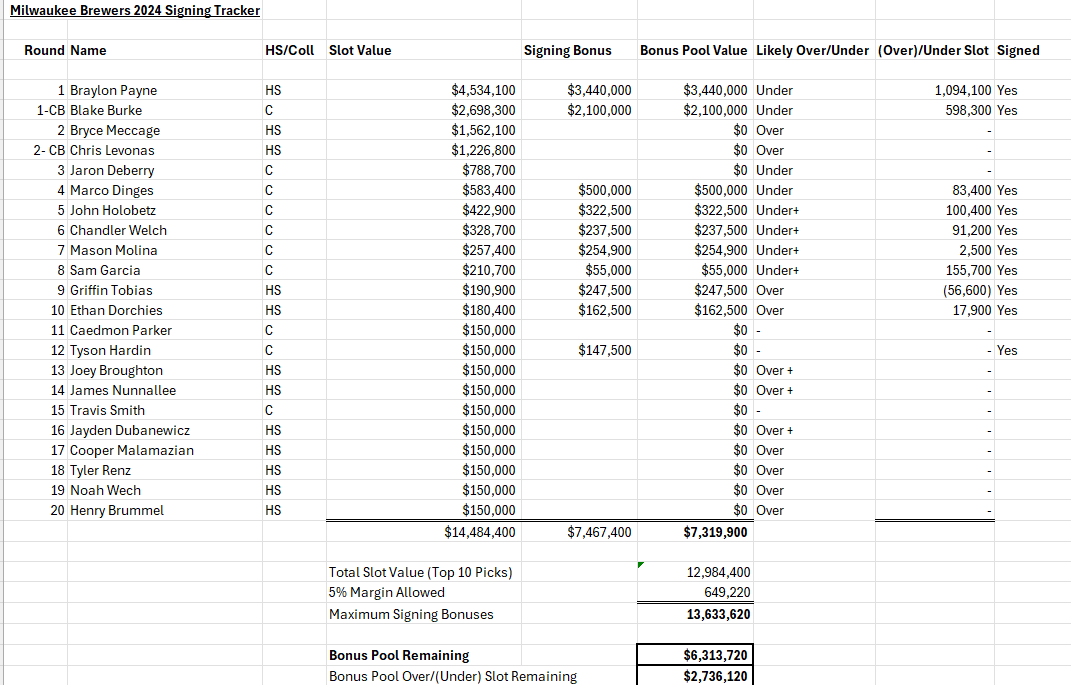
2024 Draft Signings Thread
Jake McKibbin replied to Jake McKibbin's topic in MLB Draft & International Signings
Unsure of the accounts validity and may be old information, but still the most likely outcome here -
2024 Draft Signings Thread
Jake McKibbin replied to Jake McKibbin's topic in MLB Draft & International Signings
Seems like they've admitted defeat on some HS picks past round 10, but that might hint that Levonas is closer? Perhaps loking too into it, but if the likes of Nunnallee and others are the ones out it suggests they have that money tied up elsewhere.. either way seems like we're likely to know more today! -
2024 Draft Signings Thread
Jake McKibbin replied to Jake McKibbin's topic in MLB Draft & International Signings
Yeah, especially Caedmon Parker. I'd imagine those college picks will sign but I guess nothing's guaranteed. I'd also imagine the Brewers have ideas of numbers for those day 3 guys all sorted out and ready to go should Levonas not sign, so they'll not just be twiddling their thumbs but yeah. Spencer has left me a lil down on him signing at this point so trying to stay excited about Broughton instead -
He's got a mutual option for $20m with a $2m buyout for 2025 but it's hard to see the Brewers picking that up so yes I'd treat this as a rental. Pitch mix tweaks can be done relatively quickly and they'll get some benefit from it in the immediate future especially as it usually takes time to see the adjustments and adjust back for hitters. That's me putting a positive spin on things, but for more details on what exactly he can do Matt has written an excellent piece here
-
2024 Draft Signings Thread
Jake McKibbin replied to Jake McKibbin's topic in MLB Draft & International Signings
I've updated the initial page as we go along if that helps, so just go to the first post in this thread I'd imagine it'll all depend on Levonas and his offer. There'll probably be a deadline in place and after that the Brewers will direct that cash towards the Day 3 picks -
Giving up on Jakob Junis in his hybrid role for Frankie Montas and his 5.01 ERA this season is an out-of-left-field move from the Brewers, but does it really upgrade their playoff push? Image courtesy of © Katie Stratman-USA TODAY Sports Trading for two players with an ERA over 5.00 doesn’t usually fit into the trade deadline plans for a playoff competitor, and unlike Nick Mears, there has been no obvious misfortune in Frankie Montas conceding these runs, with peripheral metrics backing them up. Montas has some assets that were highlighted in his start to the season, with the ability to generate a lot of ground balls on that split finger and get quick outs, carrying him deep into games, but the other pitches in his arsenal have been unsuccessful to say the least. Montas has struggled with both generating strikeouts and limiting walks on the year. The Brewers had a surplus of talent in one area and a dearth in another. The surplus was in their long relief corps, with DL Hall stretched out at Nashville and Joe Ross positioned to complement Bryse Wilson, depending on whether they go with a five- or six-man rotation down the stretch. Hall hasn’t thrown over 62 pitches since April, and the Brewers may now be seeing him as the ideal man to replace Jakob Junis in the pen, with his fastball having regained some of its former vigor. There are only so many occasions where that longer relief is needed, and as such, Junis (in his current role) may have been redundant, especially with the Brewers' reluctance to stretch him out further with concerns over his “scratchy shoulder”. Montas’s splitter is a truly elite pitch, and the Brewers may see a way of restructuring his sequencing and locations to get more out of it and hide the weakness in his three-fastball mix, especially his cutter. He’s getting a little less horizontal cut than in his prime years but the real issue is command: Results-wise, Montas has two effective pitches in the slider and splitter, and by tweaking the usage of the four-seamer and sinker he may be able to get them by well enough to take advantage of those off speed offerings Whether Montas is exactly what the Brewers needed is arguable. I’m not entirely sure he presents an upgrade on Ross, should they stick with a five-man rotation. Joey Wiemer has had a hot July without the high exit velocities to assure anyone that it can be consistent. Junis was valuable, but may be replaced by Hall on his return as a longer reliever. As such, they haven’t traded a whole lot to get Montas. He can provide length and quick outs that should play up with the Brewers' premium “run-prevention unit,” as they like to call it, and Montas has the experience to slot quickly into the Brewers rotation. All that being noted, the Brewers' biggest need at the deadline was a pitcher they trusted to get outs in a playoff game against the best hitters in the league. Yes, that comes with a hefty cost, but the Brewers offense--with a firing Jackson Chourio, a (potentially) rejuvenated Christian Yelich and the likes of Willy Adames, William Contreras and Rhys Hoskins finding form at the right time--is capable of making a deep run. Montas doesn't appear to be that frontline pitcher. His sheer stuff and velocity have ticked down since his shoulder surgery last season, and even if it does work out, they'll have another pitcher hovering around an earned run average of 4.00, rather than one who's capable of going a month with a sub-3.00 and who can strike out elite opponents. They’re still missing that caliber of pitcher, and with the offense not all that consistent from one day to another, this doesn't instill a lot of confidence in the Brewers making a deep playoff run--barring a further addition. View full article
-
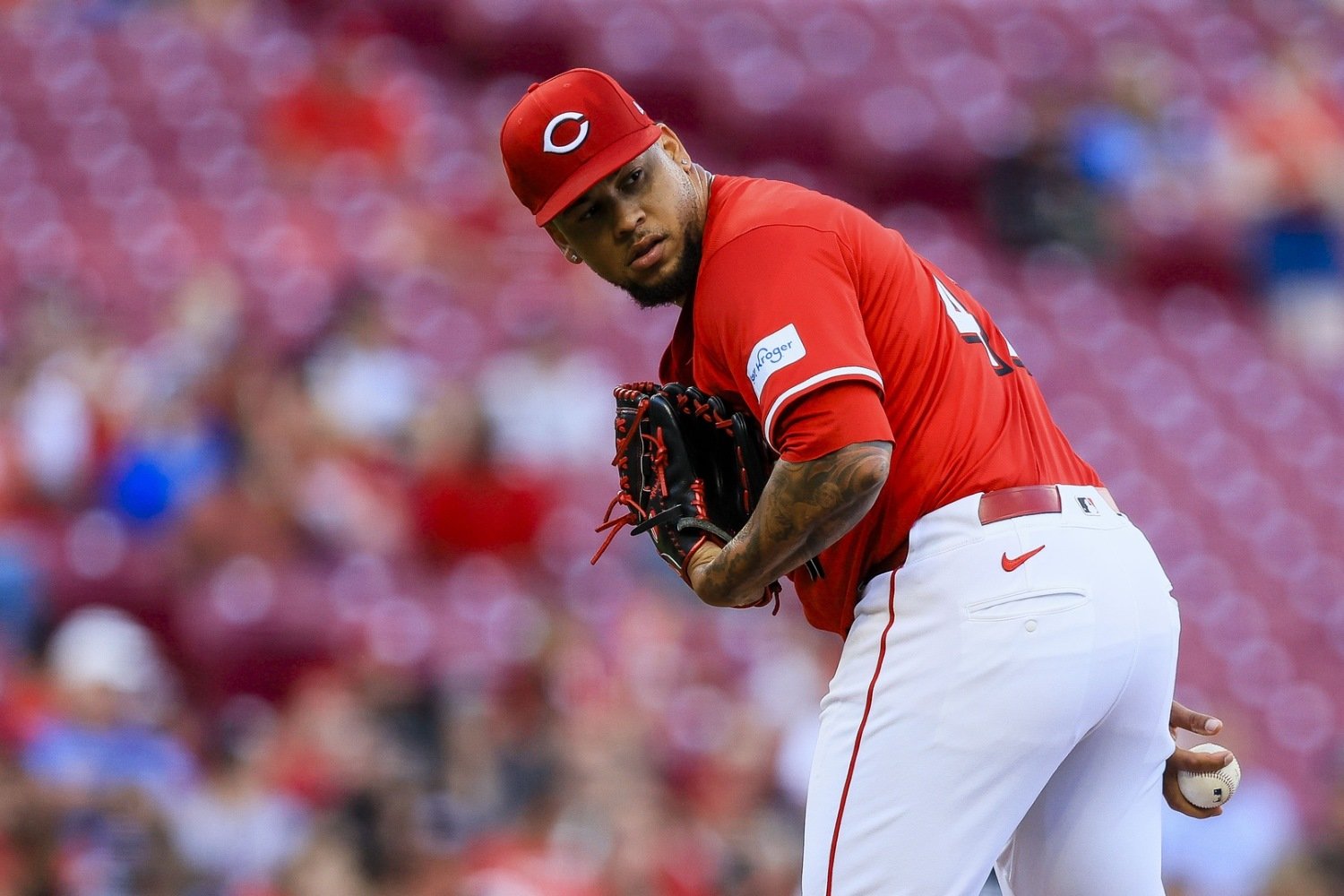 Trading for two players with an ERA over 5.00 doesn’t usually fit into the trade deadline plans for a playoff competitor, and unlike Nick Mears, there has been no obvious misfortune in Frankie Montas conceding these runs, with peripheral metrics backing them up. Montas has some assets that were highlighted in his start to the season, with the ability to generate a lot of ground balls on that split finger and get quick outs, carrying him deep into games, but the other pitches in his arsenal have been unsuccessful to say the least. Montas has struggled with both generating strikeouts and limiting walks on the year. The Brewers had a surplus of talent in one area and a dearth in another. The surplus was in their long relief corps, with DL Hall stretched out at Nashville and Joe Ross positioned to complement Bryse Wilson, depending on whether they go with a five- or six-man rotation down the stretch. Hall hasn’t thrown over 62 pitches since April, and the Brewers may now be seeing him as the ideal man to replace Jakob Junis in the pen, with his fastball having regained some of its former vigor. There are only so many occasions where that longer relief is needed, and as such, Junis (in his current role) may have been redundant, especially with the Brewers' reluctance to stretch him out further with concerns over his “scratchy shoulder”. Montas’s splitter is a truly elite pitch, and the Brewers may see a way of restructuring his sequencing and locations to get more out of it and hide the weakness in his three-fastball mix, especially his cutter. He’s getting a little less horizontal cut than in his prime years but the real issue is command: Results-wise, Montas has two effective pitches in the slider and splitter, and by tweaking the usage of the four-seamer and sinker he may be able to get them by well enough to take advantage of those off speed offerings Whether Montas is exactly what the Brewers needed is arguable. I’m not entirely sure he presents an upgrade on Ross, should they stick with a five-man rotation. Joey Wiemer has had a hot July without the high exit velocities to assure anyone that it can be consistent. Junis was valuable, but may be replaced by Hall on his return as a longer reliever. As such, they haven’t traded a whole lot to get Montas. He can provide length and quick outs that should play up with the Brewers' premium “run-prevention unit,” as they like to call it, and Montas has the experience to slot quickly into the Brewers rotation. All that being noted, the Brewers' biggest need at the deadline was a pitcher they trusted to get outs in a playoff game against the best hitters in the league. Yes, that comes with a hefty cost, but the Brewers offense--with a firing Jackson Chourio, a (potentially) rejuvenated Christian Yelich and the likes of Willy Adames, William Contreras and Rhys Hoskins finding form at the right time--is capable of making a deep run. Montas doesn't appear to be that frontline pitcher. His sheer stuff and velocity have ticked down since his shoulder surgery last season, and even if it does work out, they'll have another pitcher hovering around an earned run average of 4.00, rather than one who's capable of going a month with a sub-3.00 and who can strike out elite opponents. They’re still missing that caliber of pitcher, and with the offense not all that consistent from one day to another, this doesn't instill a lot of confidence in the Brewers making a deep playoff run--barring a further addition.
 -
I did talk about the breaking stuff as well not just on the road Vs at home but overall and in particular the curve. I think the fastball has some issues that I hope don't flare up but it is worth keeping an eye on. I think it's great but we also know Matt Bush had some nice FB metrics but got hammered a bit. I'd also say over the last couple of months to the eye test Megill hasn't looked as solid and there have been a lot of deep fly balls that put a lump in your throat. I think Mears will be good and I do think there's a tweak in the breaking pitches he uses but does being elevated at 95+ regularly enough give something to watch, I think so. Anyway happy to leave it there!
-
I can see both sides here, it's not likely to do damage to all fields but also Isaac Paredes is making a living out of pulling balls down the line for HR's at that launch angle. So it's still absolutely relevant for me and a useful statistic
-
There's clearly some difference in how they're measured but it's not a wonky definition at all with a ton of variables. I think savant maybe tapers barrels more within a high exit velo, in the a 10 degree LA can be a barrel if you hit it 120 mph whereas Trumedia includes all hard hit balls with the sweet spot launch angle but either way I'm happy enough saying that the barrel rate presented by Trumedia gives me some cause for concern and it's a justifiable opinion. Being hit 95+ with optimal launch angles is never ideal. I can't say for sure that's the difference as I'm currently on my phone and out in town, but Trumedia is a very good source of statistical information used by a lot of baseball writers so I'm happy to back it's relevance here
-
Thanks Matt, just went to screenshot it myself! Didn't realize the differential was quite so vast and may use other indicators to back it up in future, but the sweet spot rates per batted ball being 45.2% as well is a fairly strong indicator it hasn't entirely worked out for him in terms of movement and my point essentially is that I'm hoping he doesn't turn out like a Nate Pearson/Matt Bush type with the stuff on paper that doesn't quite translate to in game success
-
2024 Draft Signings Thread
Jake McKibbin replied to Jake McKibbin's topic in MLB Draft & International Signings
I wondered that too, it came out yesterday at $25k however so yeah big underslot there -
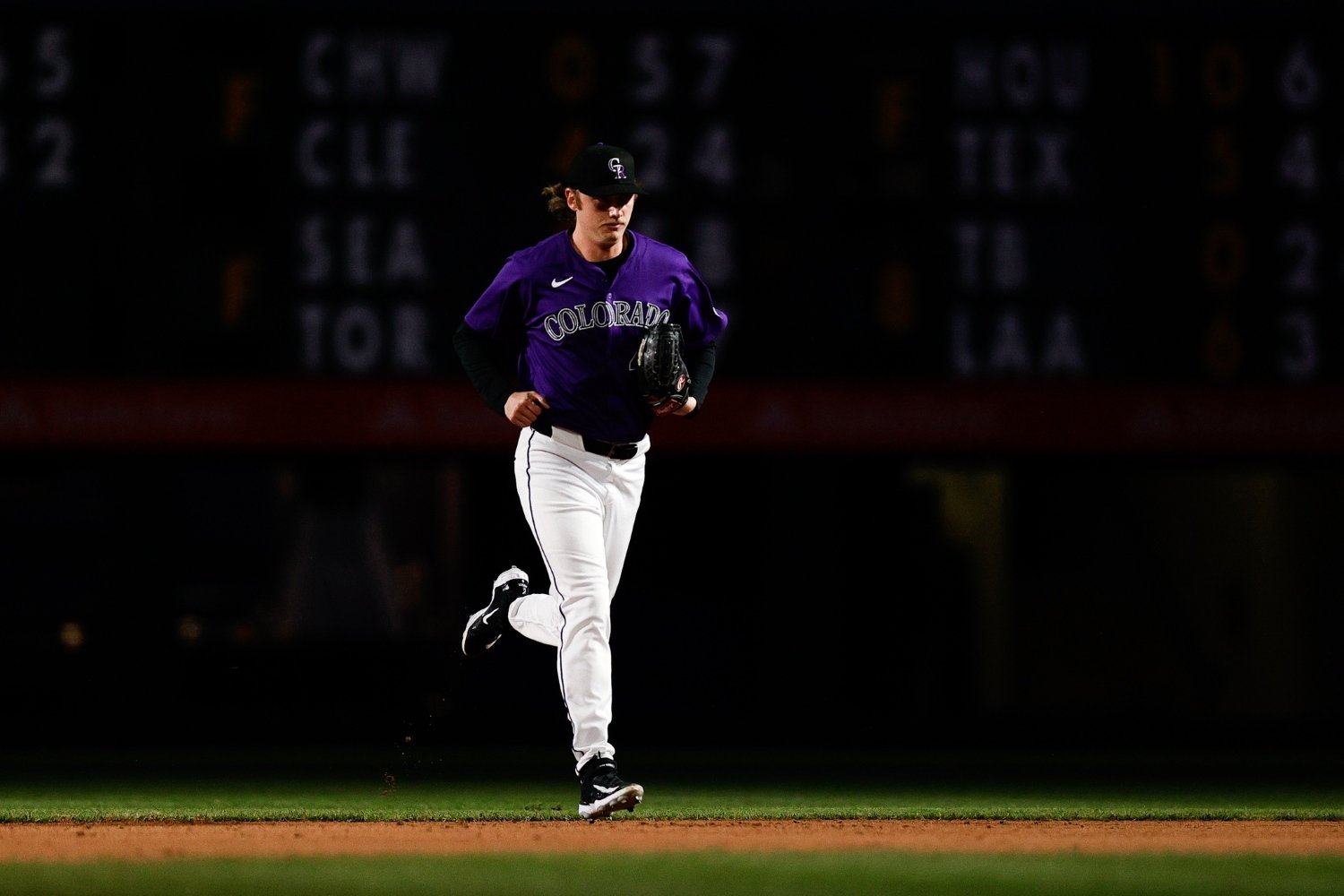 On Saturday evening, the Brewers traded for relief pitcher Nick Mears from the Colorado Rockies, giving up Yujanyer Herrera and Bradley Blalock. Mears has a 5.56 ERA this season, which doesn’t jump off the page, but it does initially appear that he’s been burned to some extent by his defense, given his 2.70 FIP and impressive 28.1% strikeout rate. The Brewers pen struggled earlier in the year with getting that swing-and-miss element, but with Devin Williams's return, Joel Payamps finding some form and then Trevor Megill, the Brewers may have four elite strikeout merchants that they can deploy in situations such as the one Elvis Peguero struggled with on Saturday night to escape a jam. Some may be slightly perturbed by Mears being more effective in Colorado than he has been on the road, given Denver's friendliness to hitters. However, the biggest issue with playing at elevation isn’t always the elevation itself, so much as having to adjust with such frequency to how your pitches function at different elevations. He’s struggled more with walks while on the road, which lends some credence to this, but he's still kept up the gaudy strikeout numbers and he's given up just two home runs all year. He won't be back at Coors Field this season, so being able to have that consistency with how the pitches move should be beneficial to his command. What Makes Him Different? I’ll have to credit Matthew Trueblood for the observation that Mears's stuff has a very different profile from a lot of the Brewers relievers, who favor horizontal movement with their sweepers and two-seamers from lowish arm slots. With a fastball like his, Mears can still generate significant swing-and-miss, with the added advantage of that more downward action on his breaking pitches being conducive to ground balls and getting underneath the bat. Given the slider and curveball are slightly different speeds but have similar movement profiles, he may consider ditching one of them, and I’d advocate that it be the curveball, due to how much better he commands the slider (slider on the left, curveball on the right): The slider has better quality-of-contact metrics, in large part because of a tendency to hang the curveball more than he would like. When you narrow down more in terms of sequencing, when used after the four-seamer, the slider has been massively more effective. He hasn’t given up a single hard-hit ball this season on the slider, compared with a 17.6% barrel rate for the curveball. He’s thrown the curve a lot more in these situations, but it is something you may look to change. The Fastball Is Electric Mears real strength is his fastball, which has the type of movement you dream of in a late-inning reliever, and it really plays up when away from Coors Field. On the road this year, it averages 19” of induced vertical break (an elite number that creates an appearance of the pitch rising while it defies gravity) from a highish release slot. The real damage he does comes from his velocity and above-average extension, releasing the ball close to home plate in a way that makes it seem as though he’s throwing almost 98 mph on average. When located in the upper third of the zone (and away from Coors Field), Mears induces a whiff rate of 31.3% on the heater, again an elite number, and his slider can really play well off of that. It’s a blink-and-you-’ll-miss-it offering that’s incredibly effective, not just because of the swing and miss but based on how well it avoids barrels. A Word of Caution There are two factors that may hinder Mears with the Brewers. His four-seam fastball has been barreled up at almost double the rate away from Coors Field, despite the improved metrics on the pitch. This is where the consistency in the air/lack of elevation can hopefully make a big turnaround for him in terms of results, but a 24.2% barrel rate just will not play at this level. Then there are the walks. A late-inning reliever will give up runs every now and then, but they cannot afford to be walking people with regularity. Mears has walked hitters more than you would like, but there is a hope that, again, he can be more effective with a more consistent playing field. He overall has avoided barrels well enough to project he can be effective with an above-average walk rate, but it still needs to improve from where it is now, at a 10.3% walk rate. So How Shrewd Is This Pickup? Nick Mears has the kind of arm talent that’s reminiscent of Megill, with an elite fastball and quality breaking pitches that the Crew's pitching lab can get more out of than even his peripherals are suggesting. Yujanyer Herrera was a talented arm to give up, but the Brewers have a lot of such arms in the lower levels of the minors; they can afford to trade from a position of organizational depth. Given Mears has such a different look compared to everyone else (save Megill), and the best bullpens should have a variety of pitch shapes and angles, it may be a big boost if they use him well. They’ll need more from Mears than just looking pretty on paper, but the Brewers front office are excited about this pickup and the boost he can give them through 2027.
 -
Nick Mears may just be the option the Brewers need, with an electric fastball and some underrated breaking stuff. Some stats may give pause, but here’s why you should be excited about the Brewers' latest pickup. Image courtesy of © Isaiah J. Downing-USA TODAY Sports On Saturday evening, the Brewers traded for relief pitcher Nick Mears from the Colorado Rockies, giving up Yujanyer Herrera and Bradley Blalock. Mears has a 5.56 ERA this season, which doesn’t jump off the page, but it does initially appear that he’s been burned to some extent by his defense, given his 2.70 FIP and impressive 28.1% strikeout rate. The Brewers pen struggled earlier in the year with getting that swing-and-miss element, but with Devin Williams's return, Joel Payamps finding some form and then Trevor Megill, the Brewers may have four elite strikeout merchants that they can deploy in situations such as the one Elvis Peguero struggled with on Saturday night to escape a jam. Some may be slightly perturbed by Mears being more effective in Colorado than he has been on the road, given Denver's friendliness to hitters. However, the biggest issue with playing at elevation isn’t always the elevation itself, so much as having to adjust with such frequency to how your pitches function at different elevations. He’s struggled more with walks while on the road, which lends some credence to this, but he's still kept up the gaudy strikeout numbers and he's given up just two home runs all year. He won't be back at Coors Field this season, so being able to have that consistency with how the pitches move should be beneficial to his command. What Makes Him Different? I’ll have to credit Matthew Trueblood for the observation that Mears's stuff has a very different profile from a lot of the Brewers relievers, who favor horizontal movement with their sweepers and two-seamers from lowish arm slots. With a fastball like his, Mears can still generate significant swing-and-miss, with the added advantage of that more downward action on his breaking pitches being conducive to ground balls and getting underneath the bat. Given the slider and curveball are slightly different speeds but have similar movement profiles, he may consider ditching one of them, and I’d advocate that it be the curveball, due to how much better he commands the slider (slider on the left, curveball on the right): The slider has better quality-of-contact metrics, in large part because of a tendency to hang the curveball more than he would like. When you narrow down more in terms of sequencing, when used after the four-seamer, the slider has been massively more effective. He hasn’t given up a single hard-hit ball this season on the slider, compared with a 17.6% barrel rate for the curveball. He’s thrown the curve a lot more in these situations, but it is something you may look to change. The Fastball Is Electric Mears real strength is his fastball, which has the type of movement you dream of in a late-inning reliever, and it really plays up when away from Coors Field. On the road this year, it averages 19” of induced vertical break (an elite number that creates an appearance of the pitch rising while it defies gravity) from a highish release slot. The real damage he does comes from his velocity and above-average extension, releasing the ball close to home plate in a way that makes it seem as though he’s throwing almost 98 mph on average. When located in the upper third of the zone (and away from Coors Field), Mears induces a whiff rate of 31.3% on the heater, again an elite number, and his slider can really play well off of that. It’s a blink-and-you-’ll-miss-it offering that’s incredibly effective, not just because of the swing and miss but based on how well it avoids barrels. A Word of Caution There are two factors that may hinder Mears with the Brewers. His four-seam fastball has been barreled up at almost double the rate away from Coors Field, despite the improved metrics on the pitch. This is where the consistency in the air/lack of elevation can hopefully make a big turnaround for him in terms of results, but a 24.2% barrel rate just will not play at this level. Then there are the walks. A late-inning reliever will give up runs every now and then, but they cannot afford to be walking people with regularity. Mears has walked hitters more than you would like, but there is a hope that, again, he can be more effective with a more consistent playing field. He overall has avoided barrels well enough to project he can be effective with an above-average walk rate, but it still needs to improve from where it is now, at a 10.3% walk rate. So How Shrewd Is This Pickup? Nick Mears has the kind of arm talent that’s reminiscent of Megill, with an elite fastball and quality breaking pitches that the Crew's pitching lab can get more out of than even his peripherals are suggesting. Yujanyer Herrera was a talented arm to give up, but the Brewers have a lot of such arms in the lower levels of the minors; they can afford to trade from a position of organizational depth. Given Mears has such a different look compared to everyone else (save Megill), and the best bullpens should have a variety of pitch shapes and angles, it may be a big boost if they use him well. They’ll need more from Mears than just looking pretty on paper, but the Brewers front office are excited about this pickup and the boost he can give them through 2027. View full article
-
2024 Draft Signings Thread
Jake McKibbin replied to Jake McKibbin's topic in MLB Draft & International Signings
That includes the overage -
2024 Draft Signings Thread
Jake McKibbin replied to Jake McKibbin's topic in MLB Draft & International Signings
DeBerry has signed but the value hasn't been mentioned anywhere -
2024 Draft Signings Thread
Jake McKibbin replied to Jake McKibbin's topic in MLB Draft & International Signings
I wonderif say DeBerry signed for 400k, would the Brewers choose to go all in with 3.4m for Levonas (If that's even enough) or would they prefer spreading it round multiple picks? It's a lot to gamble on for one HS pitcher but such a talented arm -
The news about Christian Yelich's back injury doesn't sound good. The possibility of season-ending surgery has been mentioned, and should that happen, the Brewers would have a gaping hole in their lineup. They would need a consistent middle-of-the-lineup hitter with power. Where can they find one? Image courtesy of © Jerome Miron-USA TODAY Sports The best possible news for the Brewers would be for Christian Yelich to finally fix his long-term, nagging back issue, while still returning in time for September and/or October (assuming the Brewers reach the postseason). From Yelich’s quotes, however, it sounds like season-ending surgery is very much on the table, in which case the question turns to whether the Brewers' outfield and DH mix is sufficient for a team hoping to win a World Series. In the immediate future, in either case, there are likely to be more plate appearances for Jake Bauers, while the young quarter of Blake Perkins, Garrett Mitchell, Sal Frelick and Jackson Chourio roam the outfield grass and provide what should be elite defense. The problem is that Chourio is the only one you’d want at the plate in a big moment right now; there are substantial question marks over the other three. Frelick has been better in the last month, but still struggles to pose any extra-base threat. Mitchell is still hitting ground balls and whiffing a lot, while Perkins has a high strikeout rate and provides fairly minimal extra-base power, as well. Even taking into account the lack of form from some of the Brewers' streakier power hitters (which has resulted in the Brewers ranking 27th in home runs and 30th in doubles since Jun. 1), the lineup needs more thump. Regression won't take care of this. These players might. Jesse Winker Poetic irony at its finest, Jesse Winker has found the health that eluded him for much of last season and has been mashing all season, especially in July. His defense hasn’t been great, but his arm has been good, and he’s stolen 14 bases, with his average sprint speed rebounding substantially from its levels in 2023. In short, he looks healthy, and the bat looks to be getting better and better as the season goes on. Since Jun. 1, he has a .294/.414/.476 slash line, thanks in substantial part to crushing four-seamers, something he couldn't catch up to last season at all. Winker’s ending in a Milwaukee uniform last season wasn’t a fond one for fans or the player. He was made a scapegoat in the playoffs, introduced as a pinch-hitter to prolific booing. The Brewers may have been a year early on Winker, but his profile looks strong. He'd be quite the fit for replacing Yelich, given his elite chase rates, 97th-percentile walk rate and that sneaky left-handed power. He isn’t a raw slugger. He should be more consistent than that profile, as well as being the best like-for-like replacement you could get for Yelich. It’s very easy to picture Winker in a Brewers uniform come August. He won’t be too expensive as a rental, and therefore, he'd also free up the Brewers outfield mix for 2025 for a healthier Yelich to return. Brent Rooker Possibly the most intriguing bat available, Rooker can play the outfield, but given the Brewers' focus on run prevention, he’s likely to be purely a DH should they pursue him. Rooker is what the Brewers always hoped Keston Hiura could be, with a 31% strikeout rate that’s offset by monstrous power--as evidenced by his .290/.369/.574 line so far, with 23 home runs on the year. If you make a mistake, Rooker can punish it, and he could be the player that turns this Brewers lineup (with all its on base skills) into a legitimate threat. He elevates the ball extremely well, with a sweet spot launch angle of 35%, a hard hit rate of 51% and an elite barrel rate of 29.4%. It’s quite similar to Aaron Judge in some ways, but the contact rates are worrying: You could very easily get a cold stretch of baseball from Rooker against elite pitchers with the command to take advantage of those swing-and-miss tendencies, which is exactly what you would face in October. I'm not entirely convinced he’s what the Brewers need and adding in his controllability through 2027, the cost doesn’t entirely align with what the Brewers really need from this trade--which is help in the short term, and hopefully only in the short term. That being said, Rooker has the eighth-highest expected WOBA for a reason; this isn’t just a lucky first half. He hit 30 homers last year, too. Taylor Ward Ward is particularly interesting as a platoon option here, and it’s notable that the Brewers have struggled to hit southpaw pitchers this year. William Contreras and Rhys Hoskins haven’t had the expected production against left-handers, and it’s brought the Brewers down to Earth a little. This season, Ward is slashing .333/.382/.522 against lefties, with a 94.1 mph exit velocity and 28% barrel rate. He’s struggled against right-handers, but due to the depth of left-hitting outfielders the Brewers have, a right-handed platoon bat and/or pinch-hit option may fit the roster very nicely. A competent outfield defender to boot, he doesn’t necessitate the DH spot like Rooker or Winker may, and is significantly more affordable than Rooker. He elevates well, hits the ball hard consistently and fits a need, but he’s only hitting arbitration in 2025 and is likely going to cost more as a result of the controllability. All of that makes him less of a fit in my mind, unless the Brewers are trading from one of their own outfield crop. Randy Arozarena An electric player made for the big stage, Arozarena has struggled to start the year, but since the start of June, he has a .290/.402/.517 line, with an 1.173 OPS against left-handed pitchers and passable outfield defense. He’s wild, entertaining and controllable through 2025, but in a slightly down year, his value may be worth the expenditure. There aren’t many concerns about Arozarena when he hits like he has since Jun. 1, and he could be exactly the type of impact bat that not only keeps the Brewers ticking over into the playoffs, but can become a difference-maker in the postseason to a team that needs someone capable of that big hit. The Rays are pretty much out of the race, and there are strong rumors that Arozarena is on the trade block, but he won’t come cheaply. The Rays organization, as a whole, is smart enough to extract some high-value players in return. Will the Brewers be ready to make that big splash, for once? Joc Pederson (albeit unlikely) The Diamondbacks had been struggling mightily prior to June, but a hot stretch this month has left them half a game back of the Wild Card spots. Given their success last year from just such a position, it’s hard to imagine them not going for it. Pederson would be ideal for the Brewers, with a $12.5 million contract this season and mutual option for 2025 (which never seems to get picked up). He's shown some really massive power, and playoff pedigree to boot. There’s still potential if Arizona slump hard over the next week, but it’s becoming less likely. Pederson is hitting .273/.376/.492, helping to hold up the Diamondbacks offense against right-handers. He’s got big-game temperament and power the Brewers could really use. If he even remotely becomes available, the Brewers simply have to be in on him. So What's The Best Option? Given the lack of outfield options on the market, and the controllability needs for the Brewers, it would seem that Winker or Arozarena are the best options for the Brewers. Arozarena will be a tough get, with the Dodgers and other suitors in need of offensive reinforcements very interested in his bat, but the Brewers farm system is significantly better than theirs in terms of options. Winker will cost less, but can replicate the on-base skills with a smidgen less power than Yelich, Ward fits the lefty-mashing outfielder need well, but both he and Rooker will be expensive with their extensive team control. That may put the Brewers off, given the volatility and limitations of both bats. It’s a tough call, and the Brewers may simply look to make the postseason and work things from there, while retaining the outfield corps they have. More playing time for Gary Sánchez may help his bat come around, and a hot Hoskins, Willy Adames and Sánchez can absolutely carry a playoff-caliber team for a month. Which direction they go will be fascinating, but Yelich is going to be a massive loss for this Brewers team, and if they don’t replace him proactively, then the postseason ambitions will take a major hit. View full article
-
How Do The Brewers Replace Christian Yelich If His Season Is Over?
Jake McKibbin posted an article in Brewers
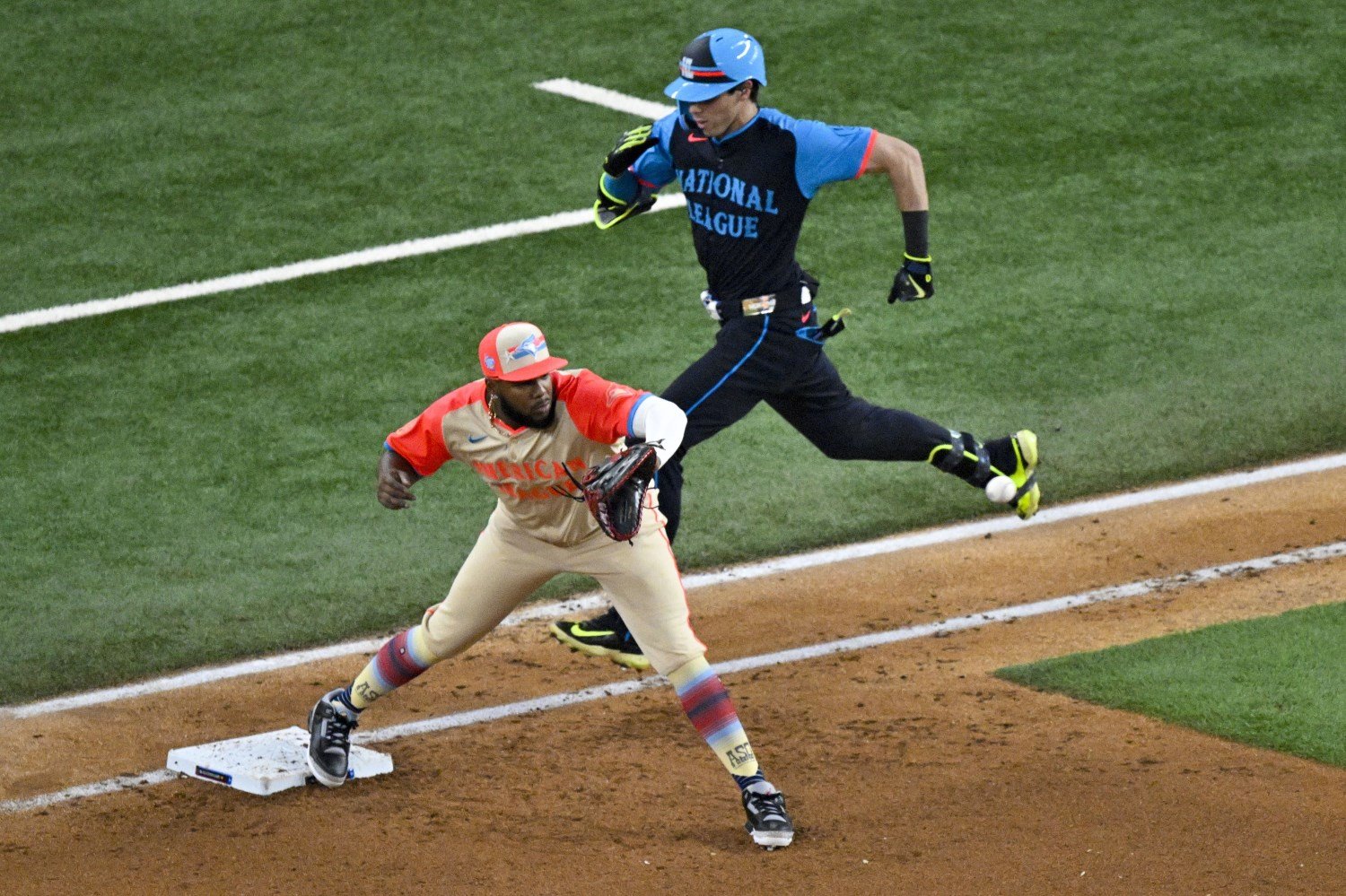 The best possible news for the Brewers would be for Christian Yelich to finally fix his long-term, nagging back issue, while still returning in time for September and/or October (assuming the Brewers reach the postseason). From Yelich’s quotes, however, it sounds like season-ending surgery is very much on the table, in which case the question turns to whether the Brewers' outfield and DH mix is sufficient for a team hoping to win a World Series. In the immediate future, in either case, there are likely to be more plate appearances for Jake Bauers, while the young quarter of Blake Perkins, Garrett Mitchell, Sal Frelick and Jackson Chourio roam the outfield grass and provide what should be elite defense. The problem is that Chourio is the only one you’d want at the plate in a big moment right now; there are substantial question marks over the other three. Frelick has been better in the last month, but still struggles to pose any extra-base threat. Mitchell is still hitting ground balls and whiffing a lot, while Perkins has a high strikeout rate and provides fairly minimal extra-base power, as well. Even taking into account the lack of form from some of the Brewers' streakier power hitters (which has resulted in the Brewers ranking 27th in home runs and 30th in doubles since Jun. 1), the lineup needs more thump. Regression won't take care of this. These players might. Jesse Winker Poetic irony at its finest, Jesse Winker has found the health that eluded him for much of last season and has been mashing all season, especially in July. His defense hasn’t been great, but his arm has been good, and he’s stolen 14 bases, with his average sprint speed rebounding substantially from its levels in 2023. In short, he looks healthy, and the bat looks to be getting better and better as the season goes on. Since Jun. 1, he has a .294/.414/.476 slash line, thanks in substantial part to crushing four-seamers, something he couldn't catch up to last season at all. Winker’s ending in a Milwaukee uniform last season wasn’t a fond one for fans or the player. He was made a scapegoat in the playoffs, introduced as a pinch-hitter to prolific booing. The Brewers may have been a year early on Winker, but his profile looks strong. He'd be quite the fit for replacing Yelich, given his elite chase rates, 97th-percentile walk rate and that sneaky left-handed power. He isn’t a raw slugger. He should be more consistent than that profile, as well as being the best like-for-like replacement you could get for Yelich. It’s very easy to picture Winker in a Brewers uniform come August. He won’t be too expensive as a rental, and therefore, he'd also free up the Brewers outfield mix for 2025 for a healthier Yelich to return. Brent Rooker Possibly the most intriguing bat available, Rooker can play the outfield, but given the Brewers' focus on run prevention, he’s likely to be purely a DH should they pursue him. Rooker is what the Brewers always hoped Keston Hiura could be, with a 31% strikeout rate that’s offset by monstrous power--as evidenced by his .290/.369/.574 line so far, with 23 home runs on the year. If you make a mistake, Rooker can punish it, and he could be the player that turns this Brewers lineup (with all its on base skills) into a legitimate threat. He elevates the ball extremely well, with a sweet spot launch angle of 35%, a hard hit rate of 51% and an elite barrel rate of 29.4%. It’s quite similar to Aaron Judge in some ways, but the contact rates are worrying: You could very easily get a cold stretch of baseball from Rooker against elite pitchers with the command to take advantage of those swing-and-miss tendencies, which is exactly what you would face in October. I'm not entirely convinced he’s what the Brewers need and adding in his controllability through 2027, the cost doesn’t entirely align with what the Brewers really need from this trade--which is help in the short term, and hopefully only in the short term. That being said, Rooker has the eighth-highest expected WOBA for a reason; this isn’t just a lucky first half. He hit 30 homers last year, too. Taylor Ward Ward is particularly interesting as a platoon option here, and it’s notable that the Brewers have struggled to hit southpaw pitchers this year. William Contreras and Rhys Hoskins haven’t had the expected production against left-handers, and it’s brought the Brewers down to Earth a little. This season, Ward is slashing .333/.382/.522 against lefties, with a 94.1 mph exit velocity and 28% barrel rate. He’s struggled against right-handers, but due to the depth of left-hitting outfielders the Brewers have, a right-handed platoon bat and/or pinch-hit option may fit the roster very nicely. A competent outfield defender to boot, he doesn’t necessitate the DH spot like Rooker or Winker may, and is significantly more affordable than Rooker. He elevates well, hits the ball hard consistently and fits a need, but he’s only hitting arbitration in 2025 and is likely going to cost more as a result of the controllability. All of that makes him less of a fit in my mind, unless the Brewers are trading from one of their own outfield crop. Randy Arozarena An electric player made for the big stage, Arozarena has struggled to start the year, but since the start of June, he has a .290/.402/.517 line, with an 1.173 OPS against left-handed pitchers and passable outfield defense. He’s wild, entertaining and controllable through 2025, but in a slightly down year, his value may be worth the expenditure. There aren’t many concerns about Arozarena when he hits like he has since Jun. 1, and he could be exactly the type of impact bat that not only keeps the Brewers ticking over into the playoffs, but can become a difference-maker in the postseason to a team that needs someone capable of that big hit. The Rays are pretty much out of the race, and there are strong rumors that Arozarena is on the trade block, but he won’t come cheaply. The Rays organization, as a whole, is smart enough to extract some high-value players in return. Will the Brewers be ready to make that big splash, for once? Joc Pederson (albeit unlikely) The Diamondbacks had been struggling mightily prior to June, but a hot stretch this month has left them half a game back of the Wild Card spots. Given their success last year from just such a position, it’s hard to imagine them not going for it. Pederson would be ideal for the Brewers, with a $12.5 million contract this season and mutual option for 2025 (which never seems to get picked up). He's shown some really massive power, and playoff pedigree to boot. There’s still potential if Arizona slump hard over the next week, but it’s becoming less likely. Pederson is hitting .273/.376/.492, helping to hold up the Diamondbacks offense against right-handers. He’s got big-game temperament and power the Brewers could really use. If he even remotely becomes available, the Brewers simply have to be in on him. So What's The Best Option? Given the lack of outfield options on the market, and the controllability needs for the Brewers, it would seem that Winker or Arozarena are the best options for the Brewers. Arozarena will be a tough get, with the Dodgers and other suitors in need of offensive reinforcements very interested in his bat, but the Brewers farm system is significantly better than theirs in terms of options. Winker will cost less, but can replicate the on-base skills with a smidgen less power than Yelich, Ward fits the lefty-mashing outfielder need well, but both he and Rooker will be expensive with their extensive team control. That may put the Brewers off, given the volatility and limitations of both bats. It’s a tough call, and the Brewers may simply look to make the postseason and work things from there, while retaining the outfield corps they have. More playing time for Gary Sánchez may help his bat come around, and a hot Hoskins, Willy Adames and Sánchez can absolutely carry a playoff-caliber team for a month. Which direction they go will be fascinating, but Yelich is going to be a massive loss for this Brewers team, and if they don’t replace him proactively, then the postseason ambitions will take a major hit.
 -
2024 Draft Signings Thread
Jake McKibbin replied to Jake McKibbin's topic in MLB Draft & International Signings
Jaron DeBerry confirmed sign, no contract value yet -
2024 Draft Signings Thread
Jake McKibbin replied to Jake McKibbin's topic in MLB Draft & International Signings
That's entirely fair. I think, despite the frame an stuff that's already there the thing that get some most excited is the extension he gets. Making not just the fastball but the slider, change etc even nastier. A little sneak peak of something I've been looking into, but extension has a big impact on whiff rates. I took this random sample over 2023-today of breaking pitches with 2800+ RPM's, and have a look at the Whiff rates and swinging strike rates progressivly increasing. the same trend occurs for xERA and xFIP That extension makes me gaudy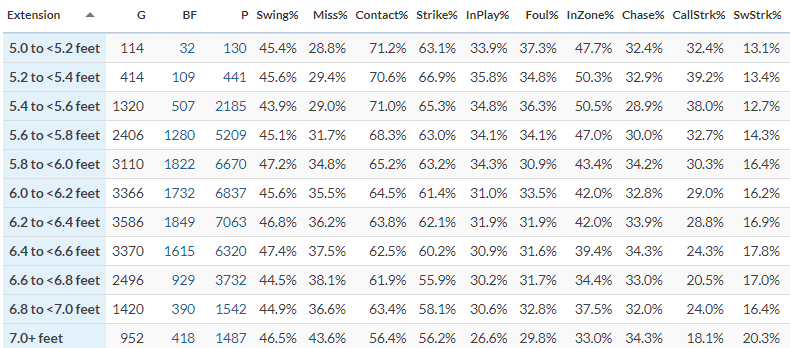
-
2024 Draft Signings Thread
Jake McKibbin replied to Jake McKibbin's topic in MLB Draft & International Signings
I'm guessing they very much did, given the round he was taken in I'd imagine this is more due to a change in demands. Either way I'm not entirely convinced it's a big deal yet or just rumors, we'll likely find out today/tomorrow about Meccage and I expect both would be announced together a la Burke/Payne -
2024 Draft Signings Thread
Jake McKibbin replied to Jake McKibbin's topic in MLB Draft & International Signings
$2.4m would be fine, I think it's if it starts approaching $3m is when the concern starts. We can afford around $5m on Meccage/Levonas with the ability to spend another $1m or so (provided DeBerry signs for around $300k or less) It's probably my breaking point for the whole thing, but if the Brewers walked away with these two + Broughton, along with Noah Wech, I'd be pretty happy. I wonder if he think he can be a top 10 pick in 2027 as a reason to go to college, but that's a long way off for a pitcher when injuries can strike at any time. Losing out on one extra late rounder because of Levonas changing his demands is a tough balance, but if its a round 18-20 player you may just have to, Nunnallee was always a bit of a pipe dream -
2024 Draft Signings Thread
Jake McKibbin replied to Jake McKibbin's topic in MLB Draft & International Signings
Updated Draft Tracker