



Spencer Michaelis
-
Posts
1,119 -
Joined
-
Last visited
-
Days Won
17
Content Type
Profiles
Forums
Blogs
Events
News
2026 Milwaukee Brewers Top Prospects Ranking
Milwaukee Brewers Videos
2022 Milwaukee Brewers Draft Picks
Milwaukee Brewers Free Agent & Trade Rumors, Notes, & Tidbits
Guides & Resources
2023 Milwaukee Brewers Draft Picks
2024 Milwaukee Brewers Draft Picks
The Milwaukee Brewers Players Project
2025 Milwaukee Brewers Draft Pick Tracker
2026 Milwaukee Brewers Draft Tracker: Picks & Bonuses
Store
Downloads
Gallery
Everything posted by Spencer Michaelis
-
 Some more Kay-Lan Nicasia video dropped yesterday
- 2 replies
-
- 1
-

-
- gregory barrios
- tayden hall
- (and 1 more)
-
Episode 4 of the Brewer Fanatic Podcast talks about last week in Brewers baseball and looks forward to the upcoming Yankees series at home. Jack and Spencer review a successful 5-2 road trip against the Cardinals and Pirates, rate Pat Murphy as a manager, and evaluate some minor leaguers who could impact the Brewers later in the season. View full article
-
 Jack and Spencer review a successful 5-2 road trip against the Cardinals and Pirates, rate Pat Murphy as a manager, and evaluate some minor leaguers who could impact the Brewers later in the season.
 -
Update: he is gross. The curve is an especially nasty pitch. That’s a plus pitch. Fastball definitely seems to get really good ride. Slider seems to be left arm side a lot but when he gets it glove side, that thing is sharp too. I agree @Joseph Zarrhe will likely move quickly. Mississippi State fans seem convinced he was being screwed up by their old pitching coach, so probably some untapped potential the Brewers are helping him tap into.
-
He caught my eye with some of the offseason video that came out, I haven’t had a chance to watch him yet but I’m stuck on a bus the next hour and a half so might as well check some of his outings out haha
-
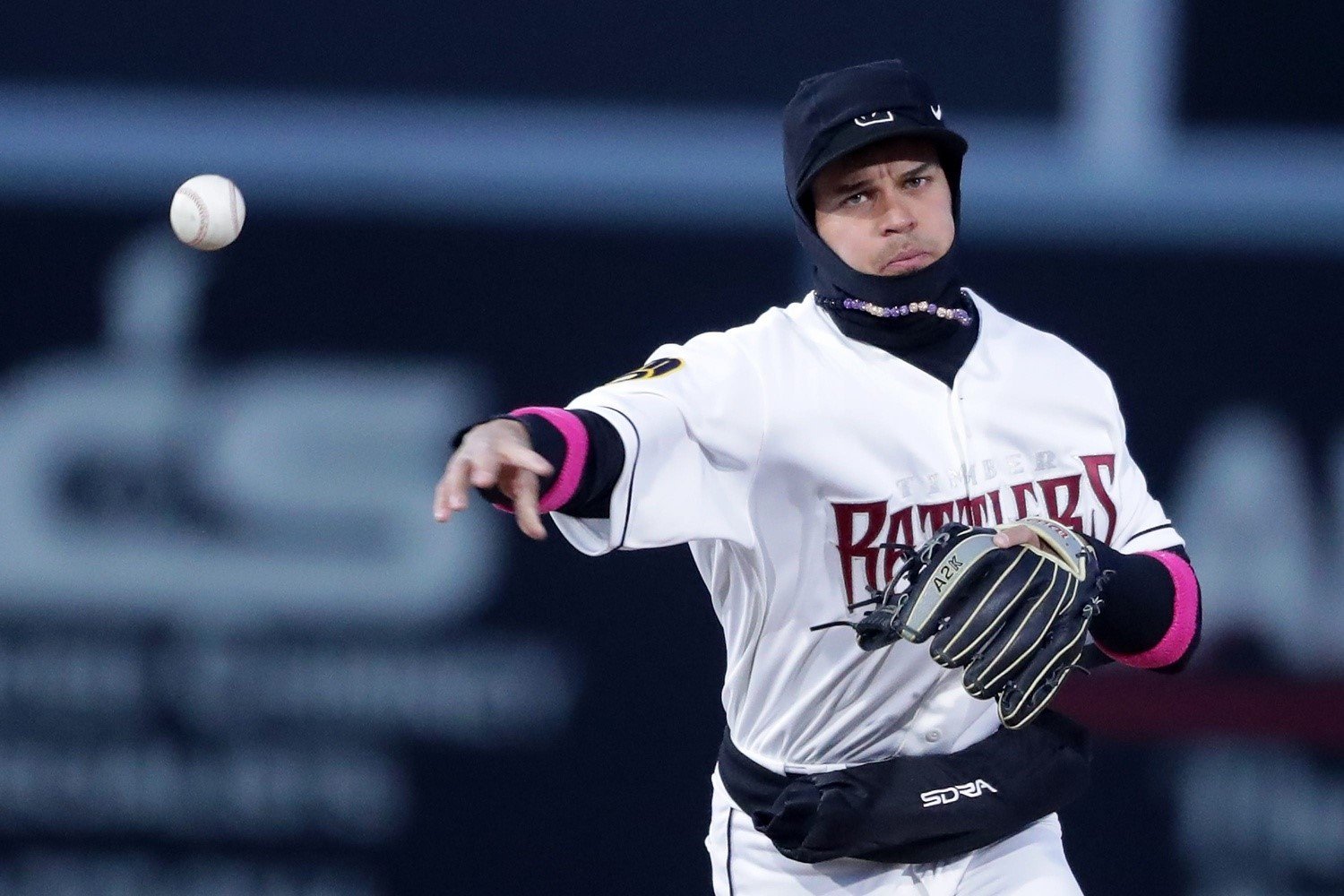 Gregory Barrios Signed in the same international signing class as Jackson Chourio, Barrios received the second-highest bonus ($1 million) in that class, behind only Chourio. Known for his glovework, he has started to show signs of an offensive breakout in 2024. After a slow start in the Dominican Summer League his first season, he stepped it up in 2022 and was a league-average hitter in the Arizona Complex League. Unfortunately, he followed that up with a 69 wRC+ in Low-A Carolina last season. While the results in Carolina were poor, Barrios did flash some of the tools you are hoping to see from young hitters. Despite a low walk rate, Barrios showed solid plate discipline and a good approach at the plate. He also demonstrated very strong bat-to-ball abilities, striking out at only a 13.5% clip. He also stole 32 bases. The approach is likely the reason the Brewers chose to be aggressive with his assignment in 2024, moving him up to High-A despite the lackluster results in 2023. Still only 20 years old this season, Barrios has shown that the Brewers made the correct decision. Through his first 13 games, Barrios is posting an OPS of 1.027 and a wRC+ of 184. While keeping his strikeout rate at 17%, he has been able to tap into a bit more power. He has already posted 8 doubles, which means he’s one-third of the way to his extra-base hit output of 2023 (24 total) in only one-ninth as many plate appearances. Barrios has a short, compact swing that allows him to get the bat to inside pitches extremely consistently. Last year, he had some issues covering the outer third of the plate, for that same reason. In 2024, he’s shown a better ability to get to those outside pitches, while also taking his 40% fly ball rate and cutting that down to 20%. He’s improved his line drive rate from 20% to 35%. With his limited game power and athleticism, line drives and hard-hit ground balls will do him a lot better than fly balls will. Barrios will likely continue to get stronger, and hopefully, that will allow him to tap into a bit more power, but this will always be a contact-driven profile. He has the glove and the stick to be an everyday shortstop if he can continue to improve his plate coverage and keep hitting the ball on a line. Barrios was named this past week's Player of the Week for the Midwest League. The Brewers Player Development account provided us with some video from the week, where you can see all of the tools on display. He shows his ability to get his hands to inside pitches, as well as the newfound ability to take them where they're pitched as well. Tayden Hall Hall was the Brewers' ninth-round selection in 2022 out of a Junior College (State College of Florida, Manatee-Sarasota), and signed for slot value. Son of former MLB catcher Toby Hall, Tayden was drafted as a backstop, but he has settled into an everyday first base role at the pro level. Equipped with one of the most impressive approaches in the Brewers system, Hall makes fantastic swing decisions and has above-average contact skills, as well. Walking at a 24% clip in 2024 so far, he rarely expands the zone. On the other hand, he can get a bit too patient at times and will put himself in two-strike counts by taking hittable pitches. The good news is that he’s also very comfortable in those spots, as shown by his 18% strikeout rate in 2023, and his even lower 14.8% rate so far in 2024. Hall was drafted with a very interesting setup (similar to the way Tony Batista used to do it), with the entire front of his body facing the pitcher. He has since closed himself off and has a much more generic stance these days. His current stance would seem more likely to help him get to some power than his original one. Power is the one tool that Hall is currently lacking in his offensive toolbox. He has yet to homer in professional baseball (though he did hit five in Australia this past winter), and hasn’t had many extra-base hits, in general. He is off to a stronger start in that regard in 2024, already with three doubles and a triple. Hall’s build would lead you to believe that he will eventually find some in-game power. He also hits the ball pretty hard on average, which means that while he is currently sporting a 54% ground ball rate with a 15% fly ball rate, if he can elevate more often, the power may begin to show up. While the pop continues to develop, Hall shows an impressive ability to hit to all fields. In 2024, he is pulling the ball more (which is something that could help him tap into his power), but he is also hitting the ball the opposite way at a strong 30% clip. He is hitting line drives on 30% of his batted balls, which are the batted balls most likely to end in hits. Hall plays a fine first base, and has very good hands due to his catching background. He’s a good enough athlete with a decent arm; he could probably handle a corner outfield spot if needed. It feels like everything will come down to Hall’s ability to drive the ball, and as mentioned earlier, despite the lack of home runs, he has been hitting the ball hard this season, currently posting a hard-hit rate of around 60%. His approach and his bat path give him a solid floor; the power will decide whether he reaches his ceiling. Kay-Lan Nicasia Nicasia might be the least known of the three on this list. The Brewers' 16th-round selection in 2021, some may have never heard his name before right now. If the start of the 2024 season is any indication, it’s one you’re going to want to get to know. Nicasia is a switch-hitter who has an explosive but smooth-looking swing from the left side. His right-handed swing seems to lack some of the same juice, and it will be interesting to see if the Brewers eventually just have him stay on the left side. This is a player who looked better visually than his results would lead you to believe. His 30% strikeout rate was not indicative of the type of approach he showed, nor was his .212 batting average. While his 97 wRC+ wasn’t much worse than league-average, it also felt lower than what he was showing on a nightly basis. Nicasia showed really strong pitch recognition skills in 2023. He didn’t go outside of the zone all that often, as shown by his 13.7% walk rate. He did, however, have some issues with his ability to put the bat on the ball, which contributed to that high strikeout rate. In 2024, his strikeout rate is down to a much more reasonable 23.6% rate. Keeping it in the 25% range is something Nicasia is capable of, and would be a great sign for him moving forward. Listed at 5-foot-11 and 176 pounds, Nicasia seems to carry that weight well and looks a bit stronger than what he’s listed at. While he only hit six home runs in 2023, Nicasia has shown an ability to drive the ball, particularly from the left side. He has already gone deep three times in April (all from the left side), and seems to be tapping into that power more consistently so far. His hit tool is closer to average than to plus, but Nicasia isn’t up there selling out for power. He uses the middle of the field well, and is capable of going the other way with pitches on the outer third. The outer third is likely the area pitchers will want to attack the most, as he can have issues with offspeed away. Drafted as a shortstop, Nicasia is a strong defender in the outfield, and he has an above-average arm as well. He did spend a little time at second base this season for the Mudcats, but that was out of necessity. He appears to be pretty locked into an outfield role moving forward. His speed allows his defense to play up out there, and also shows up on the bases, where he was 27 of 34 in 2023 and is four for four in 2024. At 22 years old, Nicasia is a player the Brewers may want to push to High-A to see if this progress is legitimate. So far, the results seem to be more in line with what somebody would expect if you watch him every night. He is far from a sure thing, but a few more solid months of production could start to get him some attention, because the tools are certainly there already. The Brewers haven’t had as many standout performances from their top prospects as they were probably hoping for. Much of this can be attributed to the injury issues they have had to deal with so far, seeing players like Jeferson Quero, Brock Wilken, Cooper Pratt and more sidelined for extended periods already, There are a lot of lesser-known players who have gotten off to very strong starts, though, and this trio is among them.
- 2 comments
-
- 1
-
-
- gregory barrios
- tayden hall
- (and 1 more)
-
The Brewers have a lot of positional talent in the minor leagues, with 20 of their top 30 being hitters on MLB Pipeline’s rankings. Beyond those 20 though, there is a lot of talent waiting to crack those types of lists, as well. Let's look at three hitters who might not get the attention of some of the bigger names, but who have gotten off to fast starts and have tools to go with the early production. Image courtesy of © Wm. Glasheen/USA TODAY NETWORK-Wisconsin / USA TODAY NETWORK Gregory Barrios Signed in the same international signing class as Jackson Chourio, Barrios received the second-highest bonus ($1 million) in that class, behind only Chourio. Known for his glovework, he has started to show signs of an offensive breakout in 2024. After a slow start in the Dominican Summer League his first season, he stepped it up in 2022 and was a league-average hitter in the Arizona Complex League. Unfortunately, he followed that up with a 69 wRC+ in Low-A Carolina last season. While the results in Carolina were poor, Barrios did flash some of the tools you are hoping to see from young hitters. Despite a low walk rate, Barrios showed solid plate discipline and a good approach at the plate. He also demonstrated very strong bat-to-ball abilities, striking out at only a 13.5% clip. He also stole 32 bases. The approach is likely the reason the Brewers chose to be aggressive with his assignment in 2024, moving him up to High-A despite the lackluster results in 2023. Still only 20 years old this season, Barrios has shown that the Brewers made the correct decision. Through his first 13 games, Barrios is posting an OPS of 1.027 and a wRC+ of 184. While keeping his strikeout rate at 17%, he has been able to tap into a bit more power. He has already posted 8 doubles, which means he’s one-third of the way to his extra-base hit output of 2023 (24 total) in only one-ninth as many plate appearances. Barrios has a short, compact swing that allows him to get the bat to inside pitches extremely consistently. Last year, he had some issues covering the outer third of the plate, for that same reason. In 2024, he’s shown a better ability to get to those outside pitches, while also taking his 40% fly ball rate and cutting that down to 20%. He’s improved his line drive rate from 20% to 35%. With his limited game power and athleticism, line drives and hard-hit ground balls will do him a lot better than fly balls will. Barrios will likely continue to get stronger, and hopefully, that will allow him to tap into a bit more power, but this will always be a contact-driven profile. He has the glove and the stick to be an everyday shortstop if he can continue to improve his plate coverage and keep hitting the ball on a line. Barrios was named this past week's Player of the Week for the Midwest League. The Brewers Player Development account provided us with some video from the week, where you can see all of the tools on display. He shows his ability to get his hands to inside pitches, as well as the newfound ability to take them where they're pitched as well. Tayden Hall Hall was the Brewers' ninth-round selection in 2022 out of a Junior College (State College of Florida, Manatee-Sarasota), and signed for slot value. Son of former MLB catcher Toby Hall, Tayden was drafted as a backstop, but he has settled into an everyday first base role at the pro level. Equipped with one of the most impressive approaches in the Brewers system, Hall makes fantastic swing decisions and has above-average contact skills, as well. Walking at a 24% clip in 2024 so far, he rarely expands the zone. On the other hand, he can get a bit too patient at times and will put himself in two-strike counts by taking hittable pitches. The good news is that he’s also very comfortable in those spots, as shown by his 18% strikeout rate in 2023, and his even lower 14.8% rate so far in 2024. Hall was drafted with a very interesting setup (similar to the way Tony Batista used to do it), with the entire front of his body facing the pitcher. He has since closed himself off and has a much more generic stance these days. His current stance would seem more likely to help him get to some power than his original one. Power is the one tool that Hall is currently lacking in his offensive toolbox. He has yet to homer in professional baseball (though he did hit five in Australia this past winter), and hasn’t had many extra-base hits, in general. He is off to a stronger start in that regard in 2024, already with three doubles and a triple. Hall’s build would lead you to believe that he will eventually find some in-game power. He also hits the ball pretty hard on average, which means that while he is currently sporting a 54% ground ball rate with a 15% fly ball rate, if he can elevate more often, the power may begin to show up. While the pop continues to develop, Hall shows an impressive ability to hit to all fields. In 2024, he is pulling the ball more (which is something that could help him tap into his power), but he is also hitting the ball the opposite way at a strong 30% clip. He is hitting line drives on 30% of his batted balls, which are the batted balls most likely to end in hits. Hall plays a fine first base, and has very good hands due to his catching background. He’s a good enough athlete with a decent arm; he could probably handle a corner outfield spot if needed. It feels like everything will come down to Hall’s ability to drive the ball, and as mentioned earlier, despite the lack of home runs, he has been hitting the ball hard this season, currently posting a hard-hit rate of around 60%. His approach and his bat path give him a solid floor; the power will decide whether he reaches his ceiling. Kay-Lan Nicasia Nicasia might be the least known of the three on this list. The Brewers' 16th-round selection in 2021, some may have never heard his name before right now. If the start of the 2024 season is any indication, it’s one you’re going to want to get to know. Nicasia is a switch-hitter who has an explosive but smooth-looking swing from the left side. His right-handed swing seems to lack some of the same juice, and it will be interesting to see if the Brewers eventually just have him stay on the left side. This is a player who looked better visually than his results would lead you to believe. His 30% strikeout rate was not indicative of the type of approach he showed, nor was his .212 batting average. While his 97 wRC+ wasn’t much worse than league-average, it also felt lower than what he was showing on a nightly basis. Nicasia showed really strong pitch recognition skills in 2023. He didn’t go outside of the zone all that often, as shown by his 13.7% walk rate. He did, however, have some issues with his ability to put the bat on the ball, which contributed to that high strikeout rate. In 2024, his strikeout rate is down to a much more reasonable 23.6% rate. Keeping it in the 25% range is something Nicasia is capable of, and would be a great sign for him moving forward. Listed at 5-foot-11 and 176 pounds, Nicasia seems to carry that weight well and looks a bit stronger than what he’s listed at. While he only hit six home runs in 2023, Nicasia has shown an ability to drive the ball, particularly from the left side. He has already gone deep three times in April (all from the left side), and seems to be tapping into that power more consistently so far. His hit tool is closer to average than to plus, but Nicasia isn’t up there selling out for power. He uses the middle of the field well, and is capable of going the other way with pitches on the outer third. The outer third is likely the area pitchers will want to attack the most, as he can have issues with offspeed away. Drafted as a shortstop, Nicasia is a strong defender in the outfield, and he has an above-average arm as well. He did spend a little time at second base this season for the Mudcats, but that was out of necessity. He appears to be pretty locked into an outfield role moving forward. His speed allows his defense to play up out there, and also shows up on the bases, where he was 27 of 34 in 2023 and is four for four in 2024. At 22 years old, Nicasia is a player the Brewers may want to push to High-A to see if this progress is legitimate. So far, the results seem to be more in line with what somebody would expect if you watch him every night. He is far from a sure thing, but a few more solid months of production could start to get him some attention, because the tools are certainly there already. The Brewers haven’t had as many standout performances from their top prospects as they were probably hoping for. Much of this can be attributed to the injury issues they have had to deal with so far, seeing players like Jeferson Quero, Brock Wilken, Cooper Pratt and more sidelined for extended periods already, There are a lot of lesser-known players who have gotten off to very strong starts, though, and this trio is among them. View full article
- 2 replies
-
- 2
-

-
- gregory barrios
- tayden hall
- (and 1 more)
-
New Yoho video just dropped with some extra pitches compared to what was in the article!
-
 At the moment, MLB Pipeline has 20 position players in the Brewers' Top 30, compared to only 10 pitchers. If you dig a bit deeper, there are quite a few interesting arms that don’t find their names on those lists. We are going to look at three names that fans will want to keep an eye on this season. Jesus Rivero Signed out of Venezuela as part of the 2021 international signing class, Rivero spent that first season entirely in the Dominican Summer League. After 30 innings in the Arizona Complex League in 2022, Rivero began his 2023 campaign back in Arizona. This time, he only spent three games there, in which he struck out 19 and walked only one batter over 11 1/3 innings. He was promoted to Low-A Carolina at the end of June and finished the season there. In 2024, he is back in Carolina and showing some signs of continued development. Rivero has elite fastball characteristics, despite only sitting in the low 90s the majority of the time. The general shape of the pitch doesn’t stand out as special, either, generating around 16” of Induced Vertical Break (IVB), and 10” horizontally. However, Rivero throws from a low arm slot, and that slot helps him generate an elite Vertical Approach Angle (VAA) of -4 degrees on the fastball. VAA is a term, and measurement, that has only been around for a few years now. It measures the degree of variation from parallel to the ground at which the ball is traveling as it enters the zone. The average four-seam fastball in MLB the last couple of years has been right around -5 degrees. While the difference of only one degree may not seem all that noteworthy, it is a much bigger difference than it appears on the surface. Batters have trained the majority of their lives against fastballs that come in around the average VAA. They are used to the ball following a somewhat predictable downward drop based on gravity, speed, and spin. Connecting with any pitch requires a split-second decision, which means they have to rely on the law of averages for how pitches move. That’s why outliers in either direction are valued so highly. Outliers play tricks on the eyes. A -4 degree fastball is much flatter than what most hitters are used to, and it will often cause them to swing under the ball. Freddy Peralta’s “invisible fastball” averaged a -3.89 VAA in 2023. Check out the league's performance on four-seamers last year, split by VAA, to get a sense of the effect. Vertical Approach Angle P wOBA Swing% Whiff% InZoneWhiff% InPlay% Foul% Chase% CompLoc% -8 to <-7 degrees 413 0.579 14.80% 23.00% 13.30% 47.50% 29.50% 8.70% 68.30% -7 to <-6 degrees 2849 0.432 26.90% 10.20% 8.20% 51.20% 38.60% 8.70% 89.40% -6 to <-5 degrees 8591 0.344 49.40% 12.80% 12.30% 44.30% 42.90% 18.40% 95.20% -5 to <-4 degrees 11225 0.298 59.70% 22.40% 21.30% 31.90% 45.60% 31.30% 94.40% -4 to <-3 degrees 5481 0.29 42.10% 37.90% 32.80% 18.70% 43.50% 27.20% 79.80% -3 to <-2 degrees 1142 0.427 14.70% 47.60% 36.40% 13.10% 39.30% 12.30% 37.90% Flat fastballs earn whiffs and stifle overall offense. Rivero has one. He is more than a one-pitch pitcher though. He also throws a curveball, slider, cutter and changeup. All of these grade out as close to average, or better, with the slider currently being the best of them. It is a starter's repertoire, and he knows how to use his fastball to help the other offerings play up as well. Rivero showed off all five pitches in his last outing, as you can see below, thanks to the Brewers Player Development account on Twitter. Rivero has been used as a bulk innings reliever in Carolina the majority of the time. However, the pitch counts and innings pitched still point to a pitcher they would like to have start in the future. At only 20 years old, Rivero will be a name to follow this season. Yujanyer Herrera Herrera is a perfect example of the importance of exercising patience when it comes to prospects--especially those who are young for their level. Though he made it to Carolina during the 2022 season, Herrera was only 18 at that time. This aggressive promotion, mixed with some preliminary knowledge of his pitch mix, had Herrera checking a lot of boxes for a potential breakout. Unfortunately, he followed the promotion with command struggles and quite a bit of loud opponent contact. Thus, he headed into the 2024 season without much attention. Through his first three outings this year, Herrera has done his best to get some of that attention back, highlighted by his second appearance, wherein he went four innings, allowing only one hit, while punching out nine. In that outing, he racked up an insane whiff rate of 53%. For the season, his whiff rate is hovering right around 40% overall. He is keeping hitters off-balance with his starter's pitch mix, throwing four different pitches. Herrera’s fastball sits in the 93-95 range and has reached up to 97. He can use it up in the zone, or run it in on the hands of right-handers at times. Metrics have been hard to come by for the pitch, but it seems to have a decent shape to it, with the previously mentioned mid-90s velocity. The changeup has been Herrera’s best secondary since he signed, and that still appears to be the case. It has late fade and tumble and is his best swing-and-miss pitch against left-handed hitters, though he isn’t afraid to use it against righties, either. His slider was his go-to strikeout pitch against righties in the past, and that seems to be the case again this year. While it has an inconsistent shape at times, it generates quite a bit of sweep at its best. He will likely continue to work on consistency, but the slider shows flashes of being an above-average pitch. Herrera’s curveball is the pitch that seems to have made the biggest strides so far this season, showing more consistent command, and a sharper shape. Previously a pitch he liked to drop in for strikes more than anything else, it has shown an ability to get more swing and miss in 2024. Herrera is being used very similarly to Rivero so far. He’s pitched out of the bullpen, but his pitch count and inning load are those of a starter. The Brewers seem to want to give him the chance to stay stretched out and potentially start down the road. If the first three games of 2024 are any indication, he is going to have a chance to do just that. Craig Yoho The Brewers' eighth-round selection in the 2023 draft out of Indiana, Yoho is the only one of these arms that appears to already be slotted into a relief role in the future. Once a position player in college, he transitioned to a two-way role for a couple of seasons, but after battling quite a few injuries, he finished his college career exclusively working off the mound. Yoho does not possess the velocity that we have all come to expect out of a high-leverage reliever. You will not see him in the upper 90s. His fastball is a strong offering, currently sitting in the 91-93 range with huge arm-side run. Carrying his profile, though, are his secondaries. Instead of throwing heat, the pitcher named “Yoho” looks like he’s throwing pitches attached to a “yo-yo.” Comparing a changeup to Devin Williams’s “Airbender” is not something you can (or should) do very often. Yoho is throwing a changeup in the 78-81 MPH range that is very similar to that of the “Airbender.” In reality, given the movement they generate, both of them should probably classify their pitches as screwballs. Whatever you want to call it, it looks like a special pitch and it would be hard to grade it as anything less than a plus offering. Devin Williams has struggled to find a third pitch that moves to the glove side. An inability to throw a breaking ball is not uncommon for someone who has such comfort with pronating while throwing. Yoho, however, does not have this issue whatsoever. His curveball is another borderline plus pitch, sitting in the 74-76 MPH range, with spin rates of up to 3,000 RPM. The spin and the axis he throws it on help him generate a ton of sharp movement, both vertically and horizontally. Yoho also threw a sweeper in college, but does not appear to be using it in pro ball thus far. Despite scrapping the sweeper, he may still have another wrinkle in his repertoire. As Curt Hogg showed in this tweet, Yoho looks to be mixing in a cutter (or perhaps a shorter slider) in the 86-88 range. It’s early right now, but the early returns on the pitch are very interesting. The cutter could pair very well with the run he gets on his primary fastball, and it would also give Yoho a pitch that changes speeds a bit differently than his other secondaries. Yoho is the type of pitcher who could work out as a starting pitcher with the repertoire he has. The Brewers likely determined that his injury history would make starting difficult over the long haul. While that dream seems to be in the rearview, this is the type of pitcher who could move through the system very quickly now that he is locked into a relief role. A 2025 MLB debut should not be ruled out for Yoho. There were a number of pitchers who could have been featured in this article. Brett Wichrowski, Tyler Woessner, Manuel Rodriguez, Bishop Letson, and others were all worthy of consideration. The pitching depth is proving to be a lot better than what prospect lists would lead you to believe. While there may not be a Brandon Woodruff/Corbin Burnes/Peralta trio coming through the system, there are a lot of talented arms who will give the Brewers quite a few shots at forming a strong stable of pitchers for years to come.
- 4 comments
-
- 3
-
-
- craig yoho
- jesus rivero
- (and 1 more)
-
While the Milwaukee Brewers have been praised for their pitching development in recent years, their highly-rated farm system is currently being carried by the position players--at least on the surface. Image courtesy of © Allan Henry-USA TODAY Sports At the moment, MLB Pipeline has 20 position players in the Brewers' Top 30, compared to only 10 pitchers. If you dig a bit deeper, there are quite a few interesting arms that don’t find their names on those lists. We are going to look at three names that fans will want to keep an eye on this season. Jesus Rivero Signed out of Venezuela as part of the 2021 international signing class, Rivero spent that first season entirely in the Dominican Summer League. After 30 innings in the Arizona Complex League in 2022, Rivero began his 2023 campaign back in Arizona. This time, he only spent three games there, in which he struck out 19 and walked only one batter over 11 1/3 innings. He was promoted to Low-A Carolina at the end of June and finished the season there. In 2024, he is back in Carolina and showing some signs of continued development. Rivero has elite fastball characteristics, despite only sitting in the low 90s the majority of the time. The general shape of the pitch doesn’t stand out as special, either, generating around 16” of Induced Vertical Break (IVB), and 10” horizontally. However, Rivero throws from a low arm slot, and that slot helps him generate an elite Vertical Approach Angle (VAA) of -4 degrees on the fastball. VAA is a term, and measurement, that has only been around for a few years now. It measures the degree of variation from parallel to the ground at which the ball is traveling as it enters the zone. The average four-seam fastball in MLB the last couple of years has been right around -5 degrees. While the difference of only one degree may not seem all that noteworthy, it is a much bigger difference than it appears on the surface. Batters have trained the majority of their lives against fastballs that come in around the average VAA. They are used to the ball following a somewhat predictable downward drop based on gravity, speed, and spin. Connecting with any pitch requires a split-second decision, which means they have to rely on the law of averages for how pitches move. That’s why outliers in either direction are valued so highly. Outliers play tricks on the eyes. A -4 degree fastball is much flatter than what most hitters are used to, and it will often cause them to swing under the ball. Freddy Peralta’s “invisible fastball” averaged a -3.89 VAA in 2023. Check out the league's performance on four-seamers last year, split by VAA, to get a sense of the effect. Vertical Approach Angle P wOBA Swing% Whiff% InZoneWhiff% InPlay% Foul% Chase% CompLoc% -8 to <-7 degrees 413 0.579 14.80% 23.00% 13.30% 47.50% 29.50% 8.70% 68.30% -7 to <-6 degrees 2849 0.432 26.90% 10.20% 8.20% 51.20% 38.60% 8.70% 89.40% -6 to <-5 degrees 8591 0.344 49.40% 12.80% 12.30% 44.30% 42.90% 18.40% 95.20% -5 to <-4 degrees 11225 0.298 59.70% 22.40% 21.30% 31.90% 45.60% 31.30% 94.40% -4 to <-3 degrees 5481 0.29 42.10% 37.90% 32.80% 18.70% 43.50% 27.20% 79.80% -3 to <-2 degrees 1142 0.427 14.70% 47.60% 36.40% 13.10% 39.30% 12.30% 37.90% Flat fastballs earn whiffs and stifle overall offense. Rivero has one. He is more than a one-pitch pitcher though. He also throws a curveball, slider, cutter and changeup. All of these grade out as close to average, or better, with the slider currently being the best of them. It is a starter's repertoire, and he knows how to use his fastball to help the other offerings play up as well. Rivero showed off all five pitches in his last outing, as you can see below, thanks to the Brewers Player Development account on Twitter. Rivero has been used as a bulk innings reliever in Carolina the majority of the time. However, the pitch counts and innings pitched still point to a pitcher they would like to have start in the future. At only 20 years old, Rivero will be a name to follow this season. Yujanyer Herrera Herrera is a perfect example of the importance of exercising patience when it comes to prospects--especially those who are young for their level. Though he made it to Carolina during the 2022 season, Herrera was only 18 at that time. This aggressive promotion, mixed with some preliminary knowledge of his pitch mix, had Herrera checking a lot of boxes for a potential breakout. Unfortunately, he followed the promotion with command struggles and quite a bit of loud opponent contact. Thus, he headed into the 2024 season without much attention. Through his first three outings this year, Herrera has done his best to get some of that attention back, highlighted by his second appearance, wherein he went four innings, allowing only one hit, while punching out nine. In that outing, he racked up an insane whiff rate of 53%. For the season, his whiff rate is hovering right around 40% overall. He is keeping hitters off-balance with his starter's pitch mix, throwing four different pitches. Herrera’s fastball sits in the 93-95 range and has reached up to 97. He can use it up in the zone, or run it in on the hands of right-handers at times. Metrics have been hard to come by for the pitch, but it seems to have a decent shape to it, with the previously mentioned mid-90s velocity. The changeup has been Herrera’s best secondary since he signed, and that still appears to be the case. It has late fade and tumble and is his best swing-and-miss pitch against left-handed hitters, though he isn’t afraid to use it against righties, either. His slider was his go-to strikeout pitch against righties in the past, and that seems to be the case again this year. While it has an inconsistent shape at times, it generates quite a bit of sweep at its best. He will likely continue to work on consistency, but the slider shows flashes of being an above-average pitch. Herrera’s curveball is the pitch that seems to have made the biggest strides so far this season, showing more consistent command, and a sharper shape. Previously a pitch he liked to drop in for strikes more than anything else, it has shown an ability to get more swing and miss in 2024. Herrera is being used very similarly to Rivero so far. He’s pitched out of the bullpen, but his pitch count and inning load are those of a starter. The Brewers seem to want to give him the chance to stay stretched out and potentially start down the road. If the first three games of 2024 are any indication, he is going to have a chance to do just that. Craig Yoho The Brewers' eighth-round selection in the 2023 draft out of Indiana, Yoho is the only one of these arms that appears to already be slotted into a relief role in the future. Once a position player in college, he transitioned to a two-way role for a couple of seasons, but after battling quite a few injuries, he finished his college career exclusively working off the mound. Yoho does not possess the velocity that we have all come to expect out of a high-leverage reliever. You will not see him in the upper 90s. His fastball is a strong offering, currently sitting in the 91-93 range with huge arm-side run. Carrying his profile, though, are his secondaries. Instead of throwing heat, the pitcher named “Yoho” looks like he’s throwing pitches attached to a “yo-yo.” Comparing a changeup to Devin Williams’s “Airbender” is not something you can (or should) do very often. Yoho is throwing a changeup in the 78-81 MPH range that is very similar to that of the “Airbender.” In reality, given the movement they generate, both of them should probably classify their pitches as screwballs. Whatever you want to call it, it looks like a special pitch and it would be hard to grade it as anything less than a plus offering. Devin Williams has struggled to find a third pitch that moves to the glove side. An inability to throw a breaking ball is not uncommon for someone who has such comfort with pronating while throwing. Yoho, however, does not have this issue whatsoever. His curveball is another borderline plus pitch, sitting in the 74-76 MPH range, with spin rates of up to 3,000 RPM. The spin and the axis he throws it on help him generate a ton of sharp movement, both vertically and horizontally. Yoho also threw a sweeper in college, but does not appear to be using it in pro ball thus far. Despite scrapping the sweeper, he may still have another wrinkle in his repertoire. As Curt Hogg showed in this tweet, Yoho looks to be mixing in a cutter (or perhaps a shorter slider) in the 86-88 range. It’s early right now, but the early returns on the pitch are very interesting. The cutter could pair very well with the run he gets on his primary fastball, and it would also give Yoho a pitch that changes speeds a bit differently than his other secondaries. Yoho is the type of pitcher who could work out as a starting pitcher with the repertoire he has. The Brewers likely determined that his injury history would make starting difficult over the long haul. While that dream seems to be in the rearview, this is the type of pitcher who could move through the system very quickly now that he is locked into a relief role. A 2025 MLB debut should not be ruled out for Yoho. There were a number of pitchers who could have been featured in this article. Brett Wichrowski, Tyler Woessner, Manuel Rodriguez, Bishop Letson, and others were all worthy of consideration. The pitching depth is proving to be a lot better than what prospect lists would lead you to believe. While there may not be a Brandon Woodruff/Corbin Burnes/Peralta trio coming through the system, there are a lot of talented arms who will give the Brewers quite a few shots at forming a strong stable of pitchers for years to come. View full article
- 4 replies
-
- 5
-
-
- craig yoho
- jesus rivero
- (and 1 more)
-
Boy do I have a tweet for you! Tweeted this last night:
-
Catch up with the latest in the Milwaukee Brewers with the Brewer Fanatic Podcast! Image courtesy of Brock Beauchamp Jack and Spencer wrap up the most recent week of games, mixing in listener questions throughout. They discuss what has gone wrong with DL Hall, as well as the potential "fix." They also talk about Pat Murphy's bullpen management thus far and why it may be cause for some concern. Spencer gives a rundown on some of the impressive performances from the minor league side so far, and they wrap up with some injury updates and a quick preview of the upcoming series with the Cardinals. View full article
-
 Jack and Spencer wrap up the most recent week of games, mixing in listener questions throughout. They discuss what has gone wrong with DL Hall, as well as the potential "fix." They also talk about Pat Murphy's bullpen management thus far and why it may be cause for some concern. Spencer gives a rundown on some of the impressive performances from the minor league side so far, and they wrap up with some injury updates and a quick preview of the upcoming series with the Cardinals.
 -
I was given a shot clock! They’ll definitely get some love soon haha. I think I may have been a year early on the Herrera breakout, and then I jumped off the bandwagon too early last July. He looks fantastic.
-
Episode 2 of the Brewer Fanatic Podcast, co-hosted by Jack Stern and Spencer Michaelis. Jack and Spencer discuss the series against the Mariners, as well as the one against the Reds. They talk about how the Brewers will stabilize their pitching staff, whether the offensive output is sustainable, and they also shine a light on a couple of under-appreciated position players. Jack and Spencer also review the first week of minor league play and cover some of the standouts in the farm system, on both sides of the ball, thus far. You can subscribe to the Brewer Fanatic Podcast below: Apple Podcasts: https://podcasts.apple.com/us/podcast/the-brewer-fanatic-podcast/id1740648724 Spotify: https://open.spotify.com/show/5CY8mWsQayqjDXqw9OT2Td iHeartRadio: https://www.iheart.com/podcast/263-the-brewer-fanatic-podcast-166534588/ Don't see your favorite podcast app listed? Comment below and we'll get it added! View full article
-
Episode 2: Reds, Mariners, & The Start Of The Minor League Season
Spencer Michaelis posted an article in Brewers
 Jack and Spencer discuss the series against the Mariners, as well as the one against the Reds. They talk about how the Brewers will stabilize their pitching staff, whether the offensive output is sustainable, and they also shine a light on a couple of under-appreciated position players. Jack and Spencer also review the first week of minor league play and cover some of the standouts in the farm system, on both sides of the ball, thus far. You can subscribe to the Brewer Fanatic Podcast below: Apple Podcasts: https://podcasts.apple.com/us/podcast/the-brewer-fanatic-podcast/id1740648724 Spotify: https://open.spotify.com/show/5CY8mWsQayqjDXqw9OT2Td iHeartRadio: https://www.iheart.com/podcast/263-the-brewer-fanatic-podcast-166534588/ Don't see your favorite podcast app listed? Comment below and we'll get it added!
 -
Sorry @Joseph Zarr, this is my super busy part of the year so I’m a bit behind on these threads so far haha. But yes Birchard was definitely throwing both a slider and a curve! Both could be above average to plus offerings imo
-
Episode 1 of the Brewer Fanatic podcast, co-hosted by Jack Stern and Spencer Michaelis. Image courtesy of Brock Beauchamp & Brewer Fanatic Jack and Spencer discuss the first five games of the Brewers season, give their early thoughts on Pat Murphy as a manager, their expectations for the season and preview the upcoming series against the Mariners. View full article
-
 Jack and Spencer discuss the first five games of the Brewers season, give their early thoughts on Pat Murphy as a manager, their expectations for the season and preview the upcoming series against the Mariners.
 -
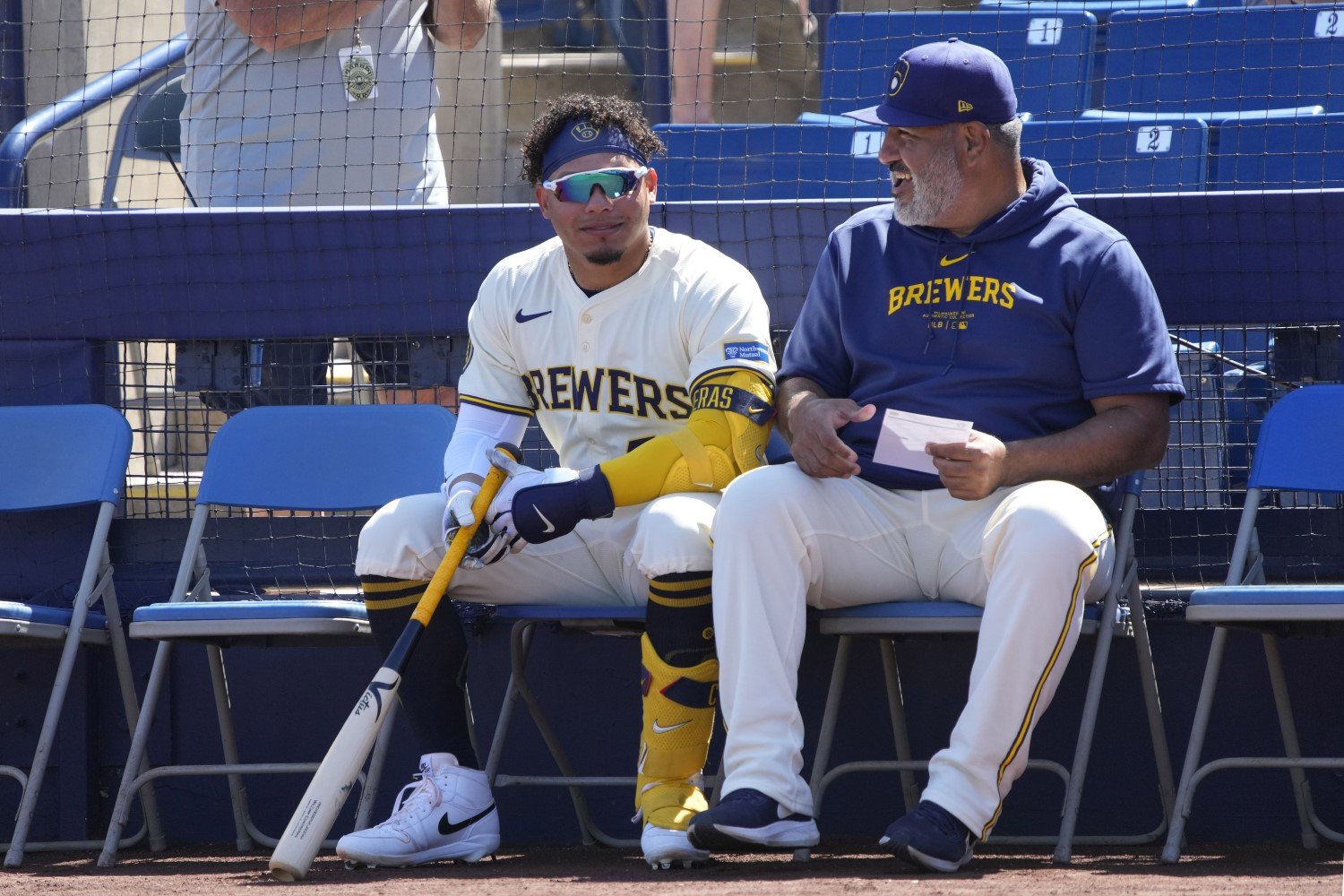 While there is no debating the fact that strikeouts are valuable (they nearly guarantee that a batter will not reach base, nor will they allow a baserunner to advance), not every pitcher’s repertoire allows them to pitch that way. Should those pitchers simply be thrown by the wayside? Do they no longer have a place in the game? The Brewers, as well as many other teams, don’t see it that way. Taking a look at the Crew's projected rotation for 2024, it’s clear that while they are missing their two horses from the past (Corbin Burnes and Brandon Woodruff), they do still have some pitchers who can miss bats and rack up strikeouts. Freddy Peralta had a 30.9% strikeout rate for 2023, which was eighth-highest in baseball among pitchers who made at least 15 starts. DL Hall was pitching in relief last season and only threw 19 1/3 MLB innings, but he posted a strikeout rate of 28.4%. He also posted a 32.3% rate in Triple-A, when he was mostly being used as a starter. Jakob Junis also largely came out of the pen, though he did so in longer stints, and he posted a 26.2% rate in 86 innings. Per TruMedia, the league average for pitchers who started at least 15 games last season was 22.8%. There are two names that are expected to be in the rotation who fall into the below-average range. Neither Colin Rea (21.3%) nor Wade Miley (16.1%) were at or above league average this past season. Another candidate for the rotation, Joe Ross, has a career strikeout rate of 21.3% as well. During his time in Arizona, Jack Stern wrote about Rea’s pitchability and how he gets outs despite his “average stuff”. While most of the impetus falls on Rea to execute his pitches, he also made it a point to credit William Contreras's pitch calling in his most recent post-game availability. Contreras is the latest in a long line of strong game-callers whom the Brewers have had behind the plate. Game-calling seems to be a skill the Brewers value when acquiring catchers, but they have also shown an ability to develop that skill once the catchers have been brought in. What may surprise some people is the goal that catchers have when they are calling pitches. For the most part, they are looking to induce early, weak contact, as often as possible. They aren’t going into an at-bat chasing a strikeout, the majority of the time. There are always extenuating circumstances, such as a runner on third base with less than two outs, In that scenario, a catcher and pitcher will often be looking to go after a strikeout from pitch one. Closers and high-leverage relievers are normally pitchers that you are going to want to have the ability to miss bats as well. But in most situations, especially early in games? Soft contact can still reign supreme. When calling a game, there are a number of factors that catchers take into account in order to create the type of contact that limits hits, while also limiting the number of pitches thrown. First, there must be an extremely strong knowledge of the pitcher they're catching. They have to know the pitcher’s repertoire just as well as the pitcher does. They need to know how each pitch moves, what pitches pair well with each other in sequence, as well as which ones do not play well off of each other. Sequencing pitches can sound like a relatively easy thing to understand and implement as a catcher. A high fastball pairs well with a big curveball. A low fastball away from a left-handed hitter could pair well with a changeup. Most people have seen the GIFs that Pitching Ninja posts on Twitter, showing how pitches tunnel with each other. Those are very appealing to the eye, and they do show how one pitch can help another. However, there is a lot more to sequencing than just tunneling pitches. Catchers also need to sequence pitches to change eye levels, to ensure that hitters aren’t able to cue in on one area of the zone, something that makes a hitter's job a lot easier. This is something Burnes needed to make some adjustments to in his final season and a half in Milwaukee, in terms of always wanting to throw low cutters. Eventually, hitters just started sitting on it, and despite the pitch’s impressive characteristics, they were able to ambush it more often as time went on. While certain pitches often pair well with a different pitch, a catcher also has to make sure that they’re not sequencing the same way every time they use a certain pitch. For example, if a catcher always follows a high fastball with a curveball (or vice versa), teams will pick up on that. Although conventional wisdom might tell them to call a certain pitch, they can’t just keep throwing down the same sequence every time. Sequencing also involves the ability to “read swings”. A hitter will often tell you what pitches he is seeing well, as well as which pitches he might be struggling with. This is the job of a catcher, but also of the pitcher. Wade Miley is the king of using a hitter's swings against him. Vinny Rottino did a breakdown on Bally Sports Live last season that perfectly encapsulates how Miley used future teammate Mark Canha's swings against him. during a plate appearance against the Mets. As the video shows, while location is important, timing will always reign supreme for hitters. If a hitter is on time, and a pitcher makes a mistake, he will probably not get that mistake back. What strong sequencing and reading swings can do, though, is to give the location of those pitches a larger margin for error. A hitter who is not on time might be able to get a barrel to a mistake, but he’s not going to be able to hit it at the ideal launch angle. Christian Yelich’s rocket choppers, especially in 2021 and 2022, are a great example of what it looks like when a hitter’s timing is off and they can’t truly punish the mistakes. Pitchers and catchers are aiming to create that type of timing discrepancy. Brewers catchers have done a strong job limiting hard contact through pitch calling. Last year, out of 95 catchers who caught at least 1000 pitches at the MLB level, Victor Caratini was 16th in lowest average exit velocity against. William Contreras was also above average in that regard. Former Brewers catchers Manny Piña and Omar Narvaez were in the top 10, and the recently acquired Gary Sánchez was, as well. Calling pitches is only half of the battle, though. In order to turn weak contact into outs with consistency, your defense needs to work in conjunction with the pitch calling. The Brewers have also excelled in that regard, as they finished first in Outs Above Average in 2023. They also finished second in Baseball Prospectus's "Deserved Runs Prevented". The combination of defense and pitch calling are a recipe for success, but how do the Brewers specifically partner these two facets of the game? In early March, our own Matthew Trueblood spoke to Pat Murphy about defensive positioning and game planning. “There’s a guy upstairs named Fox," Murphy said, referring to Director Baseball Research and Development Andrew Fox. "It’s a collaboration. Andy Fox, [Jason] Lane and [Matt] Erickson, [Quentin] Berry, and Fox. They get together. And then the starting pitcher has a little say in there, where they say in there, ‘I’m gonna throw this guy this way.’ Then we’re gonna do it that way.” Based on that quote, it sounds as though the pitcher and catcher game planning likely happens prior to the defensive positioning. That way, the defensive game plan can be adjusted based on how the battery plans to attack certain hitters. An example of this could be a pitcher planning to only throw a certain hitter pitches away. The defense wants to know that, so that they can align themselves a bit differently to account for the higher likelihood of the batter taking that pitch the other way. "You can’t dictate what’s going to happen in a game, how the ball is going to be hit, whatever," Murphy summarized. "You can’t. You just do what you can to try and put them in the right positions, and put your best defenders out there that you can have, and still put together a complete team." Baseball can be a confusing and frustrating sport. Sometimes a pitcher, catcher, and the entire defense can do everything right. They can have the defense positioned exactly how they should be, and then a soft batted ball will still find a hole for a hit. On the other side, sometimes a hitter will square up a line drive at 110 MPH and it will hit the center fielder in the chest for an out. While pitchers certainly get lucky from time to time, the odds of recording outs are much higher when the ball is hit softly, and that will always remain the goal of a battery. Despite the loss of pitchers like Burnes and Woodruff, the Brewers have the type of defensive personnel (as well as the pitch callers) to generate and capitalize on that soft contact more often than most teams.
- 7 comments
-
- 6
-
-
-
- colin rea
- william contreras
- (and 1 more)
-
The job of a big-league pitcher has evolved quite a bit. Though the ability to miss bats and rack up strikeouts has always been valuable, they've never been more in vogue than they are right now. In the not-so-distant past, the ability to generate soft contact was seen as a more valuable trait. Image courtesy of © Rick Scuteri-USA TODAY Sports While there is no debating the fact that strikeouts are valuable (they nearly guarantee that a batter will not reach base, nor will they allow a baserunner to advance), not every pitcher’s repertoire allows them to pitch that way. Should those pitchers simply be thrown by the wayside? Do they no longer have a place in the game? The Brewers, as well as many other teams, don’t see it that way. Taking a look at the Crew's projected rotation for 2024, it’s clear that while they are missing their two horses from the past (Corbin Burnes and Brandon Woodruff), they do still have some pitchers who can miss bats and rack up strikeouts. Freddy Peralta had a 30.9% strikeout rate for 2023, which was eighth-highest in baseball among pitchers who made at least 15 starts. DL Hall was pitching in relief last season and only threw 19 1/3 MLB innings, but he posted a strikeout rate of 28.4%. He also posted a 32.3% rate in Triple-A, when he was mostly being used as a starter. Jakob Junis also largely came out of the pen, though he did so in longer stints, and he posted a 26.2% rate in 86 innings. Per TruMedia, the league average for pitchers who started at least 15 games last season was 22.8%. There are two names that are expected to be in the rotation who fall into the below-average range. Neither Colin Rea (21.3%) nor Wade Miley (16.1%) were at or above league average this past season. Another candidate for the rotation, Joe Ross, has a career strikeout rate of 21.3% as well. During his time in Arizona, Jack Stern wrote about Rea’s pitchability and how he gets outs despite his “average stuff”. While most of the impetus falls on Rea to execute his pitches, he also made it a point to credit William Contreras's pitch calling in his most recent post-game availability. Contreras is the latest in a long line of strong game-callers whom the Brewers have had behind the plate. Game-calling seems to be a skill the Brewers value when acquiring catchers, but they have also shown an ability to develop that skill once the catchers have been brought in. What may surprise some people is the goal that catchers have when they are calling pitches. For the most part, they are looking to induce early, weak contact, as often as possible. They aren’t going into an at-bat chasing a strikeout, the majority of the time. There are always extenuating circumstances, such as a runner on third base with less than two outs, In that scenario, a catcher and pitcher will often be looking to go after a strikeout from pitch one. Closers and high-leverage relievers are normally pitchers that you are going to want to have the ability to miss bats as well. But in most situations, especially early in games? Soft contact can still reign supreme. When calling a game, there are a number of factors that catchers take into account in order to create the type of contact that limits hits, while also limiting the number of pitches thrown. First, there must be an extremely strong knowledge of the pitcher they're catching. They have to know the pitcher’s repertoire just as well as the pitcher does. They need to know how each pitch moves, what pitches pair well with each other in sequence, as well as which ones do not play well off of each other. Sequencing pitches can sound like a relatively easy thing to understand and implement as a catcher. A high fastball pairs well with a big curveball. A low fastball away from a left-handed hitter could pair well with a changeup. Most people have seen the GIFs that Pitching Ninja posts on Twitter, showing how pitches tunnel with each other. Those are very appealing to the eye, and they do show how one pitch can help another. However, there is a lot more to sequencing than just tunneling pitches. Catchers also need to sequence pitches to change eye levels, to ensure that hitters aren’t able to cue in on one area of the zone, something that makes a hitter's job a lot easier. This is something Burnes needed to make some adjustments to in his final season and a half in Milwaukee, in terms of always wanting to throw low cutters. Eventually, hitters just started sitting on it, and despite the pitch’s impressive characteristics, they were able to ambush it more often as time went on. While certain pitches often pair well with a different pitch, a catcher also has to make sure that they’re not sequencing the same way every time they use a certain pitch. For example, if a catcher always follows a high fastball with a curveball (or vice versa), teams will pick up on that. Although conventional wisdom might tell them to call a certain pitch, they can’t just keep throwing down the same sequence every time. Sequencing also involves the ability to “read swings”. A hitter will often tell you what pitches he is seeing well, as well as which pitches he might be struggling with. This is the job of a catcher, but also of the pitcher. Wade Miley is the king of using a hitter's swings against him. Vinny Rottino did a breakdown on Bally Sports Live last season that perfectly encapsulates how Miley used future teammate Mark Canha's swings against him. during a plate appearance against the Mets. As the video shows, while location is important, timing will always reign supreme for hitters. If a hitter is on time, and a pitcher makes a mistake, he will probably not get that mistake back. What strong sequencing and reading swings can do, though, is to give the location of those pitches a larger margin for error. A hitter who is not on time might be able to get a barrel to a mistake, but he’s not going to be able to hit it at the ideal launch angle. Christian Yelich’s rocket choppers, especially in 2021 and 2022, are a great example of what it looks like when a hitter’s timing is off and they can’t truly punish the mistakes. Pitchers and catchers are aiming to create that type of timing discrepancy. Brewers catchers have done a strong job limiting hard contact through pitch calling. Last year, out of 95 catchers who caught at least 1000 pitches at the MLB level, Victor Caratini was 16th in lowest average exit velocity against. William Contreras was also above average in that regard. Former Brewers catchers Manny Piña and Omar Narvaez were in the top 10, and the recently acquired Gary Sánchez was, as well. Calling pitches is only half of the battle, though. In order to turn weak contact into outs with consistency, your defense needs to work in conjunction with the pitch calling. The Brewers have also excelled in that regard, as they finished first in Outs Above Average in 2023. They also finished second in Baseball Prospectus's "Deserved Runs Prevented". The combination of defense and pitch calling are a recipe for success, but how do the Brewers specifically partner these two facets of the game? In early March, our own Matthew Trueblood spoke to Pat Murphy about defensive positioning and game planning. “There’s a guy upstairs named Fox," Murphy said, referring to Director Baseball Research and Development Andrew Fox. "It’s a collaboration. Andy Fox, [Jason] Lane and [Matt] Erickson, [Quentin] Berry, and Fox. They get together. And then the starting pitcher has a little say in there, where they say in there, ‘I’m gonna throw this guy this way.’ Then we’re gonna do it that way.” Based on that quote, it sounds as though the pitcher and catcher game planning likely happens prior to the defensive positioning. That way, the defensive game plan can be adjusted based on how the battery plans to attack certain hitters. An example of this could be a pitcher planning to only throw a certain hitter pitches away. The defense wants to know that, so that they can align themselves a bit differently to account for the higher likelihood of the batter taking that pitch the other way. "You can’t dictate what’s going to happen in a game, how the ball is going to be hit, whatever," Murphy summarized. "You can’t. You just do what you can to try and put them in the right positions, and put your best defenders out there that you can have, and still put together a complete team." Baseball can be a confusing and frustrating sport. Sometimes a pitcher, catcher, and the entire defense can do everything right. They can have the defense positioned exactly how they should be, and then a soft batted ball will still find a hole for a hit. On the other side, sometimes a hitter will square up a line drive at 110 MPH and it will hit the center fielder in the chest for an out. While pitchers certainly get lucky from time to time, the odds of recording outs are much higher when the ball is hit softly, and that will always remain the goal of a battery. Despite the loss of pitchers like Burnes and Woodruff, the Brewers have the type of defensive personnel (as well as the pitch callers) to generate and capitalize on that soft contact more often than most teams. View full article
- 7 replies
-
- 3
-
-
-
- colin rea
- william contreras
- (and 1 more)
-
I feel like the "eye test" wording here is being used in lieu of "analytics"? Because to me, the eye test and using your gut are more or less the same thing. It's ignoring statistics or numbers and going with what you (think) you see. I'll also add, Bauers' .750 OPS with a reasonable 24% K-rate seems to be getting ripped on a lot. He's had a pretty decent spring and has the ability to hit for power. I'm not sure what he's done this spring to be roped into the same category as Turang's pit of ineptitude at the plate haha.
-
Prospects Live's Top 100 was just released. I'm a big fan of the work they do. It's their own evaluations, they aren't just following a crowd. They're often the first on breakouts and their rankings are often quite a bit different than consensus. Seven Brewers in the Top 100 (helps that, like with Baseball America, they include DL Hall as prospect eligible still) https://www.prospectslive.com/prospects-live/2024-preseason-top-100-prospects-list
-
The "Wiemer needs to make more contact" thing while arguing in favor of Mitchell is something I have seen a lot of, and I just don't get it. In MLB, Mitchell's K% is 38.3%. Wiemer is at 28.3%. Mitchell's whiff rate is 35.4%. Wiemer's whiff rate is 33.6%. Both have issues with swing and miss, but Wiemer has had fewer than Mitchell. It's ok to talk about the struggles of Wiemer, but I don't see how it can be flipped into a positive for Mitchell at the same time. Frankly, I think we were very much on the precipice of a Mitchell collapse right before his injury last year, and there would likely be a much different view of him amongst the fanbase if he had played more. All that said... We don't know that he would have collapsed for sure, and I do think his results will usually be better than his expected stats, due to the speed and hustle that will turn grounders into singles and singles into doubles. He has also made some swing adjustments this offseason, like Wiemer. We will see if that helps him cover the top of the zone fastballs any better. TLDR; both Wiemer and Mitchell have plenty of concerns, but using Wiemer's swing and miss concerns as a pro-Mitchell argument doesn't make much sense.
-
Big League Spring Games, Minor Leaguers On Hand
Spencer Michaelis replied to Jim Goulart's topic in Brewers Minor League Talk
Prospect Tilt has been hyping up Henderson a lot lately, and this news of 94-96 with 18 IVB is extremely exciting. It really will all come down to the slider development for Henderson's chances of starting.


