Jason Wang
-
Posts
955 -
Joined
-
Last visited
-
Days Won
1
Content Type
Profiles
Forums
Blogs
Events
News
2026 Milwaukee Brewers Top Prospects Ranking
Milwaukee Brewers Videos
2022 Milwaukee Brewers Draft Picks
Milwaukee Brewers Free Agent & Trade Rumors, Notes, & Tidbits
Guides & Resources
2023 Milwaukee Brewers Draft Picks
2024 Milwaukee Brewers Draft Picks
The Milwaukee Brewers Players Project
2025 Milwaukee Brewers Draft Pick Tracker
2026 Milwaukee Brewers Draft Tracker: Picks & Bonuses
Store
Downloads
Gallery
Everything posted by Jason Wang
-

How to Watch & Stream Milwaukee Brewers Playoff Games On Television
Jason Wang posted an article in Brewers
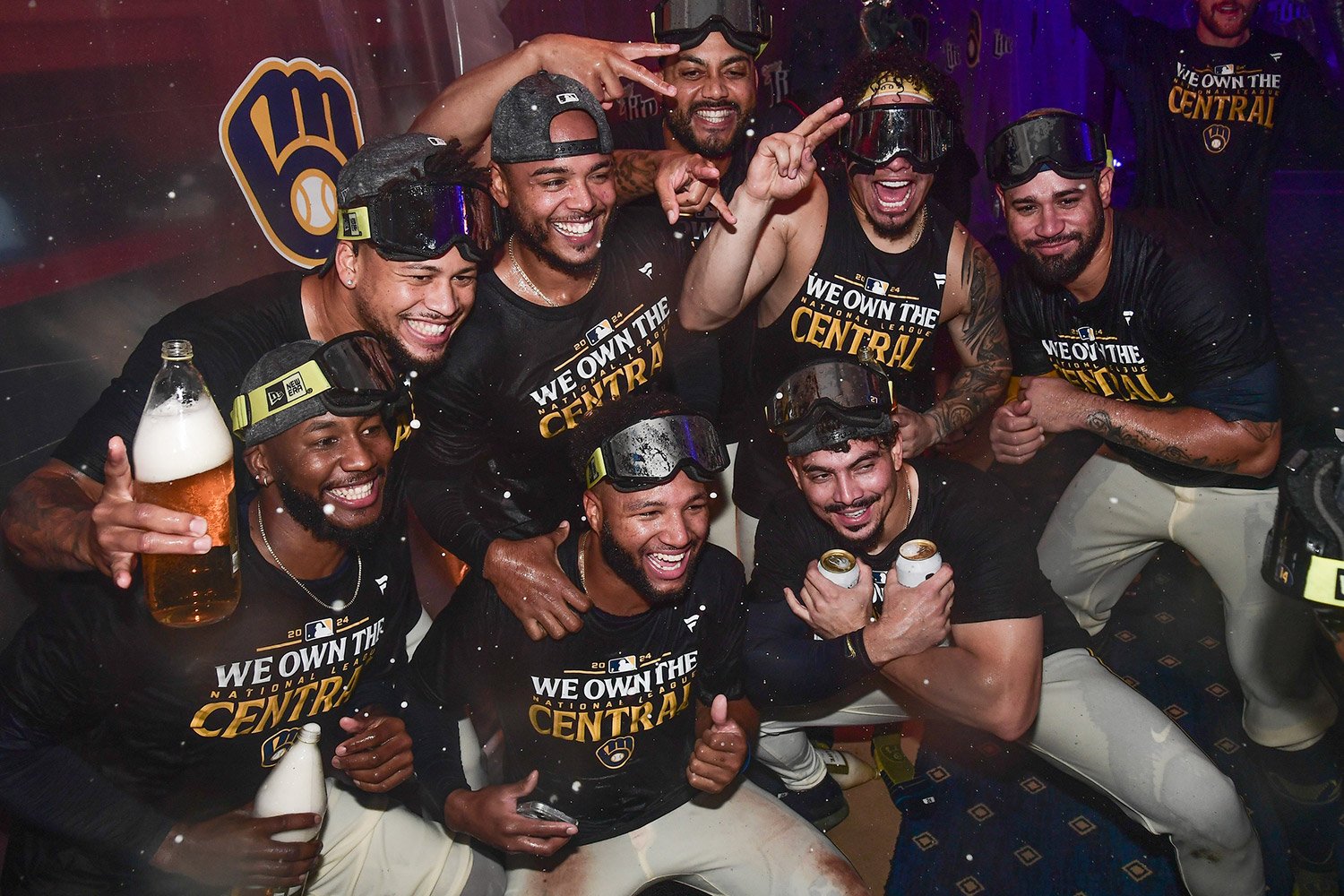 Unlike the regular season, the streaming landscape for the postseason is much less centralized. Even with an MLB.TV subscription, fans will only have access to the radio broadcast without linking a separate paid television subscription. The channels that will be broadcasting postseason games through MLB.TV are ESPN, TBS, FOX, and FS1. Furthermore, not every channel has the broadcast rights for every round of the playoffs. Wild Card Round ABC ESPN ESPN2 NLDS/NLCS/World Series FOX FS1 ALDS/ALCS TBS If you have an MLB.TV subscription and wish to link your streaming service of choice, note that not all providers have this option available. Major networks like DIRECTV, DISH, FuboTV, Cox, and Spectrum are great nationwide candidates for this option. Similarly, other regional providers like Armstrong, Blue Ridge Communications, and Midco are also valid partners if you’re in their service area. The complete list of valid subscriptions that can be linked to MLB.tv can be found here. If you don’t have an MLB.TV subscription or simply don’t care about linking streaming platforms, any service that contains the channels listed above will work. None of the Brewers’ games will be broadcast on TBS since they only have the broadcast rights for the AL side of the bracket and only the opening series against the Mets will be on ABC/ESPN/ESPN2. Sling TV, Youtube TV, and Fubo have both Fox and FS1 while Hulu TV only carries Fox. Sling TV: $40/month ($20 w/ first month promotion) Youtube TV: $72.99/month Fubo TV: $59.99/month Hulu TV: $82.99/month
 -
Where and how can Brewers fanatics watch and stream their favorite team’s playoff games on television? Image courtesy of © Benny Sieu-Imagn Images Where and how can Brewers fanatics watch and stream their favorite team’s playoff games on television? Unlike the regular season, the streaming landscape for the postseason is much less centralized. Even with an MLB.TV subscription, fans will only have access to the radio broadcast without linking a separate paid television subscription. The channels that will be broadcasting postseason games through MLB.TV are ESPN, TBS, FOX, and FS1. Furthermore, not every channel has the broadcast rights for every round of the playoffs. Wild Card Round ABC ESPN ESPN2 NLDS/NLCS/World Series FOX FS1 ALDS/ALCS TBS If you have an MLB.TV subscription and wish to link your streaming service of choice, note that not all providers have this option available. Major networks like DIRECTV, DISH, FuboTV, Cox, and Spectrum are great nationwide candidates for this option. Similarly, other regional providers like Armstrong, Blue Ridge Communications, and Midco are also valid partners if you’re in their service area. The complete list of valid subscriptions that can be linked to MLB.tv can be found here. If you don’t have an MLB.TV subscription or simply don’t care about linking streaming platforms, any service that contains the channels listed above will work. None of the Brewers’ games will be broadcast on TBS since they only have the broadcast rights for the AL side of the bracket and only the opening series against the Mets will be on ABC/ESPN/ESPN2. Sling TV, Youtube TV, and Fubo have both Fox and FS1 while Hulu TV only carries Fox. Sling TV: $40/month ($20 w/ first month promotion) Youtube TV: $72.99/month Fubo TV: $59.99/month Hulu TV: $82.99/month View full article
-
Yup, think he's done for the season since he broke his wrist which is why Milwaukee will definitely be facing Jose Iglesias at second base in his stead.
-
How Mets Will Line Up and Look Against Brewers in Wild Card Series
Jason Wang posted an article in Brewers
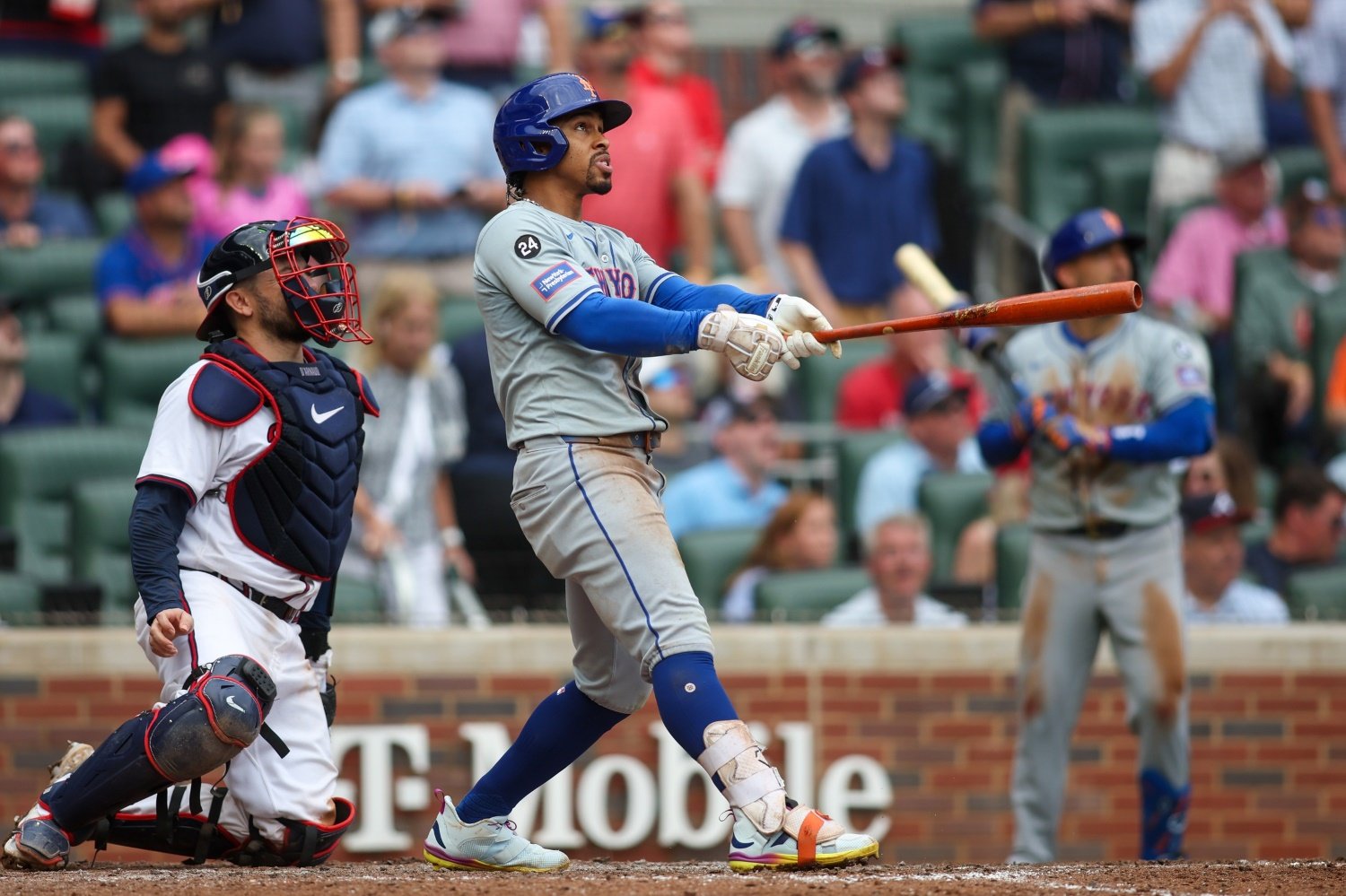 The Brewers played well against the Mets this year, going 5-1. In fact, they seem to do well against them nearly every year, having a 22-9 head-to-head record going back to 2019. This seems to be an encouraging sign that the Crew could win a playoff series for the first time in six years, but let’s not get ahead of ourselves. What are the Mets’ strengths and weaknesses and how can they be overcome and exploited, respectively? Strengths The Mets’ team OPS of .736 is ninth-best in MLB, just slightly above the Brewers’ own mark of .729. That probably undersells New York, too, because Citi Field is a slightly less hitter-friendly ballpark than American Family Field. The bulk of the Mets' offensive production comes from their infield, where some unexpected names have found a way to rise to the top. NL MVP contender Francisco Lindor and third baseman Mark Vientos lead the pack of qualified hitters, both having OPS+ figures of 137. Perennial slugger Pete Alonso is third, with an OPS+ of 124 after accumulating 30 or more doubles and 30 or more home runs for the first time since his Rookie of the Year campaign in 2019. Lindor and Alonso were expected to be anchors of the lineup, but Vientos's consistent excellence has been a pleasant surprise. While Jeff McNeil has had his struggles at the plate, his replacement (defensive whiz-***-Latin pop sensation José Iglesias) has been outstanding, putting up a 141 OPS+ in about half a season's worth of playing time. Luisangel Acuña will probably stay on the bench with Lindor’s return from a lingering back injury, but his brief time in the big leagues has been impressive. Their rotation also feels underrated, since it lacks any marquee names. Gone are the days of Justin Verlander and Max Scherzer reuniting to be paid more than the entire Athletics roster combined. With Kodai Senga also sidelined with injury and doubtful to return in the playoffs, David Peterson and Sean Manaea have stepped up to the plate (mound?) to lead the rotation. They’ve got great depth, too: Everyone in the full-time rotation has managed to keep an ERA under 4.00 this season. This may be partially thanks to the park factors and the broader league context, but Tylor Megill’s 99 ERA+ is the lowest of any qualified starter on the team. Teams will rarely utilize a full five-man rotation in the postseason, given the more spread-out schedule, but they have viable hurlers to spare. Weaknesses Compared to the great numbers put up by the infield, the offensive numbers of the outfield are somewhat lackluster. Brandon Nimmo and Starling Marte have been slightly better than average, but Harrison Bader hasn’t done much at the plate all year, posting an OPS+ of just 89. Their backups tell a similar story. Ex-Brewer Tyrone Taylor has had a great defensive year in right field, but will only play out there because Marte is nursing an injury and somewhat limited in his ability to play defense. Another ex-Brewer, Jesse Winker, was having a strong showing in Washington before being shipped at the deadline. He has had his moments, but has regressed as a Met, posting a 97 OPS+ over 129 plate appearances. The biggest hole might lie in the bullpen. They have some solid names, including José Buttó (2.55 ERA, 1.07 WHIP), Phil Maton (1.91 ERA, 0.81 WHIP since joining the team), and of course, Edwin Díaz (3.29 ERA, 1.00 WHIP). Unfortunately, the other arms haven’t been as consistent. Ryne Stanek has been disastrous since being acquired from the Mariners, pitching to a 6.06 ERA and 1.29 WHIP. Adam Ottavino and Danny Young have both been about replacement-level, while Huascar Brazobán has failed to rediscover the success he had in Miami earlier this year. Key Takeaways The best hitters in this lineup are dangerous, but it’s not like the Brewers haven’t encountered them already. The pitching staff has done a good job at neutralizing their bats in the six games they’ve played in 2024, keeping all but Iglesias to OPS figures below .720. Vientos and Lindor had a few good swings in the most recent three-game series, but Iglesias was held to singles, while Alonso was largely ineffective. The Mets’ pitching depth may also fall victim to the way they had to run their staff to get this far. Luis Severino will be available to pitch Game 1 on full rest, but he wouldn't have been one of the team's first two choices to do so. Behind him will lie a very tired bullpen, including Díaz, who figures to be unavailable at least Tuesday evening. Drawing out long at-bats, running up high pitch counts for Mets starters, taking aggressive swings on vulnerable relievers, and avoiding ground balls are obviously easier said than done, but even without all that, Milwaukee may be able to steal the series away by just staying the course. It hasn’t failed them thus far, so if it ain’t broke, why fix it?
 -
Fresh off beating them twice in three games, the Brewers get to welcome the Mets back to Milwaukee with everything on the line. What are their opponents' strengths and weaknesses? Image courtesy of © Brett Davis-Imagn Images Fresh off beating them twice in three games, the Brewers get to welcome the Mets back to Milwaukee with everything on the line. What are their opponents' strengths and weaknesses? The Brewers played well against the Mets this year, going 5-1. In fact, they seem to do well against them nearly every year, having a 22-9 head-to-head record going back to 2019. This seems to be an encouraging sign that the Crew could win a playoff series for the first time in six years, but let’s not get ahead of ourselves. What are the Mets’ strengths and weaknesses and how can they be overcome and exploited, respectively? Strengths The Mets’ team OPS of .736 is ninth-best in MLB, just slightly above the Brewers’ own mark of .729. That probably undersells New York, too, because Citi Field is a slightly less hitter-friendly ballpark than American Family Field. The bulk of the Mets' offensive production comes from their infield, where some unexpected names have found a way to rise to the top. NL MVP contender Francisco Lindor and third baseman Mark Vientos lead the pack of qualified hitters, both having OPS+ figures of 137. Perennial slugger Pete Alonso is third, with an OPS+ of 124 after accumulating 30 or more doubles and 30 or more home runs for the first time since his Rookie of the Year campaign in 2019. Lindor and Alonso were expected to be anchors of the lineup, but Vientos's consistent excellence has been a pleasant surprise. While Jeff McNeil has had his struggles at the plate, his replacement (defensive whiz-***-Latin pop sensation José Iglesias) has been outstanding, putting up a 141 OPS+ in about half a season's worth of playing time. Luisangel Acuña will probably stay on the bench with Lindor’s return from a lingering back injury, but his brief time in the big leagues has been impressive. Their rotation also feels underrated, since it lacks any marquee names. Gone are the days of Justin Verlander and Max Scherzer reuniting to be paid more than the entire Athletics roster combined. With Kodai Senga also sidelined with injury and doubtful to return in the playoffs, David Peterson and Sean Manaea have stepped up to the plate (mound?) to lead the rotation. They’ve got great depth, too: Everyone in the full-time rotation has managed to keep an ERA under 4.00 this season. This may be partially thanks to the park factors and the broader league context, but Tylor Megill’s 99 ERA+ is the lowest of any qualified starter on the team. Teams will rarely utilize a full five-man rotation in the postseason, given the more spread-out schedule, but they have viable hurlers to spare. Weaknesses Compared to the great numbers put up by the infield, the offensive numbers of the outfield are somewhat lackluster. Brandon Nimmo and Starling Marte have been slightly better than average, but Harrison Bader hasn’t done much at the plate all year, posting an OPS+ of just 89. Their backups tell a similar story. Ex-Brewer Tyrone Taylor has had a great defensive year in right field, but will only play out there because Marte is nursing an injury and somewhat limited in his ability to play defense. Another ex-Brewer, Jesse Winker, was having a strong showing in Washington before being shipped at the deadline. He has had his moments, but has regressed as a Met, posting a 97 OPS+ over 129 plate appearances. The biggest hole might lie in the bullpen. They have some solid names, including José Buttó (2.55 ERA, 1.07 WHIP), Phil Maton (1.91 ERA, 0.81 WHIP since joining the team), and of course, Edwin Díaz (3.29 ERA, 1.00 WHIP). Unfortunately, the other arms haven’t been as consistent. Ryne Stanek has been disastrous since being acquired from the Mariners, pitching to a 6.06 ERA and 1.29 WHIP. Adam Ottavino and Danny Young have both been about replacement-level, while Huascar Brazobán has failed to rediscover the success he had in Miami earlier this year. Key Takeaways The best hitters in this lineup are dangerous, but it’s not like the Brewers haven’t encountered them already. The pitching staff has done a good job at neutralizing their bats in the six games they’ve played in 2024, keeping all but Iglesias to OPS figures below .720. Vientos and Lindor had a few good swings in the most recent three-game series, but Iglesias was held to singles, while Alonso was largely ineffective. The Mets’ pitching depth may also fall victim to the way they had to run their staff to get this far. Luis Severino will be available to pitch Game 1 on full rest, but he wouldn't have been one of the team's first two choices to do so. Behind him will lie a very tired bullpen, including Díaz, who figures to be unavailable at least Tuesday evening. Drawing out long at-bats, running up high pitch counts for Mets starters, taking aggressive swings on vulnerable relievers, and avoiding ground balls are obviously easier said than done, but even without all that, Milwaukee may be able to steal the series away by just staying the course. It hasn’t failed them thus far, so if it ain’t broke, why fix it? View full article
-
The Turbulent Flight of Joel Payamps Has Finally Come In for Smooth Landing
Jason Wang posted an article in Brewers
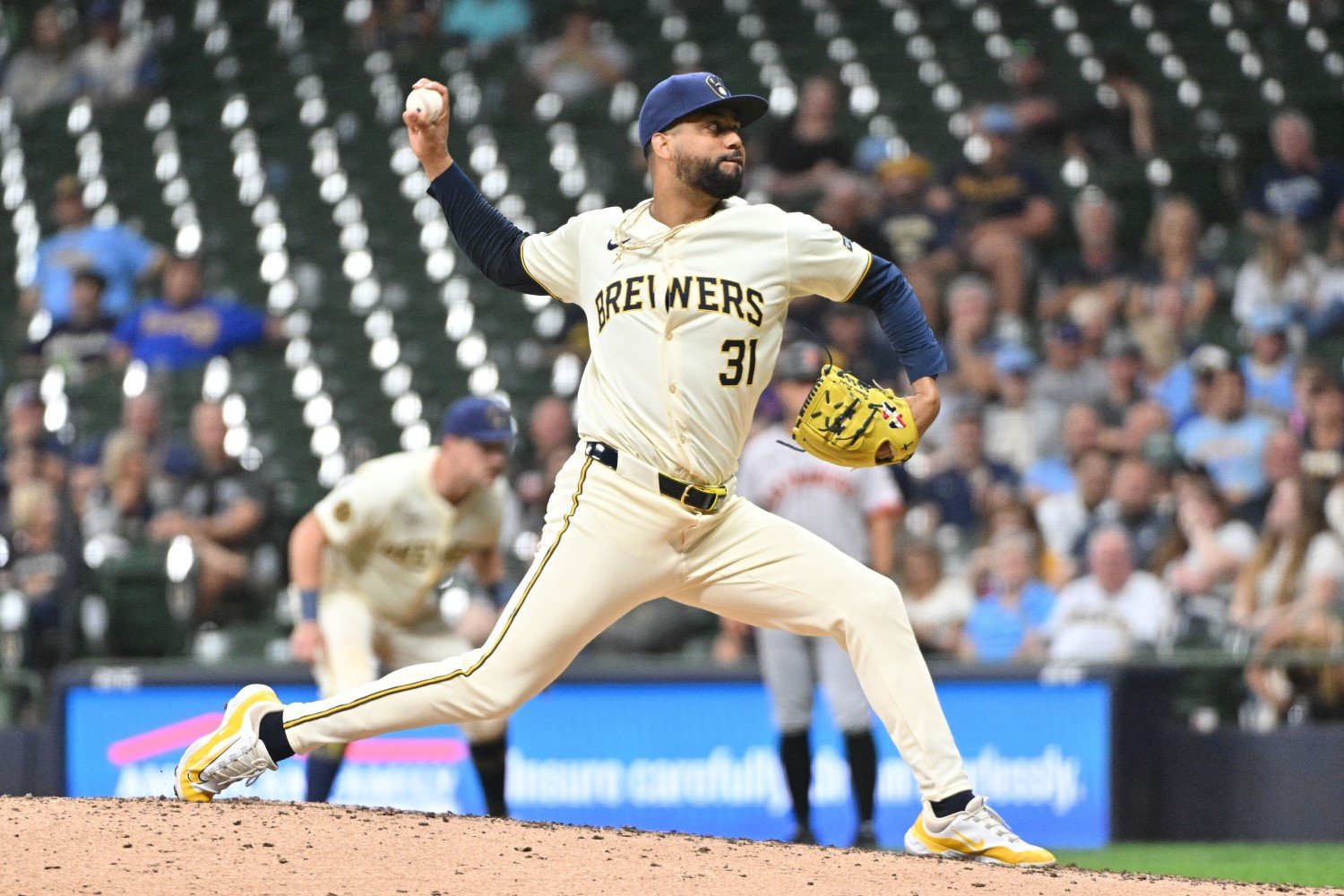 In 2023, Joel Payamps was an integral part of the Brewers bullpen. He was the main setup man for the team, pitching to a 2.55 ERA with a 1.05 WHIP and a 26.8% strikeout rate. His four-seam/slider combo was great, and allowed him to achieve both strikeouts and mostly soft contact, boasting a barrel rate in the lowest decile of qualified pitchers. He started to show some concerning signs toward the end of the year, conceding six earned runs in just 9 ⅓ innings pitched in the final month, but after 1 ⅔ innings of scoreless relief in his lone postseason appearance, Payamps entered this year as a projected linchpin of the Brewers pen. Unfortunately, it wasn't long before the lingering issues from the end of last year began to rear their ugly heads again. His first-half ERA of 4.41 pushed him lower and lower on the reliever depth chart, leaving many to wonder if he’d be relevant or even on the team down the line. After all, with a bountiful haul of arm talent in the farm system, it didn’t seem like he’d be very hard to replace. The main cause for his regression seemed to be his four-seam fastball. The high-level numbers said it was resulting in too much hard contact for it to be effective. 2023 2024 (Pre-ASB) BA .118 .176 SLG .221 .471 K% 45.2% 50.0% HR% 2.7% 8.3% While the opposing batting average increased by a considerable amount, it was still .176, still somewhat palatable for empathetic fans. The opposing slugging percentage, on the other hand, had nearly doubled, while the home run rate had more than tripled. Payamps doesn’t have wicked velocity on his fastball, averaging roughly 95 mph on the pitch, so he has to rely on great command to get through the day. In 2023, his command of the high fastball was excellent, creating a lot of swing-and-miss while limiting damage. Because of the excellent command at the top of the zone, Payamps had similar splits between RHB (1.40 ERA) and LHB (1.93 ERA) last year and it worked extremely well with his slider that covered the bottom edge of the zone. anFaV0FfWGw0TUFRPT1fVUZSVUFWSldWUUlBRGxwVFhnQUFBVlJlQUFNRVZBY0FDbFJRQVZBQUIxVlVVbGRV.mp4 In the first half of this year, Payamps tended to leave his fastballs slightly too low, landing many of his pitches in the heart of the zone, explaining the thunderous homers he was conceding. I believe these are what some fans like to call "meatballs." It also created a heinous platoon disadvantage. He gave up zero hits and just two walks while striking out 10 of the 15 batters whose plate appearances ended on the fastball. Against the 21 lefties he faced, he gave up six hits, three of which were homers, while striking out just eight. QnZ6MVFfWGw0TUFRPT1fVXdnQ1VWQU5Bd1lBQ0FOUVVBQUFCdzhBQUFCVVZBSUFCd0FEQkFOWEJBVUdVbGRT.mp4 It’s hard to say for sure whether these fastball issues were directly responsible for the regression in other pitches, since the command for his slider has been relatively consistent throughout the season. However, his sinker was seeing similarly disastrous results against lefties, a possible indicator that poor command was indeed a root of his broader issues. Jumping to the second half, it seems Payamps found his way back to his old self. He saw notable improvement against lefties, and while he’s still leaving a few pitches over the middle of the plate, it’s not as egregious as it was before the All-Star break. As a result, the second-half numbers on his fastball have looked significantly better, and his second-half ERA has plummeted to 1.16 over 23 ⅓ innings, capped off by 7 ⅓ scoreless innings so far in September. Batters Faced 15 BA .077 SLG .308 K% 46.7% OGdZbFhfWGw0TUFRPT1fQWdFREJsRUNCRkVBREZWV1ZnQUFDRkFDQUZoUlVsUUFCQWNGQ1FzRFV3VUFDUVpm.mp4 The best part of this in-season resurgence is that it’s just in time for the playoffs, and can help compensate for other bullpen arms who may be feeling the pain of a full, 162-game season. No Brewers reliever with more than three innings pitched in the second half has a better ERA than Payamps, and previously rock-solid pitchers have started to sputter--like Jared Koenig (3.91) and Trevor Megill (4.40 ERA). With his recent performances on the mound, Payamps has gone from irrelevant to a potentially key member of the October squad. Is there still a chance he’ll fall back into old habits, leave a few fastballs out over the plate, and fall short when it matters most? Of course, but the evidence instead suggests that he’s left his old self back in June.
 -
After a campaign stained by inconsistency, he’s rediscovering what made him great in years past at the perfect time. Image courtesy of © Michael McLoone-Imagn Images After a campaign stained by inconsistency, he’s rediscovering what made him great in years past at the perfect time. In 2023, Joel Payamps was an integral part of the Brewers bullpen. He was the main setup man for the team, pitching to a 2.55 ERA with a 1.05 WHIP and a 26.8% strikeout rate. His four-seam/slider combo was great, and allowed him to achieve both strikeouts and mostly soft contact, boasting a barrel rate in the lowest decile of qualified pitchers. He started to show some concerning signs toward the end of the year, conceding six earned runs in just 9 ⅓ innings pitched in the final month, but after 1 ⅔ innings of scoreless relief in his lone postseason appearance, Payamps entered this year as a projected linchpin of the Brewers pen. Unfortunately, it wasn't long before the lingering issues from the end of last year began to rear their ugly heads again. His first-half ERA of 4.41 pushed him lower and lower on the reliever depth chart, leaving many to wonder if he’d be relevant or even on the team down the line. After all, with a bountiful haul of arm talent in the farm system, it didn’t seem like he’d be very hard to replace. The main cause for his regression seemed to be his four-seam fastball. The high-level numbers said it was resulting in too much hard contact for it to be effective. 2023 2024 (Pre-ASB) BA .118 .176 SLG .221 .471 K% 45.2% 50.0% HR% 2.7% 8.3% While the opposing batting average increased by a considerable amount, it was still .176, still somewhat palatable for empathetic fans. The opposing slugging percentage, on the other hand, had nearly doubled, while the home run rate had more than tripled. Payamps doesn’t have wicked velocity on his fastball, averaging roughly 95 mph on the pitch, so he has to rely on great command to get through the day. In 2023, his command of the high fastball was excellent, creating a lot of swing-and-miss while limiting damage. Because of the excellent command at the top of the zone, Payamps had similar splits between RHB (1.40 ERA) and LHB (1.93 ERA) last year and it worked extremely well with his slider that covered the bottom edge of the zone. anFaV0FfWGw0TUFRPT1fVUZSVUFWSldWUUlBRGxwVFhnQUFBVlJlQUFNRVZBY0FDbFJRQVZBQUIxVlVVbGRV.mp4 In the first half of this year, Payamps tended to leave his fastballs slightly too low, landing many of his pitches in the heart of the zone, explaining the thunderous homers he was conceding. I believe these are what some fans like to call "meatballs." It also created a heinous platoon disadvantage. He gave up zero hits and just two walks while striking out 10 of the 15 batters whose plate appearances ended on the fastball. Against the 21 lefties he faced, he gave up six hits, three of which were homers, while striking out just eight. QnZ6MVFfWGw0TUFRPT1fVXdnQ1VWQU5Bd1lBQ0FOUVVBQUFCdzhBQUFCVVZBSUFCd0FEQkFOWEJBVUdVbGRT.mp4 It’s hard to say for sure whether these fastball issues were directly responsible for the regression in other pitches, since the command for his slider has been relatively consistent throughout the season. However, his sinker was seeing similarly disastrous results against lefties, a possible indicator that poor command was indeed a root of his broader issues. Jumping to the second half, it seems Payamps found his way back to his old self. He saw notable improvement against lefties, and while he’s still leaving a few pitches over the middle of the plate, it’s not as egregious as it was before the All-Star break. As a result, the second-half numbers on his fastball have looked significantly better, and his second-half ERA has plummeted to 1.16 over 23 ⅓ innings, capped off by 7 ⅓ scoreless innings so far in September. Batters Faced 15 BA .077 SLG .308 K% 46.7% OGdZbFhfWGw0TUFRPT1fQWdFREJsRUNCRkVBREZWV1ZnQUFDRkFDQUZoUlVsUUFCQWNGQ1FzRFV3VUFDUVpm.mp4 The best part of this in-season resurgence is that it’s just in time for the playoffs, and can help compensate for other bullpen arms who may be feeling the pain of a full, 162-game season. No Brewers reliever with more than three innings pitched in the second half has a better ERA than Payamps, and previously rock-solid pitchers have started to sputter--like Jared Koenig (3.91) and Trevor Megill (4.40 ERA). With his recent performances on the mound, Payamps has gone from irrelevant to a potentially key member of the October squad. Is there still a chance he’ll fall back into old habits, leave a few fastballs out over the plate, and fall short when it matters most? Of course, but the evidence instead suggests that he’s left his old self back in June. View full article
-
Key Storylines as Brewers Look Toward Postseason: Whom Should They Play?
Jason Wang posted an article in Brewers
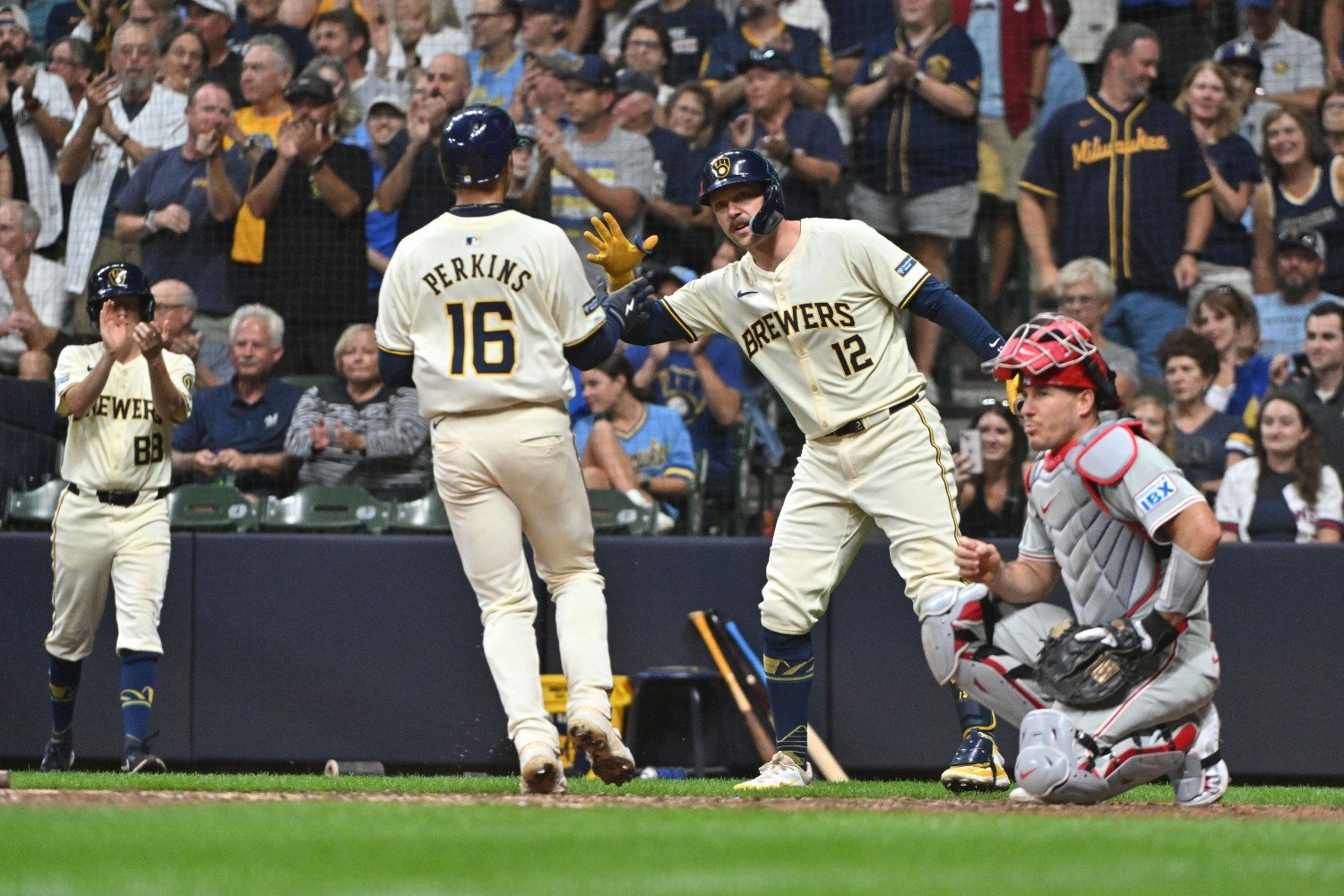 The Brewers managed to clinch the NL Central last week, to cap off what has been a dominant season. Their run differential of +124 is the third-highest in MLB, behind only the Yankees (+147) and Dodgers (+133). That's despite Milwaukee not having nearly the same star power, and their biggest name, Christian Yelich, being out of the lineup since late July. Instead, the team's powerhouse offense has been led by a group of youngsters, one of whom is 20 years old in Jackson Chourio. They've exceeded the expectations of many, but does this team of Gen-Z young'uns have what it takes to make a deeper playoff run? Potential Matchups In terms of seeding, it seems like the Brewers will probably come in third place once again. The Dodgers are four games up and have a remaining schedule of mild difficulty, finishing off with three games against the Rockies and three games against the Padres. The Phillies are three games up on the Crew, with an arguably easier schedule than the Dodgers', ending their regular season with a series against the Cubs and one against the Nationals. This means the Brewers will likely end up facing the sixth-seeded Wild Card team, a hard spot to predict at this time. The Diamondbacks and Mets have identical records at 87-69, and the Braves are just two games behind them. The Brewers have played well against both NL East teams this year, going 3-0 against the Mets and 4-2 against the Braves. The Mets might still be the better matchup for Milwaukee, given the uncertainty around the return of Francisco Lindor, but Atlanta’s own injury problems with Reynaldo López and Austin Riley may make them beatable, too. Either way, the Diamondbacks are the team to avoid--not that the Brewers have that power, per se. Their team OPS of .779 is the highest in MLB, and their second-half OPS of .850 is a step above the second-place Dodgers (.790 OPS). Their pitching is some of the worst in MLB, with a combined 4.63 ERA, but Zac Gallen and Merrill Kelly could be a formidable 1-2 punch. Additionally, let's not forget Brandon Pfaadt’s incredible efforts in the 2023 postseason. In their most recent series this past weekend, the Brewers narrowly avoided a four-game Snakes sweep with some eighth-inning heroics in the final game from Rhys Hoskins and Jake Bauers. Roster Battles The greatest positional depth can be found in the outfield. In Yelich’s absence, Chourio and Garrett Mitchell have risen to the occasion, as both players have an OPS north of .840 since Ye;ich's last game on Jul. 23. Sal Frelick and Blake Perkins have struggled mightily at the plate, with OPSes below .600 in that same span, but they’ve been stellar defensively, providing 14 and 8 Defensive Runs Saved, respectively. Frelick, Perkins and Mitchell figure to be mixed and matched, with Chourio the constant in the lineup come the playoffs. The infield is more or less settled, with the slight exception of first base. Hoskins holds the top spot on the depth chart for the position, but Bauers has been getting a decent number of reps. He’s played a total of 538 innings at first base, compared to Hoskins’s 739, and has been slightly better defensively, although neither will be winning Fielding Bible awards anytime soon. Picking between Bauers and Hoskins is sort of like picking between the snot and vomit-flavored jelly beans at the bottom of the bag your friends gave you: neither option is ideal. One factor leaning in the favor of Hoskins is his more favorable numbers against righties. His .710 OPS is a marked improvement over the .641 put up by Bauers this season, and Hoskins also has some postseason bona fides. On the mound, it seems like Colin Rea may already be earmarked for the bullpen. After being mauled by the Giants earlier in the month, he came out of the bullpen to pitch 2 ⅔ scoreless innings against the Phillies and picked up the first save of his career. He made an unimpressive four-inning start against Arizona that saw him concede three earned runs, foreshadowing issues if he were to take the ball in key playoff games. Tobias Myers and Freddy Peralta seem to be the frontrunners for the top two rotation spots. Myers has pitched to a 2.96 ERA over nine starts since the start of August, and Peralta has posted a 3.19 ERA over the same span. Aaron Civale has also been good since landing in Milwaukee, achieving a 3.84 ERA over 68 innings with the squad. Aside from the ever-impressive Devin Williams, expect Trevor Megill and Jared Koenig to play key roles at the back of the bullpen. With Bryan Hudson still in Triple-A even after someone was called up to replace Enoli Paredes, Koenig’s position as one of the few effective lefties on the team will be an imperative one. Will this finally be the year the Brewers make it out of the first round of postseason play? It’s always hard to predict the outcome of baseball games, especially series played in October, but after nearly 160 games of quality Brew Crew ball, there’s an exciting story heading into the playoffs.
 -
With the regular season conquered, Milwaukee must now look to October to find their next challenge. Image courtesy of © Michael McLoone-Imagn Images With the regular season conquered, Milwaukee must now look to October to find their next challenge. The Brewers managed to clinch the NL Central last week, to cap off what has been a dominant season. Their run differential of +124 is the third-highest in MLB, behind only the Yankees (+147) and Dodgers (+133). That's despite Milwaukee not having nearly the same star power, and their biggest name, Christian Yelich, being out of the lineup since late July. Instead, the team's powerhouse offense has been led by a group of youngsters, one of whom is 20 years old in Jackson Chourio. They've exceeded the expectations of many, but does this team of Gen-Z young'uns have what it takes to make a deeper playoff run? Potential Matchups In terms of seeding, it seems like the Brewers will probably come in third place once again. The Dodgers are four games up and have a remaining schedule of mild difficulty, finishing off with three games against the Rockies and three games against the Padres. The Phillies are three games up on the Crew, with an arguably easier schedule than the Dodgers', ending their regular season with a series against the Cubs and one against the Nationals. This means the Brewers will likely end up facing the sixth-seeded Wild Card team, a hard spot to predict at this time. The Diamondbacks and Mets have identical records at 87-69, and the Braves are just two games behind them. The Brewers have played well against both NL East teams this year, going 3-0 against the Mets and 4-2 against the Braves. The Mets might still be the better matchup for Milwaukee, given the uncertainty around the return of Francisco Lindor, but Atlanta’s own injury problems with Reynaldo López and Austin Riley may make them beatable, too. Either way, the Diamondbacks are the team to avoid--not that the Brewers have that power, per se. Their team OPS of .779 is the highest in MLB, and their second-half OPS of .850 is a step above the second-place Dodgers (.790 OPS). Their pitching is some of the worst in MLB, with a combined 4.63 ERA, but Zac Gallen and Merrill Kelly could be a formidable 1-2 punch. Additionally, let's not forget Brandon Pfaadt’s incredible efforts in the 2023 postseason. In their most recent series this past weekend, the Brewers narrowly avoided a four-game Snakes sweep with some eighth-inning heroics in the final game from Rhys Hoskins and Jake Bauers. Roster Battles The greatest positional depth can be found in the outfield. In Yelich’s absence, Chourio and Garrett Mitchell have risen to the occasion, as both players have an OPS north of .840 since Ye;ich's last game on Jul. 23. Sal Frelick and Blake Perkins have struggled mightily at the plate, with OPSes below .600 in that same span, but they’ve been stellar defensively, providing 14 and 8 Defensive Runs Saved, respectively. Frelick, Perkins and Mitchell figure to be mixed and matched, with Chourio the constant in the lineup come the playoffs. The infield is more or less settled, with the slight exception of first base. Hoskins holds the top spot on the depth chart for the position, but Bauers has been getting a decent number of reps. He’s played a total of 538 innings at first base, compared to Hoskins’s 739, and has been slightly better defensively, although neither will be winning Fielding Bible awards anytime soon. Picking between Bauers and Hoskins is sort of like picking between the snot and vomit-flavored jelly beans at the bottom of the bag your friends gave you: neither option is ideal. One factor leaning in the favor of Hoskins is his more favorable numbers against righties. His .710 OPS is a marked improvement over the .641 put up by Bauers this season, and Hoskins also has some postseason bona fides. On the mound, it seems like Colin Rea may already be earmarked for the bullpen. After being mauled by the Giants earlier in the month, he came out of the bullpen to pitch 2 ⅔ scoreless innings against the Phillies and picked up the first save of his career. He made an unimpressive four-inning start against Arizona that saw him concede three earned runs, foreshadowing issues if he were to take the ball in key playoff games. Tobias Myers and Freddy Peralta seem to be the frontrunners for the top two rotation spots. Myers has pitched to a 2.96 ERA over nine starts since the start of August, and Peralta has posted a 3.19 ERA over the same span. Aaron Civale has also been good since landing in Milwaukee, achieving a 3.84 ERA over 68 innings with the squad. Aside from the ever-impressive Devin Williams, expect Trevor Megill and Jared Koenig to play key roles at the back of the bullpen. With Bryan Hudson still in Triple-A even after someone was called up to replace Enoli Paredes, Koenig’s position as one of the few effective lefties on the team will be an imperative one. Will this finally be the year the Brewers make it out of the first round of postseason play? It’s always hard to predict the outcome of baseball games, especially series played in October, but after nearly 160 games of quality Brew Crew ball, there’s an exciting story heading into the playoffs. View full article
-
With His Sweeper in Flux, Can Colin Rea Be A Viable Postseason Starter?
Jason Wang posted an article in Brewers
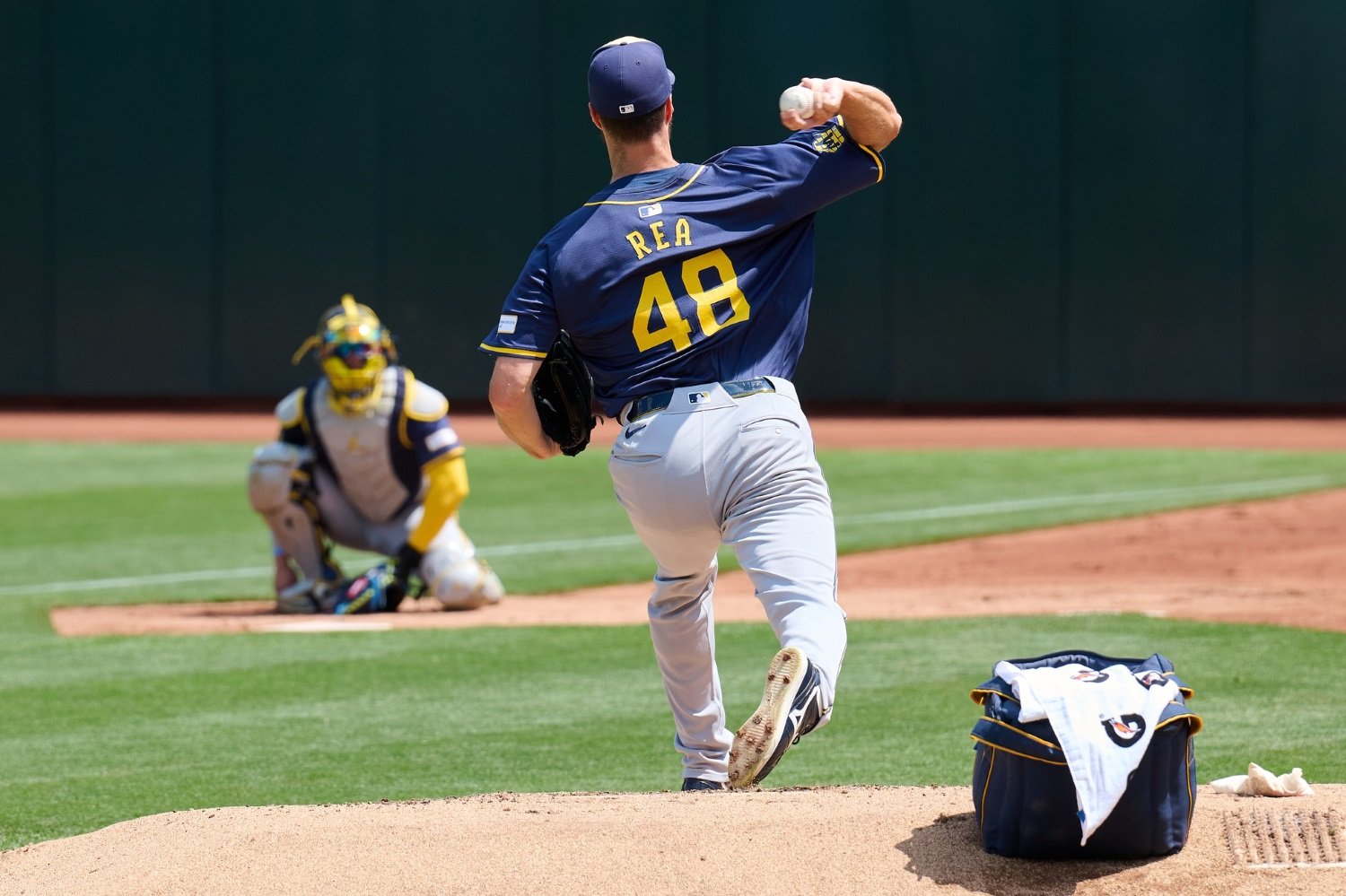 For the majority of this year, Colin Rea has exceeded expectations. Despite being a back-of-the-rotation guy in 2023, he ascended to new heights in 2024. After his 19th start on Aug. 6, he had a 3.38 ERA and a 1.18 WHIP. Since then, he’s managed just one quality start, while conceding seven or more earned runs twice, dragging his overall statistics down to a 4.21 ERA and 1.22 WHIP. How did this happen? Rea’s array of fastballs sits in the low 90s (though his cutter more often registers in the high 80s), and isn’t anything spectacular. Opposing batters are slugging .506 against his sinker and .647 against his cutter this year--a big problem, since those are the two pitches he throws most frequently. He has had slightly more success with his four-seam fastball, but he’s still conceded 11 earned runs with it, around the same number as his other two fastballs. Instead, the secret sauce has been his sweeper. Prior to Aug. 7, Rea threw his sweeper 329 times. Over this span, he gave up just five hits and zero earned runs. At an average velocity of 82 mph, with 42 inches of vertical drop, it’s a pretty good pitch. It has some late break, and to his credit, Rea was commanding it well, attacking the bottom portion of the zone while hitting the upper portions with his four-seam fastball. Rea to Suzuki.mp4 Hitters had a cumulative .182 OPS against the sweeper to that point, while whiffing on 24.8% of swings. A whopping 32.4% of their takes ended up as called strikes. Rea to Gunnar.mp4 Aug. 13 is when things started to unravel. Rea had a six-inning start against the Dodgers that saw him give up 10 hits and seven earned runs. It took him 92 pitches to get through four innings against the Reds, and his most recent start against the Giants was an unmitigated disaster, ending in a final line of 10 earned runs over four innings. His greatest pitch suddenly became his worst enemy, as hitters started catching on. While he allowed five hits and zero earned runs on his first 329 sweepers, his last 96 have resulted in eight hits and eight earned runs. The biggest cause for concern seems to be his command, especially against lefties. In the first portion of the year, he did a great job of placing the pitch either on the low inside corner or on the outside edge, painful spots for any batter. Lately, too many of his pitches are in the heart of the zone. That makes sense, as command tends to deteriorate quickly under the duress and fatigue of leading a top-notch rotation for a lengthy baseball season. Rea has never pitched this many innings, his closest mark being the 124 ⅔ innings he tossed last year. He’s already at 154 innings this year, with a few more turns of the rotation left plus playoff games in October, it’s not looking great for his workload. Furthermore, analytical fans will note that his FIP has always seemingly foreshadowed a return to Earth. Even through early August, when his ERA was at the 3.38 mark, his FIP was 4.27, heavily affected by a relatively low strikeout rate (19.5%) and average walk (7.1%) and home-run rates (3.1%). While it's not a perfect metric and can seem somewhat arbitrary, it's been a better predictor of future ERA than pretty much anything else. Milwaukee has the privilege of having several playoff-viable starters. Tobias Myers, while inexperienced, has been excellent all year. Freddy Peralta and Frankie Montas have several postseason appearances, and both have been on an upward trajectory in this final stretch. Even Aaron Civale has been more productive than many expected, after a brutal stint with the Rays. All of this means that Rea isn’t a necessary part of the playoff pitching picture. However, he’s demonstrated his ability to be great when in his full form, so perhaps some rest and recovery could help him help the team. In a worst-case scenario, maybe he crawls over the finish line of the regular season and finds himself in a long reliever role out of the bullpen, eating medium-leverage innings or coming in to stabilize the situation in the event of an emergency. Managing the pitching staff in the postseason is a unique exercise. Because of the higher importance of each game and the compressed schedule, teams usually shift from a five-man rotation to a four-man corps. The four names mentioned above could fill these spots and take the pressure off of Rea, allowing him to find the peak version of himself once again. Otherwise, seeing a depleted version of him taking the mound against the Dodgers, Phillies, or Diamondbacks in an elimination game could end in new, disappointing postseason memories for Brewers fans all over the world.
 -
Over his last stretch of brutal outings, the career journeyman has regressed to his former self. What does that mean for his role as a starter come playoff time? Image courtesy of © Robert Edwards-Imagn Images Over his last stretch of brutal outings, the career journeyman has regressed to his former self. What does that mean for his role as a starter come playoff time? For the majority of this year, Colin Rea has exceeded expectations. Despite being a back-of-the-rotation guy in 2023, he ascended to new heights in 2024. After his 19th start on Aug. 6, he had a 3.38 ERA and a 1.18 WHIP. Since then, he’s managed just one quality start, while conceding seven or more earned runs twice, dragging his overall statistics down to a 4.21 ERA and 1.22 WHIP. How did this happen? Rea’s array of fastballs sits in the low 90s (though his cutter more often registers in the high 80s), and isn’t anything spectacular. Opposing batters are slugging .506 against his sinker and .647 against his cutter this year--a big problem, since those are the two pitches he throws most frequently. He has had slightly more success with his four-seam fastball, but he’s still conceded 11 earned runs with it, around the same number as his other two fastballs. Instead, the secret sauce has been his sweeper. Prior to Aug. 7, Rea threw his sweeper 329 times. Over this span, he gave up just five hits and zero earned runs. At an average velocity of 82 mph, with 42 inches of vertical drop, it’s a pretty good pitch. It has some late break, and to his credit, Rea was commanding it well, attacking the bottom portion of the zone while hitting the upper portions with his four-seam fastball. Rea to Suzuki.mp4 Hitters had a cumulative .182 OPS against the sweeper to that point, while whiffing on 24.8% of swings. A whopping 32.4% of their takes ended up as called strikes. Rea to Gunnar.mp4 Aug. 13 is when things started to unravel. Rea had a six-inning start against the Dodgers that saw him give up 10 hits and seven earned runs. It took him 92 pitches to get through four innings against the Reds, and his most recent start against the Giants was an unmitigated disaster, ending in a final line of 10 earned runs over four innings. His greatest pitch suddenly became his worst enemy, as hitters started catching on. While he allowed five hits and zero earned runs on his first 329 sweepers, his last 96 have resulted in eight hits and eight earned runs. The biggest cause for concern seems to be his command, especially against lefties. In the first portion of the year, he did a great job of placing the pitch either on the low inside corner or on the outside edge, painful spots for any batter. Lately, too many of his pitches are in the heart of the zone. That makes sense, as command tends to deteriorate quickly under the duress and fatigue of leading a top-notch rotation for a lengthy baseball season. Rea has never pitched this many innings, his closest mark being the 124 ⅔ innings he tossed last year. He’s already at 154 innings this year, with a few more turns of the rotation left plus playoff games in October, it’s not looking great for his workload. Furthermore, analytical fans will note that his FIP has always seemingly foreshadowed a return to Earth. Even through early August, when his ERA was at the 3.38 mark, his FIP was 4.27, heavily affected by a relatively low strikeout rate (19.5%) and average walk (7.1%) and home-run rates (3.1%). While it's not a perfect metric and can seem somewhat arbitrary, it's been a better predictor of future ERA than pretty much anything else. Milwaukee has the privilege of having several playoff-viable starters. Tobias Myers, while inexperienced, has been excellent all year. Freddy Peralta and Frankie Montas have several postseason appearances, and both have been on an upward trajectory in this final stretch. Even Aaron Civale has been more productive than many expected, after a brutal stint with the Rays. All of this means that Rea isn’t a necessary part of the playoff pitching picture. However, he’s demonstrated his ability to be great when in his full form, so perhaps some rest and recovery could help him help the team. In a worst-case scenario, maybe he crawls over the finish line of the regular season and finds himself in a long reliever role out of the bullpen, eating medium-leverage innings or coming in to stabilize the situation in the event of an emergency. Managing the pitching staff in the postseason is a unique exercise. Because of the higher importance of each game and the compressed schedule, teams usually shift from a five-man rotation to a four-man corps. The four names mentioned above could fill these spots and take the pressure off of Rea, allowing him to find the peak version of himself once again. Otherwise, seeing a depleted version of him taking the mound against the Dodgers, Phillies, or Diamondbacks in an elimination game could end in new, disappointing postseason memories for Brewers fans all over the world. View full article
-
do u think its because they were besties with mark canha last year when he was a brewer and didn't wanna embarrass him and get uninvited from his birthday party at chuck e cheese?
-
In the bottom of the ninth inning Tuesday night, the Brewers’ closer had to face an imposing rookie threat to preserve the team’s one-run lead. Image courtesy of © Stan Szeto-Imagn Images In the bottom of the ninth inning Tuesday night, the Brewers’ closer had to face an imposing rookie threat to preserve the team’s one-run lead. Milwaukee got to work quickly against the Giants, scoring two runs in the first inning and adding a third by way of a Garrett Mitchell home run in the sixth inning. Unfortunately, the Giants went tit-for-tat, keeping things within one run throughout the entire game. The Brewers were up 3-2 in the bottom of the ninth inning, and with the heart of the order coming to the plate, Pat Murphy called on the services of Devin Williams. After giving up a single to Heliot Ramos, Williams struck out Michael Conforto, got Matt Chapman to pop out, and walked Mark Canha. With the winning runner now on first, this called for a mound visit. Williams was 17 pitches into this appearance and the fatigue was starting to show. In his at-bat against Canha, he threw just one strike while his four-seam fastball struggled to find the plate. He needed just one more out, but with no margin for error, it wouldn’t be an easy one to get. Tyler Fitzgerald has been a welcome surprise for Giants fans this year. He has posted a .870 OPS over 288 plate appearances, and has consequently become one of the most valuable members of the team. He has performed slightly worse against right-handed pitching (.827 OPS) than he has against left-handed pitching (.947 OPS), but his numbers are still competitive. To make matters worse, he has a .854 OPS against four-seam fastballs and a 1.000 OPS against changeups from the right side, a seemingly uphill battle for Williams who throws these pitches exclusively. Williams led off with a changeup, perhaps wanting to recreate the success that DL Hall had against Fitzgerald with his change in the seventh inning, albeit from the left side. It was actually a pretty good pitch, boasting 44 inches of drop and 22 inches of arm-side run. Fitzgerald, likely expecting a changeup after witnessing Williams’s lack of command with the fastball, decided to take it, putting him in a 1-0 count. QnZxNDVfWGw0TUFRPT1fQXdVSFV3WU5VVlFBQ1ZJSFVRQUFWVk5VQUZrQkFGVUFVMVJSQVZBTlZ3TlJCVlFE.mp4 So it was time to turn up the gas, or at least as much as possible. Because of the workload, Williams was sitting around 93 mph on his fastball, a dip from his usual velocity around the 95 mph mark. Still, if it was tunneled and commanded well enough, he’d get a whiff or at least some soft contact. Fitzgerald was probably still expecting another changeup, since the last one had been a ball, so he decided to take again, watching his first strike on the outside edge. Williams was back to an even count at 1-1. QnZxNDVfWGw0TUFRPT1fVXdnRlhWSUFYZ29BREZWV1V3QUFCd1ZmQUFNRlYxRUFBMVlGQmxkWENRWlJCMVlI.mp4 In even counts with fewer than two strikes, Williams has a slight preference for throwing his fastball. While he’s famous for his “Airbender”, his fastball is still immensely effective, not necessarily because of its scorching velocity or wicked spin, but instead, because of how well he sequences it with his changeup. Batters are constantly expecting the change, which allows him to get away with free heaters in the low 90s. That's exactly what he did on the third pitch of the at-bat. It clocked in at just 93 mph, one of the slowest fastballs he has thrown all season, but Fitzgerald just watched it go by him to put him into a do-or-die 1-2 count. QnZxNDVfWGw0TUFRPT1fQXdZRlYxSU1CMUVBQUFBS1ZBQUFDQVFIQUZsVEFWTUFWRklIQWdwUlVsQUhVbFlF.mp4 At this point, Williams had the clear psychological advantage. He was ahead in the count, and even with runners on base and the game on the line, it was a position he had been in before, as a six-year veteran. Tyler Fitzgerald, on the other hand, had just stared at two strikes and was one mistake away from costing his team the game. He couldn’t possibly afford to stare at a third strike in the zone; Giants Twitter would have his head for it. He was going to, at the very least, try to fight off the next few pitches if they looked even close to the plate. So what did Williams do? Go back to the bread-and-butter bender of air. Perhaps sensing a green light for Fitzgerald, William Contreras set up on the outside edge, wanting to avoid any chance of contact. Williams delivered, getting a foul tip that looked more like a pure whiff to end the game. QnZxNDVfWGw0TUFRPT1fQkZRQ0FGQUhBbGNBV2xZS1h3QUFVZ2RlQUFBQ0IxZ0FDd1lDQlZWUlZRWlNBQUJY.mp4 After some adversity, Williams came away with a two-strikeout save in 21 pitches. His final strikeout added 17% of win probability, the biggest change of any single plate appearance in the game. His performance under duress helped start the series on the right foot and bring the Brewers into single-digit magic number territory, in terms of clinching the NL Central for the fourth time in five years. View full article
-
Anatomy of an At-Bat: Devin Williams Changes It Up On Tyler Fitzgerald
Jason Wang posted an article in Brewers
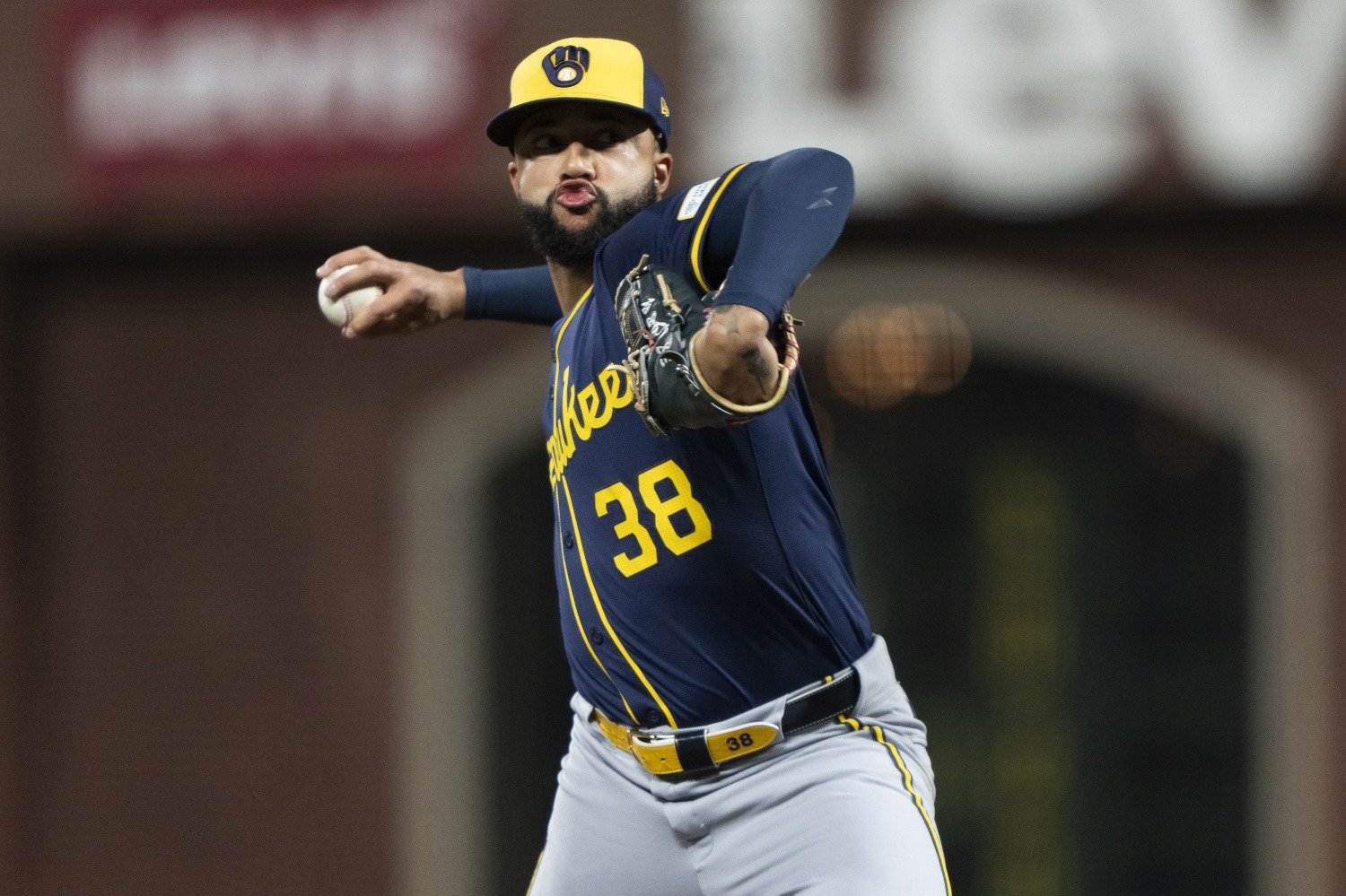 Milwaukee got to work quickly against the Giants, scoring two runs in the first inning and adding a third by way of a Garrett Mitchell home run in the sixth inning. Unfortunately, the Giants went tit-for-tat, keeping things within one run throughout the entire game. The Brewers were up 3-2 in the bottom of the ninth inning, and with the heart of the order coming to the plate, Pat Murphy called on the services of Devin Williams. After giving up a single to Heliot Ramos, Williams struck out Michael Conforto, got Matt Chapman to pop out, and walked Mark Canha. With the winning runner now on first, this called for a mound visit. Williams was 17 pitches into this appearance and the fatigue was starting to show. In his at-bat against Canha, he threw just one strike while his four-seam fastball struggled to find the plate. He needed just one more out, but with no margin for error, it wouldn’t be an easy one to get. Tyler Fitzgerald has been a welcome surprise for Giants fans this year. He has posted a .870 OPS over 288 plate appearances, and has consequently become one of the most valuable members of the team. He has performed slightly worse against right-handed pitching (.827 OPS) than he has against left-handed pitching (.947 OPS), but his numbers are still competitive. To make matters worse, he has a .854 OPS against four-seam fastballs and a 1.000 OPS against changeups from the right side, a seemingly uphill battle for Williams who throws these pitches exclusively. Williams led off with a changeup, perhaps wanting to recreate the success that DL Hall had against Fitzgerald with his change in the seventh inning, albeit from the left side. It was actually a pretty good pitch, boasting 44 inches of drop and 22 inches of arm-side run. Fitzgerald, likely expecting a changeup after witnessing Williams’s lack of command with the fastball, decided to take it, putting him in a 1-0 count. QnZxNDVfWGw0TUFRPT1fQXdVSFV3WU5VVlFBQ1ZJSFVRQUFWVk5VQUZrQkFGVUFVMVJSQVZBTlZ3TlJCVlFE.mp4 So it was time to turn up the gas, or at least as much as possible. Because of the workload, Williams was sitting around 93 mph on his fastball, a dip from his usual velocity around the 95 mph mark. Still, if it was tunneled and commanded well enough, he’d get a whiff or at least some soft contact. Fitzgerald was probably still expecting another changeup, since the last one had been a ball, so he decided to take again, watching his first strike on the outside edge. Williams was back to an even count at 1-1. QnZxNDVfWGw0TUFRPT1fVXdnRlhWSUFYZ29BREZWV1V3QUFCd1ZmQUFNRlYxRUFBMVlGQmxkWENRWlJCMVlI.mp4 In even counts with fewer than two strikes, Williams has a slight preference for throwing his fastball. While he’s famous for his “Airbender”, his fastball is still immensely effective, not necessarily because of its scorching velocity or wicked spin, but instead, because of how well he sequences it with his changeup. Batters are constantly expecting the change, which allows him to get away with free heaters in the low 90s. That's exactly what he did on the third pitch of the at-bat. It clocked in at just 93 mph, one of the slowest fastballs he has thrown all season, but Fitzgerald just watched it go by him to put him into a do-or-die 1-2 count. QnZxNDVfWGw0TUFRPT1fQXdZRlYxSU1CMUVBQUFBS1ZBQUFDQVFIQUZsVEFWTUFWRklIQWdwUlVsQUhVbFlF.mp4 At this point, Williams had the clear psychological advantage. He was ahead in the count, and even with runners on base and the game on the line, it was a position he had been in before, as a six-year veteran. Tyler Fitzgerald, on the other hand, had just stared at two strikes and was one mistake away from costing his team the game. He couldn’t possibly afford to stare at a third strike in the zone; Giants Twitter would have his head for it. He was going to, at the very least, try to fight off the next few pitches if they looked even close to the plate. So what did Williams do? Go back to the bread-and-butter bender of air. Perhaps sensing a green light for Fitzgerald, William Contreras set up on the outside edge, wanting to avoid any chance of contact. Williams delivered, getting a foul tip that looked more like a pure whiff to end the game. QnZxNDVfWGw0TUFRPT1fQkZRQ0FGQUhBbGNBV2xZS1h3QUFVZ2RlQUFBQ0IxZ0FDd1lDQlZWUlZRWlNBQUJY.mp4 After some adversity, Williams came away with a two-strikeout save in 21 pitches. His final strikeout added 17% of win probability, the biggest change of any single plate appearance in the game. His performance under duress helped start the series on the right foot and bring the Brewers into single-digit magic number territory, in terms of clinching the NL Central for the fourth time in five years.
 -
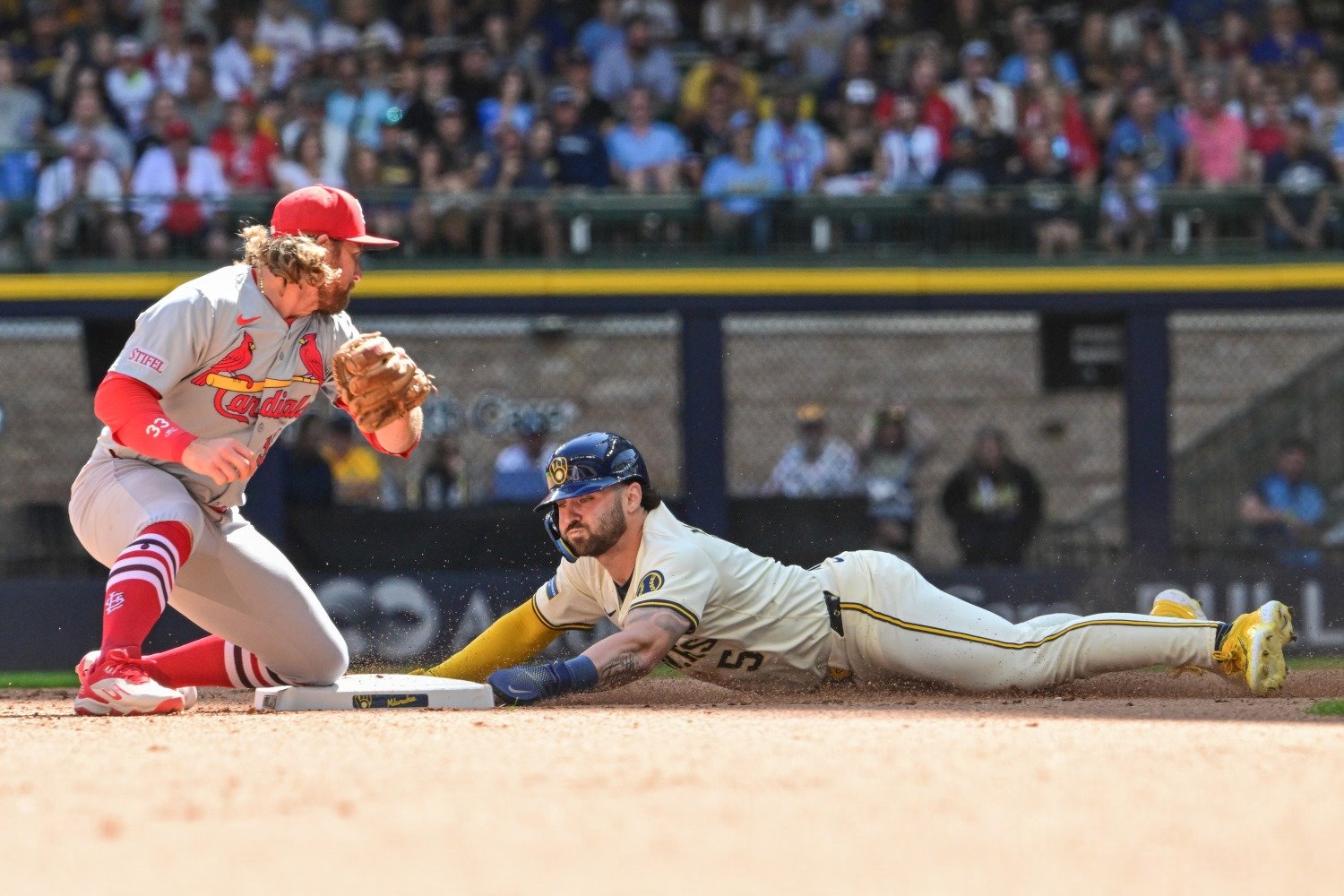 Last month, Matthew Trueblood put out a great article looking into the early numbers being put up by Garrett Mitchell, and brought a couple of key things to light. First, he had an oddly high whiff rate, despite having an excellent chase rate. Second, he was striking out at a reasonable rate while walking >10% of the time. Third, his BABIP was incredible, perhaps unsustainably so. All of these statements were made when he had 78 plate appearances under his belt. Now that we’ve got 167 plate appearances worth of data, I wanted to revisit how he’s progressed (or regressed) in each of the areas of concern. To start, let’s unpack his whiff and chase rates. He’s still chasing at an elite percentage of 15.8%, the best mark on the team. Unfortunately, his issues with swinging and missing seem to be chronic. His cumulative whiff rate is a whopping 32.8%, and he has an in-zone whiff rate of 26.8%, the highest mark of any Brewer with at least 110 plate appearances. Here’s how that in-zone whiff rate breaks down by pitch type. Hard (four-seam, sinker, cutter) 28.5% Off-speed (changeup, splitter) 28.1% Breaking (curveball, slider, sweeper) 22.2% Given this breakdown, I wondered if this was due to Mitchell not being able to time up velocity very well. This would make sense given his long layoff and how darn tough it is to hit a baseball when it’s thrown really hard. However, his in-zone whiff rate against fastballs thrown 95 mph or harder is just 24.4%, better than his cumulative rate. Against pitches slower than 95 mph, it jumps up to 35.4%, but even more interesting is how bad he has been against 94 mph fastballs, specifically. He has 17 total misses against four-seam fastballs thrown between 94 and 95 miles an hour, and an in-zone whiff rate of 57.7%. This holds little to no statistical significance, but I thought it was peculiar enough to mention. Because of his swing decisions, it makes a ton of sense that a player who both chases at an elite rate and whiffs worse than the majority of MLB would have correspondingly high walk and strikeout rates. If he had a penchant for hitting home runs, he'd be another great example of a three-true-outcome player, but with just four homers to speak of so far, he's missing the final piece of the puzzle. Furthermore, this has been his M.O. since he was called up. His career whiff rate is 34.0%, so fans can be glad that at least he's mostly missing on pitches inside the zone. When Mitchell does manage to make contact, things tend to swing his way. His cumulative BABIP of .371 is the best on the team of anyone with >60 plate appearances. This isn’t necessarily due to a wicked-high launch-angle sweet-spot rate or tremendous exit velocity that blasts baseballs off of outfield walls for doubles and triples. Instead, it’s likely due to his speed. His 97th percentile sprint speed allows him to leg out hits that would otherwise be routine groundouts. Take this hit against the Reds that was only made possible by Mitchell’s wild wheels, or this play against the Marlins. With his extended stay with the Brewers in 2024, Mitchell has shown himself to be a capable outfielder. Despite the lopsided nature of his intrinsic hitting profile, his .252/.341/.422 slash line and 111 OPS+ mean he’s capable at the plate, and if nothing else, he’s got good on-base skills. Defensively, he’s primarily been playing center field, with some time in right field as well and has already accumulated 8 Defensive Runs Saved. So what does this all mean for his future with the team? There is a ton of talent in Milwaukee’s outfield, and Mitchell doesn’t have the same star power of Christian Yelich or Jackson Chourio that almost demands a starting spot. He’s proven himself to be valuable and perhaps an offensive upgrade over the likes of Blake Perkins and Sal Frelick, but it would be hard to definitively say that he’s a clear step up. Perhaps the future for Mitchell lies outside of the Brewers, and his greatest use is as a trade piece. Before Joey Wiemer was ultimately packaged and sent off to Cincinnati in exchange for Frankie Montas, Mitchell was seen as the most likely outfielder to be shipped off. His numbers have cooled off since the trade deadline, but they haven’t drifted far enough for his value to significantly change. With his abilities, years of team control, and existing competition in the outfield, he’d fetch a hefty haul in the offseason, and could help set the Brewers up for deep playoff runs in the future. Until then, he’s a critical piece of the outfield sans Christian Yelich.
 -
He’s already made more plate appearances in 2024 than in his last two years combined. What has this larger sample size shown us? Image courtesy of © Benny Sieu-Imagn Images He’s already made more plate appearances in 2024 than in his last two years combined. What has this larger sample size shown us? Last month, Matthew Trueblood put out a great article looking into the early numbers being put up by Garrett Mitchell, and brought a couple of key things to light. First, he had an oddly high whiff rate, despite having an excellent chase rate. Second, he was striking out at a reasonable rate while walking >10% of the time. Third, his BABIP was incredible, perhaps unsustainably so. All of these statements were made when he had 78 plate appearances under his belt. Now that we’ve got 167 plate appearances worth of data, I wanted to revisit how he’s progressed (or regressed) in each of the areas of concern. To start, let’s unpack his whiff and chase rates. He’s still chasing at an elite percentage of 15.8%, the best mark on the team. Unfortunately, his issues with swinging and missing seem to be chronic. His cumulative whiff rate is a whopping 32.8%, and he has an in-zone whiff rate of 26.8%, the highest mark of any Brewer with at least 110 plate appearances. Here’s how that in-zone whiff rate breaks down by pitch type. Hard (four-seam, sinker, cutter) 28.5% Off-speed (changeup, splitter) 28.1% Breaking (curveball, slider, sweeper) 22.2% Given this breakdown, I wondered if this was due to Mitchell not being able to time up velocity very well. This would make sense given his long layoff and how darn tough it is to hit a baseball when it’s thrown really hard. However, his in-zone whiff rate against fastballs thrown 95 mph or harder is just 24.4%, better than his cumulative rate. Against pitches slower than 95 mph, it jumps up to 35.4%, but even more interesting is how bad he has been against 94 mph fastballs, specifically. He has 17 total misses against four-seam fastballs thrown between 94 and 95 miles an hour, and an in-zone whiff rate of 57.7%. This holds little to no statistical significance, but I thought it was peculiar enough to mention. Because of his swing decisions, it makes a ton of sense that a player who both chases at an elite rate and whiffs worse than the majority of MLB would have correspondingly high walk and strikeout rates. If he had a penchant for hitting home runs, he'd be another great example of a three-true-outcome player, but with just four homers to speak of so far, he's missing the final piece of the puzzle. Furthermore, this has been his M.O. since he was called up. His career whiff rate is 34.0%, so fans can be glad that at least he's mostly missing on pitches inside the zone. When Mitchell does manage to make contact, things tend to swing his way. His cumulative BABIP of .371 is the best on the team of anyone with >60 plate appearances. This isn’t necessarily due to a wicked-high launch-angle sweet-spot rate or tremendous exit velocity that blasts baseballs off of outfield walls for doubles and triples. Instead, it’s likely due to his speed. His 97th percentile sprint speed allows him to leg out hits that would otherwise be routine groundouts. Take this hit against the Reds that was only made possible by Mitchell’s wild wheels, or this play against the Marlins. With his extended stay with the Brewers in 2024, Mitchell has shown himself to be a capable outfielder. Despite the lopsided nature of his intrinsic hitting profile, his .252/.341/.422 slash line and 111 OPS+ mean he’s capable at the plate, and if nothing else, he’s got good on-base skills. Defensively, he’s primarily been playing center field, with some time in right field as well and has already accumulated 8 Defensive Runs Saved. So what does this all mean for his future with the team? There is a ton of talent in Milwaukee’s outfield, and Mitchell doesn’t have the same star power of Christian Yelich or Jackson Chourio that almost demands a starting spot. He’s proven himself to be valuable and perhaps an offensive upgrade over the likes of Blake Perkins and Sal Frelick, but it would be hard to definitively say that he’s a clear step up. Perhaps the future for Mitchell lies outside of the Brewers, and his greatest use is as a trade piece. Before Joey Wiemer was ultimately packaged and sent off to Cincinnati in exchange for Frankie Montas, Mitchell was seen as the most likely outfielder to be shipped off. His numbers have cooled off since the trade deadline, but they haven’t drifted far enough for his value to significantly change. With his abilities, years of team control, and existing competition in the outfield, he’d fetch a hefty haul in the offseason, and could help set the Brewers up for deep playoff runs in the future. Until then, he’s a critical piece of the outfield sans Christian Yelich. View full article
-
WIll Amazon Be A Future Streaming Home Of The Milwaukee Brewers?
Jason Wang posted an article in Brewers
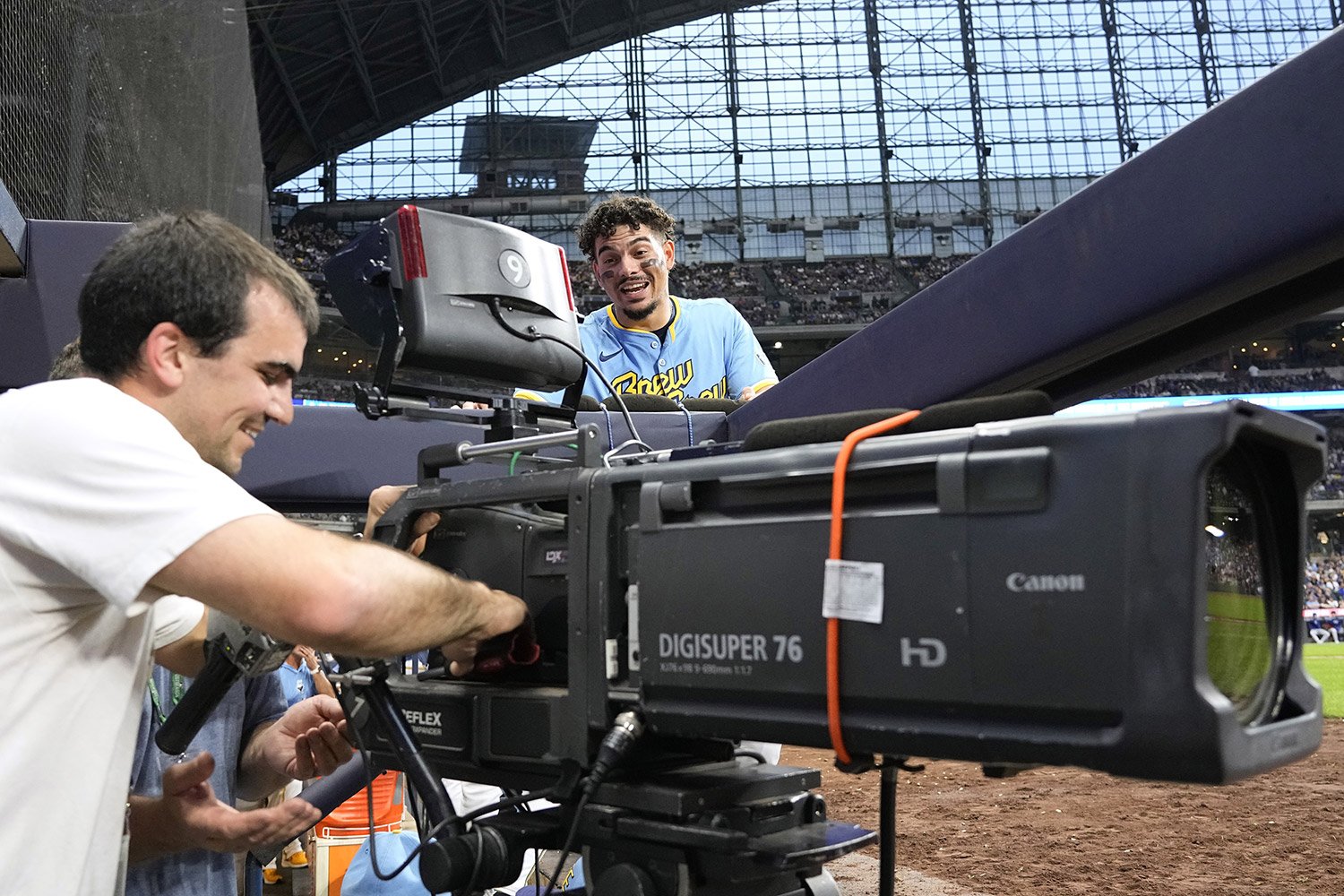 Diamond Sports Group, the owner of Bally Sports, started running into bankruptcy in February 2023 after missing an interest payment of $140 million. In the months following, they further missed payments to various sports teams, and confusion regarding the future of their portfolio of streaming rights left fans in a daze. Luckily for them (and perhaps unluckily for the average consumer), Amazon started talks to fold Bally’s assets into Amazon Prime Video. When it was announced, there was still a chance that the bankruptcy court would reject the deal, but as per recent reports, it seems that negotiations are in the final stages. So, what does this mean for fans hoping to stream Brew Crew baseball? The Brewers are one of the five MLB teams (along with the Tigers, Royals, Marlins, and Rays) whose existing contracts with Diamond Sports Group will carry over into the future. The current plan seems that Amazon will charge $20/month for a streaming package through Prime that provides fans access to teams in their local area. Most importantly, this means that in-market viewers with Prime subscriptions will no longer need cable access to watch the Brewers. Regional sports networks have struggled as cord-cutting has continued, and more people have moved towards consolidated television packages. This partnership with Amazon is a temporary fix, but a few hurdles still need to be cleared. First, DSG must prove that it can be a sustainable business to satisfy the bankruptcy court. Second, Amazon must stay true to its word as its earlier withdrawal of a discussed $115 million investment doesn’t necessarily convey the most faith. Sure, they’re interested in the broadcasting rights now, but what about in five to ten years? Will consumers have to go through this charade again? Finally, what about customers without Amazon Prime? Will they have to succumb to an Amazon Prime subscription in addition to the added fee to stream games? Potentially, but as things are yet to be set in stone, it’s hard to make a definitive claim. An interesting tidbit about this deal is that it may not be exclusive, meaning DSG could enter similar partnerships with competing platforms, providing customers with alternative viewing options. To further complicate matters, MLB has expressed interest in tossing their hat in the streaming ring and could release their package as soon as 2025. Rob Manfred said this is one of his main focuses moving forward and could simplify things in an in-market package similar to the existing out-of-market MLB.tv product. In the interim, you can look forward to funneling your hard funds into the pockets of Amazon investors worldwide so you can enjoy some good ol’ Milwaukee baseball.
 -
After more than a year of financial uncertainty, Bally Sports could finally be nearing a deal with the tech giant. Image courtesy of © Jeff Hanisch-Imagn Images After more than a year of financial uncertainty, Bally Sports could finally be nearing a deal with the tech giant. Diamond Sports Group, the owner of Bally Sports, started running into bankruptcy in February 2023 after missing an interest payment of $140 million. In the months following, they further missed payments to various sports teams, and confusion regarding the future of their portfolio of streaming rights left fans in a daze. Luckily for them (and perhaps unluckily for the average consumer), Amazon started talks to fold Bally’s assets into Amazon Prime Video. When it was announced, there was still a chance that the bankruptcy court would reject the deal, but as per recent reports, it seems that negotiations are in the final stages. So, what does this mean for fans hoping to stream Brew Crew baseball? The Brewers are one of the five MLB teams (along with the Tigers, Royals, Marlins, and Rays) whose existing contracts with Diamond Sports Group will carry over into the future. The current plan seems that Amazon will charge $20/month for a streaming package through Prime that provides fans access to teams in their local area. Most importantly, this means that in-market viewers with Prime subscriptions will no longer need cable access to watch the Brewers. Regional sports networks have struggled as cord-cutting has continued, and more people have moved towards consolidated television packages. This partnership with Amazon is a temporary fix, but a few hurdles still need to be cleared. First, DSG must prove that it can be a sustainable business to satisfy the bankruptcy court. Second, Amazon must stay true to its word as its earlier withdrawal of a discussed $115 million investment doesn’t necessarily convey the most faith. Sure, they’re interested in the broadcasting rights now, but what about in five to ten years? Will consumers have to go through this charade again? Finally, what about customers without Amazon Prime? Will they have to succumb to an Amazon Prime subscription in addition to the added fee to stream games? Potentially, but as things are yet to be set in stone, it’s hard to make a definitive claim. An interesting tidbit about this deal is that it may not be exclusive, meaning DSG could enter similar partnerships with competing platforms, providing customers with alternative viewing options. To further complicate matters, MLB has expressed interest in tossing their hat in the streaming ring and could release their package as soon as 2025. Rob Manfred said this is one of his main focuses moving forward and could simplify things in an in-market package similar to the existing out-of-market MLB.tv product. In the interim, you can look forward to funneling your hard funds into the pockets of Amazon investors worldwide so you can enjoy some good ol’ Milwaukee baseball. View full article
-
Milwaukee continued their savage stretch of shoving, posting a combined team ERA of 3.25 over 28 games. Milwaukee continued their savage stretch of shoving, posting a combined team ERA of 3.25 over 28 games. Honorable Mentions Joel Payamps 12 2/3 IP, 5 H, 2 ER, 3 BB, 12 K Payamps had his best month of the year so far, pitching to the tune of a 1.42 ERA over 14 appearances. It was the first month of the season where his ERA was under 4.00 as he dialed in on his sinker and slider. Against 72 sliders thrown, opposing batters batted just .059 with a 27.8% strikeout rate. While his sinker didn’t net a single strikeout, it also didn’t give up a single hit or walk over 34 pitches. Statistical Nugget: Of Brewers pitchers with 10+ innings pitched in August, Payamps’ WHIP of 0.63 was the second-lowest behind just Bryan Hudson (0.50). Joe Ross 13 IP, 8 H, 1 ER, 3 BB, 11 K Following a disappointing stretch of starts before and after a lengthy IL stint, Ross has been great out of the bullpen so far. It was his first full month as a reliever and he was lights out, posting a 0.69 ERA over his seven appearances. While his four-seam fastball was a secondary weapon to his sinker this month, it had an impressive 42.9% strikeout rate with a 0.0% walk rate. The only run he gave up was against his slider, a pitch that still kept opposing batters to a .387 OPS. Statistical Nugget: Of Brewers pitchers with 10+ innings pitched in August, Ross’s opposing slugging percentage of .174 was the lowest. Freddy Peralta 28 IP, 22 H, 9 ER, 11 BB, 23 K Like the aforementioned names on this list, Peralta hit a real stride this month. His 2.89 ERA over five starts was a significant improvement over the approximately 4.00 ERA mark he was sitting at over the prior three months. It has been discussed a few times on Brewer Fanatic already, but when his slider is working well, Peralta is at his best. Over 78 sliders thrown in August, he didn’t concede a single run. The curveball was just as effective, also avoiding any scoring damage over 48 pitches. He’s locking in at just the right time and if he maintains this momentum into the postseason, Milwaukee will have a great rotation setup for any playoff series. Statistical Nugget: Of Brewers pitchers with more than 20 batters faced in August, Freddy Peralta’s barrel rate against his breaking balls was 6.3%, second-lowest behind just Joe Ross (5.6%). Pitcher of the Month - Tobias Myers 27 IP, 24 H, 8 ER, 5 BB, 21 K The defending champion kept it going with a 2.67 ERA over five starts, his best monthly ERA since the mind-blowing 1.44 he posted in June. His four-seam/slider combo continued to help carry the sagging weight of a cutter that continues to struggle at the major league level. These two pitches combined for an opposing batting average of just .186, a big improvement over the .360 average against his cutter in August. While Peralta may have entered the season as the ace of the rotation, Myers seems to have risen to the top spot statistically, leading the team in starter ERA (3.00). Regardless of who is actually top dog, it’s clear that the starting rotation injury catastrophe that threatened to sink the ship has been patched up just in time for October. Statistical Nugget: Of Brewers starters, Myers’ August walk rate of 4.6% was the second-lowest, behind just Colin Rea (0.8%). View full article
-
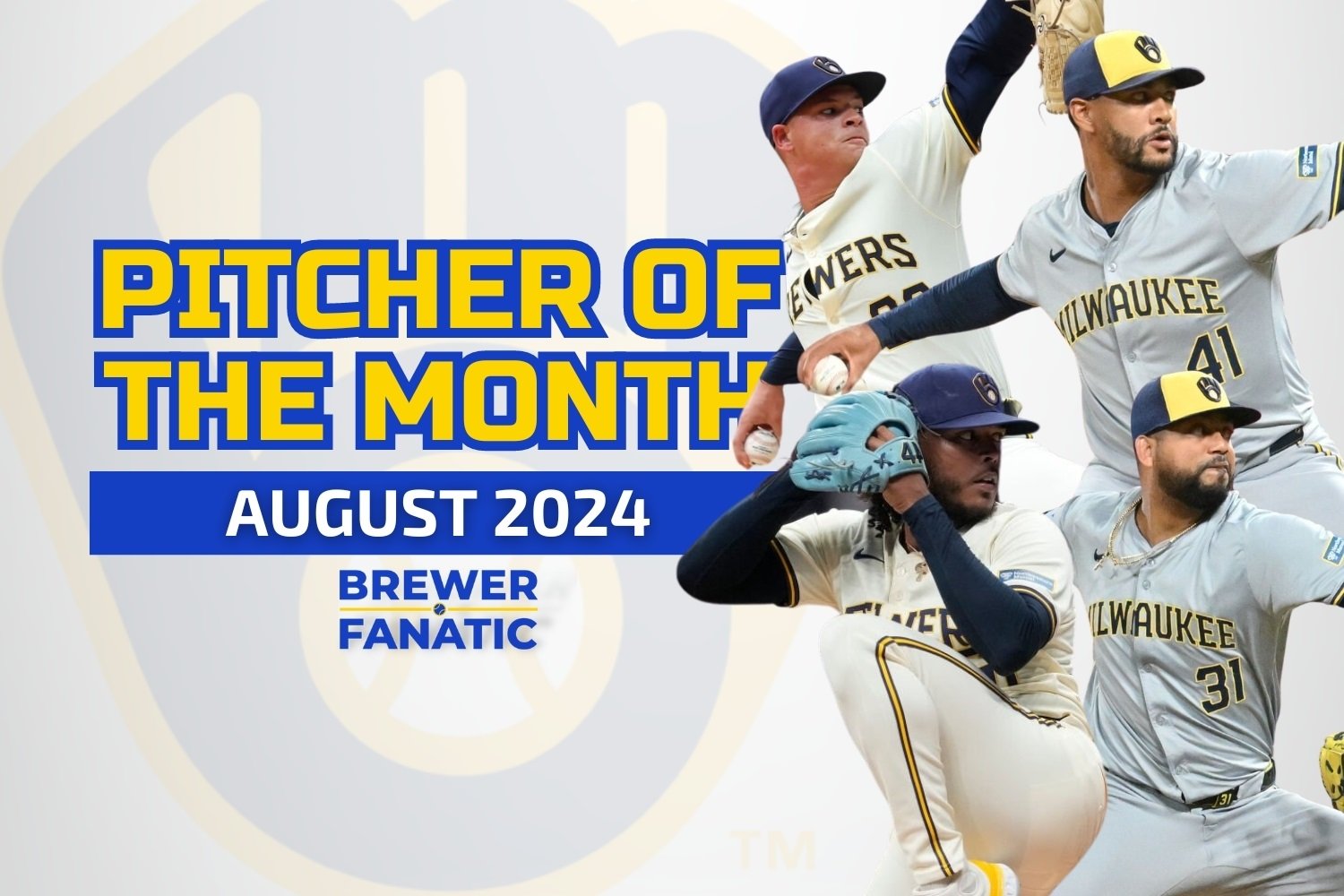 Honorable Mentions Joel Payamps 12 2/3 IP, 5 H, 2 ER, 3 BB, 12 K Payamps had his best month of the year so far, pitching to the tune of a 1.42 ERA over 14 appearances. It was the first month of the season where his ERA was under 4.00 as he dialed in on his sinker and slider. Against 72 sliders thrown, opposing batters batted just .059 with a 27.8% strikeout rate. While his sinker didn’t net a single strikeout, it also didn’t give up a single hit or walk over 34 pitches. Statistical Nugget: Of Brewers pitchers with 10+ innings pitched in August, Payamps’ WHIP of 0.63 was the second-lowest behind just Bryan Hudson (0.50). Joe Ross 13 IP, 8 H, 1 ER, 3 BB, 11 K Following a disappointing stretch of starts before and after a lengthy IL stint, Ross has been great out of the bullpen so far. It was his first full month as a reliever and he was lights out, posting a 0.69 ERA over his seven appearances. While his four-seam fastball was a secondary weapon to his sinker this month, it had an impressive 42.9% strikeout rate with a 0.0% walk rate. The only run he gave up was against his slider, a pitch that still kept opposing batters to a .387 OPS. Statistical Nugget: Of Brewers pitchers with 10+ innings pitched in August, Ross’s opposing slugging percentage of .174 was the lowest. Freddy Peralta 28 IP, 22 H, 9 ER, 11 BB, 23 K Like the aforementioned names on this list, Peralta hit a real stride this month. His 2.89 ERA over five starts was a significant improvement over the approximately 4.00 ERA mark he was sitting at over the prior three months. It has been discussed a few times on Brewer Fanatic already, but when his slider is working well, Peralta is at his best. Over 78 sliders thrown in August, he didn’t concede a single run. The curveball was just as effective, also avoiding any scoring damage over 48 pitches. He’s locking in at just the right time and if he maintains this momentum into the postseason, Milwaukee will have a great rotation setup for any playoff series. Statistical Nugget: Of Brewers pitchers with more than 20 batters faced in August, Freddy Peralta’s barrel rate against his breaking balls was 6.3%, second-lowest behind just Joe Ross (5.6%). Pitcher of the Month - Tobias Myers 27 IP, 24 H, 8 ER, 5 BB, 21 K The defending champion kept it going with a 2.67 ERA over five starts, his best monthly ERA since the mind-blowing 1.44 he posted in June. His four-seam/slider combo continued to help carry the sagging weight of a cutter that continues to struggle at the major league level. These two pitches combined for an opposing batting average of just .186, a big improvement over the .360 average against his cutter in August. While Peralta may have entered the season as the ace of the rotation, Myers seems to have risen to the top spot statistically, leading the team in starter ERA (3.00). Regardless of who is actually top dog, it’s clear that the starting rotation injury catastrophe that threatened to sink the ship has been patched up just in time for October. Statistical Nugget: Of Brewers starters, Myers’ August walk rate of 4.6% was the second-lowest, behind just Colin Rea (0.8%).
 -
What Do The Brewers Need To Do In September To Score A Playoff Bye Round?
Jason Wang posted an article in Brewers
 It has been a great regular season for the Brewers so far. They have vastly exceeded expectations, and since they’re comfortably winning the NL Central, the next goal should be to skip straight to the division series, if possible. As things currently stand, the Dodgers have the most wins in the National League with 81, while the Phillies and Brewers are just two games back with identical records of 79-56. This gives the Dodgers a clear bye, but we’ll have to head to a tiebreaker for the other two teams. The first factor is the head-to-head record. Unfortunately for Milwaukee, the only series they played against Philadelphia was a three-game sweep back at the start of June. On the other hand, they have an upcoming three-game series at home to settle the score. If the Brewers manage to sweep the Phillies right back, then the head-to-head record will be 3-3, so we’ll have to defer to the second tiebreaker, their record against division opponents. Some might say the Phillies and Brewers are not in the same division. While I personally deny such outlandish claims and believe them to be a part of a larger conspiracy, I must admit that it’s technically true. However, MLB still uses intradivision record as the tiebreaker in this case. Against NL Central teams, the Brewers are 28-16, giving them a winning percentage of 63.6%. Against NL East teams, the Phillies are 21-15, giving them a winning percentage of 58.3% so that the Brewers would take the #2 National League seed and the attached bye. But hold on, the season isn’t exactly over yet. There are under 30 games to play, and a lot can change over that span, especially if teams are currently caught in a deadlock. If we instead try to imagine the playoff bracket after a full 162 games have been completed, things look slightly different. Per FanGraphs, the Dodgers are still projected to end up on top with 97 projected wins. The Phillies come in second with 94 projected wins, and the Brewers get relegated to the Wild Card Round with 93. Still, there’s a meager spread of just four games between first and third here, so what can the Crew do to sway the odds back in their favor? Based on FanGraphs, they have the strongest strength of schedule of the three current division leaders down the stretch. A couple of upcoming series that could prove to be somewhat challenging are the Diamondbacks (twice) and Phillies. Furthermore, the Mets and Cardinals aren’t exactly pushovers, even though the Brewers have played well against them this year. Finally, there’s a three-game set against the Giants on the schedule, and they’ve had a decent second half, going 21-18 with a +10 run differential. The Phillies have to wrap up their series against the heated rival Braves, but after that, their schedule doesn’t contain any playoff locks other than the Brewers. Instead, it’s filled with four games against the Marlins, three games against the Cubs, three games against the Nationals, and seven games against the Mets. Mathematically, the Brewers just need to win one more game than the Phillies to get ahead, but because of the difference in opponent quality, they have a slightly uphill battle to fight if they want to seize the #2 seed. On the bright side, the Phillies seem to have hit a bumpy stretch after the All-Star break, while the Brewers are riding high on upward momentum, which could shift the sands in a meaningful way. But is getting a bye even beneficial? The 2023 postseason called this into question after every team that received a bye other than the Astros was bounced out in their first series, leading to the #5 seeded Texas Rangers and #6 Arizona Diamondbacks playing for the grand prize. In my opinion, this concern can be attributed more to recency bias as well as the inherent uncertainty of baseball. The biggest advantage of the bye is being able to orient your pitching staff the way you want while keeping them fresh. Milwaukee’s rotation has been a sore spot since the offseason, but with the top of their rotation seeming to hit a stride, this could give the team the upper hand. Who knows, maybe we’ll get to see more than one round of playoff Brewers baseball for the first time since 2018.
 -
Because of their success this year, Milwaukee could get a few extra days of rest in October. Image courtesy of © Jovanny Hernandez / Milwaukee Journal Sentinel / USA TODAY NETWORK It has been a great regular season for the Brewers so far. They have vastly exceeded expectations, and since they’re comfortably winning the NL Central, the next goal should be to skip straight to the division series, if possible. As things currently stand, the Dodgers have the most wins in the National League with 81, while the Phillies and Brewers are just two games back with identical records of 79-56. This gives the Dodgers a clear bye, but we’ll have to head to a tiebreaker for the other two teams. The first factor is the head-to-head record. Unfortunately for Milwaukee, the only series they played against Philadelphia was a three-game sweep back at the start of June. On the other hand, they have an upcoming three-game series at home to settle the score. If the Brewers manage to sweep the Phillies right back, then the head-to-head record will be 3-3, so we’ll have to defer to the second tiebreaker, their record against division opponents. Some might say the Phillies and Brewers are not in the same division. While I personally deny such outlandish claims and believe them to be a part of a larger conspiracy, I must admit that it’s technically true. However, MLB still uses intradivision record as the tiebreaker in this case. Against NL Central teams, the Brewers are 28-16, giving them a winning percentage of 63.6%. Against NL East teams, the Phillies are 21-15, giving them a winning percentage of 58.3% so that the Brewers would take the #2 National League seed and the attached bye. But hold on, the season isn’t exactly over yet. There are under 30 games to play, and a lot can change over that span, especially if teams are currently caught in a deadlock. If we instead try to imagine the playoff bracket after a full 162 games have been completed, things look slightly different. Per FanGraphs, the Dodgers are still projected to end up on top with 97 projected wins. The Phillies come in second with 94 projected wins, and the Brewers get relegated to the Wild Card Round with 93. Still, there’s a meager spread of just four games between first and third here, so what can the Crew do to sway the odds back in their favor? Based on FanGraphs, they have the strongest strength of schedule of the three current division leaders down the stretch. A couple of upcoming series that could prove to be somewhat challenging are the Diamondbacks (twice) and Phillies. Furthermore, the Mets and Cardinals aren’t exactly pushovers, even though the Brewers have played well against them this year. Finally, there’s a three-game set against the Giants on the schedule, and they’ve had a decent second half, going 21-18 with a +10 run differential. The Phillies have to wrap up their series against the heated rival Braves, but after that, their schedule doesn’t contain any playoff locks other than the Brewers. Instead, it’s filled with four games against the Marlins, three games against the Cubs, three games against the Nationals, and seven games against the Mets. Mathematically, the Brewers just need to win one more game than the Phillies to get ahead, but because of the difference in opponent quality, they have a slightly uphill battle to fight if they want to seize the #2 seed. On the bright side, the Phillies seem to have hit a bumpy stretch after the All-Star break, while the Brewers are riding high on upward momentum, which could shift the sands in a meaningful way. But is getting a bye even beneficial? The 2023 postseason called this into question after every team that received a bye other than the Astros was bounced out in their first series, leading to the #5 seeded Texas Rangers and #6 Arizona Diamondbacks playing for the grand prize. In my opinion, this concern can be attributed more to recency bias as well as the inherent uncertainty of baseball. The biggest advantage of the bye is being able to orient your pitching staff the way you want while keeping them fresh. Milwaukee’s rotation has been a sore spot since the offseason, but with the top of their rotation seeming to hit a stride, this could give the team the upper hand. Who knows, maybe we’ll get to see more than one round of playoff Brewers baseball for the first time since 2018. View full article
-
 Injuries Dash Hopes of Two Potential Call-Ups Jeferson Quero tore his labrum in April and had season-ending surgery, nullifying his chances of making his MLB debut this year. As the No. 1-ranked prospect in the Brewers system, he’ll have to wait a little longer to get called up, but with an ETA of 2025, it shouldn’t be too long. With Gary Sánchez hitting free agency at the end of the year and Eric Haase hardly a long-term backup option, Quero will be a great second-string catcher behind William Contreras in the near future. Abner Uribe hit the 7-day injured list back in June. He is also out for the season after undergoing knee surgery in July. He was a shadow of himself from 2023, pitching to a 6.91 ERA over 14 ⅓ innings with the Brewers this year. He did, however, manage a 1.04 ERA over 8 ⅔ innings with the Nashville Sounds. Uribe is one of the underdiscussed losses of this season, on a pitching staff filled with them. Hopefully, he'll be back with a vengeance in 2025. Who Should Get Added to the 28-Man? Other than "What is my favorite craft beer?", this is the most-asked question by Brewers fans. With a farm system as rich in talent as Milwaukee’s, it can be hard to pick just two names. The most popular choice would undoubtedly be pitching phenom Jacob Misiorowski. The third-ranked prospect in the system and 66th overall prospect in baseball, his sheer potential has made fans clamor for him to be added to the active roster. With a four-seam fastball that topped out at 100.7 mph this year and a curveball with 46.6 inches of vertical drop, it’s no surprise. After posting a 3.50 ERA over 19 starts in Double-A, he has gone on to post a 1.69 ERA over 10 ⅔ innings coming out of the bullpen. He could be a great X-factor for the Crew's October bullpen. At the very least, he'd be a fun sight to see in the final month of the summer. Along the theme of pitchers, my fellow Indiana University graduate Craig Yoho seems poised to break out, himself. He doesn’t quite get the same amount of attention as Misiorowski, but don’t get it twisted: he’s a ballplayer. His 1.09 ERA and 17.0 K/9 across 49 ⅔ innings of minor-league ball this year speak for themselves. He has only pitched 6 ⅓ innings in Nashville, but has shown that he can compete at the higher levels of the sport. Tyler Black is another potential name to add, although he already debuted earlier this year. He seemed to struggle at the major-league level with an OPS of just .561 but he only received 57 plate appearances, not enough time to find his footing. He’s got an .842 OPS with Nashville this year over a much more robust sample size of 386 plate appearances. What about the aptly named Brewer Hicklen? He has been great in right field and he might be an offensive upgrade over Sal Frelick who is currently one of the team’s weakest bats. Hicklen has slashed .250/.367/.484 with 20 home runs, 16 doubles, and five triples. He may not provide the defensive prowess of Frelick, but adding Hicklen would give Pat Murphy more optionality and the team a player with literally the perfect name. Can Mequon’s Favorite Son Return to His Hometown Team? After starting the season with Nashville, Owen Miller was called up to replace Christian Yelich in April. He had a disappointing stretch of just 27 plate appearances before being designated for assignment and outrighted in July. He has been okay at the plate for the Sounds, keeping strikeouts low and his average high, but he still lacks impactful power. He has just four home runs over 326 plate appearances and a .115 ISO. So what can he do to get back to Milwaukee? For now, it seems like an uphill battle, but perhaps the most straightforward path is to play backup to Brice Turang, who has been floundering after a stellar start to the year. Even then, he’ll have to find himself in a situation where Joey Ortiz is also unavailable to fill in at second base, but Ortiz is very much needed at third right now. Overall, the outlook isn’t good, if his production doesn’t take a big step forward. Carlos Rodriguez vs. Carlos Rodríguez Did you know there are two people named Carlos Rodriguez on the team? Separated solely by their middle initial (also handedness, position, country of origin, general appearance, and a bunch of other things), it can sometimes be hard to tell the difference between the two. Luckily, I’m here to help you tell them apart. Carlos Fernando Rodríguez is the 21st-ranked prospect in Milwaukee’s system, and is a right-handed pitcher who actually debuted earlier this year, making three lukewarm starts at the height of the Brewers' starting pitcher injury crisis. With Nashville, he has a 4.56 ERA over 18 starts, but he's had a great August, posting a 2.31 ERA over 23 ⅓ innings. He’s still struggling to minimize hard contact against his fastball, but it’s coming along. I doubt that he’ll make it back to the majors this year over the aforementioned Misiorowski and Yoho, but he’s talented nonetheless. Carlos David Rodriguez is an outfielder who spent most of the season with Double-A Biloxi before joining his name twin in Triple-A. He has slashed .273/.365/.382 with two doubles and two triples over 63 plate appearances. Yet to hit his first home run with the Sounds, he’s still got a long way to go before being a potential call-up candidate, especially with an already crowded outfield in Milwaukee.
-
- 2
-

-
- craig yoho
- jacob misiorowski
- (and 5 more)
-
How have the organization’s top prospects and most advanced farmhands been faring as their season heads into the home stretch? Image courtesy of © Curt Hogg / USA TODAY NETWORK How have the organization’s top prospects and most advanced farmhands been faring as their season heads into the home stretch? Injuries Dash Hopes of Two Potential Call-Ups Jeferson Quero tore his labrum in April and had season-ending surgery, nullifying his chances of making his MLB debut this year. As the No. 1-ranked prospect in the Brewers system, he’ll have to wait a little longer to get called up, but with an ETA of 2025, it shouldn’t be too long. With Gary Sánchez hitting free agency at the end of the year and Eric Haase hardly a long-term backup option, Quero will be a great second-string catcher behind William Contreras in the near future. Abner Uribe hit the 7-day injured list back in June. He is also out for the season after undergoing knee surgery in July. He was a shadow of himself from 2023, pitching to a 6.91 ERA over 14 ⅓ innings with the Brewers this year. He did, however, manage a 1.04 ERA over 8 ⅔ innings with the Nashville Sounds. Uribe is one of the underdiscussed losses of this season, on a pitching staff filled with them. Hopefully, he'll be back with a vengeance in 2025. Who Should Get Added to the 28-Man? Other than "What is my favorite craft beer?", this is the most-asked question by Brewers fans. With a farm system as rich in talent as Milwaukee’s, it can be hard to pick just two names. The most popular choice would undoubtedly be pitching phenom Jacob Misiorowski. The third-ranked prospect in the system and 66th overall prospect in baseball, his sheer potential has made fans clamor for him to be added to the active roster. With a four-seam fastball that topped out at 100.7 mph this year and a curveball with 46.6 inches of vertical drop, it’s no surprise. After posting a 3.50 ERA over 19 starts in Double-A, he has gone on to post a 1.69 ERA over 10 ⅔ innings coming out of the bullpen. He could be a great X-factor for the Crew's October bullpen. At the very least, he'd be a fun sight to see in the final month of the summer. Along the theme of pitchers, my fellow Indiana University graduate Craig Yoho seems poised to break out, himself. He doesn’t quite get the same amount of attention as Misiorowski, but don’t get it twisted: he’s a ballplayer. His 1.09 ERA and 17.0 K/9 across 49 ⅔ innings of minor-league ball this year speak for themselves. He has only pitched 6 ⅓ innings in Nashville, but has shown that he can compete at the higher levels of the sport. Tyler Black is another potential name to add, although he already debuted earlier this year. He seemed to struggle at the major-league level with an OPS of just .561 but he only received 57 plate appearances, not enough time to find his footing. He’s got an .842 OPS with Nashville this year over a much more robust sample size of 386 plate appearances. What about the aptly named Brewer Hicklen? He has been great in right field and he might be an offensive upgrade over Sal Frelick who is currently one of the team’s weakest bats. Hicklen has slashed .250/.367/.484 with 20 home runs, 16 doubles, and five triples. He may not provide the defensive prowess of Frelick, but adding Hicklen would give Pat Murphy more optionality and the team a player with literally the perfect name. Can Mequon’s Favorite Son Return to His Hometown Team? After starting the season with Nashville, Owen Miller was called up to replace Christian Yelich in April. He had a disappointing stretch of just 27 plate appearances before being designated for assignment and outrighted in July. He has been okay at the plate for the Sounds, keeping strikeouts low and his average high, but he still lacks impactful power. He has just four home runs over 326 plate appearances and a .115 ISO. So what can he do to get back to Milwaukee? For now, it seems like an uphill battle, but perhaps the most straightforward path is to play backup to Brice Turang, who has been floundering after a stellar start to the year. Even then, he’ll have to find himself in a situation where Joey Ortiz is also unavailable to fill in at second base, but Ortiz is very much needed at third right now. Overall, the outlook isn’t good, if his production doesn’t take a big step forward. Carlos Rodriguez vs. Carlos Rodríguez Did you know there are two people named Carlos Rodriguez on the team? Separated solely by their middle initial (also handedness, position, country of origin, general appearance, and a bunch of other things), it can sometimes be hard to tell the difference between the two. Luckily, I’m here to help you tell them apart. Carlos Fernando Rodríguez is the 21st-ranked prospect in Milwaukee’s system, and is a right-handed pitcher who actually debuted earlier this year, making three lukewarm starts at the height of the Brewers' starting pitcher injury crisis. With Nashville, he has a 4.56 ERA over 18 starts, but he's had a great August, posting a 2.31 ERA over 23 ⅓ innings. He’s still struggling to minimize hard contact against his fastball, but it’s coming along. I doubt that he’ll make it back to the majors this year over the aforementioned Misiorowski and Yoho, but he’s talented nonetheless. Carlos David Rodriguez is an outfielder who spent most of the season with Double-A Biloxi before joining his name twin in Triple-A. He has slashed .273/.365/.382 with two doubles and two triples over 63 plate appearances. Yet to hit his first home run with the Sounds, he’s still got a long way to go before being a potential call-up candidate, especially with an already crowded outfield in Milwaukee. View full article
-
we should just call up the prospect with the coolest name in which case jesus made should be the one making his debut this september