



Jason Wang
-
Posts
955 -
Joined
-
Last visited
-
Days Won
1
Content Type
Profiles
Forums
Blogs
Events
News
2026 Milwaukee Brewers Top Prospects Ranking
Milwaukee Brewers Videos
2022 Milwaukee Brewers Draft Picks
Milwaukee Brewers Free Agent & Trade Rumors, Notes, & Tidbits
Guides & Resources
2023 Milwaukee Brewers Draft Picks
2024 Milwaukee Brewers Draft Picks
The Milwaukee Brewers Players Project
2025 Milwaukee Brewers Draft Pick Tracker
2026 Milwaukee Brewers Draft Tracker: Picks & Bonuses
Store
Downloads
Gallery
Everything posted by Jason Wang
-
 It was a rough week for the Javelinas, netting just one close win while suffering several brutal blowouts. Nonetheless, there were some highlights for the Brew Crew’s prospects--and that's what this league is really about. Image courtesy of © Dan Powers/USA TODAY NETWORK-Wisconsin / USA TODAY NETWORK It was a rough week for the Javelinas, netting just one close win while suffering several brutal blowouts. Nonetheless, there were some highlights for the Brew Crew’s prospects--and that's what this league is really about. Game Results Monday, 10/14 | Glendale 5, Peoria 3 Tuesday, 10/15 | Glendale 19, Peoria 9 Wednesday, 10/16 | Peoria 7, Mesa 8 Thursday, 10/17 | Scottsdale 11, Peoria 6 Friday, 10/18 | Peoria 4, Salt River 14 Saturday, 10/19 | Mesa 4, Peoria 5 3B Brock Wilken Week: 4 G, 19 PA, 1 H, 1 HR, 1 R, 1 RBI, 4 BB, 6 K Following last week’s slow start to the short season, Wilken continued to struggle, with a home run being his only hit for this week. On the bright side, he managed to walk four times to bring his on-base percentage to .263 for the week. We've seen too much swing-and-miss (over 35% of his swings) but not much chase outside the zone, and he's deserved better outcomes than he's gotten when making contact. In a limited sample of Statcast-included games, he had one flyout this week that jumped off his bat at 102.6 miles per hour and a launch angle of 32 degrees. The power in the bat is clearly there, but scouts have known that for a while now. Can Wilken increase his average and on-base percentage enough to maximize the use of that power? We’ll find out over the next few weeks. OF Luis Lara Week: 5 G, 20 PA, 5 H, 1 2B, 1 HR, 3 R, 2 RBI, 3 K, 1 HBP Lara saw more time playing this week, starting in all five games. He was also consistent, getting on base at least once in each game in which he appeared. He managed to hit his first home run of the Arizona Fall League to help lead the Javelinas to their only win against the Mesa Solar Sox on Saturday. In general, he did a better job of elevating the ball this week, after showing the ability to hit it hard but mostly on the ground in Week 1. Of 13 batted balls tracked for public consumption, Lara has had three over 102 MPH and none under 83. That's a bit surprising and more than a bit encouraging, from a player who won't turn 20 until next month and whose size is one of the biggest reasons to doubt his long-term upside. Nor is he selling out for power; he's made contact on over 75% of his swings in this stint. Interestingly, Lara has had no walks in his 32 plate appearances. It’s a small sample size, but it’s something to keep an eye on as the season progresses. He'll have to make good swing decisions to keep tapping into this kind of quality contact against more advanced pitchers next year. INF Juan Baez Week: 4 G, 15 PA, 5 H, 1 HR, 5 R, 3 RBI, 3 BB, 3 K, 1 SB Baez saw more playing time after his standout first week, and while he wasn’t as close to hitting for the cycle, he still hit well, notably scoring five runs. He also walked as much as he struck out, and currently has a .556 OBP over his first 27 plate appearances with the Javelinas. As young and raw as he is, the feel for contact is undeniable. RHP Coleman Crow Week: 1 G, 2 IP, 1 H, 0 ER, 1 BB, 2 K Crow pitched two innings, starting Wednesday’s game against the Solar Sox. He didn’t run into a ton of trouble and the only runner that reached scoring position got there by walking and then advancing on a balk. Overall, he threw 34 pitches, 23 of which were strikes. The stuff is still not jumping out at you, though, and the looming Rule 5 decision on him looks tough right now. RHP Ryan Birchard Week: 1 G, 2 ⅓ IP, 2 H, 2 ER, 5 BB, 5 K Birchard got the start in the final game of the week and was a little all-over-the-place. In the first inning, he conceded three walks, threw a wild pitch, and gave up a hit before finally getting the third out. He had a more straightforward second inning, giving up a double and a walk but managing to prevent any further scoring. By the time he had given up his fifth in the third inning, he had already thrown 63 pitches, only 34 of which were strikes. That said, we got Statcast data on this outing--and it's as exciting as his wildness is discouraging. His fastball sat 94, in the extremely low-adrenaline environment of the AFL, and its carry is Tobias Myers-like. He comes from an extreme, deceptive over-the-top slot, with depth on a curve, a lot of movement on a sweeper, and a power slider/cutter that fits in between the other three pitches. Everything is going to come down to whether this guy can throw strikes. RHP Will Childers Week: 2 G, 2 IP, 0 H, 0 ER, 2 BB, 3 K Childers was lights-out in two games, getting most of his work done in the final game against the Solar Sox. He earned the final out of Thursday’s 11-6 loss to the Scorpions with just one pitch but got a chance for more work on Saturday. He relieved Birchard after his shaky outing and was efficient, throwing 30 pitches and striking out three. He also had a few walks, but unlike Birchard, none of his baserunners led to anything meaningful for the Solar Sox. His fastball sat 95 and touched 97, and his slider plays off it nicely, so it all comes down to his execution and command. LHP Mark Manfredi Week: 2 G, 1 ⅓ IP, 5 H, 5 ER, 1 BB, 2 K Manfredi had a tough start to his week. He gave up five earned runs in one inning of work against the Desert Dogs and may have been responsible for putting the game out of reach for his team. He entered the game in the seventh inning, at which point the Javelinas were down by just two runs. After a two-run home run by Otto Kemp, Manfredi closed out the inning with a lineout. Unfortunately, things quickly fell apart in the eighth. After back-to-back singles to lead things off, a three-run homer by Colson Montgomery put the Desert Dogs up 12-8. Manfredi then walked a batter and hit the next one, leading to his replacement without recording a single out in the eighth inning. He finished the week strong, coming in to earn the final out of the team’s sole win with a strikeout on five pitches. RHP Nick Merkel Week: 1 G, 1 ⅓ IP, 3 H, 2 ER, 0 BB, 2 K Merkel entered Wednesday’s close loss to the Solar Sox to get the final out of the sixth inning and stretch his outing into the seventh. He was on the wrong end of two solo home runs and a double, resulting in him being officially charged with the loss. On the bright side, he seemed aggressive in the zone, throwing 19 strikes out of 27 total pitches, but it may have been the reason for all of the loud contact. View full article
 -
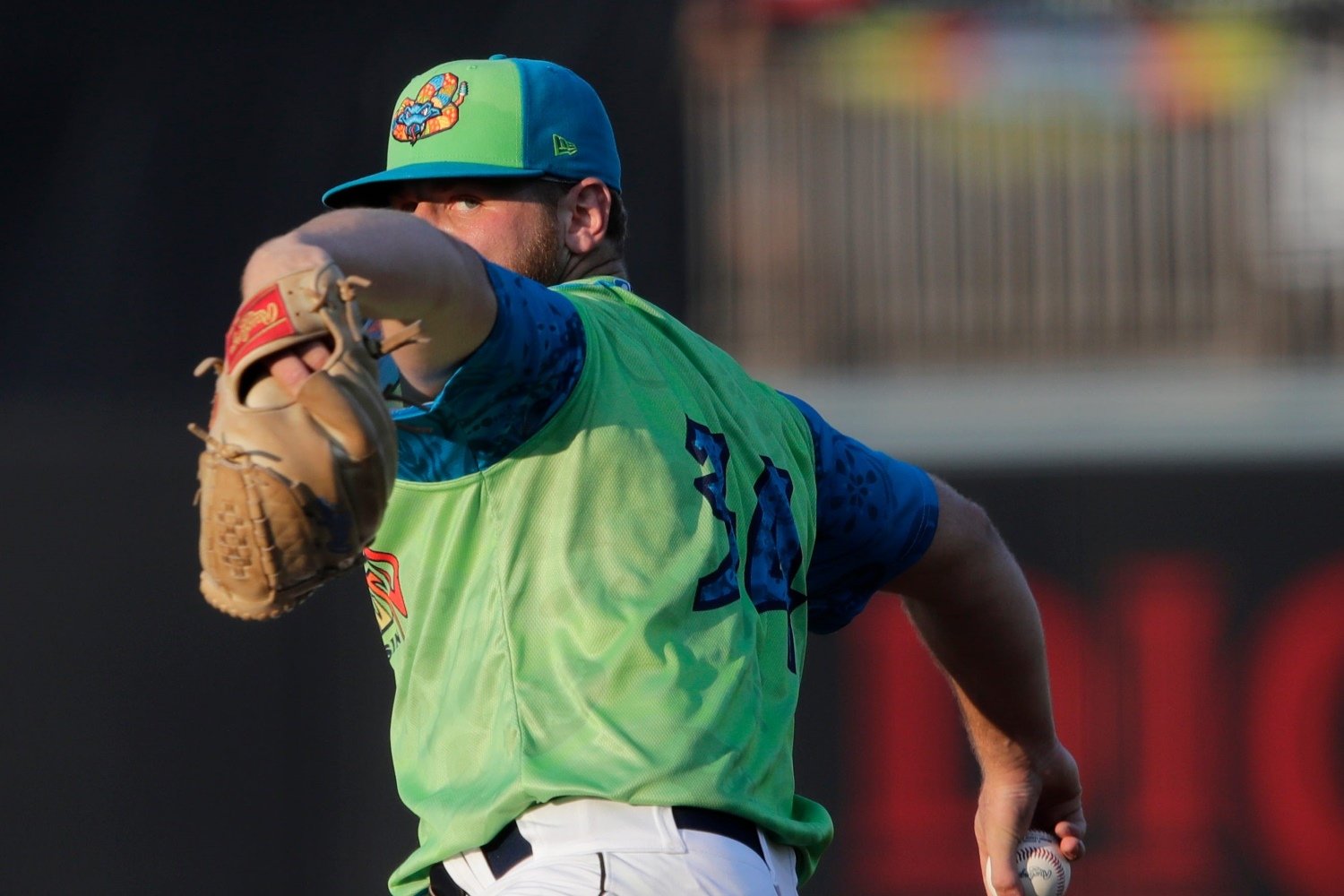 Game Results Monday, 10/14 | Glendale 5, Peoria 3 Tuesday, 10/15 | Glendale 19, Peoria 9 Wednesday, 10/16 | Peoria 7, Mesa 8 Thursday, 10/17 | Scottsdale 11, Peoria 6 Friday, 10/18 | Peoria 4, Salt River 14 Saturday, 10/19 | Mesa 4, Peoria 5 3B Brock Wilken Week: 4 G, 19 PA, 1 H, 1 HR, 1 R, 1 RBI, 4 BB, 6 K Following last week’s slow start to the short season, Wilken continued to struggle, with a home run being his only hit for this week. On the bright side, he managed to walk four times to bring his on-base percentage to .263 for the week. We've seen too much swing-and-miss (over 35% of his swings) but not much chase outside the zone, and he's deserved better outcomes than he's gotten when making contact. In a limited sample of Statcast-included games, he had one flyout this week that jumped off his bat at 102.6 miles per hour and a launch angle of 32 degrees. The power in the bat is clearly there, but scouts have known that for a while now. Can Wilken increase his average and on-base percentage enough to maximize the use of that power? We’ll find out over the next few weeks. OF Luis Lara Week: 5 G, 20 PA, 5 H, 1 2B, 1 HR, 3 R, 2 RBI, 3 K, 1 HBP Lara saw more time playing this week, starting in all five games. He was also consistent, getting on base at least once in each game in which he appeared. He managed to hit his first home run of the Arizona Fall League to help lead the Javelinas to their only win against the Mesa Solar Sox on Saturday. In general, he did a better job of elevating the ball this week, after showing the ability to hit it hard but mostly on the ground in Week 1. Of 13 batted balls tracked for public consumption, Lara has had three over 102 MPH and none under 83. That's a bit surprising and more than a bit encouraging, from a player who won't turn 20 until next month and whose size is one of the biggest reasons to doubt his long-term upside. Nor is he selling out for power; he's made contact on over 75% of his swings in this stint. Interestingly, Lara has had no walks in his 32 plate appearances. It’s a small sample size, but it’s something to keep an eye on as the season progresses. He'll have to make good swing decisions to keep tapping into this kind of quality contact against more advanced pitchers next year. INF Juan Baez Week: 4 G, 15 PA, 5 H, 1 HR, 5 R, 3 RBI, 3 BB, 3 K, 1 SB Baez saw more playing time after his standout first week, and while he wasn’t as close to hitting for the cycle, he still hit well, notably scoring five runs. He also walked as much as he struck out, and currently has a .556 OBP over his first 27 plate appearances with the Javelinas. As young and raw as he is, the feel for contact is undeniable. RHP Coleman Crow Week: 1 G, 2 IP, 1 H, 0 ER, 1 BB, 2 K Crow pitched two innings, starting Wednesday’s game against the Solar Sox. He didn’t run into a ton of trouble and the only runner that reached scoring position got there by walking and then advancing on a balk. Overall, he threw 34 pitches, 23 of which were strikes. The stuff is still not jumping out at you, though, and the looming Rule 5 decision on him looks tough right now. RHP Ryan Birchard Week: 1 G, 2 ⅓ IP, 2 H, 2 ER, 5 BB, 5 K Birchard got the start in the final game of the week and was a little all-over-the-place. In the first inning, he conceded three walks, threw a wild pitch, and gave up a hit before finally getting the third out. He had a more straightforward second inning, giving up a double and a walk but managing to prevent any further scoring. By the time he had given up his fifth in the third inning, he had already thrown 63 pitches, only 34 of which were strikes. That said, we got Statcast data on this outing--and it's as exciting as his wildness is discouraging. His fastball sat 94, in the extremely low-adrenaline environment of the AFL, and its carry is Tobias Myers-like. He comes from an extreme, deceptive over-the-top slot, with depth on a curve, a lot of movement on a sweeper, and a power slider/cutter that fits in between the other three pitches. Everything is going to come down to whether this guy can throw strikes. RHP Will Childers Week: 2 G, 2 IP, 0 H, 0 ER, 2 BB, 3 K Childers was lights-out in two games, getting most of his work done in the final game against the Solar Sox. He earned the final out of Thursday’s 11-6 loss to the Scorpions with just one pitch but got a chance for more work on Saturday. He relieved Birchard after his shaky outing and was efficient, throwing 30 pitches and striking out three. He also had a few walks, but unlike Birchard, none of his baserunners led to anything meaningful for the Solar Sox. His fastball sat 95 and touched 97, and his slider plays off it nicely, so it all comes down to his execution and command. LHP Mark Manfredi Week: 2 G, 1 ⅓ IP, 5 H, 5 ER, 1 BB, 2 K Manfredi had a tough start to his week. He gave up five earned runs in one inning of work against the Desert Dogs and may have been responsible for putting the game out of reach for his team. He entered the game in the seventh inning, at which point the Javelinas were down by just two runs. After a two-run home run by Otto Kemp, Manfredi closed out the inning with a lineout. Unfortunately, things quickly fell apart in the eighth. After back-to-back singles to lead things off, a three-run homer by Colson Montgomery put the Desert Dogs up 12-8. Manfredi then walked a batter and hit the next one, leading to his replacement without recording a single out in the eighth inning. He finished the week strong, coming in to earn the final out of the team’s sole win with a strikeout on five pitches. RHP Nick Merkel Week: 1 G, 1 ⅓ IP, 3 H, 2 ER, 0 BB, 2 K Merkel entered Wednesday’s close loss to the Solar Sox to get the final out of the sixth inning and stretch his outing into the seventh. He was on the wrong end of two solo home runs and a double, resulting in him being officially charged with the loss. On the bright side, he seemed aggressive in the zone, throwing 19 strikes out of 27 total pitches, but it may have been the reason for all of the loud contact.
 -
what if we moved the twins to las vegas
-
Eight Milwaukee prospects will get a chance to play some extra-credit baseball with the Peoria Javelinas this year: three position players and five pitchers. Image courtesy of © Dan Powers/USA TODAY NETWORK-Wisconsin / USA TODAY NETWORK via Imagn Images Eight Milwaukee prospects will get a chance to play some extra-credit baseball with the Peoria Javelinas this year: three position players and five pitchers. Game Results Monday, 10/7 | None Tuesday, 10/8 | Peoria 13, Glendale 15 Wednesday, 10/9 | Peoria 5, Surprise 3 Thursday, 10/10 | Peoria 6, Glendale 13 Friday, 10/11 | Mesa 6, Peoria 9 Saturday, 10/12 | Peoria 1, Mesa 4 3B Brock Wilken Week: 4 G, 18 PA, 3 H, 1 HR, 2 R, 1 RBI, 5 K The top-ranked Brewers prospect in Arizona this year, Wilken had a bit of a slow start to the season. He managed to hit an opposite-field home run in the first game against Andrew Dalquist and had a single in the sixth inning of a chaotic 28-run game. Unfortunately, he quickly hit a snag and struggled to get going offensively for the rest of the week, notably striking out three times in Thursday’s loss to the Glendale Desert Dogs. OF Luis Lara Week: 3 G, 12 PA, 3 H, 1 RBI, 2 K, 1 SB Lara held his own, starting his season off with two hits in Peoria’s first victory against the Surprise Saguaros on Wednesday, also stealing his first base in the same game. Similar to Wilken, though, he wasn’t able to maintain the momentum throughout the week and went 0-4 in Thursday’s game against the Desert Dogs. INF Juan Baez Week: 3 G, 12 PA, 7 H, 2 2B, 1 3B, 4 R, 3 RBI, 1 K Baez was a superstar at the plate this week, notching a 1.500 OPS, the fifth-highest mark of any player in the AFL and second-highest on the Peoria Javelinas. The 19-year-old was a home run away from hitting for the cycle in the victory over the Mesa Solar Sox on Friday. RHP Coleman Crow Week: 1 G, 1 ⅔ IP, 1 H, 1 ER, 1 BB, 0 K Crow pitched in just one game this week, facing the Desert Dogs on Thursday. His outing started off great, retiring the first three batters with consecutive groundouts. He ran into some trouble against Matt McLain and Christian Encarnacion-Strand, two major leaguers on rehab assignments, before another groundout allowed runners to advance, leading to his departure from the mound. RHP Ryan Birchard Week: 1 G, 3 IP, 1 H, 0 ER, 3 BB, 3 K Birchard appeared in the final game of the week, making a three-inning start and keeping the Solar Sox scoreless despite quite a few free passes. The closest he got to trouble was allowing a single and a walk in the third inning before retiring the next three batters in a row. RHP Will Childers Week: 2 G, 1 ⅔ IP, 3 H, 2 ER, 0 BB, 2 K, 1 SV Childers was thrown into the fire as soon as he came out of the bullpen for the first time. After Gabe Mosser conceded a whopping seven earned runs in the first inning, Childers was left to clean up the mess. He earned the final out of the first, but gave up three straight doubles in the second inning before ending his AFL debut. His second outing was far more mellow, getting called upon to earn just the final out of the game. He struck out Benjamin Cowles on three pitches to earn his first save as a Javelina. LHP Mark Manfredi Week: 1 G, 1 IP, 0 H, 0 ER, 1 BB, 1 K, 1 SV Manfredi threw 23 pitches against the Saguaros on Wednesday to earn his first save of the season. It wasn’t the smoothest ninth-inning performance, as he would walk a batter and hit another, but he finished strong by striking out Brett Squires on four pitches. RHP Nick Merkel Week: 1 G, 2 IP, 1 H, 0 ER, 1 BB, 3 K Merkel relieved Birchard following his three innings of work and pitched efficiently, using just 30 pitches to deal with the eight batters he faced. After allowing two baserunners in the fourth inning, he needed only seven pitches to get through the fifth inning and finish his week. View full article
-
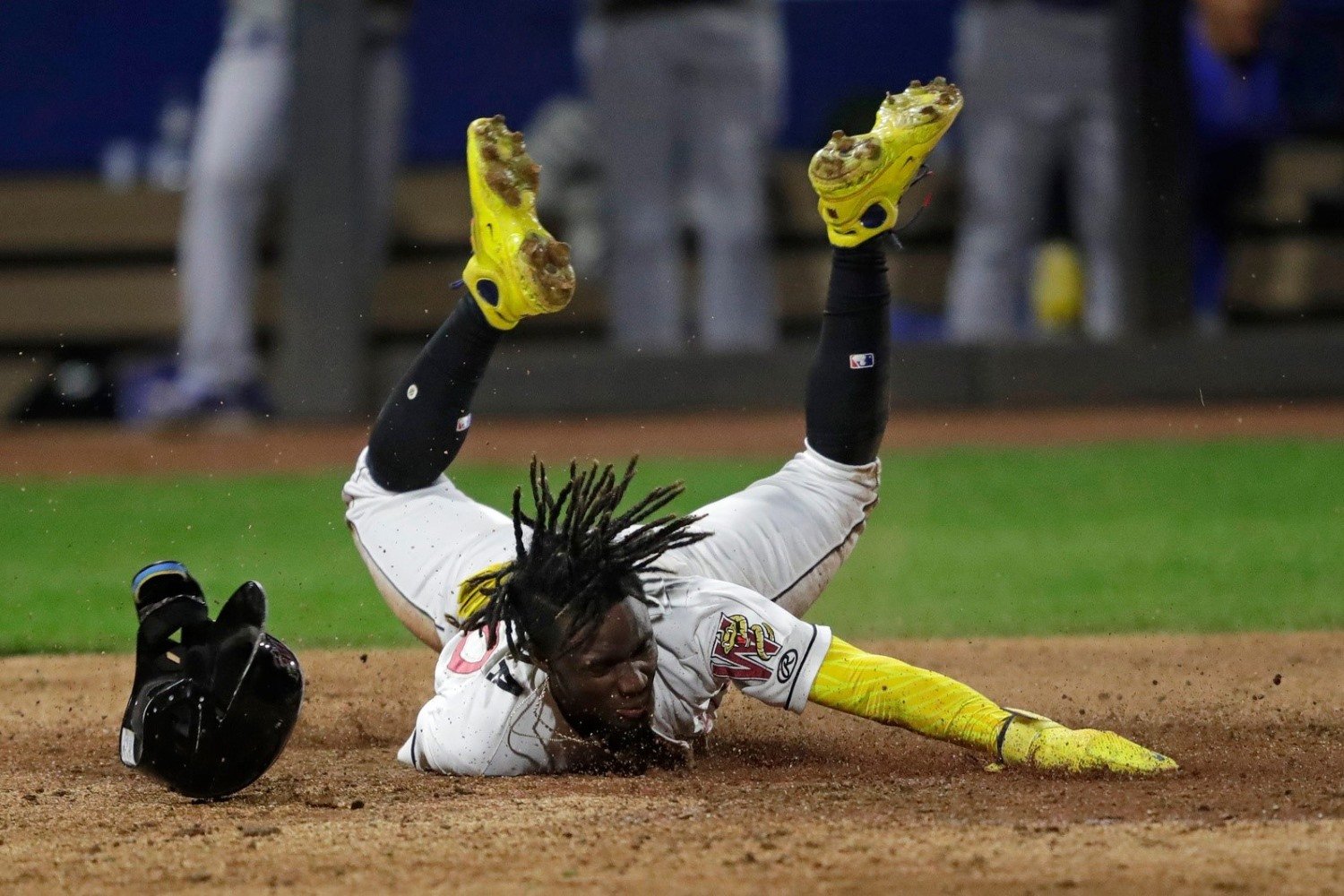 Game Results Monday, 10/7 | None Tuesday, 10/8 | Peoria 13, Glendale 15 Wednesday, 10/9 | Peoria 5, Surprise 3 Thursday, 10/10 | Peoria 6, Glendale 13 Friday, 10/11 | Mesa 6, Peoria 9 Saturday, 10/12 | Peoria 1, Mesa 4 3B Brock Wilken Week: 4 G, 18 PA, 3 H, 1 HR, 2 R, 1 RBI, 5 K The top-ranked Brewers prospect in Arizona this year, Wilken had a bit of a slow start to the season. He managed to hit an opposite-field home run in the first game against Andrew Dalquist and had a single in the sixth inning of a chaotic 28-run game. Unfortunately, he quickly hit a snag and struggled to get going offensively for the rest of the week, notably striking out three times in Thursday’s loss to the Glendale Desert Dogs. OF Luis Lara Week: 3 G, 12 PA, 3 H, 1 RBI, 2 K, 1 SB Lara held his own, starting his season off with two hits in Peoria’s first victory against the Surprise Saguaros on Wednesday, also stealing his first base in the same game. Similar to Wilken, though, he wasn’t able to maintain the momentum throughout the week and went 0-4 in Thursday’s game against the Desert Dogs. INF Juan Baez Week: 3 G, 12 PA, 7 H, 2 2B, 1 3B, 4 R, 3 RBI, 1 K Baez was a superstar at the plate this week, notching a 1.500 OPS, the fifth-highest mark of any player in the AFL and second-highest on the Peoria Javelinas. The 19-year-old was a home run away from hitting for the cycle in the victory over the Mesa Solar Sox on Friday. RHP Coleman Crow Week: 1 G, 1 ⅔ IP, 1 H, 1 ER, 1 BB, 0 K Crow pitched in just one game this week, facing the Desert Dogs on Thursday. His outing started off great, retiring the first three batters with consecutive groundouts. He ran into some trouble against Matt McLain and Christian Encarnacion-Strand, two major leaguers on rehab assignments, before another groundout allowed runners to advance, leading to his departure from the mound. RHP Ryan Birchard Week: 1 G, 3 IP, 1 H, 0 ER, 3 BB, 3 K Birchard appeared in the final game of the week, making a three-inning start and keeping the Solar Sox scoreless despite quite a few free passes. The closest he got to trouble was allowing a single and a walk in the third inning before retiring the next three batters in a row. RHP Will Childers Week: 2 G, 1 ⅔ IP, 3 H, 2 ER, 0 BB, 2 K, 1 SV Childers was thrown into the fire as soon as he came out of the bullpen for the first time. After Gabe Mosser conceded a whopping seven earned runs in the first inning, Childers was left to clean up the mess. He earned the final out of the first, but gave up three straight doubles in the second inning before ending his AFL debut. His second outing was far more mellow, getting called upon to earn just the final out of the game. He struck out Benjamin Cowles on three pitches to earn his first save as a Javelina. LHP Mark Manfredi Week: 1 G, 1 IP, 0 H, 0 ER, 1 BB, 1 K, 1 SV Manfredi threw 23 pitches against the Saguaros on Wednesday to earn his first save of the season. It wasn’t the smoothest ninth-inning performance, as he would walk a batter and hit another, but he finished strong by striking out Brett Squires on four pitches. RHP Nick Merkel Week: 1 G, 2 IP, 1 H, 0 ER, 1 BB, 3 K Merkel relieved Birchard following his three innings of work and pitched efficiently, using just 30 pitches to deal with the eight batters he faced. After allowing two baserunners in the fourth inning, he needed only seven pitches to get through the fifth inning and finish his week.
 -
The financial trade-offs of having MLB manage the Brewers' games distribution show there really is no such thing as a free lunch. All we need to do is look at what's happening on the other side of the St. Croix River. Image courtesy of © Jovanny Hernandez / Milwaukee Journal Sentinel / USA TODAY NETWORK via Imagn Images The financial trade-offs of having MLB manage the Brewers' games distribution show there really is no such thing as a free lunch. All we need to do is look at what's happening on the other side of the St. Croix River. Earlier this week, it was announced that the Brewers would not be renewing their contract with Diamond Sports Group, the parent company of Bally Sports Wisconsin. Instead, MLB will be taking over the broadcast, offering a blackout-free streaming option to fans in the local area. Unlike buying popcorn at the movie theater, this seems a pretty good deal for fans. It’s a centralized way to view Milwaukee baseball and finally addresses the dreaded blackouts that have plagued Iowa residents for far too long. So what’s the catch? Well, if precedent is anything to go off of, Milwaukee is definitely going to have lighter pockets in 2025. The Minnesota Twins have ended up in the same boat at a more gradual pace. After their contract with Bally Sports expired at the end of the 2023 season they cut their payroll by $30 million, about half of the roughly $60 million they received annually from DSG. They later renewed their contract with Bally for a significantly smaller payout and, like the Brewers, will now be one of the several teams whose rights are entirely handled by MLB. The Padres and Diamondbacks had their fair share of contractual issues with DSG, and rather than renewing for another year, both teams offered their own in-market packages through MLB.TV in 2024. The in-market Padres streaming package costs $100 per season, and it was reported that Padres had about 40,000 subscribers. Suppose my calculator app is to be trusted. In that case, they generated a measly $4 million in revenue, enough to pay for almost three whole beers at Petco Park but not enough to finance a shiny new free agent or lengthy extension. The question then becomes: Will the Brewers cut spending further, or have they done that already? Total payroll allocations went down by approximately $16 million from 2023 to 2024, but was that in anticipation of this move or just the result of natural fluctuations in the budget? When asked about the topic, general manager Matt Arnold stated something along the lines of “I don’t know, not my circus,”* something I often say when asked about the business hours of my local carnival. *not Matt Arnold's actual quote, editorial paraphrasing by us As things currently stand, Milwaukee already had a total 2025 payroll allocation of $112.7 million before finalized arbitration salaries. $10.5 million of that could be saved by rejecting the team option for Devin Williams, but there’s not much room to trim payroll without starting to surrender postseason equity. On the bright side, Brewers' attendance has been quite robust, totaling 2.5 million in 2024. It has been growing steadily and was at just 1.8 million for the 2021 season, something the front office could and should capitalize on. If they choose to maintain or increase spending this year, they'd take a bigger financial hit in the short term and hope that the team's positive momentum leads to more streaming revenue and even more money spent on beers and bratwursts. Another complication of this whole streaming debacle is that Bally Sports Wisconsin still holds the rights to broadcast Milwaukee Bucks games, so if you want to watch Bobby Portis and the other guys on that team hoop, you’ll still be tied to their offerings. If you want to watch both the end of the Bucks' season and the start of the Brewers', you’ll be forced to purchase both streaming options. From a pure viewer standpoint, this is a good move, even if it means roster construction is hamstrung over the next few years. Given the organization's historic fiscal practices, fans might not even notice a difference. Unfortunately for me, this probably means Milwaukee won't be offering Joey Gallo that $100 million contract I hoped he would be getting this offseason**. **this isn't a real thing anyone wants View full article
-
2025 Milwaukee Brewers Payroll May Drop Due To New Broadcasting Deal
Jason Wang posted an article in Brewers
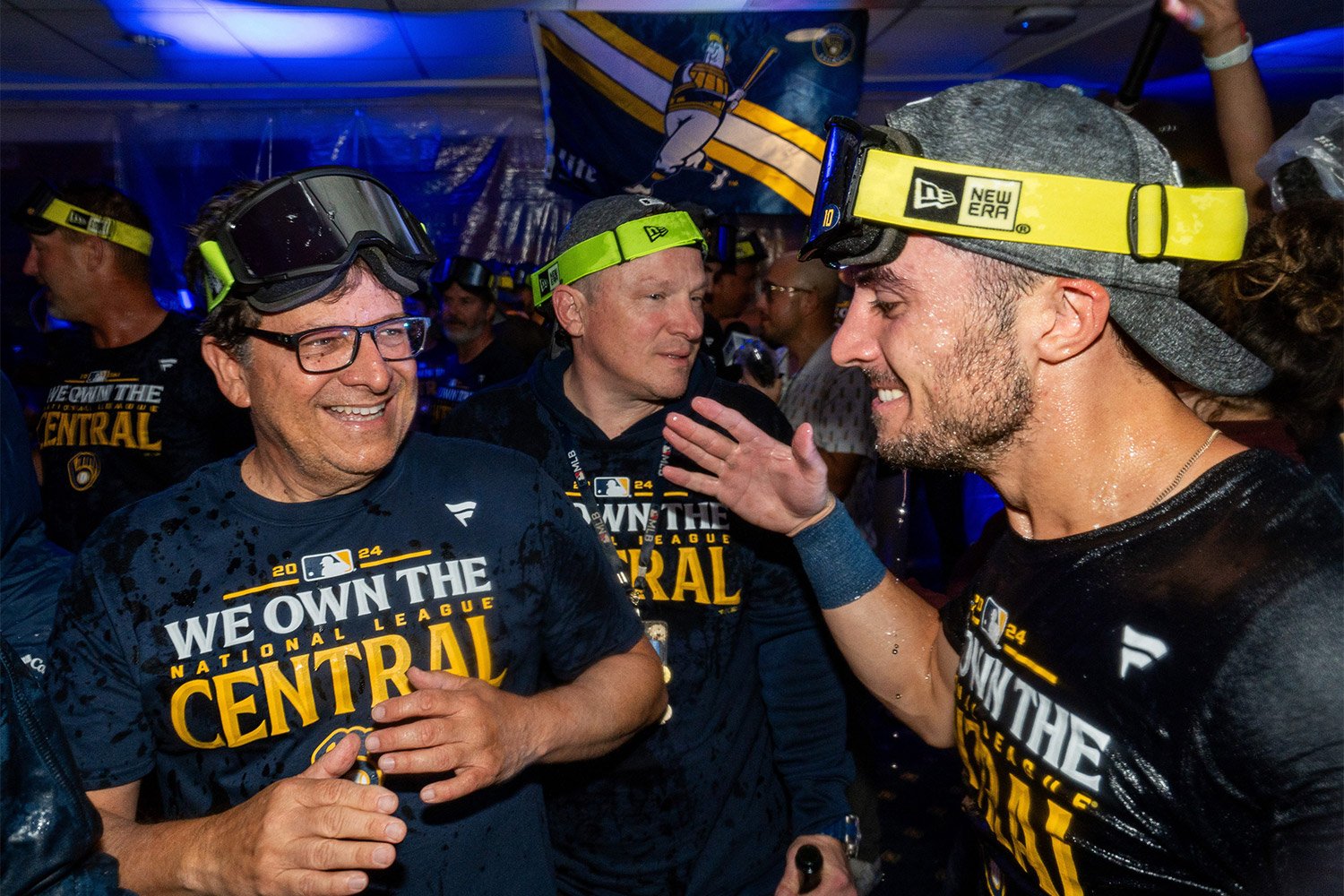 Earlier this week, it was announced that the Brewers would not be renewing their contract with Diamond Sports Group, the parent company of Bally Sports Wisconsin. Instead, MLB will be taking over the broadcast, offering a blackout-free streaming option to fans in the local area. Unlike buying popcorn at the movie theater, this seems a pretty good deal for fans. It’s a centralized way to view Milwaukee baseball and finally addresses the dreaded blackouts that have plagued Iowa residents for far too long. So what’s the catch? Well, if precedent is anything to go off of, Milwaukee is definitely going to have lighter pockets in 2025. The Minnesota Twins have ended up in the same boat at a more gradual pace. After their contract with Bally Sports expired at the end of the 2023 season they cut their payroll by $30 million, about half of the roughly $60 million they received annually from DSG. They later renewed their contract with Bally for a significantly smaller payout and, like the Brewers, will now be one of the several teams whose rights are entirely handled by MLB. The Padres and Diamondbacks had their fair share of contractual issues with DSG, and rather than renewing for another year, both teams offered their own in-market packages through MLB.TV in 2024. The in-market Padres streaming package costs $100 per season, and it was reported that Padres had about 40,000 subscribers. Suppose my calculator app is to be trusted. In that case, they generated a measly $4 million in revenue, enough to pay for almost three whole beers at Petco Park but not enough to finance a shiny new free agent or lengthy extension. The question then becomes: Will the Brewers cut spending further, or have they done that already? Total payroll allocations went down by approximately $16 million from 2023 to 2024, but was that in anticipation of this move or just the result of natural fluctuations in the budget? When asked about the topic, general manager Matt Arnold stated something along the lines of “I don’t know, not my circus,”* something I often say when asked about the business hours of my local carnival. *not Matt Arnold's actual quote, editorial paraphrasing by us As things currently stand, Milwaukee already had a total 2025 payroll allocation of $112.7 million before finalized arbitration salaries. $10.5 million of that could be saved by rejecting the team option for Devin Williams, but there’s not much room to trim payroll without starting to surrender postseason equity. On the bright side, Brewers' attendance has been quite robust, totaling 2.5 million in 2024. It has been growing steadily and was at just 1.8 million for the 2021 season, something the front office could and should capitalize on. If they choose to maintain or increase spending this year, they'd take a bigger financial hit in the short term and hope that the team's positive momentum leads to more streaming revenue and even more money spent on beers and bratwursts. Another complication of this whole streaming debacle is that Bally Sports Wisconsin still holds the rights to broadcast Milwaukee Bucks games, so if you want to watch Bobby Portis and the other guys on that team hoop, you’ll still be tied to their offerings. If you want to watch both the end of the Bucks' season and the start of the Brewers', you’ll be forced to purchase both streaming options. From a pure viewer standpoint, this is a good move, even if it means roster construction is hamstrung over the next few years. Given the organization's historic fiscal practices, fans might not even notice a difference. Unfortunately for me, this probably means Milwaukee won't be offering Joey Gallo that $100 million contract I hoped he would be getting this offseason**. **this isn't a real thing anyone wants
 -
Brewer Fanatic’s 2024 Brewers MVP
Jason Wang replied to Jason Wang's topic in Brewer Fanatic Front Page News
isn't it this one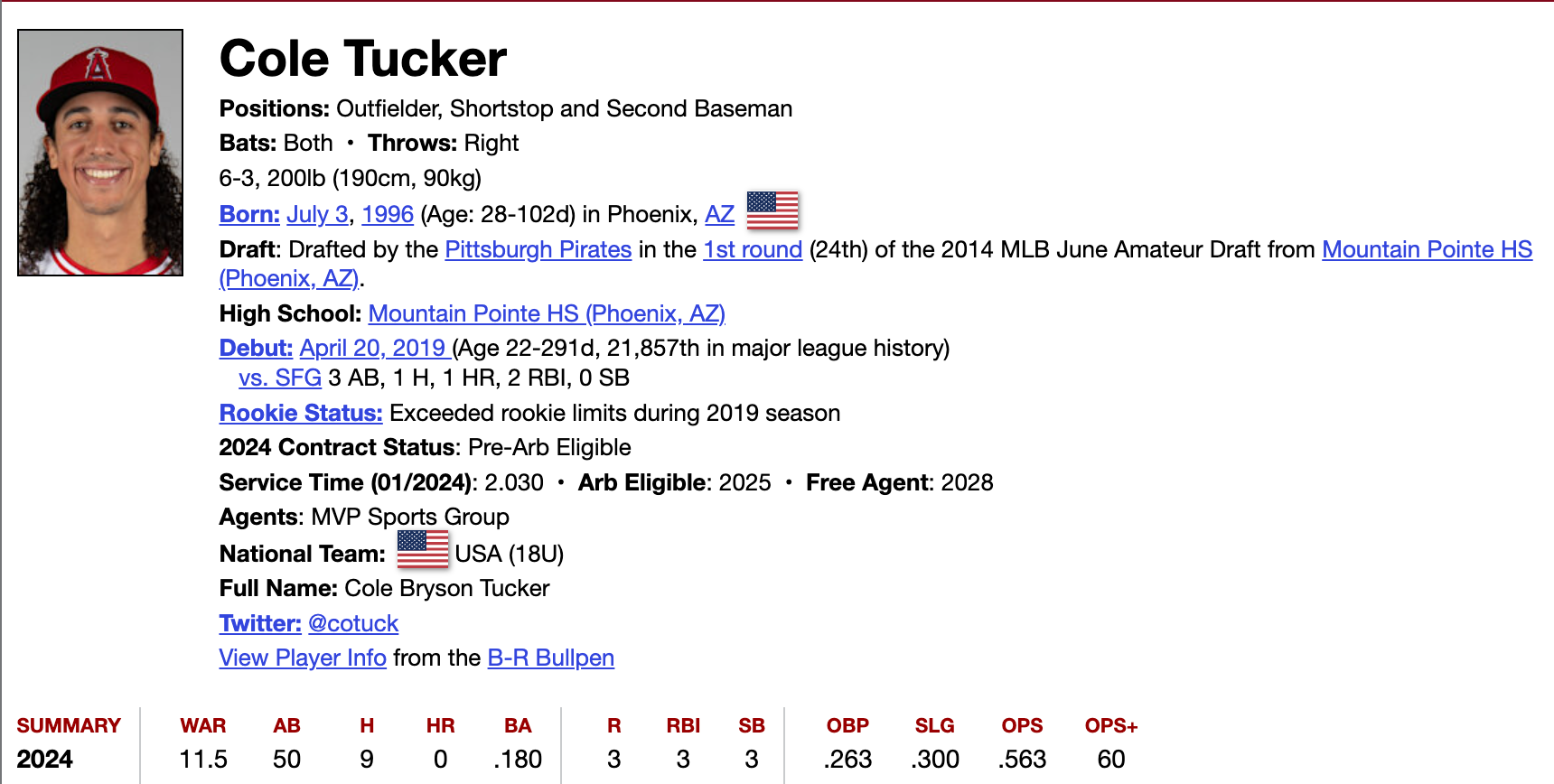
-
has anyone tried deferring contracts by .7 x 10^106 years i.e. after the proposed heat death of the universe? Think it would be a good way to clear payroll to build a more solid winning team. why hasn't any front office done this? are they stupid?
-
In all seriousness, I'm not convinced either way. He's pre-arb and still pretty young so I don't think there's a huge rush. If he's able to perform a little better against offspeed and curveballs, he could be a really interesting contact/speed/defense combo for the team. but I also think it would be cool if he got the ohtani contract for the memes idk
-
93 wins, a dominant division lead, and a smooth path to the postseason. Who was the crown jewel of this talented team according to our writers? 93 wins, a dominant division lead, and a smooth path to the postseason. Who was the crown jewel of this talented team according to our writers? Honorable Mentions SP Tobias Myers 138 IP, 3.00 ERA, 3.91 FIP, 1.17 WHIP, 8.3 SO/9, 2.3 BB/9, 140 ERA+, 2.7 rWAR Myers had a stellar season and was recently voted as the team’s most valuable pitcher so it only makes sense that he would also be one of the most valuable players. He might have been one of the most underrated starting pitchers in the entire National League this year as his rookie campaign drastically outperformed any prior expectations. He’s one of a few young pieces that could carry the existing NL Central dynasty for the next several years. He’ll still have to avoid a sophomore slump but with less pressure next year and more veteran arms in the rotation, there’s a good chance he’ll be even better next year. myers_strikeout.mp4 OF Christian Yelich 315 PA, .315/.406/.504, 12 2B, 3 3B, 11 HR, 42 RBI, 21 SB, 151 OPS+, 2.2 rWAR It’s an absolute shame to see Yelich’s best season since his MVP-caliber campaign in 2019 cut short by back injury. He was on an absolutely torrid stretch and was seeming to peak before he went down in July, posting a 1.008 OPS for the month. He was pummeling baseballs while exercising elite plate discipline and stealing bases and a monumental pace. If not for those pesky back issues, there’s a good chance he would have gotten some MVP votes for his troubles. If Yelich had been in the lineup all season, could the postseason outcome have been different? Perhaps, it’s always hard to say, but it poses an interesting question: is he back (get it, cause back surgery)? From 2021-2023, he never had an OPS >.900 for a single month. In 2024, he had two months with a total OPS >1.000, indicating a potential return to form. We’ll have to wait until next season to see but with just a few years left in his baseball prime, Milwaukee is undoubtedly looking to get the most out of the face of their franchise. yelich_homer.mp4 2B Brice Turang 619 PA, .254/.316/.349, 142 H, 24 2B, 4 3B, 7 HR, 57 RBI, 50 SB, 85 OPS+, 4.6 rWAR Already named Brewer Fanatic’s Most Improved Player of 2024, Turang’s overall contributions were enough to make him one of the most important names in the lineup. Offensively, he looked great in the first half with a .731 OPS before hitting a wall and regressing to a 2023 level in the second half. On the bright side, his performance against four-seam fastballs was strong all year (except for an ugly July) and a big step up from last season. Defensively, Turang was otherworldly and has a decent chance of winning the National League Gold Glove award for his position. In fact, it may not even be close if Defensive Runs Saved is to be believed. Turang’s 21 DRS is 11 more than the next-best guy in the National League (Ketel Marte, 10). It was a big reason his WAR was so high despite his below-average offensive contributions. Looking ahead to 2025, my watch will always be set to Turang Time. turang_play.mp4 SP Freddy Peralta 173 ⅔ IP, 3.68 ERA, 4.16 FIP, 1.22 WHIP, 10.4 SO/9, 3.5 BB/9, 114 ERA+, 2.6 rWAR Like Myers, Peralta recently shared Brewer Fanatic’s Pitcher of the Year award for 2024. Peralta’s numbers weren’t as nice as Myers but his total workload and raw stuff helped compensate for a slight difference in ERA. He’s an unlikely ace, especially for a roster as loaded in pitching talent as the Brewers but things could be a lot worse - you could always have Patrick Corbin throw 174 ⅔ innings for your team. Peralta can be a somewhat frustrating pitcher to watch, with his 9.4% walk rate and tendency to give up some loud contact but he’s genuinely pretty good, I promise. Would I wager my unborn child’s college tuition on him having a quality start in the postseason? Probably not, but he’s on a team-friendly contract with a reasonable $8 million team option coming up, a fair price for 170 innings of <4.00 ERA pitching. peralta_strikeout.mp4 Top 3 Most Valuable Players of 2024 3. OF Jackson Chourio 573 PA, .275/.327/.464, 29 2B, 4 3B, 21 HR, 79 RBI, 22 SB, 117 OPS+, 3.8 rWAR I don’t know about you guys, but to me, this Chourio guy really came out of nowhere. I mean, who expected this young kid to be this good? I sure didn’t! After all, I didn't see him at the Perfect Game showcase so what gives? Totally kidding of course, Chourio was ranked the eighth-best prospect in baseball in 2023 and scouts have raved about his diverse skill set since he was naught but a teenager, emphasizing his outstanding power, speed, and fielding ability. After making the Opening Day roster, fans realized they’d get a full season to watch the 20-year old grow and develop into a bona fide major-leaguer. Many analysts and projection systems assumed he was going to need some time to ramp up but boy did he come to the office ready to work. Chourio did struggle for the first two months of the season, posting a .608 OPS in April and a .542 OPS in May. His fielding was inconsistent and he was sometimes out of position, an understandable side effect of moving from center field to corner outfield. However starting in June, he must have started taking an extra multivitamin gummy in the morning because he went on a rampage, slashing .303/.358/.525 through the rest of the season. With his glove, he ended the year with 12 DRS, putting him in the top 10 of all outfielders. When the lights were the brightest in the playoffs, he went 5-11 with two homers and three RBI, getting on base twice in all three games against the Mets. The Brewers front office is notoriously frugal so to sign Chourio to a $82 million contract to win his services for the next eight years could not have been offered lightly. Now that we’ve seen him in the big leagues for a full year, the next seven may be even better than we had hoped. chourio_homer.mp4 2. SS Willy Adames 688 PA, .251/.331/.462, 33 2B, 32 HR, 112 RBI, 21 SB, 118 OPS+, 3.1 rWAR Did 2023 make you think that Willy Adames was potentially washed up? Don’t worry, it made me think that too, kind of. There were a lot of concerns about his ability to hit the ball hard and maintain a tight strike zone and it showed in his numbers. Last year’s batting average of .217 and slugging percentage of .407 were both career lows for a full season. Perhaps he had been saving all of his energy for his contract year because 2024 gave us the Willy Adames we have all come to know and love. You know, the one that’s a great shortstop and winks in the dugout. His 118 OPS+ was his best mark since his superb 2021 season when he first landed in Milwaukee. His slugging percentage returned to healthy levels and he set a new career-high for doubles, home runs and RBI. Sadly, this may be the last time we’ll be seeing Willy in Wisconsin. As one of the few prized shortstops on the free agent market this year (Vanessa Hudgens’ husband is the other), he’ll likely receive a call from a big market team with a gargantuan offer, one that the humble village of Milwaukee probably won’t be able to compete with. Can Cooper Pratt fill his shoes? Will Brice Turang have to move over to shortstop? Find out on the next episode of Brewer Ball Z. Brewer Fanatic’s Most Valuable Player for 2024 1. C William Contreras 679 PA, .281/.365/.466, 37 2B, 2 3B, 23 HR, 92 RBI, 9 SB, 129 OPS+, 4.9 rWAR You know, I have a suspicion that players with “Will” as the first four letters of their first name tend to be great Brewers. William Contreras. Willy Adames. WillRobin Yount. The proof is in the pudding. As the player on the team with the highest rWAR this year, it makes sense that Contreras would also be the team’s MVP. But let’s do away with these newfangled metrics and return to the basic numbers that made baseball great. He led the team in runs (99), doubles, walks (78), batting average, on-base percentage, slugging, intentional walks (5), and K/BB (1.78). He also had the second-most plate appearances on the team as a catcher, a testament to the sheer strength of the man’s legs and willingness to play the sport of baseball. Defensively, he seemed to have forgotten the improvements he made last year to his blocking and framing ability, regressing to a league-average backstop in those aspects but he still managed to accumulate six DRS, a new single-season record for him. Contreras will hit arbitration for the first time this offseason and MLB Trade Rumors has estimated that he’ll earn $7.6 million, a pretty penny but so far, he seems to be worth every penny. Milwaukee only has three years left of team control over him but by then, we may be blessed with a brand new catcher talent in Jeferson Quero. For now, let’s enjoy the best catcher in the National League in Brewer blue. contreras_homer.mp4 View full article
-
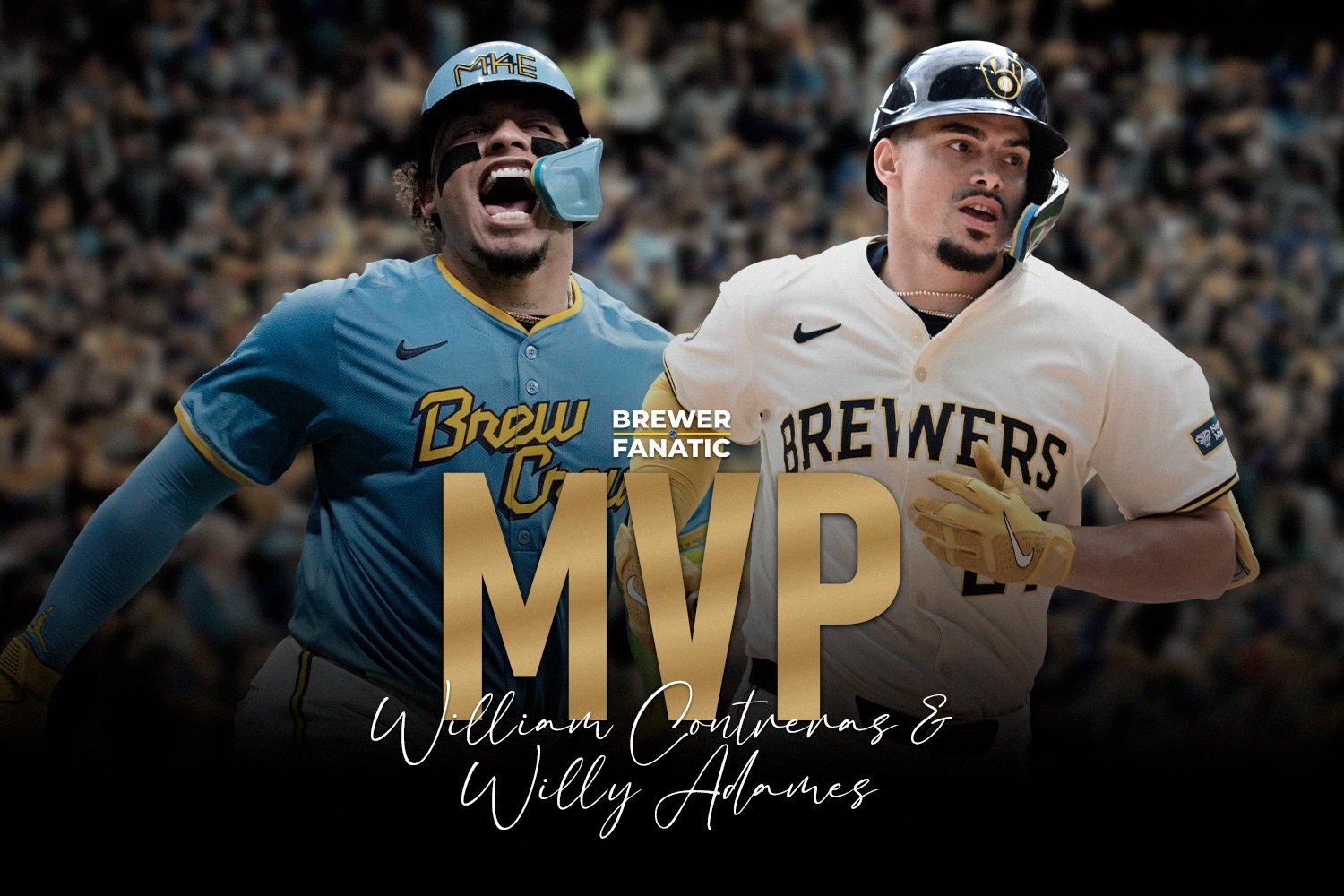 Honorable Mentions SP Tobias Myers 138 IP, 3.00 ERA, 3.91 FIP, 1.17 WHIP, 8.3 SO/9, 2.3 BB/9, 140 ERA+, 2.7 rWAR Myers had a stellar season and was recently voted as the team’s most valuable pitcher so it only makes sense that he would also be one of the most valuable players. He might have been one of the most underrated starting pitchers in the entire National League this year as his rookie campaign drastically outperformed any prior expectations. He’s one of a few young pieces that could carry the existing NL Central dynasty for the next several years. He’ll still have to avoid a sophomore slump but with less pressure next year and more veteran arms in the rotation, there’s a good chance he’ll be even better next year. myers_strikeout.mp4 OF Christian Yelich 315 PA, .315/.406/.504, 12 2B, 3 3B, 11 HR, 42 RBI, 21 SB, 151 OPS+, 2.2 rWAR It’s an absolute shame to see Yelich’s best season since his MVP-caliber campaign in 2019 cut short by back injury. He was on an absolutely torrid stretch and was seeming to peak before he went down in July, posting a 1.008 OPS for the month. He was pummeling baseballs while exercising elite plate discipline and stealing bases and a monumental pace. If not for those pesky back issues, there’s a good chance he would have gotten some MVP votes for his troubles. If Yelich had been in the lineup all season, could the postseason outcome have been different? Perhaps, it’s always hard to say, but it poses an interesting question: is he back (get it, cause back surgery)? From 2021-2023, he never had an OPS >.900 for a single month. In 2024, he had two months with a total OPS >1.000, indicating a potential return to form. We’ll have to wait until next season to see but with just a few years left in his baseball prime, Milwaukee is undoubtedly looking to get the most out of the face of their franchise. yelich_homer.mp4 2B Brice Turang 619 PA, .254/.316/.349, 142 H, 24 2B, 4 3B, 7 HR, 57 RBI, 50 SB, 85 OPS+, 4.6 rWAR Already named Brewer Fanatic’s Most Improved Player of 2024, Turang’s overall contributions were enough to make him one of the most important names in the lineup. Offensively, he looked great in the first half with a .731 OPS before hitting a wall and regressing to a 2023 level in the second half. On the bright side, his performance against four-seam fastballs was strong all year (except for an ugly July) and a big step up from last season. Defensively, Turang was otherworldly and has a decent chance of winning the National League Gold Glove award for his position. In fact, it may not even be close if Defensive Runs Saved is to be believed. Turang’s 21 DRS is 11 more than the next-best guy in the National League (Ketel Marte, 10). It was a big reason his WAR was so high despite his below-average offensive contributions. Looking ahead to 2025, my watch will always be set to Turang Time. turang_play.mp4 SP Freddy Peralta 173 ⅔ IP, 3.68 ERA, 4.16 FIP, 1.22 WHIP, 10.4 SO/9, 3.5 BB/9, 114 ERA+, 2.6 rWAR Like Myers, Peralta recently shared Brewer Fanatic’s Pitcher of the Year award for 2024. Peralta’s numbers weren’t as nice as Myers but his total workload and raw stuff helped compensate for a slight difference in ERA. He’s an unlikely ace, especially for a roster as loaded in pitching talent as the Brewers but things could be a lot worse - you could always have Patrick Corbin throw 174 ⅔ innings for your team. Peralta can be a somewhat frustrating pitcher to watch, with his 9.4% walk rate and tendency to give up some loud contact but he’s genuinely pretty good, I promise. Would I wager my unborn child’s college tuition on him having a quality start in the postseason? Probably not, but he’s on a team-friendly contract with a reasonable $8 million team option coming up, a fair price for 170 innings of <4.00 ERA pitching. peralta_strikeout.mp4 Top 3 Most Valuable Players of 2024 3. OF Jackson Chourio 573 PA, .275/.327/.464, 29 2B, 4 3B, 21 HR, 79 RBI, 22 SB, 117 OPS+, 3.8 rWAR I don’t know about you guys, but to me, this Chourio guy really came out of nowhere. I mean, who expected this young kid to be this good? I sure didn’t! After all, I didn't see him at the Perfect Game showcase so what gives? Totally kidding of course, Chourio was ranked the eighth-best prospect in baseball in 2023 and scouts have raved about his diverse skill set since he was naught but a teenager, emphasizing his outstanding power, speed, and fielding ability. After making the Opening Day roster, fans realized they’d get a full season to watch the 20-year old grow and develop into a bona fide major-leaguer. Many analysts and projection systems assumed he was going to need some time to ramp up but boy did he come to the office ready to work. Chourio did struggle for the first two months of the season, posting a .608 OPS in April and a .542 OPS in May. His fielding was inconsistent and he was sometimes out of position, an understandable side effect of moving from center field to corner outfield. However starting in June, he must have started taking an extra multivitamin gummy in the morning because he went on a rampage, slashing .303/.358/.525 through the rest of the season. With his glove, he ended the year with 12 DRS, putting him in the top 10 of all outfielders. When the lights were the brightest in the playoffs, he went 5-11 with two homers and three RBI, getting on base twice in all three games against the Mets. The Brewers front office is notoriously frugal so to sign Chourio to a $82 million contract to win his services for the next eight years could not have been offered lightly. Now that we’ve seen him in the big leagues for a full year, the next seven may be even better than we had hoped. chourio_homer.mp4 2. SS Willy Adames 688 PA, .251/.331/.462, 33 2B, 32 HR, 112 RBI, 21 SB, 118 OPS+, 3.1 rWAR Did 2023 make you think that Willy Adames was potentially washed up? Don’t worry, it made me think that too, kind of. There were a lot of concerns about his ability to hit the ball hard and maintain a tight strike zone and it showed in his numbers. Last year’s batting average of .217 and slugging percentage of .407 were both career lows for a full season. Perhaps he had been saving all of his energy for his contract year because 2024 gave us the Willy Adames we have all come to know and love. You know, the one that’s a great shortstop and winks in the dugout. His 118 OPS+ was his best mark since his superb 2021 season when he first landed in Milwaukee. His slugging percentage returned to healthy levels and he set a new career-high for doubles, home runs and RBI. Sadly, this may be the last time we’ll be seeing Willy in Wisconsin. As one of the few prized shortstops on the free agent market this year (Vanessa Hudgens’ husband is the other), he’ll likely receive a call from a big market team with a gargantuan offer, one that the humble village of Milwaukee probably won’t be able to compete with. Can Cooper Pratt fill his shoes? Will Brice Turang have to move over to shortstop? Find out on the next episode of Brewer Ball Z. Brewer Fanatic’s Most Valuable Player for 2024 1. C William Contreras 679 PA, .281/.365/.466, 37 2B, 2 3B, 23 HR, 92 RBI, 9 SB, 129 OPS+, 4.9 rWAR You know, I have a suspicion that players with “Will” as the first four letters of their first name tend to be great Brewers. William Contreras. Willy Adames. WillRobin Yount. The proof is in the pudding. As the player on the team with the highest rWAR this year, it makes sense that Contreras would also be the team’s MVP. But let’s do away with these newfangled metrics and return to the basic numbers that made baseball great. He led the team in runs (99), doubles, walks (78), batting average, on-base percentage, slugging, intentional walks (5), and K/BB (1.78). He also had the second-most plate appearances on the team as a catcher, a testament to the sheer strength of the man’s legs and willingness to play the sport of baseball. Defensively, he seemed to have forgotten the improvements he made last year to his blocking and framing ability, regressing to a league-average backstop in those aspects but he still managed to accumulate six DRS, a new single-season record for him. Contreras will hit arbitration for the first time this offseason and MLB Trade Rumors has estimated that he’ll earn $7.6 million, a pretty penny but so far, he seems to be worth every penny. Milwaukee only has three years left of team control over him but by then, we may be blessed with a brand new catcher talent in Jeferson Quero. For now, let’s enjoy the best catcher in the National League in Brewer blue. contreras_homer.mp4
- 2 comments
-
- 1
-

-
- william contreras
- willy adames
- (and 4 more)
-
i would do $700mm/10 years with $68mm of each year deferred by ten years
-
Brewer Fanatic's 2024 Brewers Pitchers of the Year
Jason Wang replied to Jason Wang's topic in Brewer Fanatic Front Page News
His fastball definitely has some great rise with 19 inches of induced vertical break! I said serviceable because to me, the actual numbers are good but not insane. .239 BA, .436 SLG, 19.2% whiff rate are solid but definitely still some work to do. Just to totally cherry pick a random dude, Brandon Woodruff's four-seam fastball had .184 BA, .381 SLG, 28.4% whiff rate in 2022 also I hate cheerios- 5 replies
-
- 1
-
-
- tobias myers
- freddy peralta
- (and 3 more)
-
Who were the best arms on one of the league's best pitching staffs--and who won the acclaim of our writers? Who were the best arms on one of the league's best pitching staffs--and who won the acclaim of our writers? Honorable Mentions SP Aaron Civale (Brewers Stats) 74 IP, 3.53 ERA, 4.79 FIP, 1.22 WHIP, 7.9 SO/9, 3.0 BB/9, 119 ERA+, 1.1 rWAR Civale was an unassuming trade deadline acquisition, to say the least. After a tenure with the Rays that saw him pitch to a 5.17 ERA over 27 starts, he didn’t seem like he was going to be very effective with any team. After all, if the Rays--an organization known for developing great pitching talent--couldn’t make it work, how could anyone? Well, the Brewers did make it work, getting a great set of 14 starts from Civale and using him to bolster an injury-plagued rotation. Keen-eyed readers may note that his FIP of 4.79 is roughly the same as it was in Tampa this year, and perhaps he was the beneficiary of a solid defensive effort rather than of tangible pitching improvements. MLB Trade Rumors projects him to earn $8 million in arbitration, which might be a little hefty for a back-of-the-rotation guy, so despite his contributions in 2024, he may not make any more to the team in 2025. civale_strikeout.mp4 SP Colin Rea 167 ⅔ IP, 4.29 ERA, 4.75 FIP, 1.26 WHIP, 7.2 SO/9, 2.3 BB/9, 98 ERA+, 1.3 rWAR In the face of unprecedented responsibility, Rea stepped up and led the Brewers rotation for the first four months of the season. His sweeper was one of the best pitches on the team, having an opposing batting average of just .054 with a BABIP of .082 before Aug. 1. Unfortunately for Rea, his pitching seemed to hit a wall due to the sheer workload of his season, requiring 40 more innings from him than he threw in 2023, and his performance regressed significantly in the final month. Luckily, the Brewers had established themselves as division champions by that point, so it didn’t have much of an effect on the team’s postseason position, but it was enough to leave him off of the Wild Card roster. rea_strikeout.mp4 RP Bryan Hudson 62 ⅓ IP, 1.73 ERA, 3.60 FIP, 0.72 WHIP, 9.0 SO/9, 2.5 BB/9, 243 ERA+, 2.5 rWAR 2024 was a great comeback year for Bryan Hudson. After being designated for assignment by the Dodgers, he was traded to the Brewers and was one of the best arms in the bullpen, leading all qualified Milwaukee pitchers in ERA+. His sweeper was dominant, boasting an opposing batting average of .052, a whiff rate of 35.2%, and a put-away rate of 26.4%. His FIP was a little suspect as it was considerably higher than his actual ERA but that was largely affected by a brutal July which saw him post a 10.83 FIP over a span of six games. If you recalculate his numbers without July, his FIP plummets to 2.49, so he may really just be that good. hudson_strikeout.mp4 Top 3 Best Pitchers of 2024 3. RP Trevor Megill 46 ⅓ IP, 2.72 ERA, 21 SV, 3.10 FIP, 1.01 WHIP, 9.7 SO/9, 2.7 BB/9, 155 ERA+, 1.3 rWAR Like some of the other names on this list, Megill was saddled with higher expectations because of injuries affecting the people above him on the depth chart. Because Devin Williams missed much of the year, he was asked to take on the closer role and stepped up in a big way, putting together the first 21 saves of his career. Fans already know about his scorching four-seam fastball that averages 98.8 mph and topped out at 101.4 mph but his curveball was sneaky nice too, having an opposing batting average of .167 and a mind-blowing whiff rate of 55.0%. With Williams potentially gone this offseason, Megill’s performance as the interim closer could push for the team to give him the full-time job in 2025. If you’re worried about the Airbender being traded away, Trevor could just end up being the next reincarnation of the Avatar. megill_strikeout.mp4 (Tie) 1. SP Tobias Myers 138 IP, 3.00 ERA, 3.91 FIP, 1.17 WHIP, 8.3 SO/9, 2.3 BB/9, 140 ERA+, 2.7 rWAR If not for a 20-year old Venezuelan outfielder whose last name is somewhat similar to everyone’s least favorite childhood breakfast cereal, Myers would have undoubtedly been the Brewers’ rookie of the year. It has been a wild ride, to having the second-most losses in the minor leagues in 2022 to an unimpressive full-time minor-leaguer, to having the best ERA+ of any starting pitcher on the Brewers. He also pitched five shutout innings in his postseason debut. His four-seam fastball was serviceable but the pitch with the best results might have been his changeup. It was pretty unhittable with an opposing average of .083 and a whiff rate of 44.4%, the only pitch he threw to have a whiff rate above 25%. His slider was effective as well with a .255 opposing slugging percentage. Can he keep up the good work in 2025? If he does, Milwaukee’s starters will be a menacing bunch with Brandon Woodruff back in the fray and Robert Gasser potentially returning from surgery halfway through the season. myers_strikeout.mp4 (Tie) 1. Freddy Peralta 173 ⅔ IP, 3.68 ERA, 4.16 FIP, 1.22 WHIP, 10.4 SO/9, 3.5 BB/9, 114 ERA+, 2.6 rWAR Peralta may never return to his 2021 peak but Milwaukee has now gotten three seasons of pretty consistent starting pitching from him. He threw more innings than any previous season in 2024, making 32 starts at the top of the rotation and maintaining solid numbers while doing it. His season had a lukewarm ending with a shaky start ending in a postseason loss to the Mets but he redeemed himself a little bit by coming out of the bullpen in the eighth inning of the final game. Freddy didn’t do a ton differently than last year but he made a few small adjustments. He decreased the usage of his curveball in exchange for more heater and changeups. His fastball was less effective but his changeup was better, particularly at avoiding hard contact. Opponents slugged just .291 against the changeup in 2024 vs. .388 in 2023. It’ll be interesting to see where he ends up on the depth chart in 2025. Brandon Woodruff has been out for the whole year and may need some time to get back to his former self, perhaps clearing a way for Freddy Peralta to lead the way once again. There is a minuscule chance the Brewers don’t exercise his $8 million team option for 2025 but there’s probably a higher chance that I’ll be the Opening Day starter than that happening, especially after his solid showing this year. peralta_strikeout.mp4 View full article
-
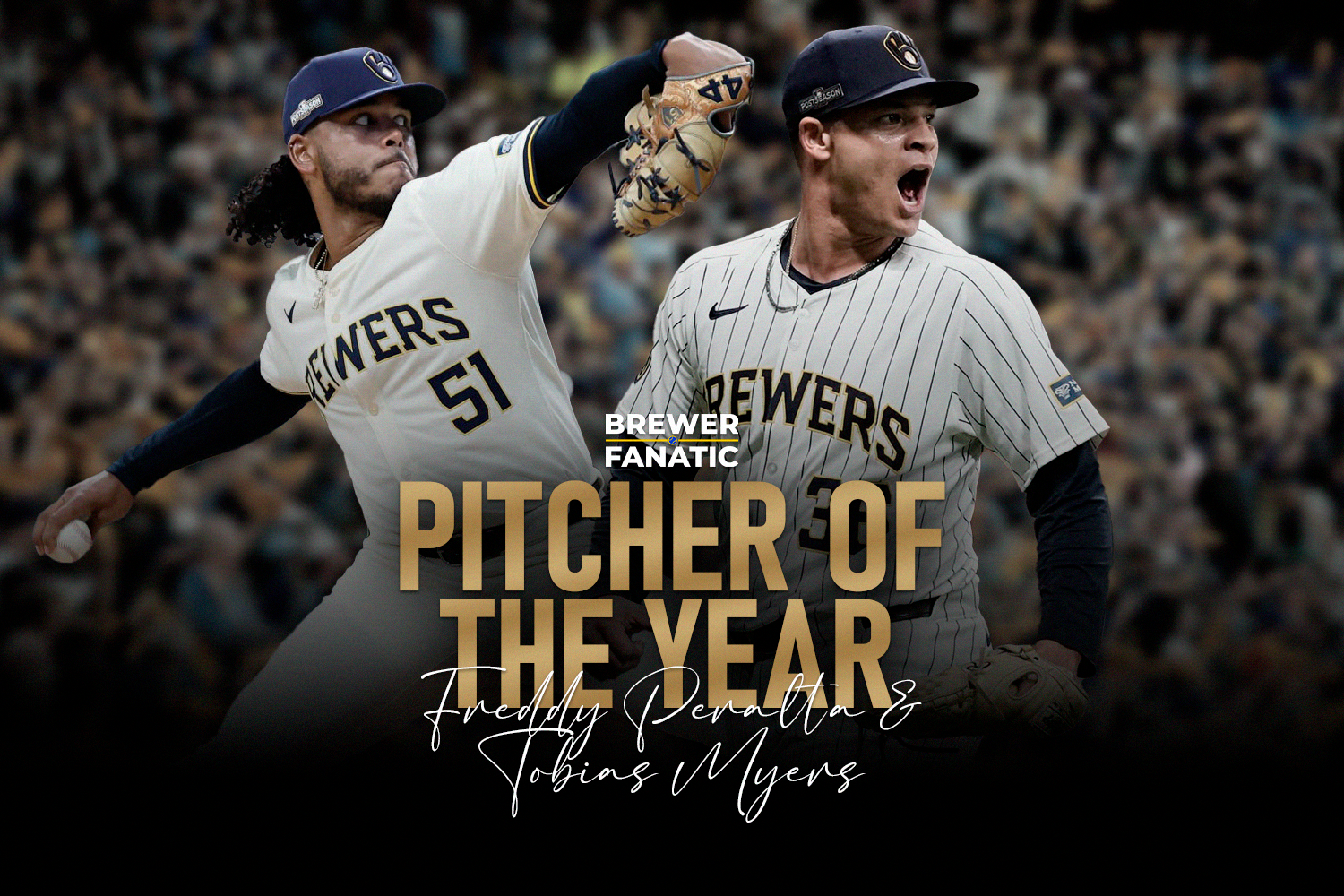 Honorable Mentions SP Aaron Civale (Brewers Stats) 74 IP, 3.53 ERA, 4.79 FIP, 1.22 WHIP, 7.9 SO/9, 3.0 BB/9, 119 ERA+, 1.1 rWAR Civale was an unassuming trade deadline acquisition, to say the least. After a tenure with the Rays that saw him pitch to a 5.17 ERA over 27 starts, he didn’t seem like he was going to be very effective with any team. After all, if the Rays--an organization known for developing great pitching talent--couldn’t make it work, how could anyone? Well, the Brewers did make it work, getting a great set of 14 starts from Civale and using him to bolster an injury-plagued rotation. Keen-eyed readers may note that his FIP of 4.79 is roughly the same as it was in Tampa this year, and perhaps he was the beneficiary of a solid defensive effort rather than of tangible pitching improvements. MLB Trade Rumors projects him to earn $8 million in arbitration, which might be a little hefty for a back-of-the-rotation guy, so despite his contributions in 2024, he may not make any more to the team in 2025. civale_strikeout.mp4 SP Colin Rea 167 ⅔ IP, 4.29 ERA, 4.75 FIP, 1.26 WHIP, 7.2 SO/9, 2.3 BB/9, 98 ERA+, 1.3 rWAR In the face of unprecedented responsibility, Rea stepped up and led the Brewers rotation for the first four months of the season. His sweeper was one of the best pitches on the team, having an opposing batting average of just .054 with a BABIP of .082 before Aug. 1. Unfortunately for Rea, his pitching seemed to hit a wall due to the sheer workload of his season, requiring 40 more innings from him than he threw in 2023, and his performance regressed significantly in the final month. Luckily, the Brewers had established themselves as division champions by that point, so it didn’t have much of an effect on the team’s postseason position, but it was enough to leave him off of the Wild Card roster. rea_strikeout.mp4 RP Bryan Hudson 62 ⅓ IP, 1.73 ERA, 3.60 FIP, 0.72 WHIP, 9.0 SO/9, 2.5 BB/9, 243 ERA+, 2.5 rWAR 2024 was a great comeback year for Bryan Hudson. After being designated for assignment by the Dodgers, he was traded to the Brewers and was one of the best arms in the bullpen, leading all qualified Milwaukee pitchers in ERA+. His sweeper was dominant, boasting an opposing batting average of .052, a whiff rate of 35.2%, and a put-away rate of 26.4%. His FIP was a little suspect as it was considerably higher than his actual ERA but that was largely affected by a brutal July which saw him post a 10.83 FIP over a span of six games. If you recalculate his numbers without July, his FIP plummets to 2.49, so he may really just be that good. hudson_strikeout.mp4 Top 3 Best Pitchers of 2024 3. RP Trevor Megill 46 ⅓ IP, 2.72 ERA, 21 SV, 3.10 FIP, 1.01 WHIP, 9.7 SO/9, 2.7 BB/9, 155 ERA+, 1.3 rWAR Like some of the other names on this list, Megill was saddled with higher expectations because of injuries affecting the people above him on the depth chart. Because Devin Williams missed much of the year, he was asked to take on the closer role and stepped up in a big way, putting together the first 21 saves of his career. Fans already know about his scorching four-seam fastball that averages 98.8 mph and topped out at 101.4 mph but his curveball was sneaky nice too, having an opposing batting average of .167 and a mind-blowing whiff rate of 55.0%. With Williams potentially gone this offseason, Megill’s performance as the interim closer could push for the team to give him the full-time job in 2025. If you’re worried about the Airbender being traded away, Trevor could just end up being the next reincarnation of the Avatar. megill_strikeout.mp4 (Tie) 1. SP Tobias Myers 138 IP, 3.00 ERA, 3.91 FIP, 1.17 WHIP, 8.3 SO/9, 2.3 BB/9, 140 ERA+, 2.7 rWAR If not for a 20-year old Venezuelan outfielder whose last name is somewhat similar to everyone’s least favorite childhood breakfast cereal, Myers would have undoubtedly been the Brewers’ rookie of the year. It has been a wild ride, to having the second-most losses in the minor leagues in 2022 to an unimpressive full-time minor-leaguer, to having the best ERA+ of any starting pitcher on the Brewers. He also pitched five shutout innings in his postseason debut. His four-seam fastball was serviceable but the pitch with the best results might have been his changeup. It was pretty unhittable with an opposing average of .083 and a whiff rate of 44.4%, the only pitch he threw to have a whiff rate above 25%. His slider was effective as well with a .255 opposing slugging percentage. Can he keep up the good work in 2025? If he does, Milwaukee’s starters will be a menacing bunch with Brandon Woodruff back in the fray and Robert Gasser potentially returning from surgery halfway through the season. myers_strikeout.mp4 (Tie) 1. Freddy Peralta 173 ⅔ IP, 3.68 ERA, 4.16 FIP, 1.22 WHIP, 10.4 SO/9, 3.5 BB/9, 114 ERA+, 2.6 rWAR Peralta may never return to his 2021 peak but Milwaukee has now gotten three seasons of pretty consistent starting pitching from him. He threw more innings than any previous season in 2024, making 32 starts at the top of the rotation and maintaining solid numbers while doing it. His season had a lukewarm ending with a shaky start ending in a postseason loss to the Mets but he redeemed himself a little bit by coming out of the bullpen in the eighth inning of the final game. Freddy didn’t do a ton differently than last year but he made a few small adjustments. He decreased the usage of his curveball in exchange for more heater and changeups. His fastball was less effective but his changeup was better, particularly at avoiding hard contact. Opponents slugged just .291 against the changeup in 2024 vs. .388 in 2023. It’ll be interesting to see where he ends up on the depth chart in 2025. Brandon Woodruff has been out for the whole year and may need some time to get back to his former self, perhaps clearing a way for Freddy Peralta to lead the way once again. There is a minuscule chance the Brewers don’t exercise his $8 million team option for 2025 but there’s probably a higher chance that I’ll be the Opening Day starter than that happening, especially after his solid showing this year. peralta_strikeout.mp4
 -
brice turang before and after switching from 2% to 1% milk this offseason
- 4 replies
-
- 1
-

-
- brice turang
- blake perkins
- (and 2 more)
-
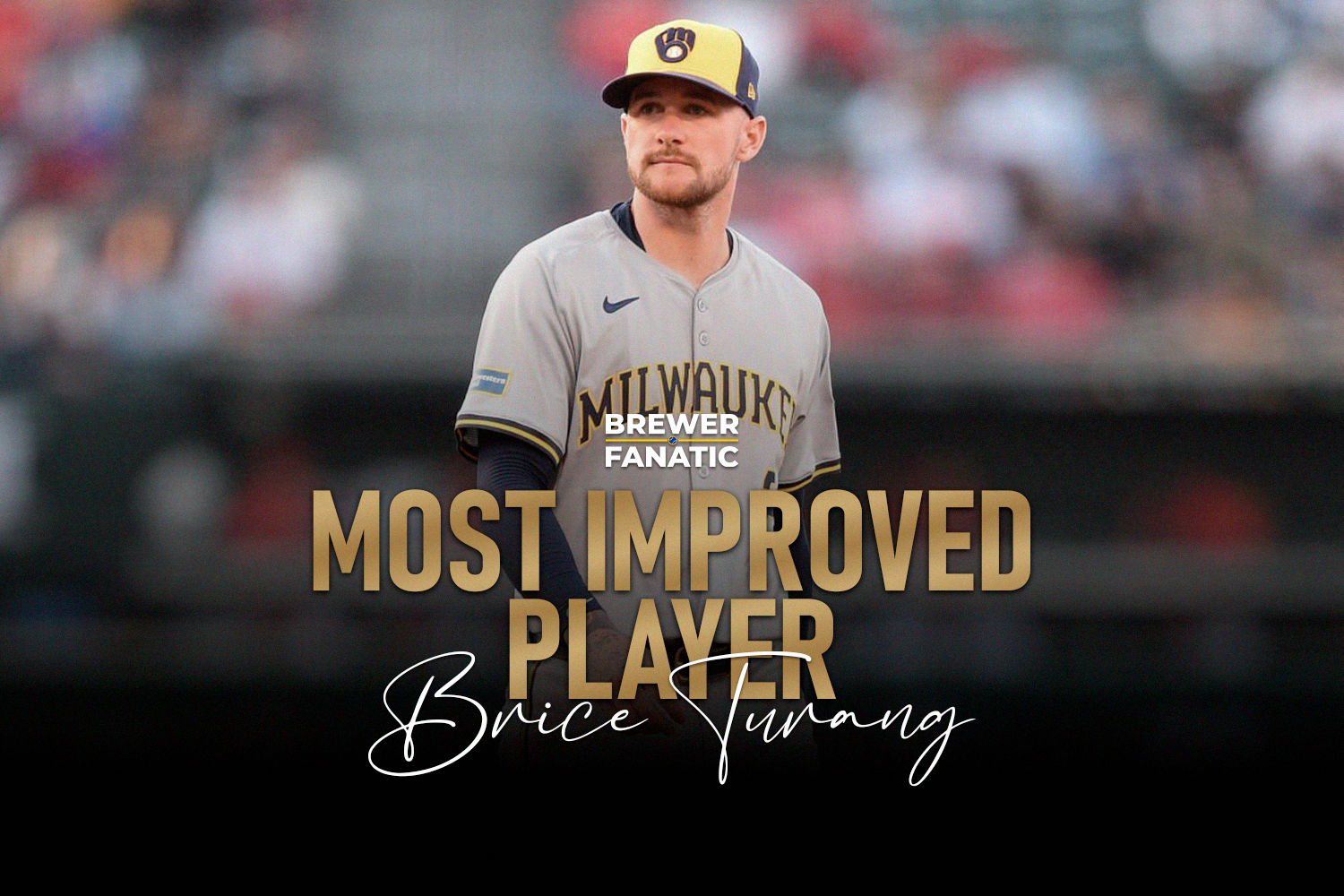 Honorable Mentions SS Willy Adames 688 PA, .251/.331/.462, 153 H, 33 2B, 32 HR, 112 RBI, 21 SB, 118 OPS+, 3.1 rWAR The 2023 campaign was arguably the worst offensive season of Willy Adames's major-league career, as he posted a .717 OPS with a 94 OPS+ over 638 plate appearances. It may have been hampered by a concussion he sustained in May, but it may have also just been a slow year for him. He was immaculate defensively and still managed to be a great shortstop, but he simply didn’t have the same offensive value as he had since arriving from the Rays. In 2024, his final year of team control, he revived his swing and set new career highs in doubles and home runs. He led all MLB shortstops in RBIs and rediscovered his ability to hit for power. His defense took a massive step backward, posting a career-worst -16 Defensive Runs Saved and committing 20 errors. It would be great to have him as the Brewers’ shortstop in the long term, as he’s proven his ability to be a consistent piece of the lineup. With free-agent infielders a rare commodity this offseason, however, he’ll likely come with a high price tag. adames_homer.mp4 OF Sal Frelick 524 PA, .259/.320/.335, 123 H, 22 2B, 4 3B, 2 HR, 32 RBI, 18 SB, 83 OPS+, 2.1 rWAR After making a dazzling debut, Frelick’s rookie campaign slowed down, as he struggled to hit the ball with much power, homering just three times in 223 plate appearances. His defense and speed made him a viable defensive option, but it was unclear whether he’d ever be an impactful bat in the lineup. This year, he leaned into his strengths even more, focusing on putting the ball in play and squaring up the ball as well as he could. His average exit velocity is still among the lowest of anyone in the big leagues, but he manages a decent batting average and on-base percentage. Furthermore, his glove in the outfield has ascended from great to magnificent, accumulating 15 total DRS. frelick_catch.mp4 3B Joey Ortiz 511 PA, .239/.329/.398, 105 H, 25 2B, 6 3B, 11 HR, 60 RBI, 11 SB, 101 OPS+, 2.6 rWAR Ortiz had just 34 plate appearances with the Orioles in 2023, before coming to Milwaukee in the Corbin Burnes trade. Designated a top-tier prospect, he proved himself to be just what the Brewers needed at third base and put an end to the uncertainty at the position. He wasn’t a particularly powerful bat, but had a collected approach at the plate, exercising great plate discipline and putting up an 11.0% walk rate. He was able to barrel up the ball occasionally, but his average exit velocity was still in the bottom quartile of qualified hitters. His glove was solid, allowing him to collect 7 DRS at third base. ortiz_homer.mp4 Top 4 Most Improved Players of 2024 4. OF Blake Perkins 434 PA, .240/.316/.332, 92 H, 13 2B, 2 3B, 6 HR, 43 RBI, 23 SB, 81 OPS+, 1.8 rWAR Perkins was on the back end of a crowded outfield in 2023, allowing him fewer than 200 plate appearances to strut his stuff. With much of his outfield competition in Milwaukee injured or shipped off to new horizons, he finally got a significant amount of playing time. While it may not seem obvious from his surface-level numbers, Perkins took a significant step forward in his weakest area, adding ~3 mph to his average exit velocity over the course of the season. Additionally, he improved his batting average against four-seam fastballs from .163 to .244, while cutting his strikeout rate in half. On the basepaths, he finally got around to using his wicked speed to steal the second-most bags on the team. His glove was exceptional, as always, collecting 8 DRS while spending his entire year in center field. perkins_catch.mp4 3. SP Colin Rea 167 ⅔ IP, 4.29 ERA, 4.75 FIP, 1.26 WHIP, 7.2 SO/9, 2.3 BB/9, 98 ERA+, 1.3 rWAR Rea was never meant to be more than a back-of-the-rotation arm in Milwaukee, especially with the talents of Corbin Burnes and Brandon Woodruff leading the way. With Burnes in Baltimore and Woodruff still recovering from shoulder surgery, Rea suddenly found himself as the second name on the starting pitcher depth chart. He got off to a great start but many expected him to regress to the ~4.50 ERA pitcher he has been in his major-league career. However, by the first week of August, he was still sitting pretty at a 3.59 ERA after 115 ⅓ innings. His sweeper had become a thing of beauty, giving up just four hits in 311 pitches thrown up to that point. He finally crashed down to Earth in the final stretch of the season and regressed so badly that he was left off of the roster for the Wild Card series against the Mets, but for his first 20 starts or so, it was like we were watching a whole new hurler. rea_strikeout.mp4 2. OF Garrett Mitchell 224 PA, .255/.342/.469, 50 H, 12 2B, 3 3B, 8 HR, 21 RBI, 11 SB, 123 OPS+, 2.0 rWAR Brewers fans finally got a slightly more full taste of what Garrett Mitchell can do on the baseball field. For the first time in his career, he had more than 75 plate appearances in a season and teased us with what could have been if he had been around since Opening Day. While he played just one-third of the season, his OPS of .812 would have been the second-highest among qualified hitters in the lineup behind just William Contreras. His performance in center field was just as good, accumulating six DRS in fewer than 500 innings and he had the 11th-highest rWAR on the team, right behind Sal Frelick. Will Garrett Mitchell join the likes of Royce Lewis and Byron Buxton as elusive creatures whose full form is unstoppable but only shows up for a narrow window of time? Hopefully not, but it’s hard to predict. Should he find a way to stay healthy in 2025, he could be one of the most valuable members on the team. mitchell_homer.mp4 Brewer Fanatic Most Improved Player for 2024 2B Brice Turang 619 PA, .254/.316/.349, 142 H, 24 2B, 4 3B, 7 HR, 57 RBI, 50 SB, 85 OPS+ Last year, Brice Turang was a solid rookie with good fielding ability and disastrous results at the plate. His 61 OPS+ was one of the worst marks for any qualified hitter in baseball, somehow even worse than Javier Báez’s own 63 OPS+ in 2023. The primary difference between Turang and Báez is, however, that the former took a big step forward while the latter took a step all the way back to the bench. The biggest lift to his numbers came from a significant improvement in his approach against big-league heaters. He averaged just .198 against four-seam fastballs in 2023 but bumped it all the way up to a .308 average this year. He didn’t hit for much power but his strong plate discipline helped push his on-base percentage above .300 and showed the world how much of a basepath menace he really is. His 50 stolen bases was third in all of MLB behind just Elly De La Cruz and Shohei Ohtani. If he had hit just 43 more home runs, he would’ve made 50/50 history too. He even managed a 1.227 OPS in the 12 postseason plate appearances he had against the Mets, accumulating five hits and three doubles. His fielding at second base was somehow even better than his spectacular 2023. He had 21 DRS, more than any other second baseman and was second only to Daulton Varsho in defensive rWAR at 2.7. So what version of Turang will the Brewers see next year? All glove and no bat?All gas no brakes on the basepaths? Or can he finally put it all together and be one of the middle infielders in the game today? If the improvements he made are any indication of what’s to come, he just might be Milwaukee’s most valuable hidden gem. eFoxUlZfWGw0TUFRPT1fRHdBSFVBWUVVQVlBQ2xRSEJBQUFVMUpSQUZoVUJWTUFDbDFYVlZkVUJ3dFRBd3BW.mp4
- 4 comments
-
- 1
-
-
- brice turang
- blake perkins
- (and 2 more)
-
With a roster full of young talent, the future looks bright for Milwaukee, especially with several players taking big steps forward. Image courtesy of Thiéres Rabelo With a roster full of young talent, the future looks bright for Milwaukee, especially with several players taking big steps forward. Honorable Mentions SS Willy Adames 688 PA, .251/.331/.462, 153 H, 33 2B, 32 HR, 112 RBI, 21 SB, 118 OPS+, 3.1 rWAR The 2023 campaign was arguably the worst offensive season of Willy Adames's major-league career, as he posted a .717 OPS with a 94 OPS+ over 638 plate appearances. It may have been hampered by a concussion he sustained in May, but it may have also just been a slow year for him. He was immaculate defensively and still managed to be a great shortstop, but he simply didn’t have the same offensive value as he had since arriving from the Rays. In 2024, his final year of team control, he revived his swing and set new career highs in doubles and home runs. He led all MLB shortstops in RBIs and rediscovered his ability to hit for power. His defense took a massive step backward, posting a career-worst -16 Defensive Runs Saved and committing 20 errors. It would be great to have him as the Brewers’ shortstop in the long term, as he’s proven his ability to be a consistent piece of the lineup. With free-agent infielders a rare commodity this offseason, however, he’ll likely come with a high price tag. adames_homer.mp4 OF Sal Frelick 524 PA, .259/.320/.335, 123 H, 22 2B, 4 3B, 2 HR, 32 RBI, 18 SB, 83 OPS+, 2.1 rWAR After making a dazzling debut, Frelick’s rookie campaign slowed down, as he struggled to hit the ball with much power, homering just three times in 223 plate appearances. His defense and speed made him a viable defensive option, but it was unclear whether he’d ever be an impactful bat in the lineup. This year, he leaned into his strengths even more, focusing on putting the ball in play and squaring up the ball as well as he could. His average exit velocity is still among the lowest of anyone in the big leagues, but he manages a decent batting average and on-base percentage. Furthermore, his glove in the outfield has ascended from great to magnificent, accumulating 15 total DRS. frelick_catch.mp4 3B Joey Ortiz 511 PA, .239/.329/.398, 105 H, 25 2B, 6 3B, 11 HR, 60 RBI, 11 SB, 101 OPS+, 2.6 rWAR Ortiz had just 34 plate appearances with the Orioles in 2023, before coming to Milwaukee in the Corbin Burnes trade. Designated a top-tier prospect, he proved himself to be just what the Brewers needed at third base and put an end to the uncertainty at the position. He wasn’t a particularly powerful bat, but had a collected approach at the plate, exercising great plate discipline and putting up an 11.0% walk rate. He was able to barrel up the ball occasionally, but his average exit velocity was still in the bottom quartile of qualified hitters. His glove was solid, allowing him to collect 7 DRS at third base. ortiz_homer.mp4 Top 4 Most Improved Players of 2024 4. OF Blake Perkins 434 PA, .240/.316/.332, 92 H, 13 2B, 2 3B, 6 HR, 43 RBI, 23 SB, 81 OPS+, 1.8 rWAR Perkins was on the back end of a crowded outfield in 2023, allowing him fewer than 200 plate appearances to strut his stuff. With much of his outfield competition in Milwaukee injured or shipped off to new horizons, he finally got a significant amount of playing time. While it may not seem obvious from his surface-level numbers, Perkins took a significant step forward in his weakest area, adding ~3 mph to his average exit velocity over the course of the season. Additionally, he improved his batting average against four-seam fastballs from .163 to .244, while cutting his strikeout rate in half. On the basepaths, he finally got around to using his wicked speed to steal the second-most bags on the team. His glove was exceptional, as always, collecting 8 DRS while spending his entire year in center field. perkins_catch.mp4 3. SP Colin Rea 167 ⅔ IP, 4.29 ERA, 4.75 FIP, 1.26 WHIP, 7.2 SO/9, 2.3 BB/9, 98 ERA+, 1.3 rWAR Rea was never meant to be more than a back-of-the-rotation arm in Milwaukee, especially with the talents of Corbin Burnes and Brandon Woodruff leading the way. With Burnes in Baltimore and Woodruff still recovering from shoulder surgery, Rea suddenly found himself as the second name on the starting pitcher depth chart. He got off to a great start but many expected him to regress to the ~4.50 ERA pitcher he has been in his major-league career. However, by the first week of August, he was still sitting pretty at a 3.59 ERA after 115 ⅓ innings. His sweeper had become a thing of beauty, giving up just four hits in 311 pitches thrown up to that point. He finally crashed down to Earth in the final stretch of the season and regressed so badly that he was left off of the roster for the Wild Card series against the Mets, but for his first 20 starts or so, it was like we were watching a whole new hurler. rea_strikeout.mp4 2. OF Garrett Mitchell 224 PA, .255/.342/.469, 50 H, 12 2B, 3 3B, 8 HR, 21 RBI, 11 SB, 123 OPS+, 2.0 rWAR Brewers fans finally got a slightly more full taste of what Garrett Mitchell can do on the baseball field. For the first time in his career, he had more than 75 plate appearances in a season and teased us with what could have been if he had been around since Opening Day. While he played just one-third of the season, his OPS of .812 would have been the second-highest among qualified hitters in the lineup behind just William Contreras. His performance in center field was just as good, accumulating six DRS in fewer than 500 innings and he had the 11th-highest rWAR on the team, right behind Sal Frelick. Will Garrett Mitchell join the likes of Royce Lewis and Byron Buxton as elusive creatures whose full form is unstoppable but only shows up for a narrow window of time? Hopefully not, but it’s hard to predict. Should he find a way to stay healthy in 2025, he could be one of the most valuable members on the team. mitchell_homer.mp4 Brewer Fanatic Most Improved Player for 2024 2B Brice Turang 619 PA, .254/.316/.349, 142 H, 24 2B, 4 3B, 7 HR, 57 RBI, 50 SB, 85 OPS+ Last year, Brice Turang was a solid rookie with good fielding ability and disastrous results at the plate. His 61 OPS+ was one of the worst marks for any qualified hitter in baseball, somehow even worse than Javier Báez’s own 63 OPS+ in 2023. The primary difference between Turang and Báez is, however, that the former took a big step forward while the latter took a step all the way back to the bench. The biggest lift to his numbers came from a significant improvement in his approach against big-league heaters. He averaged just .198 against four-seam fastballs in 2023 but bumped it all the way up to a .308 average this year. He didn’t hit for much power but his strong plate discipline helped push his on-base percentage above .300 and showed the world how much of a basepath menace he really is. His 50 stolen bases was third in all of MLB behind just Elly De La Cruz and Shohei Ohtani. If he had hit just 43 more home runs, he would’ve made 50/50 history too. He even managed a 1.227 OPS in the 12 postseason plate appearances he had against the Mets, accumulating five hits and three doubles. His fielding at second base was somehow even better than his spectacular 2023. He had 21 DRS, more than any other second baseman and was second only to Daulton Varsho in defensive rWAR at 2.7. So what version of Turang will the Brewers see next year? All glove and no bat?All gas no brakes on the basepaths? Or can he finally put it all together and be one of the middle infielders in the game today? If the improvements he made are any indication of what’s to come, he just might be Milwaukee’s most valuable hidden gem. eFoxUlZfWGw0TUFRPT1fRHdBSFVBWUVVQVlBQ2xRSEJBQUFVMUpSQUZoVUJWTUFDbDFYVlZkVUJ3dFRBd3BW.mp4 View full article
-
Brewer Fanatic Minor League Relief Pitcher of the Year - 2024
Jason Wang posted an article in Minor Leagues
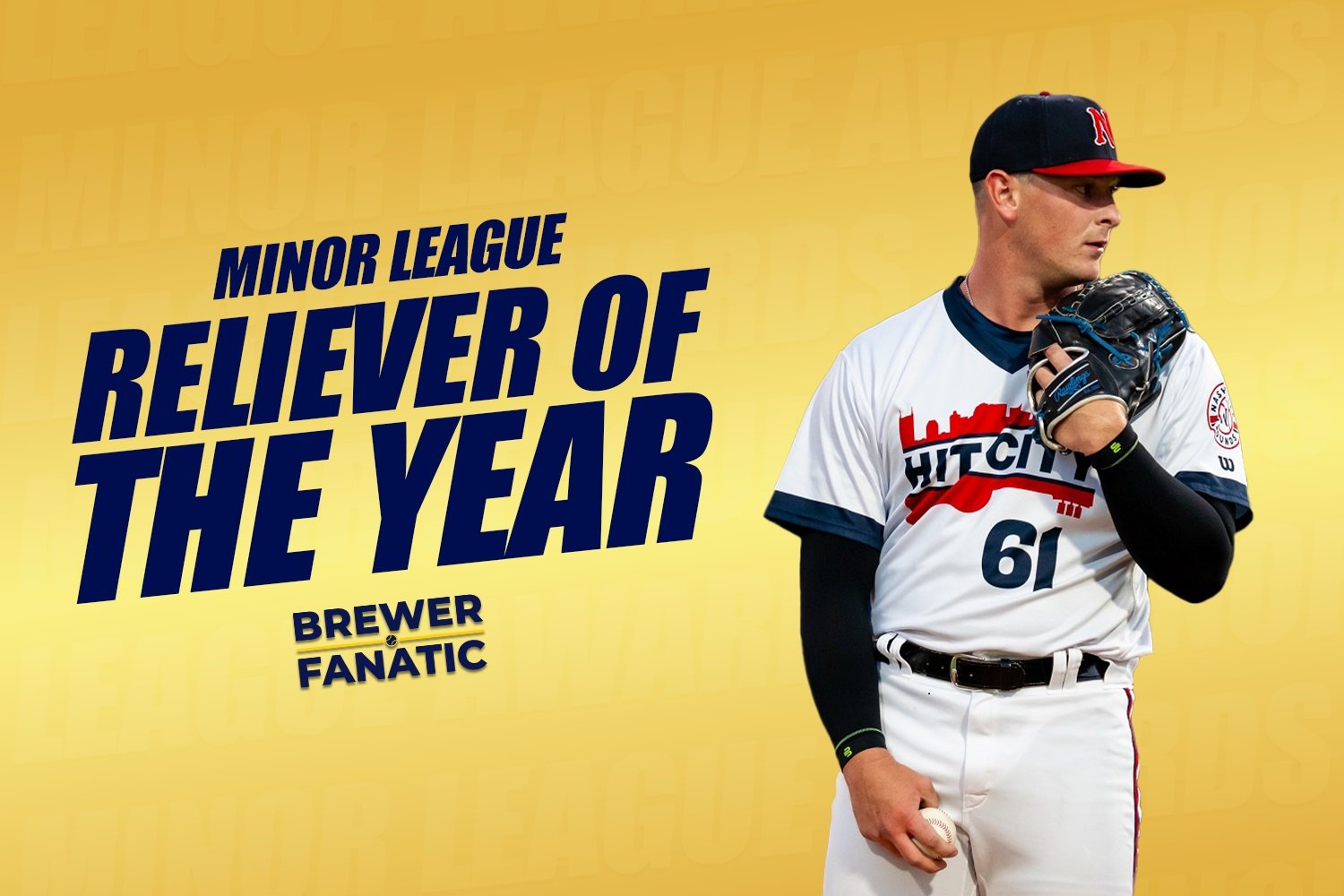 Honorable Mentions Enoli Paredes (Nashville Sounds) 26.0 IP, 1.73 ERA, 1.41 FIP, 0.96 WHIP, 14.2 K/9, 3.8 BB/9 Paredes signed a free agent contract early in the 2023 offseason, coming off an unremarkable year with the Astros Triple-A affiliate, the Sugar Land Space Cowboys. After a stellar stretch of games with Triple-A Nashville, he was called up to the Brewers in may and stuck around for quite a while, amassing 20 ⅔ innings at the big league level. He ran into some right forearm tendinitis in early July and wasn’t activated until mid-September where he made three more appearances for Milwaukee. Unfortunately for Paredes fans, he was designated for assignment in the final days of September and was claimed off waivers by the Cubs who managed to trot him out for a single inning against the Phillies. Dikember Sanchez (Carolina Mudcats) 32.2 IP, 1.38 ERA, 3.39 FIP, 0.98 WHIP, 8.0 K/9, 3.0 BB/9 Signed as an international free agent in 2021, this year was his first in the minor league system, having spent the previous three years in the Dominican Summer League. He was impressive as a 20 year old, often pitching multiple innings of relief and amassing nearly 33 innings in just 19 total appearances. He was moved up to High-A Wisconsin at the end of August and he was less effective over a smaller sample size. He’ll likely start the year at the level and potentially see a jump to Double-A Biloxi if all things go well. Top Three Minor League Relief Pitchers Of 2024 3. Kevin Herget (Nashville Sounds) 47.2 IP, 2.27 ERA, 2.07 FIP, 0.94 WHIP, 11.1 K/9, 2.1 BB/9 After being designated for assignment by the Reds at the end of 2023 and electing free agency, Herget signed a minor league deal with the Brewers and spent the majority of his season with the Sounds. He had a few trips to the major-league level (three, to be exact) but never stayed for more than a few consecutive appearances. Nonetheless, he was a great bullpen piece for Triple-A Nashville and was also a strong performer in his 11 1/3 total innings pitched for Milwaukee, posting a 1.59 ERA. 2. Sam Gardner (Biloxi Shuckers) 34 2/3 IP, 2.34 ERA, 1.82 FIP, 0.87 WHIP, 12.5 K/9, 3.1 BB/9 Gardner was an undrafted free agent who had spent some time in the independent leagues and Australia after his college career at Murray State. 2024 was his first full year in an affiliated system and he seemed to have made big strides in the right direction, dominating Double-A Biloxi while racking up outstanding strikeout numbers. He dealt with recurring injury issues throughout the year, hitting the injured list several times and ending the season on the 60-day IL but there haven’t been any reports about him receiving surgery of any kind. Brewer Fanatic Minor League Starting Pitcher of the Year for 2024 Craig Yoho (Wisconsin Timber Rattlers, Biloxi Shuckers, Nashville Sounds) 57 2/3 IP, 0.94 ERA, 0.94 WHIP, 15.8 K/9, 3.6 BB/9 Yoho’s rise to the top has been a sight to see. An eighth-round draft pick out of Indiana University (go Hoosiers!) in 2023, he rocketed through the minor league ranks and graduated from High-A Wisconsin, Double-A Biloxi, and finished the year with dominant numbers in Triple-A Nashville. His walk rate of 9.7% is a little high but with a strikeout rate of 42.4% and an opposing slugging percentage of just .190, it seems that free passes are any hitter’s best shot of beating Yoho. His upside has far exceeded his initial expectations and it wouldn’t be surprising if he was called up at some point in 2025, maybe even making the Opening Day roster. At just 24 years old, he’s clearly immensely talented and could be the latest star reliever to come out of the Milwaukee system. Congratulations to Craig Yoho on a tremendous season across three Brewers affiliates on an absolutely remarkable season. It's almost surprising that he wasn't called up to the big league club. That should happen early in the 2025 season.
 -
After a solid year of work down on the farm, a few relievers stood out above the rest. After a solid year of work down on the farm, a few relievers stood out above the rest. Honorable Mentions Enoli Paredes (Nashville Sounds) 26.0 IP, 1.73 ERA, 1.41 FIP, 0.96 WHIP, 14.2 K/9, 3.8 BB/9 Paredes signed a free agent contract early in the 2023 offseason, coming off an unremarkable year with the Astros Triple-A affiliate, the Sugar Land Space Cowboys. After a stellar stretch of games with Triple-A Nashville, he was called up to the Brewers in may and stuck around for quite a while, amassing 20 ⅔ innings at the big league level. He ran into some right forearm tendinitis in early July and wasn’t activated until mid-September where he made three more appearances for Milwaukee. Unfortunately for Paredes fans, he was designated for assignment in the final days of September and was claimed off waivers by the Cubs who managed to trot him out for a single inning against the Phillies. Dikember Sanchez (Carolina Mudcats) 32.2 IP, 1.38 ERA, 3.39 FIP, 0.98 WHIP, 8.0 K/9, 3.0 BB/9 Signed as an international free agent in 2021, this year was his first in the minor league system, having spent the previous three years in the Dominican Summer League. He was impressive as a 20 year old, often pitching multiple innings of relief and amassing nearly 33 innings in just 19 total appearances. He was moved up to High-A Wisconsin at the end of August and he was less effective over a smaller sample size. He’ll likely start the year at the level and potentially see a jump to Double-A Biloxi if all things go well. Top Three Minor League Relief Pitchers Of 2024 3. Kevin Herget (Nashville Sounds) 47.2 IP, 2.27 ERA, 2.07 FIP, 0.94 WHIP, 11.1 K/9, 2.1 BB/9 After being designated for assignment by the Reds at the end of 2023 and electing free agency, Herget signed a minor league deal with the Brewers and spent the majority of his season with the Sounds. He had a few trips to the major-league level (three, to be exact) but never stayed for more than a few consecutive appearances. Nonetheless, he was a great bullpen piece for Triple-A Nashville and was also a strong performer in his 11 1/3 total innings pitched for Milwaukee, posting a 1.59 ERA. 2. Sam Gardner (Biloxi Shuckers) 34 2/3 IP, 2.34 ERA, 1.82 FIP, 0.87 WHIP, 12.5 K/9, 3.1 BB/9 Gardner was an undrafted free agent who had spent some time in the independent leagues and Australia after his college career at Murray State. 2024 was his first full year in an affiliated system and he seemed to have made big strides in the right direction, dominating Double-A Biloxi while racking up outstanding strikeout numbers. He dealt with recurring injury issues throughout the year, hitting the injured list several times and ending the season on the 60-day IL but there haven’t been any reports about him receiving surgery of any kind. Brewer Fanatic Minor League Starting Pitcher of the Year for 2024 Craig Yoho (Wisconsin Timber Rattlers, Biloxi Shuckers, Nashville Sounds) 57 2/3 IP, 0.94 ERA, 0.94 WHIP, 15.8 K/9, 3.6 BB/9 Yoho’s rise to the top has been a sight to see. An eighth-round draft pick out of Indiana University (go Hoosiers!) in 2023, he rocketed through the minor league ranks and graduated from High-A Wisconsin, Double-A Biloxi, and finished the year with dominant numbers in Triple-A Nashville. His walk rate of 9.7% is a little high but with a strikeout rate of 42.4% and an opposing slugging percentage of just .190, it seems that free passes are any hitter’s best shot of beating Yoho. His upside has far exceeded his initial expectations and it wouldn’t be surprising if he was called up at some point in 2025, maybe even making the Opening Day roster. At just 24 years old, he’s clearly immensely talented and could be the latest star reliever to come out of the Milwaukee system. Congratulations to Craig Yoho on a tremendous season across three Brewers affiliates on an absolutely remarkable season. It's almost surprising that he wasn't called up to the big league club. That should happen early in the 2025 season. View full article
- 1 reply
-
- 1
-
-
- craig yoho
- sam gardner
- (and 3 more)
-
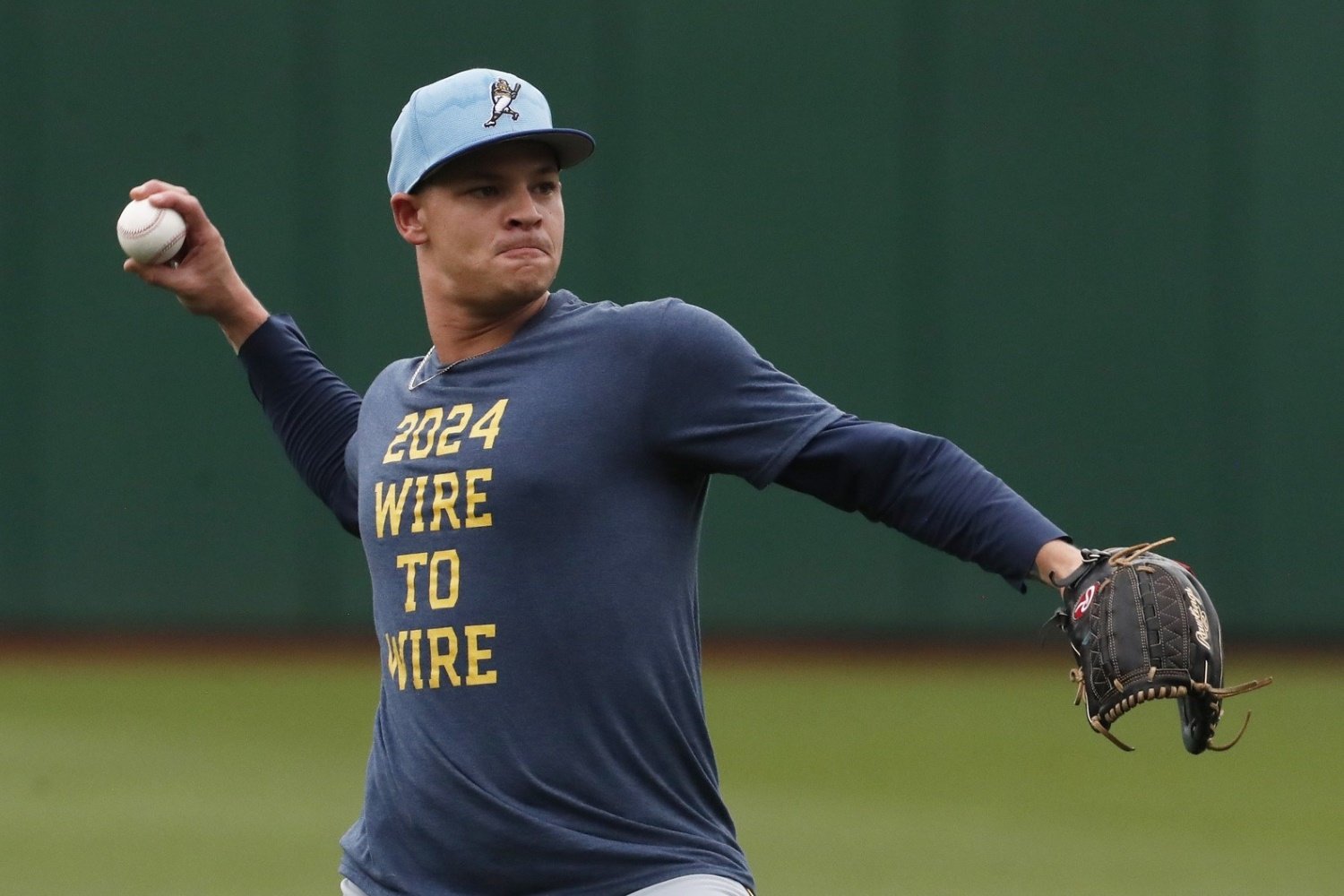 The second game of the Wild Card Series was a thriller, highlighted by Jackson Chourio’s two home runs (the first player in Brewers history to hit multiple in a postseason game), Garrett Mitchell’s go-ahead blast, and outstanding bullpen utilization. With a 5-3 victory, Milwaukee staved off elimination and put the “can’t win a postseason game to save their lives” accusations to bed, for now. One aspect of the game that was a cause for concern was the starting pitching situation. Through 3 ⅔ innings, Frankie Montas gave up six hits, three runs, made a key error, and looked generally unsteady. It was the second subpar outing from a Brewers starter in a row, after Freddy Peralta managed to go just four innings while giving up three earned runs. Now, the burden of moving the team to the Division Series will fall upon Tobias Myers. Myers exceeded all expectations this year, tossing 138 innings and posting a 3.00 ERA with a 1.17 WHIP. Utilizing four pitches in his arsenal, his primary weapon was the four-seam fastball, complemented by a cutter, slider, and changeup. His pair of fastballs was alright, but a closer look at the details spells potential trouble. His four-seamer had a relatively low whiff rate of 19.2%, while opposing hitters slugged .436 against it. To make matters worse, the Mets have several prolific hitters who have excelled against right-handed four-seamers, like Tyrone Taylor (.717 SLG), Mark Vientos (.661 SLG), and Pete Alonso (.606 SLG), all threats to do significant damage if Myers doesn't command and execute well with his heater. Myers’s cutter has a similar story, with a low whiff rate of 11.9%, a .330 opposing batting average, and a .495 slugging percentage. Righty cutters have been generally more effective against the Mets, but because Myers has struggled to make his cutter competitive, it still leaves him vulnerable against hitters like Francisco Alvarez (.818 SLG) and Harrison Bader (.583 SLG). Fortunately, Bader doesn't figure to be in the starting lineup. The keys to success lie in his slider and changeup. Myers threw his slider 21% of the time, and it was remarkably impactful, limiting batters to just a .474 OPS and a .269 BABIP. He isn’t particularly good at generating ground balls, getting them at just a 37.7% clip, but his slider had a stellar ground ball rate of 51.9% and an average exit velocity of just 86.7 mph. His changeup is somehow even better than his slider, allowing a .414 OPS, racking up a 44.4% whiff rate, an average exit velocity of 74.6 mph, and a hard-hit rate of 7.4%. Furthermore, outside of Francisco Lindor, the Mets’ offensive production against these two pitches from right-handed pitchers is dramatically lower than it is against fastballs. If Myers leans into his strengths, he can overcome what has proven to be a scrappy New York lineup. Taking the ball for the Mets will be José Quintana, a lefty bedrock of consistency since time immemorial. He had a 3.75 ERA over 170 ⅓ innings for the Mets, while throwing sinkers, four-seamers, curveballs, and changeups. Not much of a “stuff” pitcher, his low 90s-velocity, low strikeout (18.8%) and whiff (21.8%) rates leave him open to batted-ball luck and general chaotic baseball. Milwaukee was average against southpaws this year, with a .713 team OPS, but struggled immensely against four-seam fastballs and curveballs. Their offensive production against sinkers and changeups was among the top five teams in MLB, which creates an even matchup based on arsenal. Although Quintana’s 0.72 ERA in four September starts gives him a slight momentum advantage, the Brewers need to stay aggressive and attack the sinker. It worked well against Sean Manaea, another sinker-reliant starter, in the second game and was working well against Luis Severino in the first game before the lineup stalled completely. With everyone in the bullpen getting a taste of the action and a Brewers starter yet to go past four innings, Myers must come up big to give Milwaukee a fighting chance in this series, as well as the next one. Quintana’s status as a workhorse means he’ll probably go relatively deep into the game, and if not, Carlos Mendoza’s stable of relievers is fresher than Pat Murphy's. Notably, Edwin Díaz is yet to come out of the bullpen in this series. Myers has what it takes to get the job done. He has proved himself over the course of a full season, and has demonstrated the ability to step up when the team needs him most. Quintana has years of experience and three postseason series already under his belt, but he’s susceptible. Just as the lineup have been led by the youth in Jackson Chourio and Brice Turang, it’s time for a 26-year old rookie pitcher to take the team to the next level.
 -
The rookie will face a 13-year big-league veteran in a do-or-die game for the Brewers. Image courtesy of © Charles LeClaire-Imagn Images The rookie will face a 13-year big-league veteran in a do-or-die game for the Brewers. The second game of the Wild Card Series was a thriller, highlighted by Jackson Chourio’s two home runs (the first player in Brewers history to hit multiple in a postseason game), Garrett Mitchell’s go-ahead blast, and outstanding bullpen utilization. With a 5-3 victory, Milwaukee staved off elimination and put the “can’t win a postseason game to save their lives” accusations to bed, for now. One aspect of the game that was a cause for concern was the starting pitching situation. Through 3 ⅔ innings, Frankie Montas gave up six hits, three runs, made a key error, and looked generally unsteady. It was the second subpar outing from a Brewers starter in a row, after Freddy Peralta managed to go just four innings while giving up three earned runs. Now, the burden of moving the team to the Division Series will fall upon Tobias Myers. Myers exceeded all expectations this year, tossing 138 innings and posting a 3.00 ERA with a 1.17 WHIP. Utilizing four pitches in his arsenal, his primary weapon was the four-seam fastball, complemented by a cutter, slider, and changeup. His pair of fastballs was alright, but a closer look at the details spells potential trouble. His four-seamer had a relatively low whiff rate of 19.2%, while opposing hitters slugged .436 against it. To make matters worse, the Mets have several prolific hitters who have excelled against right-handed four-seamers, like Tyrone Taylor (.717 SLG), Mark Vientos (.661 SLG), and Pete Alonso (.606 SLG), all threats to do significant damage if Myers doesn't command and execute well with his heater. Myers’s cutter has a similar story, with a low whiff rate of 11.9%, a .330 opposing batting average, and a .495 slugging percentage. Righty cutters have been generally more effective against the Mets, but because Myers has struggled to make his cutter competitive, it still leaves him vulnerable against hitters like Francisco Alvarez (.818 SLG) and Harrison Bader (.583 SLG). Fortunately, Bader doesn't figure to be in the starting lineup. The keys to success lie in his slider and changeup. Myers threw his slider 21% of the time, and it was remarkably impactful, limiting batters to just a .474 OPS and a .269 BABIP. He isn’t particularly good at generating ground balls, getting them at just a 37.7% clip, but his slider had a stellar ground ball rate of 51.9% and an average exit velocity of just 86.7 mph. His changeup is somehow even better than his slider, allowing a .414 OPS, racking up a 44.4% whiff rate, an average exit velocity of 74.6 mph, and a hard-hit rate of 7.4%. Furthermore, outside of Francisco Lindor, the Mets’ offensive production against these two pitches from right-handed pitchers is dramatically lower than it is against fastballs. If Myers leans into his strengths, he can overcome what has proven to be a scrappy New York lineup. Taking the ball for the Mets will be José Quintana, a lefty bedrock of consistency since time immemorial. He had a 3.75 ERA over 170 ⅓ innings for the Mets, while throwing sinkers, four-seamers, curveballs, and changeups. Not much of a “stuff” pitcher, his low 90s-velocity, low strikeout (18.8%) and whiff (21.8%) rates leave him open to batted-ball luck and general chaotic baseball. Milwaukee was average against southpaws this year, with a .713 team OPS, but struggled immensely against four-seam fastballs and curveballs. Their offensive production against sinkers and changeups was among the top five teams in MLB, which creates an even matchup based on arsenal. Although Quintana’s 0.72 ERA in four September starts gives him a slight momentum advantage, the Brewers need to stay aggressive and attack the sinker. It worked well against Sean Manaea, another sinker-reliant starter, in the second game and was working well against Luis Severino in the first game before the lineup stalled completely. With everyone in the bullpen getting a taste of the action and a Brewers starter yet to go past four innings, Myers must come up big to give Milwaukee a fighting chance in this series, as well as the next one. Quintana’s status as a workhorse means he’ll probably go relatively deep into the game, and if not, Carlos Mendoza’s stable of relievers is fresher than Pat Murphy's. Notably, Edwin Díaz is yet to come out of the bullpen in this series. Myers has what it takes to get the job done. He has proved himself over the course of a full season, and has demonstrated the ability to step up when the team needs him most. Quintana has years of experience and three postseason series already under his belt, but he’s susceptible. Just as the lineup have been led by the youth in Jackson Chourio and Brice Turang, it’s time for a 26-year old rookie pitcher to take the team to the next level. View full article
-
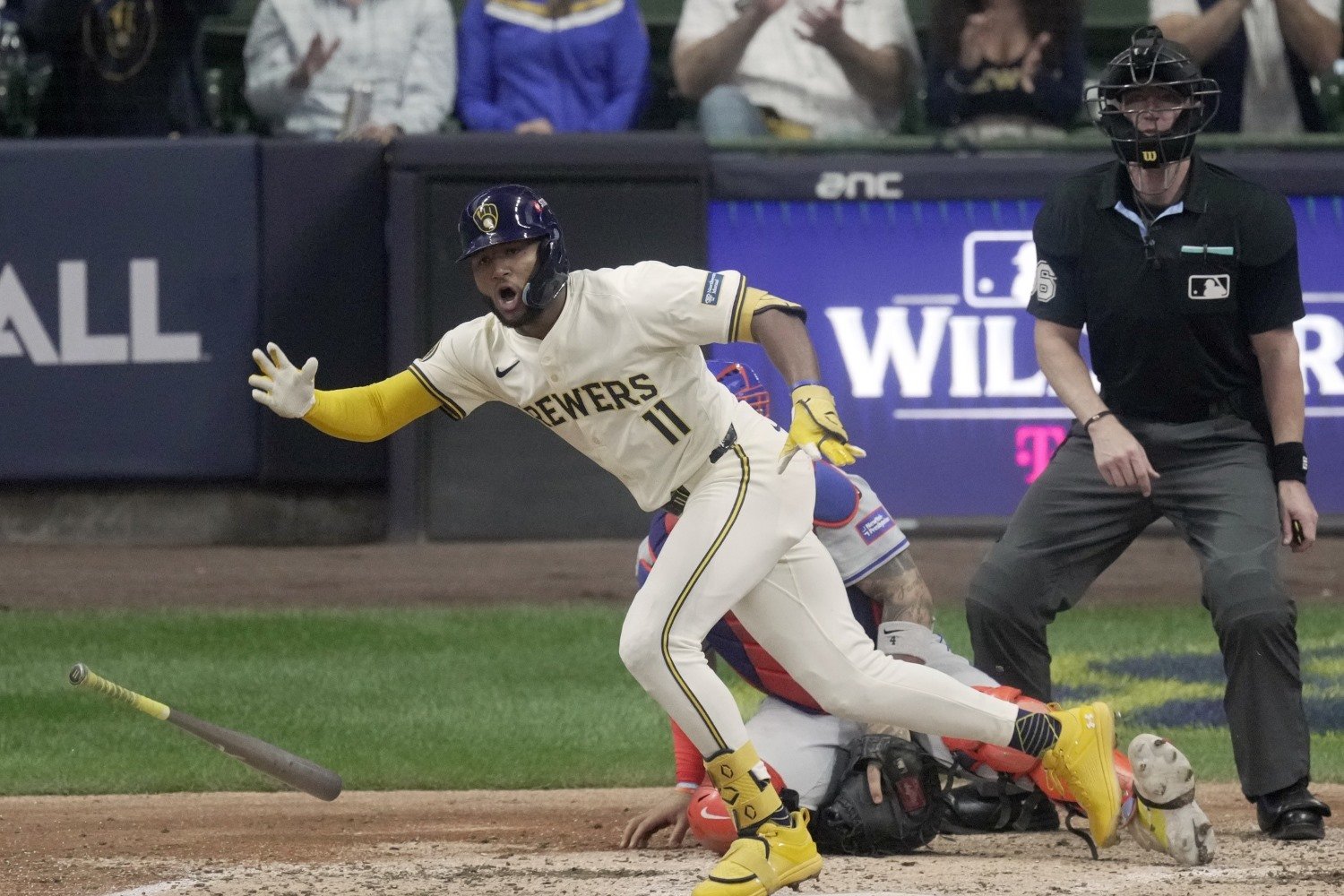 Despite a final score of 8-4, don’t let the box score mislead you into thinking that the Brewers were clearly overmatched by the Mets. They performed well early against Luis Severino, accumulating eight hits and four total runs over six innings against him. Brice Turang had a great night at the plate, going 3-for-5 with two doubles, and Jackson Chourio made great defensive and offensive plays in his first October showing. It was a disastrous bullpen collapse in the fifth inning that ultimately tilted things New York's way, but the other innings were competitive to say the least. Now facing elimination and yet another October sweep, the Brewers will have to stay focused on what they can do better in what will hopefully be the next two games of the series. Sean Manaea will be taking the mound in the second game. This was a great year for him, especially after two rough ones split between the Padres and Giants. The lefty pitched to a 3.47 ERA, with a 1.08 WHIP and 184 strikeouts over 181 ⅔ innings. Utilizing a four-pitch arsenal, his bread-and-butter is the sinker, which has a whiff rate of 20.8% and a .201 opposing batting average. Since he changed his mechanics in August and committed to giving hitters a new set of angles, the sinker and his sweeper have paired brilliantly with one another. Manaea says he undertook a conscious imitation of Chris Sale, and the results have been good enough to stop you from chuckling at the parallel. The Brewers have been around league average against southpaws, posting a .713 OPS as a team, but they do have a walk rate of 10.3% against left-handed pitching, second in MLB behind just the Yankees. Most importantly, they’re exceptional against lefty sinkers, with an .895 team OPS, fourth in MLB. Thus, it makes sense that they played particularly well against Manaea in their only meeting this year, putting up seven hits and five earned runs in just 3 ⅔ innings on Sept. 27. He relies on that sinker about 60 percent of the time, so the Crew need to go up there looking for it. Bullpen-wise, Carlos Mendoza was conservative in the first game and used just two arms: José Butto and Ryne Stanek. This leaves most of their highest-performing pieces, like Edwin Díaz, Phil Maton, and Reed Garrett fresh and ready to be deployed. However, Díaz has already thrown 66 pitches over the past few days, a relatively heavy workload that might keep him out until Game 3. The Mets will probably trot out at least one of their less intimidating relievers, someone like Adam Ottavino or Danny Young, another opportunity for the Brewers’ lineup to put up some scoring. On Milwaukee’s side, Frankie Montas has been marked as the starter. The most worrying thing about Montas is that, after seeming to dial in during August, he’s been a lot more hittable in September. Most notably, his outing on Sept. 22 saw him give up seven earned runs against the Diamondbacks in just under three innings. A fastball-dominant pitcher, Montas lives and dies by the sword, striking out 11 batters per nine innings but giving up hard contact to do so. The Mets have struggled against right-handed splitters in 2024, managing just a .508 OPS against them. As his most frequently-thrown non-fastball pitch, the splitter could see more action in his start. He'll just need to be careful not to give away his pitch grips, as he did during that clunker against Arizona. If Pat Murphy needs to go to the bullpen earlier than expected, he can use Joe Ross or even DL Hall to eat innings. For higher leverage, he still has Devin Williams and Trevor Megill ready and waiting. Jared Koenig is the only other bullpen option, as it would make sense for Tobias Myers to be saved for a Game 3 start. The Mets are very beatable, and the Brewers have more than enough tools to get the job done. There’s no use languishing in the past. ;it’s time to lock in on the future.
 -
With a disappointing loss now in the rearview mirror, what can Milwaukee do to avoid yet another early playoff exit? Image courtesy of © Mark Hoffman/Milwaukee Journal Sentinel/USA TODAY Network via Imagn Images With a disappointing loss now in the rearview mirror, what can Milwaukee do to avoid yet another early playoff exit? Despite a final score of 8-4, don’t let the box score mislead you into thinking that the Brewers were clearly overmatched by the Mets. They performed well early against Luis Severino, accumulating eight hits and four total runs over six innings against him. Brice Turang had a great night at the plate, going 3-for-5 with two doubles, and Jackson Chourio made great defensive and offensive plays in his first October showing. It was a disastrous bullpen collapse in the fifth inning that ultimately tilted things New York's way, but the other innings were competitive to say the least. Now facing elimination and yet another October sweep, the Brewers will have to stay focused on what they can do better in what will hopefully be the next two games of the series. Sean Manaea will be taking the mound in the second game. This was a great year for him, especially after two rough ones split between the Padres and Giants. The lefty pitched to a 3.47 ERA, with a 1.08 WHIP and 184 strikeouts over 181 ⅔ innings. Utilizing a four-pitch arsenal, his bread-and-butter is the sinker, which has a whiff rate of 20.8% and a .201 opposing batting average. Since he changed his mechanics in August and committed to giving hitters a new set of angles, the sinker and his sweeper have paired brilliantly with one another. Manaea says he undertook a conscious imitation of Chris Sale, and the results have been good enough to stop you from chuckling at the parallel. The Brewers have been around league average against southpaws, posting a .713 OPS as a team, but they do have a walk rate of 10.3% against left-handed pitching, second in MLB behind just the Yankees. Most importantly, they’re exceptional against lefty sinkers, with an .895 team OPS, fourth in MLB. Thus, it makes sense that they played particularly well against Manaea in their only meeting this year, putting up seven hits and five earned runs in just 3 ⅔ innings on Sept. 27. He relies on that sinker about 60 percent of the time, so the Crew need to go up there looking for it. Bullpen-wise, Carlos Mendoza was conservative in the first game and used just two arms: José Butto and Ryne Stanek. This leaves most of their highest-performing pieces, like Edwin Díaz, Phil Maton, and Reed Garrett fresh and ready to be deployed. However, Díaz has already thrown 66 pitches over the past few days, a relatively heavy workload that might keep him out until Game 3. The Mets will probably trot out at least one of their less intimidating relievers, someone like Adam Ottavino or Danny Young, another opportunity for the Brewers’ lineup to put up some scoring. On Milwaukee’s side, Frankie Montas has been marked as the starter. The most worrying thing about Montas is that, after seeming to dial in during August, he’s been a lot more hittable in September. Most notably, his outing on Sept. 22 saw him give up seven earned runs against the Diamondbacks in just under three innings. A fastball-dominant pitcher, Montas lives and dies by the sword, striking out 11 batters per nine innings but giving up hard contact to do so. The Mets have struggled against right-handed splitters in 2024, managing just a .508 OPS against them. As his most frequently-thrown non-fastball pitch, the splitter could see more action in his start. He'll just need to be careful not to give away his pitch grips, as he did during that clunker against Arizona. If Pat Murphy needs to go to the bullpen earlier than expected, he can use Joe Ross or even DL Hall to eat innings. For higher leverage, he still has Devin Williams and Trevor Megill ready and waiting. Jared Koenig is the only other bullpen option, as it would make sense for Tobias Myers to be saved for a Game 3 start. The Mets are very beatable, and the Brewers have more than enough tools to get the job done. There’s no use languishing in the past. ;it’s time to lock in on the future. View full article
