


Matthew Trueblood
-
Posts
1,964 -
Joined
-
Last visited
-
Days Won
10
Content Type
Profiles
Forums
Blogs
Events
News
2026 Milwaukee Brewers Top Prospects Ranking
Milwaukee Brewers Videos
2022 Milwaukee Brewers Draft Picks
Milwaukee Brewers Free Agent & Trade Rumors, Notes, & Tidbits
Guides & Resources
2023 Milwaukee Brewers Draft Picks
2024 Milwaukee Brewers Draft Picks
The Milwaukee Brewers Players Project
2025 Milwaukee Brewers Draft Pick Tracker
2026 Milwaukee Brewers Draft Tracker: Picks & Bonuses
Store
Downloads
Gallery
Everything posted by Matthew Trueblood
-
Image courtesy of © Kirby Lee-Imagn Images Ask anyone who's been paying attention, and they'll tell you: there's likely to be a work stoppage in the next year-plus in Major League Baseball. The Collective Bargaining Agreement (CBA) between the league and the MLB Players Association (MLBPA) expires on Dec. 1, 2026, and the overwhelming likelihood is that owners will lock out the players on that date. That's what they did on Dec. 1, 2021, when the last CBA expired, and they've telegraphed their intention to do it again. Everyone agrees that a lockout is very likely. From there, many have extrapolated that the 2027 season itself is in some jeopardy—and more still have suggested that even if the season is played, it will be shortened by labor strife. I think everyone is probably right about a lockout coming next December. I think those who foresee lost games in the actual 2027 season are baselessly speculating, and that their baseless speculation will turn out to be wrong. Tensions between the league and the union are high, though the degree to which they exceed where they were five or 10 years ago has been overstated by some. Because catastrophizing makes for better content, though, many who see that tension are jumping from that premise to the conclusion that the on-field product will be directly affected. For fans who lived through work stoppages in the 1970s, 1980s and 1990s, it's impossible to imagine an expiration of the CBA that doesn't come with either an immediate renewal or games being lost. Even if you were a sentient fan in 2002, you probably have that association in your head. That summer, the league nearly shut down again in late August, as the players and the owners again engaged in a fierce staredown. Since then, though, these fights have been confined to offseasons. It wouldn't automatically have to be that way. In 1994, the players began the season without a new contract, because the previous one expired on Dec. 31, 1993. They did so again in 2002, after the CBA expired on Halloween 2001. Since then, though, the union's position has changed. They refuse to take the field without an active CBA, and when the last CBA expired on Dec. 1, 2021, the owners locked the players out to ensure that contracts wouldn't be signed while a new deal was pending. The game of chicken that is a season played without a new agreement is over. Both sides ended it, without a formal agreement to do so, because the roughly quadrennial panic that a perfectly good season would grind to a halt over labor strife was untenable for all involved. However, it's only when at least some chance of lost games creeps into view that the stakes of a lockout or a strike rise enough to stir movement from either side. With neither side willing to proceed with their business without a signed deal in place, they've pushed the fight into the winter—but in the winter, it doesn't get resolved quickly or reliably. We'll probably experience another protracted lockout next winter, which will damage fan morale and prompt lots of hand-wringing over whether any games will be played the following summer—all for naught, really, because all 162 games will probably be played. There's no perfect time on the calendar to have the CBA expire, and no perfect way to handle the fact that both sides are intransigent and greedy. There's no easy solution to the eternal problem of labor strife in MLB. However, for the good of the game, each side might consider retreating a bit from the direction in which they've moved the fight over the last two decades. While they've shielded themselves from the disaster of lost games or a nixed postseason, they've also decreased the costs of brinksmanship. Each side can afford to be more rigid and more pugnacious, and that's bad for everyone: the players, the owners, and the fans. Were these debates and these moments of near-crisis still happening in the summer, there would be much greater risks if things didn't get done, but for that very reason, the deals would get done faster and with less posturing on each side. We're not heading for Armageddon next winter. We're just heading for a headache. For fans being squeezed for more of their dollars each year while the profits for both owners and players skyrocket, it's obnoxious. It's certainly unnecessary, given that the union isn't even protecting their most vulnerable members or taking on some of the most important issues they should be addressing. The sides are fighting over money, and both sides already have too much money. They're going to have a long staredown, because each side believes it's the best way to maximize the slice of the pie they eventually get. Meanwhile, fans are all anxiety over a calamity that probably isn't coming, and it's just because this is the cycle of negotiations that is most comfortable for the already comfortable parties thereto. When we escaped the summer sweats over the danger of lost games, we lost something vital: the sense of urgency that gets the owners and the players to the table faster, in deal-making mode. View full article
-
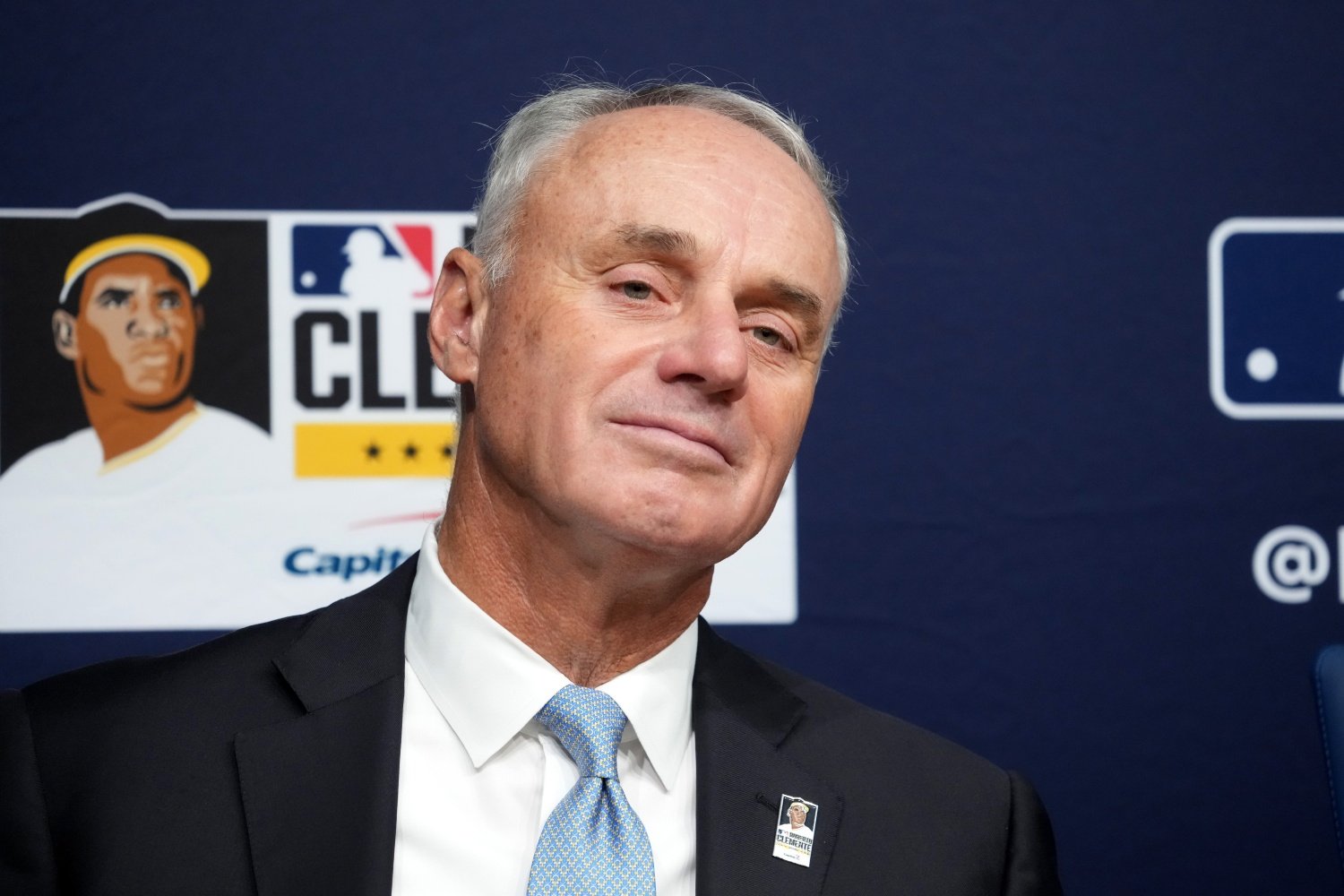 Ask anyone who's been paying attention, and they'll tell you: there's likely to be a work stoppage in the next year-plus in Major League Baseball. The Collective Bargaining Agreement (CBA) between the league and the MLB Players Association (MLBPA) expires on Dec. 1, 2026, and the overwhelming likelihood is that owners will lock out the players on that date. That's what they did on Dec. 1, 2021, when the last CBA expired, and they've telegraphed their intention to do it again. Everyone agrees that a lockout is very likely. From there, many have extrapolated that the 2027 season itself is in some jeopardy—and more still have suggested that even if the season is played, it will be shortened by labor strife. I think everyone is probably right about a lockout coming next December. I think those who foresee lost games in the actual 2027 season are baselessly speculating, and that their baseless speculation will turn out to be wrong. Tensions between the league and the union are high, though the degree to which they exceed where they were five or 10 years ago has been overstated by some. Because catastrophizing makes for better content, though, many who see that tension are jumping from that premise to the conclusion that the on-field product will be directly affected. For fans who lived through work stoppages in the 1970s, 1980s and 1990s, it's impossible to imagine an expiration of the CBA that doesn't come with either an immediate renewal or games being lost. Even if you were a sentient fan in 2002, you probably have that association in your head. That summer, the league nearly shut down again in late August, as the players and the owners again engaged in a fierce staredown. Since then, though, these fights have been confined to offseasons. It wouldn't automatically have to be that way. In 1994, the players began the season without a new contract, because the previous one expired on Dec. 31, 1993. They did so again in 2002, after the CBA expired on Halloween 2001. Since then, though, the union's position has changed. They refuse to take the field without an active CBA, and when the last CBA expired on Dec. 1, 2021, the owners locked the players out to ensure that contracts wouldn't be signed while a new deal was pending. The game of chicken that is a season played without a new agreement is over. Both sides ended it, without a formal agreement to do so, because the roughly quadrennial panic that a perfectly good season would grind to a halt over labor strife was untenable for all involved. However, it's only when at least some chance of lost games creeps into view that the stakes of a lockout or a strike rise enough to stir movement from either side. With neither side willing to proceed with their business without a signed deal in place, they've pushed the fight into the winter—but in the winter, it doesn't get resolved quickly or reliably. We'll probably experience another protracted lockout next winter, which will damage fan morale and prompt lots of hand-wringing over whether any games will be played the following summer—all for naught, really, because all 162 games will probably be played. There's no perfect time on the calendar to have the CBA expire, and no perfect way to handle the fact that both sides are intransigent and greedy. There's no easy solution to the eternal problem of labor strife in MLB. However, for the good of the game, each side might consider retreating a bit from the direction in which they've moved the fight over the last two decades. While they've shielded themselves from the disaster of lost games or a nixed postseason, they've also decreased the costs of brinksmanship. Each side can afford to be more rigid and more pugnacious, and that's bad for everyone: the players, the owners, and the fans. Were these debates and these moments of near-crisis still happening in the summer, there would be much greater risks if things didn't get done, but for that very reason, the deals would get done faster and with less posturing on each side. We're not heading for Armageddon next winter. We're just heading for a headache. For fans being squeezed for more of their dollars each year while the profits for both owners and players skyrocket, it's obnoxious. It's certainly unnecessary, given that the union isn't even protecting their most vulnerable members or taking on some of the most important issues they should be addressing. The sides are fighting over money, and both sides already have too much money. They're going to have a long staredown, because each side believes it's the best way to maximize the slice of the pie they eventually get. Meanwhile, fans are all anxiety over a calamity that probably isn't coming, and it's just because this is the cycle of negotiations that is most comfortable for the already comfortable parties thereto. When we escaped the summer sweats over the danger of lost games, we lost something vital: the sense of urgency that gets the owners and the players to the table faster, in deal-making mode.
 -
Image courtesy of © Troy Taormina-Imagn Images Call it counterintuitive, but even though it will cost more to sign Brandon Woodruff if he turns down the qualifying offer from the Brewers by Tuesday, it would feel more worthwhile to do so. The big question around Woodruff isn't his talent level; it's about health and durability. When he's on the mound, Woodruff is likely to be a solidly mid-rotation starter, with upside from there. Unfortunately, given the way his last three seasons have gone, it's hard to count on him being on the mound very often. If he has the confidence to turn down $22.025 million on a one-year deal, it's a signal that his shoulder is essentially intact, for now. However, if he does turn down that contract, Milwaukee is more likely to move on than to re-engage with him. As much as the whole franchise loves Woodruff, they have lots of upside in their projected 2026 rotation as it is. What they need is volume—the very reliability that is the missing ingredient for the veteran righthander. Besides, if they let Woodruff depart after he turns down this offer, they reap a draft pick to deepen their 2026 class, which would make it easier for them to retain Freddy Peralta. If they re-sign him, the price tag is likely to increase the pressure to trade Peralta, and they'll need to find another way to improve their depth on the farm. Letting Woodruff depart would leave an open spot in the rotation, but it would also mean considerable flexibility with which to fill it. The Brewers are never going to wade into the market for the top-end starting pitchers in free agency, but this year, there's a fairly robust second and third tier of them. In particular, two right-handed starters who will be available without the loss of draft compensation stand out as viable options. Merrill Kelly After being traded from the Diamondbacks to the Rangers in July, Kelly hits the market as he heads toward his age-37 season. Despite getting old, though, he's been one of the league's sturdier workhorses for the last half-decade—nearly always taking the ball, often working relatively deep in games, and consistently pitching better than an average starter. Though he only has one plus weapon, in his changeup, Kelly has a kitchen-sink repertoire and uses all three fastball varieties. He's a rich man's Colin Rea, and while Rea departed for the Cubs last winter, he's still very much the style of pitcher the Brewers like for the middle of their rotation. Projections for Kelly's next contract are considerably higher than what the Cubs paid Rea, or what they will pay him in 2026. He's expected to make north of $30 million on a two-year deal. Because his age will keep the term of the contract short, however, he could be in the Crew's price range. Nick Martinez Whereas Kelly is coming off a strong season, Martinez hits the market after taking the qualifying offer from the Reds last fall—and probably wishing he hadn't. Though his stuff remained essentially intact, Martinez's strikeout rate against righties declined sharply, and with that went some of his effectiveness. The Reds leaned on him to start more than he had the previous few years, and it seemed to stretch him too thin. Martinez won't make what Kelly will this winter. He's in line for something closer to $22 million over two years, making him reasonably priced. The key question for him will be whether he can get back to the clever sequencing and great command that made him so good from 2022 through 2024. As with Kelly, the only truly plus pitch Martinez throws is his changeup, but his arsenal is deep and balanced. The last time Martinez spent time on the injured list in the majors was 2017. He's been a swingman, rather than a full-fledged starter, but like Kelly, he provides ample value by being available when needed. If Woodruff takes the qualifying offer, the Brewers' winter pitching plans will have to be low-cost and low-wattage. If he doesn't, though, they'll have significant money to spend—and several ways to go about doing it. View full article
-
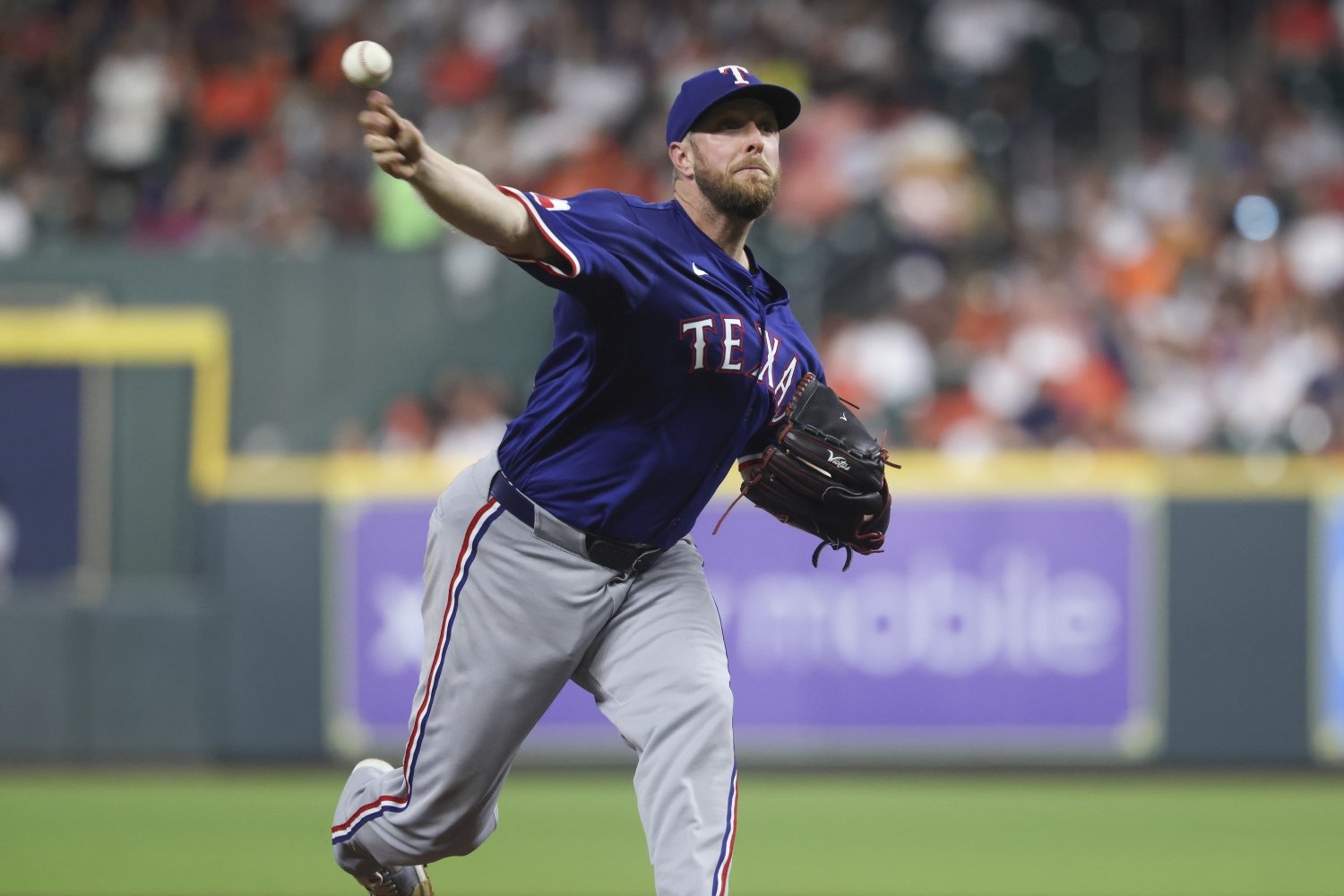 Call it counterintuitive, but even though it will cost more to sign Brandon Woodruff if he turns down the qualifying offer from the Brewers by Tuesday, it would feel more worthwhile to do so. The big question around Woodruff isn't his talent level; it's about health and durability. When he's on the mound, Woodruff is likely to be a solidly mid-rotation starter, with upside from there. Unfortunately, given the way his last three seasons have gone, it's hard to count on him being on the mound very often. If he has the confidence to turn down $22.025 million on a one-year deal, it's a signal that his shoulder is essentially intact, for now. However, if he does turn down that contract, Milwaukee is more likely to move on than to re-engage with him. As much as the whole franchise loves Woodruff, they have lots of upside in their projected 2026 rotation as it is. What they need is volume—the very reliability that is the missing ingredient for the veteran righthander. Besides, if they let Woodruff depart after he turns down this offer, they reap a draft pick to deepen their 2026 class, which would make it easier for them to retain Freddy Peralta. If they re-sign him, the price tag is likely to increase the pressure to trade Peralta, and they'll need to find another way to improve their depth on the farm. Letting Woodruff depart would leave an open spot in the rotation, but it would also mean considerable flexibility with which to fill it. The Brewers are never going to wade into the market for the top-end starting pitchers in free agency, but this year, there's a fairly robust second and third tier of them. In particular, two right-handed starters who will be available without the loss of draft compensation stand out as viable options. Merrill Kelly After being traded from the Diamondbacks to the Rangers in July, Kelly hits the market as he heads toward his age-37 season. Despite getting old, though, he's been one of the league's sturdier workhorses for the last half-decade—nearly always taking the ball, often working relatively deep in games, and consistently pitching better than an average starter. Though he only has one plus weapon, in his changeup, Kelly has a kitchen-sink repertoire and uses all three fastball varieties. He's a rich man's Colin Rea, and while Rea departed for the Cubs last winter, he's still very much the style of pitcher the Brewers like for the middle of their rotation. Projections for Kelly's next contract are considerably higher than what the Cubs paid Rea, or what they will pay him in 2026. He's expected to make north of $30 million on a two-year deal. Because his age will keep the term of the contract short, however, he could be in the Crew's price range. Nick Martinez Whereas Kelly is coming off a strong season, Martinez hits the market after taking the qualifying offer from the Reds last fall—and probably wishing he hadn't. Though his stuff remained essentially intact, Martinez's strikeout rate against righties declined sharply, and with that went some of his effectiveness. The Reds leaned on him to start more than he had the previous few years, and it seemed to stretch him too thin. Martinez won't make what Kelly will this winter. He's in line for something closer to $22 million over two years, making him reasonably priced. The key question for him will be whether he can get back to the clever sequencing and great command that made him so good from 2022 through 2024. As with Kelly, the only truly plus pitch Martinez throws is his changeup, but his arsenal is deep and balanced. The last time Martinez spent time on the injured list in the majors was 2017. He's been a swingman, rather than a full-fledged starter, but like Kelly, he provides ample value by being available when needed. If Woodruff takes the qualifying offer, the Brewers' winter pitching plans will have to be low-cost and low-wattage. If he doesn't, though, they'll have significant money to spend—and several ways to go about doing it.
 -
Image courtesy of © Michael McLoone-Imagn Images During spring training, Pat Murphy was exuberant about Logan Henderson's future—and he was far from alone. Henderson turned heads throughout camp, and there was considerable hope among the Brewers fan base that he would quickly be promoted into the big-league rotation. A fourth-round pick in 2021, he has been on fans' radar screens a long time, and indeed, he seemed to be on the cusp of a major contribution by the early stages of 2025. In a way, that proved true. Henderson made one start in mid-April and three in the middle of May for the Crew. However, the team showed surprisingly little eagerness to entrust him with a full-time role in the big leagues. He dutifully rode the Milwaukee-Nashville shuttle, but by mid-June, it looked like a breakout was going to waste against Triple-A hitters. Henderson had a 1.82 ERA and a 33.7% strikeout rate over his first 13 appearances, and his teams won 12 of the 13 contests. By the time more opportunities opened up with the parent club, though, Henderson's window of dominance had slammed shut. He simply wasn't as good, starting around mid-June. In his next eight appearances, he had a 5.35 ERA and an underwhelming 22.2% strikeout rate. He did get the call for one more start with the Crew at the beginning of August, and just in time, because he then suffered a flexor tendon strain and missed the rest of the year. He accrued big-league service time during that stint on the shelf, but wasn't available to them during the playoffs—and probably wouldn't have been their top choice at any point, anyway. There were two problems with his performance, even before the arm injury (or perhaps because of it, but before he aggravated it enough to force him out of the rotation). First, Henderson's raw stuff ticked down as the season progressed. His velocity was down about a mile per hour, by the time of that one start in August. It had trended in the wrong direction throughout June and July, too. Henderson has good fastball shape, with more rising action than a hitter expects based on his low release point and three-quarters slot. Still, that loss of velocity is a problem for him. For one thing, his swing-and-miss pitch is the changeup, and lost velocity on the heater gives hitters fractionally more time to distinguish those two offerings and make better swing decisions. For another, a little less power on a fastball at the top of the zone can be the difference between a whiff or a pop-up and a home run. Secondly, Henderson's locations shifted for the worse as the season progressed. Here's where his pitches were distributed in the first sample cited above, through mid-June: Here's the same chart for his appearances starting in mid-June: Fewer of his fastballs stayed up above the zone; more of them ran down into barrels. He lost the strike-to-ball curveball, down and away from righties. Everything trended lower and more to Henderson's glove side, which compromised both his fastball and his changeup. With both his stuff and his command going pear-shaped, Henderson struggled mightily. If he's fully healthy entering 2026, there's good reason to hope he can get back to the form that made him such a hot name in the first half of 2025. He appears to have dodged a bullet, for now, as he didn't require surgery after the strain this summer. Whether the Brewers can count on him as a significant part of their starting rotation, though, depends on factors that are even harder to gauge than usual. Entering the offseason, the team has to treat Henderson as a nice-to-have, rather than a need-to-have, for next year. Hopefully, he can end up being very nice to have, indeed. View full article
-
What Can Brewers Count on from Logan Henderson in 2026?
Matthew Trueblood posted an article in Brewers
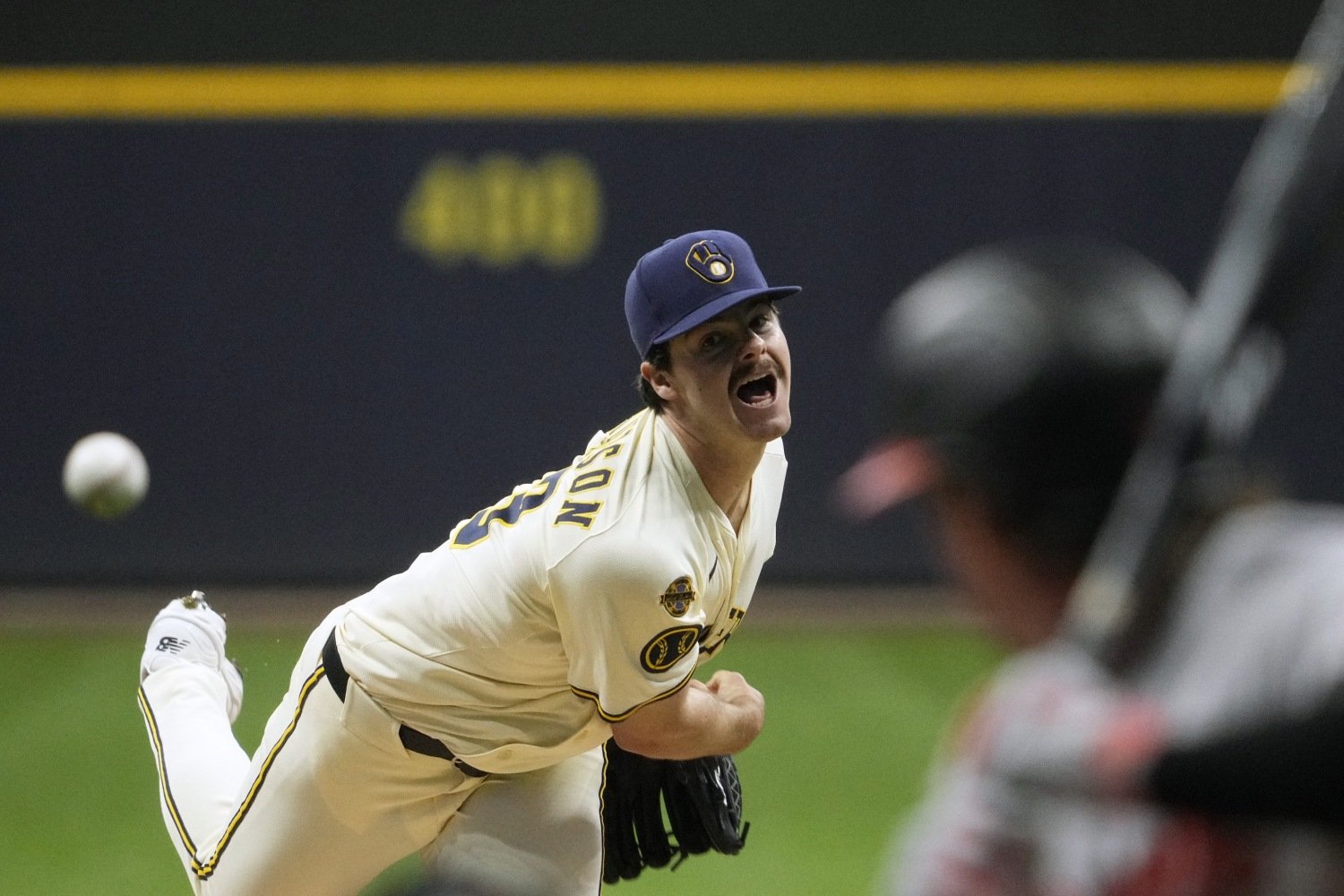 During spring training, Pat Murphy was exuberant about Logan Henderson's future—and he was far from alone. Henderson turned heads throughout camp, and there was considerable hope among the Brewers fan base that he would quickly be promoted into the big-league rotation. A fourth-round pick in 2021, he has been on fans' radar screens a long time, and indeed, he seemed to be on the cusp of a major contribution by the early stages of 2025. In a way, that proved true. Henderson made one start in mid-April and three in the middle of May for the Crew. However, the team showed surprisingly little eagerness to entrust him with a full-time role in the big leagues. He dutifully rode the Milwaukee-Nashville shuttle, but by mid-June, it looked like a breakout was going to waste against Triple-A hitters. Henderson had a 1.82 ERA and a 33.7% strikeout rate over his first 13 appearances, and his teams won 12 of the 13 contests. By the time more opportunities opened up with the parent club, though, Henderson's window of dominance had slammed shut. He simply wasn't as good, starting around mid-June. In his next eight appearances, he had a 5.35 ERA and an underwhelming 22.2% strikeout rate. He did get the call for one more start with the Crew at the beginning of August, and just in time, because he then suffered a flexor tendon strain and missed the rest of the year. He accrued big-league service time during that stint on the shelf, but wasn't available to them during the playoffs—and probably wouldn't have been their top choice at any point, anyway. There were two problems with his performance, even before the arm injury (or perhaps because of it, but before he aggravated it enough to force him out of the rotation). First, Henderson's raw stuff ticked down as the season progressed. His velocity was down about a mile per hour, by the time of that one start in August. It had trended in the wrong direction throughout June and July, too. Henderson has good fastball shape, with more rising action than a hitter expects based on his low release point and three-quarters slot. Still, that loss of velocity is a problem for him. For one thing, his swing-and-miss pitch is the changeup, and lost velocity on the heater gives hitters fractionally more time to distinguish those two offerings and make better swing decisions. For another, a little less power on a fastball at the top of the zone can be the difference between a whiff or a pop-up and a home run. Secondly, Henderson's locations shifted for the worse as the season progressed. Here's where his pitches were distributed in the first sample cited above, through mid-June: Here's the same chart for his appearances starting in mid-June: Fewer of his fastballs stayed up above the zone; more of them ran down into barrels. He lost the strike-to-ball curveball, down and away from righties. Everything trended lower and more to Henderson's glove side, which compromised both his fastball and his changeup. With both his stuff and his command going pear-shaped, Henderson struggled mightily. If he's fully healthy entering 2026, there's good reason to hope he can get back to the form that made him such a hot name in the first half of 2025. He appears to have dodged a bullet, for now, as he didn't require surgery after the strain this summer. Whether the Brewers can count on him as a significant part of their starting rotation, though, depends on factors that are even harder to gauge than usual. Entering the offseason, the team has to treat Henderson as a nice-to-have, rather than a need-to-have, for next year. Hopefully, he can end up being very nice to have, indeed.
 -
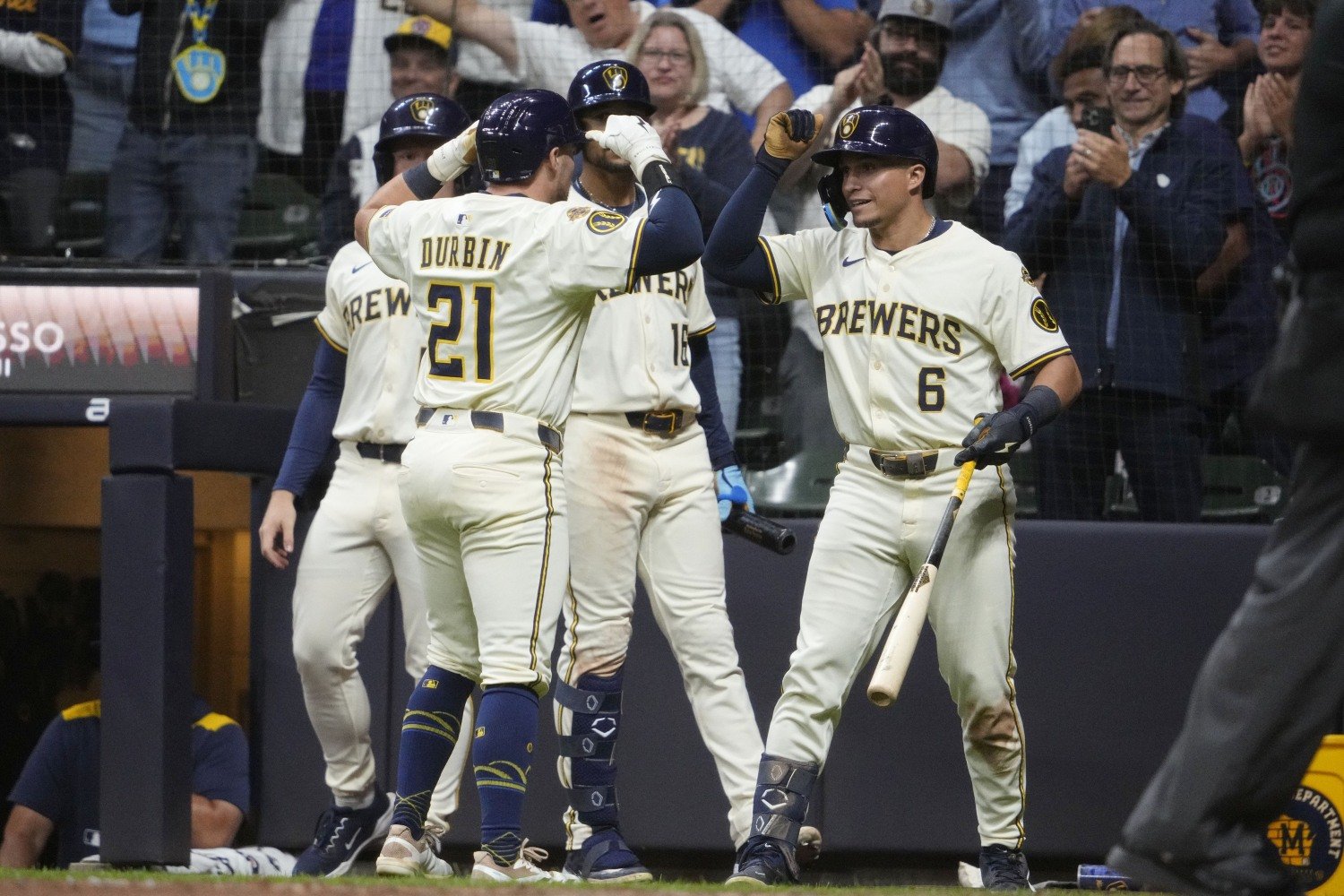 For a blink or two during midsummer, it looked like the Brewers would have to swallow the slightly bitter pill of a lost year of team control over Jacob Misiorowski. That would have been ok, on balance, because the mechanism by which it menaced them was the new rule whereby a player who finishes first or second in the Rookie of the Year balloting at the end of each season gets a full year of service time for that year, even if they were called up too late to earn that much service time in the usual way. Misiorowski was looking so good, just a month after he debuted, that he made the All-Star team, and he seemed to have the inside track on winning the award and earning that boost to his earning power. The regular season ended very unevenly for Misiorowski, though, and he became an afterthought in Rookie of the Year voting. He made such a thrilling resurgence in the playoffs that it almost feels like that was the best-case scenario: he remains a potential ace for the Crew beginning in 2026, but they won't lose him via free agency after 2030. Even better, though, they had a whopping four players receive Rookie of the Year votes this season, and while Caleb Durbin was the highest finisher (third) when the winners of each league's newcomer award were announced Monday night, the Brewers feel very much like a collective winner. Durbin finished third, so he, too, missed out on that extra service time via special incentive. Isaac Collins finished right on Durbin's heels, in fourth. Chad Patrick (who had a semi-star turn of his own in October) appeared on six ballots and finished seventh, while Misiorowski drew just one fourth-place vote. Relatively little was at stake, from the Brewers' perspective, in the finishing places of Durbin and Collins. Durbin will turn 26 in February, and his skill set isn't the kind that normally prompts a team to extend a player into their early or mid-30s. The Crew wouldn't have minded losing the sixth year of service on Durbin, and Collins exceeded one year of service this year, anyway. He's 28 years old, so it's even less likely that he'll be a Brewers regular in the 2030s than it is with Durbin. Far more important, rather, is the fact that the Crew had four fairly serious candidates for this award, in a year when they weren't even going out of their way to push prospects into vacant roles. The long-term viability of what is already a regional dynasty hinges on the Brewers' ability to keep getting great production from young, cheap players, and they did that as well as ever in 2025. Next season, Misiorowski and Patrick figure to play much larger roles for them. It's less clear that the same will be true of Durbin and/or Collins. Better health or a more active winter could displace each of them, not from the roster (in all likelihood) but from the everyday lineup. By the end of the year, each looked a bit worn down by their long season of duty, and the positions they each play are the obvious places where the Brewers have paths to upgrades this offseason. They were fine players, but arguably the worst regulars on a very, very good team. Milwaukee figures to have better luck wheh the Manager of the Year Award is announced Tuesday night. In the meantime, the team can savor the pleasure of this four-piece affirmation of their scouting and player development, and be glad that they didn't lose any years of team control along the way.
- 3 comments
-
- 2
-

-
- caleb durbin
- isaac collins
- (and 2 more)
-
Image courtesy of © Michael McLoone-Imagn Images For a blink or two during midsummer, it looked like the Brewers would have to swallow the slightly bitter pill of a lost year of team control over Jacob Misiorowski. That would have been ok, on balance, because the mechanism by which it menaced them was the new rule whereby a player who finishes first or second in the Rookie of the Year balloting at the end of each season gets a full year of service time for that year, even if they were called up too late to earn that much service time in the usual way. Misiorowski was looking so good, just a month after he debuted, that he made the All-Star team, and he seemed to have the inside track on winning the award and earning that boost to his earning power. The regular season ended very unevenly for Misiorowski, though, and he became an afterthought in Rookie of the Year voting. He made such a thrilling resurgence in the playoffs that it almost feels like that was the best-case scenario: he remains a potential ace for the Crew beginning in 2026, but they won't lose him via free agency after 2030. Even better, though, they had a whopping four players receive Rookie of the Year votes this season, and while Caleb Durbin was the highest finisher (third) when the winners of each league's newcomer award were announced Monday night, the Brewers feel very much like a collective winner. Durbin finished third, so he, too, missed out on that extra service time via special incentive. Isaac Collins finished right on Durbin's heels, in fourth. Chad Patrick (who had a semi-star turn of his own in October) appeared on six ballots and finished seventh, while Misiorowski drew just one fourth-place vote. Relatively little was at stake, from the Brewers' perspective, in the finishing places of Durbin and Collins. Durbin will turn 26 in February, and his skill set isn't the kind that normally prompts a team to extend a player into their early or mid-30s. The Crew wouldn't have minded losing the sixth year of service on Durbin, and Collins exceeded one year of service this year, anyway. He's 28 years old, so it's even less likely that he'll be a Brewers regular in the 2030s than it is with Durbin. Far more important, rather, is the fact that the Crew had four fairly serious candidates for this award, in a year when they weren't even going out of their way to push prospects into vacant roles. The long-term viability of what is already a regional dynasty hinges on the Brewers' ability to keep getting great production from young, cheap players, and they did that as well as ever in 2025. Next season, Misiorowski and Patrick figure to play much larger roles for them. It's less clear that the same will be true of Durbin and/or Collins. Better health or a more active winter could displace each of them, not from the roster (in all likelihood) but from the everyday lineup. By the end of the year, each looked a bit worn down by their long season of duty, and the positions they each play are the obvious places where the Brewers have paths to upgrades this offseason. They were fine players, but arguably the worst regulars on a very, very good team. Milwaukee figures to have better luck wheh the Manager of the Year Award is announced Tuesday night. In the meantime, the team can savor the pleasure of this four-piece affirmation of their scouting and player development, and be glad that they didn't lose any years of team control along the way. View full article
-
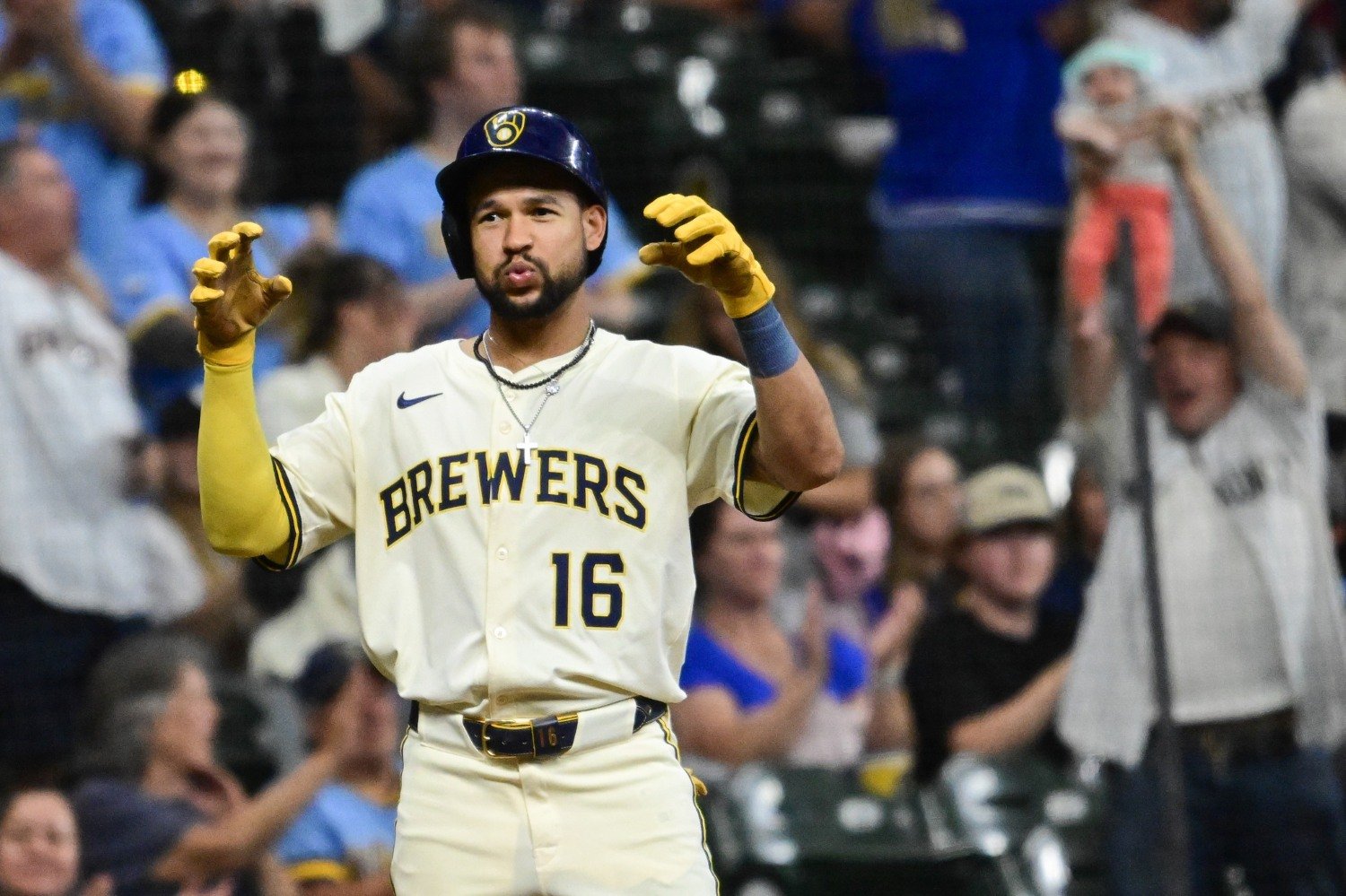 Traditionally, this is the time of year when the Brewers put on their work boots and their gloves. They bundle up against the first biting winds of November and they head to the dump, where the league leaves its scraps. There, they find treasure. Each November, the Brewers make some forays into minor-league free agency. It's not a place where stars can be found, but the occasional gem can be mined by taking the time to study what looks like a piece of ordinary rock from a new angle. Few teams in the league do this better than the Brewers, but traditionally, the Crew has also had some advantages in this regard. Timing is everything, when one is shopping in the minor-league free agent class. Whereas the top free agents in the game often wait a month or two to find their homes, the best minor-league free agents tend to sign right away. These are players with low ceilings and limited markets, who were left (or tossed) off their previous club's 40-man roster at the end of the season. They've been in professional baseball a long time, but no one believes in them. That's not quite true, of course. Someone believes in at least some of the 574 players who became minor-league free agents on Thursday. If you need evidence of that, consider Joe La Sorsa, a lefty reliever who ended the season on the fringes of the Mets roster but was jettisoned this week. He's already signed with the Pirates, on a minor-league deal that will pay him $800,000 for the season if he makes the Pittsburgh roster next spring. La Sorsa was one of a dozen or so priority names on my own early list of potential targets from this huge pool of players. He's a low-slot lefty with a sinker-sweeper combination that can be devastating, when it's right. The challenge will merely be to find a way to more consistently keep him right. Players like La Sorsa don't linger on the market until Christmas or beyond, though, because they're not waiting to see if someone will bid $10 million for their services. They know the drill. They live on the cliff's edge, barely in contact with the major leagues. La Sorsa is a fairly typical case. He's pitched 46 times for three different teams over the last three seasons, but ended the season in the minors—an insurance policy against all-out injury disaster for a team on the outskirts of the playoff race. Just as often, though, they're guys who have never played in the majors at all. Thus, getting a guaranteed roster spot—placement on the 40-man roster, with the relative security that brings and the higher salary level even if one is in the minor leagues—is like hitting the jackpot for these guys. When the Brewers targeted Blake Perkins in November 2022, they got him not by bidding any significant amount beyond the league-minimum salary, but by giving him a place on the 40-man roster. Those spots are precious, though. A team in a rebuild or a transition between competitive phases can sometimes offer one even to a fringy player, but the majority of the league has to guard those places closely. The Brewers are a bit more of an old-growth competitive forest right now, and they don't have a slot on their 40-man that will be easy to allocate to a player like this. Of course, La Sorsa (again, a relatively typical priority target) didn't get such a prize from the Pirates. What he did get is the open lane to an eventual roster spot, which comes with signing up with a team short on money, talent, or both. Jared Koenig signed with the Brewers as a non-roster invitee in November 2023, and although he spent most of spring training in the most anonymous corner of the Maryvale clubhouse, he was in big-league camp. (That is a much easier thing to offer than a roster spot, and it's usually the table stakes for any team trying to woo a hidden gem they like.) They sold Koenig on joining them partially by being themselves: players and agents know the team is both good at player development and unlikely to sign big-name free agents who will block their path to a job. They also had the luxury, then, of being viewed as somewhat thin and open to change in the bullpen. Those days are gone. To their credit, the Pirates landed a priority target last November, too, re-signing righty reliever Isaac Mattson a fortnight after they'd cast him into minor-league free agency. Mattson had been bad for them in 2024, but he knew they would have room for him if he could make the minor adjustments required. He did, and they did, and he pitched 47 innings with a 2.45 ERA for the Bucs in 2025. Signing in November is a sign that a minor-league free agent is among the subset of that group viewed as potentially valuable. Some team prioritized them; they got one of those coveted spring invites or an inside track in a race for the final spot on the roster. Players who linger on the market, if they come from this demographic, are doing so because they're holding out for a real shot—but haven't yet been offered one. The Brewers are in a tougher position to lure top minor-league free agents, because they don't have the roster spot to expend or the obvious playing time to offer. Nonetheless, keep an eye on them this month. Small moves they make now might pay off in medium-sized ways in 2026. Ismael Munguia, 27, is a speedy left-hitting outfielder who moved from the Giants farm system to that of the Yankees last offseason. He has very little power, but his bat-to-ball skills are elite, and his swing decisions show some promise. He's the kind of player the Crew might snap up, and while he could easily spend the whole season stashed at Triple-A Nashville, if he signs with Milwaukee this month, it will probably be because they made a case to him that he will have a role with them next season. Ditto for Ryder Ryan, a right-handed reliever out of the Pirates system who switched out his tight slider for a better sweeper and added a cutter as a bridge pitch in 2025. Those were promising changes; he has a chance to be a very late-blooming but usable big-league arm. If he scraps his sinker and leans more on his four-seamer (off which the sweeper and cutter play better, anyway), he could take another step forward next year. With players of his ilk, the key is to identify a player whom the development group firmly believes they can improve; make that case to the player and/or their agent; and be frank with them about the opportunity they would find in the organization. Lefty Parker Mushinski, recently of the Guardians, is another potential addition. Minor-league free agents move based on factors like reputation and soft promises. The key, from a team's perspective, is to be honest enough to maintain a reputation for treating players like these well. Guys at this stage of their career are carrying a precious candle in a high wind. They have, in most cases, just one more chance to make their big-league dream come true. It's bad form to deceive them, and smart teams know better than that. Without expending undue resources, the goal is to get a few players to believe that their best hope at keeping that flame from being extinguished is to take shelter with you. The Brewers already have a crowded roster, full of good players. That makes it harder for them to pitch themselves to players like these. Because they spend little in big-league free agency, though, they have to keep making minor moves. It's a delicate balancing act, but few teams in the league do it better.
- 1 comment
-
- 3
-
-
- blake perkins
- jared koenig
- (and 3 more)
-
Image courtesy of © Benny Sieu-Imagn Images Traditionally, this is the time of year when the Brewers put on their work boots and their gloves. They bundle up against the first biting winds of November and they head to the dump, where the league leaves its scraps. There, they find treasure. Each November, the Brewers make some forays into minor-league free agency. It's not a place where stars can be found, but the occasional gem can be mined by taking the time to study what looks like a piece of ordinary rock from a new angle. Few teams in the league do this better than the Brewers, but traditionally, the Crew has also had some advantages in this regard. Timing is everything, when one is shopping in the minor-league free agent class. Whereas the top free agents in the game often wait a month or two to find their homes, the best minor-league free agents tend to sign right away. These are players with low ceilings and limited markets, who were left (or tossed) off their previous club's 40-man roster at the end of the season. They've been in professional baseball a long time, but no one believes in them. That's not quite true, of course. Someone believes in at least some of the 574 players who became minor-league free agents on Thursday. If you need evidence of that, consider Joe La Sorsa, a lefty reliever who ended the season on the fringes of the Mets roster but was jettisoned this week. He's already signed with the Pirates, on a minor-league deal that will pay him $800,000 for the season if he makes the Pittsburgh roster next spring. La Sorsa was one of a dozen or so priority names on my own early list of potential targets from this huge pool of players. He's a low-slot lefty with a sinker-sweeper combination that can be devastating, when it's right. The challenge will merely be to find a way to more consistently keep him right. Players like La Sorsa don't linger on the market until Christmas or beyond, though, because they're not waiting to see if someone will bid $10 million for their services. They know the drill. They live on the cliff's edge, barely in contact with the major leagues. La Sorsa is a fairly typical case. He's pitched 46 times for three different teams over the last three seasons, but ended the season in the minors—an insurance policy against all-out injury disaster for a team on the outskirts of the playoff race. Just as often, though, they're guys who have never played in the majors at all. Thus, getting a guaranteed roster spot—placement on the 40-man roster, with the relative security that brings and the higher salary level even if one is in the minor leagues—is like hitting the jackpot for these guys. When the Brewers targeted Blake Perkins in November 2022, they got him not by bidding any significant amount beyond the league-minimum salary, but by giving him a place on the 40-man roster. Those spots are precious, though. A team in a rebuild or a transition between competitive phases can sometimes offer one even to a fringy player, but the majority of the league has to guard those places closely. The Brewers are a bit more of an old-growth competitive forest right now, and they don't have a slot on their 40-man that will be easy to allocate to a player like this. Of course, La Sorsa (again, a relatively typical priority target) didn't get such a prize from the Pirates. What he did get is the open lane to an eventual roster spot, which comes with signing up with a team short on money, talent, or both. Jared Koenig signed with the Brewers as a non-roster invitee in November 2023, and although he spent most of spring training in the most anonymous corner of the Maryvale clubhouse, he was in big-league camp. (That is a much easier thing to offer than a roster spot, and it's usually the table stakes for any team trying to woo a hidden gem they like.) They sold Koenig on joining them partially by being themselves: players and agents know the team is both good at player development and unlikely to sign big-name free agents who will block their path to a job. They also had the luxury, then, of being viewed as somewhat thin and open to change in the bullpen. Those days are gone. To their credit, the Pirates landed a priority target last November, too, re-signing righty reliever Isaac Mattson a fortnight after they'd cast him into minor-league free agency. Mattson had been bad for them in 2024, but he knew they would have room for him if he could make the minor adjustments required. He did, and they did, and he pitched 47 innings with a 2.45 ERA for the Bucs in 2025. Signing in November is a sign that a minor-league free agent is among the subset of that group viewed as potentially valuable. Some team prioritized them; they got one of those coveted spring invites or an inside track in a race for the final spot on the roster. Players who linger on the market, if they come from this demographic, are doing so because they're holding out for a real shot—but haven't yet been offered one. The Brewers are in a tougher position to lure top minor-league free agents, because they don't have the roster spot to expend or the obvious playing time to offer. Nonetheless, keep an eye on them this month. Small moves they make now might pay off in medium-sized ways in 2026. Ismael Munguia, 27, is a speedy left-hitting outfielder who moved from the Giants farm system to that of the Yankees last offseason. He has very little power, but his bat-to-ball skills are elite, and his swing decisions show some promise. He's the kind of player the Crew might snap up, and while he could easily spend the whole season stashed at Triple-A Nashville, if he signs with Milwaukee this month, it will probably be because they made a case to him that he will have a role with them next season. Ditto for Ryder Ryan, a right-handed reliever out of the Pirates system who switched out his tight slider for a better sweeper and added a cutter as a bridge pitch in 2025. Those were promising changes; he has a chance to be a very late-blooming but usable big-league arm. If he scraps his sinker and leans more on his four-seamer (off which the sweeper and cutter play better, anyway), he could take another step forward next year. With players of his ilk, the key is to identify a player whom the development group firmly believes they can improve; make that case to the player and/or their agent; and be frank with them about the opportunity they would find in the organization. Lefty Parker Mushinski, recently of the Guardians, is another potential addition. Minor-league free agents move based on factors like reputation and soft promises. The key, from a team's perspective, is to be honest enough to maintain a reputation for treating players like these well. Guys at this stage of their career are carrying a precious candle in a high wind. They have, in most cases, just one more chance to make their big-league dream come true. It's bad form to deceive them, and smart teams know better than that. Without expending undue resources, the goal is to get a few players to believe that their best hope at keeping that flame from being extinguished is to take shelter with you. The Brewers already have a crowded roster, full of good players. That makes it harder for them to pitch themselves to players like these. Because they spend little in big-league free agency, though, they have to keep making minor moves. It's a delicate balancing act, but few teams in the league do it better. View full article
-
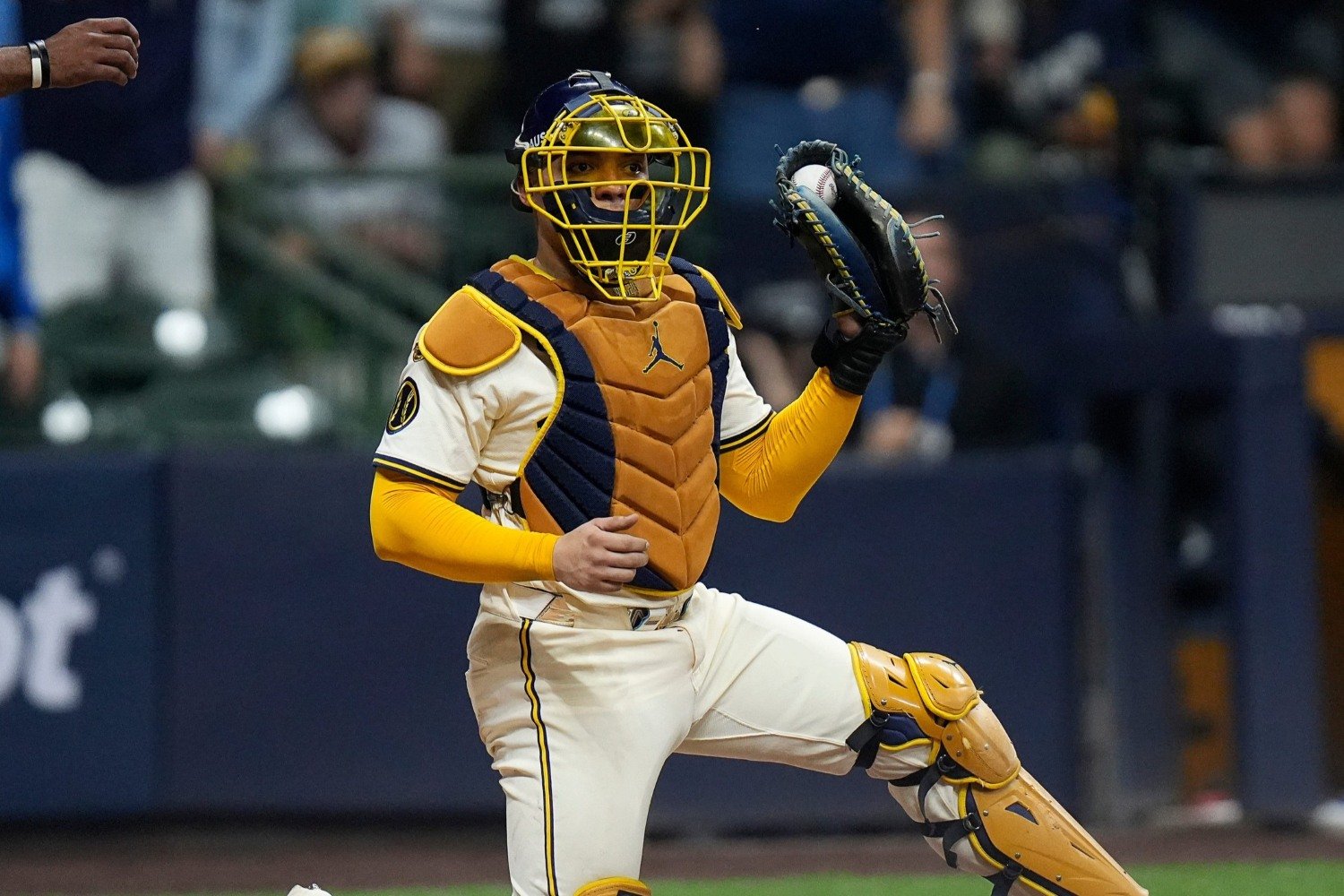 Brewers fans can finally stop their hand-wringing about the hand of William Contreras, which caused frustration and worry at many points during his slightly underwhelming 2025 season. Contreras was slowed, especially early in the season, by a fracture in the middle finger on his left hand, which didn't heal well because of the daily beating of catching. He wanted badly to be out there, and the Brewers were better for having him, but the gap between how he played and how he's capable of playing caused distress for many onlookers. The initial report, via MLB.com Brewers beat writer Adam McCalvy, suggests Contreras will be barred from baseball activities for 5-6 weeks, but that he should be a full go for spring training. There is a difference, though, between being ready to put on the uniform and get to work come mid-February and being ready for high-level competition by early March. It sounds like Contreras will meet both thresholds, but how well could determine whether he's a part of Team Venezuela at next spring's World Baseball Classic. In 2023, Contreras had only partially announced himself as a good big-league catcher. He didn't crack the roster for his native nation in that year's WBC. Salvador Perez, Omar Narváez and Robinson Chirinos split the time at catcher for that edition of the Venezuelan side, and Miguel Cabrera and Gleyber Torres divided the time at designated hitter. Three years later, though, Contreras has emerged as a legitimate star. Perez is very much still around, but he's gotten old between then and now. Narváez and Chirinos are no longer considerations for the team, which will have ambitions of winning the tournament after finishing fifth in 2023. Though clearly one of the four biggest baseball powerhouses in the world (along with the United States, the Dominican Republic, and Japan), Venezuela has never finished higher than fourth in the tournament, and they only placed that well in 2009. There are other young catchers who will vie for playing time on next year's version of the team. Omar's cousin, the Red Sox's Carlos Narváez, had a strong rookie season in 2025. Freddy Fermin emerged from Perez's shadow in Kansas City and was traded to the Padres in July, where he burnished his reputation as an elite defender and a clutch hitter on a bigger stage. Pedro Pagés of the Cardinals is very good behind the plate, but not nearly as good a hitter as Narváez or (especially) Contreras. If the Brewers' backstop is healthy and willing, he'll be the team's first choice to play catcher for them as they try to announce themselves more forcefully on the international landscape. The scope of that opportunity for Contreras, personally, is not to be underestimated. The last two WBCs have been star-making events, and any player offered the chance to play is likely to be interested in doing so. Contreras and Jackson Chourio could see their celebrity magnified if they lead an always-loaded Team Venezuela deeper into the tournament than they've gotten in the past, and the Brewers are unlikely to bar them from participating. If Contreras recovers as well as expected from the operation he underwent, he could be spending a good chunk of spring training somewhere other than Maryvale—and that would probably be a good thing.
 -
Image courtesy of © Jovanny Hernandez / Milwaukee Journal Sentinel / USA TODAY NETWORK via Imagn Images Brewers fans can finally stop their hand-wringing about the hand of William Contreras, which caused frustration and worry at many points during his slightly underwhelming 2025 season. Contreras was slowed, especially early in the season, by a fracture in the middle finger on his left hand, which didn't heal well because of the daily beating of catching. He wanted badly to be out there, and the Brewers were better for having him, but the gap between how he played and how he's capable of playing caused distress for many onlookers. The initial report, via MLB.com Brewers beat writer Adam McCalvy, suggests Contreras will be barred from baseball activities for 5-6 weeks, but that he should be a full go for spring training. There is a difference, though, between being ready to put on the uniform and get to work come mid-February and being ready for high-level competition by early March. It sounds like Contreras will meet both thresholds, but how well could determine whether he's a part of Team Venezuela at next spring's World Baseball Classic. In 2023, Contreras had only partially announced himself as a good big-league catcher. He didn't crack the roster for his native nation in that year's WBC. Salvador Perez, Omar Narváez and Robinson Chirinos split the time at catcher for that edition of the Venezuelan side, and Miguel Cabrera and Gleyber Torres divided the time at designated hitter. Three years later, though, Contreras has emerged as a legitimate star. Perez is very much still around, but he's gotten old between then and now. Narváez and Chirinos are no longer considerations for the team, which will have ambitions of winning the tournament after finishing fifth in 2023. Though clearly one of the four biggest baseball powerhouses in the world (along with the United States, the Dominican Republic, and Japan), Venezuela has never finished higher than fourth in the tournament, and they only placed that well in 2009. There are other young catchers who will vie for playing time on next year's version of the team. Omar's cousin, the Red Sox's Carlos Narváez, had a strong rookie season in 2025. Freddy Fermin emerged from Perez's shadow in Kansas City and was traded to the Padres in July, where he burnished his reputation as an elite defender and a clutch hitter on a bigger stage. Pedro Pagés of the Cardinals is very good behind the plate, but not nearly as good a hitter as Narváez or (especially) Contreras. If the Brewers' backstop is healthy and willing, he'll be the team's first choice to play catcher for them as they try to announce themselves more forcefully on the international landscape. The scope of that opportunity for Contreras, personally, is not to be underestimated. The last two WBCs have been star-making events, and any player offered the chance to play is likely to be interested in doing so. Contreras and Jackson Chourio could see their celebrity magnified if they lead an always-loaded Team Venezuela deeper into the tournament than they've gotten in the past, and the Brewers are unlikely to bar them from participating. If Contreras recovers as well as expected from the operation he underwent, he could be spending a good chunk of spring training somewhere other than Maryvale—and that would probably be a good thing. View full article
-
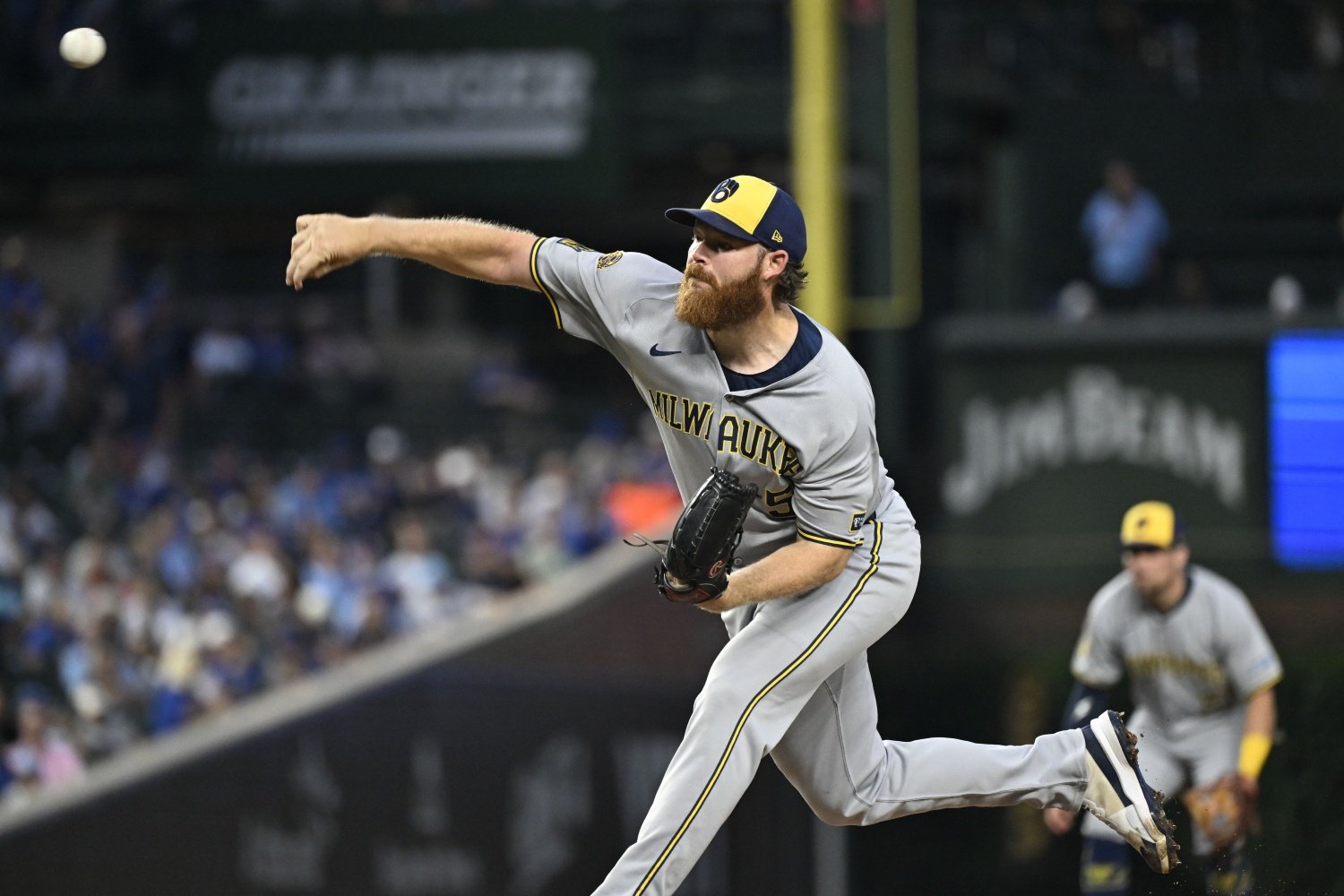 As expected, the Brewers declined their half of the mutual option on Danny Jansen on Monday. Equally unsurprisingly, Brandon Woodruff declined his side of a mutual option for 2026. Milwaukee will owe buyouts to Jansen and Woodruff, but the $10 million they'll pay to the latter will be divided evenly between January and July installments, and it's a small price to pay to have had Woodruff under contract for just $5 million in 2025. They're letting each player hit the market, but there's a good chance they'll re-engage with Woodruff in the coming days and weeks. He's more likely to find his highest bidder elsewhere, but the Brewers won't simply wave goodbye and the door and turn away from their erstwhile co-ace. For now, though, Jansen and Woodruff join the pool of free agents and come off the Milwaukee roster, which made room for Coleman Crow. After a strong season was cut short by injuries, it was an open question whether Crow would merit such a spot. He's only pitched twice at Triple-A Nashville, and between the injuries that have held him to a total of 74 innings since the start of 2023 and the lack of experience at the highest level of the minors, it's hard to imagine that he'll make much of a contribution in 2026. He's a dubious use of a roster spot, at the front end of the winter, but the team clearly didn't want to lose him for nothing. They'll try to navigate at least the early stages of next season with a slightly shorter 40-man, in the hope that Crow can come up and contribute as needed by the time the early spring gives way to summer. Crow has five pitches, in theory, but his sinker and changeup don't yet look playable by major-league standards. He does generate excellent spin rates and a flat vertical approach on his four-seam fastball, but that pitch only sits 92-93, and it's pretty ordinary, overall. His best offerings are a slow curveball in the mid-70s and a cutterish slider in the 87-88 range. If the Brewers view Crow as a potential starter for 2026, it makes sense to retain him now. They probably wouldn't have done so if they saw him only as a reliever, although the lines between multi-inning relief roles and that of a starter are blurrier than they used to be. As a starter, Crow has prospective utility, but he needs several more starts in the upper minors before he's likely to be ready for that kind of assignment—and, to reiterate, his durability is a major question. There are still, technically, decisions to come on a few more players with contract options for 2026. Milwaukee did officially exercise their option on Freddy Peralta, whom they can retain for $8 million in 2026, but that was never in doubt. Nor is it much of a mystery that the team will decline their sides of options with Jose Quintana and Rhys Hoskins. These procedural moves are important, but they're also perfunctory. The departures of Jansen, Quintana, Hoskins and even (for now) Woodruff aren't especially newsworthy, but the fact that Crow got one of the spots created by those moves is interesting. The Brewers are always working to build a homegrown, low-cost, deep pitching staff, and Crow fits into that paradigm. His upside is extremely limited, though, and the team is likely to need his roster spot for a better arm at some point next year.
- 8 comments
-
- 1
-
-
- coleman crow
- brandon woodruff
- (and 2 more)
-
Image courtesy of © Matt Marton-Imagn Images As expected, the Brewers declined their half of the mutual option on Danny Jansen on Monday. Equally unsurprisingly, Brandon Woodruff declined his side of a mutual option for 2026. Milwaukee will owe buyouts to Jansen and Woodruff, but the $10 million they'll pay to the latter will be divided evenly between January and July installments, and it's a small price to pay to have had Woodruff under contract for just $5 million in 2025. They're letting each player hit the market, but there's a good chance they'll re-engage with Woodruff in the coming days and weeks. He's more likely to find his highest bidder elsewhere, but the Brewers won't simply wave goodbye and the door and turn away from their erstwhile co-ace. For now, though, Jansen and Woodruff join the pool of free agents and come off the Milwaukee roster, which made room for Coleman Crow. After a strong season was cut short by injuries, it was an open question whether Crow would merit such a spot. He's only pitched twice at Triple-A Nashville, and between the injuries that have held him to a total of 74 innings since the start of 2023 and the lack of experience at the highest level of the minors, it's hard to imagine that he'll make much of a contribution in 2026. He's a dubious use of a roster spot, at the front end of the winter, but the team clearly didn't want to lose him for nothing. They'll try to navigate at least the early stages of next season with a slightly shorter 40-man, in the hope that Crow can come up and contribute as needed by the time the early spring gives way to summer. Crow has five pitches, in theory, but his sinker and changeup don't yet look playable by major-league standards. He does generate excellent spin rates and a flat vertical approach on his four-seam fastball, but that pitch only sits 92-93, and it's pretty ordinary, overall. His best offerings are a slow curveball in the mid-70s and a cutterish slider in the 87-88 range. If the Brewers view Crow as a potential starter for 2026, it makes sense to retain him now. They probably wouldn't have done so if they saw him only as a reliever, although the lines between multi-inning relief roles and that of a starter are blurrier than they used to be. As a starter, Crow has prospective utility, but he needs several more starts in the upper minors before he's likely to be ready for that kind of assignment—and, to reiterate, his durability is a major question. There are still, technically, decisions to come on a few more players with contract options for 2026. Milwaukee did officially exercise their option on Freddy Peralta, whom they can retain for $8 million in 2026, but that was never in doubt. Nor is it much of a mystery that the team will decline their sides of options with Jose Quintana and Rhys Hoskins. These procedural moves are important, but they're also perfunctory. The departures of Jansen, Quintana, Hoskins and even (for now) Woodruff aren't especially newsworthy, but the fact that Crow got one of the spots created by those moves is interesting. The Brewers are always working to build a homegrown, low-cost, deep pitching staff, and Crow fits into that paradigm. His upside is extremely limited, though, and the team is likely to need his roster spot for a better arm at some point next year. View full article
-
Heh. I hear you... but there's NO chance of anything remotely like a limit on contract length or the elimination of guaranteed contracts. I'm not actually sure how the latter would make things less complicated, anyway, but at any rate, it's several folds of the space-time continuum from becoming a possibility. The owners aren't even pushing to get rid of those; it's not an issue that will even land on the table during negotiations. I could see some very lenient limits being placed on deferred money in the next CBA, but even that's a long shot. Sorry, Michael; these ideas aren't gonna get anywhere.
-
 By Thursday, MLB teams and the players with whom they've struck past deals that include options for 2026 have to make their decisions about whether to exercise or decline those options. For the Milwaukee Brewers, this fall, that means five dilemmas—none of them especially difficult, and four of them being mutual options on which the player also has a choice to make. Rhys Hoskins, Brandon Woodruff, Danny Jansen and Jose Quintana are all impending free agents, but their contracts each contain mutual options. The Brewers use those options to manage their payroll situation, pushing payments out beyond the season in which a player is actually with the team. Fewer than 10% of contracts that include mutual options result in both sides exercising their option; the player nearly always becomes a free agent instead. That means a buyout being paid to the player, which is effectively part of their salary for the previous year(s) of the deal but acts as a miniature deferral for the team. In the cases of Hoskins and Woodruff, those deferrals are particularly extreme. Hoskins will get a $4-million buyout when the Brewers turn down their side of an $18-million option for 2026, but that payment won't be made until Feb. 1, 2026. The Brewers will get another quarterly disbursal from the league's revenue-sharing pool before then, in addition to having some of the money generated by their playoff run this fall flow in—including what figure to be strong ticket sales for 2026. Woodruff has a $20-million mutual option for next season, which the Brewers will probably exercise but which Woodruff will almost certainly decline. That's because the option comes with a $10-million buyout, so he'd only need to make more than that via free agency to make turning down his side of the option wise. For the Brewers, though, that's no problem. They'll pay $5 million on the buyout on Jan. 15, and another $5 million on Jul. 15. From a cash-flow perspective, Milwaukee will have an easy time absorbing that buyout, thanks to the way they've spread the payments. The $2-million buyout on a $15-million mutual option with Quintana will be paid more or less immediately, as will the $500,000 on a $12-million option with Jansen. However, when the Crew traded for Jansen in July, they got $1.6 million from the Rays, which covered about half of his salary for the balance of the year. Milwaukee will surely decline their option on William Contreras, returning him to the arbitration pipeline, and they'll owe just $100,000 to Contreras when they do so. The money on each of these deals sloshes, from one year to the next and across the offseason. It can make things difficult, if you're inclined toward the traditional ways of tabulating payroll for big-league teams. For most clubs, fans and analysts default to a one-number annual payroll summary. That can be the 26-man Opening Day payroll, or the full-season 40-man figure, or the one calculated for the purposes of the competitive-balance tax, which averages players' earnings across all the guaranteed years of their current contracts. It's often best to use the second of those three for teams like the Brewers, who never get especially close to the CBT threshold. It's usually important to use the CBT number for the teams who pay it, or often flirt with the line. In the specific case of the Brewers, though, the best approach is a much thornier one. The Crew move money around too deftly, even within the annual baseball revenue cycle, for any of those lone numbers to paint anything close to a complete picture. They're masters of creating flexibility, and they use that to make nimbler offseason moves than a typical team with their financial fundamentals otherwise would. As frustrating as it can be, it's best not to act as though any one number sums up the Brewers' spending for a given year, the same way one number can sum up what the Cubs or the Dodgers or the Pirates spend. That doesn't mean fans should assume the team is spending enough and give them the benefit of the doubt. On the contrary, the best assumption is that the club can spend at least a bit more than they currently do, and as they enjoy the fruits of their playoff success in the middle of a fecund winning window, the expectation should be that they spend more to supplement a World Series contender. It's just a cautionary note. While we should urge the team to spend more, we also have to acknowledge the beneficial complexity of their approach to spending.
- 8 comments
-
- 2
-
-
- brandon woodruff
- rhys hoskins
- (and 1 more)
-
Image courtesy of © Dave Kallmann / Milwaukee Journal Sentinel / USA TODAY NETWORK via Imagn Images By Thursday, MLB teams and the players with whom they've struck past deals that include options for 2026 have to make their decisions about whether to exercise or decline those options. For the Milwaukee Brewers, this fall, that means five dilemmas—none of them especially difficult, and four of them being mutual options on which the player also has a choice to make. Rhys Hoskins, Brandon Woodruff, Danny Jansen and Jose Quintana are all impending free agents, but their contracts each contain mutual options. The Brewers use those options to manage their payroll situation, pushing payments out beyond the season in which a player is actually with the team. Fewer than 10% of contracts that include mutual options result in both sides exercising their option; the player nearly always becomes a free agent instead. That means a buyout being paid to the player, which is effectively part of their salary for the previous year(s) of the deal but acts as a miniature deferral for the team. In the cases of Hoskins and Woodruff, those deferrals are particularly extreme. Hoskins will get a $4-million buyout when the Brewers turn down their side of an $18-million option for 2026, but that payment won't be made until Feb. 1, 2026. The Brewers will get another quarterly disbursal from the league's revenue-sharing pool before then, in addition to having some of the money generated by their playoff run this fall flow in—including what figure to be strong ticket sales for 2026. Woodruff has a $20-million mutual option for next season, which the Brewers will probably exercise but which Woodruff will almost certainly decline. That's because the option comes with a $10-million buyout, so he'd only need to make more than that via free agency to make turning down his side of the option wise. For the Brewers, though, that's no problem. They'll pay $5 million on the buyout on Jan. 15, and another $5 million on Jul. 15. From a cash-flow perspective, Milwaukee will have an easy time absorbing that buyout, thanks to the way they've spread the payments. The $2-million buyout on a $15-million mutual option with Quintana will be paid more or less immediately, as will the $500,000 on a $12-million option with Jansen. However, when the Crew traded for Jansen in July, they got $1.6 million from the Rays, which covered about half of his salary for the balance of the year. Milwaukee will surely decline their option on William Contreras, returning him to the arbitration pipeline, and they'll owe just $100,000 to Contreras when they do so. The money on each of these deals sloshes, from one year to the next and across the offseason. It can make things difficult, if you're inclined toward the traditional ways of tabulating payroll for big-league teams. For most clubs, fans and analysts default to a one-number annual payroll summary. That can be the 26-man Opening Day payroll, or the full-season 40-man figure, or the one calculated for the purposes of the competitive-balance tax, which averages players' earnings across all the guaranteed years of their current contracts. It's often best to use the second of those three for teams like the Brewers, who never get especially close to the CBT threshold. It's usually important to use the CBT number for the teams who pay it, or often flirt with the line. In the specific case of the Brewers, though, the best approach is a much thornier one. The Crew move money around too deftly, even within the annual baseball revenue cycle, for any of those lone numbers to paint anything close to a complete picture. They're masters of creating flexibility, and they use that to make nimbler offseason moves than a typical team with their financial fundamentals otherwise would. As frustrating as it can be, it's best not to act as though any one number sums up the Brewers' spending for a given year, the same way one number can sum up what the Cubs or the Dodgers or the Pirates spend. That doesn't mean fans should assume the team is spending enough and give them the benefit of the doubt. On the contrary, the best assumption is that the club can spend at least a bit more than they currently do, and as they enjoy the fruits of their playoff success in the middle of a fecund winning window, the expectation should be that they spend more to supplement a World Series contender. It's just a cautionary note. While we should urge the team to spend more, we also have to acknowledge the beneficial complexity of their approach to spending. View full article
-
 In 24 tries, the 2025 Milwaukee Brewers got calls overturned via replay review 17 times. Only the Arizona Diamondbacks had a higher success rate when they chose to challenge a call—but part of the reason for that was that the Crew challenged many fewer plays than many of their opponents. Only the Red Sox (22) issued fewer challenges than did Milwaukee, so while their 70.8% overturn rate looks good, the sheer number of plays they got reversed was tied for ninth-lowest in baseball. The math says that the team was too conservative with their challenges. They should have asked the umpires to go to the headsets on more close calls. The rules allow each team one challenge (during the regular season), though they can request a crew chief review on close calls in the eighth inning and later. Thus, a team does have to be somewhat more careful early in the game—but realistically, most close calls of any serious importance deserve a second look. It's not likely that multiple especially close calls will go against you within the window of a game during which you have to initiate any review, so a team should only feel it needs to be roughly 50/50 to make challenging a play worthwhile. To say the least, the Brewers did not approach it that way. Of their 24 challenges, they issued 12 in innings 1-5. Of those 12, 11 were overturned, meaning that the team only called for the review if they were almost certain it would go their way. In fact, the only play on which they lost a challenge during the first five frames came in the bottom of the fifth, in an August game at Wrigley Field. They kept a very high standard of expected success, and only brought it south of 100% when the leverage was high or the game was getting close to that point at which it's possible to request a review even if your challenge has already been used. Overall, the Brewers' average Leverage Index on challenged plays was 1.59, and the median was 1.24. Isolating the first five innings, the median was the same, but the average dipped to 1.15. The latter makes it sound like they were more lax about requiring the play to matter in order to challenge early, but the reality is that it's hard to crank the leverage index up especially high in the first half of a game. In practice, the Brewers spent the first five innings of every game challenging only if they felt sure they would be right, and even then, they only challenged plays they viewed as important in the context of the contest. It's hard to gauge the right success rate for challenges. The break-even rate does change, to be sure, based on the inning, score and situation, but the biggest variable is the likelihood of success, as estimated by the team's replay coordinator. Teams handle the decision protocol from there differently. For some clubs, the coordinator will relay a confidence estimate to the dugout, where coaches decide whether to use the challenge based on that information. More often, the coordinator generates an estimate of their own confidence that the play will be overturned, consults a chart or refers to their training on adjusting the advice based on that confidence and the context of the game, and relays a simple 'go' or 'no go' to the dugout. On balance, though, teams should aim to be right between 60 and 66% of the time. Any less, and you're wasting time, as well as exposing yourself to the risk of late-game calls that you can't appeal. Any more and (as was the case with this year's Brewers) you're leaving value on the table. This is a rare instance of the Brewers—a highly analytical organization with great communication and processes to ensure that they win on the margins when it comes to preparation, intelligence and optimization—not being good enough at one of the little things. Next year, they need a better replay review process, so they get more value out of the right to appeal bad calls. Every out, every hit and every run matters, and the Crew didn't claim every scrap they could in 2025.
 -
Image courtesy of © Jeff Curry-Imagn Images In 24 tries, the 2025 Milwaukee Brewers got calls overturned via replay review 17 times. Only the Arizona Diamondbacks had a higher success rate when they chose to challenge a call—but part of the reason for that was that the Crew challenged many fewer plays than many of their opponents. Only the Red Sox (22) issued fewer challenges than did Milwaukee, so while their 70.8% overturn rate looks good, the sheer number of plays they got reversed was tied for ninth-lowest in baseball. The math says that the team was too conservative with their challenges. They should have asked the umpires to go to the headsets on more close calls. The rules allow each team one challenge (during the regular season), though they can request a crew chief review on close calls in the eighth inning and later. Thus, a team does have to be somewhat more careful early in the game—but realistically, most close calls of any serious importance deserve a second look. It's not likely that multiple especially close calls will go against you within the window of a game during which you have to initiate any review, so a team should only feel it needs to be roughly 50/50 to make challenging a play worthwhile. To say the least, the Brewers did not approach it that way. Of their 24 challenges, they issued 12 in innings 1-5. Of those 12, 11 were overturned, meaning that the team only called for the review if they were almost certain it would go their way. In fact, the only play on which they lost a challenge during the first five frames came in the bottom of the fifth, in an August game at Wrigley Field. They kept a very high standard of expected success, and only brought it south of 100% when the leverage was high or the game was getting close to that point at which it's possible to request a review even if your challenge has already been used. Overall, the Brewers' average Leverage Index on challenged plays was 1.59, and the median was 1.24. Isolating the first five innings, the median was the same, but the average dipped to 1.15. The latter makes it sound like they were more lax about requiring the play to matter in order to challenge early, but the reality is that it's hard to crank the leverage index up especially high in the first half of a game. In practice, the Brewers spent the first five innings of every game challenging only if they felt sure they would be right, and even then, they only challenged plays they viewed as important in the context of the contest. It's hard to gauge the right success rate for challenges. The break-even rate does change, to be sure, based on the inning, score and situation, but the biggest variable is the likelihood of success, as estimated by the team's replay coordinator. Teams handle the decision protocol from there differently. For some clubs, the coordinator will relay a confidence estimate to the dugout, where coaches decide whether to use the challenge based on that information. More often, the coordinator generates an estimate of their own confidence that the play will be overturned, consults a chart or refers to their training on adjusting the advice based on that confidence and the context of the game, and relays a simple 'go' or 'no go' to the dugout. On balance, though, teams should aim to be right between 60 and 66% of the time. Any less, and you're wasting time, as well as exposing yourself to the risk of late-game calls that you can't appeal. Any more and (as was the case with this year's Brewers) you're leaving value on the table. This is a rare instance of the Brewers—a highly analytical organization with great communication and processes to ensure that they win on the margins when it comes to preparation, intelligence and optimization—not being good enough at one of the little things. Next year, they need a better replay review process, so they get more value out of the right to appeal bad calls. Every out, every hit and every run matters, and the Crew didn't claim every scrap they could in 2025. View full article
-
 The modest but meaningful power Caleb Durbin demonstrated during the summer faded in September and October. His bat speed fell to the lowest marks of his rookie campaign in those months, at 66.9 miles per hour—about 1.5 miles per hour slower than had been his norm until then. Durbin was a good hitter in his first year in the majors, achieving more than most expected by being surprisingly deft at going the opposite way in addition to consistently lifting the ball to the pull field. His contact rate was elite; his willingness to take a base via being hit by pitches was very valuable. Going forward, though, the team needs to have insurance against regression, fatigue and/or injury for Durbin. For one thing, while he did put up adequate numbers in September (.253/.359/.367) and good ones in October (.276/.364/.414), those stats were less well-supported by his process at the plate than in previous, better months. The bat speed was down, and that led to just eight extra-base hits—just two of them homers, the last of them on Sept. 14—in 125 plate appearances after the end of August. In the postseason, he also struck out much more (eight times in 33 trips to the plate) than at any previous juncture of the year. For another thing, we saw a few more mistakes from Durbin in other facets of the game down the stretch. He had two key misplays in the field and two poor moments on the bases during the playoffs. For a player who thrives on being excellent at the small things of the game, that was a jarring change, and an unwelcome one. It's clear that, to stay as sharp as he needs to be to remain at his best, Durbin needs to play a bit less often. The good news is that, as a tactical roster piece, Durbin is pretty easy to fit into a just-under-full-time role. Despite starting the 2025 season at Triple-A Nashville, he played 136 games (and started 122) for the Brewers after being promoted in mid-April. (He'd also played 13 full games with the Sounds.) If the goal is to reduce that workload to roughly 120 starts over the full season in 2026, the Crew can do it in a pretty straightforward way: 15 starts at second base against left-handed opposing starters, spelling and partially platooning with Brice Turang 105 starts at third base, 90 of them against righties and 15 of them against lefties Based on the usual breakdown of opposing starting pitcher handedness, this would give Durbin 90 starts against righties and 30 against lefties, leaving him on the bench for roughly 25 games against righties and roughly 15 against lefties. Why not maximize his exposure to left-handed pitchers and hide him a bit more from righties? Because Durbin is (if anything) better against righties; that's why. vs. RHP: 373 plate appearances, .255/.337/.385, 6.2% walk rate, 5.1% HBP rate, 11.5% strikeout rate, 7.5% extra-base hit rate vs. LHP: 133 PA, .258/.326/.392, 5.3% walk rate, 3.8% HBP rate, 5.3% strikeout rate, 6.0% XBH rate One wrinkle, with hitters who get hit by pitches often, is that they tend to have small or reverse platoon splits—because most pitchers are much more likely to hit a same-handed batter with a pitch than to hit an opposite-handed batter with one. Durbin gets hit so often by righties that it inflates his overall production against them. Most of his over-the-fence power comes against lefties, but he's just as good against righties because of the extra times he reaches base by being plunked. Thus, you can play Durbin against righties more and against lefties less than you might play a typical righty batter in need of this kind of workload management. He can fill in just a bit for Turang, to keep the latter fresher in his own right, by playing against southpaws at second. That leaves us to fill (theoretically) just 57 starts at third base: something like 30 against lefties and 27 against righties. To do that, the Brewers could engage any of several impending free agents. Switch-hitters like Willi Castro and Yoán Moncada hold some appeal, but each is coming off a tough season as they hit the market. Enrique Hernández and Isiah Kiner-Falefa, each of whom can be seen this week playing in the World Series, would be excellent fits for this role, particularly because each could also move around the diamond and fill some other needs likely to arise for the team over the course of the year. Bo Bichette is an enticing potential fit on multiple levels for Milwaukee this winter. Though radically unlikely to be a long-term fit at shortstop for his new team, the impending free agent might prefer a landing spot where he can stay at his most familiar position in the short term. Bringing in Bichette to displace Joey Ortiz and stop the gap while the team waits for the matriculation of Cooper Pratt and/or Jesus Made from the farm system would be a landmark move for the Crew, and he could begin his gradual transition to third base by sliding over to spell Durbin on this part-time basis, with Ortiz rotating in at short. The most intriguing pair of potential targets, however, have to be the two star sluggers likely to be posted by their Nippon Professional Baseball (NPB) teams this winter, Munetaka Murakami and Kazuma Okamoto. Murakami, who will turn 26 in February, is a lefty power bat with 265 career homers in Japan. Okamoto, a righty hitter who will turn 30 next summer, is a bit more balanced in his approach and makes more contact, but he, too, has tapped into huge power: He has 91 doubles and 83 home runs since the start of the 2023 season, despite missing roughly half of the 2025 campaign. Both players have spent the majority of their careers at third base, but have also played some first base. Both are expected to play more at the cold corner than at the hot one as they come to the States. However, each profiles as a solid complement to both Durbin and Andrew Vaughn, the incumbent Brewers first baseman for 2026. Murakami could start most of the time against righties at first, but slide over to third against most lefties. Okamoto, who will be less expensive and is therefore much more likely to slide into the Brewers' price range, is an imperfect platoon partner to Vaughn but could find some playing time by spelling Christian Yelich against lefties at designated hitter. Bichette, Murakami and Okamoto sound like pie-in-the-sky possibilities, but the Brewers will have money to spend this winter. Even if they ultimately allocate those resources elsewhere, though, they should select a lower-wattage target and bolster their infield mix by bringing in someone who fits alongside Durbin at third base. Doing so would make Durbin himself more effective, in addition to deepening the talent pool around the horn for the World Series aspirants in the third year of the Pat Murphy era.
- 10 comments
-
- 1
-
-
- caleb durbin
- enrique hernandez
- (and 6 more)
-
Image courtesy of © Jayne Kamin-Oncea-Imagn Images The modest but meaningful power Caleb Durbin demonstrated during the summer faded in September and October. His bat speed fell to the lowest marks of his rookie campaign in those months, at 66.9 miles per hour—about 1.5 miles per hour slower than had been his norm until then. Durbin was a good hitter in his first year in the majors, achieving more than most expected by being surprisingly deft at going the opposite way in addition to consistently lifting the ball to the pull field. His contact rate was elite; his willingness to take a base via being hit by pitches was very valuable. Going forward, though, the team needs to have insurance against regression, fatigue and/or injury for Durbin. For one thing, while he did put up adequate numbers in September (.253/.359/.367) and good ones in October (.276/.364/.414), those stats were less well-supported by his process at the plate than in previous, better months. The bat speed was down, and that led to just eight extra-base hits—just two of them homers, the last of them on Sept. 14—in 125 plate appearances after the end of August. In the postseason, he also struck out much more (eight times in 33 trips to the plate) than at any previous juncture of the year. For another thing, we saw a few more mistakes from Durbin in other facets of the game down the stretch. He had two key misplays in the field and two poor moments on the bases during the playoffs. For a player who thrives on being excellent at the small things of the game, that was a jarring change, and an unwelcome one. It's clear that, to stay as sharp as he needs to be to remain at his best, Durbin needs to play a bit less often. The good news is that, as a tactical roster piece, Durbin is pretty easy to fit into a just-under-full-time role. Despite starting the 2025 season at Triple-A Nashville, he played 136 games (and started 122) for the Brewers after being promoted in mid-April. (He'd also played 13 full games with the Sounds.) If the goal is to reduce that workload to roughly 120 starts over the full season in 2026, the Crew can do it in a pretty straightforward way: 15 starts at second base against left-handed opposing starters, spelling and partially platooning with Brice Turang 105 starts at third base, 90 of them against righties and 15 of them against lefties Based on the usual breakdown of opposing starting pitcher handedness, this would give Durbin 90 starts against righties and 30 against lefties, leaving him on the bench for roughly 25 games against righties and roughly 15 against lefties. Why not maximize his exposure to left-handed pitchers and hide him a bit more from righties? Because Durbin is (if anything) better against righties; that's why. vs. RHP: 373 plate appearances, .255/.337/.385, 6.2% walk rate, 5.1% HBP rate, 11.5% strikeout rate, 7.5% extra-base hit rate vs. LHP: 133 PA, .258/.326/.392, 5.3% walk rate, 3.8% HBP rate, 5.3% strikeout rate, 6.0% XBH rate One wrinkle, with hitters who get hit by pitches often, is that they tend to have small or reverse platoon splits—because most pitchers are much more likely to hit a same-handed batter with a pitch than to hit an opposite-handed batter with one. Durbin gets hit so often by righties that it inflates his overall production against them. Most of his over-the-fence power comes against lefties, but he's just as good against righties because of the extra times he reaches base by being plunked. Thus, you can play Durbin against righties more and against lefties less than you might play a typical righty batter in need of this kind of workload management. He can fill in just a bit for Turang, to keep the latter fresher in his own right, by playing against southpaws at second. That leaves us to fill (theoretically) just 57 starts at third base: something like 30 against lefties and 27 against righties. To do that, the Brewers could engage any of several impending free agents. Switch-hitters like Willi Castro and Yoán Moncada hold some appeal, but each is coming off a tough season as they hit the market. Enrique Hernández and Isiah Kiner-Falefa, each of whom can be seen this week playing in the World Series, would be excellent fits for this role, particularly because each could also move around the diamond and fill some other needs likely to arise for the team over the course of the year. Bo Bichette is an enticing potential fit on multiple levels for Milwaukee this winter. Though radically unlikely to be a long-term fit at shortstop for his new team, the impending free agent might prefer a landing spot where he can stay at his most familiar position in the short term. Bringing in Bichette to displace Joey Ortiz and stop the gap while the team waits for the matriculation of Cooper Pratt and/or Jesus Made from the farm system would be a landmark move for the Crew, and he could begin his gradual transition to third base by sliding over to spell Durbin on this part-time basis, with Ortiz rotating in at short. The most intriguing pair of potential targets, however, have to be the two star sluggers likely to be posted by their Nippon Professional Baseball (NPB) teams this winter, Munetaka Murakami and Kazuma Okamoto. Murakami, who will turn 26 in February, is a lefty power bat with 265 career homers in Japan. Okamoto, a righty hitter who will turn 30 next summer, is a bit more balanced in his approach and makes more contact, but he, too, has tapped into huge power: He has 91 doubles and 83 home runs since the start of the 2023 season, despite missing roughly half of the 2025 campaign. Both players have spent the majority of their careers at third base, but have also played some first base. Both are expected to play more at the cold corner than at the hot one as they come to the States. However, each profiles as a solid complement to both Durbin and Andrew Vaughn, the incumbent Brewers first baseman for 2026. Murakami could start most of the time against righties at first, but slide over to third against most lefties. Okamoto, who will be less expensive and is therefore much more likely to slide into the Brewers' price range, is an imperfect platoon partner to Vaughn but could find some playing time by spelling Christian Yelich against lefties at designated hitter. Bichette, Murakami and Okamoto sound like pie-in-the-sky possibilities, but the Brewers will have money to spend this winter. Even if they ultimately allocate those resources elsewhere, though, they should select a lower-wattage target and bolster their infield mix by bringing in someone who fits alongside Durbin at third base. Doing so would make Durbin himself more effective, in addition to deepening the talent pool around the horn for the World Series aspirants in the third year of the Pat Murphy era. View full article
-
 Entering this offseason, Blake Perkins has 2 years, 133 days of official MLB service time. That puts him extremely close to the line between those players in the two-to-three-year service tier who qualify for arbitration eligibility under Super Two rules, and those who don't, according to a review of the eligible players. The line fell at 2 years and 132 days last fall, but looks likely to be 2.135 this time around. That would drop Perkins just below the threshold, and the Brewers would be able to retain him for roughly the league's minimum salary. If, instead, Perkins clears the line and slots in among the 22% of players with 2-3 years of service who become arbitration-eligible, he's likely to make around $1.6 million, according to Cot's Contracts. The difference is less than $1 million, but if Perkins does qualify for arbitration, it would create one low-friction deadline at which the Brewers could decide to cut the switch-hitting outfielder loose. It seems likely that the Brewers keep just one of Perkins and first-time arbitration-eligible teammate Garrett Mitchell this offseason. If Perkins is made eligible for arbitration, he might be the one who goes. On the other hand, if he remains essentially free, Mitchell could have one foot out the door. With some higher-priced players, the alternative to keeping them might be non-tendering the guy and letting him test free agency. In this case, though, there's little economic incentive for the Brewers to do that. Rather, the pressure to choose between Perkins and Mitchell comes from the crowding of the Milwaukee 40-man roster. Both players still have multiple seasons remaining in which they can be optioned to the minor leagues, so they offer ample flexibility. With the farm system producing so much young talent that could force its way into the big-league picture this winter, though, there are better ways the team might need to use a final roster spot than a fifth or sixth outfielder. As a result, the path forward is to trade one of the two. Perkins missed the first half of this season after fracturing his leg with a foul ball early in spring training, and his season was rough even after he returned to the active roster. Never much of an offensive force, he was worse in 2025, and his defense got a tick worse, too. Mitchell, however, has shown no ability to stay healthy at all. He was working his way back from an oblique strain when, in mid-June, he suffered another major shoulder injury while diving back into first base during a minor-league rehab assignment. In his 133 career games, he's batted .254/.333/.433, and he can be just as good a defender in center field as Perkins, but Mitchell's injuries make it hard to believe that he'll ever be reliably available when the team really needs him. Even so, Mitchell is younger, toolsier, and a former first-round pick, whereas Perkins was signed as a minor-league free agent. His projected arbitration-driven salary is lower than Perkins's, if the latter makes it over the aforementioned line. Each player has trade value, but Mitchell's is slightly higher, because of his greater upside. Jackson Chourio, Isaac Collins, Sal Frelick, Christian Yelich and at least one of Mitchell and Perkins will be pieces of the team's outfield rotation heading into next season. They can retain Brandon Lockridge for virtually nothing, and they nearly always find another player in this vein to scoop up during the fall, as players throughout the league reach minor-league free agency. At some point, Mitchell and Perkins become redundant, and if Perkins is a Super Two guy, he becomes the better trade candidate.
- 14 comments
-
- 1
-
-
- blake perkins
- garrett mitchell
- (and 1 more)
-
Image courtesy of © Benny Sieu-Imagn Images Entering this offseason, Blake Perkins has 2 years, 133 days of official MLB service time. That puts him extremely close to the line between those players in the two-to-three-year service tier who qualify for arbitration eligibility under Super Two rules, and those who don't, according to a review of the eligible players. The line fell at 2 years and 132 days last fall, but looks likely to be 2.135 this time around. That would drop Perkins just below the threshold, and the Brewers would be able to retain him for roughly the league's minimum salary. If, instead, Perkins clears the line and slots in among the 22% of players with 2-3 years of service who become arbitration-eligible, he's likely to make around $1.6 million, according to Cot's Contracts. The difference is less than $1 million, but if Perkins does qualify for arbitration, it would create one low-friction deadline at which the Brewers could decide to cut the switch-hitting outfielder loose. It seems likely that the Brewers keep just one of Perkins and first-time arbitration-eligible teammate Garrett Mitchell this offseason. If Perkins is made eligible for arbitration, he might be the one who goes. On the other hand, if he remains essentially free, Mitchell could have one foot out the door. With some higher-priced players, the alternative to keeping them might be non-tendering the guy and letting him test free agency. In this case, though, there's little economic incentive for the Brewers to do that. Rather, the pressure to choose between Perkins and Mitchell comes from the crowding of the Milwaukee 40-man roster. Both players still have multiple seasons remaining in which they can be optioned to the minor leagues, so they offer ample flexibility. With the farm system producing so much young talent that could force its way into the big-league picture this winter, though, there are better ways the team might need to use a final roster spot than a fifth or sixth outfielder. As a result, the path forward is to trade one of the two. Perkins missed the first half of this season after fracturing his leg with a foul ball early in spring training, and his season was rough even after he returned to the active roster. Never much of an offensive force, he was worse in 2025, and his defense got a tick worse, too. Mitchell, however, has shown no ability to stay healthy at all. He was working his way back from an oblique strain when, in mid-June, he suffered another major shoulder injury while diving back into first base during a minor-league rehab assignment. In his 133 career games, he's batted .254/.333/.433, and he can be just as good a defender in center field as Perkins, but Mitchell's injuries make it hard to believe that he'll ever be reliably available when the team really needs him. Even so, Mitchell is younger, toolsier, and a former first-round pick, whereas Perkins was signed as a minor-league free agent. His projected arbitration-driven salary is lower than Perkins's, if the latter makes it over the aforementioned line. Each player has trade value, but Mitchell's is slightly higher, because of his greater upside. Jackson Chourio, Isaac Collins, Sal Frelick, Christian Yelich and at least one of Mitchell and Perkins will be pieces of the team's outfield rotation heading into next season. They can retain Brandon Lockridge for virtually nothing, and they nearly always find another player in this vein to scoop up during the fall, as players throughout the league reach minor-league free agency. At some point, Mitchell and Perkins become redundant, and if Perkins is a Super Two guy, he becomes the better trade candidate. View full article
-
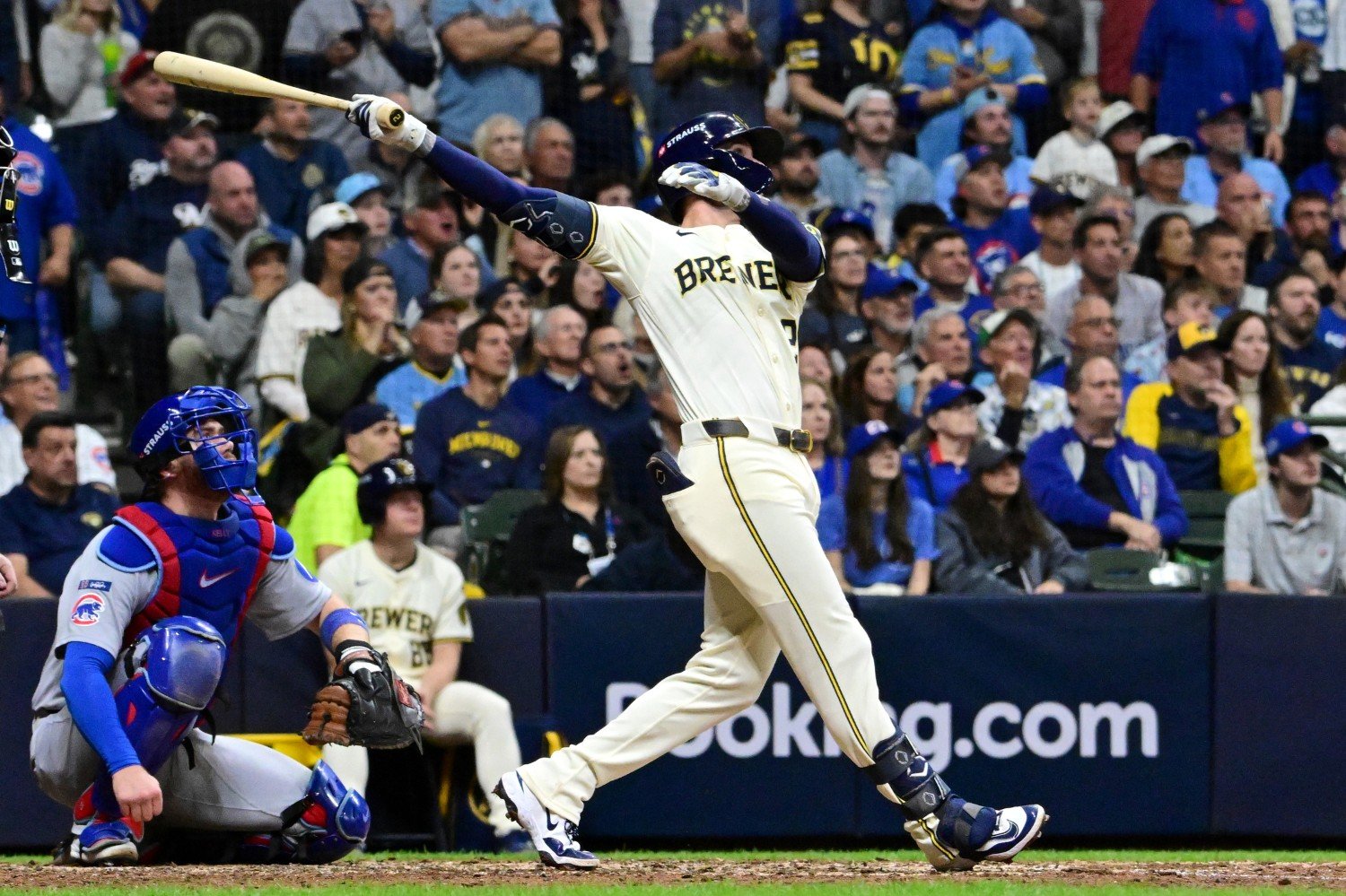 Whenever a young player has a breakthrough season, the team for whom they play is likely to have some interest in locking them up to a long-term deal. The Brewers are no exception to that rule. Often, though, by the time a player actually has that kind of campaign, it's too late for the Crew to get them signed on terms they find agreeable. They did give Christian Yelich a big, market-rate extension after his superstar turn in 2018-19, but more often, they either succeed with proactive overtures to players before they really establish themselves as stars (as with Freddy Peralta, Aaron Ashby and Jackson Chourio) or end up trading those players or letting them walk as free agents (as with Josh Hader, Brandon Woodruff, Corbin Burnes and Willy Adames, among others). If you try to put Brice Turang in one of those categories as he heads toward arbitration for the first time this winter, you'll end up lumping him with the guys who departed Milwaukee. Turang hit 18 home runs and went from about 15% worse than a league-average batter to about 20% better than one, all while continuing to run the bases well and play plus defense at second base. A year ago, the Brewers could have at least hoped to sew up his services beyond late 2029 (when he's currently scheduled to become a free agent) for under $60 million, in total. That's out the window now. If they want to strike a deal that keeps Turang in Milwaukee for the long run, they'll have to be ready to pay as much as $100 million. Even acknowledging how good he was in 2025, that feels unlikely. Presumably, the Brewers will be willing to let Turang go after 2029, instead of committing that much money to him. That's how they tend to operate. They're ruthless; it's a large part of what makes them great at team-building. With Jesus Made, Luis Pena and Cooper Pratt (among others) in the pipeline, they don't need to lock themselves into eight-figure annual salaries for a second baseman—at least, that's what you'd think at a glance. Here's the rub: According to MLB Trade Rumors, Turang is set to make somewhere around $4.4 million next year, in his first season of arbitration eligibility. That will be the first of four years of eligibility for Turang, who is just a week shy of three full years of MLB service time and will qualify for arbitration as a Super Two player this fall. The rules and norms of the league's arbitration system are such that platform years (and platform earnings) are very important. Players can't receive more than a 20% pay cut from one year to the next once they reach arbitration, and in practice, they nearly always see substantial year-to-year increases—even if they don't have especially strong campaigns. Even one or two good years, on the other hand, can effect major acceleration in a player's earning power. That $4.4 million as a first-year award for a player headed for four trips through the arbitration system is the kind of number that imperils the Crew's control of Turang for 2029. If he remains a productive player (the kind the team would love to retain, in a vacuum), by that final year of team control, he's likely to be in line for nearly $20 million. The Brewers kept Willy Adames all the way to free agency and paid him $12.25 million in 2024, but after agreeing with Corbin Burnes at $15.6 million to avoid arbitration, they traded him. If Turang ends up in a position to earn more than Adames or Burnes (even accounting for salary inflation throughout the sport), they'll have a hard time fitting him into their plans for that final year of what should be control over their former first-round pick. Unfortunately, the team has little leverage over Turang, even at this relatively early juncture. He made just over $368,000 in bonus money via the league's new pre-arbitration bonus pool arrangement last season, and will receive an even bigger payout sometime this winter. He also got $3.4 million and change as a signing bonus when the team took him in the 2018 MLB Draft. He's already made more than $5 million in the game, and that figure will roughly double in 2026. To get him to sign a deal that tamps down his earning power over the next few years in exchange for a guaranteed payday beyond that, the Brewers are likelt to have to stretch beyond their comfort zone. A structure like this would make sense: Signing bonus: $2 million 2026: $4 million 2027: $9 million 2028: $9 million 2029: $13 million 2030: $18 million 2031: $18 million 2032: $18 million 2033: $25 million vesting or club option, with $9-million buyout That's a seven-year deal worth $100 million, with a chance to stretch to eight years and $116 million. With some financial uncertainty ahead for the game as a whole and given the rough market for 30-something middle infielders, Turang might be willing to sign such a deal—but the Brewers would have to believe so much in his long-term viability (and the utility of, especially, his 2029 and 2030 seasons) than they'd be willing to guarantee so much and risk overpaying for a player in decline at the end of the deal. Normally, that's out of the question for this front office, under this ownership group. However, Turang is an important cog in the machine that has churned out three straight division titles, and he took a huge step forward in 2025. If signing a deal like this is the best way to avoid the risk of losing him a year ahead of schedule, the Brewers might feel the gamble is worth it.
 -
Image courtesy of © Benny Sieu-Imagn Images Whenever a young player has a breakthrough season, the team for whom they play is likely to have some interest in locking them up to a long-term deal. The Brewers are no exception to that rule. Often, though, by the time a player actually has that kind of campaign, it's too late for the Crew to get them signed on terms they find agreeable. They did give Christian Yelich a big, market-rate extension after his superstar turn in 2018-19, but more often, they either succeed with proactive overtures to players before they really establish themselves as stars (as with Freddy Peralta, Aaron Ashby and Jackson Chourio) or end up trading those players or letting them walk as free agents (as with Josh Hader, Brandon Woodruff, Corbin Burnes and Willy Adames, among others). If you try to put Brice Turang in one of those categories as he heads toward arbitration for the first time this winter, you'll end up lumping him with the guys who departed Milwaukee. Turang hit 18 home runs and went from about 15% worse than a league-average batter to about 20% better than one, all while continuing to run the bases well and play plus defense at second base. A year ago, the Brewers could have at least hoped to sew up his services beyond late 2029 (when he's currently scheduled to become a free agent) for under $60 million, in total. That's out the window now. If they want to strike a deal that keeps Turang in Milwaukee for the long run, they'll have to be ready to pay as much as $100 million. Even acknowledging how good he was in 2025, that feels unlikely. Presumably, the Brewers will be willing to let Turang go after 2029, instead of committing that much money to him. That's how they tend to operate. They're ruthless; it's a large part of what makes them great at team-building. With Jesus Made, Luis Pena and Cooper Pratt (among others) in the pipeline, they don't need to lock themselves into eight-figure annual salaries for a second baseman—at least, that's what you'd think at a glance. Here's the rub: According to MLB Trade Rumors, Turang is set to make somewhere around $4.4 million next year, in his first season of arbitration eligibility. That will be the first of four years of eligibility for Turang, who is just a week shy of three full years of MLB service time and will qualify for arbitration as a Super Two player this fall. The rules and norms of the league's arbitration system are such that platform years (and platform earnings) are very important. Players can't receive more than a 20% pay cut from one year to the next once they reach arbitration, and in practice, they nearly always see substantial year-to-year increases—even if they don't have especially strong campaigns. Even one or two good years, on the other hand, can effect major acceleration in a player's earning power. That $4.4 million as a first-year award for a player headed for four trips through the arbitration system is the kind of number that imperils the Crew's control of Turang for 2029. If he remains a productive player (the kind the team would love to retain, in a vacuum), by that final year of team control, he's likely to be in line for nearly $20 million. The Brewers kept Willy Adames all the way to free agency and paid him $12.25 million in 2024, but after agreeing with Corbin Burnes at $15.6 million to avoid arbitration, they traded him. If Turang ends up in a position to earn more than Adames or Burnes (even accounting for salary inflation throughout the sport), they'll have a hard time fitting him into their plans for that final year of what should be control over their former first-round pick. Unfortunately, the team has little leverage over Turang, even at this relatively early juncture. He made just over $368,000 in bonus money via the league's new pre-arbitration bonus pool arrangement last season, and will receive an even bigger payout sometime this winter. He also got $3.4 million and change as a signing bonus when the team took him in the 2018 MLB Draft. He's already made more than $5 million in the game, and that figure will roughly double in 2026. To get him to sign a deal that tamps down his earning power over the next few years in exchange for a guaranteed payday beyond that, the Brewers are likelt to have to stretch beyond their comfort zone. A structure like this would make sense: Signing bonus: $2 million 2026: $4 million 2027: $9 million 2028: $9 million 2029: $13 million 2030: $18 million 2031: $18 million 2032: $18 million 2033: $25 million vesting or club option, with $9-million buyout That's a seven-year deal worth $100 million, with a chance to stretch to eight years and $116 million. With some financial uncertainty ahead for the game as a whole and given the rough market for 30-something middle infielders, Turang might be willing to sign such a deal—but the Brewers would have to believe so much in his long-term viability (and the utility of, especially, his 2029 and 2030 seasons) than they'd be willing to guarantee so much and risk overpaying for a player in decline at the end of the deal. Normally, that's out of the question for this front office, under this ownership group. However, Turang is an important cog in the machine that has churned out three straight division titles, and he took a huge step forward in 2025. If signing a deal like this is the best way to avoid the risk of losing him a year ahead of schedule, the Brewers might feel the gamble is worth it. View full article
