


Matthew Trueblood
-
Posts
1,964 -
Joined
-
Last visited
-
Days Won
10
Content Type
Profiles
Forums
Blogs
Events
News
2026 Milwaukee Brewers Top Prospects Ranking
Milwaukee Brewers Videos
2022 Milwaukee Brewers Draft Picks
Milwaukee Brewers Free Agent & Trade Rumors, Notes, & Tidbits
Guides & Resources
2023 Milwaukee Brewers Draft Picks
2024 Milwaukee Brewers Draft Picks
The Milwaukee Brewers Players Project
2025 Milwaukee Brewers Draft Pick Tracker
2026 Milwaukee Brewers Draft Tracker: Picks & Bonuses
Store
Downloads
Gallery
Everything posted by Matthew Trueblood
-
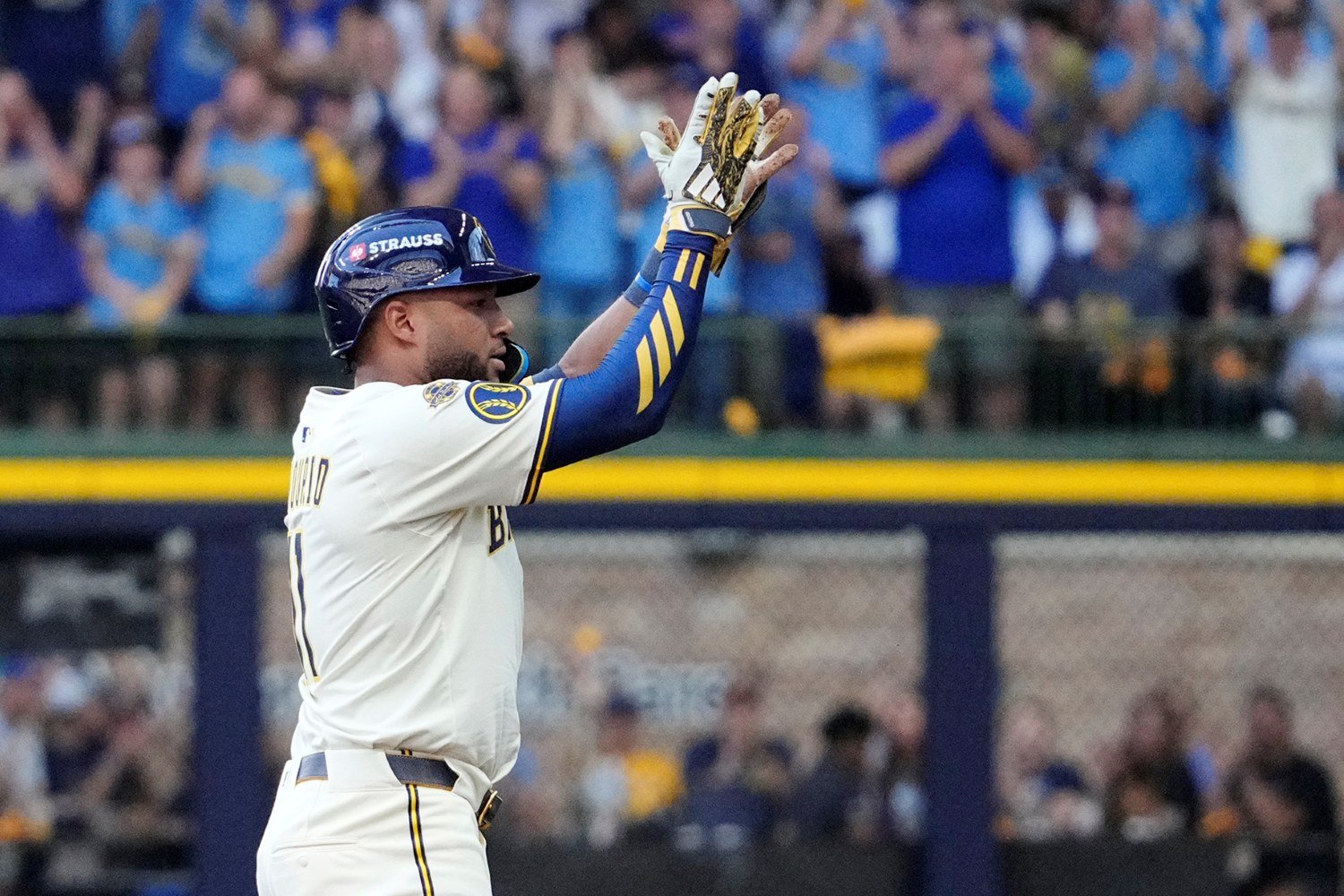
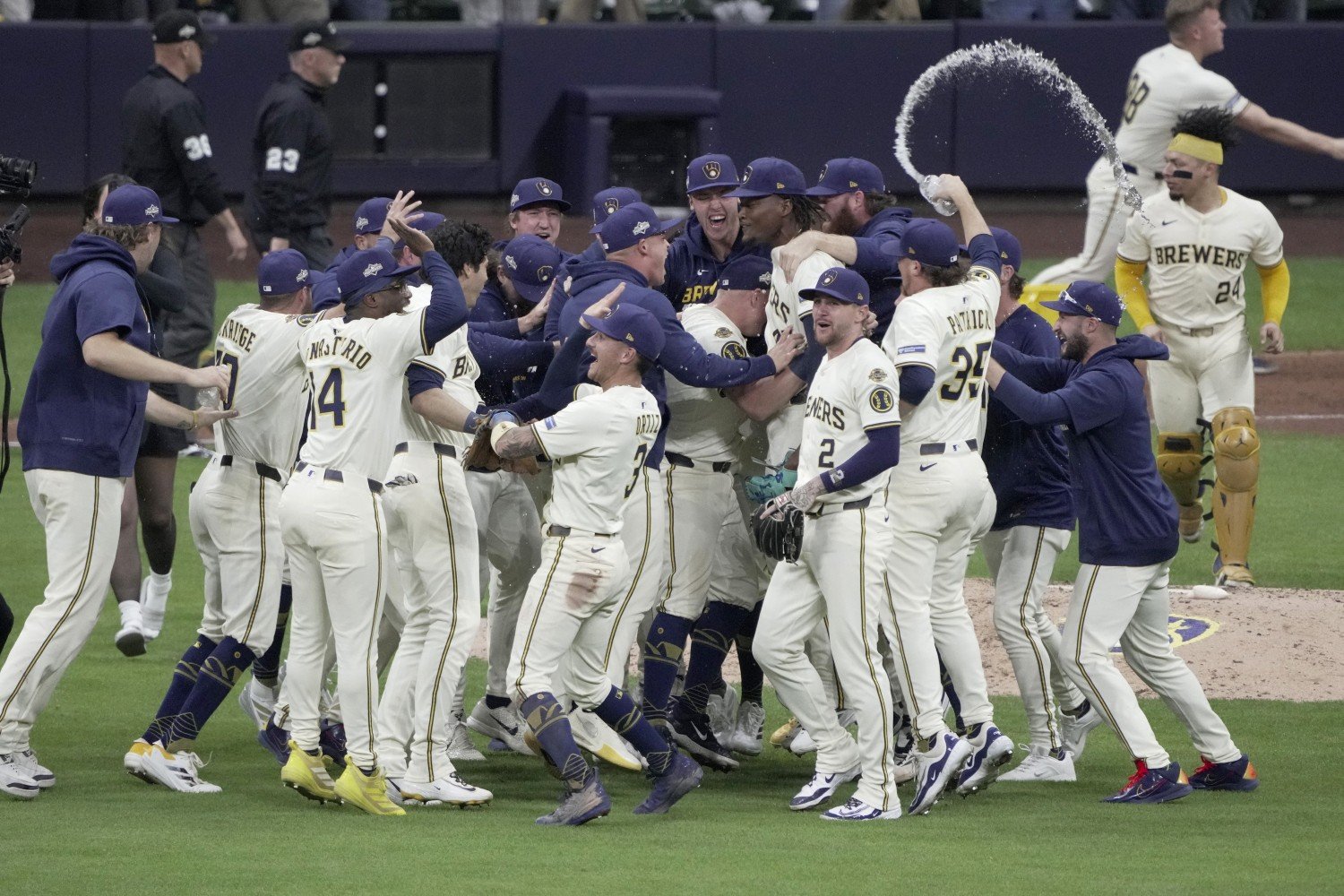 Pat Murphy made a plan, and executed it brilliantly. So did the Brewers' three most emblematic hitters of the 2025 season, And under the pressure and the bright lights of a win-or-go-home playoff game, Jacob Misiorowski spearheaded a brilliant pitching performance for the victorious Milwaukee Brewers. They beat the Chicago Cubs 3-1, to earn a place in the National League Championship Series. They'll square off with the Los Angeles Dodgers starting Monday in Milwaukee. This is, almost inarguably, the biggest win for the franchise since they came back to win the pennant against the Angels in 1982. It was a game full of catharsis and joy, as well as suspense and terror—a perfect distillation of the searing season just played by one of the best clubs ever to wear Brewers colors. Needing 27 outs but lacking a starting pitcher he could trust against a strong Cubs lineup that had already dismantled Quinn Priester once, Murphy turned to a bullpen game with his season on the line. That meant beginning with the closer, Trevor Megill, who had spent so much of the season sealing Milwaukee wins but went down at the end of August with a forearm strain that looked like it could end his campaign. Instead, there stood Megill at the center of the cauldron when the game began, pumping 98-mph fastballs and roiling curveballs. He's not quite his best, healthiest self, and the Brewers handled him carefully each time they turned to him during this series. Giving him the first inning was one way to eliminate uncertainty and put firm boundaries around his outing; he turned out not to need them. On just 11 pitches, he put the Cubs down in order. The way he came off the mound gave the first clue that this team was brimming with confidence, and that the environment would remain as unfriendly to the Cubs as Wrigley Field was during the middle phase of the series. In the bottom of the first, the Crew jumped on the visitors, availing themselves of a poor decision by Cubs manager Craig Counsell to start lefty Drew Pomeranz. The veteran southpaw retired the first two batters he faced, but on a 3-2 pitch, he threw William Contreras a two-out, two-strike fastball—the sixth in a row, in the at-bat—and paid a dear price. It wouldn't be that simple; it couldn't be. This was Game 5, do-or-die, and it was against the hated Cubs and the defector Counsell. Seiya Suzuki responded with a solo home run of his own in the top of the second against Misiorowski, and the game remained tied until the bottom of the fourth. That's when the same thing played out, with only the names changed. Colin Rea retired the first two batters he saw, but then he got stuck in a deep count with Andrew Vaughn. On a 3-2 pitch, Vaughn did something he'd only done one other time since mid-August—but that, too, having been during this same series. Misiorowski made it four innings, leaving the Brewers just 12 outs to get to secure the victory. That didn't come easy, either. Clinging to a one-run lead, Aaron Ashby allowed the first two Cubs batters of the sixth inning to reach base—but then, he struck out Kyle Tucker, and Murphy rescued the situation by lifting him in favor of Chad Patrick. After a lineout by Suzuki, Patrick froze Ian Happ on the best backdoor cutter in team history, killing the uprising. In the bottom of the seventh, it was time for the team's best all-around player (this year, anyway) to put the challengers out of their misery. Andrew Kittredge got two outs to open the bottom of the seventh, but once more, two outs proved to be one too few. The Brewers are never dead. Just when you think they are, you're dead, instead. Turang didn't wait for a full count. He blasted a first-pitch slider to center field, well over the wall (don't tell Pete Crow-Armstrong, if you see him, but it was), and the deed was virtually done. As fitting as it was to have Contreras (the team's gladiator), Vaughn (their latest impossible discovery) and Turang (as big a player-development win as a first-round pick can ever be) provide the scoring, though, perhaps the most fitting moment came last. Abner Uribe entered and mowed down the Cubs to close out the series win. He issued a walk and allowed some hard contact, but he sailed through six outs in just 22 pitches. Uribe, whose misplaced aggression led to a suspension and whose wildness led to a demotion (before a season-ending injury) last spring, represents the maturation of this team. It's still aggressive, and even, occasionally, aggro (see Uribe's celebration after the final out, which included an emphatic phone gesture toward the Cubs dugout that seems to be part of a team-wide, somewhat unearned grievance with Counsell). It's still young, and electric, and (like all electric things) a bit dangerous. But it's also a team with an unswerving sense of purpose and an intensity that doesn't crack under pressure. They are, in short, champions. They've been the NL Central champions for three years now, but they reasserted that dominance Saturday night. More importantly, they look like a worthy contender to become the champions of the entire league. This franchise has never summited that mountain. They might not do it this year, either. For at least one more night, though, they were the best team in baseball—with more wins and fewer losses than anyone else, and more swagger and more toughness, to boot. 'Bragging rights' is much too small a phrase for what they won by beating the Cubs in an October doubledown after another full-season win. They won, for themselves and fans, a real sense of superiority and freedom from a long-hanging shadow of playoff failure. Now, they just have to go do it all (in a slightly different form) again.
-
- 1
-

-
- 2025 postseason
- brice turang
- (and 4 more)
-
I hear you on the Miz thing, but in addition to him having better raw stuff in a vacuum, he seems to pose the Cubs, specifically, a much tougher matchup than Priester does. Wouldn't be surprised if we get a good dose of both. I *WOULD* be pretty surprised, honestly, if we see Quintana.
- 4 replies
-
- 1
-
-
- aaron ashby
- abner uribe
- (and 5 more)
-
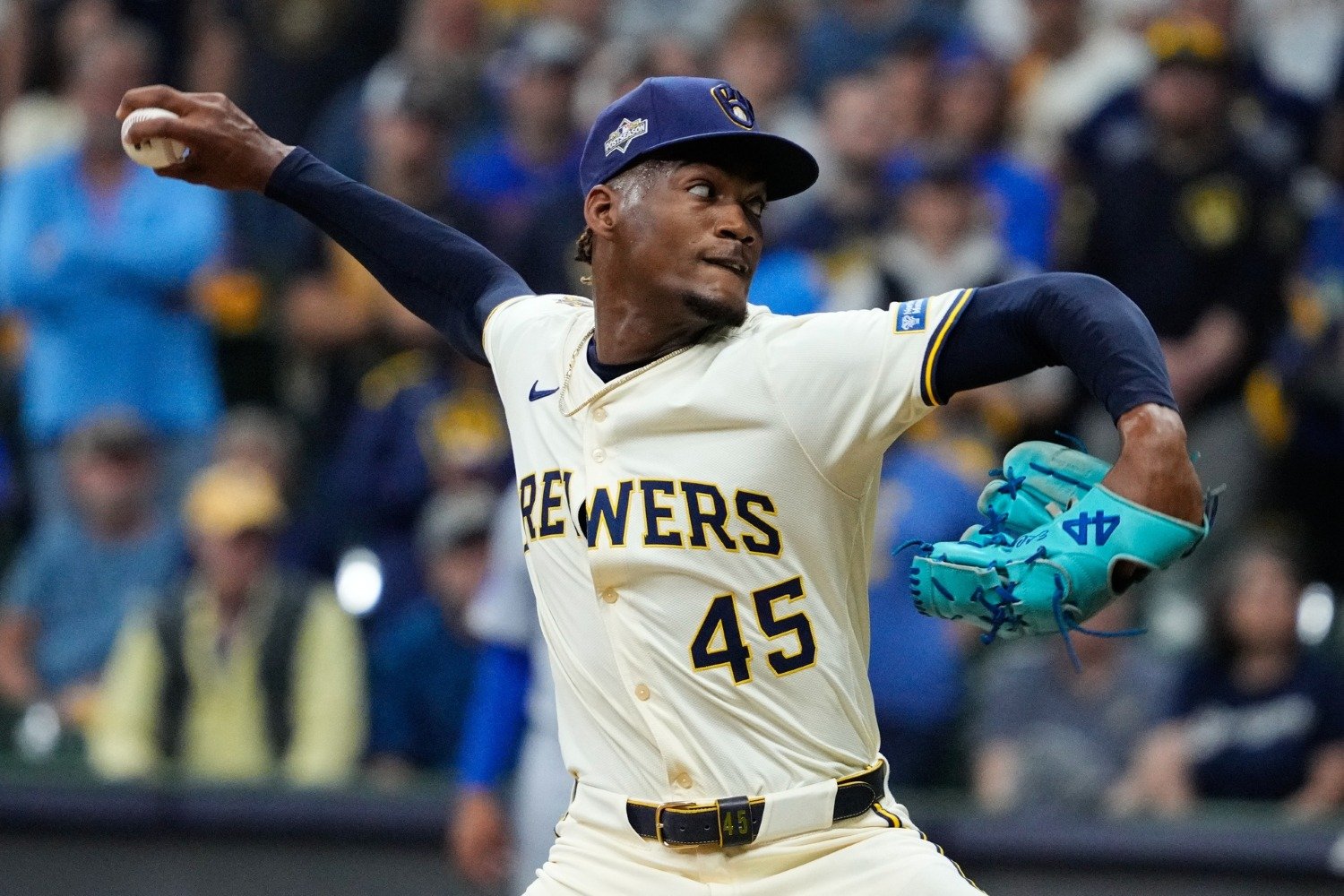 Neither the Cubs nor the Brewers has yet announced their starting pitcher for Game 5 of the National League Division Series, which will be played at 7:08 PM Central on Saturday night at Uecker Field in Milwaukee. We can presume, though, that the Brewers' main two pitching options—the candidates to give them bulk innings—are Game 2 winner Jacob Misiorowski and Game 3 starter Quinn Priester. Jose Quintana might also be in consideration, but the best odds are that Misiorowski and/or Priester will get at least 12 outs in any version of the game where the Brewers win. We can consider them co-starters, in a way. Whichever starts, the other might well appear in relief, but neither is likely to take the game past the sixth inning—and it would be a mild surprise if they weren't into the bullpen for good by the end of the fifth. For that matter, it's possible that neither of the two big righties will actually start the game. That honor might go to one of the lefties who work primarily in short relief for the Crew, in Aaron Ashby and Jared Koenig. That would force the Cubs into a tough decision about their leadoff slugger Michael Busch, at the very least, and if Craig Counsell is unwilling to start a win-or-go-home game with his best hitter on the bench, it would create a good matchup for Milwaukee the first time through. On the other hand, both Ashby and Koenig have already been used quite heavily during this series. That's the main thing we should talk about right now, as we look forward to the game and try to guess along with the managers. Who's fresh in the Brewers pen, and who's tired? Who's been overexposed? The latter is a very real and important factor; the more times a hitter sees a given reliever within a playoff series, the more likely they are to perform well against them. In fact, Cubs batters have five plate appearances against Brewers relievers they were seeing for the third time in the series, and they're 3-for-4 with a walk in those encounters. So, first, here are the six key Brewers relievers, and the number of times they've faced each Cubs batter over the first four games of the NLDS. Pitcher/Batter Busch Hoerner Tucker Suzuki Happ Kelly Crow-Armstrong Swanson Shaw Turner Ballesteros Uribe X X X Megill X X X X X X Ashby XX X XX XX XX XX XXX XXX XXX XX Koenig XX XXX XXX X X X Mears X X X XX X X Patrick X X X XX XX XX Little of this information will surprise you. Koenig and Ashby have risked overexposure in a major way, and indeed, the Cubs have made them pay. Koenig gave up back-to-back singles to Nico Hoerner and Kyle Tucker in the bottom of the seventh in Game 3, and although Chad Patrick rescued him from that jam, it very nearly led to an insurance run for the home side. In Game 4, Dansby Swanson drew a walk in his third look at Ashby in the series, and Matt Shaw went way, way down and scooped a curveball into center field for an RBI single—the quintessential example of a player benefiting from familiarity with a pitcher. That distills the dilemma Murphy will face at some points in this game neatly. He needs to pounce on opportunities for good matchups, but avoid repeating some of the ones he's already created during the series. It's a slightly different thing to face a pitcher a third time in five games (and eight days) than to face them a third time in four games (and six days), so the skipper need not necessarily shrink from letting Ashby see Tucker or Busch a third time, but it would be preferable to maximize the number of times that a pitcher whose stuff and handedness match up well with a hitter is also facing that hitter for the first or second time in this series. To that end, let me propose something superficially radical: Abner Uribe should start this game. He's been sparingly used, coming in only for the very easy closeout of Game 2, and he faced the bottom part of the Cubs order in a 1-2-3 frame. The Brewers should try to get more than three outs from him, anyway. He hasn't faced any of Chicago's top five hitters since the last time the teams met in the regular season, in mid-August. The electricity of what is sure to be a rabid crowd and the adrenaline of this do-or-die setting should assuage any concerns about using a late-inning guy in the early innings. As a kicker, the Cubs struggle mightily against high-velocity fastballs, of which Uribe has a doozy, and they've hit .087/.276/.087 against him this year. Uribe should work the first two innings. After Uribe and (let's say) Misiorowski do their thing, there should only be nine outs left for the Crew to get. At that point, it's just about picking pockets—finding the right mix of matchup value and freshness/novelty to avoid letting the Cubs do damage against the remaining relievers. Koenig should be slated to face the bottom third of Chicago's order. He hasn't seen Kelly yet, but that isn't a good fit for him. The real value starts with him facing Pete Crow-Armstrong (a lefty-lefty matchup we're yet to see in this series), and then attacking Swanson and Shaw. Megill, by contrast, could find himself in the danger zone if matched up with Crow-Armstrong. It makes more sense to get him in there against Hoerner, Tucker, Seiya Suzuki and Ian Happ, although all of those except Tucker have seen him already. One key question is how short a leash Megill is on, in terms of pitch count and of whether or not he can sit down and come back on the other side of an inning break, as he nurses a forearm strain that he's pitching through, more than truly recovered from. Ashby is a tough one. As great and as ubiquitous as he has been for this team all season, he might have rendered as much service as he can to this team in this series. Ideally, Uribe, Misiorowski/Priester, Koenig and Megill can get the Brewers to 27 outs. Failing that, there are more pockets where Nick Mears might fit in than there are where Ashby feels like a safe inclusion. If, at some midgame juncture, the team needs just one out against a tough righty bat like Suzuki or Hoerner, Grant Anderson might factor into the equation. The other question, of course, is how tired (or not) each of these pitchers are. In a series with three off days, it's hard to burn people out, per se, but Ashby also stands out as the one who has borne the heaviest load in the team's bullpen mix. MON TUE WED THU FRI TOT Ashby 43 0 0 32 0 75 Koenig 16 0 7 0 0 23 Patrick 11 0 22 4 0 37 Anderson 0 0 30 0 0 30 Uribe 13 0 0 0 0 13 Mears 3 0 14 0 0 17 Megill 9 0 0 12 0 21 Misiorowski 57 0 0 0 0 57 Gasser 0 0 0 46 0 46 Robert Gasser might not even don a pair of spikes Saturday, unless the game stretches into extra innings. Everyone else should be available, but Patrick has done a lot, too. He might be best avoided except in an emergency, unless he can be fitted in against the sequence of Shaw, Busch, Hoerner and Tucker in a spot where there's some margin for error and a pitcher ready to come in right after Tucker's at-bat. Koenig and Uribe are the obviously fresh, well-shielded, high-leverage arms. They should give Murphy at least nine outs, as a combo. Since all we've seen are protected appearances with low pitch counts from Megill, though, it's hard to know whether he can be given any more than that. The Brewers will have the crowd on their side for this game. It will be the game of the decade, for both teams—a hinge point, thrusting the winner forward and making the winter a thorny and depressing eon for the loser. It's imperative that Murphy have a sound and flexible plan to win the battle, but he does have the arms to do it. A gambit—starting Uribe, and letting him cover some real ground before turning things over to Misiorowski—might be the best way to convert that potential into an actual, much-needed victory.
- 4 comments
-
- 1
-
-
- aaron ashby
- abner uribe
- (and 5 more)
-
Image courtesy of © Michael McLoone-Imagn Images Neither the Cubs nor the Brewers has yet announced their starting pitcher for Game 5 of the National League Division Series, which will be played at 7:08 PM Central on Saturday night at Uecker Field in Milwaukee. We can presume, though, that the Brewers' main two pitching options—the candidates to give them bulk innings—are Game 2 winner Jacob Misiorowski and Game 3 starter Quinn Priester. Jose Quintana might also be in consideration, but the best odds are that Misiorowski and/or Priester will get at least 12 outs in any version of the game where the Brewers win. We can consider them co-starters, in a way. Whichever starts, the other might well appear in relief, but neither is likely to take the game past the sixth inning—and it would be a mild surprise if they weren't into the bullpen for good by the end of the fifth. For that matter, it's possible that neither of the two big righties will actually start the game. That honor might go to one of the lefties who work primarily in short relief for the Crew, in Aaron Ashby and Jared Koenig. That would force the Cubs into a tough decision about their leadoff slugger Michael Busch, at the very least, and if Craig Counsell is unwilling to start a win-or-go-home game with his best hitter on the bench, it would create a good matchup for Milwaukee the first time through. On the other hand, both Ashby and Koenig have already been used quite heavily during this series. That's the main thing we should talk about right now, as we look forward to the game and try to guess along with the managers. Who's fresh in the Brewers pen, and who's tired? Who's been overexposed? The latter is a very real and important factor; the more times a hitter sees a given reliever within a playoff series, the more likely they are to perform well against them. In fact, Cubs batters have five plate appearances against Brewers relievers they were seeing for the third time in the series, and they're 3-for-4 with a walk in those encounters. So, first, here are the six key Brewers relievers, and the number of times they've faced each Cubs batter over the first four games of the NLDS. Pitcher/Batter Busch Hoerner Tucker Suzuki Happ Kelly Crow-Armstrong Swanson Shaw Turner Ballesteros Uribe X X X Megill X X X X X X Ashby XX X XX XX XX XX XXX XXX XXX XX Koenig XX XXX XXX X X X Mears X X X XX X X Patrick X X X XX XX XX Little of this information will surprise you. Koenig and Ashby have risked overexposure in a major way, and indeed, the Cubs have made them pay. Koenig gave up back-to-back singles to Nico Hoerner and Kyle Tucker in the bottom of the seventh in Game 3, and although Chad Patrick rescued him from that jam, it very nearly led to an insurance run for the home side. In Game 4, Dansby Swanson drew a walk in his third look at Ashby in the series, and Matt Shaw went way, way down and scooped a curveball into center field for an RBI single—the quintessential example of a player benefiting from familiarity with a pitcher. That distills the dilemma Murphy will face at some points in this game neatly. He needs to pounce on opportunities for good matchups, but avoid repeating some of the ones he's already created during the series. It's a slightly different thing to face a pitcher a third time in five games (and eight days) than to face them a third time in four games (and six days), so the skipper need not necessarily shrink from letting Ashby see Tucker or Busch a third time, but it would be preferable to maximize the number of times that a pitcher whose stuff and handedness match up well with a hitter is also facing that hitter for the first or second time in this series. To that end, let me propose something superficially radical: Abner Uribe should start this game. He's been sparingly used, coming in only for the very easy closeout of Game 2, and he faced the bottom part of the Cubs order in a 1-2-3 frame. The Brewers should try to get more than three outs from him, anyway. He hasn't faced any of Chicago's top five hitters since the last time the teams met in the regular season, in mid-August. The electricity of what is sure to be a rabid crowd and the adrenaline of this do-or-die setting should assuage any concerns about using a late-inning guy in the early innings. As a kicker, the Cubs struggle mightily against high-velocity fastballs, of which Uribe has a doozy, and they've hit .087/.276/.087 against him this year. Uribe should work the first two innings. After Uribe and (let's say) Misiorowski do their thing, there should only be nine outs left for the Crew to get. At that point, it's just about picking pockets—finding the right mix of matchup value and freshness/novelty to avoid letting the Cubs do damage against the remaining relievers. Koenig should be slated to face the bottom third of Chicago's order. He hasn't seen Kelly yet, but that isn't a good fit for him. The real value starts with him facing Pete Crow-Armstrong (a lefty-lefty matchup we're yet to see in this series), and then attacking Swanson and Shaw. Megill, by contrast, could find himself in the danger zone if matched up with Crow-Armstrong. It makes more sense to get him in there against Hoerner, Tucker, Seiya Suzuki and Ian Happ, although all of those except Tucker have seen him already. One key question is how short a leash Megill is on, in terms of pitch count and of whether or not he can sit down and come back on the other side of an inning break, as he nurses a forearm strain that he's pitching through, more than truly recovered from. Ashby is a tough one. As great and as ubiquitous as he has been for this team all season, he might have rendered as much service as he can to this team in this series. Ideally, Uribe, Misiorowski/Priester, Koenig and Megill can get the Brewers to 27 outs. Failing that, there are more pockets where Nick Mears might fit in than there are where Ashby feels like a safe inclusion. If, at some midgame juncture, the team needs just one out against a tough righty bat like Suzuki or Hoerner, Grant Anderson might factor into the equation. The other question, of course, is how tired (or not) each of these pitchers are. In a series with three off days, it's hard to burn people out, per se, but Ashby also stands out as the one who has borne the heaviest load in the team's bullpen mix. MON TUE WED THU FRI TOT Ashby 43 0 0 32 0 75 Koenig 16 0 7 0 0 23 Patrick 11 0 22 4 0 37 Anderson 0 0 30 0 0 30 Uribe 13 0 0 0 0 13 Mears 3 0 14 0 0 17 Megill 9 0 0 12 0 21 Misiorowski 57 0 0 0 0 57 Gasser 0 0 0 46 0 46 Robert Gasser might not even don a pair of spikes Saturday, unless the game stretches into extra innings. Everyone else should be available, but Patrick has done a lot, too. He might be best avoided except in an emergency, unless he can be fitted in against the sequence of Shaw, Busch, Hoerner and Tucker in a spot where there's some margin for error and a pitcher ready to come in right after Tucker's at-bat. Koenig and Uribe are the obviously fresh, well-shielded, high-leverage arms. They should give Murphy at least nine outs, as a combo. Since all we've seen are protected appearances with low pitch counts from Megill, though, it's hard to know whether he can be given any more than that. The Brewers will have the crowd on their side for this game. It will be the game of the decade, for both teams—a hinge point, thrusting the winner forward and making the winter a thorny and depressing eon for the loser. It's imperative that Murphy have a sound and flexible plan to win the battle, but he does have the arms to do it. A gambit—starting Uribe, and letting him cover some real ground before turning things over to Misiorowski—might be the best way to convert that potential into an actual, much-needed victory. View full article
-
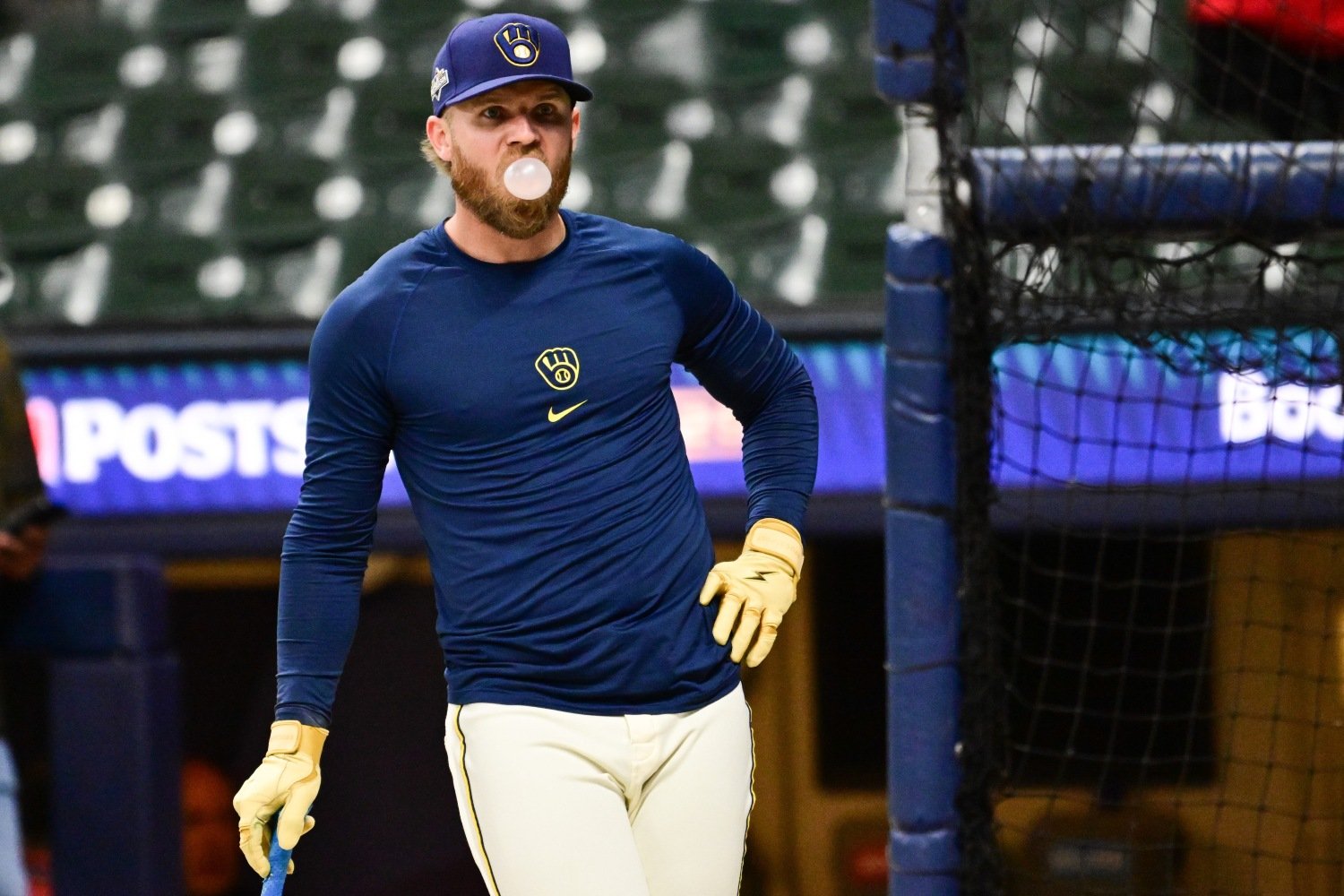 The Brewers' starting lineup is out, and Game 3 of the NLDS is just two hours away. This is the first chance the team gets to close out the Chicago Cubs and advance to their first NLCS since 2018. With right-handed starter Jameson Taillon on the mound for Chicago, you figured we'd see a couple of changes in the batting order—but as it turns out, we're seeing more than a minor shakeup or a single swapout. Here's the card manager Pat Murphy has filled out for Wednesday's start: Christian Yelich - DH Jackson Chourio - LF Brice Turang - 2B William Contreras - C Sal Frelick - RF Caleb Durbin - 3B Jake Bauers - 1B Brandon Lockridge - CF Joey Ortiz - SS If you're anything like me, you spent the first five items on that list nodding in approval and confirmation. We saw Murphy move Christian Yelich into the leadoff spot during the final week of the regular season, and it was always likely he'd be back there once the team saw a righty starter in the playoffs. It's very good to see Jackson Chourio back in the lineup, after the skipper acknowledged that he was removed from Game 2 due to feeling a new twinge in the hamstring he appears to have strained again back in Game 1. Because it's a righty on the mound, we knew there was at least some chance that Jake Bauers would take over at first base from Andrew Vaughn, so that surprise is a mild one. However, Brandon Lockridge—who hadn't been with the parent club at the end of the regular year, and whom everyone assumed to be on the roster largely as a pinch-runner and defensive replacement—has pulled a start, batting eighth and playing center field. That is an extremely informative choice, and it sets off a cascade of interesting questions. Blake Perkins, whom the team had settled on as their starting center fielder at least against lefties by the end of the year, is on the bench. Presumably, that's because he's been much worse against righties this year, and because Taillon's new kick-change has made him very effective against left-handed batters. Murphy is playing a bit of anti-platoon matchup information against the Cubs by starting the righty-batting Lockridge. However, it's fascinating to note that he's doing so only in that case. He still chose the lefty Bauers over the righty Vaughn (perhaps because Bauers, with excellent bat speed and a more refined eye this year, has a swing path and approach better suited to take advantage of Taillon than Vaughn, handedness be damned). Murphy is also choosing Lockridge in center, Chourio in left, Yelich at designated hitter and Sal Frelick in right field over at least three alternative alignments that one might have regarded as more likely, under various scenarios: Isaac Collins playing right, while Frelick slides to center field, leaving Lockridge on the bench Chourio in center, with Collins in left Bauers in left, Vaughn at first, and Chourio in center If everyone was fully healthy, we'd probably see the second of those. It sure feels like Chourio staying in left against the righty starter is a way to hide his balky hamstring in a corner spot, although the corner outfielders at Wrigley Field often have plenty of running to do in their own right. That does raise the question, though, of why we're not seeing Yelich play left, with Chourio slotted in as the DH instead. It feels like confirmation that Yelich, who missed a few days during September when his back flared up yet again, simply isn't available to play the field at the moment. He hasn't started there since August 27. With Yelich locked into the DH spot, if we also assume Chourio had to be in left, then the outfield question comes down to a few things. Starting Lockridge indicates that Murphy prefers him to Perkins, even though Perkins is at least as good a defender and would have the platoon edge. It also says that the team isn't currently treating Frelick as an option in center (he last started there August 19, and before that, it had been multiple months). If he was, they'd have to seriously consider sliding him there and starting either Collins or Bauers (with Vaughn at first) instead of Lockridge. Again, Taillon's splits add a wrinkle to all of this, but it seems as though the team is down to two center-field options and is locked into one player being their DH each day. If that's true, it does constrain the rest of Murphy's choices. This could also turn out to be some combination of a deke and a hedge. If Craig Counsell (managing in feral mode, with his seaosn under threat) goes with a bullpen-centric approach to this game, the matchup propositions at each of the spots in question will change quite a bit. By batting Bauers seventh, Murphy bought time, such that if the moment comes when Counell goes to lefties Caleb Thielbar or Drew Pomeranz and Murphy wants to pinch-hit for Bauers with Vaughn, it's likely to come in the fifth inning or so. He won't be down to his last first baseman in the third, with trouble ahead. Similarly, by starting Lockridge and batting him eighth, Murphy might just be leaving himself a maximum of options. Whenever the crucial at-bat for that lineup spot comes, it might be that Murphy will send up Perkins or Collins or even Vaughn to hit for Lockridge. The Crew might be unwilling to start Chourio or Frelick in center, but they'll probably move them there for the final three or four innings if needed. This is a very intriguing lineup card. It's clear that the Brewers are operating at less than full health and full flexibility, but then again, of which team is that not true by this time of year? With a creative and slightly eyebrow-raising starting nine, Murphy is giving us some insight into what he's dealing with—but he's still assembled a group that can finish off a sweep and send the Cubs home for the winter.
- 3 comments
-
- 2
-
-
- jackson chourio
- blake perkins
- (and 4 more)
-
Image courtesy of © Benny Sieu-Imagn Images The Brewers' starting lineup is out, and Game 3 of the NLDS is just two hours away. This is the first chance the team gets to close out the Chicago Cubs and advance to their first NLCS since 2018. With right-handed starter Jameson Taillon on the mound for Chicago, you figured we'd see a couple of changes in the batting order—but as it turns out, we're seeing more than a minor shakeup or a single swapout. Here's the card manager Pat Murphy has filled out for Wednesday's start: Christian Yelich - DH Jackson Chourio - LF Brice Turang - 2B William Contreras - C Sal Frelick - RF Caleb Durbin - 3B Jake Bauers - 1B Brandon Lockridge - CF Joey Ortiz - SS If you're anything like me, you spent the first five items on that list nodding in approval and confirmation. We saw Murphy move Christian Yelich into the leadoff spot during the final week of the regular season, and it was always likely he'd be back there once the team saw a righty starter in the playoffs. It's very good to see Jackson Chourio back in the lineup, after the skipper acknowledged that he was removed from Game 2 due to feeling a new twinge in the hamstring he appears to have strained again back in Game 1. Because it's a righty on the mound, we knew there was at least some chance that Jake Bauers would take over at first base from Andrew Vaughn, so that surprise is a mild one. However, Brandon Lockridge—who hadn't been with the parent club at the end of the regular year, and whom everyone assumed to be on the roster largely as a pinch-runner and defensive replacement—has pulled a start, batting eighth and playing center field. That is an extremely informative choice, and it sets off a cascade of interesting questions. Blake Perkins, whom the team had settled on as their starting center fielder at least against lefties by the end of the year, is on the bench. Presumably, that's because he's been much worse against righties this year, and because Taillon's new kick-change has made him very effective against left-handed batters. Murphy is playing a bit of anti-platoon matchup information against the Cubs by starting the righty-batting Lockridge. However, it's fascinating to note that he's doing so only in that case. He still chose the lefty Bauers over the righty Vaughn (perhaps because Bauers, with excellent bat speed and a more refined eye this year, has a swing path and approach better suited to take advantage of Taillon than Vaughn, handedness be damned). Murphy is also choosing Lockridge in center, Chourio in left, Yelich at designated hitter and Sal Frelick in right field over at least three alternative alignments that one might have regarded as more likely, under various scenarios: Isaac Collins playing right, while Frelick slides to center field, leaving Lockridge on the bench Chourio in center, with Collins in left Bauers in left, Vaughn at first, and Chourio in center If everyone was fully healthy, we'd probably see the second of those. It sure feels like Chourio staying in left against the righty starter is a way to hide his balky hamstring in a corner spot, although the corner outfielders at Wrigley Field often have plenty of running to do in their own right. That does raise the question, though, of why we're not seeing Yelich play left, with Chourio slotted in as the DH instead. It feels like confirmation that Yelich, who missed a few days during September when his back flared up yet again, simply isn't available to play the field at the moment. He hasn't started there since August 27. With Yelich locked into the DH spot, if we also assume Chourio had to be in left, then the outfield question comes down to a few things. Starting Lockridge indicates that Murphy prefers him to Perkins, even though Perkins is at least as good a defender and would have the platoon edge. It also says that the team isn't currently treating Frelick as an option in center (he last started there August 19, and before that, it had been multiple months). If he was, they'd have to seriously consider sliding him there and starting either Collins or Bauers (with Vaughn at first) instead of Lockridge. Again, Taillon's splits add a wrinkle to all of this, but it seems as though the team is down to two center-field options and is locked into one player being their DH each day. If that's true, it does constrain the rest of Murphy's choices. This could also turn out to be some combination of a deke and a hedge. If Craig Counsell (managing in feral mode, with his seaosn under threat) goes with a bullpen-centric approach to this game, the matchup propositions at each of the spots in question will change quite a bit. By batting Bauers seventh, Murphy bought time, such that if the moment comes when Counell goes to lefties Caleb Thielbar or Drew Pomeranz and Murphy wants to pinch-hit for Bauers with Vaughn, it's likely to come in the fifth inning or so. He won't be down to his last first baseman in the third, with trouble ahead. Similarly, by starting Lockridge and batting him eighth, Murphy might just be leaving himself a maximum of options. Whenever the crucial at-bat for that lineup spot comes, it might be that Murphy will send up Perkins or Collins or even Vaughn to hit for Lockridge. The Crew might be unwilling to start Chourio or Frelick in center, but they'll probably move them there for the final three or four innings if needed. This is a very intriguing lineup card. It's clear that the Brewers are operating at less than full health and full flexibility, but then again, of which team is that not true by this time of year? With a creative and slightly eyebrow-raising starting nine, Murphy is giving us some insight into what he's dealing with—but he's still assembled a group that can finish off a sweep and send the Cubs home for the winter. View full article
- 3 replies
-
- 1
-
-
- jackson chourio
- blake perkins
- (and 4 more)
-
Image courtesy of © Mark Hoffman/Milwaukee Journal Sentinel / USA TODAY NETWORK via Imagn Images Quinn Priester is a very good pitcher, but when he's anything shy of his best self, he's not a very good matchup for the Chicago Cubs. That was the truth underlying Pat Murphy and the team's clever strategy for winning Game 2. They wouldn't couch it that way—the more politic and more effective focal point is the strengths of the players they deployed instead—but that's the truth of the matter. By delaying using Priester within this series, Murphy gained some information. He would have had to do things one way if the series had moved to Wrigley Field knotted at 1-1; he has a different and more appealing set of options with his team ahead 2-0. Still, there's no reason Murphy and his staff should be anything but aggressive in pursuit of the closeout win Wednesday evening. Priester doesn't need to be pulled at the very first sign of trouble, and indeed, if the Brewers fall behind or race out to a big lead early, Murphy should give his young starter some leeway. Eating innings remains valuable, even in the playoffs—at least for a team who pushed their arms hard throughout the regular season, and who intends to play another couple of series beyond this one. Priester should shield the bullpen from overexposure to specific Cubs batters, as well as from overuse, if the leverage of the game is relatively low. On the other hand, if the game is tight or the Brewers hold a lead of just two or three runs into the middle innings, Murphy should push the pedal down. If the series goes beyond Wednesday, it'll almost certainly be Freddy Peralta taking the ball in Game 4. He's a good bet to shut the Cubs down and send the Crew on to the NLCS—but the team's Plan A has to be to get this game and save Peralta for Game 1 of the next round, be it against the Dodgers or the Phillies. Without giving up their posture of confidence and dominance, the Brewers should treat this game with urgency. That means making Aaron Ashby available, for what would be a third straight game (but on what is essentially his standard one day of rest). It means going to Abner Uribe, Jared Koenig and Trevor Megill fairly proactively, and in turn, it might mean lifting Priester after just 12 outs or so. There's no cause for panic, and only if the Cubs truly knock him out of the box should Priester be removed in favor of (for instance) Robert Gasser, but this game has the potential to catapult Milwaukee into the NLCS with a tailwind. They should play unreservedly for that outcome, knowing that after a five-day layoff and two days off in the first four of this series, their staff will be fresh enough to come back and finish the thing Thursday if need be. Ask a Blue Jays fan, this morning, how quickly the tide can seem to turn in a 2-0 Division Series if the trailing team (especially a home team) wins even one game. Toronto is still in control of that series, but not nearly the way they were in the fourth inning Tuesday night. Sometimes, the other team is just too good to be swept away, and maybe the Cubs will get off the mat with such a combination ready that they'll fight their way back to their corner. As the Brewers take the field Wednesday, though, Murphy should have just one thing in mind: landing the knockout blow. If that means playing more aggressively than the situation seems to demand, so be it. There's a pennant and a Commissioner's Trophy to think about, and the best chances to claim those lie in not wasting any more time on the Cubs than is necessary. View full article
-
 Quinn Priester is a very good pitcher, but when he's anything shy of his best self, he's not a very good matchup for the Chicago Cubs. That was the truth underlying Pat Murphy and the team's clever strategy for winning Game 2. They wouldn't couch it that way—the more politic and more effective focal point is the strengths of the players they deployed instead—but that's the truth of the matter. By delaying using Priester within this series, Murphy gained some information. He would have had to do things one way if the series had moved to Wrigley Field knotted at 1-1; he has a different and more appealing set of options with his team ahead 2-0. Still, there's no reason Murphy and his staff should be anything but aggressive in pursuit of the closeout win Wednesday evening. Priester doesn't need to be pulled at the very first sign of trouble, and indeed, if the Brewers fall behind or race out to a big lead early, Murphy should give his young starter some leeway. Eating innings remains valuable, even in the playoffs—at least for a team who pushed their arms hard throughout the regular season, and who intends to play another couple of series beyond this one. Priester should shield the bullpen from overexposure to specific Cubs batters, as well as from overuse, if the leverage of the game is relatively low. On the other hand, if the game is tight or the Brewers hold a lead of just two or three runs into the middle innings, Murphy should push the pedal down. If the series goes beyond Wednesday, it'll almost certainly be Freddy Peralta taking the ball in Game 4. He's a good bet to shut the Cubs down and send the Crew on to the NLCS—but the team's Plan A has to be to get this game and save Peralta for Game 1 of the next round, be it against the Dodgers or the Phillies. Without giving up their posture of confidence and dominance, the Brewers should treat this game with urgency. That means making Aaron Ashby available, for what would be a third straight game (but on what is essentially his standard one day of rest). It means going to Abner Uribe, Jared Koenig and Trevor Megill fairly proactively, and in turn, it might mean lifting Priester after just 12 outs or so. There's no cause for panic, and only if the Cubs truly knock him out of the box should Priester be removed in favor of (for instance) Robert Gasser, but this game has the potential to catapult Milwaukee into the NLCS with a tailwind. They should play unreservedly for that outcome, knowing that after a five-day layoff and two days off in the first four of this series, their staff will be fresh enough to come back and finish the thing Thursday if need be. Ask a Blue Jays fan, this morning, how quickly the tide can seem to turn in a 2-0 Division Series if the trailing team (especially a home team) wins even one game. Toronto is still in control of that series, but not nearly the way they were in the fourth inning Tuesday night. Sometimes, the other team is just too good to be swept away, and maybe the Cubs will get off the mat with such a combination ready that they'll fight their way back to their corner. As the Brewers take the field Wednesday, though, Murphy should have just one thing in mind: landing the knockout blow. If that means playing more aggressively than the situation seems to demand, so be it. There's a pennant and a Commissioner's Trophy to think about, and the best chances to claim those lie in not wasting any more time on the Cubs than is necessary.
- 2 comments
-
- 2
-
-

-
- aaron ashby
- abner uribe
- (and 4 more)
-
Palencia throws fastballs in two-strike counts more often than all but three other pitchers in baseball—over 70% of the time. Just doesn't trust his secondary stuff at all. Chourio knew what to be ready for, and made him pay.
- 7 replies
-
- 2
-
-
- andrew vaughn
- william contreras
- (and 2 more)
-
 Covering the fastball and the splitter is for suckers. So, for that matter, is covering the inside corner and the outside corner. Using the whole field? Loser stuff. Seeing it high and meeting it low? Nonsense. Modern pitchers are too good for a big-league batter to dig in and assume their stance with more than one vision in mind. That doesn't mean their vision shouldn't change, from at-bat to at-bat and even from pitch to pitch, but there's only room for one radically simple idea in the head of a successful hitter at any given time: What can I do here, and what pitch can I do it on? That's how the Brewers hit, and it's paid off for them in spades this year. They play, perhaps, the best team-oriented offense in recent memory, with a deep lineup full of hitters whose skill sets complement one another—but, more importantly, who have each bought in on the ethos of doing what the situation permits and giving their teammates chances to make plays, too. With a chance to push their fiercest rivals all the way to the ropes in Game 2 of the National League Division Series, the Crew brought that style to bear, thanks to the extremely specific plans of attack at bat that have characterized so much of their season. After Aaron Ashby got rocked by a three-run home run in the top of the first inning, the home team knew they needed some baserunners. They needed to respond by applying some pressure of their own, even if they didn't immediately tie the score. They had the luxury, in this game, of facing an extremely familiar foe, Shota Imanaga. His recent struggles are well-documented, and if I can distill and deliver a detailed diagnosis thereof to you, then you can bet the Brewers had an even better one. Imanaga, lately, has only been able to drive his splitter down below the strike zone when he pulls it across the plate, which has affected the way he can locate his fastball. As a result, he's increasingly turned to breaking balls, even against right-handed batters. That was one thing the Brewers knew. They also knew he was still living at the top of the zone with his fastball against left-handed batters. Quickly. all of that came into play in decisive fashion. Imanaga struck out both Jackson Chourio and Brice Turang to begin the outing, leaving him just one out away from getting back into the dugout and giving his team a three-run cushion on which to attempt to build. Chourio kept anticipating the breaking ball; he fanned on a heater in a hittable part of the zone. Turang whiffed on a high heater, trying to take control of that segment but failing. William Contreras, however, had just the right plan—a unique one, but an almost unbeatable one. He fouled off a first-pitch sweeper from Imanaga, which bent far in toward him. That invited another one, and Imanaga obliged—but Contreras got the swing right this time. It was a short, smooth stroke, far slower than his top speed but under control, and he lined a ball cleanly down the left-field line. It was not only a single, but (with an .890 expected batting average, according to Statcast) a sure single off the bat. It was carefully managed contact, but whereas baseball people talk mostly about pitchers managing quality of contact, this was a hitter doing so. You can't do what Contreras did with that pitch without anticipation, and you can't do it without tradeoffs. The swing he put on that ball was planned, and it was efficient, but it had no chance to generate a home run, or even a screaming line drive. It wouldn't have worked on a fastball or a splitter. Contreras had to go up knowing (or believing fiercely enough to have conviction in it) that he'd get the sweeper inside, and plan to hit a flare into left field. He had to be radically specific. So, too, did Christian Yelich, who came up next and lined the first pitch—a fastball in the top third of the zone—into left field, uncatchable. Again, it was a very controlled swing. Again, Yelich wasn't giving himself any chance to hit the ball 400 feet. Again, the expected batting average (.870) reflects the fact that (having executed the way he did) Yelich was essentially guaranteed a hit. As Contreras had watched Chourio's at-bat to lead off the game, Yelich had watched Turang's. They knew what they'd get, and what they could definitely do with that. On other teams, with two outs and nobody on base, hitters like Contreras and Yelich are exhorted not to settle for low-upside singles. They're charged with trying to hit for power, which means taking or spoiling a pitch they know they can get a hit on and trying to force one they can get a big hit on. In Milwaukee, though, even the big boppers learn to look for an easy hit when they can get it, and to pass the baton. Keep the line moving; turn left. That's Murphy's mantra, and hitting coach Al LeBoeuf's, too. Contreras and Yelich kept the inning alive, and they created a big chance. The question of how to cash it in, however, remained. Next up was Andrew Vaughn, batting fifth in the team's righty-prioritized lineup against lefty starters. Vaughn has hung in admirably since the end of his extraordinary hot streak in July and early August, but since the end of the team's 14-game winning streak in mid-August, he was in a deep power drought. In the last 129 plate appearances of his regular season, Vaughn had 12 walks and just 19 strikeouts, but he also only had nine extra-base hits—all doubles. Overall, he batted .286/.357/.366 in that stretch, getting on base at a solid rate but producing shockingly little power for a first baseman. Eventually, it becomes someone's job to turn a burbling possibility of runs into the real thing. The Brewers have excelled at that since they hit their stride this year, leading the league in crooked numbers (innings in which they scored at least three runs) despite a below-average number of home runs. In their first eight games, they only scored three or more runs in a frame once. In their first 43, they only had 22 such innings. Since then, though, they have an eye-popping 84 turns at bat that have resulted in three or more tallies, in 121 games. If you're scoring at least three runs in one turn more than twice every three games, you're as dangerous an offense as there is. Again, Vaughn largely hasn't been part of all that danger. His power-starved profile from the final six weeks doesn't exactly suit a starting first baseman, let alone a middle-of-the-order slugger at that offense-first spot. However, Vaughn cut the plate in half this time around, and Imanaga would end up being forced to play into his hands. The numbered dots above show the pitches and the sequence with which Imanaga tried to get Vaughn out to escape the first inning. After teasing him with a splitter away (one Vaughn only would have rolled over and grounded out on, but happily, he knew that), Imanaga crowded the big righty with fastballs high and tight. He showed him the sweeper down and in, but it was too far down and too far in for him to do anything with it. What Vaughn did manage to do was work the count full, and then foul off the fastball Imanaga tucked just onto the inside corner. The lefty had shown him everything, and tried a couple of things that were meant to get him out, but Vaughn forced things all the way to a two-out payoff pitch. The runners were in motion. The pitch had to be close, or Vaughn would take a walk. Imanaga doesn't trust that splitter away to go where he needs it to; it was always going to be the sweeper coming in on him to break the stalemate. The non-numbered, magenta-colored dots superimposed onto Vaughn's at-bat against Imanaga are the locations of every pitch against which he homered this year. Remember, he hadn't done that at all since August 15, but as you can see, he also did it mostly when pitchers made ghastly mistakes over the heart of the plate. It wasn't so Monday, though. Vaughn got a sweeper that stayed about belt-high, and because he'd been ready, Vaughn got well around the ball and caught it out in front. The result was a high, arcing fly, but as long as it stayed fair, it was always going to be gone—and it stayed fair by plenty. The funniest part of that pitch and that swing was that Imanaga practically asked for what he got. Yes, the ball missed the zone, and perhaps a jamshot was a possibility if he caught Vaughn looking for something out over the dish, but the truth is that Vaughn's swing is fastest (and therefore, he's the most dangerous) right in that zone. Some hitters' swings accelerate most when they can get their arms extended on a ball, but Vaughn finds most of his torque in front of his own body, on swings where the barrel gets around the ball and catches it out front. That's precisely what he did on the answering three-run blast. Somewhat inexplicably, Craig Counsell failed to adjust to what he was seeing. The Brewers had plans for Imanaga and no intention of letting them go to waste, but Counsell only saw that they were swinging and missing fairly often (he talked that up during a mid-game interview), rather than grasping that swinging and missing when guessing wrong was part of their plan—and that they'd continue to square the ball up relentlessly if Imanaga stayed in. Contreras got the telling second look at him. Knowing he'd beaten Imanaga on an inside sweeper in the first, Contreras knew he'd face splitters away and heaters in this time around. He geared up for the latter on 1-1, and got it. The result was another no-doubt homer, and the Brewers seized the lead. After that, thanks to the Brewers bullpen and its overwhelming performance, there was to be little drama left in the game—but it helped a lot to have more than a one-run margin for the back half of the contest. That cushion came courtesy of a second three-run Brewers onslaught, which began with a Caleb Durbin plunking. As we've discussed very recently, that's entirely a part of Durbin's game, and very much part of his own specific plan at the plate. On a high-and-tight fastball, he simply didn't get out of the way, and the Brewers had a baserunner. One batter later, with two outs, Joey Ortiz took his turn helping spawn runs. Sitting fastball against Daniel Palencia (against whom you can always sit fastball; he's hopelessly predictable), Ortiz flicked a ball cleanly into center field. It never had any chance to be anything more than a single, but nor did it have much chance to be anything less. It, too, had an .870 expected batting average. That brought up Chourio again, for the third time in the fourth frame. The Brewers do that; they get early turns through the lineup and force you into your bullpen. They get more batters up to the plate than you were prepared to deal with over any specified number of outs, and that puts you in scramble mode. The Cubs, of course, had been there for a while by the time Chourio took his place against Palencia. Palencia had been out there a while. He found plenty of velocity in his showdown with Chourio; all three fastballs he threw him were at least 100.5 miles per hour. In fact, the third one was 101.4. Alas, it doesn't matter much what you throw, if you throw it three times in a row here. Hitting is specific all the time. When it's against a crafty pitcher with an arsenal they cleverly use to paper the whole strike zone, it's about eliminating options and zeroing in on the one that will be productive. When it's against a guy who throws 101 but doesn't do much else or move the ball around much, it's about the specific changes one must make to the normal timing and shape of a swing to catch up to that hard a pitch. While they didn't exactly place the ball, Contreras (the first time), Yelich and Frelick had specific pitches in their sights, and they had specific places they knew they could hit those pitches without the usual difficulty of handling big-league stuff. Chourio wasn't doing that. Instead of eliminating excess possibilities, he was eliminating excess time and space. He didn't have to worry about anything else; he knew what pitch was coming. He didn't have to shape a swing to dump that pitch in a particular place; he just had to get moving very fast, on time. He did so, and the rest is history. It will be, along with the other homers hit Monday night and a fistful of highlights generated by pitchers and batters alike over the last two games, one of the great memories Brewers fans hold onto for years to come. That was the moment the Brewers put the Cubs in their rearview mirror for 2025. They still have one more game to win, and they'll take it one pitch (and one thing they know they can do with it) at a time. Now, though, it's time for someone to start formulating those specific plans for Dodgers pitchers and the NLCS.
- 7 comments
-
- 6
-
-
-
- andrew vaughn
- william contreras
- (and 2 more)
-
Image courtesy of © Michael McLoone-Imagn Images Covering the fastball and the splitter is for suckers. So, for that matter, is covering the inside corner and the outside corner. Using the whole field? Loser stuff. Seeing it high and meeting it low? Nonsense. Modern pitchers are too good for a big-league batter to dig in and assume their stance with more than one vision in mind. That doesn't mean their vision shouldn't change, from at-bat to at-bat and even from pitch to pitch, but there's only room for one radically simple idea in the head of a successful hitter at any given time: What can I do here, and what pitch can I do it on? That's how the Brewers hit, and it's paid off for them in spades this year. They play, perhaps, the best team-oriented offense in recent memory, with a deep lineup full of hitters whose skill sets complement one another—but, more importantly, who have each bought in on the ethos of doing what the situation permits and giving their teammates chances to make plays, too. With a chance to push their fiercest rivals all the way to the ropes in Game 2 of the National League Division Series, the Crew brought that style to bear, thanks to the extremely specific plans of attack at bat that have characterized so much of their season. After Aaron Ashby got rocked by a three-run home run in the top of the first inning, the home team knew they needed some baserunners. They needed to respond by applying some pressure of their own, even if they didn't immediately tie the score. They had the luxury, in this game, of facing an extremely familiar foe, Shota Imanaga. His recent struggles are well-documented, and if I can distill and deliver a detailed diagnosis thereof to you, then you can bet the Brewers had an even better one. Imanaga, lately, has only been able to drive his splitter down below the strike zone when he pulls it across the plate, which has affected the way he can locate his fastball. As a result, he's increasingly turned to breaking balls, even against right-handed batters. That was one thing the Brewers knew. They also knew he was still living at the top of the zone with his fastball against left-handed batters. Quickly. all of that came into play in decisive fashion. Imanaga struck out both Jackson Chourio and Brice Turang to begin the outing, leaving him just one out away from getting back into the dugout and giving his team a three-run cushion on which to attempt to build. Chourio kept anticipating the breaking ball; he fanned on a heater in a hittable part of the zone. Turang whiffed on a high heater, trying to take control of that segment but failing. William Contreras, however, had just the right plan—a unique one, but an almost unbeatable one. He fouled off a first-pitch sweeper from Imanaga, which bent far in toward him. That invited another one, and Imanaga obliged—but Contreras got the swing right this time. It was a short, smooth stroke, far slower than his top speed but under control, and he lined a ball cleanly down the left-field line. It was not only a single, but (with an .890 expected batting average, according to Statcast) a sure single off the bat. It was carefully managed contact, but whereas baseball people talk mostly about pitchers managing quality of contact, this was a hitter doing so. You can't do what Contreras did with that pitch without anticipation, and you can't do it without tradeoffs. The swing he put on that ball was planned, and it was efficient, but it had no chance to generate a home run, or even a screaming line drive. It wouldn't have worked on a fastball or a splitter. Contreras had to go up knowing (or believing fiercely enough to have conviction in it) that he'd get the sweeper inside, and plan to hit a flare into left field. He had to be radically specific. So, too, did Christian Yelich, who came up next and lined the first pitch—a fastball in the top third of the zone—into left field, uncatchable. Again, it was a very controlled swing. Again, Yelich wasn't giving himself any chance to hit the ball 400 feet. Again, the expected batting average (.870) reflects the fact that (having executed the way he did) Yelich was essentially guaranteed a hit. As Contreras had watched Chourio's at-bat to lead off the game, Yelich had watched Turang's. They knew what they'd get, and what they could definitely do with that. On other teams, with two outs and nobody on base, hitters like Contreras and Yelich are exhorted not to settle for low-upside singles. They're charged with trying to hit for power, which means taking or spoiling a pitch they know they can get a hit on and trying to force one they can get a big hit on. In Milwaukee, though, even the big boppers learn to look for an easy hit when they can get it, and to pass the baton. Keep the line moving; turn left. That's Murphy's mantra, and hitting coach Al LeBoeuf's, too. Contreras and Yelich kept the inning alive, and they created a big chance. The question of how to cash it in, however, remained. Next up was Andrew Vaughn, batting fifth in the team's righty-prioritized lineup against lefty starters. Vaughn has hung in admirably since the end of his extraordinary hot streak in July and early August, but since the end of the team's 14-game winning streak in mid-August, he was in a deep power drought. In the last 129 plate appearances of his regular season, Vaughn had 12 walks and just 19 strikeouts, but he also only had nine extra-base hits—all doubles. Overall, he batted .286/.357/.366 in that stretch, getting on base at a solid rate but producing shockingly little power for a first baseman. Eventually, it becomes someone's job to turn a burbling possibility of runs into the real thing. The Brewers have excelled at that since they hit their stride this year, leading the league in crooked numbers (innings in which they scored at least three runs) despite a below-average number of home runs. In their first eight games, they only scored three or more runs in a frame once. In their first 43, they only had 22 such innings. Since then, though, they have an eye-popping 84 turns at bat that have resulted in three or more tallies, in 121 games. If you're scoring at least three runs in one turn more than twice every three games, you're as dangerous an offense as there is. Again, Vaughn largely hasn't been part of all that danger. His power-starved profile from the final six weeks doesn't exactly suit a starting first baseman, let alone a middle-of-the-order slugger at that offense-first spot. However, Vaughn cut the plate in half this time around, and Imanaga would end up being forced to play into his hands. The numbered dots above show the pitches and the sequence with which Imanaga tried to get Vaughn out to escape the first inning. After teasing him with a splitter away (one Vaughn only would have rolled over and grounded out on, but happily, he knew that), Imanaga crowded the big righty with fastballs high and tight. He showed him the sweeper down and in, but it was too far down and too far in for him to do anything with it. What Vaughn did manage to do was work the count full, and then foul off the fastball Imanaga tucked just onto the inside corner. The lefty had shown him everything, and tried a couple of things that were meant to get him out, but Vaughn forced things all the way to a two-out payoff pitch. The runners were in motion. The pitch had to be close, or Vaughn would take a walk. Imanaga doesn't trust that splitter away to go where he needs it to; it was always going to be the sweeper coming in on him to break the stalemate. The non-numbered, magenta-colored dots superimposed onto Vaughn's at-bat against Imanaga are the locations of every pitch against which he homered this year. Remember, he hadn't done that at all since August 15, but as you can see, he also did it mostly when pitchers made ghastly mistakes over the heart of the plate. It wasn't so Monday, though. Vaughn got a sweeper that stayed about belt-high, and because he'd been ready, Vaughn got well around the ball and caught it out in front. The result was a high, arcing fly, but as long as it stayed fair, it was always going to be gone—and it stayed fair by plenty. The funniest part of that pitch and that swing was that Imanaga practically asked for what he got. Yes, the ball missed the zone, and perhaps a jamshot was a possibility if he caught Vaughn looking for something out over the dish, but the truth is that Vaughn's swing is fastest (and therefore, he's the most dangerous) right in that zone. Some hitters' swings accelerate most when they can get their arms extended on a ball, but Vaughn finds most of his torque in front of his own body, on swings where the barrel gets around the ball and catches it out front. That's precisely what he did on the answering three-run blast. Somewhat inexplicably, Craig Counsell failed to adjust to what he was seeing. The Brewers had plans for Imanaga and no intention of letting them go to waste, but Counsell only saw that they were swinging and missing fairly often (he talked that up during a mid-game interview), rather than grasping that swinging and missing when guessing wrong was part of their plan—and that they'd continue to square the ball up relentlessly if Imanaga stayed in. Contreras got the telling second look at him. Knowing he'd beaten Imanaga on an inside sweeper in the first, Contreras knew he'd face splitters away and heaters in this time around. He geared up for the latter on 1-1, and got it. The result was another no-doubt homer, and the Brewers seized the lead. After that, thanks to the Brewers bullpen and its overwhelming performance, there was to be little drama left in the game—but it helped a lot to have more than a one-run margin for the back half of the contest. That cushion came courtesy of a second three-run Brewers onslaught, which began with a Caleb Durbin plunking. As we've discussed very recently, that's entirely a part of Durbin's game, and very much part of his own specific plan at the plate. On a high-and-tight fastball, he simply didn't get out of the way, and the Brewers had a baserunner. One batter later, with two outs, Joey Ortiz took his turn helping spawn runs. Sitting fastball against Daniel Palencia (against whom you can always sit fastball; he's hopelessly predictable), Ortiz flicked a ball cleanly into center field. It never had any chance to be anything more than a single, but nor did it have much chance to be anything less. It, too, had an .870 expected batting average. That brought up Chourio again, for the third time in the fourth frame. The Brewers do that; they get early turns through the lineup and force you into your bullpen. They get more batters up to the plate than you were prepared to deal with over any specified number of outs, and that puts you in scramble mode. The Cubs, of course, had been there for a while by the time Chourio took his place against Palencia. Palencia had been out there a while. He found plenty of velocity in his showdown with Chourio; all three fastballs he threw him were at least 100.5 miles per hour. In fact, the third one was 101.4. Alas, it doesn't matter much what you throw, if you throw it three times in a row here. Hitting is specific all the time. When it's against a crafty pitcher with an arsenal they cleverly use to paper the whole strike zone, it's about eliminating options and zeroing in on the one that will be productive. When it's against a guy who throws 101 but doesn't do much else or move the ball around much, it's about the specific changes one must make to the normal timing and shape of a swing to catch up to that hard a pitch. While they didn't exactly place the ball, Contreras (the first time), Yelich and Frelick had specific pitches in their sights, and they had specific places they knew they could hit those pitches without the usual difficulty of handling big-league stuff. Chourio wasn't doing that. Instead of eliminating excess possibilities, he was eliminating excess time and space. He didn't have to worry about anything else; he knew what pitch was coming. He didn't have to shape a swing to dump that pitch in a particular place; he just had to get moving very fast, on time. He did so, and the rest is history. It will be, along with the other homers hit Monday night and a fistful of highlights generated by pitchers and batters alike over the last two games, one of the great memories Brewers fans hold onto for years to come. That was the moment the Brewers put the Cubs in their rearview mirror for 2025. They still have one more game to win, and they'll take it one pitch (and one thing they know they can do with it) at a time. Now, though, it's time for someone to start formulating those specific plans for Dodgers pitchers and the NLCS. View full article
-
 It's the highest compliment I can pay to a player: watching Jackson Chourio play ball puts me in mind of Roberto Clemente. Really, you can draw threads that connect Chourio to any of the three great right-hitting, slashing, power-and-speed outfield dynamos who changed baseball forever in the 1950s, and perhaps the most salient for a 21-year-old playing in Milwaukee is not Clemente, but Henry Aaron. It's Clemente, though, whose blend of a powerful frame and blazing speed (sometimes more than his game can even make use of) Chourio most vividly evokes. Now, Chourio is in the process of building a postseason legacy worthy of that mantle (not Mantle, but, you get it). Among the many incredible facts about his career, one of the most impressive is that Clemente played in 14 career World Series games, leading the Pirates to seven-game wins in both 1960 and 1971—and had at least one hit in all 14 of those contests. Chourio has yet to win even one playoff series, but in four playoff games as a member of the Crew, he's reached base at least twice in all four. Famously, he hit two home runs in Game 2 of the Wild Card Series last fall. In Game 1 of the NLDS against the rival Cubs on Saturday night, he became the first player ever to record three hits in the first two innings of a playoff game—but in beating out the third, an infield hit down the line behind third base, he seemed to tweak the same hamstring he strained in late July, costing him a month of his somewhat fraught sophomore season. Initially, nothing about it augured well. Chourio's body language looked frustrated, if not defeated, as he headed to the clubhouse. Pat Murphy sounded worried that Chourio might have suffered another fairly major setback, which could certainly have ended his season. Instead, barely 50 hours later, he was included on the team's lineup card. He'll lead off again Monday night, against Shota Imanaga and the Cubs. Few fan bases love a happy trooper more than Wisconsin's. Chourio is proving to be not only a budding superstar with a flair for the big moment, but a gamer. He's going to be in there if it's at all possible, and while he didn't look fully healthy when testing the hamstring Sunday, nor did he look truly compromised. He almost certainly has a new strain in the hamstring, but it's minor enough that the MRI was considered "inconclusive". In this day and age, teams are usually very cautious with soft-tissue injuries, but it's not so long ago that players soldiered on when they had a chance to play in October, even if it came with limitations or risks. To be sure, plenty of them still do, sometimes without letting anyone know. Chourio suffered a real injury, though, and won't even miss a game as a result of it. Iin 1997, Bobby Bonilla of the Marlins was dealing with a hamstring strain the severity of which would surely sideline almost anyone now. Still, he played in all seven games. He wasn't very good (he batted .207, with just one extra-base hit, and had to be subbed out in Game 5), but he was out there. That's the ethos Chourio has now embraced. He's burnishing a terrific legacy, for a player still well shy of his 22nd birthday. There are only 16 players in Brewers history with more postseason hits than the eight Chourio has already collected. He's also drawn a walk, and in 15 plate appearances, he's only struck out once. Whether he can keep dominating that way or not, his eagerness to take the field despite dealing with an injury adds a new wrinkle to the storybook career he's attempting to author. It's an amazing moment, infusing new energy into the team and the fan base as they try to banish the Cubs from the postseason and advance to their first NLCS since 2018.
 -
Image courtesy of © Michael McLoone-Imagn Images It's the highest compliment I can pay to a player: watching Jackson Chourio play ball puts me in mind of Roberto Clemente. Really, you can draw threads that connect Chourio to any of the three great right-hitting, slashing, power-and-speed outfield dynamos who changed baseball forever in the 1950s, and perhaps the most salient for a 21-year-old playing in Milwaukee is not Clemente, but Henry Aaron. It's Clemente, though, whose blend of a powerful frame and blazing speed (sometimes more than his game can even make use of) Chourio most vividly evokes. Now, Chourio is in the process of building a postseason legacy worthy of that mantle (not Mantle, but, you get it). Among the many incredible facts about his career, one of the most impressive is that Clemente played in 14 career World Series games, leading the Pirates to seven-game wins in both 1960 and 1971—and had at least one hit in all 14 of those contests. Chourio has yet to win even one playoff series, but in four playoff games as a member of the Crew, he's reached base at least twice in all four. Famously, he hit two home runs in Game 2 of the Wild Card Series last fall. In Game 1 of the NLDS against the rival Cubs on Saturday night, he became the first player ever to record three hits in the first two innings of a playoff game—but in beating out the third, an infield hit down the line behind third base, he seemed to tweak the same hamstring he strained in late July, costing him a month of his somewhat fraught sophomore season. Initially, nothing about it augured well. Chourio's body language looked frustrated, if not defeated, as he headed to the clubhouse. Pat Murphy sounded worried that Chourio might have suffered another fairly major setback, which could certainly have ended his season. Instead, barely 50 hours later, he was included on the team's lineup card. He'll lead off again Monday night, against Shota Imanaga and the Cubs. Few fan bases love a happy trooper more than Wisconsin's. Chourio is proving to be not only a budding superstar with a flair for the big moment, but a gamer. He's going to be in there if it's at all possible, and while he didn't look fully healthy when testing the hamstring Sunday, nor did he look truly compromised. He almost certainly has a new strain in the hamstring, but it's minor enough that the MRI was considered "inconclusive". In this day and age, teams are usually very cautious with soft-tissue injuries, but it's not so long ago that players soldiered on when they had a chance to play in October, even if it came with limitations or risks. To be sure, plenty of them still do, sometimes without letting anyone know. Chourio suffered a real injury, though, and won't even miss a game as a result of it. Iin 1997, Bobby Bonilla of the Marlins was dealing with a hamstring strain the severity of which would surely sideline almost anyone now. Still, he played in all seven games. He wasn't very good (he batted .207, with just one extra-base hit, and had to be subbed out in Game 5), but he was out there. That's the ethos Chourio has now embraced. He's burnishing a terrific legacy, for a player still well shy of his 22nd birthday. There are only 16 players in Brewers history with more postseason hits than the eight Chourio has already collected. He's also drawn a walk, and in 15 plate appearances, he's only struck out once. Whether he can keep dominating that way or not, his eagerness to take the field despite dealing with an injury adds a new wrinkle to the storybook career he's attempting to author. It's an amazing moment, infusing new energy into the team and the fan base as they try to banish the Cubs from the postseason and advance to their first NLCS since 2018. View full article
-
Image courtesy of © Matt Marton-Imagn Images Shota Imanaga has an arm angle problem. He suffered a hamstring strain covering first base during a start at Uecker Field on May 4, and after missing several weeks, he's been somewhat diminished since returning to the Chicago rotation. His overall numbers this year don't look bad, but he gave up 10 home runs in September alone, and another in Game 2 of the Cubs' Wild Card Series showdown with the Padres. He's gettable right now. The Brewers know Imanaga well. Chicago half-hid him from the Crew in 2024, and he faced them just once—in late May, when they brought him back to reality after an untouchable start to his Stateside career, putting seven runs and eight hits on him in 4 1/3 innings. This season, though, Imanaga faced the Crew every chance he got, missing only the series in June at Wrigley Field while he was on the injured list. The results were mixed; the great pitcher and the great offense wrestled each other to a draw. May 4, The Ueck: 5 2/3 IP, 4 H, 2 ER, 1 BB, 4 K July 30, The Ueck: 5 IP, 5 H, 3 ER, 2 HR, 8 K August 21, Chicago: 7 IP, 3 H, 2 ER, 1 HR, 2 BB, 5 K That's a total of 17 2/3 innings and seven runs allowed, good for a 3.56 ERA. That's a very respectable number, but Imanaga certainly didn't dominate Brewers hitters. Besides, the Brewers not only applied enough pressure to leave Imanaga hobbled at the end of the first outing, but won both that game and the one in August—ostensibly, the time Imanaga gave the Cubs the best chance to win. On a pitcher-friendly day at the Friendly Confines, Brice Turang knocked one through the wind to give the Brewers all the runs they would need in a 4-1 victory. In fact, that homer is a good place to start our discussion of what's eating Imanaga, and how the Brewers might feast against him Monday night. Notice that the target was set on the outer third of the plate, in a 2-0 count, but Imanaga missed all the way across the dish, where Turang could drop the bat head on it and crush a high line drive into the bleachers. As Imanaga has spiraled recently (he had a 6.51 ERA in September and gave up another, very different homer last week against San Diego), that mistake is emblematic of what's causing his problems. Imanaga isn't a high-slot pitcher, and his fastball gets some value from the way its riding, quasi-rising action defies a hitter's expectations due to the fact that he releases it low. However, when he's at his best, his arm angle on the four-seam fastball that fronts his arsenal is up near 40°. That's essentially a standard three-quarters release, and throughout 2024, it's what Imanaga (mostly) maintained. There's an important correlation between his arm angle on a given day and the way the fastball carries, as described by induced vertical break. These are all of Imanaga's career starts in the American majors, by arm angle and IVB (in feet, in this image) on the fastball. I've highlighted four of them: Highest and farthest right, the highest arm angle Imanaga has averaged on his heater in any start in 2025. It's lower than that of 17 starts he made last year. Second-highest, just above the trendline on the left side, Imanaga's start against the Brewers in August in Chicago; Just below and to the right of that, indicating an infinitesimally higher arm slot but less vertical climb, his start against San Diego last week; and Furthest left and lowest, his start at The Ueck on July 30. In short, all year, Imanaga's arm angle on the heater has been trending down. That's crucial, because a lower arm angle means more strikes and more called strikes when a batter doesn't swing, but also, fewer whiffs and more hard contact when they do. Arm Angle Range Zone % Called Strike % Whiff % Exit Vel. Launch Angle Under 35° 62.3 19.5 12.1 94.4 26° 35-38° 62.3 16.5 15 93 31° 38-41° 58.7 15 16 92.2 25° 41-44° 59.1 13.4 22.9 91.7 27° Over 44° 56.5 15.2 18.6 92.4 28° Lately, Imanaga has been throwing a lot more of the first two lines of heater than of the bottom three. That's how Turang was able to crack so solidly into that ball in August, and why the southpaw has been more vulnerable with the heater recently. despite a small uptick in velocity. The ball is finding the middle of the zone much more often, and running into hitters' barrels instead of hppping over them. That's (at least in part) due to his mechanics breaking down a bit. The Brewers also got to Imanaga back in July, in that start when his average arm angle was even lower—but it was more because of the other major problem he's had lately. He's not able to leave the zone reliably with his splitter, and if you sit on it in certain situations, you can make his ears ring with it. OHl3UGVfWGw0TUFRPT1fVTFWWlZsd0ZCRkFBREFNR1ZBQUhBd1pmQUZsV1V3QUFBd05SQUFRRVUxY0VVUXBm.mp4 That day, Imanaga's splitter just couldn't dip below the zone much; he struggles to get downward action on it when his arm angle drops. Here's all the splitters he threw Brewers batters in that five-inning, two-homer outing. Notice how many they were able to foul off, and where they hit the ball fair: when he left it up and on the plate. As you can see, he can still be nasty when he does get the splitter to dive; he drew a couple of whiffs that way. If he's not consistently going strike-to-ball with that pitch, however, he's hittable. The Brewers struck out eight times in his five innings that day, but got their pound of flesh by hitting it hard when they did make contact. With a pitcher like Imanaga, that's often the key. It's not just that outing in isolation. Ever since his injury in early May, Imanaga has been leaving more splitters in the zone. We could see the Brewers come out with an aggressive approach again, just as they had against Matthew Boyd Saturday, because Imanaga's two best offerings—that four-seamer and the splitter that is supposed to be its partner in crime—aren't in-zone bat-missers, and he can't get out of the zone above (with the heater) or below (with the splitter) right now. Alas, Imanaga is wily, and he'll have a counteradjustment ready. Beginning with that much better start against the Crew in August (albeit in a loss), he's ramped up his usage of the sweeper and slider to right-handed batters, so that they can't sit as easily on the splitter and the fastball away. Much of the magic of that successful all-or-nothing approach the Brewers used in late July lies in being able to get him down to two pitches, and he's emphasizing his third offering to neutralize that idea. Brewers righties will have to be disciplined and lay off the breaking ball, keeping their focus on the outer half and seeing the heater or splitter to their barrels. That's what they did so well in July. Imanaga earned several called strikes by throwing breaking balls to the inner half against righties for the Brewers, but they stayed in their game plan and drove the ball when he threw what they wanted. By the time team and pitcher saw each other again three weeks later, Imanaga had tweaked things. He landed the breaking balls as backdoor offerings in the outer third of the zone, especially up, forcing Brewers righties to come out of their plan and giving them too many things to contend with. The splitter worked anew, missing a few bats even within the zone and taking the sting out of Milwaukee contact low and away. Thank goodness for that mistake to Turang; it was the only significant mistake Imanaga made all day in that outing. The onus, then, is on the Brewers to make a new set of adjustments, not only responding to Imanaga's latest but anticipating his next ones. If he can load up the outer half with the breaking stuff even to righties, he might try running his fastball in on their hands a bit to take advantage of them looking soft and away. If they're ready for that, given his arm angle problem, they should be able to get the barrel around those offerings and hit him for power. If not, they'll be tied up and in lots of trouble. The lower slot suggests that Imanaga is slightly but importantly compromised. The Brewers should continue treating him like a wounded animal, and hunting for the moments when he shows his weaknesses. However, he's dangerous, even in this diminished state. He has the ability to use a slight alteration of his arsenal and/or approach to stymie a lineup, just as Freddy Peralta did to the Cubs in Game 1. The Brewers have a good scouting report on him, and they've forced him to make some changes. They can continue looking for the characteristic mistakes that will be especially hittable, right now, but they also need to be ready: Imanaga showed them just six weeks ago that he remains flexible and can still beat them, or at least give his team a chance to do so. View full article
-
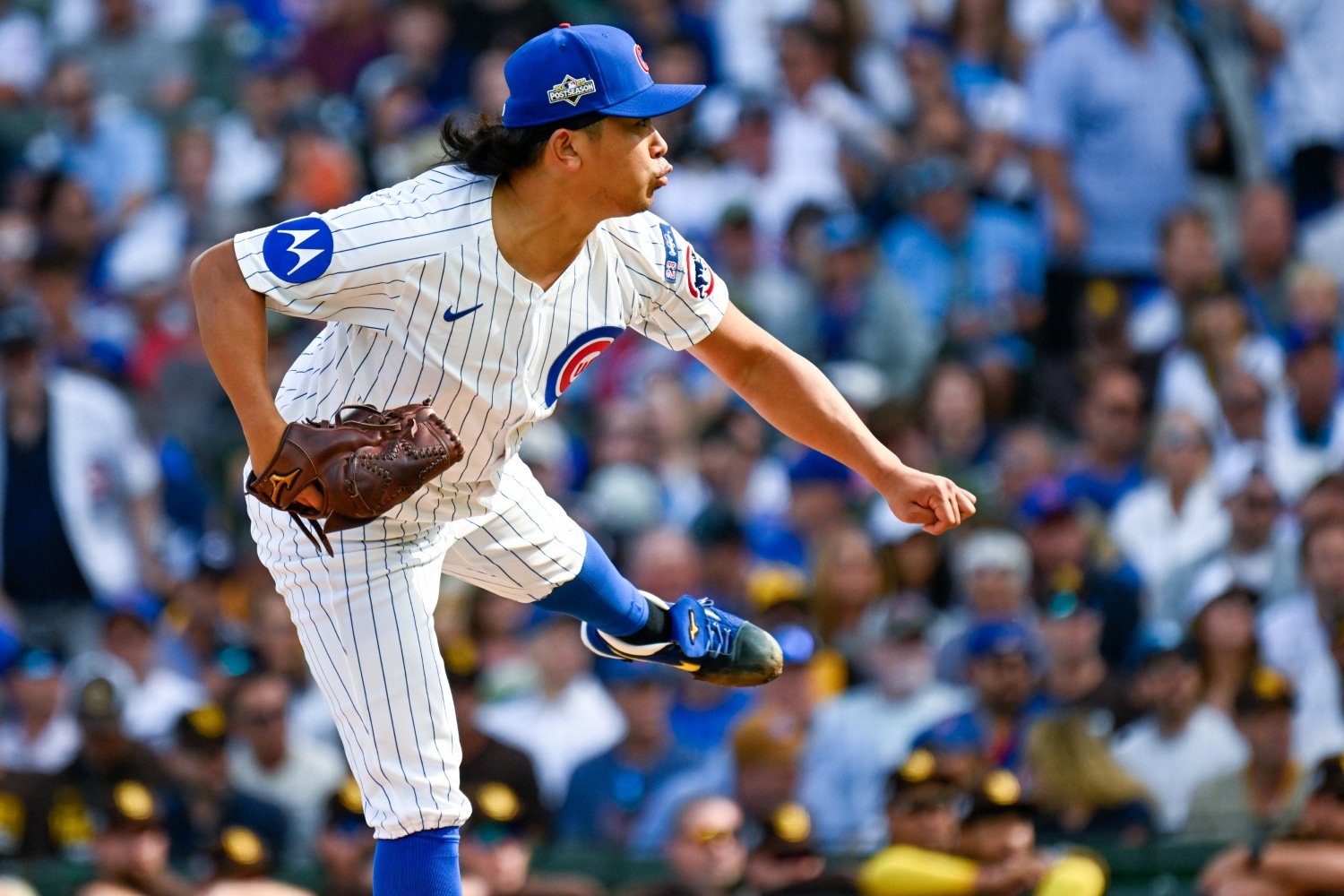 Shota Imanaga has an arm angle problem. He suffered a hamstring strain covering first base during a start at Uecker Field on May 4, and after missing several weeks, he's been somewhat diminished since returning to the Chicago rotation. His overall numbers this year don't look bad, but he gave up 10 home runs in September alone, and another in Game 2 of the Cubs' Wild Card Series showdown with the Padres. He's gettable right now. The Brewers know Imanaga well. Chicago half-hid him from the Crew in 2024, and he faced them just once—in late May, when they brought him back to reality after an untouchable start to his Stateside career, putting seven runs and eight hits on him in 4 1/3 innings. This season, though, Imanaga faced the Crew every chance he got, missing only the series in June at Wrigley Field while he was on the injured list. The results were mixed; the great pitcher and the great offense wrestled each other to a draw. May 4, The Ueck: 5 2/3 IP, 4 H, 2 ER, 1 BB, 4 K July 30, The Ueck: 5 IP, 5 H, 3 ER, 2 HR, 8 K August 21, Chicago: 7 IP, 3 H, 2 ER, 1 HR, 2 BB, 5 K That's a total of 17 2/3 innings and seven runs allowed, good for a 3.56 ERA. That's a very respectable number, but Imanaga certainly didn't dominate Brewers hitters. Besides, the Brewers not only applied enough pressure to leave Imanaga hobbled at the end of the first outing, but won both that game and the one in August—ostensibly, the time Imanaga gave the Cubs the best chance to win. On a pitcher-friendly day at the Friendly Confines, Brice Turang knocked one through the wind to give the Brewers all the runs they would need in a 4-1 victory. In fact, that homer is a good place to start our discussion of what's eating Imanaga, and how the Brewers might feast against him Monday night. Notice that the target was set on the outer third of the plate, in a 2-0 count, but Imanaga missed all the way across the dish, where Turang could drop the bat head on it and crush a high line drive into the bleachers. As Imanaga has spiraled recently (he had a 6.51 ERA in September and gave up another, very different homer last week against San Diego), that mistake is emblematic of what's causing his problems. Imanaga isn't a high-slot pitcher, and his fastball gets some value from the way its riding, quasi-rising action defies a hitter's expectations due to the fact that he releases it low. However, when he's at his best, his arm angle on the four-seam fastball that fronts his arsenal is up near 40°. That's essentially a standard three-quarters release, and throughout 2024, it's what Imanaga (mostly) maintained. There's an important correlation between his arm angle on a given day and the way the fastball carries, as described by induced vertical break. These are all of Imanaga's career starts in the American majors, by arm angle and IVB (in feet, in this image) on the fastball. I've highlighted four of them: Highest and farthest right, the highest arm angle Imanaga has averaged on his heater in any start in 2025. It's lower than that of 17 starts he made last year. Second-highest, just above the trendline on the left side, Imanaga's start against the Brewers in August in Chicago; Just below and to the right of that, indicating an infinitesimally higher arm slot but less vertical climb, his start against San Diego last week; and Furthest left and lowest, his start at The Ueck on July 30. In short, all year, Imanaga's arm angle on the heater has been trending down. That's crucial, because a lower arm angle means more strikes and more called strikes when a batter doesn't swing, but also, fewer whiffs and more hard contact when they do. Arm Angle Range Zone % Called Strike % Whiff % Exit Vel. Launch Angle Under 35° 62.3 19.5 12.1 94.4 26° 35-38° 62.3 16.5 15 93 31° 38-41° 58.7 15 16 92.2 25° 41-44° 59.1 13.4 22.9 91.7 27° Over 44° 56.5 15.2 18.6 92.4 28° Lately, Imanaga has been throwing a lot more of the first two lines of heater than of the bottom three. That's how Turang was able to crack so solidly into that ball in August, and why the southpaw has been more vulnerable with the heater recently. despite a small uptick in velocity. The ball is finding the middle of the zone much more often, and running into hitters' barrels instead of hppping over them. That's (at least in part) due to his mechanics breaking down a bit. The Brewers also got to Imanaga back in July, in that start when his average arm angle was even lower—but it was more because of the other major problem he's had lately. He's not able to leave the zone reliably with his splitter, and if you sit on it in certain situations, you can make his ears ring with it. OHl3UGVfWGw0TUFRPT1fVTFWWlZsd0ZCRkFBREFNR1ZBQUhBd1pmQUZsV1V3QUFBd05SQUFRRVUxY0VVUXBm.mp4 That day, Imanaga's splitter just couldn't dip below the zone much; he struggles to get downward action on it when his arm angle drops. Here's all the splitters he threw Brewers batters in that five-inning, two-homer outing. Notice how many they were able to foul off, and where they hit the ball fair: when he left it up and on the plate. As you can see, he can still be nasty when he does get the splitter to dive; he drew a couple of whiffs that way. If he's not consistently going strike-to-ball with that pitch, however, he's hittable. The Brewers struck out eight times in his five innings that day, but got their pound of flesh by hitting it hard when they did make contact. With a pitcher like Imanaga, that's often the key. It's not just that outing in isolation. Ever since his injury in early May, Imanaga has been leaving more splitters in the zone. We could see the Brewers come out with an aggressive approach again, just as they had against Matthew Boyd Saturday, because Imanaga's two best offerings—that four-seamer and the splitter that is supposed to be its partner in crime—aren't in-zone bat-missers, and he can't get out of the zone above (with the heater) or below (with the splitter) right now. Alas, Imanaga is wily, and he'll have a counteradjustment ready. Beginning with that much better start against the Crew in August (albeit in a loss), he's ramped up his usage of the sweeper and slider to right-handed batters, so that they can't sit as easily on the splitter and the fastball away. Much of the magic of that successful all-or-nothing approach the Brewers used in late July lies in being able to get him down to two pitches, and he's emphasizing his third offering to neutralize that idea. Brewers righties will have to be disciplined and lay off the breaking ball, keeping their focus on the outer half and seeing the heater or splitter to their barrels. That's what they did so well in July. Imanaga earned several called strikes by throwing breaking balls to the inner half against righties for the Brewers, but they stayed in their game plan and drove the ball when he threw what they wanted. By the time team and pitcher saw each other again three weeks later, Imanaga had tweaked things. He landed the breaking balls as backdoor offerings in the outer third of the zone, especially up, forcing Brewers righties to come out of their plan and giving them too many things to contend with. The splitter worked anew, missing a few bats even within the zone and taking the sting out of Milwaukee contact low and away. Thank goodness for that mistake to Turang; it was the only significant mistake Imanaga made all day in that outing. The onus, then, is on the Brewers to make a new set of adjustments, not only responding to Imanaga's latest but anticipating his next ones. If he can load up the outer half with the breaking stuff even to righties, he might try running his fastball in on their hands a bit to take advantage of them looking soft and away. If they're ready for that, given his arm angle problem, they should be able to get the barrel around those offerings and hit him for power. If not, they'll be tied up and in lots of trouble. The lower slot suggests that Imanaga is slightly but importantly compromised. The Brewers should continue treating him like a wounded animal, and hunting for the moments when he shows his weaknesses. However, he's dangerous, even in this diminished state. He has the ability to use a slight alteration of his arsenal and/or approach to stymie a lineup, just as Freddy Peralta did to the Cubs in Game 1. The Brewers have a good scouting report on him, and they've forced him to make some changes. They can continue looking for the characteristic mistakes that will be especially hittable, right now, but they also need to be ready: Imanaga showed them just six weeks ago that he remains flexible and can still beat them, or at least give his team a chance to do so.
-
- 2
-
-
-
- shota imanaga
- william contreras
- (and 1 more)
-
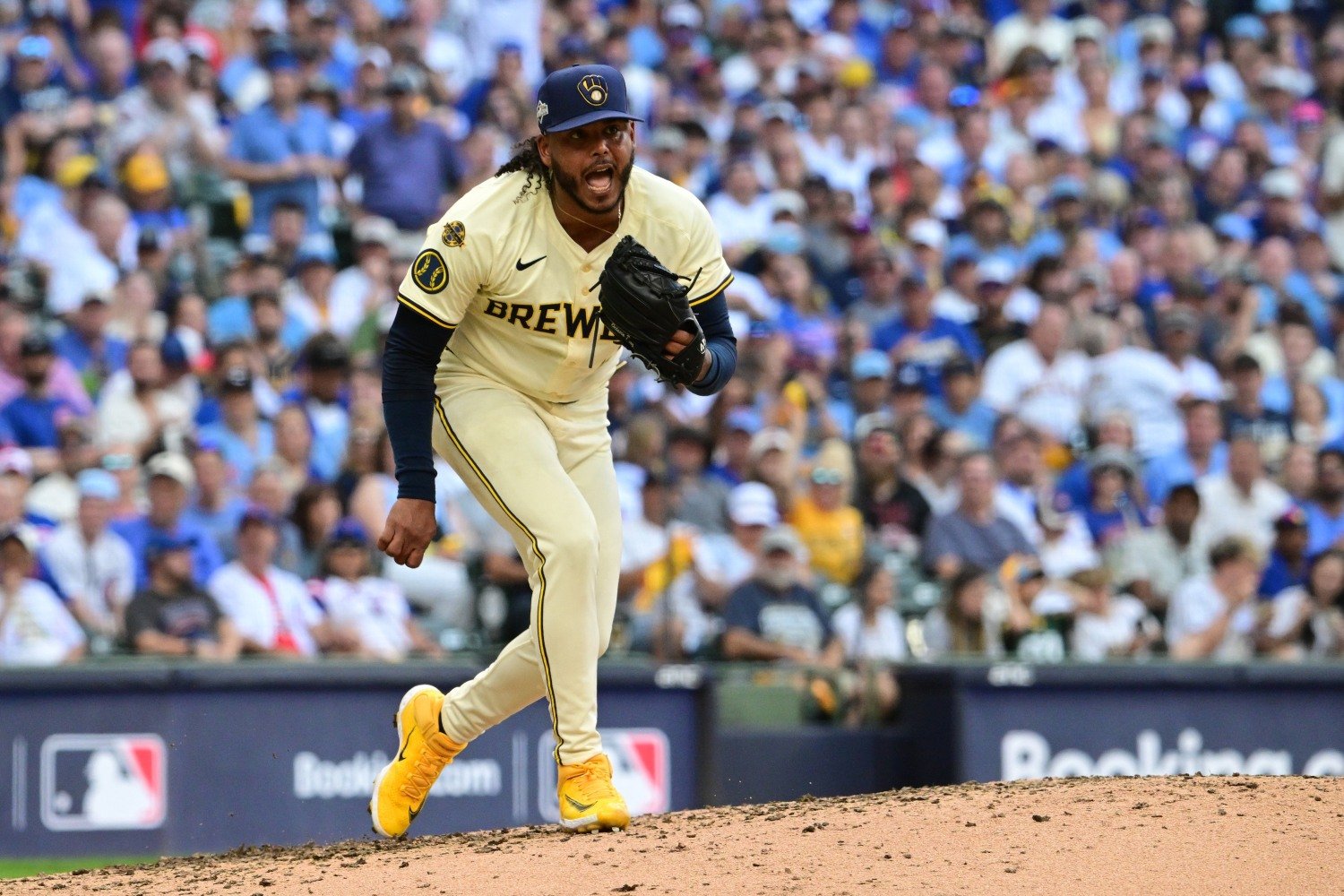 Michael Busch got the better of Freddy Peralta at the very beginning of his day. Ian Happ and Carson Kelly put good wood on him at the very end of it. In between, though, Peralta utterly dominated, securing a win in the first game of what should be one of the most hard-fought Division Series rounds in baseball history. The Brewers' ace got 17 outs and left with a comfortable 9-2 lead, having struck out nine batters and walked three. In a 95-pitch effort, Peralta induced 14 swings and misses, but he also controlled the quality of the Cubs' contact well when they did put it in play. He used his whole arsenal, and seemed to be one thought ahead of Chicago all afternoon. Between Busch's leadoff home run and Happ's solo shot in the sixth, Peralta only allowed four baserunners, and he seemed to slice through the vaunted Chicago lineup with relative ease. His velocity and movement were right where they usually are, and his command came and went, but his plan—the gameplan he and William Contreras constructed and then adapted to frustrate Cubs hitters—was as good as it's ever been. Almost immediately, it became clear that the Cubs were trying to pin Peralta down to two pitches from each side of the plate: the fastball, and then the changeup to lefties and the slider to righties. They expected something akin to his season-long approach, which still includes throwing the heater over half the time, even in the post-Fastball Freddy Era. They had some reason for that expectation, although the case was not airtight. Peralta faced the Cubs four times this regular season—once in each series in which the two teams met—and had a mixed bag of results, drawn from a widely varying set of approaches and looks. The background colors here aren't just for looks. In his first (May 4) and last (August 18) start of the regular season against Chicago, Peralta was excellent. In those two starts (one each at Uecker Field and Wrigley Field), he pitched a combined 12 innings of scoreless ball, allowing just seven hits and four walks while striking out 13. On the other hand, in starts on June 19 at Wrigley and on July 30 in Milwaukee, Peralta pitched just nine combined innings, allowing seven hits, walking six, and striking out just nine. He surrendered three homers and a total of eight runs in those two starts. While the Cubs certainly don't have his number (the way the Brewers do on Matthew Boyd, for instance), this has been a pretty even battle of ace hurler and top-tier offense this season. Peralta can't be faulted for not giving them enough different ideas. In his two successful starts against them, he was fastball-heavy, but not in a way that suggests a lack of thinking hard about how to mix in the rest of his arsenal. Early in the season, there were other outings in which (like that one in early May) he essentially ditched his slider, for which he didn't always have a feel. Some of what we're seeing above is a savvy veteran changing his plan of attack each time he sees a too-familiar foe. Another part is just the evolution of a pitcher over the course of a season, and the way Peralta is always problem-solving when he's on the mound. Here's what that same chart plotting the movement of his pitches looked like Saturday. As has been happening in many of his recent starts, Peralta's slider and curveball blended with one another quite a bit. He's leaned into that lately, as the sweep he formerly had on the slider increasingly eludes him; he just plays across a spectrum of speed and depth with a pitch that has more or less the same shape. You could say that he only has one breaking ball now. You could say he has three. To be sure, though, the slider and curveball are less distinct than they have been in the past. Initially, Peralta did try to set up lefties with his high fastball, then get them out with his changeup. The Cubs proved ready enough to force a different plan of attack, as the start wore on. Busch's leadoff homer came on the fastball, showing he was more than ready for it. Throughout the day, the changeup bore relatively little fruit against lefties. That red dot below the strike zone is the first-pitch change Pete Crow-Armstrong hit hard through the right side in the second inning. About then, Peralta and Contreras realized some Cubs were sitting on that offering, and that they were unlikely to find many of their outs with that offering to those batters. Instead, they went to the curveball, which sometimes blended with the slider. Some righties only feel comfortable working their breaking ball into the space below the zone to lefties—and for some righties, that's true with very good reason. Peralta, however, is happy to work the backdoor breaker, and he and Contreras begun whittling away the outer edge for Cubs hitters by hooking the ball onto the outer edge with a steep downward drop. As you can see, that's where he got a lot of his whiffs against those batters. The black dot in the zone is a foul tip by Ian Happ, which came on a two-strike count and thus resulted in a strikeout. Peralta got two other punchouts with curveballs to lefties, alone. Just as importantly, late in the game, he used that pitch to take the bite out of the sluggers' bats. In the sixth, he teased Kyle Tucker with curves away, and even though Tucker sat on one, he had to swing so slowly and so far outside his usual bat path that he flied lazily to left field. To righties, the story was similar—which is to say, it was flipped. Right from the jump, the righty bats in the Cubs lineup spat on the slider low and away; there was going to be no joy for Peralta in setting them up with the fastball on the outer edge and then getting a chase on the breaking ball. When an opponent is trying desperately to keyhole you on two pitches, though, it's often as simple as giving them a third one to confound their plan. As he's done often this year, Peralta went without hesitation to the right-on-right changeup, and it wrecked the anxious Cubs hitters—especially because they wanted so badly to hit their way back into the game. That he was landing so many of those changeups in the bottom part of the zone certainly helped; his execution of that particular offering was flawless. But the Cubs did some of the work for him, hunting fastballs so hard that they struck out multiple times on the changeup and gave Peralta some quick at-bats with early, weak contact on it, too. The red dot in the image above is the last pitch Peralta threw all day; he finally left a changeup up and Carson Kelly hit it viciously, but only for a single. Peralta did give up the two homers, and a bit of hard contact besides. The Cubs' bats are lively right now, and when they had him pegged, they produced dangerous contact. Mostly, though, they were fooled. Look at Chicago's batted-ball distribution against Peralta by exit velocity and launch angle, and you can see two things: A number of utterly harmless fly balls by usually dangerous hitters, induced by the way Peralta changed speeds and forced weak contact with both his fastball and his softer stuff; and A big hole where more batted balls ought to be—a negative space that speaks to the value of striking out nine against a team that hits hard line drives. I've used a yellow circle to indicate (1), below, and a red rectangle to indicate (2). Had the Cubs made better or quicker adjustments, Peralta might have had a harder time of it. His command of the breaking ball got shakier as the game went on, as if once he started working it to the arm side against lefties, he could no longer steer it to the glove side. However, he used his fastball to great effect in a few key moments, finding the players and the situations in which there was no way to cover a well-located heater—and the Cubs never did compel him to make a third-level swerve. There are no guarantees. If the Cubs force a fourth game and Peralta takes the ball again, it could continue the pattern of this season between the two combatants. Even in that case, though, it's worth noting that while the Brewers have won all three good Peralta starts against Chicago this year, the Cubs only secured victory in one of the two rougher ones. Peralta might have a whole new plan (or feel for a different sector of his arsenal) if he has to face the Cubs one more time, and even if they beat him in the next round of cat-and-mouse, he's likely to keep his team in the game. After the way he mowed down Chicago in Game 1, the best news is, Game 4 might not have to happen, anyway.
 -
Image courtesy of © Benny Sieu-Imagn Images Michael Busch got the better of Freddy Peralta at the very beginning of his day. Ian Happ and Carson Kelly put good wood on him at the very end of it. In between, though, Peralta utterly dominated, securing a win in the first game of what should be one of the most hard-fought Division Series rounds in baseball history. The Brewers' ace got 17 outs and left with a comfortable 9-2 lead, having struck out nine batters and walked three. In a 95-pitch effort, Peralta induced 14 swings and misses, but he also controlled the quality of the Cubs' contact well when they did put it in play. He used his whole arsenal, and seemed to be one thought ahead of Chicago all afternoon. Between Busch's leadoff home run and Happ's solo shot in the sixth, Peralta only allowed four baserunners, and he seemed to slice through the vaunted Chicago lineup with relative ease. His velocity and movement were right where they usually are, and his command came and went, but his plan—the gameplan he and William Contreras constructed and then adapted to frustrate Cubs hitters—was as good as it's ever been. Almost immediately, it became clear that the Cubs were trying to pin Peralta down to two pitches from each side of the plate: the fastball, and then the changeup to lefties and the slider to righties. They expected something akin to his season-long approach, which still includes throwing the heater over half the time, even in the post-Fastball Freddy Era. They had some reason for that expectation, although the case was not airtight. Peralta faced the Cubs four times this regular season—once in each series in which the two teams met—and had a mixed bag of results, drawn from a widely varying set of approaches and looks. The background colors here aren't just for looks. In his first (May 4) and last (August 18) start of the regular season against Chicago, Peralta was excellent. In those two starts (one each at Uecker Field and Wrigley Field), he pitched a combined 12 innings of scoreless ball, allowing just seven hits and four walks while striking out 13. On the other hand, in starts on June 19 at Wrigley and on July 30 in Milwaukee, Peralta pitched just nine combined innings, allowing seven hits, walking six, and striking out just nine. He surrendered three homers and a total of eight runs in those two starts. While the Cubs certainly don't have his number (the way the Brewers do on Matthew Boyd, for instance), this has been a pretty even battle of ace hurler and top-tier offense this season. Peralta can't be faulted for not giving them enough different ideas. In his two successful starts against them, he was fastball-heavy, but not in a way that suggests a lack of thinking hard about how to mix in the rest of his arsenal. Early in the season, there were other outings in which (like that one in early May) he essentially ditched his slider, for which he didn't always have a feel. Some of what we're seeing above is a savvy veteran changing his plan of attack each time he sees a too-familiar foe. Another part is just the evolution of a pitcher over the course of a season, and the way Peralta is always problem-solving when he's on the mound. Here's what that same chart plotting the movement of his pitches looked like Saturday. As has been happening in many of his recent starts, Peralta's slider and curveball blended with one another quite a bit. He's leaned into that lately, as the sweep he formerly had on the slider increasingly eludes him; he just plays across a spectrum of speed and depth with a pitch that has more or less the same shape. You could say that he only has one breaking ball now. You could say he has three. To be sure, though, the slider and curveball are less distinct than they have been in the past. Initially, Peralta did try to set up lefties with his high fastball, then get them out with his changeup. The Cubs proved ready enough to force a different plan of attack, as the start wore on. Busch's leadoff homer came on the fastball, showing he was more than ready for it. Throughout the day, the changeup bore relatively little fruit against lefties. That red dot below the strike zone is the first-pitch change Pete Crow-Armstrong hit hard through the right side in the second inning. About then, Peralta and Contreras realized some Cubs were sitting on that offering, and that they were unlikely to find many of their outs with that offering to those batters. Instead, they went to the curveball, which sometimes blended with the slider. Some righties only feel comfortable working their breaking ball into the space below the zone to lefties—and for some righties, that's true with very good reason. Peralta, however, is happy to work the backdoor breaker, and he and Contreras begun whittling away the outer edge for Cubs hitters by hooking the ball onto the outer edge with a steep downward drop. As you can see, that's where he got a lot of his whiffs against those batters. The black dot in the zone is a foul tip by Ian Happ, which came on a two-strike count and thus resulted in a strikeout. Peralta got two other punchouts with curveballs to lefties, alone. Just as importantly, late in the game, he used that pitch to take the bite out of the sluggers' bats. In the sixth, he teased Kyle Tucker with curves away, and even though Tucker sat on one, he had to swing so slowly and so far outside his usual bat path that he flied lazily to left field. To righties, the story was similar—which is to say, it was flipped. Right from the jump, the righty bats in the Cubs lineup spat on the slider low and away; there was going to be no joy for Peralta in setting them up with the fastball on the outer edge and then getting a chase on the breaking ball. When an opponent is trying desperately to keyhole you on two pitches, though, it's often as simple as giving them a third one to confound their plan. As he's done often this year, Peralta went without hesitation to the right-on-right changeup, and it wrecked the anxious Cubs hitters—especially because they wanted so badly to hit their way back into the game. That he was landing so many of those changeups in the bottom part of the zone certainly helped; his execution of that particular offering was flawless. But the Cubs did some of the work for him, hunting fastballs so hard that they struck out multiple times on the changeup and gave Peralta some quick at-bats with early, weak contact on it, too. The red dot in the image above is the last pitch Peralta threw all day; he finally left a changeup up and Carson Kelly hit it viciously, but only for a single. Peralta did give up the two homers, and a bit of hard contact besides. The Cubs' bats are lively right now, and when they had him pegged, they produced dangerous contact. Mostly, though, they were fooled. Look at Chicago's batted-ball distribution against Peralta by exit velocity and launch angle, and you can see two things: A number of utterly harmless fly balls by usually dangerous hitters, induced by the way Peralta changed speeds and forced weak contact with both his fastball and his softer stuff; and A big hole where more batted balls ought to be—a negative space that speaks to the value of striking out nine against a team that hits hard line drives. I've used a yellow circle to indicate (1), below, and a red rectangle to indicate (2). Had the Cubs made better or quicker adjustments, Peralta might have had a harder time of it. His command of the breaking ball got shakier as the game went on, as if once he started working it to the arm side against lefties, he could no longer steer it to the glove side. However, he used his fastball to great effect in a few key moments, finding the players and the situations in which there was no way to cover a well-located heater—and the Cubs never did compel him to make a third-level swerve. There are no guarantees. If the Cubs force a fourth game and Peralta takes the ball again, it could continue the pattern of this season between the two combatants. Even in that case, though, it's worth noting that while the Brewers have won all three good Peralta starts against Chicago this year, the Cubs only secured victory in one of the two rougher ones. Peralta might have a whole new plan (or feel for a different sector of his arsenal) if he has to face the Cubs one more time, and even if they beat him in the next round of cat-and-mouse, he's likely to keep his team in the game. After the way he mowed down Chicago in Game 1, the best news is, Game 4 might not have to happen, anyway. View full article
-
Image courtesy of © Jovanny Hernandez / Milwaukee Journal Sentinel / USA TODAY NETWORK via Imagn Images The Padres and Cubs have done exactly what the Brewers hoped they would this week: play two tough, evenly matched games that broke down 1-1, forcing a decisive Game 3 Thursday. Whichever team advances to face the Crew in the NLDS beginning Saturday, they'll have left a little bit of themselves at Wrigley Field. Even when Game 1 of the NLDS begins, the visitors won't be especially fresh. The Brewers, by contrast, need worry (if at all) only about rust. They've had four days off, and have one more left. There's been time for further convalescence by Trevor Megill, who returned from his forearm strain Sunday, and for Jose Quintana to get closer to full health, to boot. The team has also hosted workouts at Uecker Field over the last few days, to ensure everyone remains ready and to evaluate their options as they prepare to attempt their first deep playoff run since 2018. Let's take a beat, now, to consider those options for ourselves. Here's the best projection we can muster of the team's NLDS roster, based on the limited information available about a few players nursing injuries and on the way players performed and were used late in the campaign. Catchers William Contreras Danny Jansen Contreras hasn't been fully healthy all season, so it seemed maddeningly fitting that he picked up a new pain point during the final fortnight of the season. Hit in the back of his mitt hand on a swing, Contreras is still dealing with a bruise. Since he's been playing through a fractured finger on that hand all season, though, it's safe to say that he'll be in the lineup come Saturday. There's an argument for sliding him down in the batting order somewhat, because a tender hand makes getting off one's 'A' swing a bit more difficult, but even that seems unlikely. Infielders Andrew Vaughn Brice Turang Joey Ortiz Caleb Durbin Jake Bauers Andruw Monasterio Here, we're predicting that neither Rhys Hoskins nor Anthony Seigler will make the cut for the playoff run ahead. That shouldn't come as any significant surprise, given the lack of a real role created for Hoskins when he returned from his thumb injury. Seigler never quite found his stride in the majors and didn't even stick on the regular-season roster near the end of the year. The only case to make for carrying him is that his versatility on the infield could have shielded the team from any unforeseen injury issues. We're betting the Brewers will prefer to roll the dice on Andruw Monasterio being able to do that for them, instead. Outfielders Christian Yelich Jackson Chourio Blake Perkins Sal Frelick Isaac Collins Brandon Lockridge Most of these are extremely uncontroversial. Isaac Collins's role shrank as the season wound down, reflecting the fact that both his bat and his glove seemed to sag beginning in mid-August. Still, he's safely on the roster. Brandon Lockridge is the most intriguing inclusion. He's taking the final spot the team might carve out for hitters, at the expense of Hoskins. It's a straightforward choice of speed over right-handed power (compromised by injury and age, anyway) as the better tactical weapon for Pat Murphy; Lockridge could pinch-run for Andrew Vaughn or Contreras in a variety of plausible scenarios. Starting Pitchers Freddy Peralta Quinn Priester Jose Quintana Now, we're getting into bolder territory. Jose Quintana's recovery from a calf strain appears to be going very well over the last week, and a Game 3 start wouldn't be until Wednesday—leaving the Brewers even more time for him to get fully ready for a lengthy appearance in that contest. Quintana isn't better than Chad Patrick or Tobias Myers, or perhaps even than Jacob Misiorowski, but he's an extremely experienced starter with a postseason track record that supports his case for the third start in this series. Relief Pitchers Abner Uribe Aaron Ashby Jared Koenig Trevor Megill Chad Patrick Nick Mears Tobias Myers Rob Zastryzny Jacob Misiorowski Bulk work out of the pen is very possible, even in this short series with multiple days off threaded in early. Patrick looks poised to get a good chunk of it, along with Myers. The rest of this group is all about shortening games and intimidating hitters with great stuff or desperately pitcher-friendly matchups. Abner Uribe figures to remain the relief ace, but Megill might yet reclaim his place as the nominal closer before the postseason gets too far underway. Misiorowski's upside in a short-relief role is obvious. He just has to show enough command to rise to it. Most teams are scrambling to fill their roster with players who have at least some utility for series like these. The Brewers, instead, will leave at least a couple of useful players out of the group and ask them to stay ready in case something changes. They've suffered at least their share of injuries, but still, they've reached October intact enough to make it easy to imagine a push further into October. This might not be exactly the 26-man roster they use Saturday, and even if it is, we might see a change or two if they make it to the next round. View full article
-
Projecting 2025 Brewers NLDS Playoff Roster: The Latest Update
Matthew Trueblood posted an article in Brewers
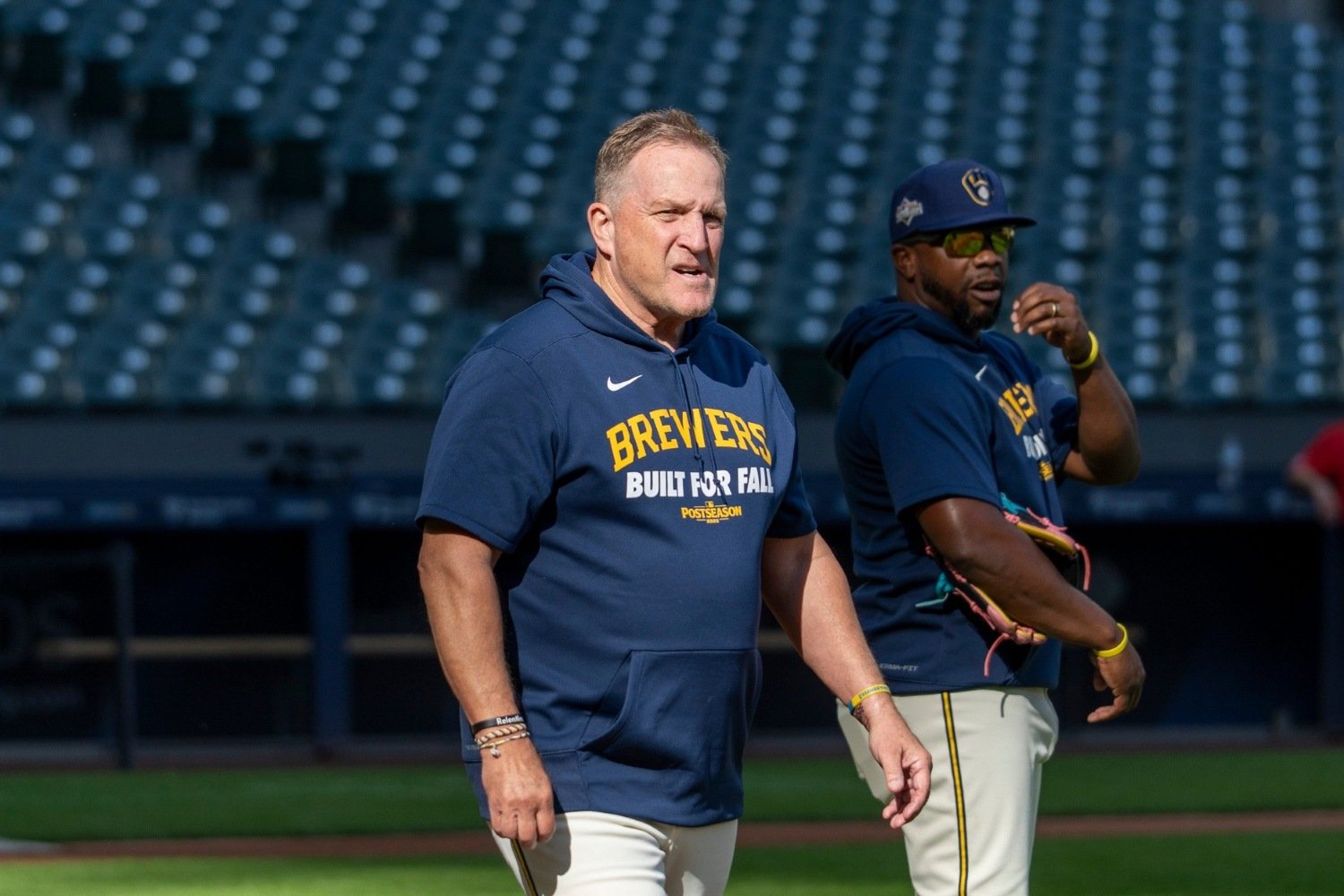 The Padres and Cubs have done exactly what the Brewers hoped they would this week: play two tough, evenly matched games that broke down 1-1, forcing a decisive Game 3 Thursday. Whichever team advances to face the Crew in the NLDS beginning Saturday, they'll have left a little bit of themselves at Wrigley Field. Even when Game 1 of the NLDS begins, the visitors won't be especially fresh. The Brewers, by contrast, need worry (if at all) only about rust. They've had four days off, and have one more left. There's been time for further convalescence by Trevor Megill, who returned from his forearm strain Sunday, and for Jose Quintana to get closer to full health, to boot. The team has also hosted workouts at Uecker Field over the last few days, to ensure everyone remains ready and to evaluate their options as they prepare to attempt their first deep playoff run since 2018. Let's take a beat, now, to consider those options for ourselves. Here's the best projection we can muster of the team's NLDS roster, based on the limited information available about a few players nursing injuries and on the way players performed and were used late in the campaign. Catchers William Contreras Danny Jansen Contreras hasn't been fully healthy all season, so it seemed maddeningly fitting that he picked up a new pain point during the final fortnight of the season. Hit in the back of his mitt hand on a swing, Contreras is still dealing with a bruise. Since he's been playing through a fractured finger on that hand all season, though, it's safe to say that he'll be in the lineup come Saturday. There's an argument for sliding him down in the batting order somewhat, because a tender hand makes getting off one's 'A' swing a bit more difficult, but even that seems unlikely. Infielders Andrew Vaughn Brice Turang Joey Ortiz Caleb Durbin Jake Bauers Andruw Monasterio Here, we're predicting that neither Rhys Hoskins nor Anthony Seigler will make the cut for the playoff run ahead. That shouldn't come as any significant surprise, given the lack of a real role created for Hoskins when he returned from his thumb injury. Seigler never quite found his stride in the majors and didn't even stick on the regular-season roster near the end of the year. The only case to make for carrying him is that his versatility on the infield could have shielded the team from any unforeseen injury issues. We're betting the Brewers will prefer to roll the dice on Andruw Monasterio being able to do that for them, instead. Outfielders Christian Yelich Jackson Chourio Blake Perkins Sal Frelick Isaac Collins Brandon Lockridge Most of these are extremely uncontroversial. Isaac Collins's role shrank as the season wound down, reflecting the fact that both his bat and his glove seemed to sag beginning in mid-August. Still, he's safely on the roster. Brandon Lockridge is the most intriguing inclusion. He's taking the final spot the team might carve out for hitters, at the expense of Hoskins. It's a straightforward choice of speed over right-handed power (compromised by injury and age, anyway) as the better tactical weapon for Pat Murphy; Lockridge could pinch-run for Andrew Vaughn or Contreras in a variety of plausible scenarios. Starting Pitchers Freddy Peralta Quinn Priester Jose Quintana Now, we're getting into bolder territory. Jose Quintana's recovery from a calf strain appears to be going very well over the last week, and a Game 3 start wouldn't be until Wednesday—leaving the Brewers even more time for him to get fully ready for a lengthy appearance in that contest. Quintana isn't better than Chad Patrick or Tobias Myers, or perhaps even than Jacob Misiorowski, but he's an extremely experienced starter with a postseason track record that supports his case for the third start in this series. Relief Pitchers Abner Uribe Aaron Ashby Jared Koenig Trevor Megill Chad Patrick Nick Mears Tobias Myers Rob Zastryzny Jacob Misiorowski Bulk work out of the pen is very possible, even in this short series with multiple days off threaded in early. Patrick looks poised to get a good chunk of it, along with Myers. The rest of this group is all about shortening games and intimidating hitters with great stuff or desperately pitcher-friendly matchups. Abner Uribe figures to remain the relief ace, but Megill might yet reclaim his place as the nominal closer before the postseason gets too far underway. Misiorowski's upside in a short-relief role is obvious. He just has to show enough command to rise to it. Most teams are scrambling to fill their roster with players who have at least some utility for series like these. The Brewers, instead, will leave at least a couple of useful players out of the group and ask them to stay ready in case something changes. They've suffered at least their share of injuries, but still, they've reached October intact enough to make it easy to imagine a push further into October. This might not be exactly the 26-man roster they use Saturday, and even if it is, we might see a change or two if they make it to the next round.
- 4 comments
-
- 2
-
-
- jose quintana
- trevor megill
- (and 4 more)
-
Image courtesy of © Mark Hoffman/Milwaukee Journal Sentinel / USA TODAY NETWORK via Imagn Images Caleb Durbin knows what he's doing. He's not diving in front of the ball, trying to get hit—there are guys in the league who do that—but he's smart and tough and fearless enough to stay in front of it if it's coming right at him. In his rookie campaign, Durbin drew just 30 walks in 506 plate appearances, but he was also hit by pitches 24 times. If, as they say, a walk is as good as a single, a plunking is also as good as a walk, and Durbin's .334 on-base percentage owes much to the fact that he was as likely to catch the ball with his body as to his actual plate discipline. He struck out just 9.9% of the time, and that, too, can be attributed partially to his proclivity for getting in the way; he would often get hit before a pitcher could work their way to the depth of count required. By and large, fans and analysts alike discount the skill of getting hit by pitches—and not without reason. Drawing walks by making superb swing decisions is more valuable, because it's more likely to unlock other dimensions of offensive value—hitting for average and power, for instance. Durbin did make good swing decisions this year, but not exceptionally good ones. He didn't draw walks at a good rate, except insofar as you give him full credit for his reaches via plunk. There's also a question of how often one can get hit by pitches without getting hurt, and there's undeniably a correlation between getting hit a lot and missing time due to injuries. Finally, there's the question of whether getting hit is a sustainable skill. Talking about Durbin (who had, just then, been sidelined as a precaution after being hit in the arm twice in as many days) back in spring training, his manager vowed that it is. "It’s a skill. Not moving," Pat Murphy said, on March 9. "And for certain, not being an early move. The guys that can hang in, turn their head, as opposed to getting out of there." That, indeed, seems to be how Durbin does it. The main question underlying a debate about the stickiness of the skill of getting hit is: will pitchers throw enough balls close to you for the opportunities to get hit to even arise? Durbin's style answers that question. Only 35 (1.9%) of the pitches he saw this year were way inside, in the areas labeled "Waste" pitches by Statcast because they're so far in on a righty batter. That's roughly average. However, he got hit by 17 of those pitches, a whopping 48.6% of his chances. Not only is that the highest rate among right-handed batters, but the second-best number was 31.1%. The difference between Durbin and second place, on a list of 122 qualifying righty bats, is as large as the difference between second place and 32nd. Here's a chart showing the location of those 17 times when he didn't move. You're probably noticing that 17 is not 24. Yes, Durbin also got hit seven times on balls closer to the zone, though the frequency at which he was hit on such pitches was not nearly as unusual as the rate at which he was hit on the ones farther in. Again, Durbin's not necessarily trying to get hit. It's about going up there willing to accept being hit, just as one must be willing to accept walks even while looking to hit the ball. Trying to get hit looks like this. Randy Arozarena is the only batter who was hit more times than Durbin, overall (although in roughly 200 more plate appearances), and 16 of his 27 plunkings came when he crowded the plate (often with two strikes) and wore one semi-intentionally, even when the ball was close to the zone. Durbin is more subtle. Murphy's characterization of it in March was perfect: the art lies in simply not moving out of the way. If one doesn't make at least half a vague effort to do so, the umpire can cancel the award of first base, but that hardly ever happens. Besides, Durbin is a good actor. He naturally opens up a bit early, because he wants to get around the ball inside and pull it, but he doesn't step into the bucket. Especially with two strikes, he stays in line and close to the plate, and he lets the natural, linear movement of his swing carry him into the ball instead of away from it. He can make a show of trying to get out of the way, then, without having any real chance to do so. Staying home that way also lets Durbin cover the outer third of the plate well, especially in two-strike counts. The danger that he'll get hurt is real, and isn't going anywhere. He's always shown a willingness to wear one, within reason, but he didn't get hit this much in the minors. The combined influences of Murphy and plunkmaster-turned-coach Rickie Weeks might have helped him learn to embrace this aspect of his game, but in the process, he might also have taken a few more bruises than is wise. He hasn't run as well or as often as one might have anticipated, when he was stealing at almost every opportunity last year. Some of that is that it's harder to run against big-league batteries, but another part is that his body has taken a pounding. Nonetheless, on balance, you have to give Durbin real credit for all the thwacks he's absorbed in the name of getting on base. He's a great complementary piece in the Brewers lineup. Only William Contreras had a higher Win Probability Added than Durbin this year, thanks in no small part to those times when he was hit by pitches to extend rallies or get himself out of a count in which the pitcher was ahead. This skill is real, and can be immensely valuable. It comes with difficulties and tradeoffs, but that's part of baseball. As long as Durbin remains willing to stay in front of a ball flying at him, he'll hold onto a significant source of offensive value. It might even be the kind of small thing that becomes big at some point during the Brewers' playoff run. View full article
-
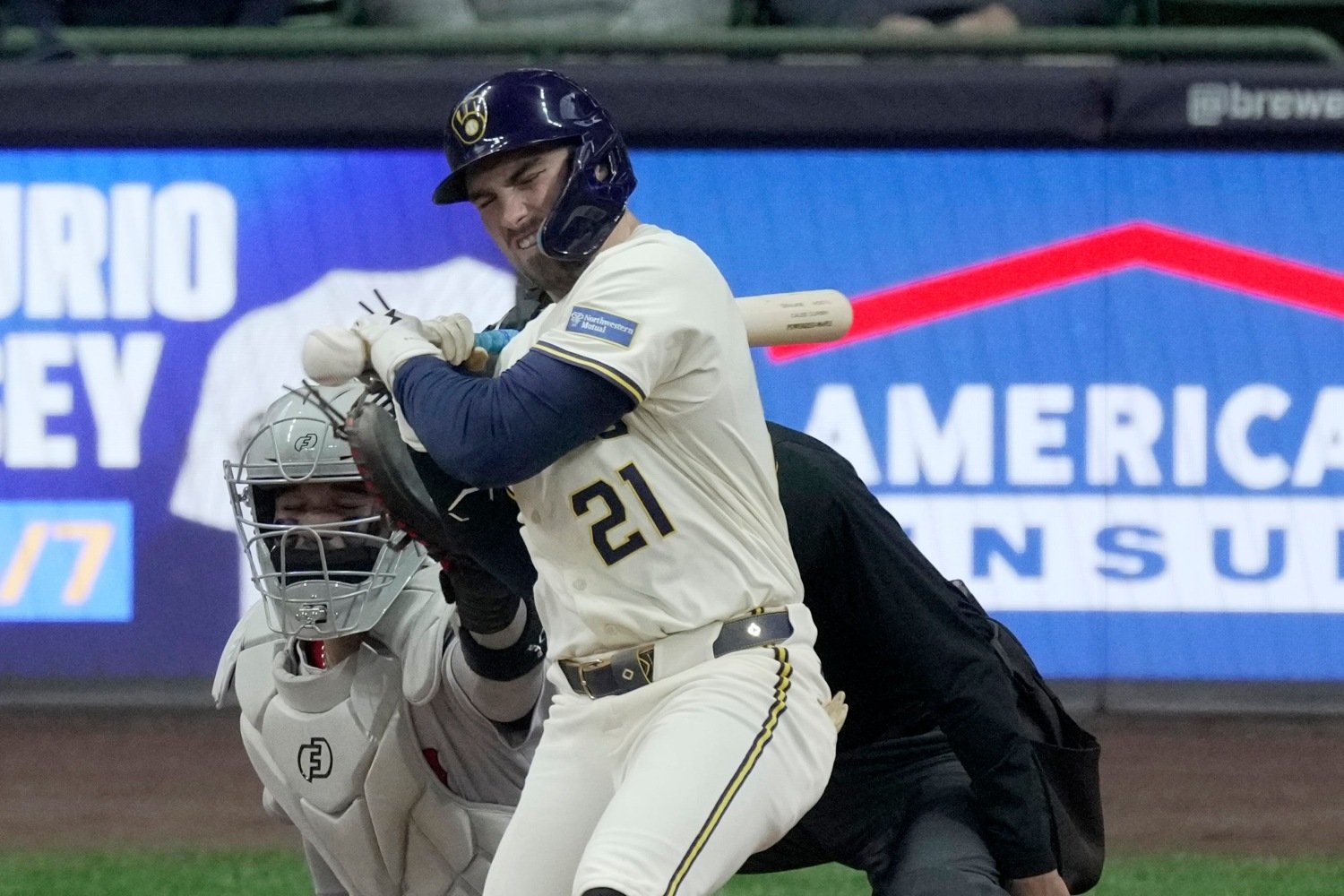 Caleb Durbin knows what he's doing. He's not diving in front of the ball, trying to get hit—there are guys in the league who do that—but he's smart and tough and fearless enough to stay in front of it if it's coming right at him. In his rookie campaign, Durbin drew just 30 walks in 506 plate appearances, but he was also hit by pitches 24 times. If, as they say, a walk is as good as a single, a plunking is also as good as a walk, and Durbin's .334 on-base percentage owes much to the fact that he was as likely to catch the ball with his body as to his actual plate discipline. He struck out just 9.9% of the time, and that, too, can be attributed partially to his proclivity for getting in the way; he would often get hit before a pitcher could work their way to the depth of count required. By and large, fans and analysts alike discount the skill of getting hit by pitches—and not without reason. Drawing walks by making superb swing decisions is more valuable, because it's more likely to unlock other dimensions of offensive value—hitting for average and power, for instance. Durbin did make good swing decisions this year, but not exceptionally good ones. He didn't draw walks at a good rate, except insofar as you give him full credit for his reaches via plunk. There's also a question of how often one can get hit by pitches without getting hurt, and there's undeniably a correlation between getting hit a lot and missing time due to injuries. Finally, there's the question of whether getting hit is a sustainable skill. Talking about Durbin (who had, just then, been sidelined as a precaution after being hit in the arm twice in as many days) back in spring training, his manager vowed that it is. "It’s a skill. Not moving," Pat Murphy said, on March 9. "And for certain, not being an early move. The guys that can hang in, turn their head, as opposed to getting out of there." That, indeed, seems to be how Durbin does it. The main question underlying a debate about the stickiness of the skill of getting hit is: will pitchers throw enough balls close to you for the opportunities to get hit to even arise? Durbin's style answers that question. Only 35 (1.9%) of the pitches he saw this year were way inside, in the areas labeled "Waste" pitches by Statcast because they're so far in on a righty batter. That's roughly average. However, he got hit by 17 of those pitches, a whopping 48.6% of his chances. Not only is that the highest rate among right-handed batters, but the second-best number was 31.1%. The difference between Durbin and second place, on a list of 122 qualifying righty bats, is as large as the difference between second place and 32nd. Here's a chart showing the location of those 17 times when he didn't move. You're probably noticing that 17 is not 24. Yes, Durbin also got hit seven times on balls closer to the zone, though the frequency at which he was hit on such pitches was not nearly as unusual as the rate at which he was hit on the ones farther in. Again, Durbin's not necessarily trying to get hit. It's about going up there willing to accept being hit, just as one must be willing to accept walks even while looking to hit the ball. Trying to get hit looks like this. Randy Arozarena is the only batter who was hit more times than Durbin, overall (although in roughly 200 more plate appearances), and 16 of his 27 plunkings came when he crowded the plate (often with two strikes) and wore one semi-intentionally, even when the ball was close to the zone. Durbin is more subtle. Murphy's characterization of it in March was perfect: the art lies in simply not moving out of the way. If one doesn't make at least half a vague effort to do so, the umpire can cancel the award of first base, but that hardly ever happens. Besides, Durbin is a good actor. He naturally opens up a bit early, because he wants to get around the ball inside and pull it, but he doesn't step into the bucket. Especially with two strikes, he stays in line and close to the plate, and he lets the natural, linear movement of his swing carry him into the ball instead of away from it. He can make a show of trying to get out of the way, then, without having any real chance to do so. Staying home that way also lets Durbin cover the outer third of the plate well, especially in two-strike counts. The danger that he'll get hurt is real, and isn't going anywhere. He's always shown a willingness to wear one, within reason, but he didn't get hit this much in the minors. The combined influences of Murphy and plunkmaster-turned-coach Rickie Weeks might have helped him learn to embrace this aspect of his game, but in the process, he might also have taken a few more bruises than is wise. He hasn't run as well or as often as one might have anticipated, when he was stealing at almost every opportunity last year. Some of that is that it's harder to run against big-league batteries, but another part is that his body has taken a pounding. Nonetheless, on balance, you have to give Durbin real credit for all the thwacks he's absorbed in the name of getting on base. He's a great complementary piece in the Brewers lineup. Only William Contreras had a higher Win Probability Added than Durbin this year, thanks in no small part to those times when he was hit by pitches to extend rallies or get himself out of a count in which the pitcher was ahead. This skill is real, and can be immensely valuable. It comes with difficulties and tradeoffs, but that's part of baseball. As long as Durbin remains willing to stay in front of a ball flying at him, he'll hold onto a significant source of offensive value. It might even be the kind of small thing that becomes big at some point during the Brewers' playoff run.
 -
Image courtesy of © Katie Stratman-Imagn Images It wasn't exactly pretty, but it wasn't exactly the playoffs, either. Trevor Megill came in to pitch the top of the fourth inning in the Brewers' regular-season finale, with the team down 2-1 and nothing at all at stake for them. He carved through the Reds, with two strikeouts in a clean inning and just 12 pitches. He only induced one whiff, but he also got a whopping five called strikes in the very brief appearance. Most importantly, he walked off the mound healthy when it was over. He's almost certain to be on the team's roster when the National League Division Series begins Saturday. What role he'll fill during that series, though, is much harder to peg. Megill's velocity was down significantly in the appearance, relative to where he's lived throughout his Brewers tenure. He was still throwing roughly 97.5 miles per hour, on average, but for a guy who touches 101 when he's in a lather, that was a noteworthy dip. Losing the same amount of speed on the curveball says his arm isn't working quite the same way, overall, and it eats into some of his potential effectiveness. It's clear that while he felt well enough to return, Megill isn't 100% healthy. You can also see that in the arm angle data, which shows us that his delivery was a bit altered. That spike at the far right is the appearance Sunday, to the highest average arm angle on his fastball in any appearance this year. Megill got good when he permanently raised his slot in mid-2023, which you can also see happening in the image above—but that doesn't necessarily mean higher is better. Working too overhand is a sign that his body isn't quite working as usual, and it led to a lot of misses higher than he intended with his curveball. Megill's movement was fine, and he showed the ability to spin the ball. As we identified just before he went down in August, though, poor command is how his body shows that it's not operating at top efficiency. That he couldn't drive the curve down and did get on top of the fastball a bit and pull it to the glove side makes clear that Megill isn't yet back to full strength. Something unwanted is still happening in his arm. He'll have another week of managed rest and ramp-up behind him, by the time the NLDS begins Saturday. He might also get a tick back on the fastball at that point, because the adrenaline will flow much more freely when the crowd is 40,000 strong and in full playoff roar. That (and what he showed even while still partially compromised Sunday) is enough to instill confidence that he can help the Brewers during their playoff run, but he's not in such good nick as to make him the de facto relief ace for this first round. Until further notice, that honor still goes to Abner Uribe, who looks healthy, fresh, and nastier than the present version of Megill. For now, the Brewers need to treat their erstwhile closer as just another middle-relief option. Hopefully, he continues to regain his form and they stay alive long enough to reconsider that stance later in October. View full article
-
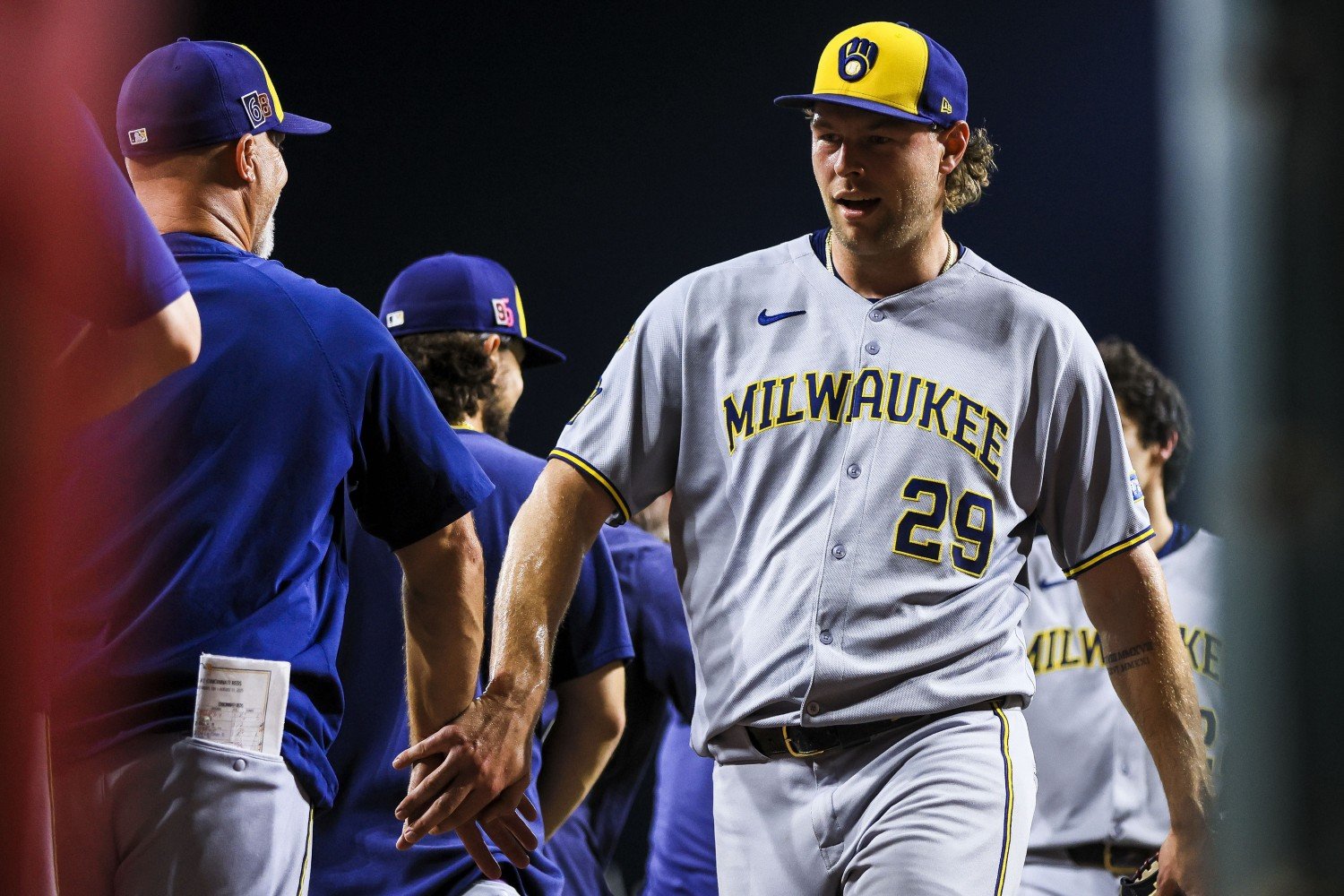 It wasn't exactly pretty, but it wasn't exactly the playoffs, either. Trevor Megill came in to pitch the top of the fourth inning in the Brewers' regular-season finale, with the team down 2-1 and nothing at all at stake for them. He carved through the Reds, with two strikeouts in a clean inning and just 12 pitches. He only induced one whiff, but he also got a whopping five called strikes in the very brief appearance. Most importantly, he walked off the mound healthy when it was over. He's almost certain to be on the team's roster when the National League Division Series begins Saturday. What role he'll fill during that series, though, is much harder to peg. Megill's velocity was down significantly in the appearance, relative to where he's lived throughout his Brewers tenure. He was still throwing roughly 97.5 miles per hour, on average, but for a guy who touches 101 when he's in a lather, that was a noteworthy dip. Losing the same amount of speed on the curveball says his arm isn't working quite the same way, overall, and it eats into some of his potential effectiveness. It's clear that while he felt well enough to return, Megill isn't 100% healthy. You can also see that in the arm angle data, which shows us that his delivery was a bit altered. That spike at the far right is the appearance Sunday, to the highest average arm angle on his fastball in any appearance this year. Megill got good when he permanently raised his slot in mid-2023, which you can also see happening in the image above—but that doesn't necessarily mean higher is better. Working too overhand is a sign that his body isn't quite working as usual, and it led to a lot of misses higher than he intended with his curveball. Megill's movement was fine, and he showed the ability to spin the ball. As we identified just before he went down in August, though, poor command is how his body shows that it's not operating at top efficiency. That he couldn't drive the curve down and did get on top of the fastball a bit and pull it to the glove side makes clear that Megill isn't yet back to full strength. Something unwanted is still happening in his arm. He'll have another week of managed rest and ramp-up behind him, by the time the NLDS begins Saturday. He might also get a tick back on the fastball at that point, because the adrenaline will flow much more freely when the crowd is 40,000 strong and in full playoff roar. That (and what he showed even while still partially compromised Sunday) is enough to instill confidence that he can help the Brewers during their playoff run, but he's not in such good nick as to make him the de facto relief ace for this first round. Until further notice, that honor still goes to Abner Uribe, who looks healthy, fresh, and nastier than the present version of Megill. For now, the Brewers need to treat their erstwhile closer as just another middle-relief option. Hopefully, he continues to regain his form and they stay alive long enough to reconsider that stance later in October.
 -
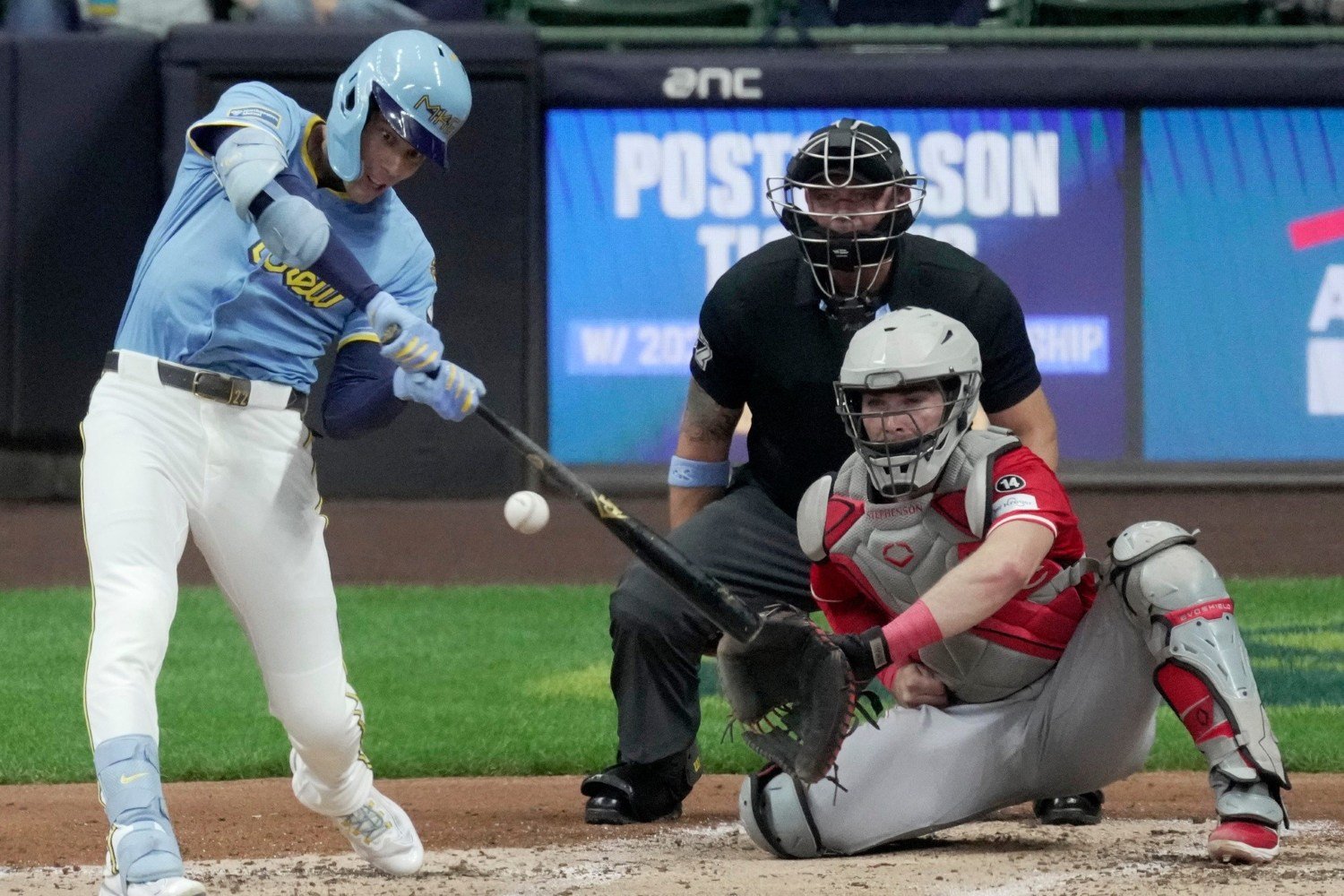 It took Pat Murphy a long time to decide to try out Christian Yelich as his leadoff hitter. Yelich batted second at the dawn of the season, then spent long stretches batting third and (especially as the season wore on) fourth. He even slid to fifth a few times, in August and September. Only in this final week has Murphy batted his highest-paid player first—but now that he's alighted on the idea, he's giving it a real look. Yelich was the leadoff man for each of the six games of the Brewers' final week of the regular season. Taking Yelich's current skill set and the typical role of a leadoff hitter in a vacuum, the peg doesn't seem to be the same shape as the hole. The leadoff spot disproportionately rewards walks and doesn't reward power as much as other lineup spots, because the leadoff hitter is more likely to come up with nobody out and less likely to come up with runners on base than any other player in the lineup. Yelich is running his lowest walk rate in a decade, and his highest isolated power figure since 2020, so now is an odd time to give him any serious consideration atop the lineup card. One argument for placing him first is that Yelich hits the ball on the ground a lot, which makes him (theoretically) prone to hitting into double plays if he comes up with runners on in front of him. In certain past seasons, that's even been true. However, the last two years, Yelich has actually been exceptionally good at avoiding double plays, as judged by the rate at which he hits into them when he comes up in double play situations. Fascinatingly, that seems to be because he's undertaken a real change to become more of a chameleon. He's shown a capacity to change his approach when he bats in spots where double plays are possible, to hit fewer grounders. See how most of the trend lines are essentially flat, but the green one bends noticeably downward? Yelich is more assiduously avoiding the double play by changing either his swing or the pitches he attacks when the twin killing is a possibility, especially over the last two seasons. In one way, that further argues against batting him first, but in another, it's encouraging no matter where he hits. He's impressively adaptable; that might mean that he can do whatever is needed even if he's asked to change roles within the offense. Speaking of adaptability, too, we had better figure out exactly how Yelich has been so productive in the power department this year. He's hitting the ball less hard (and hitting it hard less often), and his average launch angle is down. He's not hitting more fly balls, or pulling the ball more, and the ball is dead this year. Whence have come his 29 home runs? Firstly, we can identify the batted balls that have turned into better power output. Here are his radial charts (showing launch angle and (by distance from the initial point) exit velocity) of batted balls for 2023-24 and for 2025, side by side. As a glance, these look very similar, but note the small donut hole in the image on the right. Yelich has hit fewer medium-speed, low0trajectory liners and high-trajectory grounders this year. He's also hit fewer balls above about 40° of launch angle, and the high-trajectory, well-hit fly balls he has hit have carried much better. But wait. As I already mentioned, the ball isn't flying well this year, league-wide. Why is Yelich having good luck hitting high fly balls that carry out of the park? The answer to that is the same as the answer (or at least, it overlaps with the answer) to why Yelich has hit fewer of those low liners this season, and it gives us insight into how he's changed as a hitter on this side of last year's back surgery. He's also changed over the course of this year, itself. For one thing, over the last two-plus years, Yelich has slowly let go of the idea that he needs to pull the ball to create power. Here's a rolling average of his attack direction when he makes solid contact, with the trend line (in gold) to highlight the direction of change. Yelich has always been an opposite-field hitter first, but in his initial explosion into power hitting back in 2018-19, part of the key was that he would sometimes guess and attack the ball with the intent of driving it to the pull field. Lately, he's doing that less and less. He's still swinging fast and trying to drive the ball, but he's embraced the need to do so to the opposite field, which is truer to his natural stroke. As you'd guess, that means that he's catching the ball deeper in the hitting zone. The ball is getting more on top of Yelich, when he hits it hard, but that means he's less likely to be rolling over it. Thus, he's backspinning the ball better. The final ingredient in this suite of adjustments, though, is that you have to be smart about not chasing the ball down—and, in fact, about getting a pitch with enough air under it to lift the ball naturally. He's getting his 'A' swing off against slightly higher pitches, and that means slightly greater opportunity to let it travel while still getting under it enough to generate lift. Even with these adjustments, sustaining his power surge has proved difficult. Yelich is still a 33-year-old a year removed from back surgery, and entering Sunday, he'd batted just .233/.291/.370 in September. He's not heading into October running especially hot, and moving him to the top of the order hasn't done anything to catalyze a relatively quiet Brewers offense. However, it's easy to see why Murphy trusts Yelich, and why he's giving him a look as the leadoff man after mixing and matching his five best hitters in several ways over the last month. First might not be the best place for Yelich, but third looks like a good spot for Brice Turang, and fifth works nicely for Sal Frelick. Yelich's ability to change what he's doing based on situation and the signals he's getting from his own body makes him a good candidate to slide up and accommodate that construction. It's a testament to the manager's team-over-egos mentality, but also to the player's superb feel for the game and willingness to do whatever the team needs.
 -
Image courtesy of © Mark Hoffman/Milwaukee Journal Sentinel / USA TODAY NETWORK via Imagn Images It took Pat Murphy a long time to decide to try out Christian Yelich as his leadoff hitter. Yelich batted second at the dawn of the season, then spent long stretches batting third and (especially as the season wore on) fourth. He even slid to fifth a few times, in August and September. Only in this final week has Murphy batted his highest-paid player first—but now that he's alighted on the idea, he's giving it a real look. Yelich was the leadoff man for each of the six games of the Brewers' final week of the regular season. Taking Yelich's current skill set and the typical role of a leadoff hitter in a vacuum, the peg doesn't seem to be the same shape as the hole. The leadoff spot disproportionately rewards walks and doesn't reward power as much as other lineup spots, because the leadoff hitter is more likely to come up with nobody out and less likely to come up with runners on base than any other player in the lineup. Yelich is running his lowest walk rate in a decade, and his highest isolated power figure since 2020, so now is an odd time to give him any serious consideration atop the lineup card. One argument for placing him first is that Yelich hits the ball on the ground a lot, which makes him (theoretically) prone to hitting into double plays if he comes up with runners on in front of him. In certain past seasons, that's even been true. However, the last two years, Yelich has actually been exceptionally good at avoiding double plays, as judged by the rate at which he hits into them when he comes up in double play situations. Fascinatingly, that seems to be because he's undertaken a real change to become more of a chameleon. He's shown a capacity to change his approach when he bats in spots where double plays are possible, to hit fewer grounders. See how most of the trend lines are essentially flat, but the green one bends noticeably downward? Yelich is more assiduously avoiding the double play by changing either his swing or the pitches he attacks when the twin killing is a possibility, especially over the last two seasons. In one way, that further argues against batting him first, but in another, it's encouraging no matter where he hits. He's impressively adaptable; that might mean that he can do whatever is needed even if he's asked to change roles within the offense. Speaking of adaptability, too, we had better figure out exactly how Yelich has been so productive in the power department this year. He's hitting the ball less hard (and hitting it hard less often), and his average launch angle is down. He's not hitting more fly balls, or pulling the ball more, and the ball is dead this year. Whence have come his 29 home runs? Firstly, we can identify the batted balls that have turned into better power output. Here are his radial charts (showing launch angle and (by distance from the initial point) exit velocity) of batted balls for 2023-24 and for 2025, side by side. As a glance, these look very similar, but note the small donut hole in the image on the right. Yelich has hit fewer medium-speed, low0trajectory liners and high-trajectory grounders this year. He's also hit fewer balls above about 40° of launch angle, and the high-trajectory, well-hit fly balls he has hit have carried much better. But wait. As I already mentioned, the ball isn't flying well this year, league-wide. Why is Yelich having good luck hitting high fly balls that carry out of the park? The answer to that is the same as the answer (or at least, it overlaps with the answer) to why Yelich has hit fewer of those low liners this season, and it gives us insight into how he's changed as a hitter on this side of last year's back surgery. He's also changed over the course of this year, itself. For one thing, over the last two-plus years, Yelich has slowly let go of the idea that he needs to pull the ball to create power. Here's a rolling average of his attack direction when he makes solid contact, with the trend line (in gold) to highlight the direction of change. Yelich has always been an opposite-field hitter first, but in his initial explosion into power hitting back in 2018-19, part of the key was that he would sometimes guess and attack the ball with the intent of driving it to the pull field. Lately, he's doing that less and less. He's still swinging fast and trying to drive the ball, but he's embraced the need to do so to the opposite field, which is truer to his natural stroke. As you'd guess, that means that he's catching the ball deeper in the hitting zone. The ball is getting more on top of Yelich, when he hits it hard, but that means he's less likely to be rolling over it. Thus, he's backspinning the ball better. The final ingredient in this suite of adjustments, though, is that you have to be smart about not chasing the ball down—and, in fact, about getting a pitch with enough air under it to lift the ball naturally. He's getting his 'A' swing off against slightly higher pitches, and that means slightly greater opportunity to let it travel while still getting under it enough to generate lift. Even with these adjustments, sustaining his power surge has proved difficult. Yelich is still a 33-year-old a year removed from back surgery, and entering Sunday, he'd batted just .233/.291/.370 in September. He's not heading into October running especially hot, and moving him to the top of the order hasn't done anything to catalyze a relatively quiet Brewers offense. However, it's easy to see why Murphy trusts Yelich, and why he's giving him a look as the leadoff man after mixing and matching his five best hitters in several ways over the last month. First might not be the best place for Yelich, but third looks like a good spot for Brice Turang, and fifth works nicely for Sal Frelick. Yelich's ability to change what he's doing based on situation and the signals he's getting from his own body makes him a good candidate to slide up and accommodate that construction. It's a testament to the manager's team-over-egos mentality, but also to the player's superb feel for the game and willingness to do whatever the team needs. View full article


