


Matthew Trueblood
-
Posts
1,964 -
Joined
-
Last visited
-
Days Won
10
Content Type
Profiles
Forums
Blogs
Events
News
2026 Milwaukee Brewers Top Prospects Ranking
Milwaukee Brewers Videos
2022 Milwaukee Brewers Draft Picks
Milwaukee Brewers Free Agent & Trade Rumors, Notes, & Tidbits
Guides & Resources
2023 Milwaukee Brewers Draft Picks
2024 Milwaukee Brewers Draft Picks
The Milwaukee Brewers Players Project
2025 Milwaukee Brewers Draft Pick Tracker
2026 Milwaukee Brewers Draft Tracker: Picks & Bonuses
Store
Downloads
Gallery
Everything posted by Matthew Trueblood
-
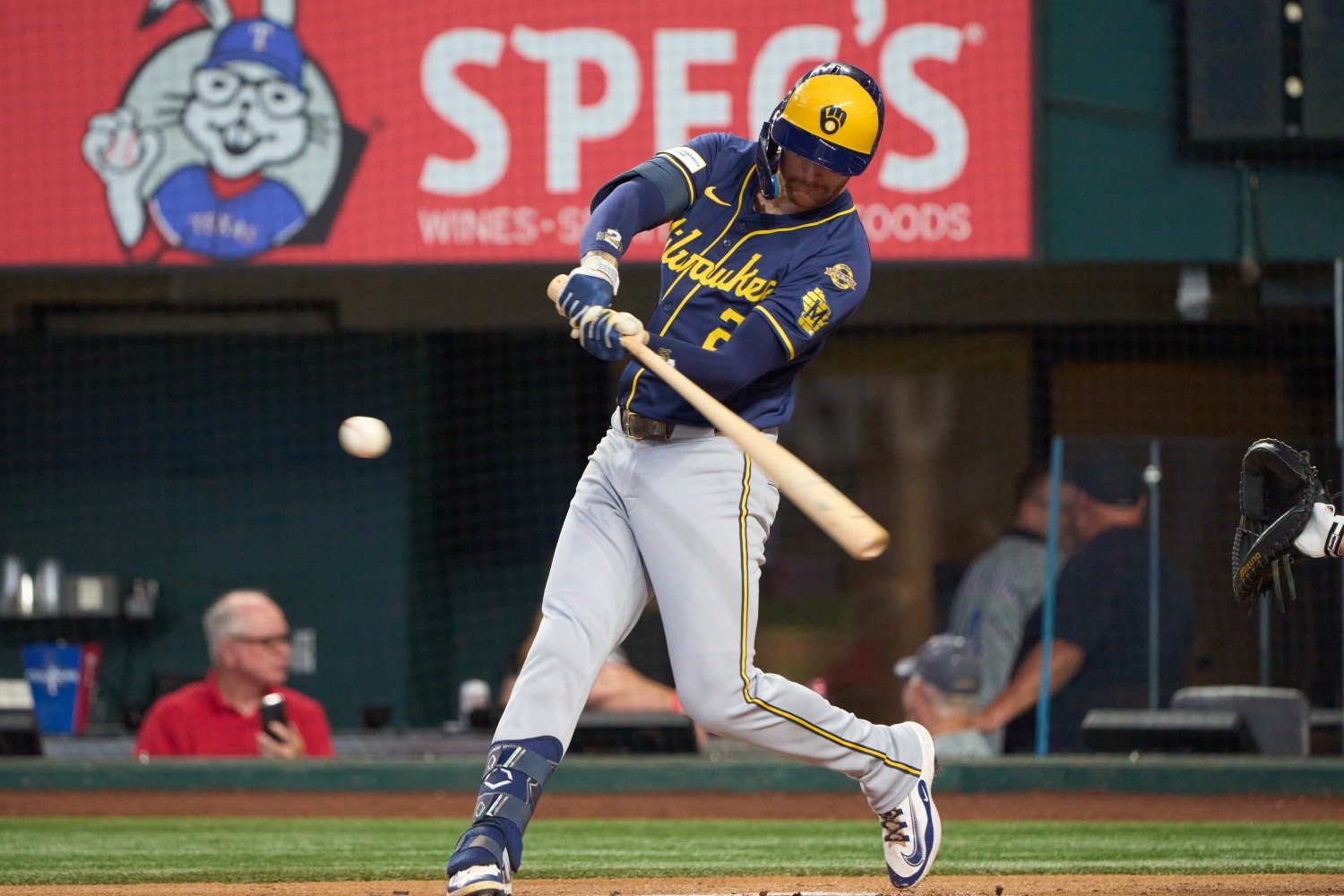 By now, the radical improvement in bat speed and hard-hit rate for Brice Turang this year is a well-known phenomenon. The changes Turang has made to unlock his power production, at long last, are front-page news, because he's been the engine of one of the league's best offenses—especially since the start of August. Much of the change lies in Turang's intention—his approach at the plate. He's learned how opposing pitchers will attack him, and this year, he set out to better attack them, rather than taking a defensive mindset into the batter's box. We've seen a major change in Turang's bat speed, but it's not a matter of entirely overhauling his swing; he just decided to cut it loose much more often. He was never a hitter who couldn't swing fast. He had just chosen not to, and he's now making a different set of choices at the plate. That said, there are more changes afoot than a simple acceleration of his swing. He's swinging faster, and swinging fast more often, but he's also getting much more value out of his fast swings than he did last year—and more out of his slower swings, too. Here's a chart showing the distribution of his swing speed for 2024, colored by run value per 100 pitches. Here's the same chart for 2025. As you can see by the more vibrant red at the right edge of the second chart, Turang has produced about twice as much value on a rate basis when swinging fast this year, in addition to swinging fast more often in the first place. To understand why, you just need to see the change in his batted-ball distribution. Here, side-by-side, are the charts of Turang's batted balls by launch angle and exit velocity for each of the last two years. The closer to the edge of the chart a given point is, the harder that ball was hit. To highlight the big changes from last season to this one, I've added three outlines to each chart. The three bins created by those outlines are: very high fly balls (basically, pop-ups, or lazy flies); hard-hit line drives; and medium- to hard-hit balls at a sharply negative launch angle. Turang has hit many fewer of the high flies and the choppers, and many more of the hard liners and low flies. That all three shifts are good news goes without saying. But how, exactly, is Turang concentrating more of his well-struck balls in a highly productive launch angle band? For that answer, we can't look to bat speed, because swinging faster usually makes one's barrel less accurate, not more so. Most guys who gain bat speed do it partially by flattening their swing, so less of the force they put into the stroke is going into the process of getting the bat moving uphill and more of it is going into the horizontal rush of the rotation. Flat swings tend to mean more contact per swing, but more balls hit at very high or low launch angles; errors in timing or pitch recognition are more likely to produce mishit batted balls. Turang, however, has gone the other way. From last year to this year, and even within this season, his swing has gotten steeper—that is, he's tilted the barrel down more as he brings the bat toward the hitting zone. That increasingly steep stroke gives him more of a range within which he can produce a batted ball between, say, 0° and 30° of launch angle. When he guesses right and he's perfectly on time, he can hit a 430-foot home run, but even when he's wrong or he's slightly late, he has a good chance to split a gap or shoot a one-hopper through the infield. Swinging faster and steeper is a neat trick. It's why he's more productive even before you account for the uptick in bat speed, and it's why he's been both more likely to hit balls in that productive launch-angle band and more successful when he does. Here's the distribution of his batted balls by launch angle for 2024, colored by run value per 100 batted balls. I've overlaid his 2025 distribution, to show the places where he's seen a big change in the frequency and/or the value of hits. He's hit a higher share of his balls in each of these (small) buckets from about 6° upward, but especially from 6° to around 40°. He was highly productive in the lower half of that range even last year, but look at the high 20s and low 30s. That's where he's not only hitting the ball more often, but has turned from not getting much out of it (his slower swing didn't power those fly balls far enough to produce the power they promise) to getting a ton out of it. That's the magic of blending increased tilt and increased swing speed. As he's made that shift, he's become better able to cover the whole plate. Even through July, with his better bat speed and better outcomes across the board, he was largely playing defense on the outer third of the plate. Pitchers could work him there without much fear, knowing that he might poke a single to left field fairly often, but he wasn't going to turn on the ball or split a gap very often. Here's a look at his weighted on-base average by pitch location through the end of July. With the increase in his tilt, though, Turang has become more adept at lifting the ball, and he can even pull pitches on the outer half—or line a ball out on the edge right into center field, as he did on his go-ahead hit against the Padres Wednesday. As a result, he's more dangerous throughout the zone—but especially in the lower half of it. As you'd guess, the steeper a swing is, the better it plays from the belt downward, and the more trouble a hitter tends to have with pitches above the navel. Turang still has a very adaptable swing, and he can sometimes sit on a location up in the zone and attack it with a flatter approach. By and large, though, he's a steeper swinger now, so he should be looking to swing at more pitches down and fewer up. Here's a heat map of his swings through the end of July. And here's the same for the last two months. There you have it. Turang has sped up his swing this year, but as it's progressed, he's also tapped into more of the loft of which he's capable. To do so, he's needed to adjust his approach, but that, too, has come fairly easily to him. By no means is Turang one of the Brewers' most cerebral players. He's a cage rat, though, and without thinking about all of this in quite the way we've just walked through it, he's found his way to an ever-improving best version of himself. Locked into one of the top five spots in the batting order on a daily basis, Turang will be a key cog in the Milwaukee Speed Machine this postseason. His power is in full bloom, but he's sold out very little for it. This is a mature swing, and a mature approach, from a player who has used every rep he's gotten in professional baseball to hone his craft.
 -
Image courtesy of © Jim Cowsert-Imagn Images By now, the radical improvement in bat speed and hard-hit rate for Brice Turang this year is a well-known phenomenon. The changes Turang has made to unlock his power production, at long last, are front-page news, because he's been the engine of one of the league's best offenses—especially since the start of August. Much of the change lies in Turang's intention—his approach at the plate. He's learned how opposing pitchers will attack him, and this year, he set out to better attack them, rather than taking a defensive mindset into the batter's box. We've seen a major change in Turang's bat speed, but it's not a matter of entirely overhauling his swing; he just decided to cut it loose much more often. He was never a hitter who couldn't swing fast. He had just chosen not to, and he's now making a different set of choices at the plate. That said, there are more changes afoot than a simple acceleration of his swing. He's swinging faster, and swinging fast more often, but he's also getting much more value out of his fast swings than he did last year—and more out of his slower swings, too. Here's a chart showing the distribution of his swing speed for 2024, colored by run value per 100 pitches. Here's the same chart for 2025. As you can see by the more vibrant red at the right edge of the second chart, Turang has produced about twice as much value on a rate basis when swinging fast this year, in addition to swinging fast more often in the first place. To understand why, you just need to see the change in his batted-ball distribution. Here, side-by-side, are the charts of Turang's batted balls by launch angle and exit velocity for each of the last two years. The closer to the edge of the chart a given point is, the harder that ball was hit. To highlight the big changes from last season to this one, I've added three outlines to each chart. The three bins created by those outlines are: very high fly balls (basically, pop-ups, or lazy flies); hard-hit line drives; and medium- to hard-hit balls at a sharply negative launch angle. Turang has hit many fewer of the high flies and the choppers, and many more of the hard liners and low flies. That all three shifts are good news goes without saying. But how, exactly, is Turang concentrating more of his well-struck balls in a highly productive launch angle band? For that answer, we can't look to bat speed, because swinging faster usually makes one's barrel less accurate, not more so. Most guys who gain bat speed do it partially by flattening their swing, so less of the force they put into the stroke is going into the process of getting the bat moving uphill and more of it is going into the horizontal rush of the rotation. Flat swings tend to mean more contact per swing, but more balls hit at very high or low launch angles; errors in timing or pitch recognition are more likely to produce mishit batted balls. Turang, however, has gone the other way. From last year to this year, and even within this season, his swing has gotten steeper—that is, he's tilted the barrel down more as he brings the bat toward the hitting zone. That increasingly steep stroke gives him more of a range within which he can produce a batted ball between, say, 0° and 30° of launch angle. When he guesses right and he's perfectly on time, he can hit a 430-foot home run, but even when he's wrong or he's slightly late, he has a good chance to split a gap or shoot a one-hopper through the infield. Swinging faster and steeper is a neat trick. It's why he's more productive even before you account for the uptick in bat speed, and it's why he's been both more likely to hit balls in that productive launch-angle band and more successful when he does. Here's the distribution of his batted balls by launch angle for 2024, colored by run value per 100 batted balls. I've overlaid his 2025 distribution, to show the places where he's seen a big change in the frequency and/or the value of hits. He's hit a higher share of his balls in each of these (small) buckets from about 6° upward, but especially from 6° to around 40°. He was highly productive in the lower half of that range even last year, but look at the high 20s and low 30s. That's where he's not only hitting the ball more often, but has turned from not getting much out of it (his slower swing didn't power those fly balls far enough to produce the power they promise) to getting a ton out of it. That's the magic of blending increased tilt and increased swing speed. As he's made that shift, he's become better able to cover the whole plate. Even through July, with his better bat speed and better outcomes across the board, he was largely playing defense on the outer third of the plate. Pitchers could work him there without much fear, knowing that he might poke a single to left field fairly often, but he wasn't going to turn on the ball or split a gap very often. Here's a look at his weighted on-base average by pitch location through the end of July. With the increase in his tilt, though, Turang has become more adept at lifting the ball, and he can even pull pitches on the outer half—or line a ball out on the edge right into center field, as he did on his go-ahead hit against the Padres Wednesday. As a result, he's more dangerous throughout the zone—but especially in the lower half of it. As you'd guess, the steeper a swing is, the better it plays from the belt downward, and the more trouble a hitter tends to have with pitches above the navel. Turang still has a very adaptable swing, and he can sometimes sit on a location up in the zone and attack it with a flatter approach. By and large, though, he's a steeper swinger now, so he should be looking to swing at more pitches down and fewer up. Here's a heat map of his swings through the end of July. And here's the same for the last two months. There you have it. Turang has sped up his swing this year, but as it's progressed, he's also tapped into more of the loft of which he's capable. To do so, he's needed to adjust his approach, but that, too, has come fairly easily to him. By no means is Turang one of the Brewers' most cerebral players. He's a cage rat, though, and without thinking about all of this in quite the way we've just walked through it, he's found his way to an ever-improving best version of himself. Locked into one of the top five spots in the batting order on a daily basis, Turang will be a key cog in the Milwaukee Speed Machine this postseason. His power is in full bloom, but he's sold out very little for it. This is a mature swing, and a mature approach, from a player who has used every rep he's gotten in professional baseball to hone his craft. View full article
-
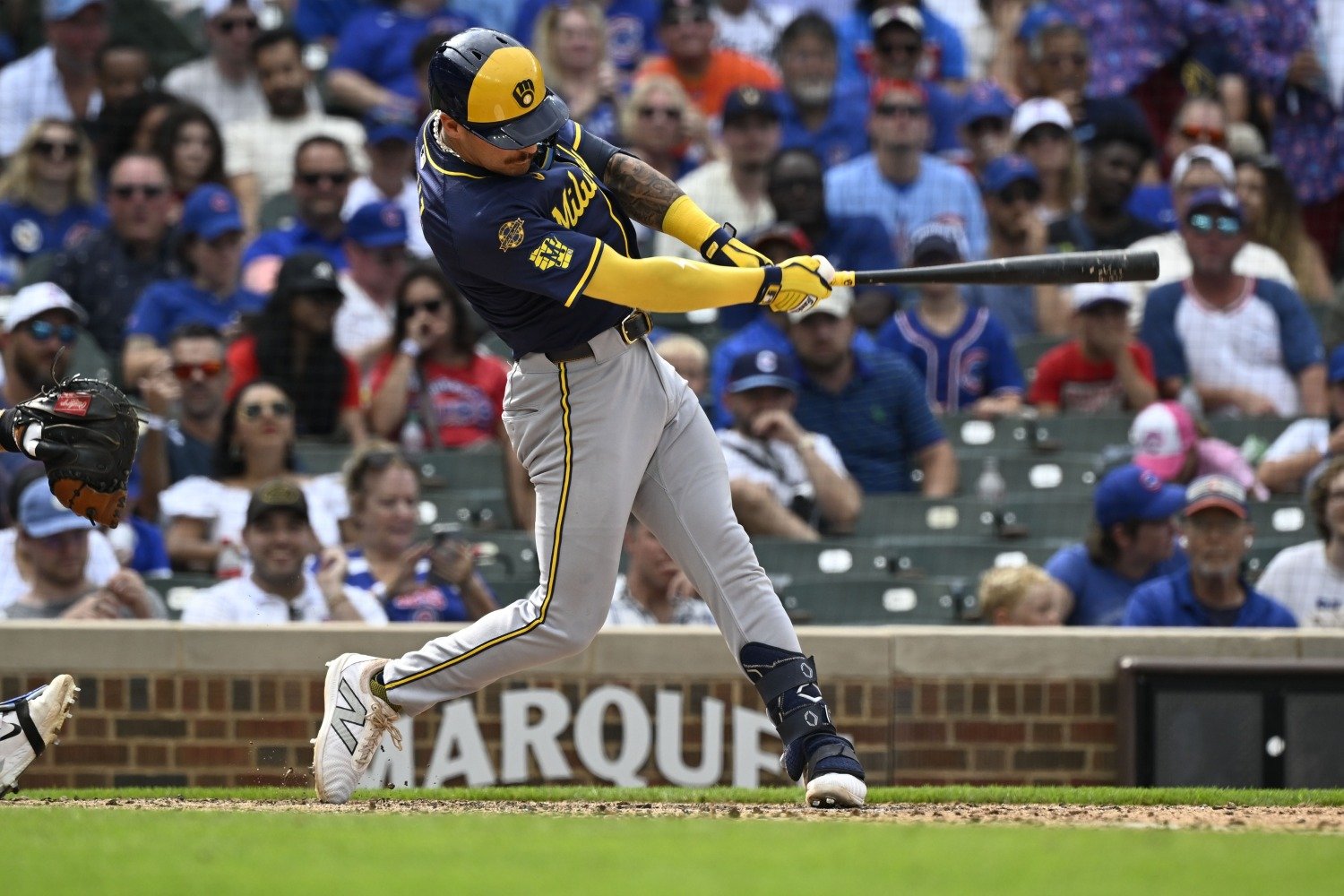 It took a few hard weeks for Joey Ortiz to get accustomed to shortstop. His glove work wasn't strong there over the first month of his sophomore season. Since then, though, it's been very good, and that's been enough to keep him in the lineup whenever he's been healthy this year. The Brewers believe firmly in good defense and good baserunning—so much so that they're willing to play a poor hitter, as long as they meet those standards and play a position where defense really matters. In Ortiz's case, it certainly does. Still, the rubber is close to meeting the road right now. Ortiz is batting .230/.242/.262 in September, after returning quickly from a hamstring strain. His bat speed is down, and his attack angle—a sign of whether he's getting level with the incoming pitch on time or not—is down, even relative to his lowest-in-baseball standard. He's unfortunately prone to hitting his best batted balls either on the ground or in the air to the opposite field, where they're not as likely to carry out of the park. He has a fragile offensive profile, and right now, that profile is shattered on the ground. His lone extra-base hit this month was a ground-ball triple. His lone walk came almost three weeks ago, and was a four-pitch slopfest amid a miniature meltdown by Pirates hurler Carmen Mlodzinski. He's not doing anything well at the plate right now, and there's little sign that he's going to improve soon. On the other hand, Andruw Monasterio has remained admirably warm, despite being sent to the bench again when Ortiz returned from his injury. Monasterio has barely played this month—just as he barely played before mid-July—but overall, he's batted .362/.397/.594 since August 1, in 73 plate appearances. He's not that caliber of hitter, of course, but he's a much more competent one than the current version of Ortiz. While he's not as good a fielder as Ortiz, Monasterio has proved himself playable at short, too. At some point, the question becomes unavoidable: might the team elect to play the hot hand over the steadier glove, when the NLDS begins next week? Milwaukee's defensive phalanx is an indispensable part of their team identity. They're unlikely to want to compromise it when the stakes are highest, especially with their pitching staff likely to be a bit diminished by injuries. To play Monasterio over Ortiz, they'd have to be confident that the former can play shortstop well enough to make the loss of the latter feel inconsequential. Monasterio has a better bat, and indeed, Ortiz has been almost an automatic out lately. The Crew can no more afford those extra outs on offense than they can afford to miss opportunities for outs on defense. Because they trust Ortiz's glove so much more than Monasterio's, though, the chance that they'll go to their journeyman backup still feels remote. It will be interesting to watch each player over the final four games of the season, to whatever extent Monasterio gets into them and is allowed to demonstrate his offensive superiority to Ortiz. Both players will appear during the upcoming series, and clever substitutions might allow Pat Murphy to make the most of them without choosing one over the other. When writing out each day's lineup card, though, he does have to choose.
 -
Image courtesy of © Matt Marton-Imagn Images It took a few hard weeks for Joey Ortiz to get accustomed to shortstop. His glove work wasn't strong there over the first month of his sophomore season. Since then, though, it's been very good, and that's been enough to keep him in the lineup whenever he's been healthy this year. The Brewers believe firmly in good defense and good baserunning—so much so that they're willing to play a poor hitter, as long as they meet those standards and play a position where defense really matters. In Ortiz's case, it certainly does. Still, the rubber is close to meeting the road right now. Ortiz is batting .230/.242/.262 in September, after returning quickly from a hamstring strain. His bat speed is down, and his attack angle—a sign of whether he's getting level with the incoming pitch on time or not—is down, even relative to his lowest-in-baseball standard. He's unfortunately prone to hitting his best batted balls either on the ground or in the air to the opposite field, where they're not as likely to carry out of the park. He has a fragile offensive profile, and right now, that profile is shattered on the ground. His lone extra-base hit this month was a ground-ball triple. His lone walk came almost three weeks ago, and was a four-pitch slopfest amid a miniature meltdown by Pirates hurler Carmen Mlodzinski. He's not doing anything well at the plate right now, and there's little sign that he's going to improve soon. On the other hand, Andruw Monasterio has remained admirably warm, despite being sent to the bench again when Ortiz returned from his injury. Monasterio has barely played this month—just as he barely played before mid-July—but overall, he's batted .362/.397/.594 since August 1, in 73 plate appearances. He's not that caliber of hitter, of course, but he's a much more competent one than the current version of Ortiz. While he's not as good a fielder as Ortiz, Monasterio has proved himself playable at short, too. At some point, the question becomes unavoidable: might the team elect to play the hot hand over the steadier glove, when the NLDS begins next week? Milwaukee's defensive phalanx is an indispensable part of their team identity. They're unlikely to want to compromise it when the stakes are highest, especially with their pitching staff likely to be a bit diminished by injuries. To play Monasterio over Ortiz, they'd have to be confident that the former can play shortstop well enough to make the loss of the latter feel inconsequential. Monasterio has a better bat, and indeed, Ortiz has been almost an automatic out lately. The Crew can no more afford those extra outs on offense than they can afford to miss opportunities for outs on defense. Because they trust Ortiz's glove so much more than Monasterio's, though, the chance that they'll go to their journeyman backup still feels remote. It will be interesting to watch each player over the final four games of the season, to whatever extent Monasterio gets into them and is allowed to demonstrate his offensive superiority to Ortiz. Both players will appear during the upcoming series, and clever substitutions might allow Pat Murphy to make the most of them without choosing one over the other. When writing out each day's lineup card, though, he does have to choose. View full article
-
 With four games left in their regular-season slate, the Milwaukee Brewers hold a 2.5-game lead on the Philadelphia Phillies for the top seed in the National League playoff bracket. The Crew looked more hungover than the hungover post-clinch Padres Tuesday night, as San Diego mashed their way to a 7-0 win over the visitors and their cannon-fodder starter, Bruce Zimmermann. However, the Phillies also lost an extra-inning mud-wrestling match with the Miami Marlins. Philadelphia still has five games left, and the separation between the teams is just two games in the loss column, but the Brewers hold the tiebreaker after winning the season series against the NL East champions. That makes the Brewers' magic number to secure home-field advantage throughout the postseason 3. When the Red Sox beat the Blue Jays in Toronto Tuesday night, it ensured that the Crew will do no worse than tying Toronto, and they have the tiebreaker over the Jays, too. No team in the American League can catch the Brewers now, so if they reach the World Series, Game 1 will be played at Uecker Field. Before then, of course, they'll have to win two playoff series, which would be two more than they've won since 2018, but they've already ensured that they'll bypass the dreaded Wild Card Series. They only need a third of the remaining results in their and the Phillies' games to go their way to make sure that even the NLCS includes home-field advantage for them. Feeling very good about their chances (and not wanting to shake up their schedule even in the wake of Brandon Woodruff hitting the injured list), Pat Murphy's staff chose to use journeyman hurler Bruce Zimmermann for six innings Tuesday night. He got his ears boxed, surrendering six runs (five earned) over those frames and striking out just one batter against two walks and two homers, but his only job was to stay on the mound long enough to spare a bullpen that had been pressed into unexpectedly heavy duty Monday night. He managed that, and Tobias Myers mopped up the final two frames of a lopsided loss. With the Padres making the NL West race unexpectedly interesting, it wasn't vital that Murphy shield his best hurlers from the sight of Padres hitters, but the two teams fought almost to a draw Monday night. It made sense to ease off the gas pedal and let ZImmermann and Myers absorb the workload Tuesday, before one final game between the two potential playoff opponents Wednesday afternoon. Meanwhile, Brewers hitters also seemed to take the night off, at least based on a glance at the box score. In reality, there were some tough at-bats, and some hard contact that found gloves. The focus on cobbling together rallies and doing what the situation demanded was relaxed, but despite just four hits and two walks, the Crew forced three Padres hurlers to throw a combined 131 pitches. It's as quiet as the Brewers offense will ever allow themselves to be kept, but they were still somewhat pesky. A bunch of rowdy Uecker Field crowds await the team, next week and beyond. They got a bit of help Tuesday, and might get a bit more before it's over, but they'd surely love to win three of four and close the season with some momentum, before what will feel like a long layoff before next Saturday's Game 1 of the NLDS. Whatever the results, the name of the game is keeping players healthy and getting back more of those who have been sidelined recently. The team is taking steps in the right direction there, with Trevor Megill still hoping to pitch this weekend after working off the mound pregame Tuesday. Zimmermann and Myers were convenient sponges, but neither factors prominently into the team's plans for a playoff series. It was a good day, because the Crew got one incrementally closer to being sure they'll have a maximum of home games—that, and no one got hurt.
 -
Image courtesy of © David Frerker-Imagn Images With four games left in their regular-season slate, the Milwaukee Brewers hold a 2.5-game lead on the Philadelphia Phillies for the top seed in the National League playoff bracket. The Crew looked more hungover than the hungover post-clinch Padres Tuesday night, as San Diego mashed their way to a 7-0 win over the visitors and their cannon-fodder starter, Bruce Zimmermann. However, the Phillies also lost an extra-inning mud-wrestling match with the Miami Marlins. Philadelphia still has five games left, and the separation between the teams is just two games in the loss column, but the Brewers hold the tiebreaker after winning the season series against the NL East champions. That makes the Brewers' magic number to secure home-field advantage throughout the postseason 3. When the Red Sox beat the Blue Jays in Toronto Tuesday night, it ensured that the Crew will do no worse than tying Toronto, and they have the tiebreaker over the Jays, too. No team in the American League can catch the Brewers now, so if they reach the World Series, Game 1 will be played at Uecker Field. Before then, of course, they'll have to win two playoff series, which would be two more than they've won since 2018, but they've already ensured that they'll bypass the dreaded Wild Card Series. They only need a third of the remaining results in their and the Phillies' games to go their way to make sure that even the NLCS includes home-field advantage for them. Feeling very good about their chances (and not wanting to shake up their schedule even in the wake of Brandon Woodruff hitting the injured list), Pat Murphy's staff chose to use journeyman hurler Bruce Zimmermann for six innings Tuesday night. He got his ears boxed, surrendering six runs (five earned) over those frames and striking out just one batter against two walks and two homers, but his only job was to stay on the mound long enough to spare a bullpen that had been pressed into unexpectedly heavy duty Monday night. He managed that, and Tobias Myers mopped up the final two frames of a lopsided loss. With the Padres making the NL West race unexpectedly interesting, it wasn't vital that Murphy shield his best hurlers from the sight of Padres hitters, but the two teams fought almost to a draw Monday night. It made sense to ease off the gas pedal and let ZImmermann and Myers absorb the workload Tuesday, before one final game between the two potential playoff opponents Wednesday afternoon. Meanwhile, Brewers hitters also seemed to take the night off, at least based on a glance at the box score. In reality, there were some tough at-bats, and some hard contact that found gloves. The focus on cobbling together rallies and doing what the situation demanded was relaxed, but despite just four hits and two walks, the Crew forced three Padres hurlers to throw a combined 131 pitches. It's as quiet as the Brewers offense will ever allow themselves to be kept, but they were still somewhat pesky. A bunch of rowdy Uecker Field crowds await the team, next week and beyond. They got a bit of help Tuesday, and might get a bit more before it's over, but they'd surely love to win three of four and close the season with some momentum, before what will feel like a long layoff before next Saturday's Game 1 of the NLDS. Whatever the results, the name of the game is keeping players healthy and getting back more of those who have been sidelined recently. The team is taking steps in the right direction there, with Trevor Megill still hoping to pitch this weekend after working off the mound pregame Tuesday. Zimmermann and Myers were convenient sponges, but neither factors prominently into the team's plans for a playoff series. It was a good day, because the Crew got one incrementally closer to being sure they'll have a maximum of home games—that, and no one got hurt. View full article
-
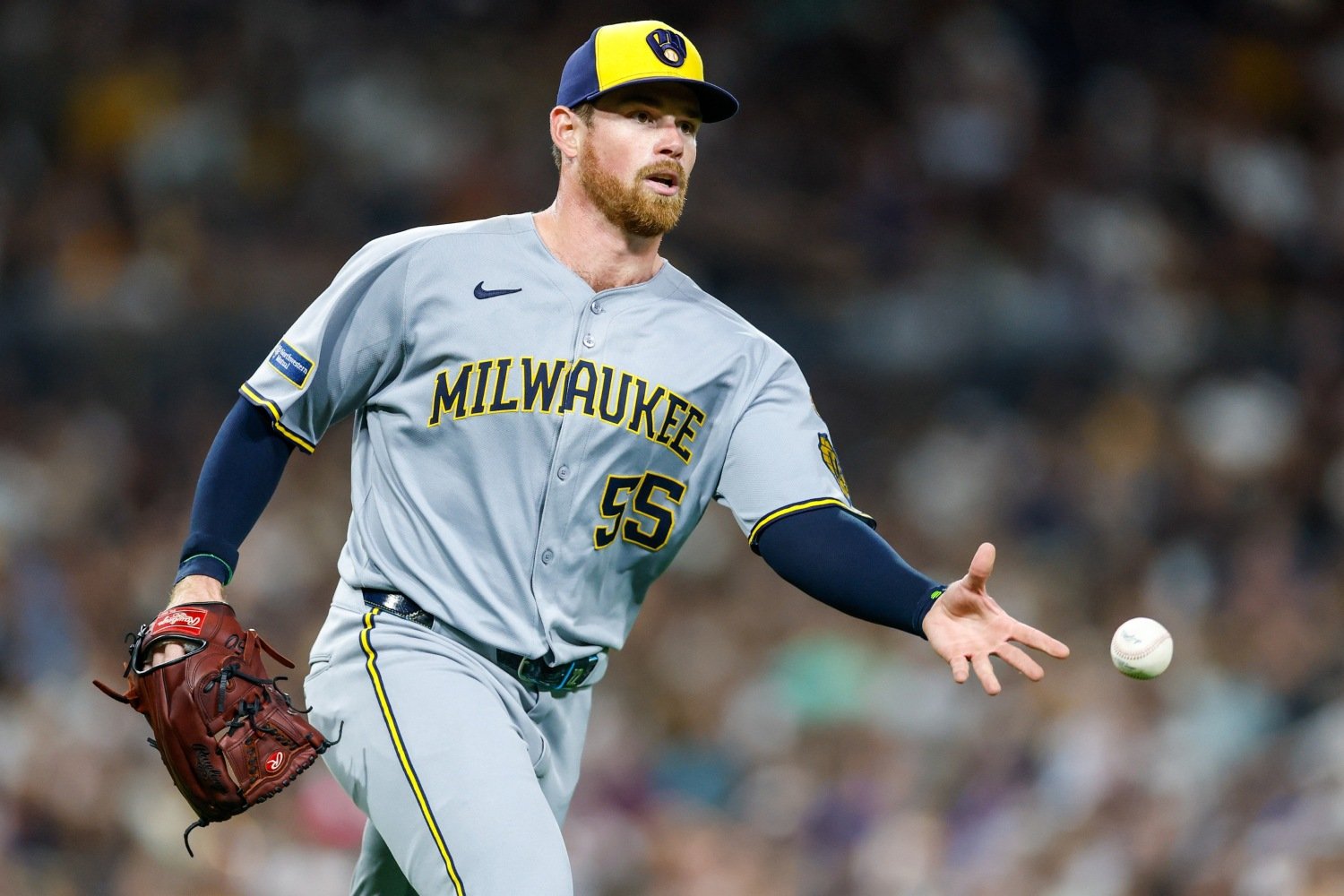
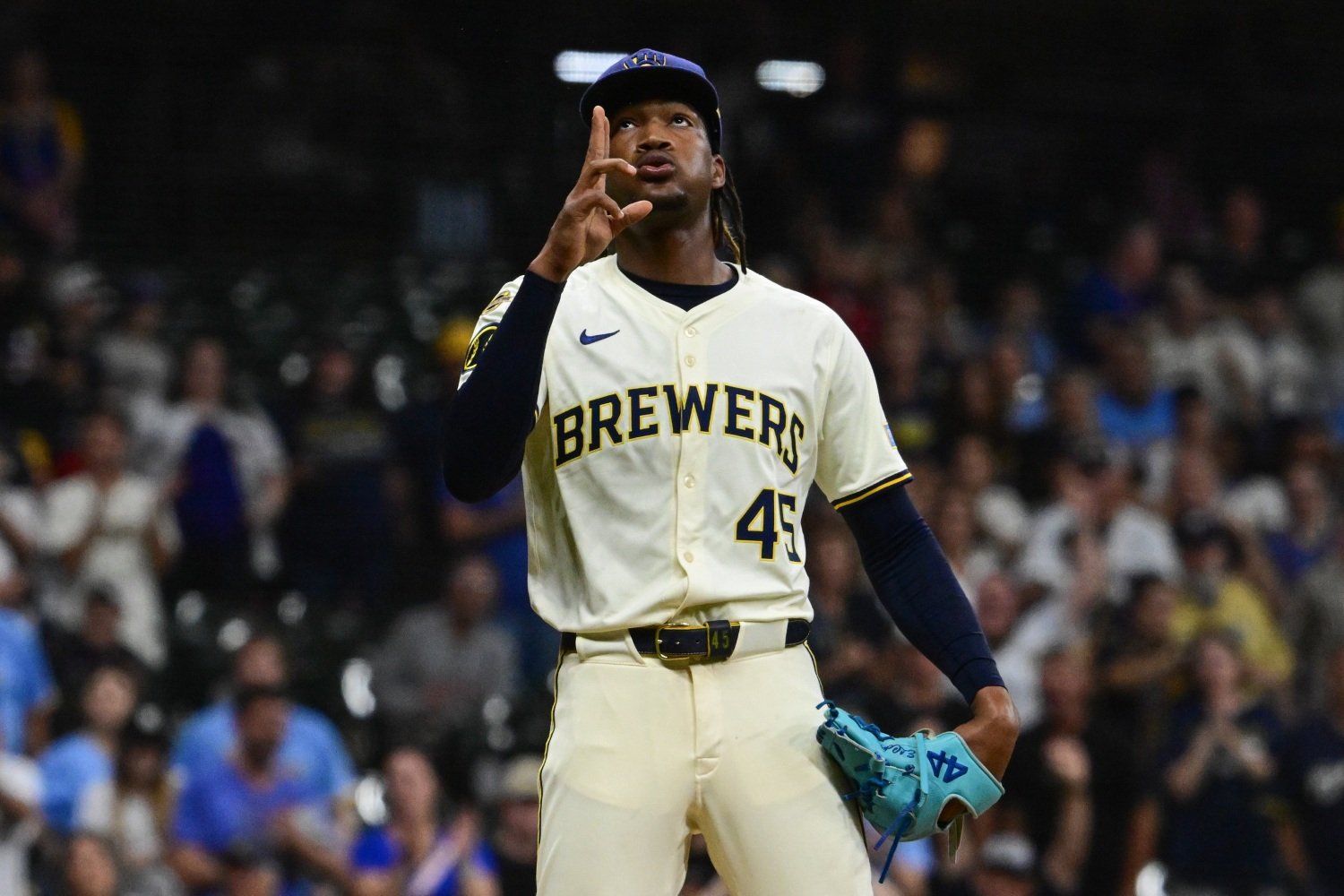 Abner Uribe not only leads the major leagues in holds this year, but has four more (37) than Hunter Gaddis (33), who's second-best. Uribe trails only Carlos Estévez of the Royals in appearances that came in save situations. He's pitched in 73 games, trailing only Tyler Rogers, Tony Santillan, Jeremiah Estrada and Brendon Little on that leaderboard for 2025—and Uribe has gotten the Brewers at least three outs 67 of those 73 times. Only Rogers has more such appearances this year, and in fact, only Rogers and Emmanuel Clase have made it to 70 such outings in any season since the pandemic hit. Uribe is emerging as one of the most available high-leverage hurlers in the game. It's terrifically valuable to have a trustworthy, matchup-proof setup man in a sport governed by the three-batter minimum. Such a pitcher can not only draw you closer to a win when protecting a narrow lead, but spare others within the bullpen—and make the manager's job much simpler, along the way. Uribe has overpowered both lefties and righties in 2025: vs. left-handed batters: .178/.313/.224, 128 batters faced, 39 strikeouts, 16 walks, 1 home run vs. right-handed batters: .213/.272/.287, 164 batters faced, 49 strikeouts, 11 walks, 3 home runs A whopping 49 of Uribe's appearances have come on either zero or one day of rest, and in them, he's holding batters to an impossibly helpless .196/.292/.215 line. He's struck 34.2% of the 187 batters he's faced in those games. He can come in on consecutive days, without Pat Murphy worrying about whether he'll be effective. He can face both lefties and righties, without exposing Milwaukee to a bad matchup. Uribe has still leaned essentially on two pitches this year, with his heavy, triple-digit sinker and his wide-sweeping slider doing all the work required of him. He's tweaked his delivery to better facilitate good location on that slider. He's not doing anything new or fancy, but he never needed to. All that his profile was missing was a bit better command, and that's what he's shown this year. He's only walked 9.2% of hitters, a figure close enough to average to shrug and keep moving when you see it on the page. Uribe has only ever needed to avoid having the walk rate be the item on the page that stopped one cold. When he does put a runner on base, Uribe's 55% ground ball rate leads to plenty of double plays. It also means that he gives up few home runs, which makes walks less costly. Getting ground balls and limiting free passes also contribute to the ability to get all the way through an inning. The suite of skills Uribe boasts has layers upon layers of utility, and even if Trevor Megill can't make it back to help the Brewers in the postseason, Uribe might be good enough to serve as the relief ace on a World Series-winning team. His durability—in terms of staying healthy, and of being able to pitch well on little rest—is a source of value that ripples out to the rest of the relief corps, and it gives Murphy the freedom to use whichever other hurlers the team carries for the NLDS more aggressively and creatively. Over the long season, Uribe has proved that he can take the ball and be the bridge to the closer. In the miniature season ahead, he might get a chance to savor even greater glory.
 -
Image courtesy of © Benny Sieu-Imagn Images Abner Uribe not only leads the major leagues in holds this year, but has four more (37) than Hunter Gaddis (33), who's second-best. Uribe trails only Carlos Estévez of the Royals in appearances that came in save situations. He's pitched in 73 games, trailing only Tyler Rogers, Tony Santillan, Jeremiah Estrada and Brendon Little on that leaderboard for 2025—and Uribe has gotten the Brewers at least three outs 67 of those 73 times. Only Rogers has more such appearances this year, and in fact, only Rogers and Emmanuel Clase have made it to 70 such outings in any season since the pandemic hit. Uribe is emerging as one of the most available high-leverage hurlers in the game. It's terrifically valuable to have a trustworthy, matchup-proof setup man in a sport governed by the three-batter minimum. Such a pitcher can not only draw you closer to a win when protecting a narrow lead, but spare others within the bullpen—and make the manager's job much simpler, along the way. Uribe has overpowered both lefties and righties in 2025: vs. left-handed batters: .178/.313/.224, 128 batters faced, 39 strikeouts, 16 walks, 1 home run vs. right-handed batters: .213/.272/.287, 164 batters faced, 49 strikeouts, 11 walks, 3 home runs A whopping 49 of Uribe's appearances have come on either zero or one day of rest, and in them, he's holding batters to an impossibly helpless .196/.292/.215 line. He's struck 34.2% of the 187 batters he's faced in those games. He can come in on consecutive days, without Pat Murphy worrying about whether he'll be effective. He can face both lefties and righties, without exposing Milwaukee to a bad matchup. Uribe has still leaned essentially on two pitches this year, with his heavy, triple-digit sinker and his wide-sweeping slider doing all the work required of him. He's tweaked his delivery to better facilitate good location on that slider. He's not doing anything new or fancy, but he never needed to. All that his profile was missing was a bit better command, and that's what he's shown this year. He's only walked 9.2% of hitters, a figure close enough to average to shrug and keep moving when you see it on the page. Uribe has only ever needed to avoid having the walk rate be the item on the page that stopped one cold. When he does put a runner on base, Uribe's 55% ground ball rate leads to plenty of double plays. It also means that he gives up few home runs, which makes walks less costly. Getting ground balls and limiting free passes also contribute to the ability to get all the way through an inning. The suite of skills Uribe boasts has layers upon layers of utility, and even if Trevor Megill can't make it back to help the Brewers in the postseason, Uribe might be good enough to serve as the relief ace on a World Series-winning team. His durability—in terms of staying healthy, and of being able to pitch well on little rest—is a source of value that ripples out to the rest of the relief corps, and it gives Murphy the freedom to use whichever other hurlers the team carries for the NLDS more aggressively and creatively. Over the long season, Uribe has proved that he can take the ball and be the bridge to the closer. In the miniature season ahead, he might get a chance to savor even greater glory. View full article
-
Image courtesy of © Jeff Curry-Imagn Images Suddenly, there's some chance that Robert Gasser will need to pitch a significant number of playoff innings for the 2025 Milwaukee Brewers. Freddy Peralta will start Game 1 of the National League Division Series, 12 days from Monday. With Brandon Woodruff looking unlikely to be ready for that series, though, Quinn Priester just moved up a spot in the team's prospective starting rotation. Jacob Misiorowski has been uneven. Chad Patrick hasn't fully regained the trust of Pat Murphy. Jose Quintana is down with a strained calf muscle, and is no more likely to take the ball at the front end of the NLDS than is Woodruff. Gasser won't start in the Division Series, unless things somehow go even more haywire, but he could very much factor into the team's plans. Murphy will hope that both Peralta and Priester deliver starts of reasonable length, but Game 3 will be a hodgepodge. Specifically, a piggyback plan would make a world of sense, with either Patrick or Misiorowski as a right-handed starter and Gasser as the left-handed counterpunch in the middle innings. For that to be viable, of course, Gasser has to prove that his stuff and command didn't stay behind when he got up off the surgeon's slab. He had Tommy John surgery in June 2024. Fifteen months later, he's back in the majors, but there's never a guarantee when a pitcher first reclaims their place. On Sunday, he pitched to big-leaguers for the first time, and while the final stat line looks unimpressive, he was a good enough facsimile of his former self to inspire some confidence. Gasser's release point is slightly up this year; he appears to have compromised slightly on the high-energy launch down the mound that characterized him the last time he pitched at the highest level. Here are his average release points by pitch type for each season since 2021. That year is circled in blue. His 2022 is circled in red; 2023 is in green; and 2024 is in purple. The release points for 2025 are circled in orange. As you can see, this is a relatively small change, but it's there. Gasser's arm angle hasn't materially changed, but he's not as deep in his legs or coming as aggressively down the mound. Hence the higher raw release point. Gasser's fastballs still sit around 93 miles per hour. His sweeper is still a bat-missing out pitch, with great lateral movement and the lift you want out of that offering. It induced three whiffs in five swings against the Cardinals across Gasser's three innings Sunday. His cutter remains very much a bridge pitch, functional only insofar as it might help keep hitters off his four-seamer, sinker, sweeper and changeup. The rest of the offerings can be better, though, and he showed at least the willingness to throw each Sunday. Ultimately, Gasser only pitched three innings Sunday. He gave up just one hit, but it was a home run. He walked two and gave up four hard-hit balls. Yet, he also fanned two, and the stuff looked good. The Brewers need an extra arm, capable of pitching multiple innings even in an October crucible. Gasser has made it back, and not a moment too soon. He might not be fully himself until next season, but even this version of him could turn out to be a huge playoff X-factor. View full article
-
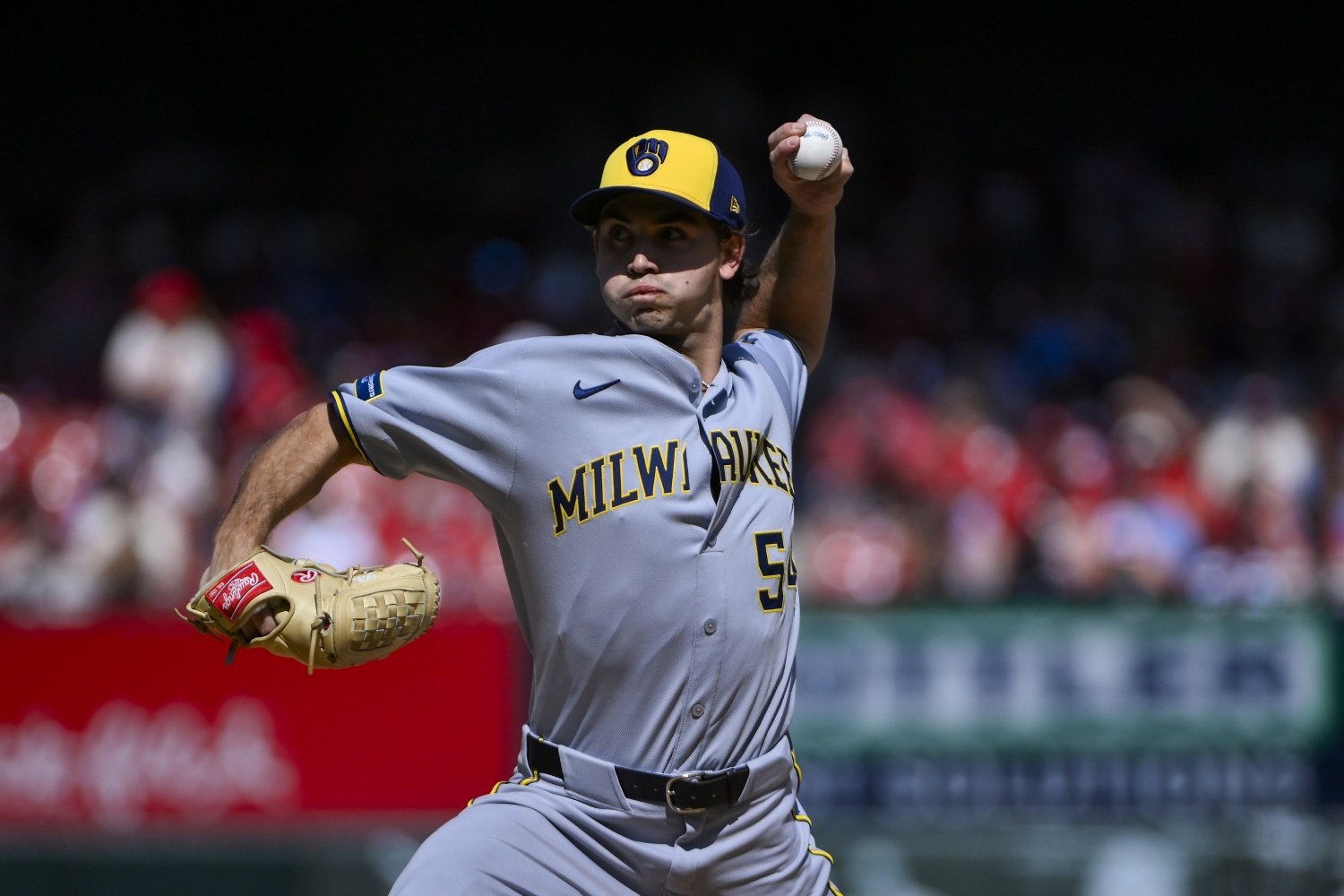 Suddenly, there's some chance that Robert Gasser will need to pitch a significant number of playoff innings for the 2025 Milwaukee Brewers. Freddy Peralta will start Game 1 of the National League Division Series, 12 days from Monday. With Brandon Woodruff looking unlikely to be ready for that series, though, Quinn Priester just moved up a spot in the team's prospective starting rotation. Jacob Misiorowski has been uneven. Chad Patrick hasn't fully regained the trust of Pat Murphy. Jose Quintana is down with a strained calf muscle, and is no more likely to take the ball at the front end of the NLDS than is Woodruff. Gasser won't start in the Division Series, unless things somehow go even more haywire, but he could very much factor into the team's plans. Murphy will hope that both Peralta and Priester deliver starts of reasonable length, but Game 3 will be a hodgepodge. Specifically, a piggyback plan would make a world of sense, with either Patrick or Misiorowski as a right-handed starter and Gasser as the left-handed counterpunch in the middle innings. For that to be viable, of course, Gasser has to prove that his stuff and command didn't stay behind when he got up off the surgeon's slab. He had Tommy John surgery in June 2024. Fifteen months later, he's back in the majors, but there's never a guarantee when a pitcher first reclaims their place. On Sunday, he pitched to big-leaguers for the first time, and while the final stat line looks unimpressive, he was a good enough facsimile of his former self to inspire some confidence. Gasser's release point is slightly up this year; he appears to have compromised slightly on the high-energy launch down the mound that characterized him the last time he pitched at the highest level. Here are his average release points by pitch type for each season since 2021. That year is circled in blue. His 2022 is circled in red; 2023 is in green; and 2024 is in purple. The release points for 2025 are circled in orange. As you can see, this is a relatively small change, but it's there. Gasser's arm angle hasn't materially changed, but he's not as deep in his legs or coming as aggressively down the mound. Hence the higher raw release point. Gasser's fastballs still sit around 93 miles per hour. His sweeper is still a bat-missing out pitch, with great lateral movement and the lift you want out of that offering. It induced three whiffs in five swings against the Cardinals across Gasser's three innings Sunday. His cutter remains very much a bridge pitch, functional only insofar as it might help keep hitters off his four-seamer, sinker, sweeper and changeup. The rest of the offerings can be better, though, and he showed at least the willingness to throw each Sunday. Ultimately, Gasser only pitched three innings Sunday. He gave up just one hit, but it was a home run. He walked two and gave up four hard-hit balls. Yet, he also fanned two, and the stuff looked good. The Brewers need an extra arm, capable of pitching multiple innings even in an October crucible. Gasser has made it back, and not a moment too soon. He might not be fully himself until next season, but even this version of him could turn out to be a huge playoff X-factor.
 -
An Updated Milwaukee Brewers Playoff Roster Projection
Matthew Trueblood posted an article in Brewers
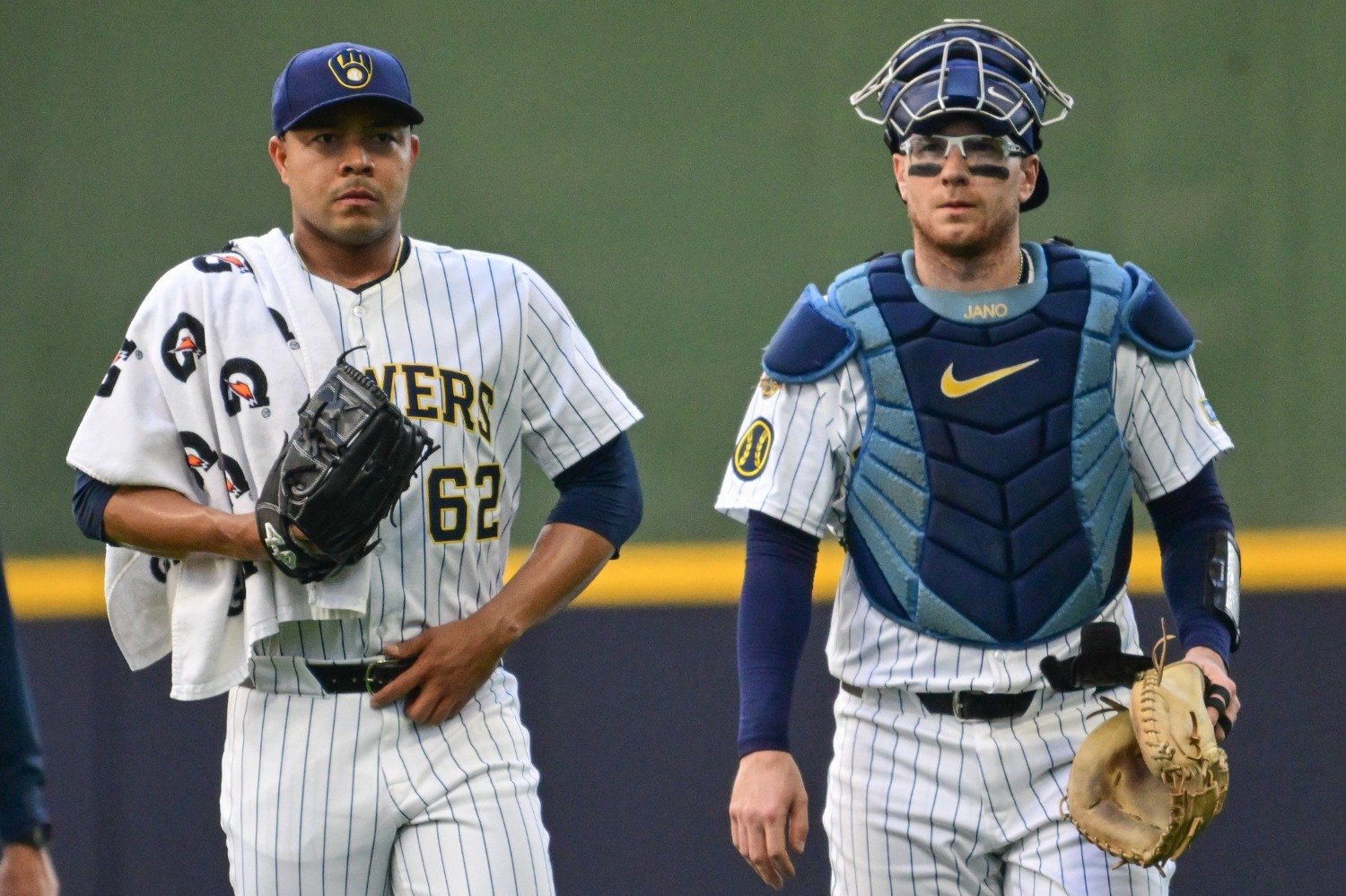 Trevor Megill had hoped to return to action this week against the Angels, but the enormous righthander felt soreness after his last bullpen session and the team pushed pack that planned reinstatement. That's fine. They have every reason to be cautious, right now, as the team still holds a comfortable lead in the race for the top seed in the postseason bracket. They did reinstate righty reliever Nick Mears Wednesday, and he immediately got an inning against the visiting Angels in a 9-2 Brewers win. The biggest questions facing the team, as they begin in earnest to sketch the roster they'll submit when the National League Division Series begins in just over two weeks, have to do with their injured but convalescing pitchers. Megill, Mears and Jose Quintana headline that discussion. That Megill sincerely intended to return this week suggests he should be healthy enough to pitch by the time the playoffs begin, but what if that soreness won't subside? The injury with which he's dealing, a flexor strain, usually requires considerably more time than he's planning to give it before returning to full-strength action. Quintana had hoped to avoid being placed on the injured list with the calf strain he suffered over the weekend, but he was shelved Wednesday, to make room for Mears's return. In addition to those three, Logan Henderson and DL Hall are working their way back, with the NLDS being their target date for a return, too. It seems unlikely that the team would trust either enough to thrust them back into the mix that rapidly, with few good ways to get them live reps before the stakes go through the roof, but then again, each has looked terrific for portions of this season, and the team's depth isn't what they had hoped it would be even a month ago. Let's do a back-of-the-envelope NLDS roster right now, to see where questions remain, and how some of the above might shake out in the broader context of constructing a winning roster for a best-of-five series with three off days built in. Catchers William Contreras Danny Jansen No controversy here. Barring injuries, both Contreras and Jansen will make the roster, and no other backstops will join them. Infielders Andrew Vaughn Brice Turang Joey Ortiz Caleb Durbin Andruw Monasterio Rhys Hoskins Jake Bauers Here, things get more intriguing. Would the team really carry three first basemen and, in effect, only one backup at the other three infield spots? It seems like a lumpy way to build a roster, but Pat Murphy clearly wants to get Joey Ortiz out of the game in favor of a more qualified bat when Ortiz's spot comes up in a high-leverage offensive situation. Having Bauers and Hoskins available would facilitate that. Isaac Collins, meanwhile, could play some third base in a pinch, so there's more coverage than meets the eye if they go without Anthony Seigler. Outfielders Christian Yelich Jackson Chourio Sal Frelick Blake Perkins Isaac Collins Brandon Lockridge Carrying six outfielders, to go with seven infielders and two catchers, feels extravagant. It feels like something out of the 1980s. On the other hand, consider a scenario: Hoskins bats for Ortiz with the team down by two runs and with two runners on in the seventh inning. He singles, scoring one and sending the trailing runner to third. Do you want Hoskins (or even Andruw Monasterio) running the bases, or would you rather have Brandon Lockridge take over as the go-ahead run? Lockridge could also pinch-run for Contreras in certain situations, or for Vaughn. Pitchers Freddy Peralta Brandon Woodruff Quinn Priester Jacob Misiorowski Trevor Megill Abner Uribe Jared Koenig Aaron Ashby Nick Mears Chad Patrick Rob Zastryzny Carrying 15 position players would leave just 11 slots for pitchers, which sounds like too few. In truth, though, the Brewers only need three starters in the series, so it still leaves a full eight-man bullpen. There's a day off between Games 1 and 2 of the NLDS, to get the two leagues' series out of phase with one another and ensure content every day for the league's broadcast partners. Then there's one between Games 2 and 3 for travel, and if the series goes the full length, there's another travel day between Games 4 and 5, too. In a series that requires just three starters and in which there can only be one back-to-back set of games, you don't need more than 11 pitchers. The relievers will get as much from the rest days as the starters will. Ashby, Misiorowski and Patrick give the team ample possible length. Zastryzny is the matchup lefty, and at the end of the game, it's a daily mélange of Mears, Uribe, Koenig and Megill—assuming, of course, that some combination of the team's three stout starters and the multi-inning weapons of Misiorowski and Ashby don't get them all the way to the ninth. You can make cases to include Tobias Myers, Grant Anderson and/or one of the returning long men, in place of Patrick or Zastryzny or at the expense of one of those bench pieces. At this moment, though, it looks like the Brewers can get by with 11 hurlers, and these 11 would make sense. There's still a lot of injury disaster left to avoid. There's still a lot of calendar to chew up, while the team waits for the winner of what looks like an inevitable Padres-Cubs tilt in Chicago to start the postseason. Right now, these 26 seem well-positioned to make the NLDS roster, but a great deal can change before the time comes.
- 18 comments
-
- 4
-

-
- trevor megill
- jose quintana
- (and 3 more)
-
Image courtesy of © Benny Sieu-Imagn Images Trevor Megill had hoped to return to action this week against the Angels, but the enormous righthander felt soreness after his last bullpen session and the team pushed pack that planned reinstatement. That's fine. They have every reason to be cautious, right now, as the team still holds a comfortable lead in the race for the top seed in the postseason bracket. They did reinstate righty reliever Nick Mears Wednesday, and he immediately got an inning against the visiting Angels in a 9-2 Brewers win. The biggest questions facing the team, as they begin in earnest to sketch the roster they'll submit when the National League Division Series begins in just over two weeks, have to do with their injured but convalescing pitchers. Megill, Mears and Jose Quintana headline that discussion. That Megill sincerely intended to return this week suggests he should be healthy enough to pitch by the time the playoffs begin, but what if that soreness won't subside? The injury with which he's dealing, a flexor strain, usually requires considerably more time than he's planning to give it before returning to full-strength action. Quintana had hoped to avoid being placed on the injured list with the calf strain he suffered over the weekend, but he was shelved Wednesday, to make room for Mears's return. In addition to those three, Logan Henderson and DL Hall are working their way back, with the NLDS being their target date for a return, too. It seems unlikely that the team would trust either enough to thrust them back into the mix that rapidly, with few good ways to get them live reps before the stakes go through the roof, but then again, each has looked terrific for portions of this season, and the team's depth isn't what they had hoped it would be even a month ago. Let's do a back-of-the-envelope NLDS roster right now, to see where questions remain, and how some of the above might shake out in the broader context of constructing a winning roster for a best-of-five series with three off days built in. Catchers William Contreras Danny Jansen No controversy here. Barring injuries, both Contreras and Jansen will make the roster, and no other backstops will join them. Infielders Andrew Vaughn Brice Turang Joey Ortiz Caleb Durbin Andruw Monasterio Rhys Hoskins Jake Bauers Here, things get more intriguing. Would the team really carry three first basemen and, in effect, only one backup at the other three infield spots? It seems like a lumpy way to build a roster, but Pat Murphy clearly wants to get Joey Ortiz out of the game in favor of a more qualified bat when Ortiz's spot comes up in a high-leverage offensive situation. Having Bauers and Hoskins available would facilitate that. Isaac Collins, meanwhile, could play some third base in a pinch, so there's more coverage than meets the eye if they go without Anthony Seigler. Outfielders Christian Yelich Jackson Chourio Sal Frelick Blake Perkins Isaac Collins Brandon Lockridge Carrying six outfielders, to go with seven infielders and two catchers, feels extravagant. It feels like something out of the 1980s. On the other hand, consider a scenario: Hoskins bats for Ortiz with the team down by two runs and with two runners on in the seventh inning. He singles, scoring one and sending the trailing runner to third. Do you want Hoskins (or even Andruw Monasterio) running the bases, or would you rather have Brandon Lockridge take over as the go-ahead run? Lockridge could also pinch-run for Contreras in certain situations, or for Vaughn. Pitchers Freddy Peralta Brandon Woodruff Quinn Priester Jacob Misiorowski Trevor Megill Abner Uribe Jared Koenig Aaron Ashby Nick Mears Chad Patrick Rob Zastryzny Carrying 15 position players would leave just 11 slots for pitchers, which sounds like too few. In truth, though, the Brewers only need three starters in the series, so it still leaves a full eight-man bullpen. There's a day off between Games 1 and 2 of the NLDS, to get the two leagues' series out of phase with one another and ensure content every day for the league's broadcast partners. Then there's one between Games 2 and 3 for travel, and if the series goes the full length, there's another travel day between Games 4 and 5, too. In a series that requires just three starters and in which there can only be one back-to-back set of games, you don't need more than 11 pitchers. The relievers will get as much from the rest days as the starters will. Ashby, Misiorowski and Patrick give the team ample possible length. Zastryzny is the matchup lefty, and at the end of the game, it's a daily mélange of Mears, Uribe, Koenig and Megill—assuming, of course, that some combination of the team's three stout starters and the multi-inning weapons of Misiorowski and Ashby don't get them all the way to the ninth. You can make cases to include Tobias Myers, Grant Anderson and/or one of the returning long men, in place of Patrick or Zastryzny or at the expense of one of those bench pieces. At this moment, though, it looks like the Brewers can get by with 11 hurlers, and these 11 would make sense. There's still a lot of injury disaster left to avoid. There's still a lot of calendar to chew up, while the team waits for the winner of what looks like an inevitable Padres-Cubs tilt in Chicago to start the postseason. Right now, these 26 seem well-positioned to make the NLDS roster, but a great deal can change before the time comes. View full article
-
Image courtesy of © Michael McLoone-Imagn Images Four times, this year, Brewers batters have been called for pitch timer violations. They've given up a strike four times, which is right around the middle of the pack for the league. Three teams have gone the whole year, so far, without a batter being called for a timer violation, so on one level, the Crew are unremarkable. Here's the thing, though: they're not. There is something unusual and valuable about the way the Crew approaches plate appearances, in terms of playing under the clock of the modern game. Of the four timer violations called on Milwaukee batters, three—one each by Caleb Durbin and Isaac Collins in June, and another by Jake Bauers last week—came before the first pitch of at-bats. Durbin and Collins were coming up right behind players who had gotten big hits, and they were really just letting the energy of the play and the dugout resettle before making ready for the pitch. Bauers was leading off an inning in Texas last Wednesday, when he was called for not engaging with the pitcher in a timely manner. The only other instance came in early April, when Joey Ortiz spent too long pondering a bunt sign on a 2-0 count. Overall, the Brewers are much more likely to push the opposing pitcher out of their comfort zone, in the opposite direction. With no runners on base, the Crew have the second-fastest average pitch tempo by batters in the league, trailing only the alacrity of the White Sox. With runners on, they're just sixth-fastest on average, but they're faster than the White Sox in that split. Furthermore, only three teams—Washington, Detroit, and quasi-Atlanta—see a higher percentage of their pitches within 15 seconds of the previous one with runners on base. This might not sound like something that matters, or even something that a batter can substantially influence, but it is. The hitter has to be in the box and attentive to the pitcher by the time the clock reads :08, but of course, they have the option to do so sooner. The pitcher, meanwhile, can't pitch without making eye contact (or, at least, ensuring that the batter is ready), so there's a real sense in which the batter controls the tempo of the at-bat. Of the 345 batters who qualify for the leaderboard in pitch tempo at Baseball Savant, eight Brewers rank in the top 69 for fastest pace with no runners on. That covers most of their main contributors, including Brice Turang, Sal Frelick, Jackson Chourio, Joey Ortiz, William Contreras and Andrew Vaughn. Garrett Mitchell, Eric Haase and Andruw Monasterio have all played too little to qualify for that leaderboard, but all of them would also crowd in near the top. It's something they even preach to newcomers. When Danny Jansen was traded from the Rays to the Brewers, he went from the 23rd percentile in average pace to the 72nd. Only 27.8% of his pitches with the bases empty came within 15 seconds of the previous one during his Tampa tenure, but with Milwaukee, that number has jumped to 37.5%. Once it's your turn, the Brewers want you in the box and forcing the issue. What effect does this have? Well, firstly, consider this: when Brewers batters are ahead in the count, opposing pitchers throw 35.3% of their pitches in the heart of the zone, according to Statcast. That's the highest rate in the league. As a result, no team in baseball can match the 266 hits the Brewers have collected on exactly that kind of pitch: a meatball, when they're already ahead. The Crew's patient approach at the plate forces pitchers to work from a disadvantage, and then their insistence on being ready for the next pitch almost instantly pressures the hurler into mistakes. That's within an at-bat. There's also the effect across at-bats, especially within innings. Countless times, this season, the situation has seemed to snowball for opponents, and the Brewers don't just push across a run; they get three. In fact, they've scored at least four runs in an inning 52 times, leading the league. They don't just string together positive outcomes. They rush them at you. There's less time for a pitcher to collect themselves, and less time for them to recover from the previous offering, and less time for the coaching staff to get a reliever warm. Things get out of control. Normally, the compensation for that comes from the other team playing more crisp defense. You've heard, countless times over the years, how a pitcher who works quickly keeps their defense alert and ready. However, as we've discussed several times over the last two years, that compensation never really comes for poor opponents with this team. The Brewers have team speed, and they bunt and they run the bases aggressively, and they use the whole field and make you defend it. Making the pitcher work quickly doesn't cannibalize that edge for them, because they're in control of the pace. It puts defenders on their heels, instead. That's why they've reached on 40 errors this year, to boot. We're into the realm of subtleties so small it's hard to believe they're intentional, but look at the difference it made when Jansen arrived in Milwaukee. Vaughn didn't even need that nod; they picked him up from the only offense more dedicated to rushing opponents than they are. The Brewers are, to borrow and (wistfully) sanitize Pat Murphy's mantra a bit, friggin' relentless. They're running to the bat racks, and from there to the on-deck circle, and then to the batter's box, and then around the bases. You'd better keep up. (You can't keep up.) View full article
-
Do Brewers Hitters Make Pitchers Work at Mistake Speed?
Matthew Trueblood posted an article in Brewers
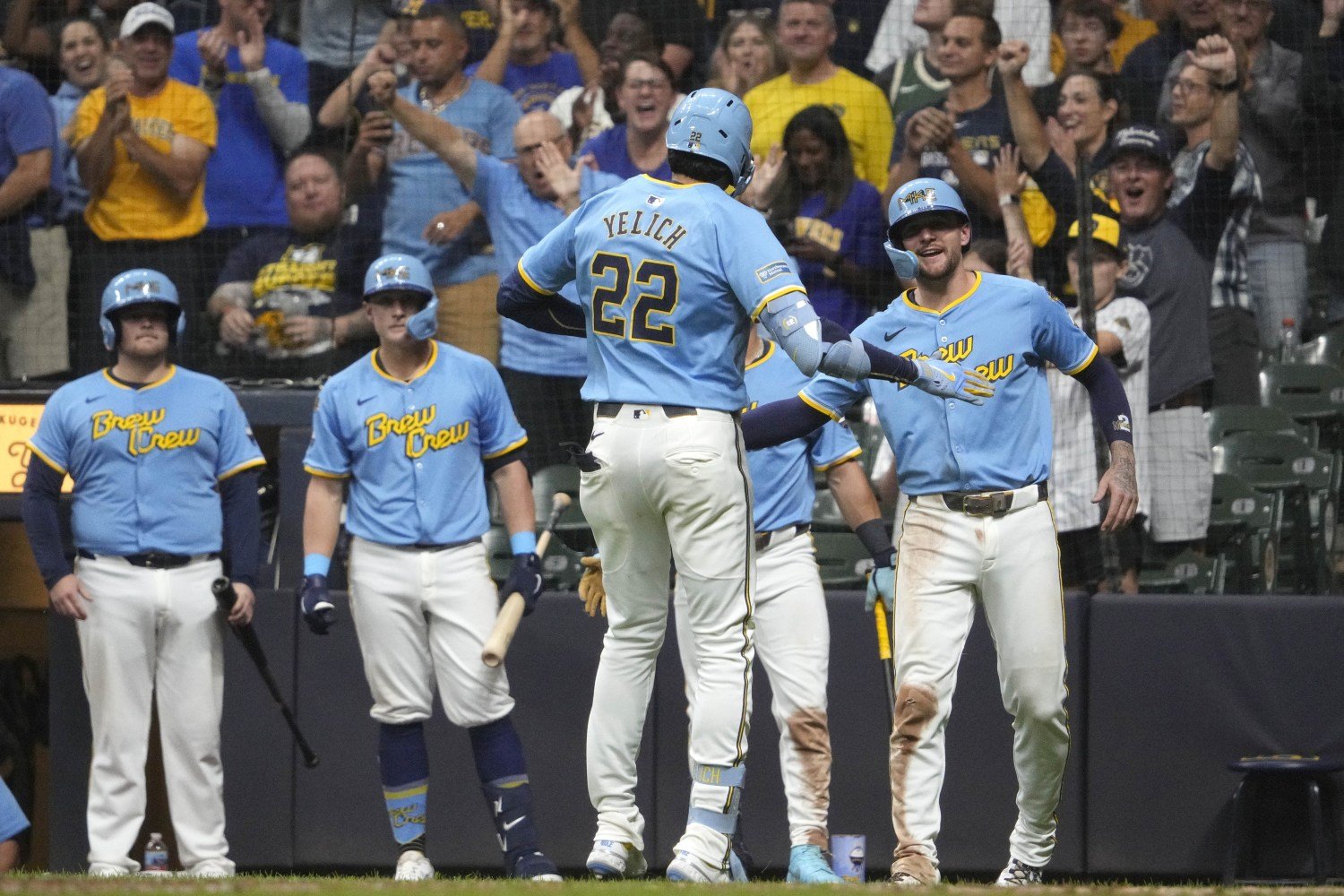 Four times, this year, Brewers batters have been called for pitch timer violations. They've given up a strike four times, which is right around the middle of the pack for the league. Three teams have gone the whole year, so far, without a batter being called for a timer violation, so on one level, the Crew are unremarkable. Here's the thing, though: they're not. There is something unusual and valuable about the way the Crew approaches plate appearances, in terms of playing under the clock of the modern game. Of the four timer violations called on Milwaukee batters, three—one each by Caleb Durbin and Isaac Collins in June, and another by Jake Bauers last week—came before the first pitch of at-bats. Durbin and Collins were coming up right behind players who had gotten big hits, and they were really just letting the energy of the play and the dugout resettle before making ready for the pitch. Bauers was leading off an inning in Texas last Wednesday, when he was called for not engaging with the pitcher in a timely manner. The only other instance came in early April, when Joey Ortiz spent too long pondering a bunt sign on a 2-0 count. Overall, the Brewers are much more likely to push the opposing pitcher out of their comfort zone, in the opposite direction. With no runners on base, the Crew have the second-fastest average pitch tempo by batters in the league, trailing only the alacrity of the White Sox. With runners on, they're just sixth-fastest on average, but they're faster than the White Sox in that split. Furthermore, only three teams—Washington, Detroit, and quasi-Atlanta—see a higher percentage of their pitches within 15 seconds of the previous one with runners on base. This might not sound like something that matters, or even something that a batter can substantially influence, but it is. The hitter has to be in the box and attentive to the pitcher by the time the clock reads :08, but of course, they have the option to do so sooner. The pitcher, meanwhile, can't pitch without making eye contact (or, at least, ensuring that the batter is ready), so there's a real sense in which the batter controls the tempo of the at-bat. Of the 345 batters who qualify for the leaderboard in pitch tempo at Baseball Savant, eight Brewers rank in the top 69 for fastest pace with no runners on. That covers most of their main contributors, including Brice Turang, Sal Frelick, Jackson Chourio, Joey Ortiz, William Contreras and Andrew Vaughn. Garrett Mitchell, Eric Haase and Andruw Monasterio have all played too little to qualify for that leaderboard, but all of them would also crowd in near the top. It's something they even preach to newcomers. When Danny Jansen was traded from the Rays to the Brewers, he went from the 23rd percentile in average pace to the 72nd. Only 27.8% of his pitches with the bases empty came within 15 seconds of the previous one during his Tampa tenure, but with Milwaukee, that number has jumped to 37.5%. Once it's your turn, the Brewers want you in the box and forcing the issue. What effect does this have? Well, firstly, consider this: when Brewers batters are ahead in the count, opposing pitchers throw 35.3% of their pitches in the heart of the zone, according to Statcast. That's the highest rate in the league. As a result, no team in baseball can match the 266 hits the Brewers have collected on exactly that kind of pitch: a meatball, when they're already ahead. The Crew's patient approach at the plate forces pitchers to work from a disadvantage, and then their insistence on being ready for the next pitch almost instantly pressures the hurler into mistakes. That's within an at-bat. There's also the effect across at-bats, especially within innings. Countless times, this season, the situation has seemed to snowball for opponents, and the Brewers don't just push across a run; they get three. In fact, they've scored at least four runs in an inning 52 times, leading the league. They don't just string together positive outcomes. They rush them at you. There's less time for a pitcher to collect themselves, and less time for them to recover from the previous offering, and less time for the coaching staff to get a reliever warm. Things get out of control. Normally, the compensation for that comes from the other team playing more crisp defense. You've heard, countless times over the years, how a pitcher who works quickly keeps their defense alert and ready. However, as we've discussed several times over the last two years, that compensation never really comes for poor opponents with this team. The Brewers have team speed, and they bunt and they run the bases aggressively, and they use the whole field and make you defend it. Making the pitcher work quickly doesn't cannibalize that edge for them, because they're in control of the pace. It puts defenders on their heels, instead. That's why they've reached on 40 errors this year, to boot. We're into the realm of subtleties so small it's hard to believe they're intentional, but look at the difference it made when Jansen arrived in Milwaukee. Vaughn didn't even need that nod; they picked him up from the only offense more dedicated to rushing opponents than they are. The Brewers are, to borrow and (wistfully) sanitize Pat Murphy's mantra a bit, friggin' relentless. They're running to the bat racks, and from there to the on-deck circle, and then to the batter's box, and then around the bases. You'd better keep up. (You can't keep up.)
 -
 All year, only two Brewers players have established anything close to a fixed, everyday lineup position under Pat Murphy. Jackson Chourio (usually) bats second, and Joey Ortiz (usually) bats ninth. Even those aren't exactly set in stone. Chourio spent significant time batting leadoff (especially against left-handed opposing starters) early in the season, and has made at least 10 starts batting both third and fourth. Ortiz, for whom the team had higher offensive hopes before his calamitous start to the season, batted eighth 32 times and spent a few games each batting sixth and seventh. Mostly, though, those two have settled into defined offensive positions. Beyond that, much has been in flux, for various reasons. Over the course of the season, Isaac Collins, Brice Turang and Sal Frelick have taken turns asserting themselves as the best or second-best hitter on the team. Rhys Hoskins had a clear role, batting lower in the batting order but punishing teams who let traffic pile up in front of him on the bases. After he got hurt, though, Andrew Vaughn stepped in and delivered such thunder—just when Christian Yelich's own pop seemed to falter—that it was impossible to keep Vaughn as low in the lineup as Hoskins had been. Yelich and William Contreras have each had stretches of brilliance at the plate, but each has been less consistent than past versions of themselves, as they navigate various background injury issues and the maintenance of their bodies under the demands of their jobs. As a result, for a team scoring the third-most runs in the major leagues and waltzing toward home-field advantage throughout the postseason, the Crew have an unusually variable lineup. It changes frequently—and even more frequently, lately, than over the campaign as a whole. Here's a color-coded tracker of their daily lineups since September began, pulled from Baseball Reference. 139. Mon9/1 vs PHI L (8-10) Turang-2B Chourio-LF Contreras-C Yelich-DH Bauers-1B Perkins-CF Frelick-RF Durbin-3B Ortiz-SS 140. Wed9/3 vs PHI W (6-3) Turang-2B Chourio-DH Contreras-C Frelick-RF Collins-LF Perkins-CF Bauers-1B Seigler-3B Ortiz-SS 141. Thu9/4 vs PHI L (0-2)# Chourio-LF Collins-RF Contreras-DH Vaughn-1B Durbin-3B Jansen-C Monasterio-2B Perkins-CF Ortiz-SS 142. Fri9/5 at PIT W (5-2) Turang-2B Collins-LF Chourio-CF Contreras-C Frelick-RF Vaughn-1B Bauers-DH Durbin-3B Ortiz-SS 143. Sat9/6 at PIT W (4-1) Frelick-RF Chourio-LF Turang-2B Contreras-C Bauers-DH Vaughn-1B Durbin-3B Perkins-CF Ortiz-SS 144. Sun9/7 at PIT W (10-2) Turang-2B Collins-LF Contreras-DH Bauers-RF Vaughn-1B Durbin-3B Perkins-CF Jansen-C Ortiz-SS 145. Mon9/8 at TEX L (0-5)# Turang-2B Chourio-LF Contreras-C Yelich-DH Vaughn-1B Durbin-3B Frelick-RF Perkins-CF Ortiz-SS 146. Tue9/9 at TEX L (4-5) Turang-2B Chourio-CF Yelich-DH Contreras-C Frelick-RF Vaughn-1B Collins-LF Durbin-3B Ortiz-SS 147. Wed9/10 at TEX L (3-6) Turang-2B Chourio-LF Yelich-DH Bauers-1B Frelick-RF Durbin-3B Perkins-CF Jansen-C Ortiz-SS 148. Fri9/12 vs STL W (8-2) Frelick-RF Chourio-CF Turang-2B Contreras-C Yelich-DH Collins-LF Bauers-1B Durbin-3B Ortiz-SS 149. Sat9/13 vs STL W (9-8) Frelick-RF Chourio-CF Turang-2B Contreras-C Yelich-DH Collins-LF Bauers-1B Durbin-3B Ortiz-SS 150. Sun9/14 vs STL L (2-3) Frelick-RF Chourio-CF Yelich-DH Collins-LF Turang-2B Durbin-3B Bauers-1B Jansen-C Monasterio-SS Though Hoskins returned to the active roster earlier this month, he hasn't yet drawn a start. Jake Bauers has gotten hot enough not only to force his way into the lineup, but to spend multiple days in the heart of the order. Caleb Durbin has drifted all the way from fifth to eighth, and not purely based on platoon matchups. Turang has moved between first, third and fifth, while Sal Frelick has mixed in as the leadoff man but also slotted often into the middle third of the group. Even Yelich and Contreras are drifting among the spots in the center of the action. A few concrete trends are developing—some with playoff implications, and some without. For instance, Danny Jansen has drawn a start every third game this month, like clockwork. That's a function of the team forcing William Contreras to rest a bit more; it's not something you'll see in October. In fact, Contreras will almost certainly catch every game the team plays during the postseason. That will leave more playing time open at designated hitter, which could be allotted to Yelich, Hoskins, or Vaughn. Isaac Collins's bat has slouched a bit (he's batting .200/.307/.320 since returning from paternity leave in mid-August), which is making more space in the top five of the order. It's almost certain that Chourio will bat second on a given night, with Frelick, Turang, Contreras and Yelich filling in around him to round out that top five. Only the order of them is changing regularly, and that might continue into the playoffs. If Yelich is often the DH, though, the question of whether to play Collins in left (with Chourio in center) or Blake Perkins in center (with Chourio in left) remains a daily dilemma for Murphy. Ditto for the question of whether to start Bauers, Vaughn or Hoskins at first base. The tricky thing with those questions is that both Perkins and Collins are switch-hitters, and each is (or at least can be) a great defender, with the overall efficiency of the outfield alignment they create hinging on how you feel about Chourio's relative merits at each of the positions between which he swings based on the deployment of his teammates. Meanwhile, of course, both Vaughn and Hoskins are righty batters. It's hard, as a manager, to know when to slot in a particular player, when you have a rotation of options to whom you want to distribute some playing time but no clear and simple algorithm for that decision. Platoons make this easy, and if Bauers continues raking, he has a chance to seize some playing time even in October. This is also why managers have traditionally defaulted to playing their backup catcher in day games after night games. Most catchers bat right-handed, so the easiest way to map playing time was to find another logical way to explain and plan the swapping-out of the starter. Murphy has allowed himself that luxury this month, perhaps because he has so many other, thornier choices to make when writing out each day's lineup card. Knowing that top five (plus Ortiz, batting ninth) is essentially locked in, the main questions the team will try to establish firmer answers to over the final fortnight of the season are: Who should play first base, and when? Which of Perkins and Collins should play, and when? Where should Durbin bat, relative to the players selected in answering the first two questions? Although some nagging injuries, slumps and sagging bat speed have diminished the Milwaukee Speed Machine a bit, they're still a potent positional group, with more good players than spots in the starting nine. That's a nice problem to have, but for now, it remains a problem Murphy has to plan ways to solve. His lineup is a fluid thing, and right now, that's just fine. By Game 1 on the NLDS, though, he'll want to have clearer criteria with which to answer all his daily questions than he has right now. That's what makes September important, even for a team already locked in for October.
- 2 comments
-
- 1
-
-
- sal frelick
- brice turang
- (and 5 more)
-
Image courtesy of © David Banks-Imagn Images All year, only two Brewers players have established anything close to a fixed, everyday lineup position under Pat Murphy. Jackson Chourio (usually) bats second, and Joey Ortiz (usually) bats ninth. Even those aren't exactly set in stone. Chourio spent significant time batting leadoff (especially against left-handed opposing starters) early in the season, and has made at least 10 starts batting both third and fourth. Ortiz, for whom the team had higher offensive hopes before his calamitous start to the season, batted eighth 32 times and spent a few games each batting sixth and seventh. Mostly, though, those two have settled into defined offensive positions. Beyond that, much has been in flux, for various reasons. Over the course of the season, Isaac Collins, Brice Turang and Sal Frelick have taken turns asserting themselves as the best or second-best hitter on the team. Rhys Hoskins had a clear role, batting lower in the batting order but punishing teams who let traffic pile up in front of him on the bases. After he got hurt, though, Andrew Vaughn stepped in and delivered such thunder—just when Christian Yelich's own pop seemed to falter—that it was impossible to keep Vaughn as low in the lineup as Hoskins had been. Yelich and William Contreras have each had stretches of brilliance at the plate, but each has been less consistent than past versions of themselves, as they navigate various background injury issues and the maintenance of their bodies under the demands of their jobs. As a result, for a team scoring the third-most runs in the major leagues and waltzing toward home-field advantage throughout the postseason, the Crew have an unusually variable lineup. It changes frequently—and even more frequently, lately, than over the campaign as a whole. Here's a color-coded tracker of their daily lineups since September began, pulled from Baseball Reference. 139. Mon9/1 vs PHI L (8-10) Turang-2B Chourio-LF Contreras-C Yelich-DH Bauers-1B Perkins-CF Frelick-RF Durbin-3B Ortiz-SS 140. Wed9/3 vs PHI W (6-3) Turang-2B Chourio-DH Contreras-C Frelick-RF Collins-LF Perkins-CF Bauers-1B Seigler-3B Ortiz-SS 141. Thu9/4 vs PHI L (0-2)# Chourio-LF Collins-RF Contreras-DH Vaughn-1B Durbin-3B Jansen-C Monasterio-2B Perkins-CF Ortiz-SS 142. Fri9/5 at PIT W (5-2) Turang-2B Collins-LF Chourio-CF Contreras-C Frelick-RF Vaughn-1B Bauers-DH Durbin-3B Ortiz-SS 143. Sat9/6 at PIT W (4-1) Frelick-RF Chourio-LF Turang-2B Contreras-C Bauers-DH Vaughn-1B Durbin-3B Perkins-CF Ortiz-SS 144. Sun9/7 at PIT W (10-2) Turang-2B Collins-LF Contreras-DH Bauers-RF Vaughn-1B Durbin-3B Perkins-CF Jansen-C Ortiz-SS 145. Mon9/8 at TEX L (0-5)# Turang-2B Chourio-LF Contreras-C Yelich-DH Vaughn-1B Durbin-3B Frelick-RF Perkins-CF Ortiz-SS 146. Tue9/9 at TEX L (4-5) Turang-2B Chourio-CF Yelich-DH Contreras-C Frelick-RF Vaughn-1B Collins-LF Durbin-3B Ortiz-SS 147. Wed9/10 at TEX L (3-6) Turang-2B Chourio-LF Yelich-DH Bauers-1B Frelick-RF Durbin-3B Perkins-CF Jansen-C Ortiz-SS 148. Fri9/12 vs STL W (8-2) Frelick-RF Chourio-CF Turang-2B Contreras-C Yelich-DH Collins-LF Bauers-1B Durbin-3B Ortiz-SS 149. Sat9/13 vs STL W (9-8) Frelick-RF Chourio-CF Turang-2B Contreras-C Yelich-DH Collins-LF Bauers-1B Durbin-3B Ortiz-SS 150. Sun9/14 vs STL L (2-3) Frelick-RF Chourio-CF Yelich-DH Collins-LF Turang-2B Durbin-3B Bauers-1B Jansen-C Monasterio-SS Though Hoskins returned to the active roster earlier this month, he hasn't yet drawn a start. Jake Bauers has gotten hot enough not only to force his way into the lineup, but to spend multiple days in the heart of the order. Caleb Durbin has drifted all the way from fifth to eighth, and not purely based on platoon matchups. Turang has moved between first, third and fifth, while Sal Frelick has mixed in as the leadoff man but also slotted often into the middle third of the group. Even Yelich and Contreras are drifting among the spots in the center of the action. A few concrete trends are developing—some with playoff implications, and some without. For instance, Danny Jansen has drawn a start every third game this month, like clockwork. That's a function of the team forcing William Contreras to rest a bit more; it's not something you'll see in October. In fact, Contreras will almost certainly catch every game the team plays during the postseason. That will leave more playing time open at designated hitter, which could be allotted to Yelich, Hoskins, or Vaughn. Isaac Collins's bat has slouched a bit (he's batting .200/.307/.320 since returning from paternity leave in mid-August), which is making more space in the top five of the order. It's almost certain that Chourio will bat second on a given night, with Frelick, Turang, Contreras and Yelich filling in around him to round out that top five. Only the order of them is changing regularly, and that might continue into the playoffs. If Yelich is often the DH, though, the question of whether to play Collins in left (with Chourio in center) or Blake Perkins in center (with Chourio in left) remains a daily dilemma for Murphy. Ditto for the question of whether to start Bauers, Vaughn or Hoskins at first base. The tricky thing with those questions is that both Perkins and Collins are switch-hitters, and each is (or at least can be) a great defender, with the overall efficiency of the outfield alignment they create hinging on how you feel about Chourio's relative merits at each of the positions between which he swings based on the deployment of his teammates. Meanwhile, of course, both Vaughn and Hoskins are righty batters. It's hard, as a manager, to know when to slot in a particular player, when you have a rotation of options to whom you want to distribute some playing time but no clear and simple algorithm for that decision. Platoons make this easy, and if Bauers continues raking, he has a chance to seize some playing time even in October. This is also why managers have traditionally defaulted to playing their backup catcher in day games after night games. Most catchers bat right-handed, so the easiest way to map playing time was to find another logical way to explain and plan the swapping-out of the starter. Murphy has allowed himself that luxury this month, perhaps because he has so many other, thornier choices to make when writing out each day's lineup card. Knowing that top five (plus Ortiz, batting ninth) is essentially locked in, the main questions the team will try to establish firmer answers to over the final fortnight of the season are: Who should play first base, and when? Which of Perkins and Collins should play, and when? Where should Durbin bat, relative to the players selected in answering the first two questions? Although some nagging injuries, slumps and sagging bat speed have diminished the Milwaukee Speed Machine a bit, they're still a potent positional group, with more good players than spots in the starting nine. That's a nice problem to have, but for now, it remains a problem Murphy has to plan ways to solve. His lineup is a fluid thing, and right now, that's just fine. By Game 1 on the NLDS, though, he'll want to have clearer criteria with which to answer all his daily questions than he has right now. That's what makes September important, even for a team already locked in for October. View full article
-
So, so many compelling potential policy solutions to problems down there... but few of them seriously explored by the people empowered to enact them! It hurts my heart.
-
 The nominees for the 2025 Roberto Clemente Award were announced Monday, as each of the 30 MLB teams selected the player they believe best embodies the league's values of character, community involvement, philanthropy and positive contributions on and off the field. The award is, in effect, the league's Man of the Year trophy, named after a player who had an enormous, transformative impact on the game—one very much akin to Robinson's. Though not the first Black player from Latin America to play in the majors, Clemente was very much the first star from that demographic, and like Robinson, he was unafraid to speak his mind or to back his thoughts and words with action. He endured slightly less focused racial animus than did Robinson, coming along more than half a decade into the integration of the National and American Leagues, but he had to deal with different prejudices, too—of culture and language, as well as skin color. Clemente was mercurial, but deeply dedicated to that which he believed in. He died in a plane crash, after he was so irrepressible in collecting and delivering relief supplies to an earthquake-stricken Nicaragua that he chartered a plane that wasn't airworthy and couldn't handle the load he'd amassed. That made Clemente baseball's closest facsimile of a saint, and has made it easy for the league to deify him as a symbol of charity and nobility ever since. That's not an inaccurate image of the man, but nor is it complete. The institution of baseball has always been comfortable with that. For that very reason, they're not sweating as much at the league's central office in New York today. Robinson, who died the same year as Clemente but had spent 15 years in post-playing career public life by then, left a legacy that could never be untangled from the racism and inequality that made up so much of the game's history. Clemente, however, had never been heralded as the same sort of trailblazer as Robinson; his story was mixed in with others somewhat like it. He was a phenomenal player with such a leonine off-field reputation that he could be upheld as the perfect confluence of baseball and personal virtue, in an uncomplicated narrative. Just as three rivers (not two) flow into one another in the city where Clemente became a baseball legend, though, there's a third element that needs to be part of a serious conversation about his impact. Clemente was born in Carolina, Puerto Rico, a majority-Black city that lies cheek-by-jowl alongside the larger, better-resourced, majority-White capital of San Juan. From a young age, he was aware of the tension of his own existence, and when he journeyed to the States and became a professional ballplayer, he never ceased to be. Clemente was born into a Puerto Rico whose future was still very much undecided, as the post-Spanish Caribbean basin took shape under the heavy influence of the United States. Throughout his childhood, though, the U.S. firmed up its control of the archipelago. Clemente was 16 years old when the U.S. military violently quashed a revolution by Puerto Rican nationalists, including by bombing the town of Jayuya and killing civilians who were American citizens. Clemente himself never took up the cause of Puerto Rican independence, but nor did he denounce it. He signed up to serve as an American military reservist, but as he experienced more of the country and its contradictions, he would go on to consider himself a "double outsider," which itself seemed to be a double-entendre. Both his Blackness and his Latino heritage alienated him from neighbors and fans in the States, while his life as a rich and famous boricua made him occasionally feel less welcome on his own home soil—though, of course, he's now virtually venerated there, as some idealized (and partially silenced) version of him is here. Though they have always wanted to trade on his exemplary attitude of service and his extraordinary, stylish play, the league has never wanted much to do with the third current of Clemente's story. Even in times when the political and cultural climate invited more attention to the history and the modern reality of racism and xenophobia, the league never used Roberto Clemente Day to talk much about it. In this climate—one that actively discourages such conversation and whitewashes history to serve the maintenance of an inequitable social order—they've been especially quiet on that front. In fact, in each of the past three years, the league announced the Clemente Award nominees earlier in September, leaving at least a bit more space to (specifically) honor Clemente and (generally) celebrate Hispanic Heritage Month. This year, they've held back those nominations until the day designated for Clemente, crowding the schedule. As for the nominees themselves, whereas 14 players of color were nominated in 2022 and 2023 and 12 in 2024, only seven of this year's 30 are people of color. It's a real shame that the league finds the waters of that third river too swift and too dangerous, because there's great power to be drawn from that current. At a moment when the world seems increasingly obsessed with mutual protection between self-selected tribes, it might be wonderful to make a bigger deal of the fact that Clemente wasn't rushing to his own home with the relief shipment that never made it. Nor was he seeking to serve his adopted hometown, or home nation. He'd only visited Nicaragua a few months earlier, while coaching Team Puerto Rico in the Amateur World Series, but that was enough to make him feel an obligation to his fellow humans. Clemente, who got used to being slapped with labels throughout his life and who came from a place that has lived in a colonialized limbo for over a century now, didn't pause a moment to consider whether the people affected by a disaster thousands of miles away were within his required circle of empathy or help. He took action, with conviction, because those people were worth as much to him as he himself was. We haven't resolved the colonial status of Puerto Rico in any satisfactory way, and life there gets more precarious by the year, as economic forces and climate change conspire against it. We also haven't resolved the sense of twice-baked alienation Clemente so often felt early in his baseball career. Preferring to read the direction of the wind and blow with it, the Commissioner's Office has abdicated any responsibility to address either issue. It can't be that way, for those of us who care a bit more about the game and the world it's played in than do Rob Manfred and his cohort. The history of American influence (sometimes imperialist, sometimes colonialist, sometimes covert, sometimes salutary, sometimes calamitous) in Puerto Rico, the Dominican Republic, Cuba, Venezuela and other places is inextricably connected to the growth and development of baseball. In a sport awash in Spanish speakers and immigrants and supported by no small number of people who sound and look like those players, baseball has a huge, urgent duty to speak up each September—not just about the virtue of a great throwing arm and mission work, but about the relationship between the U.S. and many of its neighbors, and about how wide our circles of empathy ought to sweep. The league doesn't want that conversation right now, so please, start it yourselves. Otherwise, we'll be paying just two-thirds tribute to the legacy of Clemente—and letting too much water flow under the bridge.
 -
Image courtesy of © Charles LeClaire-Imagn Images The nominees for the 2025 Roberto Clemente Award were announced Monday, as each of the 30 MLB teams selected the player they believe best embodies the league's values of character, community involvement, philanthropy and positive contributions on and off the field. The award is, in effect, the league's Man of the Year trophy, named after a player who had an enormous, transformative impact on the game—one very much akin to Robinson's. Though not the first Black player from Latin America to play in the majors, Clemente was very much the first star from that demographic, and like Robinson, he was unafraid to speak his mind or to back his thoughts and words with action. He endured slightly less focused racial animus than did Robinson, coming along more than half a decade into the integration of the National and American Leagues, but he had to deal with different prejudices, too—of culture and language, as well as skin color. Clemente was mercurial, but deeply dedicated to that which he believed in. He died in a plane crash, after he was so irrepressible in collecting and delivering relief supplies to an earthquake-stricken Nicaragua that he chartered a plane that wasn't airworthy and couldn't handle the load he'd amassed. That made Clemente baseball's closest facsimile of a saint, and has made it easy for the league to deify him as a symbol of charity and nobility ever since. That's not an inaccurate image of the man, but nor is it complete. The institution of baseball has always been comfortable with that. For that very reason, they're not sweating as much at the league's central office in New York today. Robinson, who died the same year as Clemente but had spent 15 years in post-playing career public life by then, left a legacy that could never be untangled from the racism and inequality that made up so much of the game's history. Clemente, however, had never been heralded as the same sort of trailblazer as Robinson; his story was mixed in with others somewhat like it. He was a phenomenal player with such a leonine off-field reputation that he could be upheld as the perfect confluence of baseball and personal virtue, in an uncomplicated narrative. Just as three rivers (not two) flow into one another in the city where Clemente became a baseball legend, though, there's a third element that needs to be part of a serious conversation about his impact. Clemente was born in Carolina, Puerto Rico, a majority-Black city that lies cheek-by-jowl alongside the larger, better-resourced, majority-White capital of San Juan. From a young age, he was aware of the tension of his own existence, and when he journeyed to the States and became a professional ballplayer, he never ceased to be. Clemente was born into a Puerto Rico whose future was still very much undecided, as the post-Spanish Caribbean basin took shape under the heavy influence of the United States. Throughout his childhood, though, the U.S. firmed up its control of the archipelago. Clemente was 16 years old when the U.S. military violently quashed a revolution by Puerto Rican nationalists, including by bombing the town of Jayuya and killing civilians who were American citizens. Clemente himself never took up the cause of Puerto Rican independence, but nor did he denounce it. He signed up to serve as an American military reservist, but as he experienced more of the country and its contradictions, he would go on to consider himself a "double outsider," which itself seemed to be a double-entendre. Both his Blackness and his Latino heritage alienated him from neighbors and fans in the States, while his life as a rich and famous boricua made him occasionally feel less welcome on his own home soil—though, of course, he's now virtually venerated there, as some idealized (and partially silenced) version of him is here. Though they have always wanted to trade on his exemplary attitude of service and his extraordinary, stylish play, the league has never wanted much to do with the third current of Clemente's story. Even in times when the political and cultural climate invited more attention to the history and the modern reality of racism and xenophobia, the league never used Roberto Clemente Day to talk much about it. In this climate—one that actively discourages such conversation and whitewashes history to serve the maintenance of an inequitable social order—they've been especially quiet on that front. In fact, in each of the past three years, the league announced the Clemente Award nominees earlier in September, leaving at least a bit more space to (specifically) honor Clemente and (generally) celebrate Hispanic Heritage Month. This year, they've held back those nominations until the day designated for Clemente, crowding the schedule. As for the nominees themselves, whereas 14 players of color were nominated in 2022 and 2023 and 12 in 2024, only seven of this year's 30 are people of color. It's a real shame that the league finds the waters of that third river too swift and too dangerous, because there's great power to be drawn from that current. At a moment when the world seems increasingly obsessed with mutual protection between self-selected tribes, it might be wonderful to make a bigger deal of the fact that Clemente wasn't rushing to his own home with the relief shipment that never made it. Nor was he seeking to serve his adopted hometown, or home nation. He'd only visited Nicaragua a few months earlier, while coaching Team Puerto Rico in the Amateur World Series, but that was enough to make him feel an obligation to his fellow humans. Clemente, who got used to being slapped with labels throughout his life and who came from a place that has lived in a colonialized limbo for over a century now, didn't pause a moment to consider whether the people affected by a disaster thousands of miles away were within his required circle of empathy or help. He took action, with conviction, because those people were worth as much to him as he himself was. We haven't resolved the colonial status of Puerto Rico in any satisfactory way, and life there gets more precarious by the year, as economic forces and climate change conspire against it. We also haven't resolved the sense of twice-baked alienation Clemente so often felt early in his baseball career. Preferring to read the direction of the wind and blow with it, the Commissioner's Office has abdicated any responsibility to address either issue. It can't be that way, for those of us who care a bit more about the game and the world it's played in than do Rob Manfred and his cohort. The history of American influence (sometimes imperialist, sometimes colonialist, sometimes covert, sometimes salutary, sometimes calamitous) in Puerto Rico, the Dominican Republic, Cuba, Venezuela and other places is inextricably connected to the growth and development of baseball. In a sport awash in Spanish speakers and immigrants and supported by no small number of people who sound and look like those players, baseball has a huge, urgent duty to speak up each September—not just about the virtue of a great throwing arm and mission work, but about the relationship between the U.S. and many of its neighbors, and about how wide our circles of empathy ought to sweep. The league doesn't want that conversation right now, so please, start it yourselves. Otherwise, we'll be paying just two-thirds tribute to the legacy of Clemente—and letting too much water flow under the bridge. View full article
-
Image courtesy of © Michael McLoone-Imagn Images In the month of September, the Milwaukee Brewers have the lowest collective bat speed in baseball, at 70.9 miles per hour. That's not automatically a huge deal, though. This is the Brewers we're talking about, after all. Power isn't at the heart of their offensive attack, and the power they do access doesn't all come from swinging fast. They like good swing decisions, and they like good bat control, and sometimes, that means sacrificing swing speed—either by sitting guys who swing fast in favor of some who swing slower, but who deliver speed, defense and plate discipline, or by asking the regulars to cut down their swings in certain situations to suit the requirements of the moment. Here's the thing, though: this is new. That aggregate bat speed is the lowest for the Brewers in any month of this season, and not by a small margin. In July, their average bat speed was 72.2 miles per hour; they're down by a significant margin since then. Though you don't think of bat speed first when you think about the Crew, they were middle-of-the-pack or better in that regard in each of the first four months of the campaign. Then, they were 26th in baseball in August, and now, they're dead last. What's going on here? Any time you're looking at team-level statistics, and especially any time you're studying changes in team performance over time, check to see whether the trend is a product of changing personnel or changing performance by the same personnel. For instance, if we were looking at the Nationals, we might note that their swing speed by month this year goes: April: 71.6 mph May: 71.8 June: 71.9 July: 72.0 August: 72.7 September: 73.2 That's not necessarily because their individual hitters are doing things differently, though. They traded the slow-swinging Alex Call to the Dodgers at the deadline. They got back toolsy outfielder Dylan Crews from injury last month. They've shifted playing time toward catcher Riley Adams and first baseman Andrés Chaparro, each of whom swing faster than the players they're replacing. This is the more common way for a team's apparent profile to change within a season, in any number of ways. Jack Stern wrote about a version of this earlier this year, when the arrival of Jacob Misiorowski and some of the early shuffling in the bullpen took the Brewers from being a pitch-to-contact team to one with much better raw stuff. They didn't suddenly teach Jose Quintana to throw 98; they just brought up other players who did so. In this case, though, that's not what's happening. Here are eight key Milwaukee batters' average swing speed by month, from July through September: Player July August September Jake Bauers 78.3 78.3 76.3 Jackson Chourio 74.5 75 72.8 William Contreras 74.2 73.6 72.6 Caleb Durbin 68 68.3 67.2 Sal Frelick 69.3 68.7 66.7 Danny Jansen 69.7 70.2 67.3 Joey Ortiz 73.1 71.5 70.2 Andrew Vaughn 71.5 71.4 69.8 The team certainly has needed to redistribute some playing time in recent weeks, dealing with prolonged absences from Jackson Chourio, Joey Ortiz and Rhys Hoskins. Famously, though, each of them has returned this month, so that wouldn't be much of an explanation for this phenomenon, except insofar as their replacements swung faster than they did. That's not true of, to pick a couple examples, Blake Perkins or Andruw Monasterio, so we can safely junk that hypothesis. Besides, look at that table. Each of these guys has lost substantial bat speed since July. The group is intentionally chosen, but there are no notable counterexamples. Brice Turang, Christian Yelich, Isaac Collins, Monasterio and Perkins all have essentially held steady, but none of them have seen a surge in swing speed. There's just this octet of players with big reductions, whom we need to puzzle out. It's tempting to guess that this is a normal trend within a season. This is pretty new data, and maybe you'd assume that everyone tires out as the year winds down. There's a scintilla of evidence of this, too, in that globally, the league's bat speed and fast swing rate (the percentage of swings that exceed 75 miles per hour) each peak in July. They're pretty darn flat from month to month, though. Remember, too, that the Brewers have dropped from the middle of the pack to the very bottom of the league. Whatever bat speed the whole league is losing, Milwaukee is losing more. In fact, they're the only team that has seen their bat speed fall by any significant or patterned amount in the second half of this year. Twenty-six teams are basically flat, and the Nationals, Astros, and Rays have each gotten a bit faster. So this isn't a normal seasonal effect at work. Nor is it unimportant. Even understanding that swinging fast isn't at the core of Milwaukee's hitting weltanschauung, it's good to swing fast, and less good to swing less fast. Some Brewers hitters, given their other offensive traits, already flirt with having insufficient swing speed to produce much at the plate. They can get by when they're at their best (or near it), but they get into trouble in a hurry if their bats slow down markedly, the way some of these guys' have. We can certainly go down the list and surmise a plausible reason for each player's sag. Jake Bauers, Chourio and Ortiz spent time on the injured list, and their return to play is baked into these numbers. It's possible all are still getting their timing back, and until one is back into a comfort zone and getting off one's 'A' swing consistently, that can show up as sluggish bat speed. William Contreras and Danny Jansen are catchers; enough said. I checked, and catchers do not have a different seasonal bat speed arc than the population of hitters as a whole, which is slightly surprising. Still, it's easy to imagine their bats slowing down purely because of the toll the grind takes on them and their position. That leaves Caleb Durbin, Sal Frelick and Andrew Vaughn, though. Durbin is as small as big-leaguers get, and has never played this much in a professional season before—even if you count his time in the Arizona Fall League last year, along with his minor-league season. He might be getting tired. Frelick has dealt with multiple minor injury issues this year; his body might be feeling the accumulation of them. Vaughn, though, is hard to explain. More importantly, it's hard to look at all eight of these players and accept that they're all losing bat speed purely for physical reasons, however valid each might seem in isolation. Thus, I want to advance a different theory. What if the team is using this month as a kind of hitting lab? It's possible that, at least in some at-bats, the coaching staff is asking these guys to make a more concerted effort to go the other way, or to eschew sheer bat speed for the ability to lift the ball. With enough of a cushion in terms of playoff position to lose a game here or there without losing anything of value, it's not an outrageous notion. In fact, it might be the best way for the team to approach this free month of runway before October. There's no way to know for sure that that's what is going on. Even if it were, the team probably wouldn't tell us; it's the kind of approach thing you want to keep clandestine. It's also possible that the players are all healthy (or healthy enough), but that their loss of bat speed isn't about instruction. Rather, it could be about a lack of adrenaline, in games that matter less than the ones they were playing a month ago. They have a terrific position practically sewn up. Adrenaline definitely plays a role in boosting bat speed for most hitters; maybe this group will just get souped up again when they can feel the danger and electricity of the postseason. Whatever the reason for it, this is a noteworthy development. No other team is going through it this month, the way the Brewers are. Yet, they're still having competitive at-bats and playing good baseball. For now, count this first as a curiosity, and only secondarily as anything with analytical weight. In fact, for the rest of the regular season, the analytical weight of most things around the Brewers is limited. They're just gearing up, now. They've earned the right to swing a bit slower, but only for a little while. View full article
-
The Brewers Are Going Through a September Bat Speed Crisis
Matthew Trueblood posted an article in Brewers
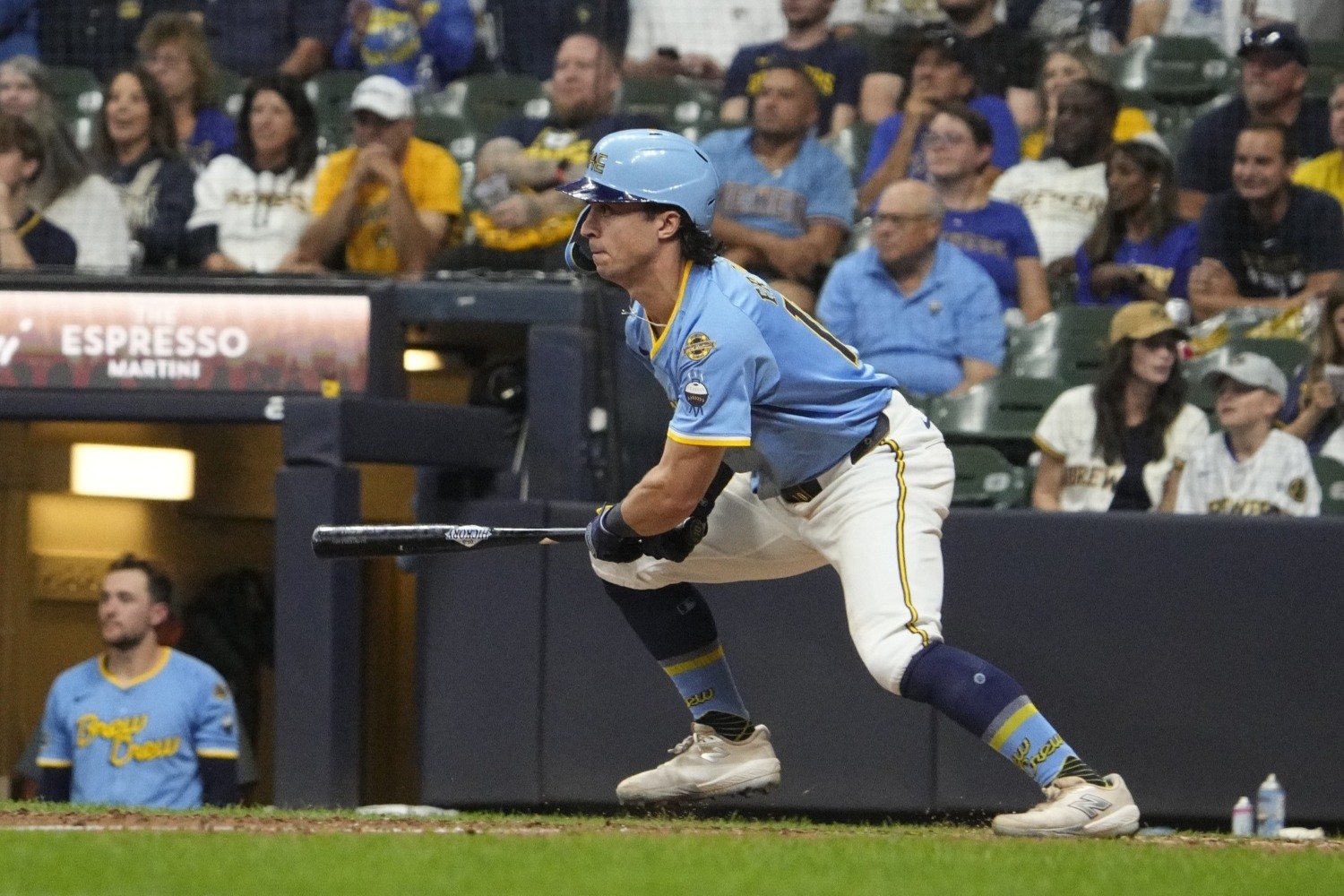 In the month of September, the Milwaukee Brewers have the lowest collective bat speed in baseball, at 70.9 miles per hour. That's not automatically a huge deal, though. This is the Brewers we're talking about, after all. Power isn't at the heart of their offensive attack, and the power they do access doesn't all come from swinging fast. They like good swing decisions, and they like good bat control, and sometimes, that means sacrificing swing speed—either by sitting guys who swing fast in favor of some who swing slower, but who deliver speed, defense and plate discipline, or by asking the regulars to cut down their swings in certain situations to suit the requirements of the moment. Here's the thing, though: this is new. That aggregate bat speed is the lowest for the Brewers in any month of this season, and not by a small margin. In July, their average bat speed was 72.2 miles per hour; they're down by a significant margin since then. Though you don't think of bat speed first when you think about the Crew, they were middle-of-the-pack or better in that regard in each of the first four months of the campaign. Then, they were 26th in baseball in August, and now, they're dead last. What's going on here? Any time you're looking at team-level statistics, and especially any time you're studying changes in team performance over time, check to see whether the trend is a product of changing personnel or changing performance by the same personnel. For instance, if we were looking at the Nationals, we might note that their swing speed by month this year goes: April: 71.6 mph May: 71.8 June: 71.9 July: 72.0 August: 72.7 September: 73.2 That's not necessarily because their individual hitters are doing things differently, though. They traded the slow-swinging Alex Call to the Dodgers at the deadline. They got back toolsy outfielder Dylan Crews from injury last month. They've shifted playing time toward catcher Riley Adams and first baseman Andrés Chaparro, each of whom swing faster than the players they're replacing. This is the more common way for a team's apparent profile to change within a season, in any number of ways. Jack Stern wrote about a version of this earlier this year, when the arrival of Jacob Misiorowski and some of the early shuffling in the bullpen took the Brewers from being a pitch-to-contact team to one with much better raw stuff. They didn't suddenly teach Jose Quintana to throw 98; they just brought up other players who did so. In this case, though, that's not what's happening. Here are eight key Milwaukee batters' average swing speed by month, from July through September: Player July August September Jake Bauers 78.3 78.3 76.3 Jackson Chourio 74.5 75 72.8 William Contreras 74.2 73.6 72.6 Caleb Durbin 68 68.3 67.2 Sal Frelick 69.3 68.7 66.7 Danny Jansen 69.7 70.2 67.3 Joey Ortiz 73.1 71.5 70.2 Andrew Vaughn 71.5 71.4 69.8 The team certainly has needed to redistribute some playing time in recent weeks, dealing with prolonged absences from Jackson Chourio, Joey Ortiz and Rhys Hoskins. Famously, though, each of them has returned this month, so that wouldn't be much of an explanation for this phenomenon, except insofar as their replacements swung faster than they did. That's not true of, to pick a couple examples, Blake Perkins or Andruw Monasterio, so we can safely junk that hypothesis. Besides, look at that table. Each of these guys has lost substantial bat speed since July. The group is intentionally chosen, but there are no notable counterexamples. Brice Turang, Christian Yelich, Isaac Collins, Monasterio and Perkins all have essentially held steady, but none of them have seen a surge in swing speed. There's just this octet of players with big reductions, whom we need to puzzle out. It's tempting to guess that this is a normal trend within a season. This is pretty new data, and maybe you'd assume that everyone tires out as the year winds down. There's a scintilla of evidence of this, too, in that globally, the league's bat speed and fast swing rate (the percentage of swings that exceed 75 miles per hour) each peak in July. They're pretty darn flat from month to month, though. Remember, too, that the Brewers have dropped from the middle of the pack to the very bottom of the league. Whatever bat speed the whole league is losing, Milwaukee is losing more. In fact, they're the only team that has seen their bat speed fall by any significant or patterned amount in the second half of this year. Twenty-six teams are basically flat, and the Nationals, Astros, and Rays have each gotten a bit faster. So this isn't a normal seasonal effect at work. Nor is it unimportant. Even understanding that swinging fast isn't at the core of Milwaukee's hitting weltanschauung, it's good to swing fast, and less good to swing less fast. Some Brewers hitters, given their other offensive traits, already flirt with having insufficient swing speed to produce much at the plate. They can get by when they're at their best (or near it), but they get into trouble in a hurry if their bats slow down markedly, the way some of these guys' have. We can certainly go down the list and surmise a plausible reason for each player's sag. Jake Bauers, Chourio and Ortiz spent time on the injured list, and their return to play is baked into these numbers. It's possible all are still getting their timing back, and until one is back into a comfort zone and getting off one's 'A' swing consistently, that can show up as sluggish bat speed. William Contreras and Danny Jansen are catchers; enough said. I checked, and catchers do not have a different seasonal bat speed arc than the population of hitters as a whole, which is slightly surprising. Still, it's easy to imagine their bats slowing down purely because of the toll the grind takes on them and their position. That leaves Caleb Durbin, Sal Frelick and Andrew Vaughn, though. Durbin is as small as big-leaguers get, and has never played this much in a professional season before—even if you count his time in the Arizona Fall League last year, along with his minor-league season. He might be getting tired. Frelick has dealt with multiple minor injury issues this year; his body might be feeling the accumulation of them. Vaughn, though, is hard to explain. More importantly, it's hard to look at all eight of these players and accept that they're all losing bat speed purely for physical reasons, however valid each might seem in isolation. Thus, I want to advance a different theory. What if the team is using this month as a kind of hitting lab? It's possible that, at least in some at-bats, the coaching staff is asking these guys to make a more concerted effort to go the other way, or to eschew sheer bat speed for the ability to lift the ball. With enough of a cushion in terms of playoff position to lose a game here or there without losing anything of value, it's not an outrageous notion. In fact, it might be the best way for the team to approach this free month of runway before October. There's no way to know for sure that that's what is going on. Even if it were, the team probably wouldn't tell us; it's the kind of approach thing you want to keep clandestine. It's also possible that the players are all healthy (or healthy enough), but that their loss of bat speed isn't about instruction. Rather, it could be about a lack of adrenaline, in games that matter less than the ones they were playing a month ago. They have a terrific position practically sewn up. Adrenaline definitely plays a role in boosting bat speed for most hitters; maybe this group will just get souped up again when they can feel the danger and electricity of the postseason. Whatever the reason for it, this is a noteworthy development. No other team is going through it this month, the way the Brewers are. Yet, they're still having competitive at-bats and playing good baseball. For now, count this first as a curiosity, and only secondarily as anything with analytical weight. In fact, for the rest of the regular season, the analytical weight of most things around the Brewers is limited. They're just gearing up, now. They've earned the right to swing a bit slower, but only for a little while.
- 2 comments
-
- 1
-
-
- danny jansen
- sal frelick
- (and 5 more)
-
Image courtesy of © Charles LeClaire-Imagn Images Assuming they're both healthy, Freddy Peralta and Brandon Woodruff will start the first two games of the Brewers' playoff run, in the National League Division Series. At certain points throughout this season, it's looked like Jacob Misiorowski or Jose Quintana could take the ball for Game 3, but at this point, it's virtually a sure thing: On October 8, Quinn Priester will make his first career playoff start. Priester has gone through two rough patches during his otherwise stellar campaign. The first came in late April and early May, as he and the Brewers worked on things and inched toward the version of him that has been unlocked since. The second came in the middle of last month, when Priester limped through 14 total innings, gave up nine runs, walked seven and struck out just 11 of 65 opposing batters over a three-start stretch. The last of those appearances came August 21 at Wrigley Field, when the Cubs were unable to land a knockout punch but still pushed Priester out of the game in the fifth inning. The Brewers saw something that worried them enough, after that, to push back his next start until August 30. Specifically, the concerning trend was a falling arm angle—a sign of the fatigue Priester is navigating as he pitches deep into a big-league season for the first time. After eight days of rest and with some work behimd the scenes, though, Priester has come back with his deceptive combination of a high arm slot and a sinker-forward arsenal restored. In fact, his arm is so rejuvenated that in his start against the Pirates on September 5, he averaged better velocity on his sinker than in any start since June—and essentially his best velocity of the season. The goal, now, is to keep Priester this fresh and strong for another six weeks or more. When he's throwing in the mid-90s, he's a very tough at-bat. In fact, as the Brewers have worked with him on a season-long evolution, he's become a very good mid-rotation starter. Of the other 11 likely playoff teams, he would start Game 2 (rather than Game 3) of a series for at least four or five. The first rough patch Priester went through included the stretch in which he moved over toward the third-base side of the rubber, which changed the angles his stuff creates and helped unlock some of the other adjustments he's made this summer. To understand them a bit better, let's briefly compare a start from that period to the one he made last week against Pittsburgh. Here's an overhead look at the trajectories of his pitches to right-handed batters in his start on April 26, against the Cardinals. The clusters of white dots show the (estimated) point at which the hitter can begin to readily identify pitches. The pink ones show the (estimated) point by which a hitter has to have committed and shaped their swing, in order to hit the ball. As you can see, there are two distinct groups within each, especially the pink dots. That's because, at that point, Priester was effectively a two-pitch pitcher to righties. He leaned heavily on his sinker and slider, and the velocity and movement difference on them gave hitters more ways to differentiate and attack them. Now, here's the equivalent image for his start against Pittsburgh last Friday. It's subtle, but start by noticing the difference in Priester's release point. The ball now leaves his hand a bit wide of the edge of the pitching rubber, because he's slid over to that side of the mound more since April. That creates different angles of travel for each of his pitches, from hand to hitting zone. Secondly, see how more of the white dots cluster closer to the plate? Again, the difference is small, but it's important. Because Priester is throwing a hair harder now than he was in April (and because of his pitch mix), he's giving hitters less time to identify and decide about pitches. Finally, see that the pink dots spread much more evenly. That's for a simple reason: Priester went to his cutter and curveball much more often against righties while facing Pittsburgh last week than he had with St. Louis batters months earlier. He's closer to a four-pitch guy to righties, now. Let's now step into the batter's box, and visualize what Priester is throwing the way a righty batter would. Here's an animation from a right-handed hitter's perspective of all the pitches he threw to Cardinals righties in late April. Immediately, you can see how early the cutter's trajectory diverges from those of the sinker and slider. You can also see the slider standing out based on how quickly it falls off the plane the sinker holds. The sinker does veer back toward the righty batter, but from the angle Priester was working and with the mix he deployed back then, the sinker and slider didn't look much like one another out of the hand. Here's the same look through the eyes of Pirates righties last week. One neat thing about this style of animation is that it gives us a chance to clearly see how much moving on the rubber or changing an arm slot can affect a hitter's visual cues. The change in release point here means that Priester's sinker, slider and cutter all hold something close to the same initial trajectory. Actually, his curveball doesn't even pop out of the hand, the way it often can for pitchers like Priester. Finally, let's zoom back to behind the plate and see where these pitches actually ended up. First, for the start against St. Louis: Because of Priester's high arm slot and the mound position he was using then, he really couldn't make much use of the inner third of the plate against righties at the time. You also need a certain amount of velocity to confidently go into the kitchen of big-league hitters, and he didn't have the pitch up to speed at that juncture. He was very slider-dependent, and as you can see friom behind the plate, some of those sliders were easy takes for Cardinals batters. Let's take a look at the same image for the Pittsburgh start. It's much easier for the sinker to hit the inside corner now. Just as importantly, though, look how Priester now uses the cutter to attack the whole zone, rather than just skidding it off the outside corner. This makes it harder for the hitter to identify both the sinker and the slider, based on the way the three play off each other in terms of movement and speed. For good measure, Priester also threw 10 curveballs to righties in this last start, a new wrinkle that put them on the defensive. There are a lot of things you can do to the Pirates lineup that won't work against, say, that of the Padres or Cubs come October. Priester can't stop evolving now. However, restored by his brief break last month, he's spun 13 marvelous innings over his last two outings. Working on extra rest yet again, his challenge Friday night against the Cardinals will be to keep honing his new, wider mix and to keep learning to balance pacing himself with cutting it loose. He's safely written into Milwaukee's October plans. He just needs to keep testing and learning, while resting and managing his body to be ready to throw 95 and fully deploy his repertoire when the lights get brighter. View full article
-
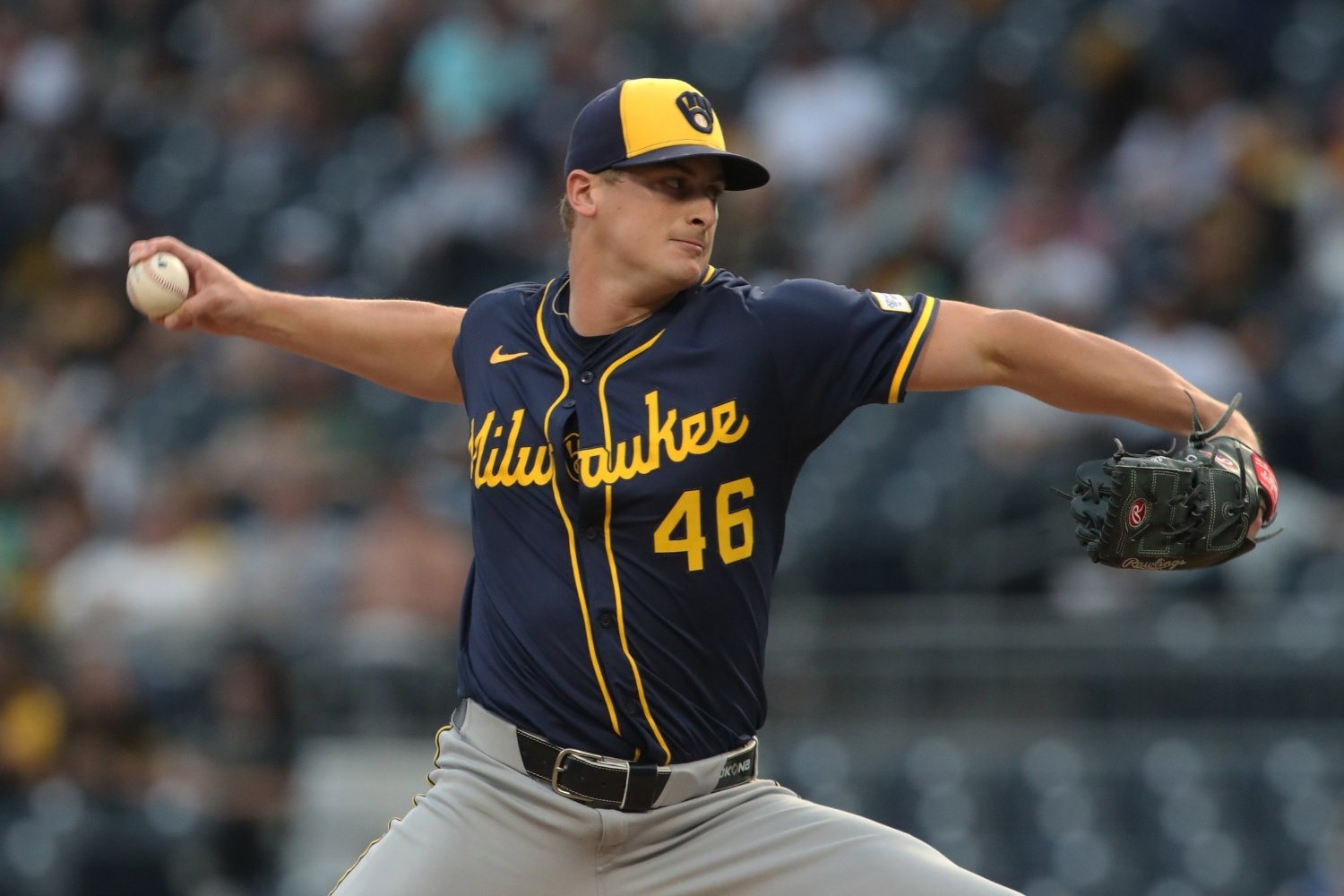 Assuming they're both healthy, Freddy Peralta and Brandon Woodruff will start the first two games of the Brewers' playoff run, in the National League Division Series. At certain points throughout this season, it's looked like Jacob Misiorowski or Jose Quintana could take the ball for Game 3, but at this point, it's virtually a sure thing: On October 8, Quinn Priester will make his first career playoff start. Priester has gone through two rough patches during his otherwise stellar campaign. The first came in late April and early May, as he and the Brewers worked on things and inched toward the version of him that has been unlocked since. The second came in the middle of last month, when Priester limped through 14 total innings, gave up nine runs, walked seven and struck out just 11 of 65 opposing batters over a three-start stretch. The last of those appearances came August 21 at Wrigley Field, when the Cubs were unable to land a knockout punch but still pushed Priester out of the game in the fifth inning. The Brewers saw something that worried them enough, after that, to push back his next start until August 30. Specifically, the concerning trend was a falling arm angle—a sign of the fatigue Priester is navigating as he pitches deep into a big-league season for the first time. After eight days of rest and with some work behimd the scenes, though, Priester has come back with his deceptive combination of a high arm slot and a sinker-forward arsenal restored. In fact, his arm is so rejuvenated that in his start against the Pirates on September 5, he averaged better velocity on his sinker than in any start since June—and essentially his best velocity of the season. The goal, now, is to keep Priester this fresh and strong for another six weeks or more. When he's throwing in the mid-90s, he's a very tough at-bat. In fact, as the Brewers have worked with him on a season-long evolution, he's become a very good mid-rotation starter. Of the other 11 likely playoff teams, he would start Game 2 (rather than Game 3) of a series for at least four or five. The first rough patch Priester went through included the stretch in which he moved over toward the third-base side of the rubber, which changed the angles his stuff creates and helped unlock some of the other adjustments he's made this summer. To understand them a bit better, let's briefly compare a start from that period to the one he made last week against Pittsburgh. Here's an overhead look at the trajectories of his pitches to right-handed batters in his start on April 26, against the Cardinals. The clusters of white dots show the (estimated) point at which the hitter can begin to readily identify pitches. The pink ones show the (estimated) point by which a hitter has to have committed and shaped their swing, in order to hit the ball. As you can see, there are two distinct groups within each, especially the pink dots. That's because, at that point, Priester was effectively a two-pitch pitcher to righties. He leaned heavily on his sinker and slider, and the velocity and movement difference on them gave hitters more ways to differentiate and attack them. Now, here's the equivalent image for his start against Pittsburgh last Friday. It's subtle, but start by noticing the difference in Priester's release point. The ball now leaves his hand a bit wide of the edge of the pitching rubber, because he's slid over to that side of the mound more since April. That creates different angles of travel for each of his pitches, from hand to hitting zone. Secondly, see how more of the white dots cluster closer to the plate? Again, the difference is small, but it's important. Because Priester is throwing a hair harder now than he was in April (and because of his pitch mix), he's giving hitters less time to identify and decide about pitches. Finally, see that the pink dots spread much more evenly. That's for a simple reason: Priester went to his cutter and curveball much more often against righties while facing Pittsburgh last week than he had with St. Louis batters months earlier. He's closer to a four-pitch guy to righties, now. Let's now step into the batter's box, and visualize what Priester is throwing the way a righty batter would. Here's an animation from a right-handed hitter's perspective of all the pitches he threw to Cardinals righties in late April. Immediately, you can see how early the cutter's trajectory diverges from those of the sinker and slider. You can also see the slider standing out based on how quickly it falls off the plane the sinker holds. The sinker does veer back toward the righty batter, but from the angle Priester was working and with the mix he deployed back then, the sinker and slider didn't look much like one another out of the hand. Here's the same look through the eyes of Pirates righties last week. One neat thing about this style of animation is that it gives us a chance to clearly see how much moving on the rubber or changing an arm slot can affect a hitter's visual cues. The change in release point here means that Priester's sinker, slider and cutter all hold something close to the same initial trajectory. Actually, his curveball doesn't even pop out of the hand, the way it often can for pitchers like Priester. Finally, let's zoom back to behind the plate and see where these pitches actually ended up. First, for the start against St. Louis: Because of Priester's high arm slot and the mound position he was using then, he really couldn't make much use of the inner third of the plate against righties at the time. You also need a certain amount of velocity to confidently go into the kitchen of big-league hitters, and he didn't have the pitch up to speed at that juncture. He was very slider-dependent, and as you can see friom behind the plate, some of those sliders were easy takes for Cardinals batters. Let's take a look at the same image for the Pittsburgh start. It's much easier for the sinker to hit the inside corner now. Just as importantly, though, look how Priester now uses the cutter to attack the whole zone, rather than just skidding it off the outside corner. This makes it harder for the hitter to identify both the sinker and the slider, based on the way the three play off each other in terms of movement and speed. For good measure, Priester also threw 10 curveballs to righties in this last start, a new wrinkle that put them on the defensive. There are a lot of things you can do to the Pirates lineup that won't work against, say, that of the Padres or Cubs come October. Priester can't stop evolving now. However, restored by his brief break last month, he's spun 13 marvelous innings over his last two outings. Working on extra rest yet again, his challenge Friday night against the Cardinals will be to keep honing his new, wider mix and to keep learning to balance pacing himself with cutting it loose. He's safely written into Milwaukee's October plans. He just needs to keep testing and learning, while resting and managing his body to be ready to throw 95 and fully deploy his repertoire when the lights get brighter.
 -
 William Contreras's work as a framer has been a constant topic of conversation, ever since the Brewers acquired him in the 2022-23 offseason. He'd been so bad at that vital skill as a member of the team from Georgia that some wondered whether even the vaunted Brewers developmental infrastructure could turn him into a solid backstop. Almost immediately, though, they did just that. There were questions about whether Contreras would be able to stay behind the plate, but now, he's established himself as one of the best catchers in the league. This season, he got off to such a great start that one could almost believe he was finding a new level as a framer. Before the All-Star break, factoring in framing, throwing out runners and blocking errant pitches, Contreras was 3.9 runs better than average as a defender, according to Baseball Prospectus. Since the break, though (in considerably less total playing time), he's been 3.4 runs worse than average. Specifically, after a hot start, Contreras went ice-cold as a framer last month. September's not off to a great start, either. William Contreras, Framing Run Value by Month and Location, 2025 Month Top of Zone Bottom of Zone 3B Edge 1B Edge April -1 3 1 -1 May 0 -1 1 0 June 0 0 0 0 July 0 1 1 0 August 0 -1 1 -1 September -1 0 0 -1 Contreras is having a harder time maintaining the edges of the strike zone and helping his pitchers out as the year wears on. It's not a pure fluke of statistics or umpire bias, either. When you watch him work, tangible differences jump out. First, here's Contreras winning a call at the bottom edge of the zone back in the first half. He got a called strike on 44.3% of taken pitches in the shadow zones along the edges of the zone before the All-Star break. OTc5WGdfWGw0TUFRPT1fQmdnQ1Z3VU1VZ29BV1ZvSEFBQUhBQTlmQUFCUUJsTUFWbEFGQ1ZCUkNGWlVVVkFI.mp4 This is not the cleanest catch you'll see, but it's typical of Contreras's effective first half. He sets up with his right knee up, creating a firm outside edge, and his stance is compact and blockish. That makes it easier for him to reach and move the ball, without appearing to be pulling it so much that the umpire assumes they're being manipulated. Here's another example of him coming up with a fringy call. WEQybmpfWGw0TUFRPT1fQTFWVEFWMEVBQVFBQ2x0VEFBQUhWUVpVQUFBTVZnSUFCMVFFVlF0UUFRTUJVZ3BV.mp4 That's a more prototypical move. It's the same sturdy setup, and a nice, quiet reception of the ball. As is the modern state of the art, he pulls the ball to the center of the zone, but he does it subtly, and the fact that he wasn't punching at the ball when he first caught it made that move smooth. Let's take a look at one more pitch Contreras framed well in the first half. QndvZEJfWGw0TUFRPT1fQndFQVhRWU1VQUlBWEZkVVZRQUhCZ1JUQUZsUkJWVUFDbFlDVkFVREFWRUJCVmNG.mp4 Chad Patrick slightly missed his spot, but Contreras was in good position to adjust to it. There's plenty of movement in the process of catching the ball, but it's all in rhythm, and the call ends up being easy for the umpire. Now, let's look at what's happened in the second half. V0FkMnFfWGw0TUFRPT1fVWxjSEIxWU5WUU1BQ1ZVQkJ3QUhCZ1ZWQUZsVVd3SUFCRmNDVVZjRkNRSlVDRlFB.mp4 There's no one thing Contreras is doing worse lately. This illustrates a couple of the small ones, together. Brandon Woodruff missed his spot here, too, but Contreras is in a much lower, less balanced stance behind the plate, which makes him less able to adapt to that. Feeling himself lunge and believing, perhaps, that he ended up reaching lower than he really did, he also carries the ball too high. It's a big, broad movement, and not a smooth one. Here's another pitch in a similar spot, more directly comparable to the successes he had in the first half. MTZxTzNfWGw0TUFRPT1fQlFGWkJRY0RYd2NBRGdSVUJ3QUhDQVZYQUZsUlVBVUFVMUFGQVZGWEFBQlZDQWRS.mp4 Catching Jacob Misiorowski is hard. He throws so hard that beating the ball to its spot—a key aspect of framing well, especially on fastballs—is difficult. Contreras didn't do nearly well enough on this one, though. He tried to catch the ball in his normal rhythm, but the ball got on him too quickly, and his resulting glove movement was all over the place. Alright, one more. SzRsT0JfV0ZRVkV3dEdEUT09X0ExTllWZ2NBQTFZQUNnRUFYd0FIQVE5U0FBTldBQVVBQzFZR0FRTldCbFVHVlFSVw==.mp4 This ball didn't technically need to be a strike, anyway. It could have been one, though. Contreras is low enough to catch the ball on a smooth drive through it, stabilizing as he does so. Instead, though, he carries it too high again, and his whole body follows that glove movement. Contreras looks, frankly, a bit tired. He's played a ton behind the plate this season, and it appears to be catching up to him. His mechanics are getting a bit more spastic. He's still thinking correctly on each pitch, but he's not physically executing his efforts to frame as well as he did earlier in the season. The Brewers should continue shopping for every opportunity to rest Contreras and to use him as the designated hitter, down the stretch, slotting Danny Jansen into his place as the backstop. Ideally, that would result in a fresher and more effective Contreras in terms of framing come October.
 -
Image courtesy of © Charles LeClaire-Imagn Images William Contreras's work as a framer has been a constant topic of conversation, ever since the Brewers acquired him in the 2022-23 offseason. He'd been so bad at that vital skill as a member of the team from Georgia that some wondered whether even the vaunted Brewers developmental infrastructure could turn him into a solid backstop. Almost immediately, though, they did just that. There were questions about whether Contreras would be able to stay behind the plate, but now, he's established himself as one of the best catchers in the league. This season, he got off to such a great start that one could almost believe he was finding a new level as a framer. Before the All-Star break, factoring in framing, throwing out runners and blocking errant pitches, Contreras was 3.9 runs better than average as a defender, according to Baseball Prospectus. Since the break, though (in considerably less total playing time), he's been 3.4 runs worse than average. Specifically, after a hot start, Contreras went ice-cold as a framer last month. September's not off to a great start, either. William Contreras, Framing Run Value by Month and Location, 2025 Month Top of Zone Bottom of Zone 3B Edge 1B Edge April -1 3 1 -1 May 0 -1 1 0 June 0 0 0 0 July 0 1 1 0 August 0 -1 1 -1 September -1 0 0 -1 Contreras is having a harder time maintaining the edges of the strike zone and helping his pitchers out as the year wears on. It's not a pure fluke of statistics or umpire bias, either. When you watch him work, tangible differences jump out. First, here's Contreras winning a call at the bottom edge of the zone back in the first half. He got a called strike on 44.3% of taken pitches in the shadow zones along the edges of the zone before the All-Star break. OTc5WGdfWGw0TUFRPT1fQmdnQ1Z3VU1VZ29BV1ZvSEFBQUhBQTlmQUFCUUJsTUFWbEFGQ1ZCUkNGWlVVVkFI.mp4 This is not the cleanest catch you'll see, but it's typical of Contreras's effective first half. He sets up with his right knee up, creating a firm outside edge, and his stance is compact and blockish. That makes it easier for him to reach and move the ball, without appearing to be pulling it so much that the umpire assumes they're being manipulated. Here's another example of him coming up with a fringy call. WEQybmpfWGw0TUFRPT1fQTFWVEFWMEVBQVFBQ2x0VEFBQUhWUVpVQUFBTVZnSUFCMVFFVlF0UUFRTUJVZ3BV.mp4 That's a more prototypical move. It's the same sturdy setup, and a nice, quiet reception of the ball. As is the modern state of the art, he pulls the ball to the center of the zone, but he does it subtly, and the fact that he wasn't punching at the ball when he first caught it made that move smooth. Let's take a look at one more pitch Contreras framed well in the first half. QndvZEJfWGw0TUFRPT1fQndFQVhRWU1VQUlBWEZkVVZRQUhCZ1JUQUZsUkJWVUFDbFlDVkFVREFWRUJCVmNG.mp4 Chad Patrick slightly missed his spot, but Contreras was in good position to adjust to it. There's plenty of movement in the process of catching the ball, but it's all in rhythm, and the call ends up being easy for the umpire. Now, let's look at what's happened in the second half. V0FkMnFfWGw0TUFRPT1fVWxjSEIxWU5WUU1BQ1ZVQkJ3QUhCZ1ZWQUZsVVd3SUFCRmNDVVZjRkNRSlVDRlFB.mp4 There's no one thing Contreras is doing worse lately. This illustrates a couple of the small ones, together. Brandon Woodruff missed his spot here, too, but Contreras is in a much lower, less balanced stance behind the plate, which makes him less able to adapt to that. Feeling himself lunge and believing, perhaps, that he ended up reaching lower than he really did, he also carries the ball too high. It's a big, broad movement, and not a smooth one. Here's another pitch in a similar spot, more directly comparable to the successes he had in the first half. MTZxTzNfWGw0TUFRPT1fQlFGWkJRY0RYd2NBRGdSVUJ3QUhDQVZYQUZsUlVBVUFVMUFGQVZGWEFBQlZDQWRS.mp4 Catching Jacob Misiorowski is hard. He throws so hard that beating the ball to its spot—a key aspect of framing well, especially on fastballs—is difficult. Contreras didn't do nearly well enough on this one, though. He tried to catch the ball in his normal rhythm, but the ball got on him too quickly, and his resulting glove movement was all over the place. Alright, one more. SzRsT0JfV0ZRVkV3dEdEUT09X0ExTllWZ2NBQTFZQUNnRUFYd0FIQVE5U0FBTldBQVVBQzFZR0FRTldCbFVHVlFSVw==.mp4 This ball didn't technically need to be a strike, anyway. It could have been one, though. Contreras is low enough to catch the ball on a smooth drive through it, stabilizing as he does so. Instead, though, he carries it too high again, and his whole body follows that glove movement. Contreras looks, frankly, a bit tired. He's played a ton behind the plate this season, and it appears to be catching up to him. His mechanics are getting a bit more spastic. He's still thinking correctly on each pitch, but he's not physically executing his efforts to frame as well as he did earlier in the season. The Brewers should continue shopping for every opportunity to rest Contreras and to use him as the designated hitter, down the stretch, slotting Danny Jansen into his place as the backstop. Ideally, that would result in a fresher and more effective Contreras in terms of framing come October. View full article

