


Matthew Trueblood
-
Posts
1,964 -
Joined
-
Last visited
-
Days Won
10
Content Type
Profiles
Forums
Blogs
Events
News
2026 Milwaukee Brewers Top Prospects Ranking
Milwaukee Brewers Videos
2022 Milwaukee Brewers Draft Picks
Milwaukee Brewers Free Agent & Trade Rumors, Notes, & Tidbits
Guides & Resources
2023 Milwaukee Brewers Draft Picks
2024 Milwaukee Brewers Draft Picks
The Milwaukee Brewers Players Project
2025 Milwaukee Brewers Draft Pick Tracker
2026 Milwaukee Brewers Draft Tracker: Picks & Bonuses
Store
Downloads
Gallery
Everything posted by Matthew Trueblood
-
Image courtesy of © Benny Sieu-Imagn Images Give William Contreras credit for his toughness, and an extra helping for his ability to make up for a major injury. He's dealing with a fracture in his left hand, which is (naturally) exacerbated and prevented from fully healing by the mere act of catching on a regular basis. Still, he's doing everything he can to be there for his team, and he's been better than many of the (closer to) fully healthy players on the roster. Contreras has played in 64 of the Brewers' first 69 games, and he's hitting .242/.353/.342 in 272 plate appearances. A whopping 57 of those games played were at catcher. Although Eric Haase (.239/.286/.419 in 50 plate appearances) is actually hitting about as well as Contreras is, there's still a real service to the team in their star catcher being willing to gut it out on a near-daily basis. If nothing else, he's been a terrific defender behind the plate, shoring up the problems he had with accuracy and throwing better than ever on steal attempts; grading out well as a framer; and improving at blocking balls in the dirt. In this day and age, it's also quite helpful to have anyone who can sustain a .353 OBP in the lineup, even if they're light on power. On the other hand, Contreras has batted second, third or fourth in every game in which he's appeared this year. He's giving up 80 points of slugging average to the league's standard at any of those places in the batting order. The Brewers needed Contreras to make good on the power potential he showed late last season, to help make up for the loss of Willy Adames via free agency. Instead, he's become one of the league's lightest-hitting should-be power hitters. When he decided to play through the injury, one might reasonably have hoped that Contreras would heal even as he did so. Bones, especially in the hands, get good blood supply. Some day-to-day improvement should happen, as long as a player isn't actively renewing the damage to the injured area. We don't have access to medical data about Contreras; maybe that healing is (very slowly) happening. What we can see, however, suggests that things are only getting worse. Through the end of April, Contreras's average bat speed was 72.6 miles per hour. That, itself, was down about 2 mph from where he was in the second half of 2024, but it was a tolerable loss. Some guys need time (and warmer weather) to get loose and achieve their full range of motion (whence comes bat speed) anyway. You could easily envision Contreras making the best of the situation and rounding more or less into form from that starting point. In May, that number slipped to 72.2 miles per hour. That's a bad sign. The margin is small, but the trend is in the wrong direction. Contreras didn't slug any better (.362) last month than he had before that (.365). Interestingly, though, even as his bat speed faded, his contact point moved farther out in front of his body. In a sketch, it sure looks like he started making earlier decisions, trying to get out to the ball with a slower swing by starting earlier and simply opting not to swing when he couldn't identify a pitch immediately. His swing rate has fluctuated throughout this season, but it's holding to a lower ebb than where it spent most of its time last season. He's become more selective, and maybe that's just a change of approach—but it feels more like an accommodation of a bat slowed down by a slightly weakened bottom hand on the bat. This month, that's come into even sharper focus. Contreras has just one extra-base hit since the calendar flipped to June, and although he belted it off the wall in the deepest reaches of The Ueck, it still only goes as a double. ZU44WkFfWGw0TUFRPT1fVkZCUlZRSldBMVFBQ0FFSFZRQUhDRlFGQUZsUVV3TUFVQWNNQVZkWEFBRUdCMVlI.mp4 He's slugging .212 for the month, so far, and damningly, that comes along with a bat speed that has fallen all the way to 71.2 mph. Again, his intercept point on swings is well in front of him, right where it was last summer. From a slower swing, though, that equivalent contact point means he must make swing decisions earlier. You can guess what that leads to: fewer swings, in general, and (since pitchers know they needn't fear him the way they did 10 months ago) a lot more called strikes. Here's the percentage of takes on which Contreras has taken a called strike, by month, since the start of last year: Mar./Apr. 2024: 27.8 May 2024: 25.7 June 2024: 28.4 July 2024: 25.4 August 2024: 24.3 September 2024: 22.9 Mar./Apr, 2025: 24.2 May 2025: 27.6 June 2025: 37.2 When we set the new Statcast visuals of players' swings side by side, we can start to see exactly why Contreras's bat is slower. Here's a first checkpoint: the moment when his bat first comes around to be parallel with the sides of home plate or the lines of the batter's box. Look both at the difference in Contreras's shoulder position and at the crook of his left wrist, in each frame. On the left, last year, you can see that he's already opened up that shoulder quite a bit. That's important to all the bat speed Contreras generated so well last year: he gets that shoulder open and forces his hands to catch up to the rapid rotation of his body. He sometimes pulled off the ball, at his best, but the bat speed created by doing things that way was still immensely valuable. Simulate that motion, though. Grip a bat (or a golf club, or an umbrella, or a wooden spoon), get into an athletic posture, and try twisting enough to get your front shoulder well open, even while your hands are still even with your belly button or so. Keep in mind, you can't do so by just dropping your front arm into a relaxed position. It has to provide a lot of strength and an upward, shearing force, working in concert with the top hand to move your implement fast in rotation. Quickly, you'll realize the angle you're creating isn't comfortable, especially in your bottom hand. You're asking it to do a lot of work, because that shoulder is clearing out of the way. Your front arm is taking over from the torso to start whipping the bat forward, and that means the hand and wrist, specifically, absorbing a lot of force. In the image on the right, Contreras is much less open with his upper half. That, plus a slightly more rolled wrist on the left arm, means he's carrying the bat into the hitting zone with more of his big muscles, leaving less to his left hand. He's subtly babying that tender hand, and already, he's a bit behind the curve in terms of generating exit velocity. Here's the moment when he first gets on plane with the incoming pitch, for both years. Contreras is considerably slower at this point of the swing this year, too, but the most interesting thing (almost imperceptible, but there) is how he's accelerated the transfer from the bottom to the top hand in terms of what's powering the swing. Well before contact, on average, he's extending that back arm forward to throw the barrel through the zone. He's also slightly further forward, in terms of balance and weight transfer. This could be (and probably even is) happening subconsciously, but the effect is to take a little strain off the bottom hand and generate as much of the swing's force and stability as possible in other places. Here's the frame closest to his contact point, for each year. This just completes what we've already seen. The differences are slight, but the front shoulder is more closed this season, and the back arm has taken over the path of the swing much more than it had by contact last year. It's a fine little compensatory fix, for a hitter playing at far less than 100%. However, it's also costing him a tick or two of bat speed, and it's coloring the swing decisions even upstream from that. He just isn't capable, right now, of consistently executing the swing that made him a fearsome, middle-of-the-order hitter over the last two seasons. Since it sounds unlikely that his hand will heal well within the season, Contreras will have to keep finding ways to succeed despite diminished bat speed. For the team's part, sliding Contreras down in the batting order seems urgently necessary. He can be helpful to the team just by showing up and taking the field, but a few more days off are in order, and when he's in the lineup, he should bat sixth or seventh. In all likelihood, that's the kind of player Contreras can be even as he plays through this injury. At some point, he'll be well enough again to start slamming the ball and slugging nearly .500. Until that point comes, though, he should move down the batting order to permit hitters with better health and better present pop to come up more often. He probably won't be back to the hitter we all expect Contreras to be until the end stages of this season, or 2026. That's a bummer, but looking at the data, it's hard to feel any other way. The Brewers must adjust to what's happening. View full article
-
Freddy Peralta, Jose Quintana, Quinn Priester and Chad Patrick will all retain their spots in the Brewers starting rotation, with the arrival of Jacob Misiorowski rounding out the group. The odd man out will be Aaron Civale, last year's early-July starting reinforcement. Civale, who turns 30 on Thursday, has a 4.91 ERA in five starts this year, and is a free agent at season's end. Everyone else in the mix either has significantly outperformed him; is more important to the long-term future of the Brewers; or meets both of those criteria. Presumably, Misiorowski will take the place on the roster of Easton McGee, whom the team recalled to replace the optioned Grant Anderson. With Civale, DL Hall and Aaron Ashby all in the pen, the Brewers now have one of the deepest groups of multi-inning relief options in the league. That figures to come in handy, since Patrick, Misiorowski and even (lately) Peralta are prone to short starts. One way or another, though, the pitching staff certainly got more talented—and Pat Murphy's job to manage it just got a hair more complicated. View full rumor
-
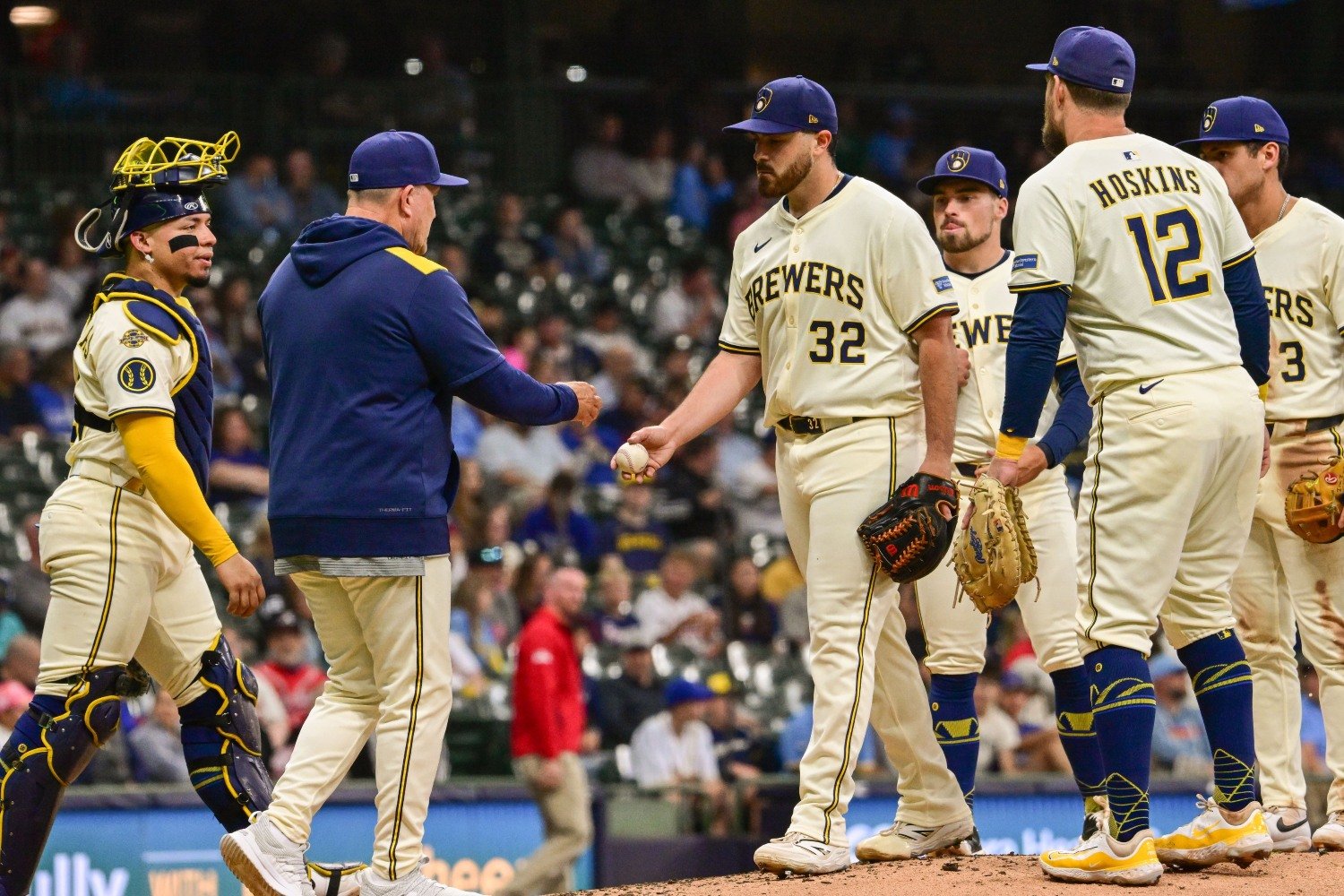 Freddy Peralta, Jose Quintana, Quinn Priester and Chad Patrick will all retain their spots in the Brewers starting rotation, with the arrival of Jacob Misiorowski rounding out the group. The odd man out will be Aaron Civale, last year's early-July starting reinforcement. Civale, who turns 30 on Thursday, has a 4.91 ERA in five starts this year, and is a free agent at season's end. Everyone else in the mix either has significantly outperformed him; is more important to the long-term future of the Brewers; or meets both of those criteria. Presumably, Misiorowski will take the place on the roster of Easton McGee, whom the team recalled to replace the optioned Grant Anderson. With Civale, DL Hall and Aaron Ashby all in the pen, the Brewers now have one of the deepest groups of multi-inning relief options in the league. That figures to come in handy, since Patrick, Misiorowski and even (lately) Peralta are prone to short starts. One way or another, though, the pitching staff certainly got more talented—and Pat Murphy's job to manage it just got a hair more complicated.
 -
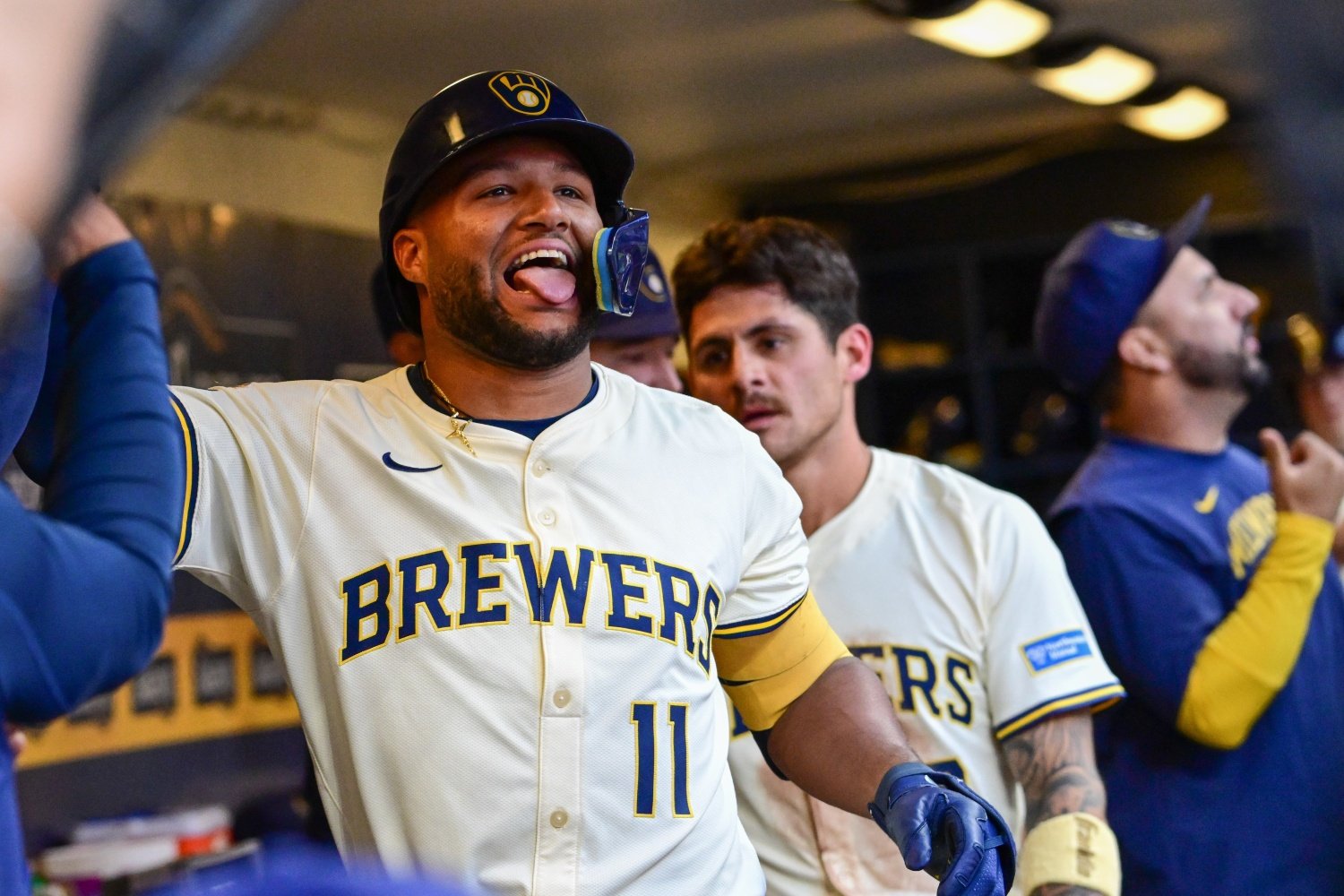 There's never been a shortage of bat speed for Jackson Chourio. He's exceptionally strong, for such a young player, and he transfers his weight forcefully into the ball. His average swing speed was a robust 73.2 miles per hour, and this year, it's up another tick. Since the start of May, Chourio's bat speed is averaging 74.1 mph, which means he's capable of hitting it harder than most hitters. Yet, Chourio's average exit velocity and hard-hit rate are actually down this season; he's not getting as much sheer exit speed out of his swing speed as he was in 2024. However, on Tuesday night against the visitors from Georgia, Chourio cracked his 11th home run of the young season. Even over a start during which he's been too aggressive and isn't playing his best baseball, he's set himself on a pace that could lead to 30 home runs on the year, all at age 21. It's fascinating that, even as he loses a bit of average jump off the bat, he's accessing more pop. How is it possible? To answer that, consider this histogram of Chourio's batted balls from 2024, binned by launch angle. The bars are colored by exit velocity; redder bars indicate bins in which he hit the ball harder, while bluer ones indicate bins in which he hit it softer. Last season, Chourio hit plenty of fly balls. Generally, though, his hardest contact came at lower launch angles. That's not unusual, especially for a hitter with a relatively flat swing, like Chourio's. He was most likely to hit the ball between 30° and 40°, but his average exit velocity on those batted balls was just 87.6 miles per hour. The balls on the higher end of a distribution like that will still do plenty of damage, and sure enough, Chourio was a valuable slugger in the second half of his rookie season. Clearly, though, it's a bit counterproductive to hit the ball hardest in the band just south of 0°. Those are ground balls, and though they have a chance to be singles, they tend to become outs most of the time. Here's the same visual, for 2025 to date. The peak frequency range is now a bit lower, and relatively speaking, he's hitting more unproductive high fly balls. However, he's also hitting way fewer balls at any angle lower than 10°, and look at the coloration of that tallest bar. His average exit velocity on batted balls between 20° and 30° is 91.1 mph. If you're hitting with that kind of authority in that bracket for launch angle, you're going to find a whole lot of power. Only approach questions need limit Chourio at this point. His uptick in swing speed has him in good shape to produce not just the 20-plus homers he's hit in each of his previous three years of professional ball, but 30 or 35. He's concentrating his hardest contact in the types of swings you want to see generate that exit velocity. He hasn't seen a massive spike in whiff rate. Now, he just needs to work a bit harder to get his pitch. Once he starts doing that, the power (already up a half-step from last year) will surge even more.
 -
Image courtesy of © Benny Sieu-Imagn Images There's never been a shortage of bat speed for Jackson Chourio. He's exceptionally strong, for such a young player, and he transfers his weight forcefully into the ball. His average swing speed was a robust 73.2 miles per hour, and this year, it's up another tick. Since the start of May, Chourio's bat speed is averaging 74.1 mph, which means he's capable of hitting it harder than most hitters. Yet, Chourio's average exit velocity and hard-hit rate are actually down this season; he's not getting as much sheer exit speed out of his swing speed as he was in 2024. However, on Tuesday night against the visitors from Georgia, Chourio cracked his 11th home run of the young season. Even over a start during which he's been too aggressive and isn't playing his best baseball, he's set himself on a pace that could lead to 30 home runs on the year, all at age 21. It's fascinating that, even as he loses a bit of average jump off the bat, he's accessing more pop. How is it possible? To answer that, consider this histogram of Chourio's batted balls from 2024, binned by launch angle. The bars are colored by exit velocity; redder bars indicate bins in which he hit the ball harder, while bluer ones indicate bins in which he hit it softer. Last season, Chourio hit plenty of fly balls. Generally, though, his hardest contact came at lower launch angles. That's not unusual, especially for a hitter with a relatively flat swing, like Chourio's. He was most likely to hit the ball between 30° and 40°, but his average exit velocity on those batted balls was just 87.6 miles per hour. The balls on the higher end of a distribution like that will still do plenty of damage, and sure enough, Chourio was a valuable slugger in the second half of his rookie season. Clearly, though, it's a bit counterproductive to hit the ball hardest in the band just south of 0°. Those are ground balls, and though they have a chance to be singles, they tend to become outs most of the time. Here's the same visual, for 2025 to date. The peak frequency range is now a bit lower, and relatively speaking, he's hitting more unproductive high fly balls. However, he's also hitting way fewer balls at any angle lower than 10°, and look at the coloration of that tallest bar. His average exit velocity on batted balls between 20° and 30° is 91.1 mph. If you're hitting with that kind of authority in that bracket for launch angle, you're going to find a whole lot of power. Only approach questions need limit Chourio at this point. His uptick in swing speed has him in good shape to produce not just the 20-plus homers he's hit in each of his previous three years of professional ball, but 30 or 35. He's concentrating his hardest contact in the types of swings you want to see generate that exit velocity. He hasn't seen a massive spike in whiff rate. Now, he just needs to work a bit harder to get his pitch. Once he starts doing that, the power (already up a half-step from last year) will surge even more. View full article
-
Image courtesy of © Dave Kallmann / Milwaukee Journal Sentinel / USA TODAY NETWORK via Imagn Images The Milwaukee Brewers are putting their best foot forward, by putting their best arm forward. Despite a veteran-laden starting rotation and amid a solid recent run, they'll call up right-handed pitcher Jacob Misiorowski—the top pitching prospect in the organization—to start Thursday's series opener against the Cardinals, a source with knowledge of their plans said Tuesday afternoon. That confirms a report from Jeff Passan that broke minutes earlier. Misiorowski has turned a corner with Triple-A Nashville over the last month and a half. He's touched as high as 103 miles per hour, even late in starts, and his command has improved markedly. The Brewers' starting rotation has been stretched very thin by injuries at times this season, but they do have arms available who could have made Thursday's start instead. This is a proactive choice by the team to promote a player with a chance to become one of the game's most electrifying arms. Since the likely date for meeting Super Two eligibility thresholds in 2027 is now past, the Brewers could call up Misiorowski without any constraints or considerations other than his recent performance and the state of their pitching staff. As their corps of arms and their approach to using them has evolved throughout the season, they've achieved a level of comfort that they can accommodate the occasional short start (thanks especially to having long men Aaron Ashby and DL Hall available in relief) that permits this promotion without any lingering worry about its ramifications for the rest of the roster. On good days, it won't matter, anyway. Misiorowski has some of baseball's nastiest stuff. After struggling to establish a third pitch or sufficient control over his two previous seasons as an emerging phenom, Misiorowski, 23, is having his best professional campaign. He's fanned 31.6% of opposing batters in 13 appearances for Nashville, and in addition to his wicked combination of a triple-digit fastball and a big-breaking, sharp curveball, he's established a cutter/slider and a changeup he can trust as ancillary weapons. The former has come along even more than that, in fact, not as an out pitch, but to set up and facilitate the rest of his game. It's all added up to a 2.13 ERA, against the best competition this continent can offer, short of the majors. Sources said there was no immediate word on a corresponding move to clear space for Misiorowski on the active roster. One declined to rule out that an injury could be involved, but we'll wait to hear more on that in the coming days. Misiorowski is not yet on the 40-man roster, so a move will need to not only open a spot on the 26-man, but clear that slot on the team's reserve list. For now, it's time to look forward to what Misiorowski can do against big-league hitters. He had nothing left to prove in the minors, and the Brewers will need to press the pedal steadily toward the floor in order to get back to October this season. This move is a sure sign that they understand that. View full article
-
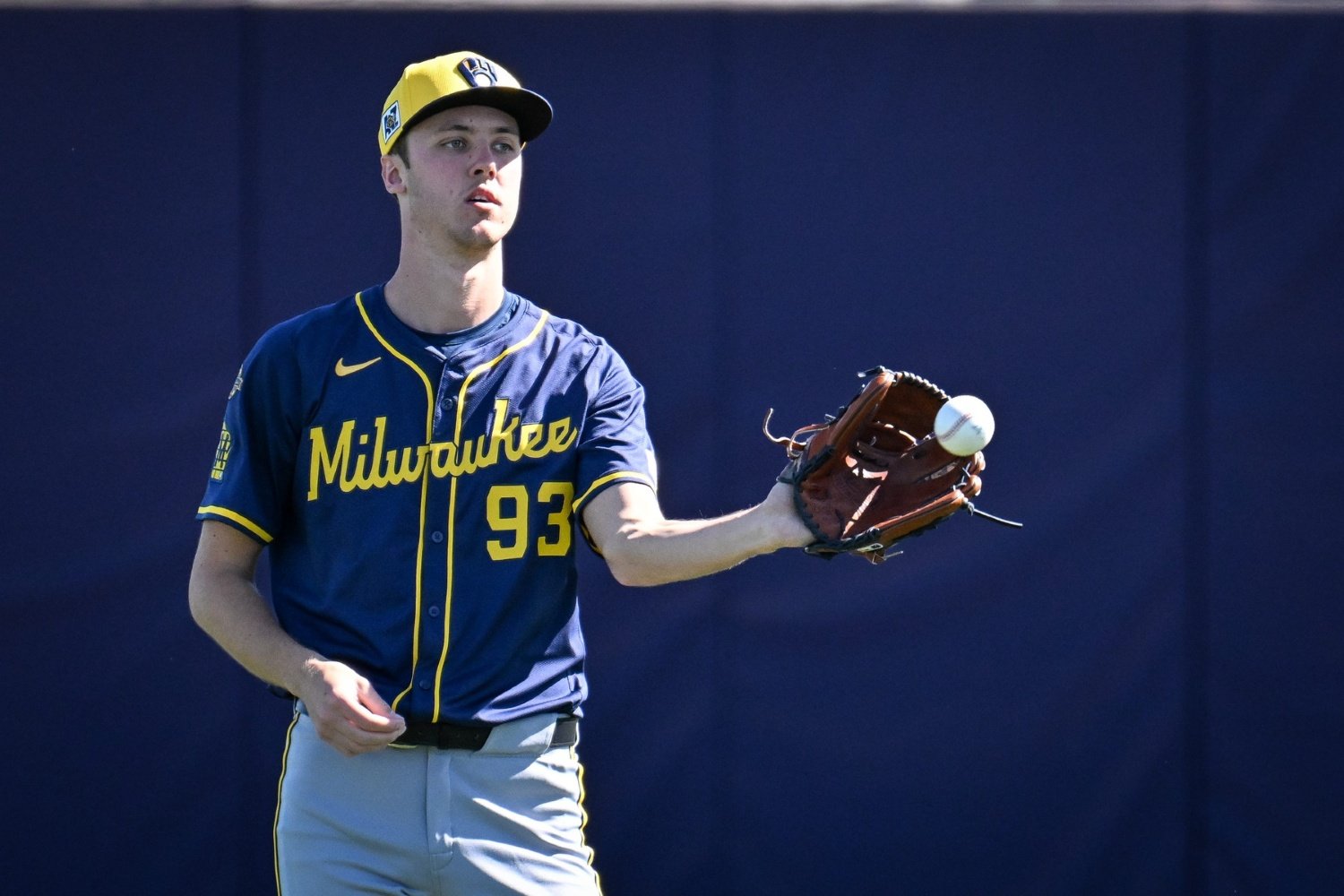 The Milwaukee Brewers are putting their best foot forward, by putting their best arm forward. Despite a veteran-laden starting rotation and amid a solid recent run, they'll call up right-handed pitcher Jacob Misiorowski—the top pitching prospect in the organization—to start Thursday's series opener against the Cardinals, a source with knowledge of their plans said Tuesday afternoon. That confirms a report from Jeff Passan that broke minutes earlier. Misiorowski has turned a corner with Triple-A Nashville over the last month and a half. He's touched as high as 103 miles per hour, even late in starts, and his command has improved markedly. The Brewers' starting rotation has been stretched very thin by injuries at times this season, but they do have arms available who could have made Thursday's start instead. This is a proactive choice by the team to promote a player with a chance to become one of the game's most electrifying arms. Since the likely date for meeting Super Two eligibility thresholds in 2027 is now past, the Brewers could call up Misiorowski without any constraints or considerations other than his recent performance and the state of their pitching staff. As their corps of arms and their approach to using them has evolved throughout the season, they've achieved a level of comfort that they can accommodate the occasional short start (thanks especially to having long men Aaron Ashby and DL Hall available in relief) that permits this promotion without any lingering worry about its ramifications for the rest of the roster. On good days, it won't matter, anyway. Misiorowski has some of baseball's nastiest stuff. After struggling to establish a third pitch or sufficient control over his two previous seasons as an emerging phenom, Misiorowski, 23, is having his best professional campaign. He's fanned 31.6% of opposing batters in 13 appearances for Nashville, and in addition to his wicked combination of a triple-digit fastball and a big-breaking, sharp curveball, he's established a cutter/slider and a changeup he can trust as ancillary weapons. The former has come along even more than that, in fact, not as an out pitch, but to set up and facilitate the rest of his game. It's all added up to a 2.13 ERA, against the best competition this continent can offer, short of the majors. Sources said there was no immediate word on a corresponding move to clear space for Misiorowski on the active roster. One declined to rule out that an injury could be involved, but we'll wait to hear more on that in the coming days. Misiorowski is not yet on the 40-man roster, so a move will need to not only open a spot on the 26-man, but clear that slot on the team's reserve list. For now, it's time to look forward to what Misiorowski can do against big-league hitters. He had nothing left to prove in the minors, and the Brewers will need to press the pedal steadily toward the floor in order to get back to October this season. This move is a sure sign that they understand that.
 -
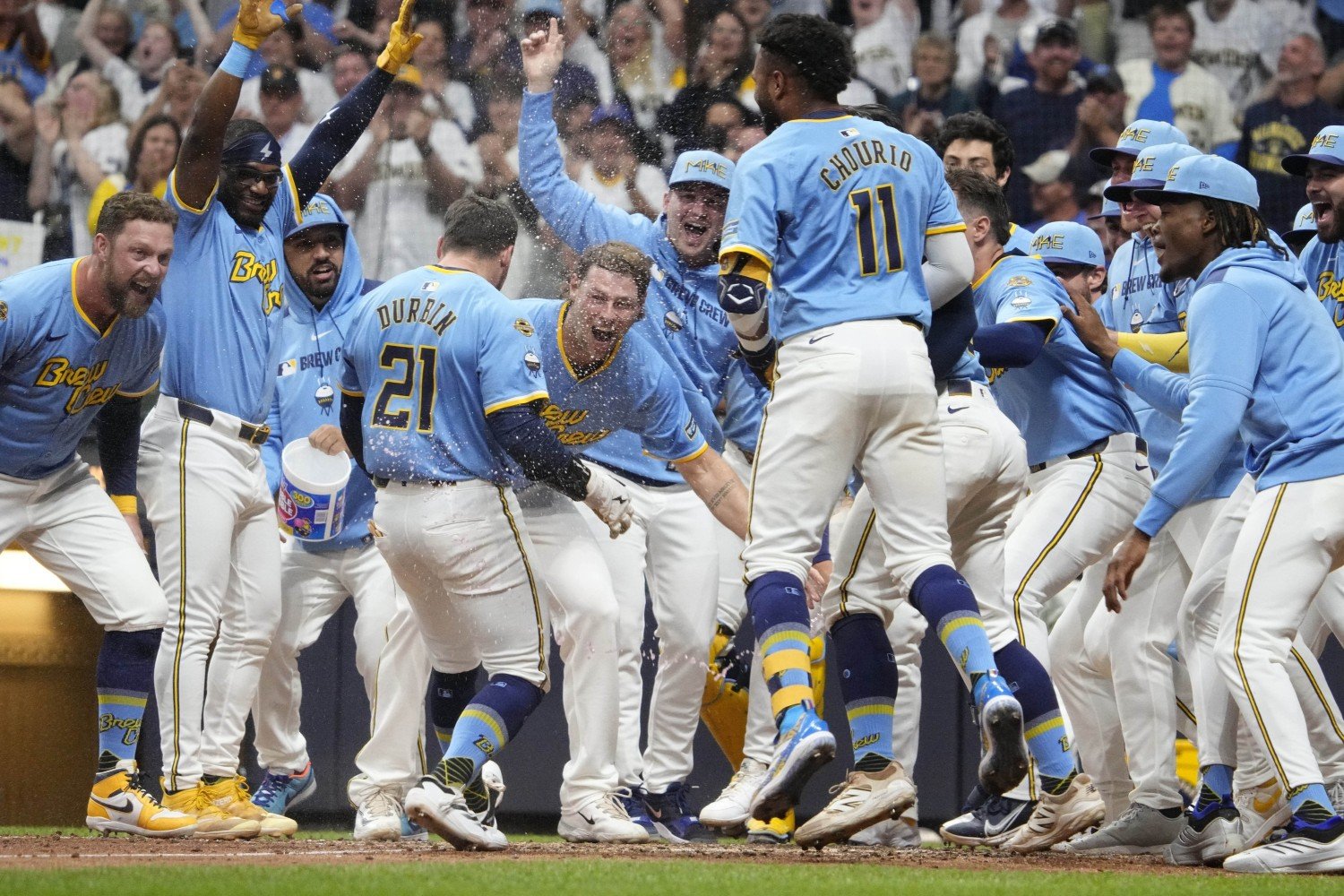 The first month in the majors didn't treat Caleb Durbin well. He made his debut on April 18, and at the end of the Brewers' weekend series against the Twins (which ran through May 18), Durbin was hitting an anemic .169/.263/.241. He still had decent control of the strike zone, forcing a few walks and very rarely striking out, and he had shown the knack for getting hit by pitches and the baserunning savvy that were big parts of his game during his time in the minor leagues. On the whole, though, he was a mess, and the batted-ball data only encouraged discouragement. Since the start of the Brewers' series against the Orioles on May 19, however, Durbin has been a whole new man. In 71 plate appearances, he's hitting .279/.357/.443. He has five walks and five strikeouts in the span, which is extraordinary control of the zone, but the real headline is that he's cracked eight extra-base hits in that three-week stretch. Seven of them were doubles, but the other one came at an awfully good time. SzRsREJfV0ZRVkV3dEdEUT09X0FGVlNWd0VBWHdZQVdsY0FVd0FIVUFKWEFBQUNBbGNBVmwwRlVWQUFWUUpVQVZSUw==.mp4 Even during this great stretch, Durbin isn't exactly destroying the ball. In fact, this homer was not exactly cheap, but nor was it a no-doubter. If he can sustain this kind of production, though, the Brewers can (and should) wait quite a bit longer to see if he can iron out his defensive struggles at third base. This is the high end of the spectrum of possible outcomes for Durbin at the big-league level; it's what the Crew was betting on getting when they traded for him. The question, of course, is how sustainable it is. The answer to that might not depend solely on Durbin, either. He was, perhaps, better than he looked for that first month—or, looking at it more gloomily, he might be set to come back to the pack. The key variable in play is the ball itself. For the first seven or eight weeks of this season, the baseball being used throughout MLB was experiencing more drag than any since at least 2015, a time when offense throughout the league ebbed down toward levels last seen in the 1970s. By measuring the velocity loss on four-seam fastballs between when they're released and when they reach the plate, the league can directly measure the drag on the ball, and it has been way, way up this year. In general, more drag means less offense. How great the effect is depends on the ball itself (and the magnitude of variation in drag). but also on environmental factors, batted-ball spin, and other variables, and even well-informed people disagree at times about how much drag affects the distance of a batted ball. This season, though, there's been lots of evidence that increased drag was taking up to 20 feet off the distance of well-struck fly balls. For Durbin, whose success at the plate rides on his ability to overcome a lack of raw bat speed by hitting lots of high line drives and backspun fly balls to the smaller parts of the park, that can be a fatal difference. You can see it on video, too. He hit some balls well, early in his tenure in the majors, only to watch them lose steam and die in an outfielder's glove. Here's an example of that happening on a ball hit much like the one that became his walkoff homer this weekend. Wng0TVhfWGw0TUFRPT1fVndZRFZ3VUZBbFlBREZkVVV3QUhVd0JWQUZoWFVGRUFBbFlCQndaUUF3VUhWQVpU.mp4 And here's one of him taking aim at one of the coziest right-center fences in the game, in Cleveland, only to see the ball run out of juice at the wall again. ZFh6NHpfWGw0TUFRPT1fVTFBSEFRSUdVd01BRFZwUUJRQUhVd05YQUFOVFdsWUFBZ1pSVlFkV0FnUlZDVkVI.mp4 Lately, though, things are changing. Here's a ball he hit in Pittsburgh that did just keep carrying, right over the outfielder's head. MDRXMTFfWGw0TUFRPT1fQlZkVVZWSUdCRkVBQ0ZvRkFBQUhBZ0JRQUFBRFdsZ0FBMVVFQlFVRENGZFFWUVJU.mp4 The reason why more of these balls are rewarding Durbin's good swings lately is simple: the ball is getting a bit more lively. Be it because of the interaction between this year's batch of balls and the weather, an intentional change by the league, or some mere coincidence, five of the 13 days with the lowest league-wide average drag have come in the last week. The ball is flying again. When we zoom in this way, you can see not only that knot of low-drag days recently, but a gradual but meaningful downward trend in drag. The ball is coming back to an average place, something very like what it was for the last two seasons. That's a huge development for hitters like Durbin. It's tempting to say that the diminutive infielder only has warning-track power, at the big-league level. To that assertion, though, we have to return the question: When does he have only that kind of pop? Because if the early results are an indication, when the ball wakes up a bit, so does Durbin's pop.
 -
Image courtesy of © Michael McLoone-Imagn Images The first month in the majors didn't treat Caleb Durbin well. He made his debut on April 18, and at the end of the Brewers' weekend series against the Twins (which ran through May 18), Durbin was hitting an anemic .169/.263/.241. He still had decent control of the strike zone, forcing a few walks and very rarely striking out, and he had shown the knack for getting hit by pitches and the baserunning savvy that were big parts of his game during his time in the minor leagues. On the whole, though, he was a mess, and the batted-ball data only encouraged discouragement. Since the start of the Brewers' series against the Orioles on May 19, however, Durbin has been a whole new man. In 71 plate appearances, he's hitting .279/.357/.443. He has five walks and five strikeouts in the span, which is extraordinary control of the zone, but the real headline is that he's cracked eight extra-base hits in that three-week stretch. Seven of them were doubles, but the other one came at an awfully good time. SzRsREJfV0ZRVkV3dEdEUT09X0FGVlNWd0VBWHdZQVdsY0FVd0FIVUFKWEFBQUNBbGNBVmwwRlVWQUFWUUpVQVZSUw==.mp4 Even during this great stretch, Durbin isn't exactly destroying the ball. In fact, this homer was not exactly cheap, but nor was it a no-doubter. If he can sustain this kind of production, though, the Brewers can (and should) wait quite a bit longer to see if he can iron out his defensive struggles at third base. This is the high end of the spectrum of possible outcomes for Durbin at the big-league level; it's what the Crew was betting on getting when they traded for him. The question, of course, is how sustainable it is. The answer to that might not depend solely on Durbin, either. He was, perhaps, better than he looked for that first month—or, looking at it more gloomily, he might be set to come back to the pack. The key variable in play is the ball itself. For the first seven or eight weeks of this season, the baseball being used throughout MLB was experiencing more drag than any since at least 2015, a time when offense throughout the league ebbed down toward levels last seen in the 1970s. By measuring the velocity loss on four-seam fastballs between when they're released and when they reach the plate, the league can directly measure the drag on the ball, and it has been way, way up this year. In general, more drag means less offense. How great the effect is depends on the ball itself (and the magnitude of variation in drag). but also on environmental factors, batted-ball spin, and other variables, and even well-informed people disagree at times about how much drag affects the distance of a batted ball. This season, though, there's been lots of evidence that increased drag was taking up to 20 feet off the distance of well-struck fly balls. For Durbin, whose success at the plate rides on his ability to overcome a lack of raw bat speed by hitting lots of high line drives and backspun fly balls to the smaller parts of the park, that can be a fatal difference. You can see it on video, too. He hit some balls well, early in his tenure in the majors, only to watch them lose steam and die in an outfielder's glove. Here's an example of that happening on a ball hit much like the one that became his walkoff homer this weekend. Wng0TVhfWGw0TUFRPT1fVndZRFZ3VUZBbFlBREZkVVV3QUhVd0JWQUZoWFVGRUFBbFlCQndaUUF3VUhWQVpU.mp4 And here's one of him taking aim at one of the coziest right-center fences in the game, in Cleveland, only to see the ball run out of juice at the wall again. ZFh6NHpfWGw0TUFRPT1fVTFBSEFRSUdVd01BRFZwUUJRQUhVd05YQUFOVFdsWUFBZ1pSVlFkV0FnUlZDVkVI.mp4 Lately, though, things are changing. Here's a ball he hit in Pittsburgh that did just keep carrying, right over the outfielder's head. MDRXMTFfWGw0TUFRPT1fQlZkVVZWSUdCRkVBQ0ZvRkFBQUhBZ0JRQUFBRFdsZ0FBMVVFQlFVRENGZFFWUVJU.mp4 The reason why more of these balls are rewarding Durbin's good swings lately is simple: the ball is getting a bit more lively. Be it because of the interaction between this year's batch of balls and the weather, an intentional change by the league, or some mere coincidence, five of the 13 days with the lowest league-wide average drag have come in the last week. The ball is flying again. When we zoom in this way, you can see not only that knot of low-drag days recently, but a gradual but meaningful downward trend in drag. The ball is coming back to an average place, something very like what it was for the last two seasons. That's a huge development for hitters like Durbin. It's tempting to say that the diminutive infielder only has warning-track power, at the big-league level. To that assertion, though, we have to return the question: When does he have only that kind of pop? Because if the early results are an indication, when the ball wakes up a bit, so does Durbin's pop. View full article
-
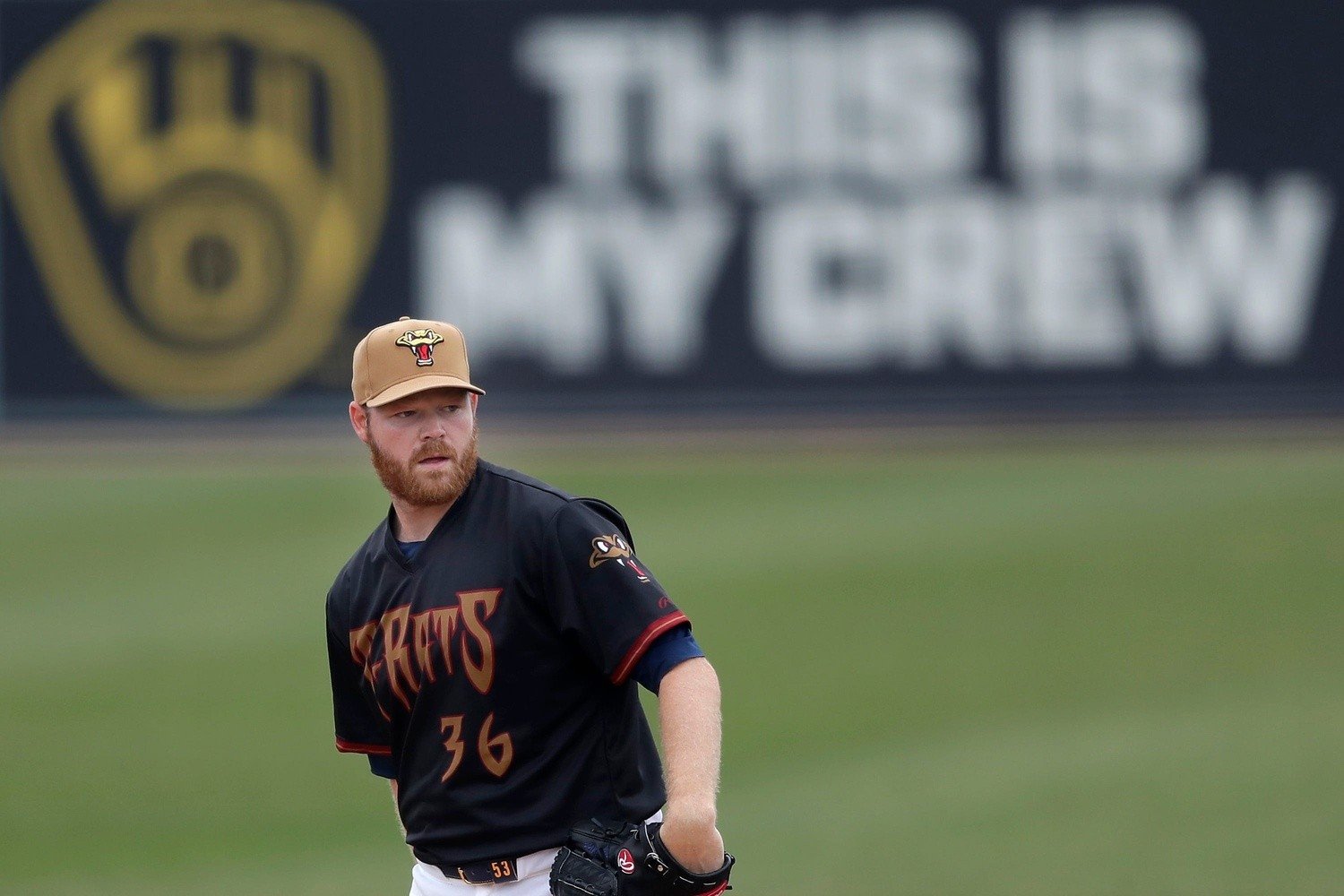 I know there's a new Final Destination movie out there right now. I don't know much about it. I don't go in for horror films, or even many thrillers, and I've never seen any of the previous movies in the franchise. However, like everyone else with the unfortunate addiction to scrolling on the internet, I have seen that one clip from one of the early Final Destination flicks—the one with the massive traffic accident, which begins... actually, I'm not sure exactly how it begins, but it involves and is certainly principally worsened by a logging truck from which the huge timbers break free, bouncing and rolling across the highway like torpedoes fired by Lady Luck in a fit of pique. If I understand the basic premise of the series correctly, that scene is an example of Death flexing a little. It's getting cocky. It's throwing all of its favorite, vicious little wrinkles at the characters who appear in the scene, gilding the lily of catastrophe. In fact, even if that's not what the movie intends, it's what that scene conveys. Death has never felt more inevitable than in that scene, and therefore, the scene is one of the most anxiety-inducing things on the web. (Which, given the state of the real world, is saying something.) That's what it's been like, watching Brandon Woodruff try to finish the long journey back to the majors after the shoulder capsule surgery he required in the fall of 2023. He's already done an extraordinary amount of work to get back to this point, but twice, now, he's been on the cusp of the majors, only to be forced to shut things down and take a step back. The first time, when the problem was a balky ankle, you could shrug and accept it. This time, when the delay of his reinstatement came in the form of a deadly projectile aimed right at his pitching elbow, it's much more painful—and pretty infuriating, if we're honest with ourselves. Death's baseball-loving cousin, Injury, is flexing now. It's ostentatious, and it's mean. Worse, it's unoriginal. I can vividly recall, 20 years ago to the week, when Injury tried this same trick. Mark Prior had a chance to be one of the great pitchers of his generation. Drafted second overall in 2001, he debuted less than a year later, on much the same timeline and with much the same fanfare as Stephen Strasburg or Paul Skenes. He was electric right away, racking up strikeouts and limiting walks. Almost immediately, though, Injury made clear that it didn't care for Prior and didn't want him to do well. A collision with Atlanta second baseman Marcus Giles nearly ruined Prior's breakout season in 2003. He developed Achilles tendonitis in early 2004 and got a very late start to his season. He began 2005 with elbow inflammation, forcing a short stint on the disabled list to start the year. Through all of that, though, he flashed plenty of brilliance. He was still very much an ace in 2003, and for stretches in both 2004 and early 2005, he still proved capable of being that guy. On May 27, 2005, the Cubs played the Rockies at Wrigley Field. It was 1-1 going into the top of the fourth, when Colorado slugger Brad Hawpe stepped into the box and hit a line drive off Prior—right on his pitching elbow. The force of the blow was so great that two things happened: the ball popped into the air and floated into foul territory beyond the third-base bag, allowing Cubs third baseman Aramis Ramírez to catch it for an out; and Prior's elbow cracked badly, sending him howling to the ground with the iniury that would finally, truly derail his career. He missed a month, and when he came back, both walks and home runs were more of a problem for him. His ERA bloated. In 2006, it exploded, and then so did his shoulder. He would spend another half-decade pitching in the minors, between major injuries (including shoulder capsule surgery), but he'd never make it back to the majors. While Injury didn't take the same instant disliking to Woodruff that it did to Prior, it made up its mind about him back in 2023. The shoulder surgery was just how that year ended; it had already been truncated by shoulder issues. Woodruff is no longer favored by the baseball gods. They're trying to get rid of him now. Woodruff got a bit luckier than Prior did, it appears. He suffered a contusion, but not a break, when he caught a liner off the elbow. He might have an easier path back, though his stuff was diminished even before he took that hit. Still, it sure feels like the universe wants him to be done meaningfully contributing to big-league teams on the mound. That's why, more than ever, I'll be fiercely rooting for Woodruff. French philosopher and writer Albert Camus believed that the fundamental tension of being human is that the universe is neither cruel nor kind. It's mindless and soulless, and that feels cruel to humans, because we have wired ourselves to seek—to need—meaning, but the very fabric of existence is meaningless. The absurdity of our quest to understand and contextualize that which defies understanding and doesn't bear contextual framing is what makes life so hard, so much of the time. The conflict humans face, then, is the question of whether even to keep on in the face of that reality. Is life worth living, once we acknowledge its lack of a higher meaning than what we can see and touch? Everyone, Camus said, must answer that for themselves, but he did offer an answer, in the person of the mythical Greek God, Sisyphus. As a punishment for tricking the gods, Sisyphus has to push a boulder up a mountain every day—only to find himself back at the bottom of that mountain, over and over again, with the boulder still needing to be pushed. It's become one of our most familiar metaphors for powerlessness, and the crushing weight of mundanity—but Camus would have us see it as a moment of triumph. We can find both joy and meaning in, to use a word Camus walked around without stepping in but which is perfect for our modern moment, pettiness—maybe even spite. If the gods have condemned us to being unable to communicate with them or to comprehend their grand plans, we have one refuge: our simple fate and the defiant satisfaction we can find in it. "His fate belongs to him," Camus wrote of Sisyphus. "His rock is his thing." Woodruff's rock is his thing, too. The ball in his hand, after all the times Injury has tried to knock it out for good, is a symbol of the inexhaustible human capacity to find hope and to keep climbing, even when it feels pointless or endless. For years, surely, Woodruff pitched toward the goal of being the go-to guy on a World Series team or of cradling a Cy Young Award, as teammate Corbin Burnes got to do four years ago. Those goals are over, now. His best hope might be to establish himself at the back end of the Milwaukee rotation, and see them make a charge through October to the franchise's first pennant in over 40 years—with him as a secondary piece, instead of an indispensable one. No matter. There's a new set of stakes at hand. Now that he's been nearly thwarted altogether, the meaning of success for Woodruff has changed, as perhaps it can for us, too. All that matters, right now, is that Woodruff maintain focus and hope, and get back onto a big-league mound. This is what Camus called "the higher fidelity that negates the gods and raises rocks." Destiny be damned, and nine-figure contracts be forgotten, Woodruff wins just by continuing when there is so much implict reason to quit. "This universe henceforth without a master seems to him neither sterile nor futile," Camus wrote of his own hero. "Each atom of that stone, each mineral flake of that night filled mountain, in itself forms a world. The struggle itself toward the heights is enough to fill a man’s heart." The pitcher's mound is just 10 inches high, but right now, it's a Sisyphean mountain, and we find (and leave) Woodruff back at the foot of it. If he does surmount it again, though, it'll be a truly thrilling moment—not because of what it would mean for the 2025 Brewers, or even for Woodruff's long-term prospects, but because he'll be there, at the top, for however long he has until the new Sisyphean cycle begins: of hurling oneself off that tiny mountain to let the rock fly, thereby to get it back and climb back into position for the next launch.
 -
Image courtesy of © Wm. Glasheen/USA TODAY NETWORK-Wisconsin / USA TODAY NETWORK via Imagn Images I know there's a new Final Destination movie out there right now. I don't know much about it. I don't go in for horror films, or even many thrillers, and I've never seen any of the previous movies in the franchise. However, like everyone else with the unfortunate addiction to scrolling on the internet, I have seen that one clip from one of the early Final Destination flicks—the one with the massive traffic accident, which begins... actually, I'm not sure exactly how it begins, but it involves and is certainly principally worsened by a logging truck from which the huge timbers break free, bouncing and rolling across the highway like torpedoes fired by Lady Luck in a fit of pique. If I understand the basic premise of the series correctly, that scene is an example of Death flexing a little. It's getting cocky. It's throwing all of its favorite, vicious little wrinkles at the characters who appear in the scene, gilding the lily of catastrophe. In fact, even if that's not what the movie intends, it's what that scene conveys. Death has never felt more inevitable than in that scene, and therefore, the scene is one of the most anxiety-inducing things on the web. (Which, given the state of the real world, is saying something.) That's what it's been like, watching Brandon Woodruff try to finish the long journey back to the majors after the shoulder capsule surgery he required in the fall of 2023. He's already done an extraordinary amount of work to get back to this point, but twice, now, he's been on the cusp of the majors, only to be forced to shut things down and take a step back. The first time, when the problem was a balky ankle, you could shrug and accept it. This time, when the delay of his reinstatement came in the form of a deadly projectile aimed right at his pitching elbow, it's much more painful—and pretty infuriating, if we're honest with ourselves. Death's baseball-loving cousin, Injury, is flexing now. It's ostentatious, and it's mean. Worse, it's unoriginal. I can vividly recall, 20 years ago to the week, when Injury tried this same trick. Mark Prior had a chance to be one of the great pitchers of his generation. Drafted second overall in 2001, he debuted less than a year later, on much the same timeline and with much the same fanfare as Stephen Strasburg or Paul Skenes. He was electric right away, racking up strikeouts and limiting walks. Almost immediately, though, Injury made clear that it didn't care for Prior and didn't want him to do well. A collision with Atlanta second baseman Marcus Giles nearly ruined Prior's breakout season in 2003. He developed Achilles tendonitis in early 2004 and got a very late start to his season. He began 2005 with elbow inflammation, forcing a short stint on the disabled list to start the year. Through all of that, though, he flashed plenty of brilliance. He was still very much an ace in 2003, and for stretches in both 2004 and early 2005, he still proved capable of being that guy. On May 27, 2005, the Cubs played the Rockies at Wrigley Field. It was 1-1 going into the top of the fourth, when Colorado slugger Brad Hawpe stepped into the box and hit a line drive off Prior—right on his pitching elbow. The force of the blow was so great that two things happened: the ball popped into the air and floated into foul territory beyond the third-base bag, allowing Cubs third baseman Aramis Ramírez to catch it for an out; and Prior's elbow cracked badly, sending him howling to the ground with the iniury that would finally, truly derail his career. He missed a month, and when he came back, both walks and home runs were more of a problem for him. His ERA bloated. In 2006, it exploded, and then so did his shoulder. He would spend another half-decade pitching in the minors, between major injuries (including shoulder capsule surgery), but he'd never make it back to the majors. While Injury didn't take the same instant disliking to Woodruff that it did to Prior, it made up its mind about him back in 2023. The shoulder surgery was just how that year ended; it had already been truncated by shoulder issues. Woodruff is no longer favored by the baseball gods. They're trying to get rid of him now. Woodruff got a bit luckier than Prior did, it appears. He suffered a contusion, but not a break, when he caught a liner off the elbow. He might have an easier path back, though his stuff was diminished even before he took that hit. Still, it sure feels like the universe wants him to be done meaningfully contributing to big-league teams on the mound. That's why, more than ever, I'll be fiercely rooting for Woodruff. French philosopher and writer Albert Camus believed that the fundamental tension of being human is that the universe is neither cruel nor kind. It's mindless and soulless, and that feels cruel to humans, because we have wired ourselves to seek—to need—meaning, but the very fabric of existence is meaningless. The absurdity of our quest to understand and contextualize that which defies understanding and doesn't bear contextual framing is what makes life so hard, so much of the time. The conflict humans face, then, is the question of whether even to keep on in the face of that reality. Is life worth living, once we acknowledge its lack of a higher meaning than what we can see and touch? Everyone, Camus said, must answer that for themselves, but he did offer an answer, in the person of the mythical Greek God, Sisyphus. As a punishment for tricking the gods, Sisyphus has to push a boulder up a mountain every day—only to find himself back at the bottom of that mountain, over and over again, with the boulder still needing to be pushed. It's become one of our most familiar metaphors for powerlessness, and the crushing weight of mundanity—but Camus would have us see it as a moment of triumph. We can find both joy and meaning in, to use a word Camus walked around without stepping in but which is perfect for our modern moment, pettiness—maybe even spite. If the gods have condemned us to being unable to communicate with them or to comprehend their grand plans, we have one refuge: our simple fate and the defiant satisfaction we can find in it. "His fate belongs to him," Camus wrote of Sisyphus. "His rock is his thing." Woodruff's rock is his thing, too. The ball in his hand, after all the times Injury has tried to knock it out for good, is a symbol of the inexhaustible human capacity to find hope and to keep climbing, even when it feels pointless or endless. For years, surely, Woodruff pitched toward the goal of being the go-to guy on a World Series team or of cradling a Cy Young Award, as teammate Corbin Burnes got to do four years ago. Those goals are over, now. His best hope might be to establish himself at the back end of the Milwaukee rotation, and see them make a charge through October to the franchise's first pennant in over 40 years—with him as a secondary piece, instead of an indispensable one. No matter. There's a new set of stakes at hand. Now that he's been nearly thwarted altogether, the meaning of success for Woodruff has changed, as perhaps it can for us, too. All that matters, right now, is that Woodruff maintain focus and hope, and get back onto a big-league mound. This is what Camus called "the higher fidelity that negates the gods and raises rocks." Destiny be damned, and nine-figure contracts be forgotten, Woodruff wins just by continuing when there is so much implict reason to quit. "This universe henceforth without a master seems to him neither sterile nor futile," Camus wrote of his own hero. "Each atom of that stone, each mineral flake of that night filled mountain, in itself forms a world. The struggle itself toward the heights is enough to fill a man’s heart." The pitcher's mound is just 10 inches high, but right now, it's a Sisyphean mountain, and we find (and leave) Woodruff back at the foot of it. If he does surmount it again, though, it'll be a truly thrilling moment—not because of what it would mean for the 2025 Brewers, or even for Woodruff's long-term prospects, but because he'll be there, at the top, for however long he has until the new Sisyphean cycle begins: of hurling oneself off that tiny mountain to let the rock fly, thereby to get it back and climb back into position for the next launch. View full article
-
So Far, Sal Frelick's Transformation is a Resounding Success
Matthew Trueblood posted an article in Brewers
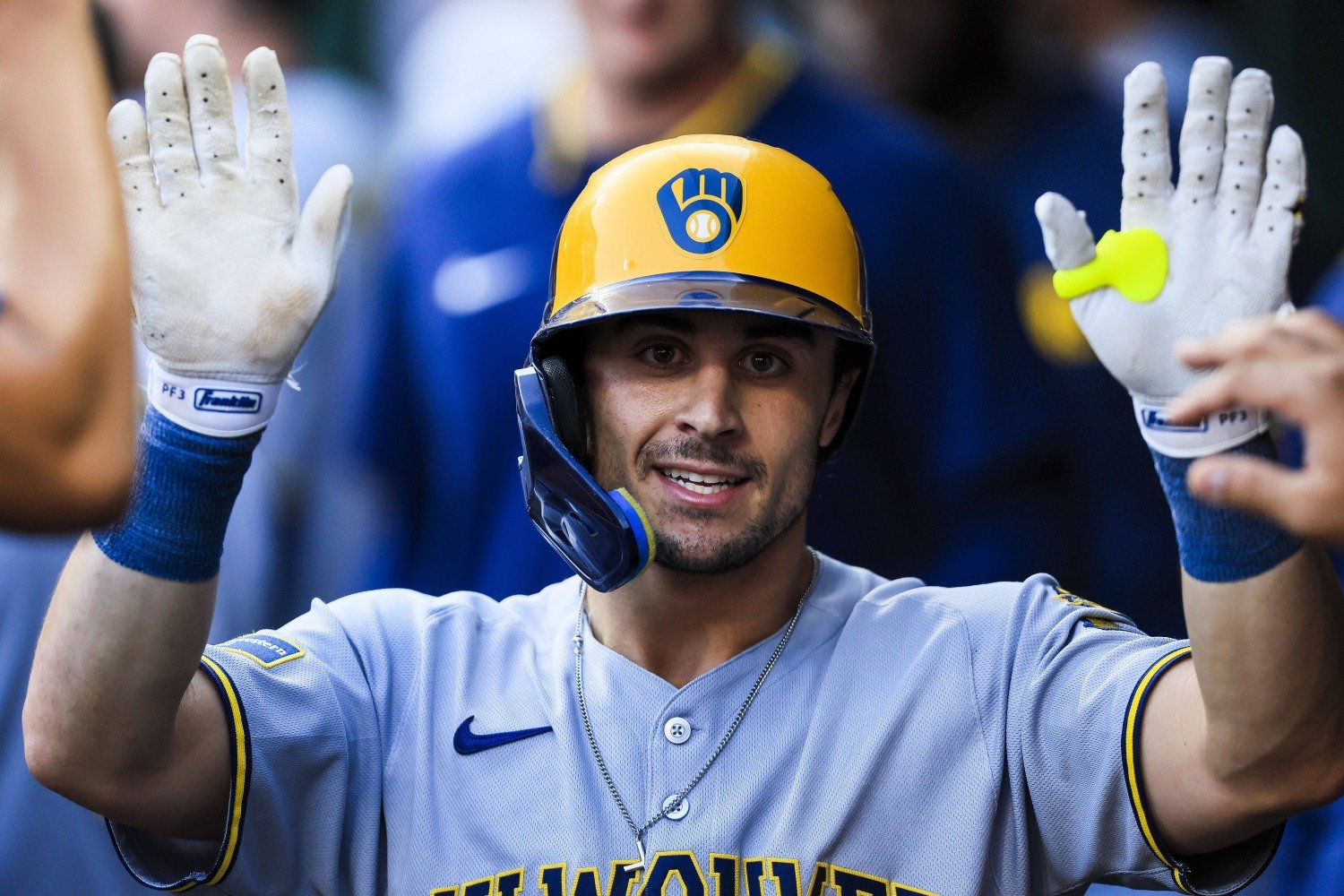 Over the first 60 games of this season, Sal Frelick has been a vital piece of the Brewers' fight to stay above .500 and in the thick of the NL playoff race. He's batting .291/.352/.404 in 237 plate appearances, and although his 13 extra-base hits sounds like an anemic number, he's already doubled last year's home run total (four, up from two) and is now making hard enough contact to consistently find singles. Last year, he wasn't even managing that. Somewhat famously, Frelick added muscle this winter, and that's translated into better bat speed this season. He averaged just 66.3 mph in bat speed in 2024, but that figure is up to 68.0 this year. To accomplish that, he's slightly flattened the tilt of his bat through the hitting zone, which can compromise one's ability to get the ball in the air—but, by getting started a bit earlier in his load and aiming to catch the ball farther in front of himself, he's more than made up for that. With an attack angle up from 6° to 8° and his attack direction swung around from 1° toward the opposite field to 2° to the pull field, on average, Frelick is earlier on his swing. The difference in bat speed explains most of that, so essentially, he's just getting started on time and letting his body take care of the rest. Frelick's average exit velocity is up 3.2 miles per hour, and he's gone from one of the lowest hard-hit rates in the league to a subpar but perfectly solid 31.2%. The flatter swing has helped him make solid contact in the upper third of the zone more often. He's trimmed his strikeout rate and is still drawing enough walks to sustain a high on-base percentage. For Frelick, a little bit of bat speed seemed almost certain to go a long way, and that's precisely what we're seeing this season. He can still make very good swing decisions; he just gets rewarded for them more consistently this way. Of course, the risk here is that that edge erodes over the grind of the season. Frelick's bat speed waned as his first full season wore on. He's at a higher baseline right now than he was at the same point last year, but if the same pattern emerges, he'll be unable to hang onto the production we've seen so far in 2025. Part of the virtue of adding good weight during the offseason should be to forestall that kind of loss, but if it does happen, he'll need to change his timing and create a different plan for being on time with the barrel. Last year, as his bat speed fell, so did his attack angle, so he wasn't able to get back on time when the swing slowed down in 2024. Under a different hitting coach this year, maybe he'd prove more able to make that adjustment, but the Brewers will hope he doesn't have to. Milwaukee's lineup engine can run without huge contributions from Frelick. If he merely holds his own and continues to play Gold Glove-caliber defense in the outfield, the team will be happy with his performance. However, if he can hold onto the improvements he's made so far as the season wears on, it will help the offense reach a higher consistent level during the late summer and fall—just when the team looks likely to need it most, as they fight tooth and nail for their third straight NL Central championship.
 -
Image courtesy of © Katie Stratman-Imagn Images Over the first 60 games of this season, Sal Frelick has been a vital piece of the Brewers' fight to stay above .500 and in the thick of the NL playoff race. He's batting .291/.352/.404 in 237 plate appearances, and although his 13 extra-base hits sounds like an anemic number, he's already doubled last year's home run total (four, up from two) and is now making hard enough contact to consistently find singles. Last year, he wasn't even managing that. Somewhat famously, Frelick added muscle this winter, and that's translated into better bat speed this season. He averaged just 66.3 mph in bat speed in 2024, but that figure is up to 68.0 this year. To accomplish that, he's slightly flattened the tilt of his bat through the hitting zone, which can compromise one's ability to get the ball in the air—but, by getting started a bit earlier in his load and aiming to catch the ball farther in front of himself, he's more than made up for that. With an attack angle up from 6° to 8° and his attack direction swung around from 1° toward the opposite field to 2° to the pull field, on average, Frelick is earlier on his swing. The difference in bat speed explains most of that, so essentially, he's just getting started on time and letting his body take care of the rest. Frelick's average exit velocity is up 3.2 miles per hour, and he's gone from one of the lowest hard-hit rates in the league to a subpar but perfectly solid 31.2%. The flatter swing has helped him make solid contact in the upper third of the zone more often. He's trimmed his strikeout rate and is still drawing enough walks to sustain a high on-base percentage. For Frelick, a little bit of bat speed seemed almost certain to go a long way, and that's precisely what we're seeing this season. He can still make very good swing decisions; he just gets rewarded for them more consistently this way. Of course, the risk here is that that edge erodes over the grind of the season. Frelick's bat speed waned as his first full season wore on. He's at a higher baseline right now than he was at the same point last year, but if the same pattern emerges, he'll be unable to hang onto the production we've seen so far in 2025. Part of the virtue of adding good weight during the offseason should be to forestall that kind of loss, but if it does happen, he'll need to change his timing and create a different plan for being on time with the barrel. Last year, as his bat speed fell, so did his attack angle, so he wasn't able to get back on time when the swing slowed down in 2024. Under a different hitting coach this year, maybe he'd prove more able to make that adjustment, but the Brewers will hope he doesn't have to. Milwaukee's lineup engine can run without huge contributions from Frelick. If he merely holds his own and continues to play Gold Glove-caliber defense in the outfield, the team will be happy with his performance. However, if he can hold onto the improvements he's made so far as the season wears on, it will help the offense reach a higher consistent level during the late summer and fall—just when the team looks likely to need it most, as they fight tooth and nail for their third straight NL Central championship. View full article
-
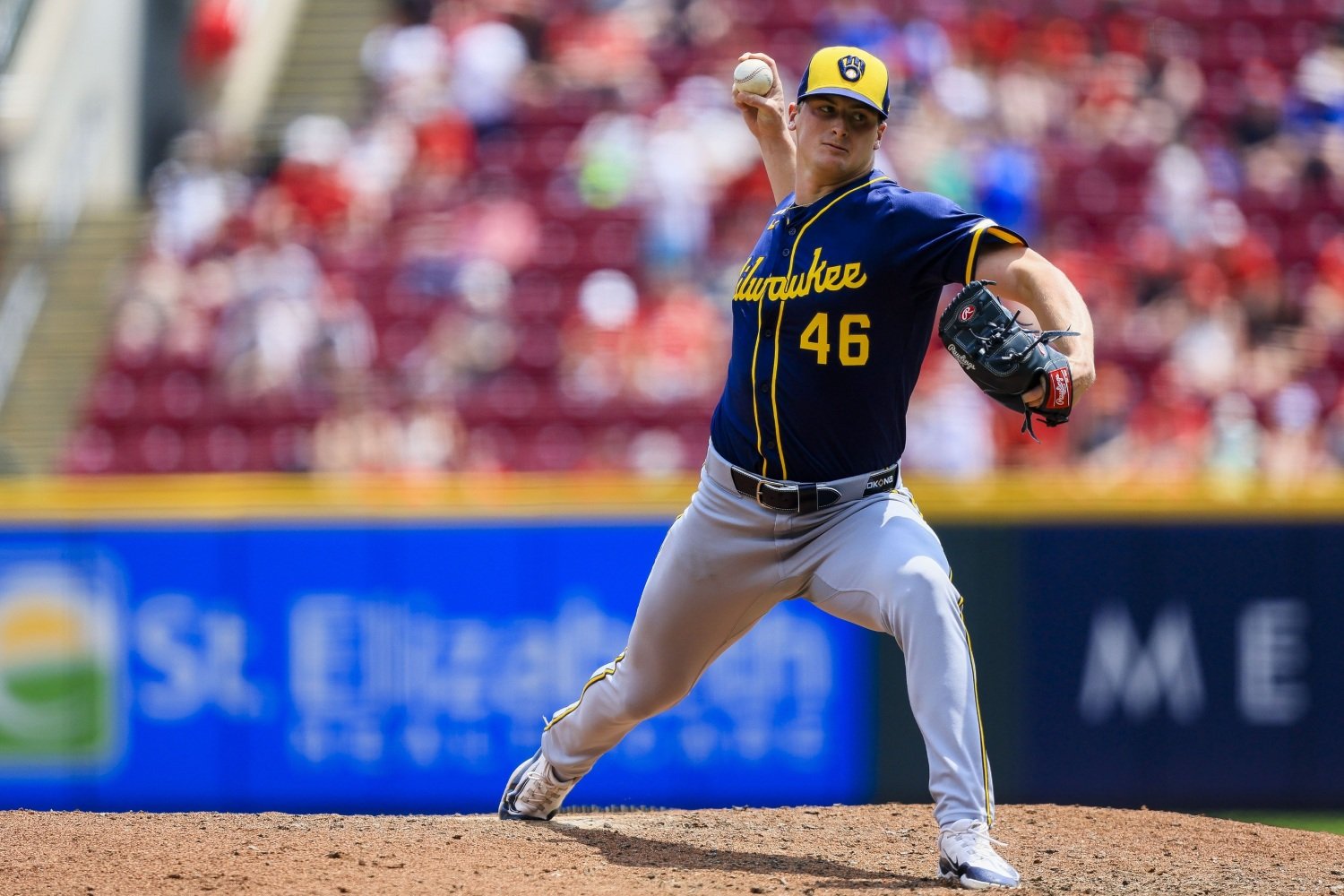 DL Hall certainly didn't pitch like any old opener in Wednesday's series-clinching win over the Reds. He didn't face just a few batters and then ease out of the way for Quinn Priester. Hall pitched three innings, allowing three baserunners and striking out three. When he did hand over the reins to Priester, it was as though he'd gotten the ball after the bottom of the first—he started with Tyler Stephenson and would see Elly De La Cruz last of all Reds batters—but he was a lap closer to finishing the race. As the Brewers piled on some runs, Hall and Priester combined to shut down the Reds, with Nick Mears soaking up the final inning of a blowout victory. After Hall, Priester gave the team five innings of one-run ball, allowing five baserunners and striking out four in his own right. It was an easy win for the Crew, but it was also a breakthrough for Hall and Priester. When (or if, as the case may be) Brandon Woodruff returns to the rotation, the team will have to make room for yet another hurler in a crowded starting rotation. They've already sent Logan Henderson back to Triple-A Nashville, and many fans rightfully worry that fellow rookie Chad Patrick could get the boot in favor of the grizzled veteran. As Wednesday proved, though, it needn't come down to that. With Hall, Aaron Ashby, Priester, Henderson, Patrick, and Aaron Civale, Pat Murphy has a bevy of choices. He can, if he's willing to be creative and flexible, mix and match that set of arms to create three rotation spots' worth of great, matchup-proof pitching. Hall and Priester were a nice preview of the potential value of the strategy. Using two pitchers who aren't quite qualified to be full-time starters on a playoff-hopeful team in tandem, as Murphy did Wednesday, can not only help each of them pitch above their station, but spare heavy use of the overtaxed set of full-time relievers. The Brewers should want to get Henderson back into the fold, along with Woodruff. They should want to create a runway for Jacob Misiorowski, and to reduce the workloads they've inflicted on Jared Koenig, Trevor Megill, Grant Anderson and Abner Uribe so far by a substantial margin. Using two stretched-out pitchers to face a lineup one or two times each is a great way to save the pen, because while one of the two performers does effectively take up a reliever's spot, they're going to exceed the number of frames such pitchers normally throw. Only needing one inning from Mears illustrates what's possible via a piggyback arrangement of the lefty Hall and the right-handed Priester. The Brewers could do this fairly regularly. Woodruff's elbow caught a line drive in his latest rehab start, so no roster dilemma is imminent just yet. To keep more of his best relievers fresh as the weather heats up, though, Murphy should keep test-driving maneuvers like the one he used Wednesday. The Brewers have tons of pitching depth, and this might be the best way to leverage it.
- 11 comments
-
- 2
-

-
- quinn priester
- dl hall
- (and 5 more)
-
Image courtesy of © Katie Stratman-Imagn Images DL Hall certainly didn't pitch like any old opener in Wednesday's series-clinching win over the Reds. He didn't face just a few batters and then ease out of the way for Quinn Priester. Hall pitched three innings, allowing three baserunners and striking out three. When he did hand over the reins to Priester, it was as though he'd gotten the ball after the bottom of the first—he started with Tyler Stephenson and would see Elly De La Cruz last of all Reds batters—but he was a lap closer to finishing the race. As the Brewers piled on some runs, Hall and Priester combined to shut down the Reds, with Nick Mears soaking up the final inning of a blowout victory. After Hall, Priester gave the team five innings of one-run ball, allowing five baserunners and striking out four in his own right. It was an easy win for the Crew, but it was also a breakthrough for Hall and Priester. When (or if, as the case may be) Brandon Woodruff returns to the rotation, the team will have to make room for yet another hurler in a crowded starting rotation. They've already sent Logan Henderson back to Triple-A Nashville, and many fans rightfully worry that fellow rookie Chad Patrick could get the boot in favor of the grizzled veteran. As Wednesday proved, though, it needn't come down to that. With Hall, Aaron Ashby, Priester, Henderson, Patrick, and Aaron Civale, Pat Murphy has a bevy of choices. He can, if he's willing to be creative and flexible, mix and match that set of arms to create three rotation spots' worth of great, matchup-proof pitching. Hall and Priester were a nice preview of the potential value of the strategy. Using two pitchers who aren't quite qualified to be full-time starters on a playoff-hopeful team in tandem, as Murphy did Wednesday, can not only help each of them pitch above their station, but spare heavy use of the overtaxed set of full-time relievers. The Brewers should want to get Henderson back into the fold, along with Woodruff. They should want to create a runway for Jacob Misiorowski, and to reduce the workloads they've inflicted on Jared Koenig, Trevor Megill, Grant Anderson and Abner Uribe so far by a substantial margin. Using two stretched-out pitchers to face a lineup one or two times each is a great way to save the pen, because while one of the two performers does effectively take up a reliever's spot, they're going to exceed the number of frames such pitchers normally throw. Only needing one inning from Mears illustrates what's possible via a piggyback arrangement of the lefty Hall and the right-handed Priester. The Brewers could do this fairly regularly. Woodruff's elbow caught a line drive in his latest rehab start, so no roster dilemma is imminent just yet. To keep more of his best relievers fresh as the weather heats up, though, Murphy should keep test-driving maneuvers like the one he used Wednesday. The Brewers have tons of pitching depth, and this might be the best way to leverage it. View full article
-
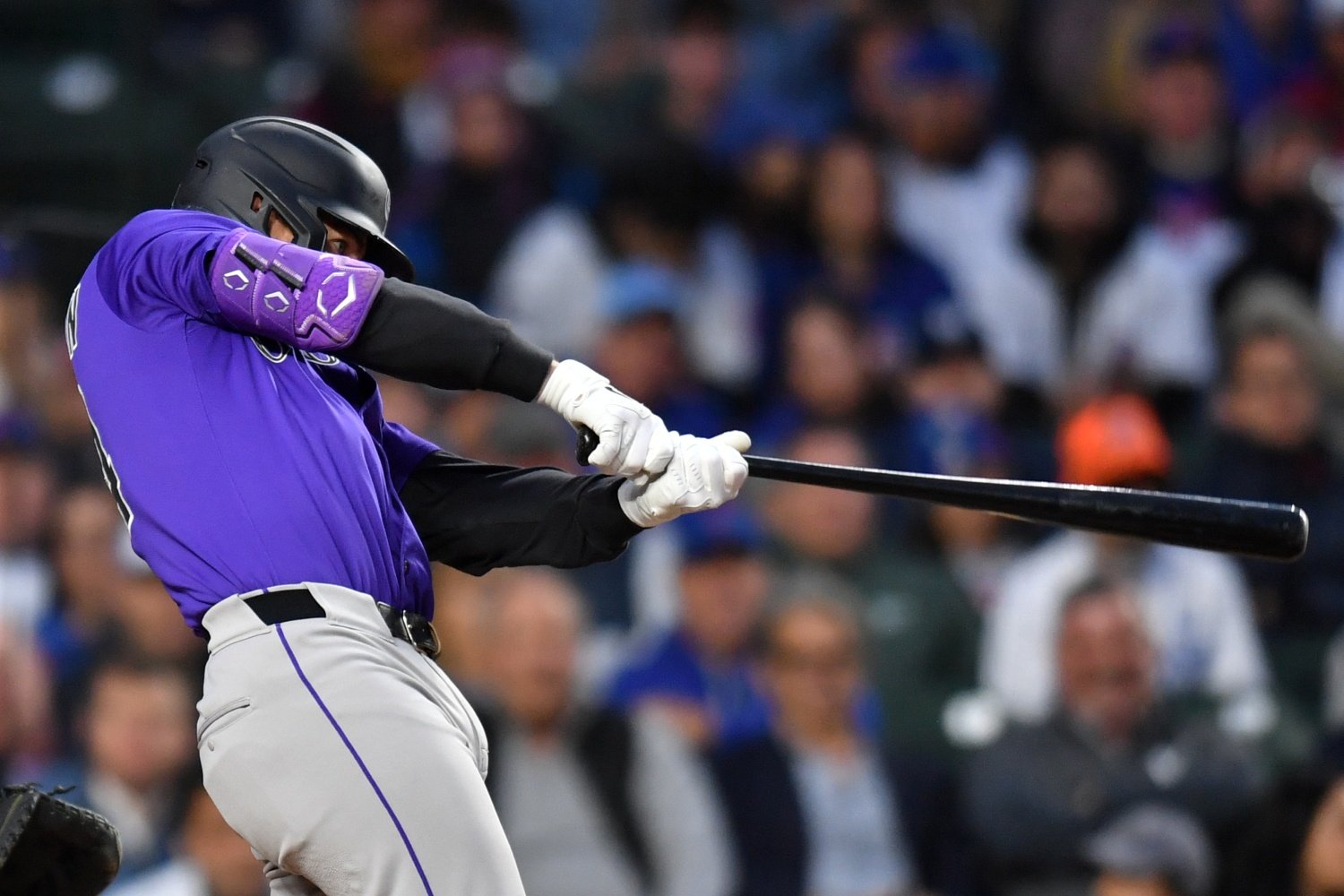 In the past, we here at Brewer Fanatic have expressed well-founded skepticism of the idea that Ryan McMahon would be an ideal fit for the Milwaukee Brewers. McMahon, 30, was an All-Star last year and has five seasons with 20 or more home runs. He lacks sizzle at third base, but his glove is easily above average there. However, as Jack Stern analyzed last fall, he's tended strongly to hit the ball the opposite way throughout his career, wasting some of his power potential. Meanwhile, because he let the ball get so deep, he was often late on any average or better big-league fastball, and strikeouts piled up far more than is justifiable from a player who's not generating high-end slugging numbers. Don't look too long at the topline numbers for McMahon so far this year, or you might become convinced that he's in deeper, murkier water than ever. He's batting just .204/.315/.345, with 16 extra-base hits in 241 plate appearances. He's still striking out a lot, although at least he's also walking a lot. It might seem like the very worst time to acquire McMahon, unless it be in some sweetheart deal whereby the Rockies package a prospect with him just to clear some of the $32 million they owe him for 2026 and 2027. Things look much better under the hood, though—not only much better than the raw numbers this season, but much better than they looked in the past, too. For instance, if you read Jack's piece in November, you know that one of his concerns was what might happen if McMahon lost any bat speed. That's still a valid worry, but perhaps a less urgent one, because he's added 1.8 miles per hour to his average swing speed this season, going from an already-robust 72.5 mph to a more thoroughly dangerous 74.3. Hitters can sometimes achieve this kind of change by lessening the tilt of their swing (since, if their bat is moving more laterally and less upward, they're not fighting gravity as much), but McMahon has preserved his steep tilt while making this change. In fact, he tilts the bat 39° now, versus 38° last year. A faster steep swing is an unalloyed good, but it's just one aspect of changing the offensive profile for McMahon. He also needed a tweak to his timing, to allow him to both lift and pull the ball more consistently. Happily, he's done that, too. His attack angle (15°, up from 9° in 2024), attack direction (2° toward the pull side, versus 5° to the opposite field last year) and contact point (27.8 inches in front of his center of mass this year, up from a hilariously untenable 22.5 inches in 2024) all speak to that. As a result, he's pulling the ball more than ever; hitting it in the air, to the pull field, more than ever; and hitting the ball a full 2 miles per hour harder this year. You can see the changes in the visuals Statcast now provides to illustrate hitters' setups and swings. First, let's look at his stance. Here's how McMahon set up in the box (black footprints) and where his stride led (red ones) in 2024. No hitter in baseball starts more spread-out than McMahon. As a result, his pickup and step into the swing is really just that; he doesn't stride forward the same way most hitters do. Notice, though, how far off the plate he is, and the slightly closed angle of his stance and stride. Notice, too, how deep in the hitting zone created by his own frame he's catching the ball, even though it's in front of the plate. Here's the same look at McMahon, but for 2025. Slightly but importantly less spread-out in his initial stance, McMahon now gains a very small but non-zero amount of ground with his stride. Substantially closer to the plate, he can cover the outer third better. He's a hair more open to the pitcher, too. There's a change afoot, alright. Now, let's look at his swing itself, at three different stages. First, here's the moment where his bat first reaches the point of being parallel to the sides of home plate (or, put another way, to the hypothetical path of a perfectly straight pitch). It's an arbitrary selection, but one that lets us do some apples-to-apples comparison of the early stages of his swing. The first thing to notice (because it will remain important) is that McMahon is subtly but clearly staying back longer in his lower half this year. Note that his torso is leaning back slightly more this year, while he's still deeper in his back leg and hasn't yet shifted his weight into his front leg via his front hip, as you can see him doing in the 2024 animation. The other thing of note is that, while his bat is not up to the same speed by this stage of the swing as it was last year, there's already more turn to the barrel. That slightly more open starting point comes into play here. It's harder to see, because of the angle we're using, but he's opening up with his front shoulder a bit more at this stage of the swing than he did last year. That's pulling his bottom hand—and thus, the entire bat, knob-first—a bit more toward first base than at the same point in 2024, so his barrel is getting closer to turning into the path of the pitch (attack direction: 45° opposite-field, around from 53° at the same point last year). Next, here's the frame from each year's animation in which we're closest to a 0° attack angle. In other words, this is the moment in each swing when McMahon gets on plane and starts working uphill into the path of the pitch. The biggest news here is the timing. Again, McMahon's not generating any more bat speed (yet) than he did at the same point in last year's swing, but he still has more weight in his back side, which means more force is still coming through him. His barrel is farther behind him on the right, which tells us that that earlier opening of the front shoulder (and the way, as you see, it invites his front elbow to row upward, maintaining tilt while still achieving extension relative to his body) is getting him on plane earlier in his swing. Also, look at the left edge of the frame in each animation. In the lefthand one, we can see the avatar of the ball appearing already. In the right, we can't. While McMahon's bat is farther forward and going the same speed on the left, he doesn't have as much acceleration of the barrel left in his body, and the ball is already getting on him. On the right, he has time, and there's still more power en route to the barrel. Here's the frame closest to his contact point for each season. This season, McMahon has the late bat speed to beat the ball to its spot, thanks to staying in his back leg a bit better and creating more rotational (albeit less linear) force with his front side. Because he got on plane earlier and worked faster in the final few milliseconds before contact, he's hitting the ball in a much better position to generate lift, and his barrel is around on the ball, able to pull it with authority. McMahon's swing is just plain better this year, by no small margin. Why, then, aren't things going well from a results standpoint? For one thing, while this is a boring answer, he's gotten very unlucky. His actual weighted on-base average this year (.298) would be his worst since his brief 2018 stint, but his expected wOBA (.342) is the best of his career. He's also suffering from the worst home/road splits of his career, which is always worth a look when the Rockies are involved. At Coors Field, McMahon—whose new swing has him timed to the fastball, rather than to breaking stuff, for the first time in years—is hitting .271/.406/.494. On the road, however, he's hitting an untenable .157/.244/.240. He's more prone to being early on breaking and offspeed stuff this year. in the past, unlike most hitters, he did most of his damage on those pitches, and struggled against fastballs. Now that he's back on time for heaters, he's better able to attack the ball at elevation (where non-fastballs tend to be much less effective), but he's more vulnerable to stuff with big movement, especially away from the park where he has to be used to hitting. That sounds like a major caveat for any optimistic analysis of McMahon, but it really isn't. For one thing, the Rockies are woeful at hitting development, and McMahon might well get better instruction on a balanced approach with his improved swing almost anywhere else, including Milwaukee. For another, the Coors Field Hangover Effect is very real. When hitters have to leave Coors and get acclimated to baseball at lower elevations again, their performance disproportionately suffers for a short time. Unlike the other 29 teams, the Rockies have to endure that effect a dozen times a year or so. Get McMahon off the Rockies, and you solve a few of his problems in a snap. Again, this is a spectacular defender, with clear power upside. He gets on base enough to be valuable even while figuring out how to more consistently extract value from the hard contact he's been generating, and he's been generating so much of it that that value itself seems likely to materialize soon. His contract will prevent the Rockies from demanding an exorbitant trade return, and their situation will force them to consider more of a shakeup than they have entertained in the recent past. The Brewers need help on the left side of the infield, and if Cooper Pratt and Jesús Made (or any other young players in the system, like Joey Ortiz, Brock Wilken or Luis Peña) have shortstop and third base sewn up by the start of 2027, a successful McMahon acquisition would mean having first base taken care of, too. Meanwhile, the Brewers could ensure that they remain competitive for 2025 by acquiring a player who would suit their lineup, giving it the ingredient it's missing at a position where he wouldn't be replacing anyone who's been especially good.
 -
Image courtesy of © Patrick Gorski-Imagn Images In the past, we here at Brewer Fanatic have expressed well-founded skepticism of the idea that Ryan McMahon would be an ideal fit for the Milwaukee Brewers. McMahon, 30, was an All-Star last year and has five seasons with 20 or more home runs. He lacks sizzle at third base, but his glove is easily above average there. However, as Jack Stern analyzed last fall, he's tended strongly to hit the ball the opposite way throughout his career, wasting some of his power potential. Meanwhile, because he let the ball get so deep, he was often late on any average or better big-league fastball, and strikeouts piled up far more than is justifiable from a player who's not generating high-end slugging numbers. Don't look too long at the topline numbers for McMahon so far this year, or you might become convinced that he's in deeper, murkier water than ever. He's batting just .204/.315/.345, with 16 extra-base hits in 241 plate appearances. He's still striking out a lot, although at least he's also walking a lot. It might seem like the very worst time to acquire McMahon, unless it be in some sweetheart deal whereby the Rockies package a prospect with him just to clear some of the $32 million they owe him for 2026 and 2027. Things look much better under the hood, though—not only much better than the raw numbers this season, but much better than they looked in the past, too. For instance, if you read Jack's piece in November, you know that one of his concerns was what might happen if McMahon lost any bat speed. That's still a valid worry, but perhaps a less urgent one, because he's added 1.8 miles per hour to his average swing speed this season, going from an already-robust 72.5 mph to a more thoroughly dangerous 74.3. Hitters can sometimes achieve this kind of change by lessening the tilt of their swing (since, if their bat is moving more laterally and less upward, they're not fighting gravity as much), but McMahon has preserved his steep tilt while making this change. In fact, he tilts the bat 39° now, versus 38° last year. A faster steep swing is an unalloyed good, but it's just one aspect of changing the offensive profile for McMahon. He also needed a tweak to his timing, to allow him to both lift and pull the ball more consistently. Happily, he's done that, too. His attack angle (15°, up from 9° in 2024), attack direction (2° toward the pull side, versus 5° to the opposite field last year) and contact point (27.8 inches in front of his center of mass this year, up from a hilariously untenable 22.5 inches in 2024) all speak to that. As a result, he's pulling the ball more than ever; hitting it in the air, to the pull field, more than ever; and hitting the ball a full 2 miles per hour harder this year. You can see the changes in the visuals Statcast now provides to illustrate hitters' setups and swings. First, let's look at his stance. Here's how McMahon set up in the box (black footprints) and where his stride led (red ones) in 2024. No hitter in baseball starts more spread-out than McMahon. As a result, his pickup and step into the swing is really just that; he doesn't stride forward the same way most hitters do. Notice, though, how far off the plate he is, and the slightly closed angle of his stance and stride. Notice, too, how deep in the hitting zone created by his own frame he's catching the ball, even though it's in front of the plate. Here's the same look at McMahon, but for 2025. Slightly but importantly less spread-out in his initial stance, McMahon now gains a very small but non-zero amount of ground with his stride. Substantially closer to the plate, he can cover the outer third better. He's a hair more open to the pitcher, too. There's a change afoot, alright. Now, let's look at his swing itself, at three different stages. First, here's the moment where his bat first reaches the point of being parallel to the sides of home plate (or, put another way, to the hypothetical path of a perfectly straight pitch). It's an arbitrary selection, but one that lets us do some apples-to-apples comparison of the early stages of his swing. The first thing to notice (because it will remain important) is that McMahon is subtly but clearly staying back longer in his lower half this year. Note that his torso is leaning back slightly more this year, while he's still deeper in his back leg and hasn't yet shifted his weight into his front leg via his front hip, as you can see him doing in the 2024 animation. The other thing of note is that, while his bat is not up to the same speed by this stage of the swing as it was last year, there's already more turn to the barrel. That slightly more open starting point comes into play here. It's harder to see, because of the angle we're using, but he's opening up with his front shoulder a bit more at this stage of the swing than he did last year. That's pulling his bottom hand—and thus, the entire bat, knob-first—a bit more toward first base than at the same point in 2024, so his barrel is getting closer to turning into the path of the pitch (attack direction: 45° opposite-field, around from 53° at the same point last year). Next, here's the frame from each year's animation in which we're closest to a 0° attack angle. In other words, this is the moment in each swing when McMahon gets on plane and starts working uphill into the path of the pitch. The biggest news here is the timing. Again, McMahon's not generating any more bat speed (yet) than he did at the same point in last year's swing, but he still has more weight in his back side, which means more force is still coming through him. His barrel is farther behind him on the right, which tells us that that earlier opening of the front shoulder (and the way, as you see, it invites his front elbow to row upward, maintaining tilt while still achieving extension relative to his body) is getting him on plane earlier in his swing. Also, look at the left edge of the frame in each animation. In the lefthand one, we can see the avatar of the ball appearing already. In the right, we can't. While McMahon's bat is farther forward and going the same speed on the left, he doesn't have as much acceleration of the barrel left in his body, and the ball is already getting on him. On the right, he has time, and there's still more power en route to the barrel. Here's the frame closest to his contact point for each season. This season, McMahon has the late bat speed to beat the ball to its spot, thanks to staying in his back leg a bit better and creating more rotational (albeit less linear) force with his front side. Because he got on plane earlier and worked faster in the final few milliseconds before contact, he's hitting the ball in a much better position to generate lift, and his barrel is around on the ball, able to pull it with authority. McMahon's swing is just plain better this year, by no small margin. Why, then, aren't things going well from a results standpoint? For one thing, while this is a boring answer, he's gotten very unlucky. His actual weighted on-base average this year (.298) would be his worst since his brief 2018 stint, but his expected wOBA (.342) is the best of his career. He's also suffering from the worst home/road splits of his career, which is always worth a look when the Rockies are involved. At Coors Field, McMahon—whose new swing has him timed to the fastball, rather than to breaking stuff, for the first time in years—is hitting .271/.406/.494. On the road, however, he's hitting an untenable .157/.244/.240. He's more prone to being early on breaking and offspeed stuff this year. in the past, unlike most hitters, he did most of his damage on those pitches, and struggled against fastballs. Now that he's back on time for heaters, he's better able to attack the ball at elevation (where non-fastballs tend to be much less effective), but he's more vulnerable to stuff with big movement, especially away from the park where he has to be used to hitting. That sounds like a major caveat for any optimistic analysis of McMahon, but it really isn't. For one thing, the Rockies are woeful at hitting development, and McMahon might well get better instruction on a balanced approach with his improved swing almost anywhere else, including Milwaukee. For another, the Coors Field Hangover Effect is very real. When hitters have to leave Coors and get acclimated to baseball at lower elevations again, their performance disproportionately suffers for a short time. Unlike the other 29 teams, the Rockies have to endure that effect a dozen times a year or so. Get McMahon off the Rockies, and you solve a few of his problems in a snap. Again, this is a spectacular defender, with clear power upside. He gets on base enough to be valuable even while figuring out how to more consistently extract value from the hard contact he's been generating, and he's been generating so much of it that that value itself seems likely to materialize soon. His contract will prevent the Rockies from demanding an exorbitant trade return, and their situation will force them to consider more of a shakeup than they have entertained in the recent past. The Brewers need help on the left side of the infield, and if Cooper Pratt and Jesús Made (or any other young players in the system, like Joey Ortiz, Brock Wilken or Luis Peña) have shortstop and third base sewn up by the start of 2027, a successful McMahon acquisition would mean having first base taken care of, too. Meanwhile, the Brewers could ensure that they remain competitive for 2025 by acquiring a player who would suit their lineup, giving it the ingredient it's missing at a position where he wouldn't be replacing anyone who's been especially good. View full article
-
Good question. Pitcher. "Glove-side" is movement or location closer to the pitcher's glove hand as they stand facing home plate. "Arm-side" is the same to the pitcher's bare/pitching hand. Arm-side stuff moves toward a same-handed batter; arm-side location is inside on said batter, or away from an opposite-handed one. And vice-versa for glove-side.
-
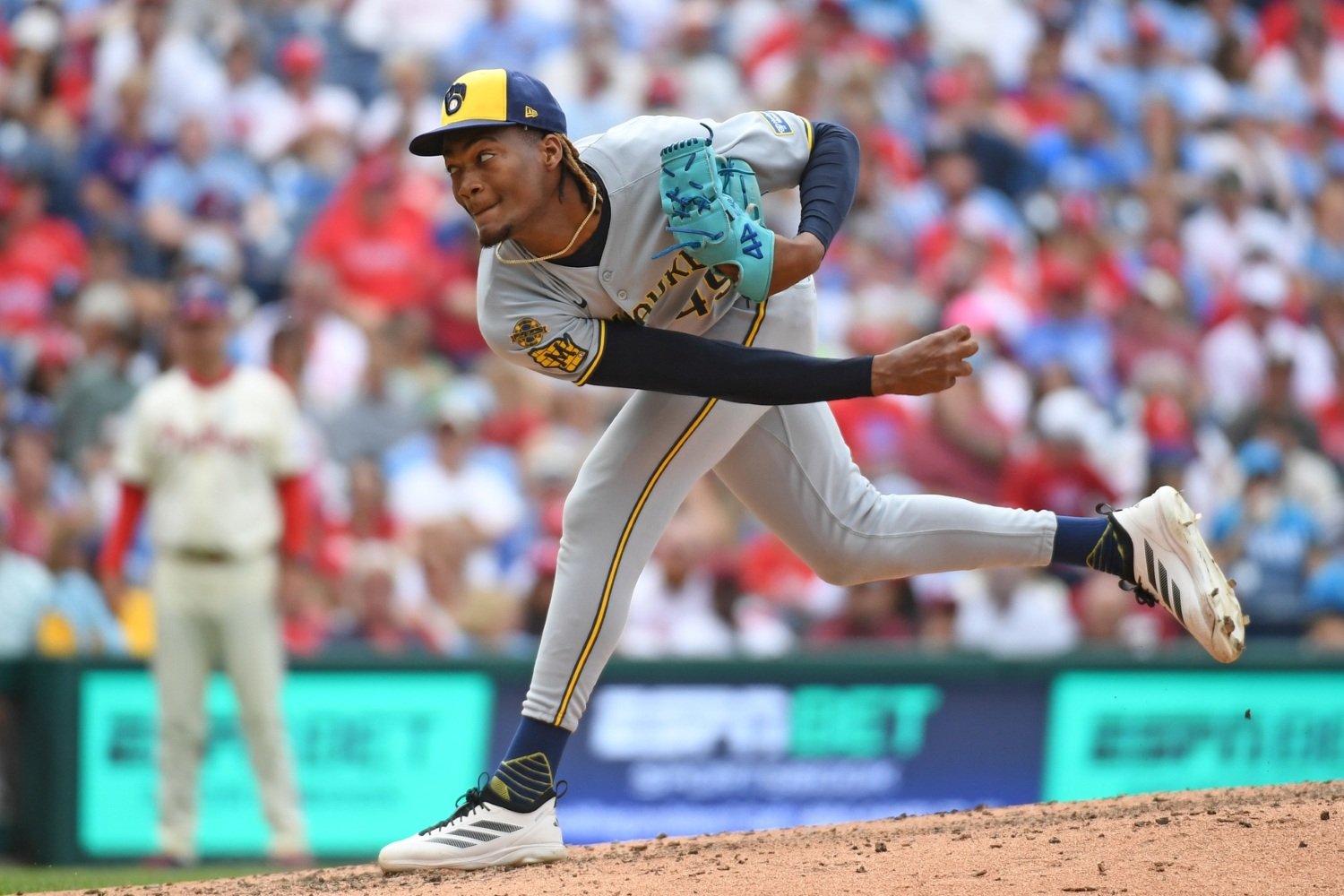 On Sunday, Abner Uribe appeared in his majors-leading 29th game, logging his 15th hold and his fourth straight scoreless inning. He also lowered his seasonal ERA to 1.59. Sixty games into the Brewers' season, Uribe is running an 84 DRA-, according to Baseball Prospectus. (When it comes to DRA-, 100 is average and lower is better.) He's striking out 32.2% of opposing batters, but his extreme level of availability has been the result of ruthless efficiency. He needed just seven pitches to dispatch the Phillies this time. The funny thing about Uribe's season is that he continues to lean into a two-pitch mix typically tilted toward platoon vulnerability—a right-handed hurler, he throws almost exclusively sinkers and sliders—but has actually been impressively lefty-proof. Righties are hitting an unimpressive .271/.338/.322, but lefties have scuffled even worse: .154/.313/.231. He's actually struck out a slightly higher share of the lefties he's seen this year (33.3%) than of the righties he's faced (31.3%). Uribe, the sinker-slider guy, overpowers even opposite-handed batters, and it's not solely (or even primarily) because of his velocity. Against right-handed batters, Uribe uses a pretty standard set of locations: sinker running across the plate, setting up sliders down and away. Righty batters face the traditional problem against righty hurlers, especially those who pair sinkers and sliders well: it's nigh impossible to distinguish the two offerings from one another. Reacting to these two pitches, with their divergent patterns of movement, is just as hard to as telling them apart in the first place. It's no mystery why a guy like Uribe baffles righty hitters. Against lefties, though, he's had to learn how to pitch a bit, and to put them on the defensive. To do so, he's approached them extremely differently. He's worked that sinker across the plate, hitting the glove-side edge. It's what the old heads call a 'front-hip' sinker, because that's what a lefty thinks the pitch will hit, before it runs back over the inside corner for a strike. Meanwhile, he's backdoored the slider more, landing it on the bottom rail of the zone after starting it off the outside corner to those batters. It's much easier for a lefty hitter to tell which pitch is coming, of course. The way Uribe releases the two and the direction each must go to get anywhere near the zone forces an early separation. Because the patterns of initial trajectory and ultimate location Uribe is pursuing with each pitch are so unusual, though, they have a hard time reacting fast and getting the head out on his stuff. Put another way, there aren't many places where a hitter can sit on either offering from Uribe, even though it's theoretically easy to see which one is which out of his hand. In locations where hitters are used to getting one of the two almost exclusively, from a righty, Uribe gives them an uneasily even share of each. In fact, Uribe throws a higher percentage of his sinkers to the glove side than all but three other right-handed pitchers in the league: Logan Webb, Shawn Armstrong and Reese Olson. That's one very valuable skill he's demonstrated, making it possible to bully lefty batters by inducing ground balls and weak contact. But the biggest change for Uribe this season isn't pitch mix or sequencing or deception. It's relentlessness. He's not wasting pitches—literally. In 2023 and 2024, when ahead in the count, Uribe threw an average of 15.7% of his pitches in what Statcast calls the waste zones, far beyond the strike zone and where hitters rarely even chase. This year, that number is 9.7%. He's no longer playing with his food. Uribe has matured in more ways than just dealing with frustration or conflict better. He's blossomed into a better all-around pitcher, more efficient, more versatile and (therefore) more available. Maybe Trevor Megill will hold onto his closer's role for another year or two, or maybe Craig Yoho will claim it. If nothing else, though, Uribe has renewed his own claim to a job at the back end of the Milwaukee bullpen, and he currently boasts the best balance of skills, experience, and team control.
 -
Image courtesy of © Eric Hartline-Imagn Images On Sunday, Abner Uribe appeared in his majors-leading 29th game, logging his 15th hold and his fourth straight scoreless inning. He also lowered his seasonal ERA to 1.59. Sixty games into the Brewers' season, Uribe is running an 84 DRA-, according to Baseball Prospectus. (When it comes to DRA-, 100 is average and lower is better.) He's striking out 32.2% of opposing batters, but his extreme level of availability has been the result of ruthless efficiency. He needed just seven pitches to dispatch the Phillies this time. The funny thing about Uribe's season is that he continues to lean into a two-pitch mix typically tilted toward platoon vulnerability—a right-handed hurler, he throws almost exclusively sinkers and sliders—but has actually been impressively lefty-proof. Righties are hitting an unimpressive .271/.338/.322, but lefties have scuffled even worse: .154/.313/.231. He's actually struck out a slightly higher share of the lefties he's seen this year (33.3%) than of the righties he's faced (31.3%). Uribe, the sinker-slider guy, overpowers even opposite-handed batters, and it's not solely (or even primarily) because of his velocity. Against right-handed batters, Uribe uses a pretty standard set of locations: sinker running across the plate, setting up sliders down and away. Righty batters face the traditional problem against righty hurlers, especially those who pair sinkers and sliders well: it's nigh impossible to distinguish the two offerings from one another. Reacting to these two pitches, with their divergent patterns of movement, is just as hard to as telling them apart in the first place. It's no mystery why a guy like Uribe baffles righty hitters. Against lefties, though, he's had to learn how to pitch a bit, and to put them on the defensive. To do so, he's approached them extremely differently. He's worked that sinker across the plate, hitting the glove-side edge. It's what the old heads call a 'front-hip' sinker, because that's what a lefty thinks the pitch will hit, before it runs back over the inside corner for a strike. Meanwhile, he's backdoored the slider more, landing it on the bottom rail of the zone after starting it off the outside corner to those batters. It's much easier for a lefty hitter to tell which pitch is coming, of course. The way Uribe releases the two and the direction each must go to get anywhere near the zone forces an early separation. Because the patterns of initial trajectory and ultimate location Uribe is pursuing with each pitch are so unusual, though, they have a hard time reacting fast and getting the head out on his stuff. Put another way, there aren't many places where a hitter can sit on either offering from Uribe, even though it's theoretically easy to see which one is which out of his hand. In locations where hitters are used to getting one of the two almost exclusively, from a righty, Uribe gives them an uneasily even share of each. In fact, Uribe throws a higher percentage of his sinkers to the glove side than all but three other right-handed pitchers in the league: Logan Webb, Shawn Armstrong and Reese Olson. That's one very valuable skill he's demonstrated, making it possible to bully lefty batters by inducing ground balls and weak contact. But the biggest change for Uribe this season isn't pitch mix or sequencing or deception. It's relentlessness. He's not wasting pitches—literally. In 2023 and 2024, when ahead in the count, Uribe threw an average of 15.7% of his pitches in what Statcast calls the waste zones, far beyond the strike zone and where hitters rarely even chase. This year, that number is 9.7%. He's no longer playing with his food. Uribe has matured in more ways than just dealing with frustration or conflict better. He's blossomed into a better all-around pitcher, more efficient, more versatile and (therefore) more available. Maybe Trevor Megill will hold onto his closer's role for another year or two, or maybe Craig Yoho will claim it. If nothing else, though, Uribe has renewed his own claim to a job at the back end of the Milwaukee bullpen, and he currently boasts the best balance of skills, experience, and team control. View full article
-
Image courtesy of © Patrick Gorski-Imagn Images Brewers first baseman and outfielder Jake Bauers is batting .253/.359/.456 this year, and even better than that in May. Although his role remains something closer to platoon DH and bench bat than full-time regular, Bauers has been indispensable. The Brewers' offense is sputtering, but without Bauers, it would be downright anemic. Surprisingly, though, it's not just that Bauers has been good this year. It's also that he's made a significant adjustment in May, to get even more dangerous at the plate. By now, we all know that Bauers has one of the fastest bats on the Brewers—indeed, in the league. His average bat speed was 73.8 miles per hour last season, and had already ticked up early this year. There were two problems, though. First, he was swinging and missing too much to get the most out of that power. Secondly (and more subtly), though, he was also fouling off too many pitches within the strike zone. Whiffing is always and obviously bad, but fouling off hittable pitches puts one behind in counts and leads to strikeouts almost as reliably as does swinging and missing. Last year, 48.2% of Bauers's in-zone swings resulted in foul balls. To fully leverage his swing speed, therefore, Bauers had to find an adjustment that would let him get to the ball on time and convert more of his swings into balls in play. That's what he's doing. He's actually whiffing at almost an identical rate on pitches in the zone this year, but he's putting the ball in play on 41.8% of his in-zone swings, up from 31.0% in 2024. How? Well, mostly, by changing the plane of his swing. In April, Bauers was still swinging more or less the way he did in 2024. His average swing tilt last year was 36°, much steeper than the league average of 32°. This season, it started the same way. In May, though, he's made a major change, flattening his swing to an average tilt of 33°. As he's changed his posture to accommodate that tweak, he's been able to battle gravity less on his way through the hitting zone, which has increased his swing speed. That number is up to over 75 mph this month. The whole thing starts with a more spread-out stance and a shorter stride. Here's how Bauers set up in the box and strode into the ball in March and April. As you can also see there, he was going out and getting the ball more than ever with that swing. That led to some good things, but also to some problems. This month, though, he's changed his whole address of the ball. You can see the way he ends up in the same position with his front foot, but has carried it less distance in his stride, because he was setting up with his feet spread farther apart in the first place. That's keeping him more upright at contact, especially on pitches in the middle or top third of the zone. Here are side-by-side looks at him at the contact point on two middle-middle pitches—one in April and one in the middle of this month. Already, you can see the change in bat angle. But in the visualizations above, you can also see that his contact point has moved much deeper and farther from Bauers, on average. He's paired his change in bat path and stride with one in how long he lets the ball travel and where he tries to meet it;. That's helped him make solid contact on some breaking and offspeed stuff that, as recently as last month, he would have either whiffed on or fouled off. Here he is on two offspeed offerings at the bottom of the zone—one from April and one from May. The change in bat path is less pronounced at the bottom reaches of the zone. More obviously, look how he's stayed back long enough to catch the ball on the right flush. A deeper contact point means a better chance of barreling up such pitches. Both pitches in the righthand halves of those side-by-sides resulted in well-struck hits. Both came on the same day against the Guardians, but Bauers has found more consistent, forward contact within the zone throughout this month. This change to his bat path makes him a bit more prone to cutting underneath the ball or getting on top of it, but importantly, that deeper contact point works to counteract the flatter path. He's in a position to make better swing decisions, and he's done so. His production has ticked up, and his process is much more sustainable. His whiff rate was 25.5% within the zone last month, but it's all the way down to 16.9% this month. His exit velocity on in-zone batted balls is up from 90.1 mph last month to 91.1 in May. Strikeouts are still a huge, looming problem for Bauers. He's drawing more walks this year, though, and the adjustment to his bat path has begotten power that should play more consistently. Unless and until the team's more established sluggers get locked in, Bauers will be an important part of the offense—and that's less daunting a notion now than it was even 30 days ago. View full article
-
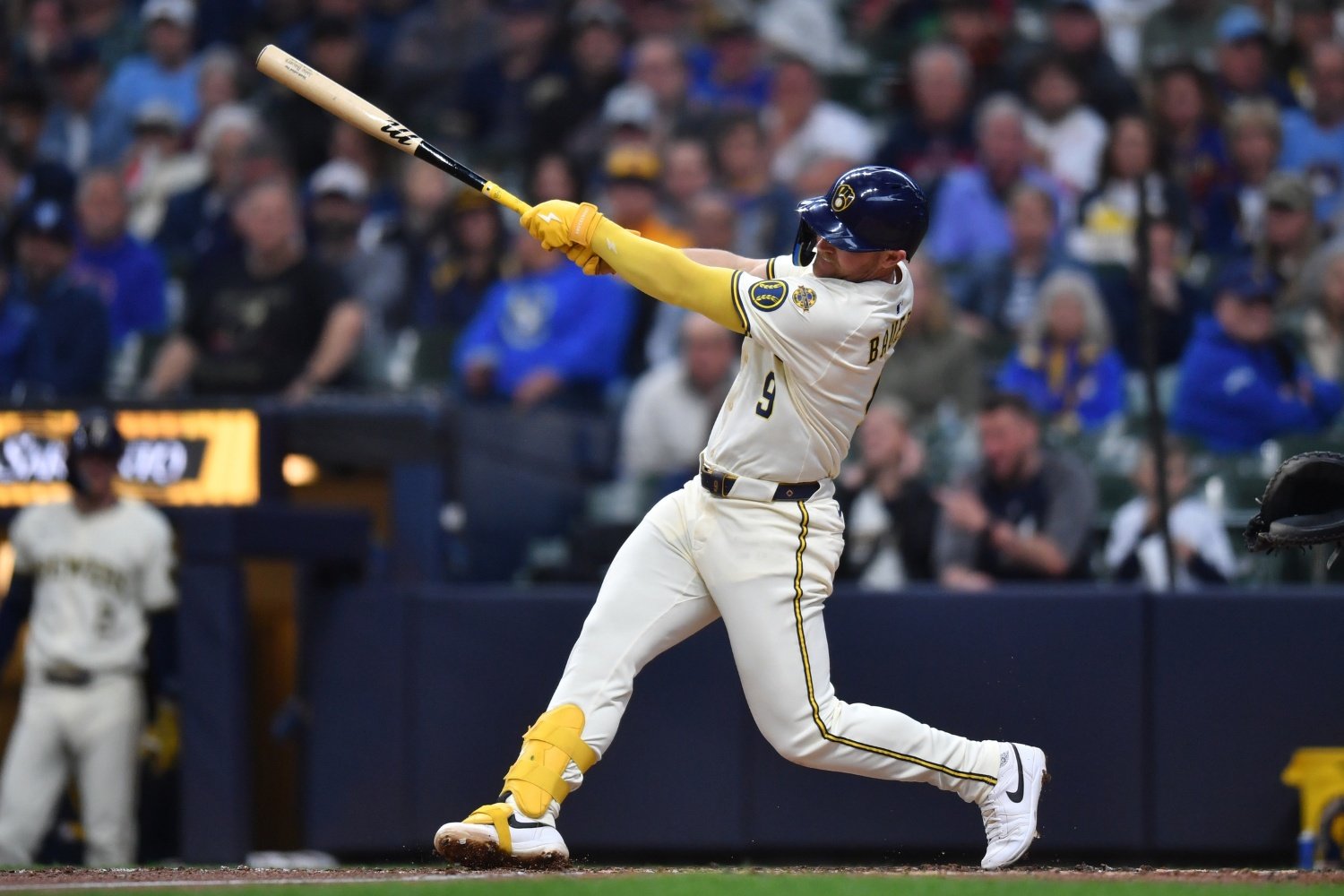 Brewers first baseman and outfielder Jake Bauers is batting .253/.359/.456 this year, and even better than that in May. Although his role remains something closer to platoon DH and bench bat than full-time regular, Bauers has been indispensable. The Brewers' offense is sputtering, but without Bauers, it would be downright anemic. Surprisingly, though, it's not just that Bauers has been good this year. It's also that he's made a significant adjustment in May, to get even more dangerous at the plate. By now, we all know that Bauers has one of the fastest bats on the Brewers—indeed, in the league. His average bat speed was 73.8 miles per hour last season, and had already ticked up early this year. There were two problems, though. First, he was swinging and missing too much to get the most out of that power. Secondly (and more subtly), though, he was also fouling off too many pitches within the strike zone. Whiffing is always and obviously bad, but fouling off hittable pitches puts one behind in counts and leads to strikeouts almost as reliably as does swinging and missing. Last year, 48.2% of Bauers's in-zone swings resulted in foul balls. To fully leverage his swing speed, therefore, Bauers had to find an adjustment that would let him get to the ball on time and convert more of his swings into balls in play. That's what he's doing. He's actually whiffing at almost an identical rate on pitches in the zone this year, but he's putting the ball in play on 41.8% of his in-zone swings, up from 31.0% in 2024. How? Well, mostly, by changing the plane of his swing. In April, Bauers was still swinging more or less the way he did in 2024. His average swing tilt last year was 36°, much steeper than the league average of 32°. This season, it started the same way. In May, though, he's made a major change, flattening his swing to an average tilt of 33°. As he's changed his posture to accommodate that tweak, he's been able to battle gravity less on his way through the hitting zone, which has increased his swing speed. That number is up to over 75 mph this month. The whole thing starts with a more spread-out stance and a shorter stride. Here's how Bauers set up in the box and strode into the ball in March and April. As you can also see there, he was going out and getting the ball more than ever with that swing. That led to some good things, but also to some problems. This month, though, he's changed his whole address of the ball. You can see the way he ends up in the same position with his front foot, but has carried it less distance in his stride, because he was setting up with his feet spread farther apart in the first place. That's keeping him more upright at contact, especially on pitches in the middle or top third of the zone. Here are side-by-side looks at him at the contact point on two middle-middle pitches—one in April and one in the middle of this month. Already, you can see the change in bat angle. But in the visualizations above, you can also see that his contact point has moved much deeper and farther from Bauers, on average. He's paired his change in bat path and stride with one in how long he lets the ball travel and where he tries to meet it;. That's helped him make solid contact on some breaking and offspeed stuff that, as recently as last month, he would have either whiffed on or fouled off. Here he is on two offspeed offerings at the bottom of the zone—one from April and one from May. The change in bat path is less pronounced at the bottom reaches of the zone. More obviously, look how he's stayed back long enough to catch the ball on the right flush. A deeper contact point means a better chance of barreling up such pitches. Both pitches in the righthand halves of those side-by-sides resulted in well-struck hits. Both came on the same day against the Guardians, but Bauers has found more consistent, forward contact within the zone throughout this month. This change to his bat path makes him a bit more prone to cutting underneath the ball or getting on top of it, but importantly, that deeper contact point works to counteract the flatter path. He's in a position to make better swing decisions, and he's done so. His production has ticked up, and his process is much more sustainable. His whiff rate was 25.5% within the zone last month, but it's all the way down to 16.9% this month. His exit velocity on in-zone batted balls is up from 90.1 mph last month to 91.1 in May. Strikeouts are still a huge, looming problem for Bauers. He's drawing more walks this year, though, and the adjustment to his bat path has begotten power that should play more consistently. Unless and until the team's more established sluggers get locked in, Bauers will be an important part of the offense—and that's less daunting a notion now than it was even 30 days ago.
 -
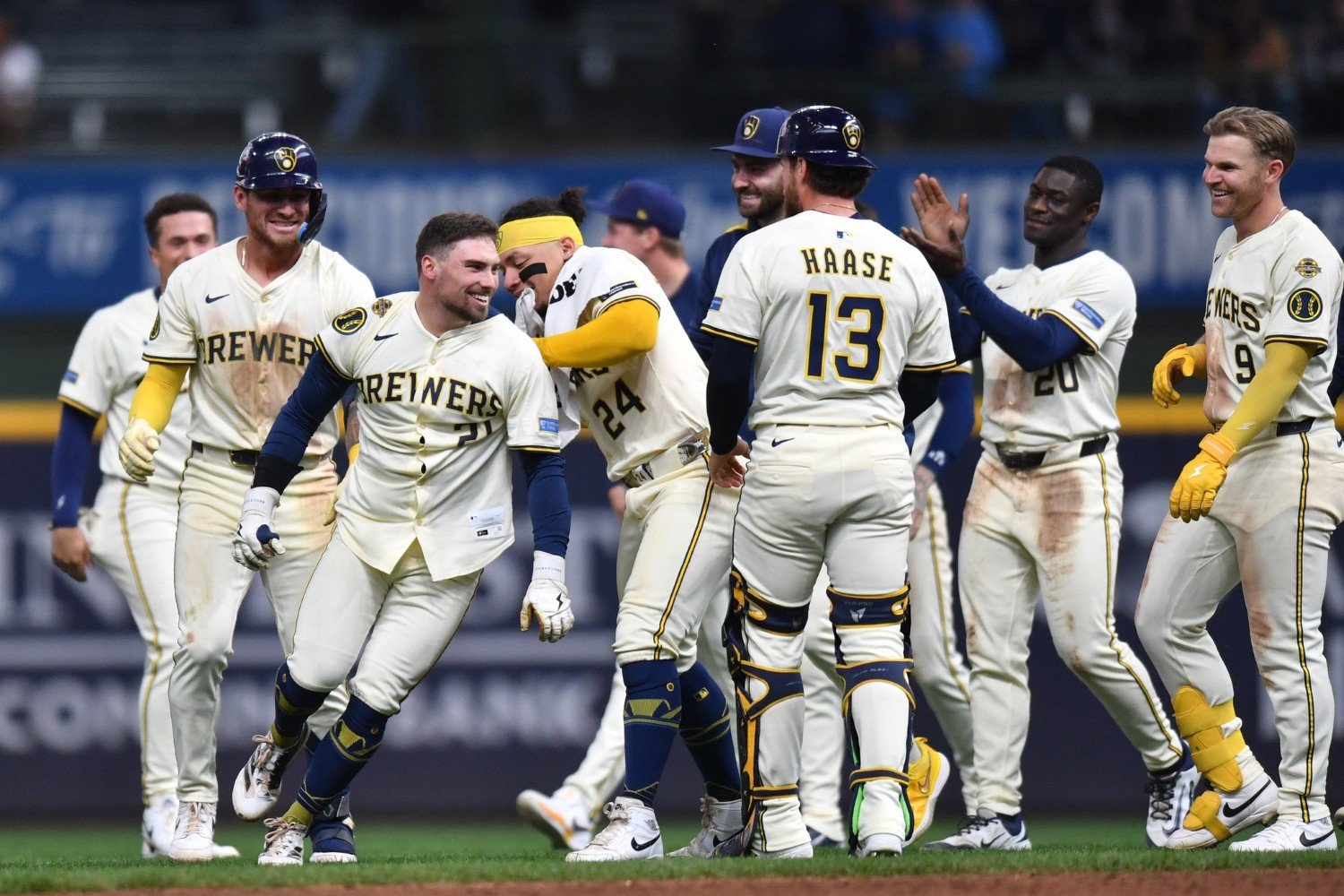 It's been ugly. It's been difficult. Joey Ortiz's OPS is still under .500. After a third straight walkoff win and their eighth victory in 11 games, though, the Brewers are 29-28. They might be running their current batch of relievers straight into the dirt just to keep their head above water, but they're above water, which is the only place to be if you want the health or performance status of your relievers to matter at all. This team has every right to be slouching and sagging toward the bottom of the National League standings. Instead, they're three games out of a Wild Card spot, with lots of help on the way. A second coming of Craig Yoho could reinforce the relief corps Pat Murphy has used so aggressively as to leave many fans in a state of perpetual agita, but the Crew doesn't need to bring Yoho back to deepen their pen. This weekend should see the return of Jose Quintana to the starting rotation. Brandon Woodruff continues his own rehab assignment. DL Hall and Aaron Ashby have already returned to the bullpen, and Logan Henderson was sent down just to make way for Quintana's return to the rotation. Jacob Misiorowski looks like a potential mega-weapon for the pitching staff in the second half, if not sooner. More injuries will come, eventually. At the same time, the team can and will get healthier, again. Woodruff and Quintana aren't even quite back yet, and the team has gotten hot without them. Garrett Mitchell and Blake Perkins are missing from the positional corps, and will be back at some point. That's to say nothing of the improvements we should still expect in the production of the team's three most important hitters, William Contreras, Jackson Chourio and Christian Yelich. When you strip away all the frustration and anxiety and disappointment on the surface of this season, the basic facts come into focus—and they're just not bad. Caleb Durbin is figuring things out a bit. Sal Frelick has locked in again lately. The defense, which was somewhat less than its usual self for the first month or more and which still misses Perkins, has nonetheless tightened up significantly of late. Having the ability to find outs in unexpected places again, even without pitchers at full strength, has helped the team survive some games they would have lost even a few weeks ago. This team is on the right side of .500, despite some key underperformances and a host of injuries. Yes, Murphy has had to push his roster to its redline, and sometimes beyond it. Yes, they're still going to have to play better to put themselves in the thick of the playoff chase later this summer. As maddening and seemingly unsustainable as Murphy's tactics might be, though, it's important not to overlook the most important criterion when evaluating them: They're working. Murphy has this team alive and kicking. If the offense can't crank things up more in a hurry, they'll blow out an arm or two, because they don't have as many ways to win (or as many wins to let slip, if needed) as they had last year. Still, there's a real chance that the team (and its second-year skipper) can pull this off. The last two weeks are proof of that—but also of the fact that it's going to be stressful and difficult, this time around.
 -
Image courtesy of © Patrick Gorski-Imagn Images It's been ugly. It's been difficult. Joey Ortiz's OPS is still under .500. After a third straight walkoff win and their eighth victory in 11 games, though, the Brewers are 29-28. They might be running their current batch of relievers straight into the dirt just to keep their head above water, but they're above water, which is the only place to be if you want the health or performance status of your relievers to matter at all. This team has every right to be slouching and sagging toward the bottom of the National League standings. Instead, they're three games out of a Wild Card spot, with lots of help on the way. A second coming of Craig Yoho could reinforce the relief corps Pat Murphy has used so aggressively as to leave many fans in a state of perpetual agita, but the Crew doesn't need to bring Yoho back to deepen their pen. This weekend should see the return of Jose Quintana to the starting rotation. Brandon Woodruff continues his own rehab assignment. DL Hall and Aaron Ashby have already returned to the bullpen, and Logan Henderson was sent down just to make way for Quintana's return to the rotation. Jacob Misiorowski looks like a potential mega-weapon for the pitching staff in the second half, if not sooner. More injuries will come, eventually. At the same time, the team can and will get healthier, again. Woodruff and Quintana aren't even quite back yet, and the team has gotten hot without them. Garrett Mitchell and Blake Perkins are missing from the positional corps, and will be back at some point. That's to say nothing of the improvements we should still expect in the production of the team's three most important hitters, William Contreras, Jackson Chourio and Christian Yelich. When you strip away all the frustration and anxiety and disappointment on the surface of this season, the basic facts come into focus—and they're just not bad. Caleb Durbin is figuring things out a bit. Sal Frelick has locked in again lately. The defense, which was somewhat less than its usual self for the first month or more and which still misses Perkins, has nonetheless tightened up significantly of late. Having the ability to find outs in unexpected places again, even without pitchers at full strength, has helped the team survive some games they would have lost even a few weeks ago. This team is on the right side of .500, despite some key underperformances and a host of injuries. Yes, Murphy has had to push his roster to its redline, and sometimes beyond it. Yes, they're still going to have to play better to put themselves in the thick of the playoff chase later this summer. As maddening and seemingly unsustainable as Murphy's tactics might be, though, it's important not to overlook the most important criterion when evaluating them: They're working. Murphy has this team alive and kicking. If the offense can't crank things up more in a hurry, they'll blow out an arm or two, because they don't have as many ways to win (or as many wins to let slip, if needed) as they had last year. Still, there's a real chance that the team (and its second-year skipper) can pull this off. The last two weeks are proof of that—but also of the fact that it's going to be stressful and difficult, this time around. View full article
-
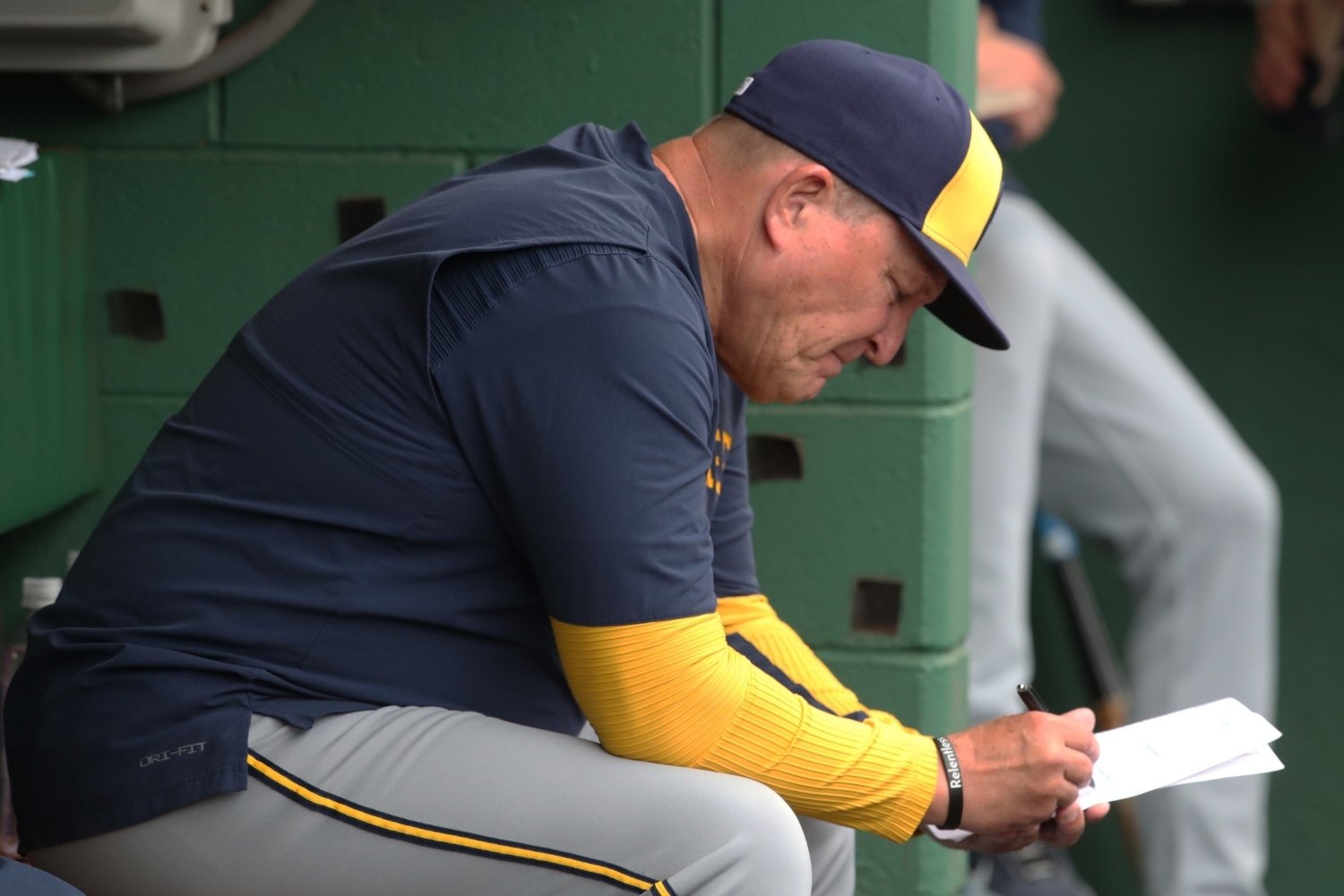 The Boston Red Sox are going with an extreme approach against Brewers ace Freddy Peralta Wednesday. The first four batters in their lineup (Jarren Duran, Rafael Devers, Wilyer Abreu and Marcelo Mayer) are all left-handed batters. It's Sox manager Alex Cora's latest remix of a group stinging from the loss of Alex Bregman, but it's also a gambit. Cora, like many opposing managers, has watched Pat Murphy deploy a quick hook the third time through the order for starting pitchers this year, and he's betting on forcing Murphy to abandon Peralta and go back to a weary bullpen early in a day game, after a night game. With the Red Sox struggling early in a season that began with high expectations, Cora has to try something like this. He's trying to create an advantage, and he's going about it the right way. Both Duran (144 wRC+ against right-handed pitching since the start of last season; 82 against lefties) and Devers (166, 107) are the type of lefty hitter no righty wants to see a third time, and the Brewers' heavily left-leaning bullpen stands ready. Pushing Peralta out of the game early would play into Cora's hands, though, because the Brewers' relief corps has been so heavily used of late that it's showing cracks in several places. Really, though, this should be an easy call for the Crew. The countermove is simple: Peralta should be scratched and moved back to start Friday against the Phillies. He's been dealing with a mild groin strain that could use an extra two days of rest, anyway, and this start would be on four days' rest. Making that six would be lovely. Philadelphia manager Rob Thomson could try the same thing Friday with Kyle Schwarber, Bryce Harper, Bryson Stott, Max Kepler and/or Brandon Marsh, but that quartet is undermined a bit by the lack of a third hitter who's any real threat—and the Brewers wouldn't gain as much from the switcheroo, as both Schwarber and Harper hit lefties better than do Duran and Devers, let alone the rookie Mayer. Aaron Ashby gave the Brewers 37 pitches Tuesday, and is down for Wednesday. However, Jared Koenig might have a yellow light on him, and it's a full green on each of Tyler Alexander, Rob Zastryzny, and DL Hall. Murphy should just bullpen his way through the imbalanced, ill-constructed Boston lineup. If ever there were a day to lean right into the tendency to overuse a bullpen, this is it. Of course, the Red Sox could counter by pinch-hitting for the likes of Abreu, Mayer or David Hamilton with righty bat Rob Refsnyder or switch-hitter Abraham Toro, but they'd be blowing up their own strategy and forced into some tough defensive decisions thereafter. You gain a tactical advantage either way, and in the grand scheme, you also come out ahead in terms of managing the pitching staff. Wednesday would mark a sixth start on four days' rest for Peralta, tying him for the league lead. It would be better to give him the extra two days, and whatever exhaustion the bullpen endures as a result of the strategic pivot could be offset both by a roster move and by the scheduled day off Thursday. Cora's ploy is based on the disadvantage a team faces when they name a starter everyone knows they don't want to take down too soon. He's trying to put Murphy in a Catch-22, forced either to endure bad mid-game matchups or to admit a failure of confidence in his ace. Instead, the Brewers should pull back Peralta, and force the Red Sox to either make a shocking admission of no-confidence in one of their top hitters in left-on-left situations, or endure their own bad matchups all day long. This almost surely won't happen. It would be a bit too radical a response, for most baseball people; it would savor of having allowed the opponent the initiative. If played correctly, though, matching Cora's gambit with one of their own could make the Brewers more likely to win both Wednesday and this weekend. It's worth a discussion, anyway.

