



Jack Stern
-
Posts
764 -
Joined
-
Last visited
-
Days Won
2
Content Type
Profiles
Forums
Blogs
Events
News
2026 Milwaukee Brewers Top Prospects Ranking
Milwaukee Brewers Videos
2022 Milwaukee Brewers Draft Picks
Milwaukee Brewers Free Agent & Trade Rumors, Notes, & Tidbits
Guides & Resources
2023 Milwaukee Brewers Draft Picks
2024 Milwaukee Brewers Draft Picks
The Milwaukee Brewers Players Project
2025 Milwaukee Brewers Draft Pick Tracker
2026 Milwaukee Brewers Draft Tracker: Picks & Bonuses
Store
Downloads
Gallery
Everything posted by Jack Stern
-
 Image courtesy of © Michael McLoone-Imagn Images The Brewers' three-game sweep of the Los Angeles Angels was not all that remarkable. It was, perhaps, even expected. The Angels are a bad team, and the Brewers did what good teams should do against bad opponents. There are takeaways to be gleaned from how they did it, though—particularly on the run-prevention side. The Angels have a poor offense, ranking 23rd in baseball with a 92 wRC+, but they're especially feeble against pitches with lift and glove-side break. Their -16 run value against cutters is the worst in the league, and their -15 run value against sweepers is fourth-worst. While no one said it outright, it sure looked like the Brewers' gameplans centered on that weakness, and their last two starters exploited it best. Brandon Woodruff, whose new cutter had largely been an auxiliary pitch to support his two existing fastballs after losing some velocity post-shoulder surgery, threw cutters at a season-high 45% rate on Wednesday. Angels hitters whiffed on eight of 16 swings against it. "I'm not going in and saying I'm going to throw 30 cutters," said Woodruff, who claimed that leaning on the pitch so heavily was not part of his original game plan that night, "but if it's working and it's playing right, I can use it to help out the other fastballs." Sinkerballer Quinn Priester followed suit the next night, throwing his cutter a season-high 40% of the time en route to his third outing of the season with double-digit strikeouts. Four of his 10 strikeouts came on cutters, which yielded six whiffs out of 16 swings. "It's just something that's keeping the guys off the sinker, and when it's working and guys aren't making the adjustment, we can kind of keep rolling with it," Priester said. It wasn't just those two starters attacking the Angels with glove-side movement. Chad Patrick and Erick Fedde, former starters who are not typical high-leverage pitchers, received opportunities in the late innings with four-run leads during the series. Patrick struck out the side on Tuesday with his usual cutter-dominant mix, while Fedde threw a cutter or sweeper for 20 of his 24 pitches across two scoreless frames the following night. Carefully orchestrating matchups to win each moment becomes even more crucial in the postseason. When the Brewers face much better lineups in more meaningful situations in October, they could deploy more specialized pitch mixes as they did this week. In last year's Wild Card series against the New York Mets, they threw several pitchers with riding fastballs from high arm angles. That might mean rostering certain pitchers over others and using them in key situations because of how their mix profiles against a lineup rather than their regular-season performance. Starters with deep arsenals might sequence differently. Identifying something that works and maximizing it to the extreme could become a more immediately obvious theme for Milwaukee in a couple of weeks. View full article
 -
Brewers Pitchers Cut Their Way Through Angels Lineup in Resounding Sweep
Jack Stern posted an article in Brewers
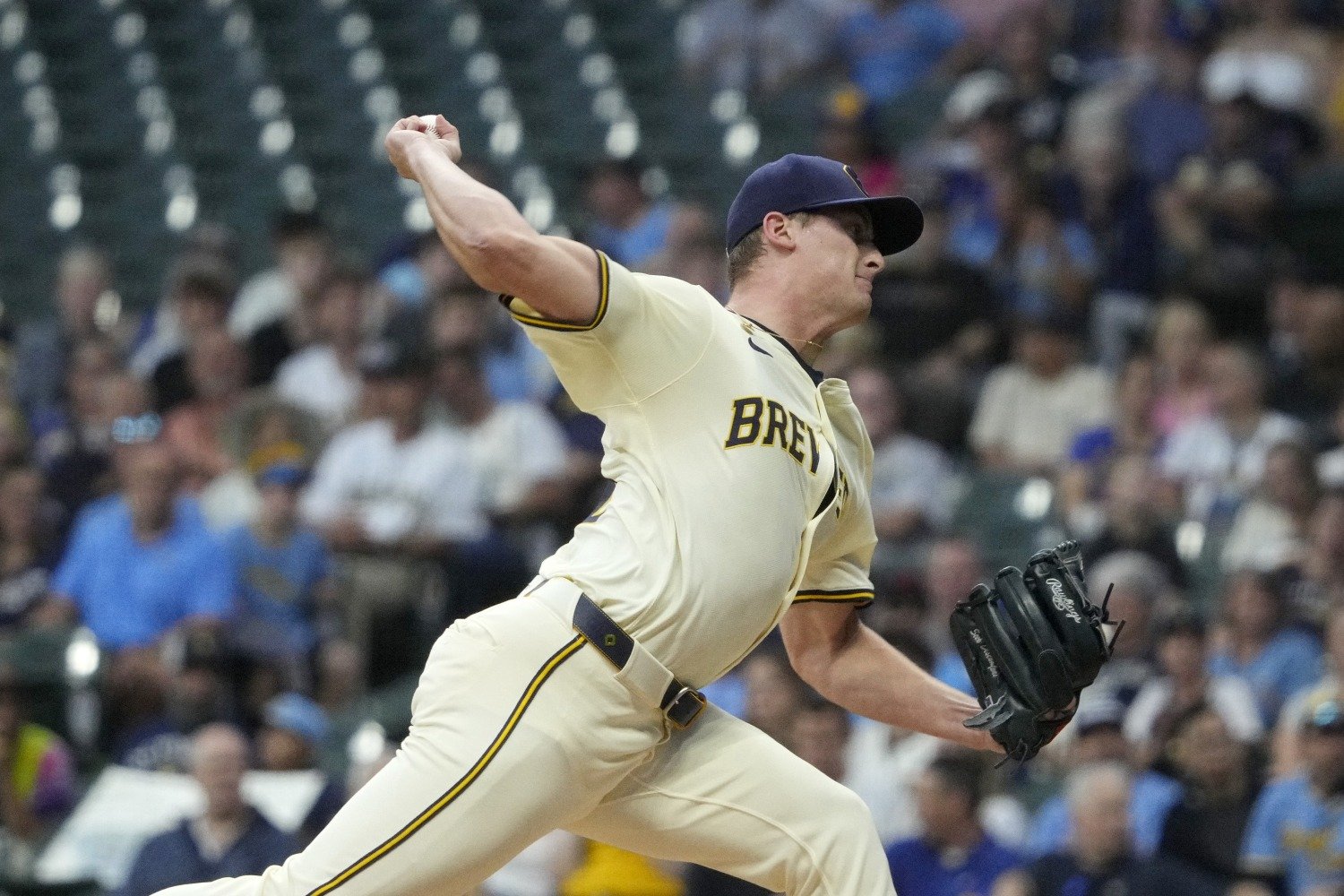 The Brewers' three-game sweep of the Los Angeles Angels was not all that remarkable. It was, perhaps, even expected. The Angels are a bad team, and the Brewers did what good teams should do against bad opponents. There are takeaways to be gleaned from how they did it, though—particularly on the run-prevention side. The Angels have a poor offense, ranking 23rd in baseball with a 92 wRC+, but they're especially feeble against pitches with lift and glove-side break. Their -16 run value against cutters is the worst in the league, and their -15 run value against sweepers is fourth-worst. While no one said it outright, it sure looked like the Brewers' gameplans centered on that weakness, and their last two starters exploited it best. Brandon Woodruff, whose new cutter had largely been an auxiliary pitch to support his two existing fastballs after losing some velocity post-shoulder surgery, threw cutters at a season-high 45% rate on Wednesday. Angels hitters whiffed on eight of 16 swings against it. "I'm not going in and saying I'm going to throw 30 cutters," said Woodruff, who claimed that leaning on the pitch so heavily was not part of his original game plan that night, "but if it's working and it's playing right, I can use it to help out the other fastballs." Sinkerballer Quinn Priester followed suit the next night, throwing his cutter a season-high 40% of the time en route to his third outing of the season with double-digit strikeouts. Four of his 10 strikeouts came on cutters, which yielded six whiffs out of 16 swings. "It's just something that's keeping the guys off the sinker, and when it's working and guys aren't making the adjustment, we can kind of keep rolling with it," Priester said. It wasn't just those two starters attacking the Angels with glove-side movement. Chad Patrick and Erick Fedde, former starters who are not typical high-leverage pitchers, received opportunities in the late innings with four-run leads during the series. Patrick struck out the side on Tuesday with his usual cutter-dominant mix, while Fedde threw a cutter or sweeper for 20 of his 24 pitches across two scoreless frames the following night. Carefully orchestrating matchups to win each moment becomes even more crucial in the postseason. When the Brewers face much better lineups in more meaningful situations in October, they could deploy more specialized pitch mixes as they did this week. In last year's Wild Card series against the New York Mets, they threw several pitchers with riding fastballs from high arm angles. That might mean rostering certain pitchers over others and using them in key situations because of how their mix profiles against a lineup rather than their regular-season performance. Starters with deep arsenals might sequence differently. Identifying something that works and maximizing it to the extreme could become a more immediately obvious theme for Milwaukee in a couple of weeks.
-
- 1
-

-
- brandon woodruff
- quinn priester
- (and 2 more)
-
Image courtesy of © Benny Sieu-Imagn Images All season long, Brewers personnel have been quick to praise Joey Ortiz's defense. While some in the front office still think highly of his offensive potential, it's his glove that has earned him a long leash as the starting shortstop, despite a 69 wRC+ that ranks second-to-last among qualified hitters. Public defensive metrics have been more divided in their evaluation. Through July, Statcast's Fielding Run Value graded Ortiz as +6 runs above average on the season, which ranked sixth among qualified shortstops. Defensive Runs Saved, meanwhile, had him bottoming out at -7 runs, and Baseball Prospectus had him at -1.9 Defensive Runs Prevented. Since the start of August, though, Ortiz has been undeniably fantastic in the field. All three metrics agree that he's been one of baseball's better defensive shortstops over the last six weeks. He quickly worked his way back to an effectively neutral -1 DRS and 0 DRP and is up to an FRV of +10 runs. Brewers infield coach Matt Erickson said some metrics dinged Ortiz early in the year because he was not completing more challenging plays. The club's internal model classifies plays by out probability based on the lateral range required of an infielder to complete them. Those with an out probability between 30% and 70% are considered "50/50 plays," and Ortiz rarely recorded outs on the most difficult opportunities. "Like 12 of those 15 [plays] were from 30 to 40 percent, where he was diving, making plays, getting up, dropping the exchange, ruled a hit," Erickson said. "Diving one way, making a throw, guy just beats it. So of the 50/50 plays that he was getting, they were on the extreme, tougher end, but he wasn't converting many of those. Now, over the course of the second half, he's gotten more opportunities, and he's made a bunch more 50/50 plays, which has brought that number back up." Erickson did not cite specific plays, but there are plenty from the first half that fit the description. Here's an attempt on May 3 where Ortiz dove to knock down a grounder in the hole, but the transfer was neither clean nor quick enough for his throw to beat Chicago Cubs catcher Carson Kelly. ortiz_dive.mp4 Two weeks later, Ortiz laid out the other way for an impressive stop up the middle, but he couldn't collect the ball to make a throw. ortiz_dive2.mp4 Of the public defensive tools, Baseball Prospectus's models best illustrate Ortiz's in-season evolution as a defender. They separately track how many batted balls above or below average an infielder reaches (Attempt Range) and how well he executes that range to record outs (Range Outs Made). Split Attempt Range Range Outs Made Reaches on Fielded GBs March-July 1.0 -2.6 28 Aug-Sept 9.7 2.6 3 Off the bat, the two metrics, plus the number of batters who reached base on ground balls he fielded, support the notion that Ortiz was getting to enough balls in the first half, but not recording the out. They also reveal that he turned things around not just by completing more of those plays, but mostly by significantly improving his range. Ortiz moves gracefully and naturally on the dirt, with exceptional coordination. His movements aren't very quick or explosive, though. On many plays in the first half, including in the clips above, he looked smooth but slow. The Brewers' model says his initial burst toward ground balls off the bat is among the worst in their infield, so improving in that area became a focus to help him make more rangy plays. "Over the course of the year, he's done things like worked on his lateral range," Erickson said. "He's changed his prep stuff a few different times. He's tried to be more efficient with that. That's a number that is as slow as anybody on our team in the infield, but it's improving over time, so I think that's helped him make more plays and get to more balls." He has also seen Ortiz's anticipation improve over time, in his first season as a big-league shortstop. The best infielders use experience and the information surrounding them to deduce where and how a ball will be hit, giving themselves a head start on properly approaching it and saving precious milliseconds on difficult bang-bang plays. "You can see his engagement getting better," Erickson said. "His physical skills are what they are, but his mental engagement—using the PitchCom, anticipating what pitch is being thrown, knowing his pitchers a little bit more now with experience, and knowing where balls come off the bat, whether they're right-handed or left-handed [hitters]—anticipating some of that, I think, is what he's really improved on, which is helping him make more plays." Ortiz's glove was his calling card as a prospect, and he flashed the ingredients of an elite defensive shortstop as soon as he debuted with the Brewers, but his fielding value did not match his reputation early in the year. It does now. As Milwaukee sets its eyes on a deep postseason run, Ortiz will remain pivotal to keeping runs off the board. "When you look at him play shortstop, there's absolute trust from the coaching staff and his teammates that he's a quality shortstop and he's going to make plays," Erickson said. View full article
-
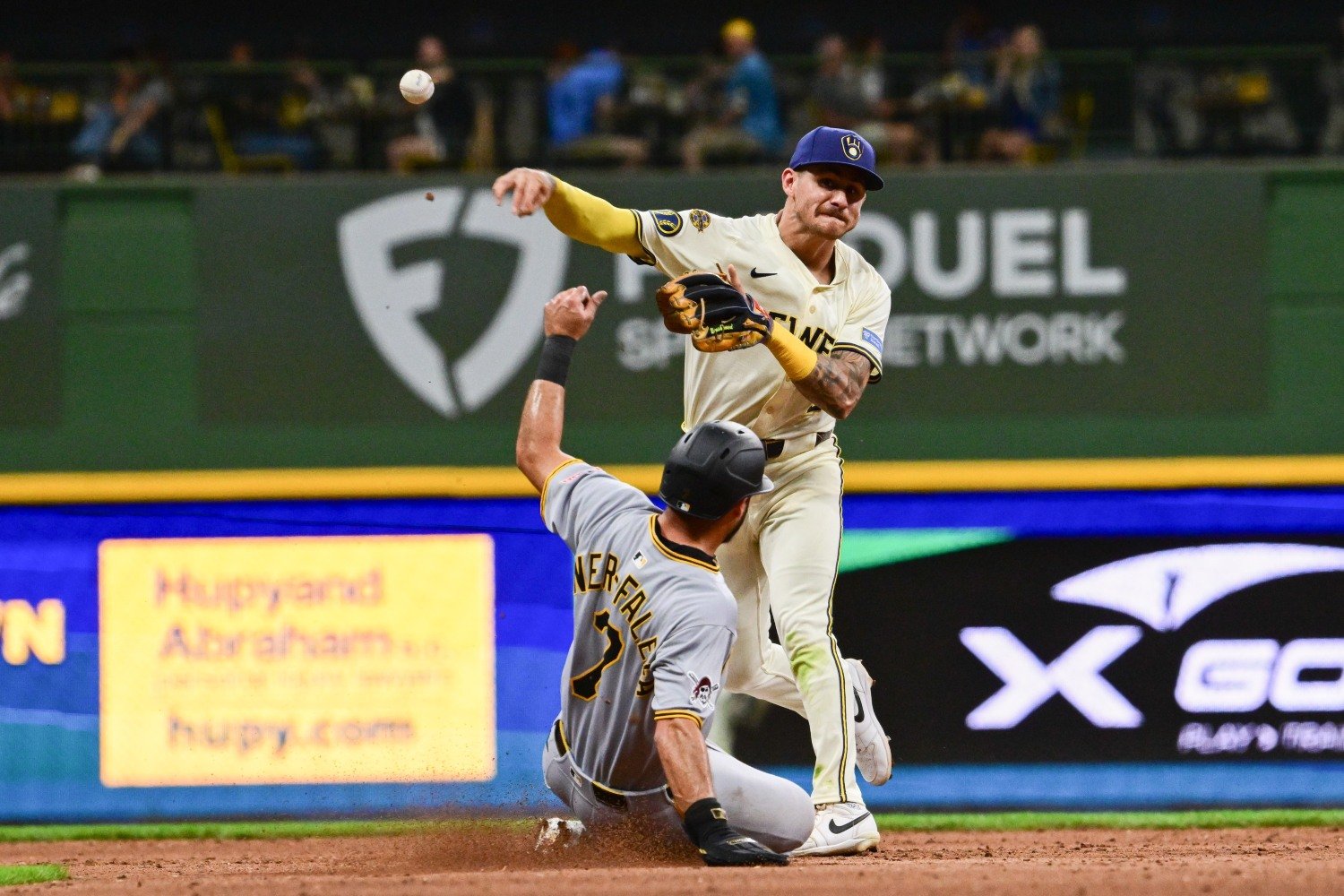 All season long, Brewers personnel have been quick to praise Joey Ortiz's defense. While some in the front office still think highly of his offensive potential, it's his glove that has earned him a long leash as the starting shortstop, despite a 69 wRC+ that ranks second-to-last among qualified hitters. Public defensive metrics have been more divided in their evaluation. Through July, Statcast's Fielding Run Value graded Ortiz as +6 runs above average on the season, which ranked sixth among qualified shortstops. Defensive Runs Saved, meanwhile, had him bottoming out at -7 runs, and Baseball Prospectus had him at -1.9 Defensive Runs Prevented. Since the start of August, though, Ortiz has been undeniably fantastic in the field. All three metrics agree that he's been one of baseball's better defensive shortstops over the last six weeks. He quickly worked his way back to an effectively neutral -1 DRS and 0 DRP and is up to an FRV of +10 runs. Brewers infield coach Matt Erickson said some metrics dinged Ortiz early in the year because he was not completing more challenging plays. The club's internal model classifies plays by out probability based on the lateral range required of an infielder to complete them. Those with an out probability between 30% and 70% are considered "50/50 plays," and Ortiz rarely recorded outs on the most difficult opportunities. "Like 12 of those 15 [plays] were from 30 to 40 percent, where he was diving, making plays, getting up, dropping the exchange, ruled a hit," Erickson said. "Diving one way, making a throw, guy just beats it. So of the 50/50 plays that he was getting, they were on the extreme, tougher end, but he wasn't converting many of those. Now, over the course of the second half, he's gotten more opportunities, and he's made a bunch more 50/50 plays, which has brought that number back up." Erickson did not cite specific plays, but there are plenty from the first half that fit the description. Here's an attempt on May 3 where Ortiz dove to knock down a grounder in the hole, but the transfer was neither clean nor quick enough for his throw to beat Chicago Cubs catcher Carson Kelly. ortiz_dive.mp4 Two weeks later, Ortiz laid out the other way for an impressive stop up the middle, but he couldn't collect the ball to make a throw. ortiz_dive2.mp4 Of the public defensive tools, Baseball Prospectus's models best illustrate Ortiz's in-season evolution as a defender. They separately track how many batted balls above or below average an infielder reaches (Attempt Range) and how well he executes that range to record outs (Range Outs Made). Split Attempt Range Range Outs Made Reaches on Fielded GBs March-July 1.0 -2.6 28 Aug-Sept 9.7 2.6 3 Off the bat, the two metrics, plus the number of batters who reached base on ground balls he fielded, support the notion that Ortiz was getting to enough balls in the first half, but not recording the out. They also reveal that he turned things around not just by completing more of those plays, but mostly by significantly improving his range. Ortiz moves gracefully and naturally on the dirt, with exceptional coordination. His movements aren't very quick or explosive, though. On many plays in the first half, including in the clips above, he looked smooth but slow. The Brewers' model says his initial burst toward ground balls off the bat is among the worst in their infield, so improving in that area became a focus to help him make more rangy plays. "Over the course of the year, he's done things like worked on his lateral range," Erickson said. "He's changed his prep stuff a few different times. He's tried to be more efficient with that. That's a number that is as slow as anybody on our team in the infield, but it's improving over time, so I think that's helped him make more plays and get to more balls." He has also seen Ortiz's anticipation improve over time, in his first season as a big-league shortstop. The best infielders use experience and the information surrounding them to deduce where and how a ball will be hit, giving themselves a head start on properly approaching it and saving precious milliseconds on difficult bang-bang plays. "You can see his engagement getting better," Erickson said. "His physical skills are what they are, but his mental engagement—using the PitchCom, anticipating what pitch is being thrown, knowing his pitchers a little bit more now with experience, and knowing where balls come off the bat, whether they're right-handed or left-handed [hitters]—anticipating some of that, I think, is what he's really improved on, which is helping him make more plays." Ortiz's glove was his calling card as a prospect, and he flashed the ingredients of an elite defensive shortstop as soon as he debuted with the Brewers, but his fielding value did not match his reputation early in the year. It does now. As Milwaukee sets its eyes on a deep postseason run, Ortiz will remain pivotal to keeping runs off the board. "When you look at him play shortstop, there's absolute trust from the coaching staff and his teammates that he's a quality shortstop and he's going to make plays," Erickson said.
 -
Image courtesy of © Michael McLoone-Imagn Images With 13 games remaining in the regular season, the Brewers find themselves in an excellent position in the standings. They boast the best record by two games and hold a 6.5-game lead over the Chicago Cubs in the NL Central. Milwaukee became the first team in baseball to clinch a playoff berth this weekend, and FanGraphs' playoff odds give the team a 97.8% chance of notching a first-round bye to the NLDS. Pat Murphy doesn't want to hear any of that, particularly when the Brewers still have some work ahead of them. They returned home after a three-game sweep at the hands of the Texas Rangers. Those games and a hard-fought extra-innings win against the St. Louis Cardinals on Saturday reinforced that having the math on their side doesn't mean punching that Division Series ticket will be easy. "When we start looking ahead or planning or coasting, we have an uphill battle," Murphy said. "Every team on our [remaining] schedule can beat us. That's been proven." "We've done some good things," said Christian Yelich, "but there's definitely things we can do better and clean up and kind of get back on track with where we want to be heading into the postseason." With the Brewers' favorable standing in the playoff race comes the challenge of striking a delicate balance. They would be well-served using the rest of September to keep key players healthy and audition others for potential October roles, but they cannot lose their competitive edge. It's not a switch they can freely toggle off and on based on the situation. It's hard to imagine a Murphy-led team running into that issue. While he acknowledged the Brewers are closely monitoring players' health – a banged-up Sal Frelick has gotten more days off lately, and Freddy Peralta and Brandon Woodruff have had starts pushed back – he doesn't sound like a manager planning to ease off the gas pedal down the stretch, particularly during games. "We've come too far by playing, 'Win tonight,'" he said. "It's been, 'Win tonight,' every time. Now, are we being very mindful of health? Yes. But it's, 'Win tonight.'" Murphy's well-known aggression in pursuit of winning was on display Friday night. Rather than turn to one of his lower-leverage relievers, he still brought Aaron Ashby into a four-run game behind Quinn Priester to keep things under control. Whether that's the best approach nightly, especially with several hard-worked relievers, remains debatable, but Murphy has demonstrated that he has no issue pushing the envelope if his arms say they feel strong enough to keep going. His message to his players as October nears: remember what got you this far, and don't let up. "People all predicted we were going to be .500 or under," Murphy said. "The reason people predicted that is because we've proven we're way better as a team – playing as a team, playing together, acquiring bases, winning the moment, winning the pitch. We're way better like that. We're not built like some of these championship teams are built." They answered that call on Saturday. In what has become typical Brewers fashion, they clawed back against the St. Louis bullpen with a series of disciplined plate appearances and well-placed hits, culminating in Andruw Monasterio's walk-off single. "I want to be in the playoffs, trying to make it to a World Series, trying to win," Monasterio said. "That's the first thought. Our only goal is to win the World Series." "Making the playoffs is huge," said Jacob Misiorowski, "but we want a little bit more." View full article
-
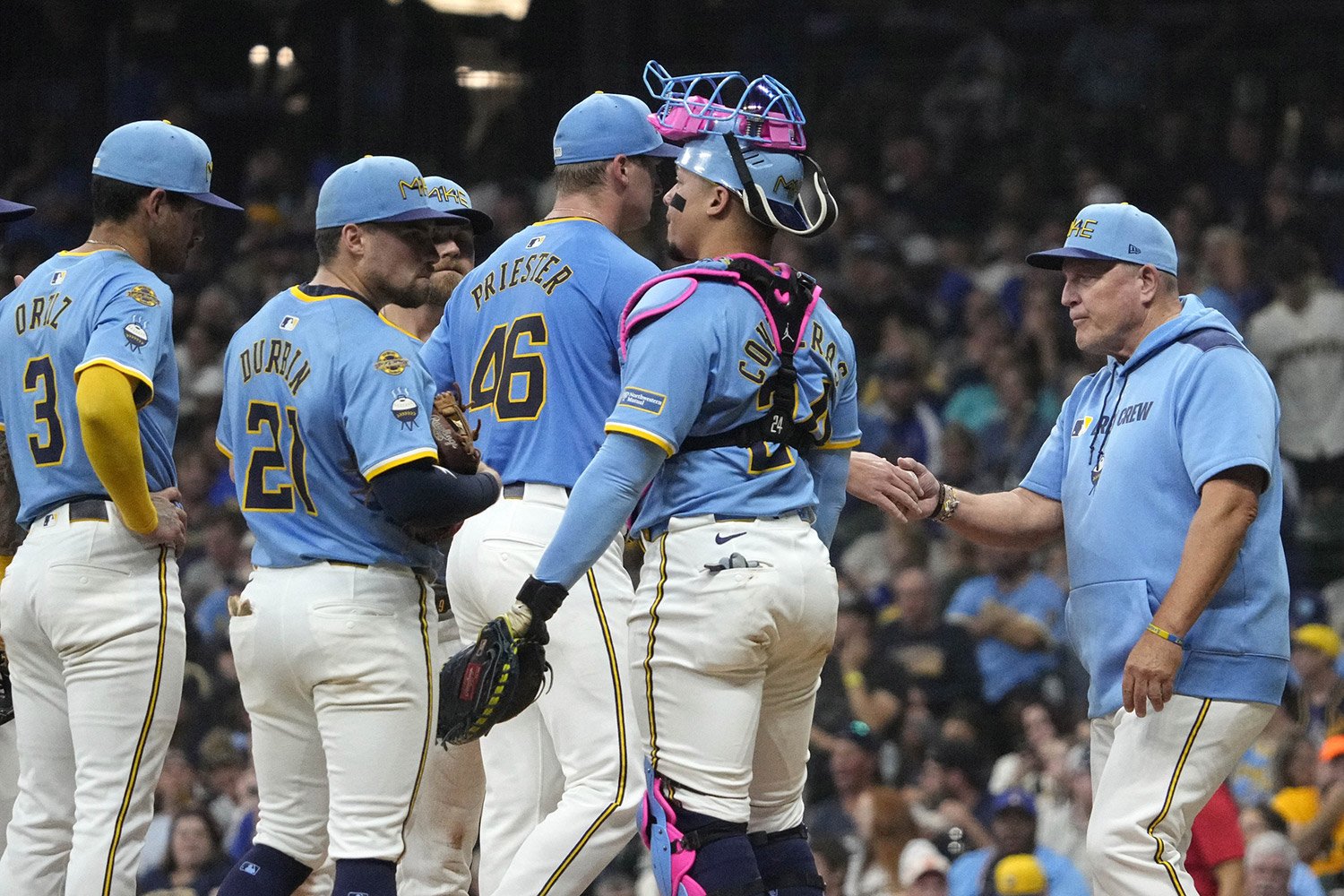 With 13 games remaining in the regular season, the Brewers find themselves in an excellent position in the standings. They boast the best record by two games and hold a 6.5-game lead over the Chicago Cubs in the NL Central. Milwaukee became the first team in baseball to clinch a playoff berth this weekend, and FanGraphs' playoff odds give the team a 97.8% chance of notching a first-round bye to the NLDS. Pat Murphy doesn't want to hear any of that, particularly when the Brewers still have some work ahead of them. They returned home after a three-game sweep at the hands of the Texas Rangers. Those games and a hard-fought extra-innings win against the St. Louis Cardinals on Saturday reinforced that having the math on their side doesn't mean punching that Division Series ticket will be easy. "When we start looking ahead or planning or coasting, we have an uphill battle," Murphy said. "Every team on our [remaining] schedule can beat us. That's been proven." "We've done some good things," said Christian Yelich, "but there's definitely things we can do better and clean up and kind of get back on track with where we want to be heading into the postseason." With the Brewers' favorable standing in the playoff race comes the challenge of striking a delicate balance. They would be well-served using the rest of September to keep key players healthy and audition others for potential October roles, but they cannot lose their competitive edge. It's not a switch they can freely toggle off and on based on the situation. It's hard to imagine a Murphy-led team running into that issue. While he acknowledged the Brewers are closely monitoring players' health – a banged-up Sal Frelick has gotten more days off lately, and Freddy Peralta and Brandon Woodruff have had starts pushed back – he doesn't sound like a manager planning to ease off the gas pedal down the stretch, particularly during games. "We've come too far by playing, 'Win tonight,'" he said. "It's been, 'Win tonight,' every time. Now, are we being very mindful of health? Yes. But it's, 'Win tonight.'" Murphy's well-known aggression in pursuit of winning was on display Friday night. Rather than turn to one of his lower-leverage relievers, he still brought Aaron Ashby into a four-run game behind Quinn Priester to keep things under control. Whether that's the best approach nightly, especially with several hard-worked relievers, remains debatable, but Murphy has demonstrated that he has no issue pushing the envelope if his arms say they feel strong enough to keep going. His message to his players as October nears: remember what got you this far, and don't let up. "People all predicted we were going to be .500 or under," Murphy said. "The reason people predicted that is because we've proven we're way better as a team – playing as a team, playing together, acquiring bases, winning the moment, winning the pitch. We're way better like that. We're not built like some of these championship teams are built." They answered that call on Saturday. In what has become typical Brewers fashion, they clawed back against the St. Louis bullpen with a series of disciplined plate appearances and well-placed hits, culminating in Andruw Monasterio's walk-off single. "I want to be in the playoffs, trying to make it to a World Series, trying to win," Monasterio said. "That's the first thought. Our only goal is to win the World Series." "Making the playoffs is huge," said Jacob Misiorowski, "but we want a little bit more."
- 1 comment
-
- 1
-
-
- pat murphy
- christian yelich
- (and 4 more)
-
Image courtesy of © Charles LeClaire-Imagn Images Pat Murphy has already explained—multiple times—why the Brewers gave Anthony Seigler starts at third base over Caleb Durbin, who has posted a solid 102 wRC+ with strong defense as a rookie. They like Seigler's swing decisions and penchant for hitting line drives, and they don't believe his results reflect the quality of his plate appearances. Liking Seigler is only half the equation, though. He wouldn't have gotten those starts had the Brewers not felt Durbin profiled poorly in certain right-on-right matchups. Murphy has been more coy when asked about that half of the decision-making. Durbin has a clear platoon split, posting a 119 wRC+ against left-handers compared to a 97 wRC+ against righties. That's still capable production against same-handed pitchers, though. Furthermore, the third base situation has not been a strict platoon. Since Seigler's debut on July 2, Durbin has started there in 26 of the Brewers' 42 games against a right-handed starter, while Seigler started at third in 16, plus a start as the DH. Rather than shielding Durbin from all right-handed pitchers, the Brewers have mostly withheld him from facing ones with low arm slots. Seigler started over him against these pitchers: Game Pitcher Arm Angle 7/02 @ NYM Clay Holmes 43.6 7/02 @ NYM Huascar Brazobán 36.2 7/13 vs. WSN Jake Irvin 27.0 7/21 @ SEA George Kirby 29.3 7/23 @ SEA Luis Castillo 14.9 7/29 vs. CHC Colin Rea 30.5 8/02 @ WSN Jake Irvin 27.0 8/03 @ WSN Brad Lord 19.8 8/04 @ ATL Erick Fedde 35.1 8/06 @ ATL Spencer Strider 42.0 8/09 vs. NYM Reed Garrett 33.9 8/13 vs. PIT Mitch Keller 37.9 8/20 @ CHC Colin Rea 30.5 8/23 vs SFG Logan Webb 22.2 8/26 vs. ARI Brandon Pfaadt 27.1 9/03 vs. PHI Aaron Nola 19.7 Fourteen of those 16 right-handers have an average arm angle lower than 40 degrees. According to Baseball Savant, Durbin has slashed .211/.308/.325 against right-handed pitches from those arm angles. Instead, he's started mostly against righties with arm angles of 40° or higher, against whom he's hitting .251/.327/.382. Since Seigler's debut, the right-handed starters he's faced have had an average arm angle of 28°. In Durbin's starts, it's been 42°. Seigler is likely to return to Triple-A as the corresponding move for Rhys Hoskins's return on Tuesday afternoon, which could mean more opportunities for Durbin against low-slot righties. It seemed that way when he started against Johan Oviedo (26° arm angle) and Mitch Keller (38°) in Pittsburgh. However, Murphy previewed a new wrinkle at third base on Monday night, hitting Isaac Collins for Durbin against Jacob Webb (34°) in the eighth inning in Texas. Collins, a former minor-league utility man who has played almost exclusively in the outfield in the majors, finished the game at third. Collins only played 13 games at the hot corner in the minors. Before Monday, his big-league experience consisted of one-third of an inning in a walk-off loss in St. Louis in April. He's continued doing pregame infield work, though, and Murphy said last month that the club had discussed the possibility of playing him more on the dirt moving forward. More time at third base would also keep Collins in the lineup regularly after Hoskins's return. To open the DH spot to get Hoskins and Andrew Vaughn in the same lineup, Christian Yelich will likely spend more time in left field down the stretch. While the Brewers cannot go on cruise control, their 7.5-game lead for a first-round postseason bye gives them some wiggle room to test new alignments ahead of October. View full article
- 3 replies
-
- 1
-
-
- caleb durbin
- anthony seigler
- (and 2 more)
-
 Pat Murphy has already explained—multiple times—why the Brewers gave Anthony Seigler starts at third base over Caleb Durbin, who has posted a solid 102 wRC+ with strong defense as a rookie. They like Seigler's swing decisions and penchant for hitting line drives, and they don't believe his results reflect the quality of his plate appearances. Liking Seigler is only half the equation, though. He wouldn't have gotten those starts had the Brewers not felt Durbin profiled poorly in certain right-on-right matchups. Murphy has been more coy when asked about that half of the decision-making. Durbin has a clear platoon split, posting a 119 wRC+ against left-handers compared to a 97 wRC+ against righties. That's still capable production against same-handed pitchers, though. Furthermore, the third base situation has not been a strict platoon. Since Seigler's debut on July 2, Durbin has started there in 26 of the Brewers' 42 games against a right-handed starter, while Seigler started at third in 16, plus a start as the DH. Rather than shielding Durbin from all right-handed pitchers, the Brewers have mostly withheld him from facing ones with low arm slots. Seigler started over him against these pitchers: Game Pitcher Arm Angle 7/02 @ NYM Clay Holmes 43.6 7/02 @ NYM Huascar Brazobán 36.2 7/13 vs. WSN Jake Irvin 27.0 7/21 @ SEA George Kirby 29.3 7/23 @ SEA Luis Castillo 14.9 7/29 vs. CHC Colin Rea 30.5 8/02 @ WSN Jake Irvin 27.0 8/03 @ WSN Brad Lord 19.8 8/04 @ ATL Erick Fedde 35.1 8/06 @ ATL Spencer Strider 42.0 8/09 vs. NYM Reed Garrett 33.9 8/13 vs. PIT Mitch Keller 37.9 8/20 @ CHC Colin Rea 30.5 8/23 vs SFG Logan Webb 22.2 8/26 vs. ARI Brandon Pfaadt 27.1 9/03 vs. PHI Aaron Nola 19.7 Fourteen of those 16 right-handers have an average arm angle lower than 40 degrees. According to Baseball Savant, Durbin has slashed .211/.308/.325 against right-handed pitches from those arm angles. Instead, he's started mostly against righties with arm angles of 40° or higher, against whom he's hitting .251/.327/.382. Since Seigler's debut, the right-handed starters he's faced have had an average arm angle of 28°. In Durbin's starts, it's been 42°. Seigler is likely to return to Triple-A as the corresponding move for Rhys Hoskins's return on Tuesday afternoon, which could mean more opportunities for Durbin against low-slot righties. It seemed that way when he started against Johan Oviedo (26° arm angle) and Mitch Keller (38°) in Pittsburgh. However, Murphy previewed a new wrinkle at third base on Monday night, hitting Isaac Collins for Durbin against Jacob Webb (34°) in the eighth inning in Texas. Collins, a former minor-league utility man who has played almost exclusively in the outfield in the majors, finished the game at third. Collins only played 13 games at the hot corner in the minors. Before Monday, his big-league experience consisted of one-third of an inning in a walk-off loss in St. Louis in April. He's continued doing pregame infield work, though, and Murphy said last month that the club had discussed the possibility of playing him more on the dirt moving forward. More time at third base would also keep Collins in the lineup regularly after Hoskins's return. To open the DH spot to get Hoskins and Andrew Vaughn in the same lineup, Christian Yelich will likely spend more time in left field down the stretch. While the Brewers cannot go on cruise control, their 7.5-game lead for a first-round postseason bye gives them some wiggle room to test new alignments ahead of October.
- 3 comments
-
- 1
-
-
- caleb durbin
- anthony seigler
- (and 2 more)
-
Image courtesy of © Patrick Gorski-Imagn Images Most hitters across baseball are at least somewhat streaky. It’s a reality of attempting perhaps the hardest task in professional sports nightly throughout a 162-game season. Even so, the Jake Bauers experience is a rollercoaster. In his two seasons with the Brewers, the part-time first baseman has typically bounced between ice-cold slumps and red-hot stretches without many spans of okay offense. Bauers is seemingly emerging from the low point of his performance cycle into one of those hot streaks. Entering the Brewers’ series against the Pittsburgh Pirates at PNC Park, he was 3 for his last 41, a stretch that was interrupted by a month-long stay on the injured list. Given more starts lately while Christian Yelich nurses a back flare-up, he has since gone 5-for-8 with a home run. Two of those swings were pivotal in Milwaukee victories – a go-ahead sixth-inning single on Friday night, and a two-run blast to open the scoring on Saturday. Those performances were a reminder of Bauers’s potential when things are clicking and why the Brewers have continued to roster him, even as his overall output has been unremarkable. His 2025 slash line now sits at .205/.324/.363 (95 wRC+), and his .347 xwOBA and 109 DRC+ indicate he’s performed like an above-average hitter process-wise. Swing-and-miss issues – including vulnerabilities to high fastballs and low-and-in breaking balls – remain the greatest wart in the veteran’s profile and partially why he’s so streaky. However, his swing decisions, bat speed, and raw power compensate for the whiffs so long as he keeps his strikeouts from ballooning out of control. Split Chase% Heart Swing% Bat Speed (mph) Barrel% Sweet Spot% xwOBAcon Bauers 19.9% 75.4% 76.6 13.0% 37.0% .450 MLB Average 28.1% 72.0% 71.8 8.6% 34.1% .380 Because he rarely chases outside the strike zone, Bauers’s 14.5% walk rate this season has carried him to an above-average 0.47 walk-to-strikeout ratio despite a 30.6% strikeout rate that borders on just enough balls in play to make his profile work. He swings hard and hits the ball sharply and on a line when he makes contact. It’s a recipe that can carry a lineup for a couple of weeks, just as Bauers did with an .841 OPS through June 1 while much of a struggling Milwaukee offense searched for its footing. It can also be useful off the bench in the right matchups and produce a big swing at a moment’s notice – his pinch-hit go-ahead home run in Game 3 of last year’s Wild Card Series was not as improbable as it may have seemed. There’s a reason why the Brewers are letting Rhys Hoskins’s rehab clock run its course in Triple-A, even as Hoskins has looked ready to return for at least a week. It’s because they still see a role for Bauers, who cannot be optioned to the minor leagues, and do not want to cut ties with any of their depth until roster rules force their hand. Bauers could be the casualty when Hoskins returns later this week, but it would not be surprising if the club optioned Anthony Seigler or even a slumping Andrew Vaughn to keep him around through the regular season and into the playoffs. View full article
-
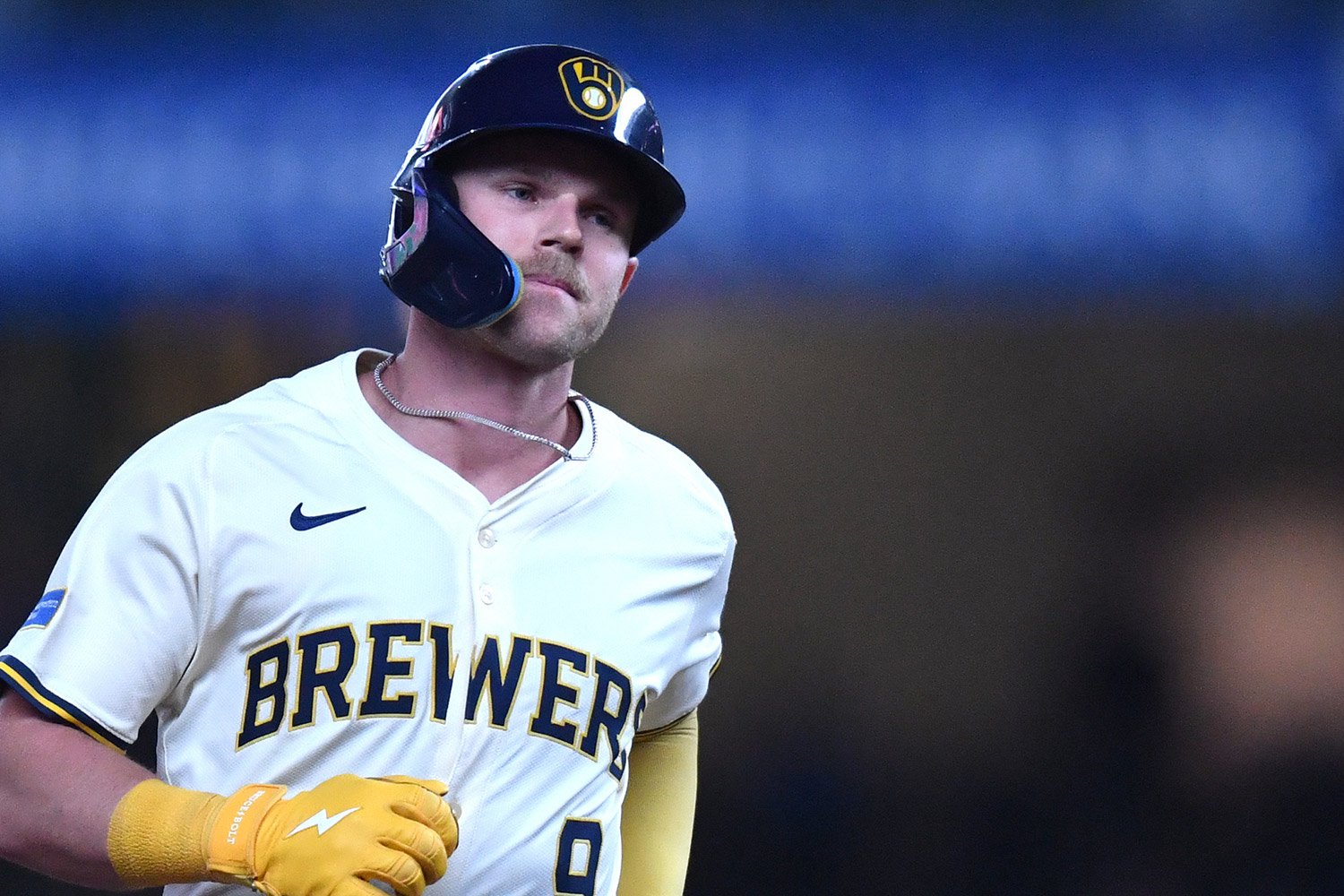 Most hitters across baseball are at least somewhat streaky. It’s a reality of attempting perhaps the hardest task in professional sports nightly throughout a 162-game season. Even so, the Jake Bauers experience is a rollercoaster. In his two seasons with the Brewers, the part-time first baseman has typically bounced between ice-cold slumps and red-hot stretches without many spans of okay offense. Bauers is seemingly emerging from the low point of his performance cycle into one of those hot streaks. Entering the Brewers’ series against the Pittsburgh Pirates at PNC Park, he was 3 for his last 41, a stretch that was interrupted by a month-long stay on the injured list. Given more starts lately while Christian Yelich nurses a back flare-up, he has since gone 5-for-8 with a home run. Two of those swings were pivotal in Milwaukee victories – a go-ahead sixth-inning single on Friday night, and a two-run blast to open the scoring on Saturday. Those performances were a reminder of Bauers’s potential when things are clicking and why the Brewers have continued to roster him, even as his overall output has been unremarkable. His 2025 slash line now sits at .205/.324/.363 (95 wRC+), and his .347 xwOBA and 109 DRC+ indicate he’s performed like an above-average hitter process-wise. Swing-and-miss issues – including vulnerabilities to high fastballs and low-and-in breaking balls – remain the greatest wart in the veteran’s profile and partially why he’s so streaky. However, his swing decisions, bat speed, and raw power compensate for the whiffs so long as he keeps his strikeouts from ballooning out of control. Split Chase% Heart Swing% Bat Speed (mph) Barrel% Sweet Spot% xwOBAcon Bauers 19.9% 75.4% 76.6 13.0% 37.0% .450 MLB Average 28.1% 72.0% 71.8 8.6% 34.1% .380 Because he rarely chases outside the strike zone, Bauers’s 14.5% walk rate this season has carried him to an above-average 0.47 walk-to-strikeout ratio despite a 30.6% strikeout rate that borders on just enough balls in play to make his profile work. He swings hard and hits the ball sharply and on a line when he makes contact. It’s a recipe that can carry a lineup for a couple of weeks, just as Bauers did with an .841 OPS through June 1 while much of a struggling Milwaukee offense searched for its footing. It can also be useful off the bench in the right matchups and produce a big swing at a moment’s notice – his pinch-hit go-ahead home run in Game 3 of last year’s Wild Card Series was not as improbable as it may have seemed. There’s a reason why the Brewers are letting Rhys Hoskins’s rehab clock run its course in Triple-A, even as Hoskins has looked ready to return for at least a week. It’s because they still see a role for Bauers, who cannot be optioned to the minor leagues, and do not want to cut ties with any of their depth until roster rules force their hand. Bauers could be the casualty when Hoskins returns later this week, but it would not be surprising if the club optioned Anthony Seigler or even a slumping Andrew Vaughn to keep him around through the regular season and into the playoffs.
- 3 comments
-
- 1
-
-
- jake bauers
- rhys hoskins
- (and 2 more)
-
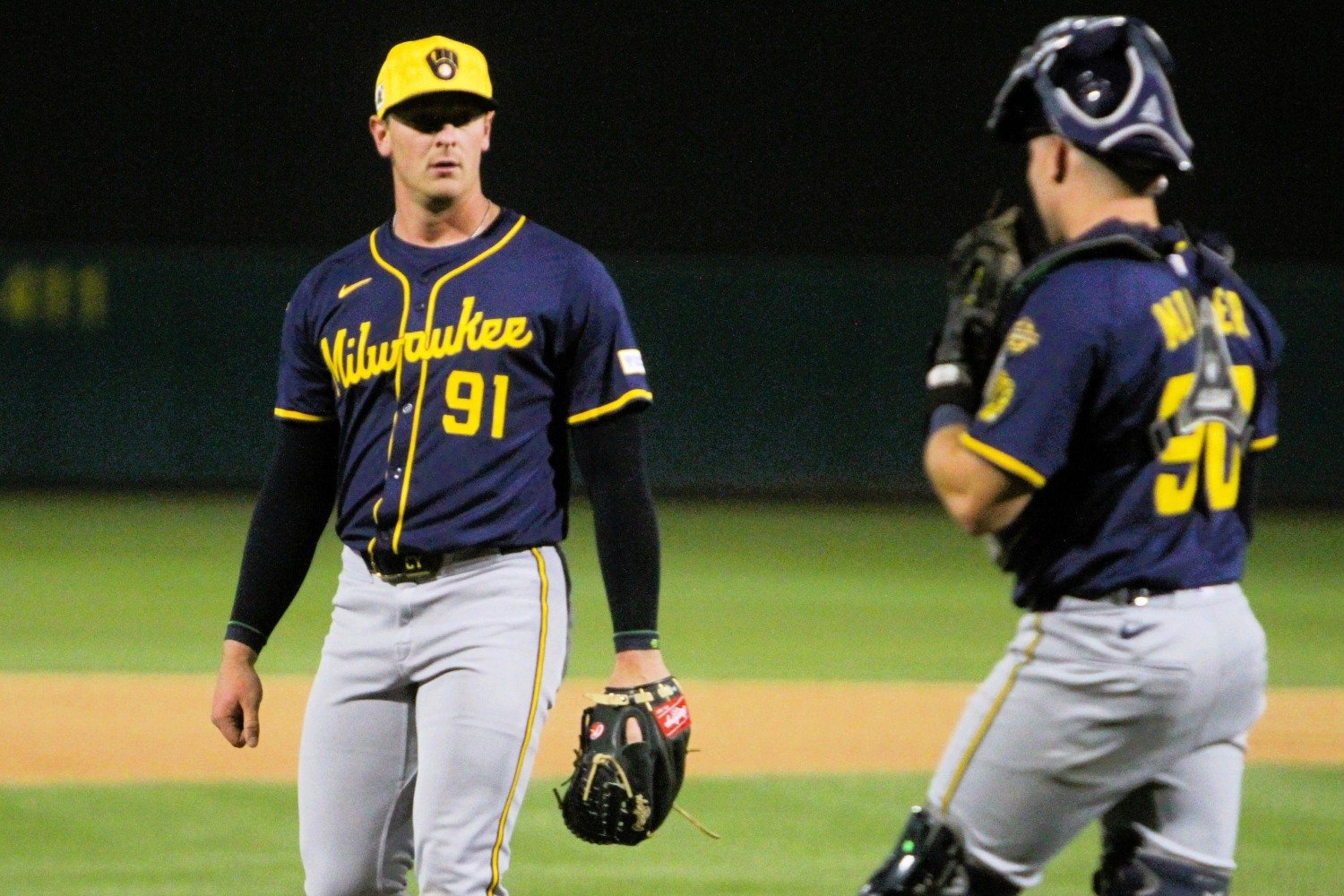 Craig Yoho’s first big-league season has not aligned with his minor-league dominance. After blazing through the Brewers’ farm system with a 1.34 ERA, 1.75 FIP, and 41.1% strikeout rate in his first 60 1/3 professional innings, the 25-year-old has pitched to an 8.22 ERA, 7.44 FIP, and 13.2% strikeout rate in just 7 2/3 MLB frames. Yoho has bounced between the Brewers and the Triple-A Nashville Sounds throughout the year; his promotion on September 1 was his fourth of the season. Since his inaugural cup of coffee in the majors in April, his focus back in the minors has become more development-oriented. “As you're kind of moving up the ranks, you're so focused on results,” Yoho said. “You feel like you have to pitch perfectly in order to get promotions and get from High-A to Double-A, Double-A to Triple-A. But getting up here, you see what the game’s like, you see what the big-league level is. Now I can go down, and I don't feel like I have to necessarily pitch perfectly. I can start working on things I need to work on.” One of the things Yoho had to work on was making more competitive pitches, an issue that plagued his first few big-league stints. He has thrown a below-average 43.1% of his total offerings in the strike zone, and opposing hitters have chased just 20.2% of his out-of-zone pitches, leading to a 23.7% walk rate. Because his pitches have so much movement, free bases will always be part of a tradeoff for Yoho, who should rack up enough strikeouts to work around them. Devin Williams and Aaron Ashby have found success in Milwaukee with similar high-walk, high-strikeout profiles. However, Yoho’s misses were too frequent, too severe, and easy for hitters to take for balls. Last month in Nashville, he made a series of changes to improve on that front, starting with moving across the pitching rubber. Finding the best starting position has been a game of trial-and-error for Yoho. For most of his professional career, he pitched from the third-base side of the rubber to create the most uncomfortable angle for right-handed hitters. After experimenting with pitching to left-handers from the first-base side, Yoho migrated there full-time in August. “I was so used to being on the third-base side of the rubber that all of a sudden a lefty would be up, I'd be two pitches in, and I'd be on the wrong side of the rubber,” he said. “So just trying to get more comfortable, it was like, ‘Let's just move to the first base side a little bit.’ My toe kind of starts right in the middle of the rubber now, and it's just helped my pitches stay on the plate longer. I actually probably get more visual movement to hitters, rather than kind of working against my movement.” In addition to helping Yoho’s screwball-like changeup (which averages 18 inches of arm-side movement) stay in the strike zone longer as it fades, sliding over also gave him more plate to work with. “It basically just kind of opens up the plate,” he said. “So instead of me trying to throw at an angle and cut the plate, it basically gives me a wider target now to hit. I felt like it's kind of opened up how I can move on the mound, too, just not having to be so perfect.” More recently, Yoho replaced his big curveball, which averaged nearly 20 inches of horizontal break and 10 inches of induced drop, with a new slider he labels a “baby sweeper.” Since debuting this version of his breaking ball, he’s thrown it nearly twice as often (16.5%) as he threw the curveball (9.4%). The curveball popped out of Yoho’s hand at release and separated early from his other pitches. He threw it in the strike zone only 20.1% of the time in Triple-A. The shorter breaking ball looks more like a fastball out of his hand, and he has thrown 42.9% of them in the strike zone. “With the bigger curveball that I threw, there was a pop to it, I guess is the best way to describe it,” Yoho said. “This one tracks more [like a] heater out of hand, which is nice. And with it being a relatively new pitch, I have a pretty good feel for it already, which is awesome. So just that little smaller movement helps with that.” If Yoho’s stuff starts playing at the big-league level, it would be a boon to a beleaguered Brewers’ bullpen that was already short Trevor Megill, DL Hall, and Grant Anderson before losing trade deadline acquisition Shelby Miller to a season-ending UCL injury. “Just give my 100% for that day,” Yoho said of his mentality after a season of ups and downs. “I don't need to try 150%. It's just let my talent that's gotten me here just take control and go compete. Just getting that mindset back is obviously the biggest thing.”
 -
Image courtesy of © Curt Hogg / USA TODAY NETWORK via Imagn Images Craig Yoho’s first big-league season has not aligned with his minor-league dominance. After blazing through the Brewers’ farm system with a 1.34 ERA, 1.75 FIP, and 41.1% strikeout rate in his first 60 1/3 professional innings, the 25-year-old has pitched to an 8.22 ERA, 7.44 FIP, and 13.2% strikeout rate in just 7 2/3 MLB frames. Yoho has bounced between the Brewers and the Triple-A Nashville Sounds throughout the year; his promotion on September 1 was his fourth of the season. Since his inaugural cup of coffee in the majors in April, his focus back in the minors has become more development-oriented. “As you're kind of moving up the ranks, you're so focused on results,” Yoho said. “You feel like you have to pitch perfectly in order to get promotions and get from High-A to Double-A, Double-A to Triple-A. But getting up here, you see what the game’s like, you see what the big-league level is. Now I can go down, and I don't feel like I have to necessarily pitch perfectly. I can start working on things I need to work on.” One of the things Yoho had to work on was making more competitive pitches, an issue that plagued his first few big-league stints. He has thrown a below-average 43.1% of his total offerings in the strike zone, and opposing hitters have chased just 20.2% of his out-of-zone pitches, leading to a 23.7% walk rate. Because his pitches have so much movement, free bases will always be part of a tradeoff for Yoho, who should rack up enough strikeouts to work around them. Devin Williams and Aaron Ashby have found success in Milwaukee with similar high-walk, high-strikeout profiles. However, Yoho’s misses were too frequent, too severe, and easy for hitters to take for balls. Last month in Nashville, he made a series of changes to improve on that front, starting with moving across the pitching rubber. Finding the best starting position has been a game of trial-and-error for Yoho. For most of his professional career, he pitched from the third-base side of the rubber to create the most uncomfortable angle for right-handed hitters. After experimenting with pitching to left-handers from the first-base side, Yoho migrated there full-time in August. “I was so used to being on the third-base side of the rubber that all of a sudden a lefty would be up, I'd be two pitches in, and I'd be on the wrong side of the rubber,” he said. “So just trying to get more comfortable, it was like, ‘Let's just move to the first base side a little bit.’ My toe kind of starts right in the middle of the rubber now, and it's just helped my pitches stay on the plate longer. I actually probably get more visual movement to hitters, rather than kind of working against my movement.” In addition to helping Yoho’s screwball-like changeup (which averages 18 inches of arm-side movement) stay in the strike zone longer as it fades, sliding over also gave him more plate to work with. “It basically just kind of opens up the plate,” he said. “So instead of me trying to throw at an angle and cut the plate, it basically gives me a wider target now to hit. I felt like it's kind of opened up how I can move on the mound, too, just not having to be so perfect.” More recently, Yoho replaced his big curveball, which averaged nearly 20 inches of horizontal break and 10 inches of induced drop, with a new slider he labels a “baby sweeper.” Since debuting this version of his breaking ball, he’s thrown it nearly twice as often (16.5%) as he threw the curveball (9.4%). The curveball popped out of Yoho’s hand at release and separated early from his other pitches. He threw it in the strike zone only 20.1% of the time in Triple-A. The shorter breaking ball looks more like a fastball out of his hand, and he has thrown 42.9% of them in the strike zone. “With the bigger curveball that I threw, there was a pop to it, I guess is the best way to describe it,” Yoho said. “This one tracks more [like a] heater out of hand, which is nice. And with it being a relatively new pitch, I have a pretty good feel for it already, which is awesome. So just that little smaller movement helps with that.” If Yoho’s stuff starts playing at the big-league level, it would be a boon to a beleaguered Brewers’ bullpen that was already short Trevor Megill, DL Hall, and Grant Anderson before losing trade deadline acquisition Shelby Miller to a season-ending UCL injury. “Just give my 100% for that day,” Yoho said of his mentality after a season of ups and downs. “I don't need to try 150%. It's just let my talent that's gotten me here just take control and go compete. Just getting that mindset back is obviously the biggest thing.” View full article
-
Danny Jansen and the Brewers Have Already Gone to Work on His Receiving
Jack Stern posted an article in Brewers
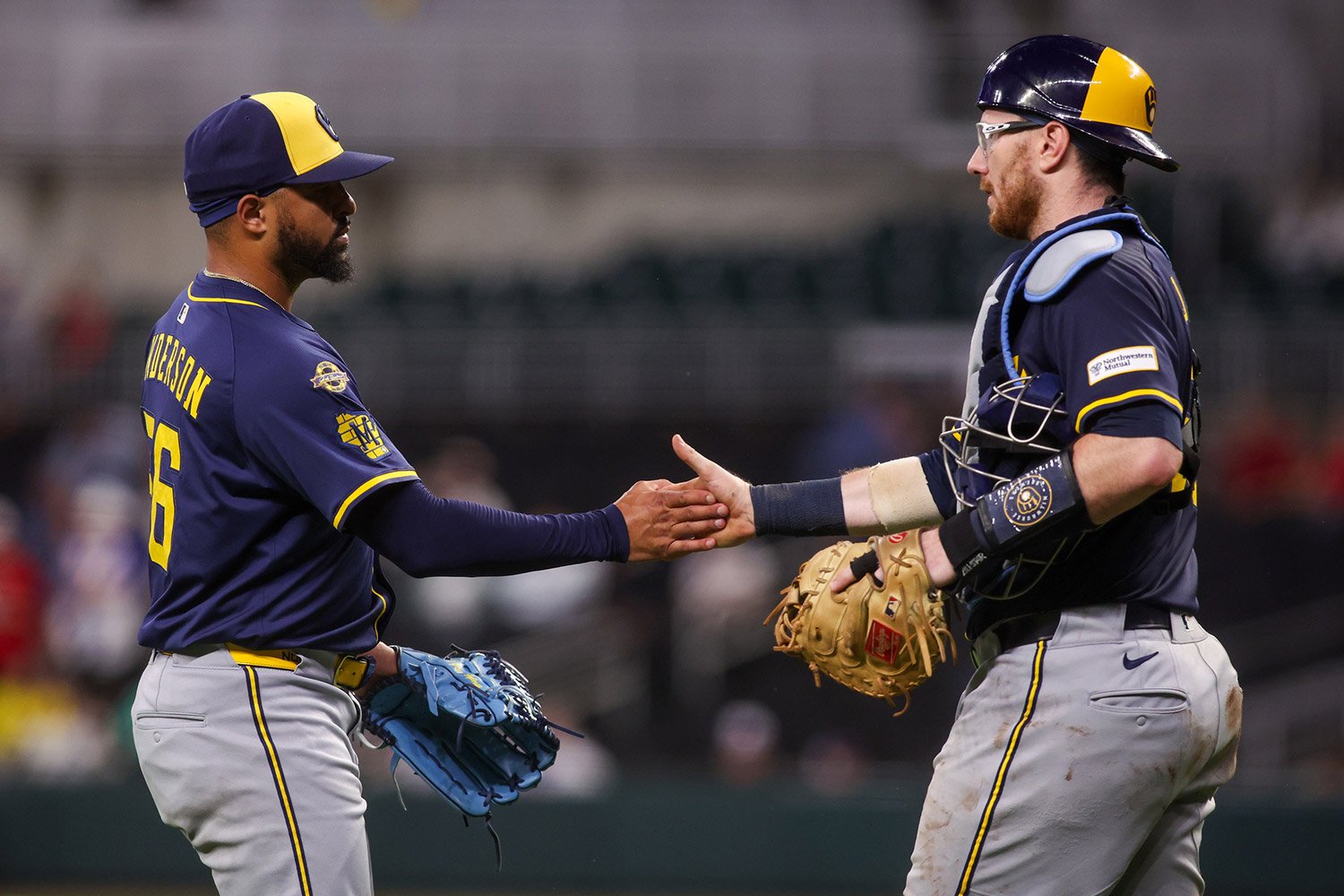 After his pitch framing fell to career lows last season, improved receiving was a focus for Danny Jansen heading into 2025. Baseball Savant, which uses Statcast pitch tracking to capture framing data, ranked him in the 21st percentile of catchers with -4 runs. "The goal is to try to improve on the balls at the bottom of the zone," he said. "I feel like the last couple years, I've been pretty good on the top of the zone and to my left a little bit, but struggled at the bottom." The numbers back it up. Jansen notched 1 framing run around the third-base edge and a palatable -1 run around the top, but -4 runs around the bottom. Catching with one knee on the ground has become the standard stance across baseball in recent years, but Jansen was one of the few to remain in the traditional squat with both knees up. Looking to get closer to the ground for the low pitch, he made the switch to a knee-down stance midway through this year's spring training with the Tampa Bay Rays. "I was a bit stubborn before giving it a shot with the one knee stuff," he said, "but just looking at how the game's kind of changed and how it's going, I think it was a good choice to go down to it." Public metrics saw no improvement in his receiving, though. When the Brewers acquired Jansen the week of the trade deadline, he was at -9 framing runs on the year, including -6 around the bottom of the zone. Here's how he looked behind the plate at that time: jansen_rays_frame_june.mp4 Jansen's glove was too noisy as it hovered around the zone. He would briefly lower it mid-pitch, trying to work underneath and through the ball, only to bring that glove up and over the low pitch as he caught it. Those issues prevented him from properly presenting the pitch to the umpire. "He was trying to catch the ball at the bottom the same way he would catch it at the top," said Brewers Major League field coordinator Nestor Corredor, who works extensively with catchers as one of his many duties on the staff. "Instead of going over, we want to go underneath." Before Jansen arrived in Milwaukee, Corredor and the rest of the catching brass studied video to identify his strengths, weaknesses, and potential tweaks to his setup and mechanics. They saw potential for a better receiver. "We noticed that he always had good hands, but he doesn't know how to use them," Corredor said. "That was the baseline." Early in the year with the Rays, Jansen tried dropping his glove all the way to the ground mid-pitch so that he could work underneath the ball more naturally. It didn't work. Corredor suggested he go back to the glove drop, but with a new wrinkle. "He said, 'Hey, you want to try this?'" Jansen recalled. "Never really forcing my hand, but just more of a trial, just to kind of see what we got." "He was like, 'Well, I did that in Tampa. It didn't work,'" Corredor said. "I said, 'How did you do it?' So he showed me. I said, 'Well, listen, let's try [starting] from the bottom. Start with a bit of a new routine, try to get the glove down, and then work through the baseball and see what happens.'" Many of the Brewers' recent framing success stories, including Omar Narvaez, William Contreras, and Eric Haase, stood under six feet tall with more compact body types, so they could maintain good control of their catching arm while sitting still behind the plate. Eliminating unnecessary movement in their setups made their receiving more precise and created a more natural-looking presentation. For Jansen, who is listed at 6-foot-1 and 240 pounds, the Brewers had to take a different approach. They believed his wider frame gave him more room to make pitches look like strikes and that trying to keep still was counterproductive. Rather than eliminating movement, they decided that constant, controlled, and rhythmic motion would best help Jansen use his hands effectively throughout the zone, not just at the top. "I think the catching group here, we did a good job because we didn't take him away from his strengths," Corredor said. "We tried working around his strengths." With the Rays, Jansen stopped moving when his glove hit the ground. His hand then stabbed over the top of the ball as it came back up, resulting in poorly presented low pitches like this one: jansen_rays_frame.mp4 With the Brewers, he has started dropping the glove and swiping it across the dirt before bringing it back up. The rhythmic motion is supposed to help Jansen receive and present the ball more naturally, as he did with this Nick Mears fastball to the same location: jansen_frame_brewers.mp4 "I've definitely attempted going to the ground with my glove, and I think that for me, just figuring out with some work that I kind of have to have some rhythm on the ground," Jansen said. "So [the glove swipe is] really just to kind of keep moving instead of being still." The sample size is still too small to tell if it's working, as Jansen has only caught 10 games since the trade. In that time, his overall strike rate around the edges of the zone has bumped from 38.2% to 41.2%, but his percentage on takes around the bottom is nearly identical. He and the Brewers think he's trending in the right direction, though. "I felt like there was some progress right off the bat, so I'm just trying to ride that out," Jansen said. "With him, it was easier because he was open-minded to change, and he was all-in to try and do something new," Corredor said. "So that's been the key. Now, the more comfortable he gets, the better he gets."
-
- 3
-
-
- danny jansen
- nestor corredor
- (and 2 more)
-
Image courtesy of © Brett Davis-Imagn Images After his pitch framing fell to career lows last season, improved receiving was a focus for Danny Jansen heading into 2025. Baseball Savant, which uses Statcast pitch tracking to capture framing data, ranked him in the 21st percentile of catchers with -4 runs. "The goal is to try to improve on the balls at the bottom of the zone," he said. "I feel like the last couple years, I've been pretty good on the top of the zone and to my left a little bit, but struggled at the bottom." The numbers back it up. Jansen notched 1 framing run around the third-base edge and a palatable -1 run around the top, but -4 runs around the bottom. Catching with one knee on the ground has become the standard stance across baseball in recent years, but Jansen was one of the few to remain in the traditional squat with both knees up. Looking to get closer to the ground for the low pitch, he made the switch to a knee-down stance midway through this year's spring training with the Tampa Bay Rays. "I was a bit stubborn before giving it a shot with the one knee stuff," he said, "but just looking at how the game's kind of changed and how it's going, I think it was a good choice to go down to it." Public metrics saw no improvement in his receiving, though. When the Brewers acquired Jansen the week of the trade deadline, he was at -9 framing runs on the year, including -6 around the bottom of the zone. Here's how he looked behind the plate at that time: jansen_rays_frame_june.mp4 Jansen's glove was too noisy as it hovered around the zone. He would briefly lower it mid-pitch, trying to work underneath and through the ball, only to bring that glove up and over the low pitch as he caught it. Those issues prevented him from properly presenting the pitch to the umpire. "He was trying to catch the ball at the bottom the same way he would catch it at the top," said Brewers Major League field coordinator Nestor Corredor, who works extensively with catchers as one of his many duties on the staff. "Instead of going over, we want to go underneath." Before Jansen arrived in Milwaukee, Corredor and the rest of the catching brass studied video to identify his strengths, weaknesses, and potential tweaks to his setup and mechanics. They saw potential for a better receiver. "We noticed that he always had good hands, but he doesn't know how to use them," Corredor said. "That was the baseline." Early in the year with the Rays, Jansen tried dropping his glove all the way to the ground mid-pitch so that he could work underneath the ball more naturally. It didn't work. Corredor suggested he go back to the glove drop, but with a new wrinkle. "He said, 'Hey, you want to try this?'" Jansen recalled. "Never really forcing my hand, but just more of a trial, just to kind of see what we got." "He was like, 'Well, I did that in Tampa. It didn't work,'" Corredor said. "I said, 'How did you do it?' So he showed me. I said, 'Well, listen, let's try [starting] from the bottom. Start with a bit of a new routine, try to get the glove down, and then work through the baseball and see what happens.'" Many of the Brewers' recent framing success stories, including Omar Narvaez, William Contreras, and Eric Haase, stood under six feet tall with more compact body types, so they could maintain good control of their catching arm while sitting still behind the plate. Eliminating unnecessary movement in their setups made their receiving more precise and created a more natural-looking presentation. For Jansen, who is listed at 6-foot-1 and 240 pounds, the Brewers had to take a different approach. They believed his wider frame gave him more room to make pitches look like strikes and that trying to keep still was counterproductive. Rather than eliminating movement, they decided that constant, controlled, and rhythmic motion would best help Jansen use his hands effectively throughout the zone, not just at the top. "I think the catching group here, we did a good job because we didn't take him away from his strengths," Corredor said. "We tried working around his strengths." With the Rays, Jansen stopped moving when his glove hit the ground. His hand then stabbed over the top of the ball as it came back up, resulting in poorly presented low pitches like this one: jansen_rays_frame.mp4 With the Brewers, he has started dropping the glove and swiping it across the dirt before bringing it back up. The rhythmic motion is supposed to help Jansen receive and present the ball more naturally, as he did with this Nick Mears fastball to the same location: jansen_frame_brewers.mp4 "I've definitely attempted going to the ground with my glove, and I think that for me, just figuring out with some work that I kind of have to have some rhythm on the ground," Jansen said. "So [the glove swipe is] really just to kind of keep moving instead of being still." The sample size is still too small to tell if it's working, as Jansen has only caught 10 games since the trade. In that time, his overall strike rate around the edges of the zone has bumped from 38.2% to 41.2%, but his percentage on takes around the bottom is nearly identical. He and the Brewers think he's trending in the right direction, though. "I felt like there was some progress right off the bat, so I'm just trying to ride that out," Jansen said. "With him, it was easier because he was open-minded to change, and he was all-in to try and do something new," Corredor said. "So that's been the key. Now, the more comfortable he gets, the better he gets." View full article
-
Brewers Still Showing 'Resiliency' Amid Marathon Stretch of Games
Jack Stern posted an article in Brewers
 The second half of August has been a grind for the Brewers. Amid a stretch of 19 games in 18 days, they’ve looked recently like a team running on fumes. Their defense hasn’t been nearly as sharp as it usually is. Their bullpen is stretched thin. On top of it all, the luck-based regression that loomed as nearly everything went right during a 14-game winning streak has started to hit. “Guys are tired and banged up,” Pat Murphy said on Tuesday night. For the second straight night, the Brewers jumped out to an early 6-0 lead against the Arizona Diamondbacks Tuesday, only for shaky defense and pitching to cede much of that breathing room and create late-inning drama. An Andrew Vaughn misplay in the fourth inning contributed to an eventual Gabriel Moreno three-run home run off Jacob Misiorowski. Tobias Myers and Jared Koenig, thrust into multi-inning duty with Trevor Megill, Abner Uribe, and Nick Mears off-limits, combined to allow five runs without much help in the field. And yet, as they have throughout most of the year, the Brewers made it out with a win by refusing to quit. Andruw Monasterio, filling in at shortstop for the injured Joey Ortiz, made a clunky-looking but pivotal diving stop in the top of the ninth to help Shelby Miller through a scoreless inning. William Contreras led off the bottom half with a single, and Christian Yelich and Vaughn worked walks to load the bases. That set the stage for Isaac Collins, who misplayed a Corbin Carroll would-be flyout into a double with Koenig on the mound an inning prior, to drive in the winning run with a walk-off sacrifice fly. “I thought we showed tremendous poise and resiliency,” Murphy said. “I'm going to hand it to the guys, man, the at-bats in the last inning.” “Resiliency is the best way to describe it,” Collins said. “We're on a stretch here of [19] games in [18] days, whatever it is. So to be able to get a win like tonight in the middle of that stretch is just a testament to the type of guys we have here.” Those guys have been a mix of younger players who have grown from experience and outcasts who have taken advantage of opportunities. Murphy noted pregame on Tuesday that Sal Frelick and Brice Turang, who continued his August power binge with another home run, are transitioning from inexperienced players to veterans, an observation he revisited hours later. “You look at the guys that do have some veteran status in Frelick, Yelich, Contreras, Turang—those guys have stepped up, and the other guys are scrapping. They're doing whatever.” It’s not the first time a Murphy team has refused to back down from challenges. It was a theme last year. Now it’s helped the Brewers go 7-6 so far in this stretch, and a palatable 5-6 since their franchise-record 14 straight wins ending on August 16. “I can't tell you how proud I am of the way they compete,” Murphy said. “That's all they can do. They can't make plays that they can't make. They can't be expected to never make a mistake.” “There’s no quit at all. They don't take plays off,” Miller said. “It's like that every day. I think the guys come in ready to play, so it's a fun group to be a part of, for sure.” The Brewers are not out of the woods yet. A marathon August continues. After a close loss Wednesday night, they have one more game against the Diamondbacks and three games in Toronto against the Blue Jays, who boast the second-best record in the American League. Until a much-needed off day, all they can do is remain resilient.
 -
Image courtesy of © Katie Stratman-Imagn Images The second half of August has been a grind for the Brewers. Amid a stretch of 19 games in 18 days, they’ve looked recently like a team running on fumes. Their defense hasn’t been nearly as sharp as it usually is. Their bullpen is stretched thin. On top of it all, the luck-based regression that loomed as nearly everything went right during a 14-game winning streak has started to hit. “Guys are tired and banged up,” Pat Murphy said on Tuesday night. For the second straight night, the Brewers jumped out to an early 6-0 lead against the Arizona Diamondbacks Tuesday, only for shaky defense and pitching to cede much of that breathing room and create late-inning drama. An Andrew Vaughn misplay in the fourth inning contributed to an eventual Gabriel Moreno three-run home run off Jacob Misiorowski. Tobias Myers and Jared Koenig, thrust into multi-inning duty with Trevor Megill, Abner Uribe, and Nick Mears off-limits, combined to allow five runs without much help in the field. And yet, as they have throughout most of the year, the Brewers made it out with a win by refusing to quit. Andruw Monasterio, filling in at shortstop for the injured Joey Ortiz, made a clunky-looking but pivotal diving stop in the top of the ninth to help Shelby Miller through a scoreless inning. William Contreras led off the bottom half with a single, and Christian Yelich and Vaughn worked walks to load the bases. That set the stage for Isaac Collins, who misplayed a Corbin Carroll would-be flyout into a double with Koenig on the mound an inning prior, to drive in the winning run with a walk-off sacrifice fly. “I thought we showed tremendous poise and resiliency,” Murphy said. “I'm going to hand it to the guys, man, the at-bats in the last inning.” “Resiliency is the best way to describe it,” Collins said. “We're on a stretch here of [19] games in [18] days, whatever it is. So to be able to get a win like tonight in the middle of that stretch is just a testament to the type of guys we have here.” Those guys have been a mix of younger players who have grown from experience and outcasts who have taken advantage of opportunities. Murphy noted pregame on Tuesday that Sal Frelick and Brice Turang, who continued his August power binge with another home run, are transitioning from inexperienced players to veterans, an observation he revisited hours later. “You look at the guys that do have some veteran status in Frelick, Yelich, Contreras, Turang—those guys have stepped up, and the other guys are scrapping. They're doing whatever.” It’s not the first time a Murphy team has refused to back down from challenges. It was a theme last year. Now it’s helped the Brewers go 7-6 so far in this stretch, and a palatable 5-6 since their franchise-record 14 straight wins ending on August 16. “I can't tell you how proud I am of the way they compete,” Murphy said. “That's all they can do. They can't make plays that they can't make. They can't be expected to never make a mistake.” “There’s no quit at all. They don't take plays off,” Miller said. “It's like that every day. I think the guys come in ready to play, so it's a fun group to be a part of, for sure.” The Brewers are not out of the woods yet. A marathon August continues. After a close loss Wednesday night, they have one more game against the Diamondbacks and three games in Toronto against the Blue Jays, who boast the second-best record in the American League. Until a much-needed off day, all they can do is remain resilient. View full article
-
Image courtesy of © Katie Stratman-Imagn Images When the Brewers brought the winning run to the plate with two outs against San Francisco Giants reliever Ryan Walker on Sunday, Pat Murphy pinch-hit left-handed-hitting Anthony Seigler for Caleb Durbin—who had hit a go-ahead home run earlier in the game and has three walk-off plate appearances this year. Seigler took four pitches outside the strike zone, but a high strike call on the first pitch contributed to an eventual strikeout. That dropped his season slash to .208/.317/.208. Yet, he has continued to receive key plate appearances against right-handed pitchers. While not in a straight platoon with Durbin at third base, Seigler has taken more of what were once his starts against righties. The box score results have not been pretty, but it's been a small sample of 64 plate appearances, and the Brewers have been impressed by the process of his at-bats. "I don't know about you," Murphy said at the start of the weekend, "but I look up at the board and I see his—what do you call it?—his [slash] line, and I'm like, 'Is that right?' Because it seems like it's been a lot more successful than his line is." The metrics agree. Seigler's .335 xwOBA and 102 DRC+ are both a few ticks above the league averages, suggesting his plate appearances have been much better process-wise than his results. He is swinging at the right pitches and hitting plenty of solid line drives, skills that are typically conducive to big-league success. His run value on swings is negative in the graphic below because of his poor results, but Seigler's swing decisions have been excellent. He is selective, but not passive. According to Statcast, he has chased just 16.3% of pitches outside the zone, while offering at pitches over the heart of the plate at an above-average rate. That discernment has fueled a strong 12.5% walk rate, against an 18.8% strikeout rate. While he has not shown much pop, Seigler's combination of a league-average hard hit rate, above-average contact rate, and elite sweet spot rate (batted balls hit with a launch angle between 8 and 32 degrees) should lead to more success than he has experienced so far. "We think that he's given us enough results, meaning we know what he's capable of," Murphy said. "He's capable of consistent contact. He's capable of ball-striking it. And the most important thing he's capable of is that he's not intimidated by the moment, and that's what always impressed me the most. Here's a guy that's never been in the big leagues, and he acts like he's been here. His presence at the dish, he acts like he's been here. "It's just one of those things where I think he's proven to me that he's got a spot here." Several of this season's role players, including Isaac Collins and Brice Turang, owe much of their success to swing decisions and hitting the ball at the right trajectory. Seigler features those same attributes. That's why he has usurped Durbin in certain spots against right-handers—including on Sunday against Walker, whose deceptive crossfire delivery has held righties to a .567 OPS this year. "Seigler's got a knack for getting on base in big situations," Murphy said after the game. "Durbin is not a good matchup for that guy. The few weaknesses Durbin has, that's not a good matchup." It may raise eyebrows, but the Brewers have valid reasons for believing in Seigler. If the results do not improve over time or his at-bats worsen, they will have to reevaluate. That time has not yet arrived, though. Nor should it do so for at least a few more weeks. "I think he and Durbin kind of give us a nice combination there, and we want to stick to that," Murphy said. View full article
-
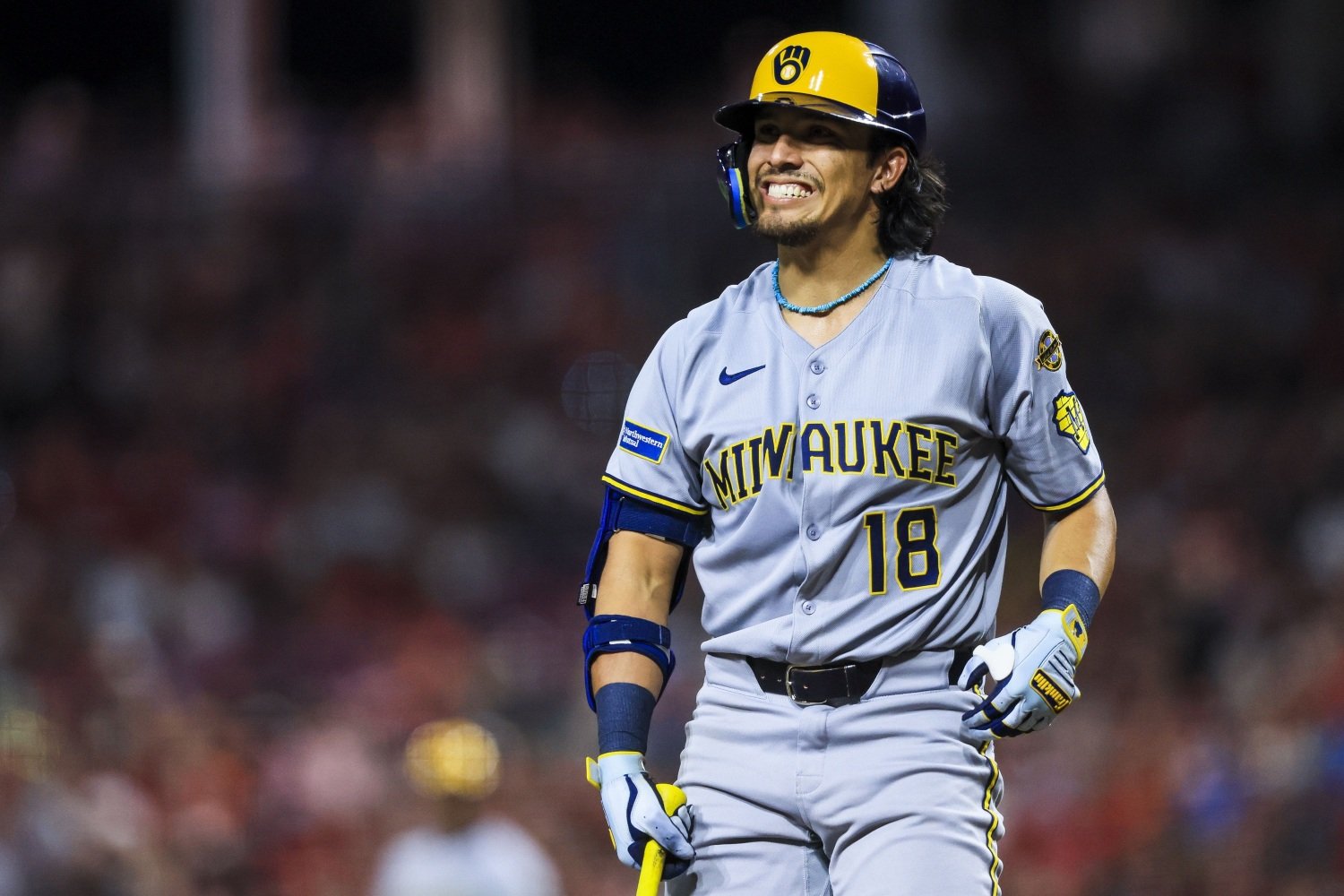 When the Brewers brought the winning run to the plate with two outs against San Francisco Giants reliever Ryan Walker on Sunday, Pat Murphy pinch-hit left-handed-hitting Anthony Seigler for Caleb Durbin—who had hit a go-ahead home run earlier in the game and has three walk-off plate appearances this year. Seigler took four pitches outside the strike zone, but a high strike call on the first pitch contributed to an eventual strikeout. That dropped his season slash to .208/.317/.208. Yet, he has continued to receive key plate appearances against right-handed pitchers. While not in a straight platoon with Durbin at third base, Seigler has taken more of what were once his starts against righties. The box score results have not been pretty, but it's been a small sample of 64 plate appearances, and the Brewers have been impressed by the process of his at-bats. "I don't know about you," Murphy said at the start of the weekend, "but I look up at the board and I see his—what do you call it?—his [slash] line, and I'm like, 'Is that right?' Because it seems like it's been a lot more successful than his line is." The metrics agree. Seigler's .335 xwOBA and 102 DRC+ are both a few ticks above the league averages, suggesting his plate appearances have been much better process-wise than his results. He is swinging at the right pitches and hitting plenty of solid line drives, skills that are typically conducive to big-league success. His run value on swings is negative in the graphic below because of his poor results, but Seigler's swing decisions have been excellent. He is selective, but not passive. According to Statcast, he has chased just 16.3% of pitches outside the zone, while offering at pitches over the heart of the plate at an above-average rate. That discernment has fueled a strong 12.5% walk rate, against an 18.8% strikeout rate. While he has not shown much pop, Seigler's combination of a league-average hard hit rate, above-average contact rate, and elite sweet spot rate (batted balls hit with a launch angle between 8 and 32 degrees) should lead to more success than he has experienced so far. "We think that he's given us enough results, meaning we know what he's capable of," Murphy said. "He's capable of consistent contact. He's capable of ball-striking it. And the most important thing he's capable of is that he's not intimidated by the moment, and that's what always impressed me the most. Here's a guy that's never been in the big leagues, and he acts like he's been here. His presence at the dish, he acts like he's been here. "It's just one of those things where I think he's proven to me that he's got a spot here." Several of this season's role players, including Isaac Collins and Brice Turang, owe much of their success to swing decisions and hitting the ball at the right trajectory. Seigler features those same attributes. That's why he has usurped Durbin in certain spots against right-handers—including on Sunday against Walker, whose deceptive crossfire delivery has held righties to a .567 OPS this year. "Seigler's got a knack for getting on base in big situations," Murphy said after the game. "Durbin is not a good matchup for that guy. The few weaknesses Durbin has, that's not a good matchup." It may raise eyebrows, but the Brewers have valid reasons for believing in Seigler. If the results do not improve over time or his at-bats worsen, they will have to reevaluate. That time has not yet arrived, though. Nor should it do so for at least a few more weeks. "I think he and Durbin kind of give us a nice combination there, and we want to stick to that," Murphy said.
 -
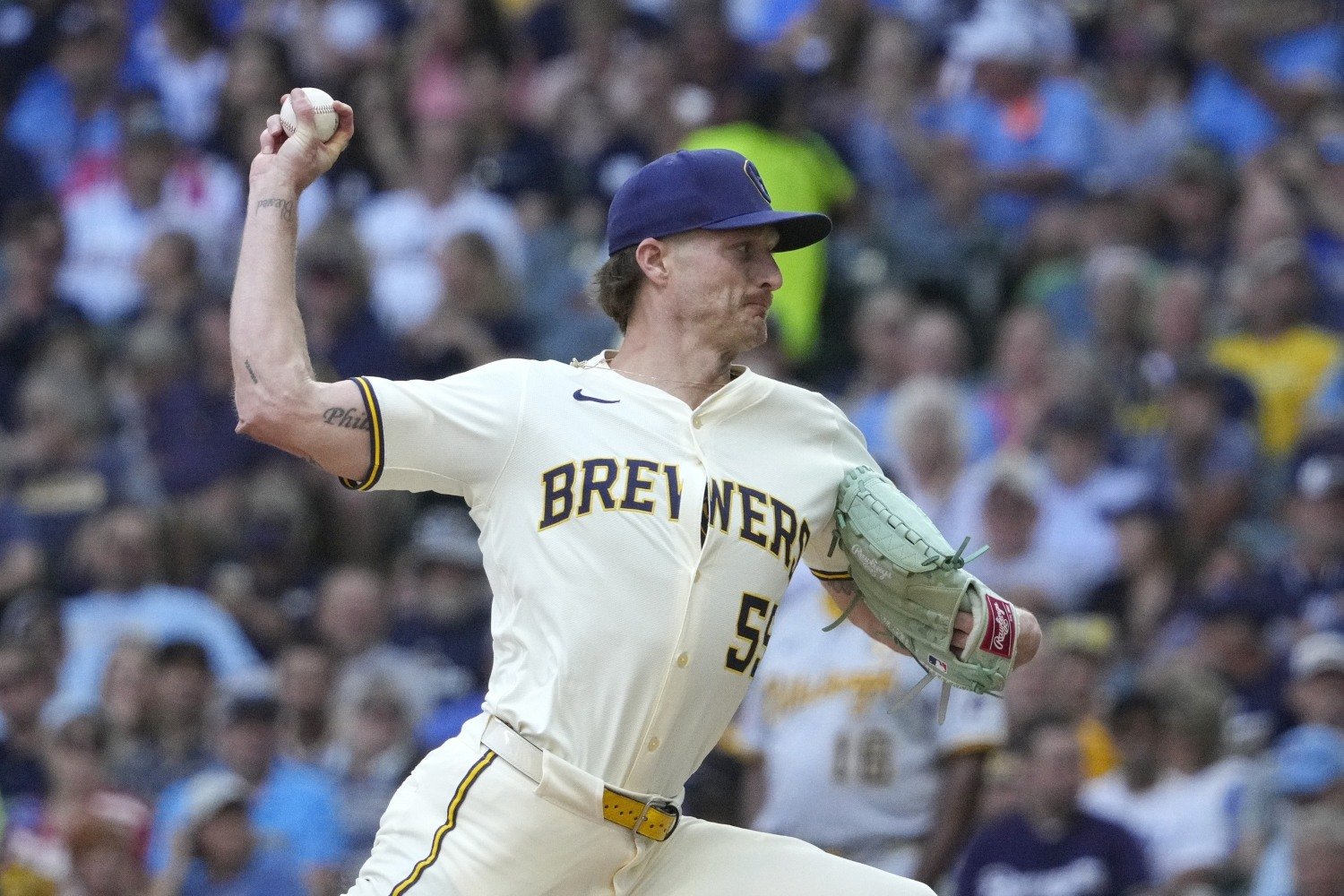 Shelby Miller's tenure with the Brewers is off to an inconsistent start, at least in the box score. After allowing a solo home run to Chicago Cubs rookie Owen Caissie at Wrigley Field on Tuesday, the 34-year-old has allowed four runs in 4 2/3 innings and has been scored on in two of five appearances. It initially appeared that Miller would provide some needed relief for the Brewers' existing late-inning arms, who shouldered heavily workloads through July. Instead, Pat Murphy has used him mostly in low-leverage situations, preferring to give Miller what he deemed "a little softer landing" after returning from a forearm strain and joining a new team at the trade deadline. It sounds like that process of working him in remains ongoing. "He's only [had five] outings since early July, so he hasn't pitched a lot," Murphy said on Tuesday. "He didn't know exactly what his role is right now, and it's hard for him—new team, all that kind of stuff." It might be tempting to draw parallels between Miller's first five outings and the Brewers' poor track record with trade deadline bullpen acquisitions since Drew Pomeranz in 2019. It's too early to assume he will join that list, though. On a pitch-to-pitch basis, Miller has not been dissimilar from the guy who served as the Arizona Diamondbacks' closer before the deadline, posting a 1.96 ERA and 3.12 SIERA. While the home run pitch in his latest outing was an important mistake—William Contreras called for another splitter, Miller said, but he shook to a fastball and missed his spot—he struck out the other three hitters he faced, inducing 7 whiffs out of 11 swings. "I think that's the only bad pitch I threw in that inning, and some damage was done," Miller reflected. "Other than that, I was on the corners below the zone and made some pretty good pitches." "I thought he threw the ball good," Murphy said. "He'd like to have that one pitch back, but credit the hitter. The hitter did a hell of a job. He hit a ball 110 miles an hour to left center." Most of the damage against Miller came in a three-run blowup in Milwaukee last week, in which his command faltered. His fastball, splitter, and sweeper are coming in at their usual velocities and shapes, and his arsenal is still getting plenty of the swings it's supposed to. For the most part, hitters have not looked all that comfortable against him. Team Chase% Whiff% FB StuffPro FS StuffPro SW StuffPro ARI 35.8% 30.9% -1.1 -1.0 0.0 MIL 30.5% 39.0% -1.1 -0.6 -0.5 "The one in Milwaukee, I was more sporadic, not throwing a lot of strikes," Miller said. "But outside of that outing, I've been feeling really good, and the stuff's been there." Those deeper metrics are descriptive, not predictive. If Miller's inconsistent early results snowball into consistently worse command and sequencing, he will face lasting consequences. At this moment, however, it's not time to panic. He is much closer to where he should be than the surface-level numbers suggest. "Sometimes it takes time to get right," Miller said. "But I feel like I'm really close, and the stuff's definitely there."
 -
Image courtesy of © Michael McLoone-Imagn Images Shelby Miller's tenure with the Brewers is off to an inconsistent start, at least in the box score. After allowing a solo home run to Chicago Cubs rookie Owen Caissie at Wrigley Field on Tuesday, the 34-year-old has allowed four runs in 4 2/3 innings and has been scored on in two of five appearances. It initially appeared that Miller would provide some needed relief for the Brewers' existing late-inning arms, who shouldered heavily workloads through July. Instead, Pat Murphy has used him mostly in low-leverage situations, preferring to give Miller what he deemed "a little softer landing" after returning from a forearm strain and joining a new team at the trade deadline. It sounds like that process of working him in remains ongoing. "He's only [had five] outings since early July, so he hasn't pitched a lot," Murphy said on Tuesday. "He didn't know exactly what his role is right now, and it's hard for him—new team, all that kind of stuff." It might be tempting to draw parallels between Miller's first five outings and the Brewers' poor track record with trade deadline bullpen acquisitions since Drew Pomeranz in 2019. It's too early to assume he will join that list, though. On a pitch-to-pitch basis, Miller has not been dissimilar from the guy who served as the Arizona Diamondbacks' closer before the deadline, posting a 1.96 ERA and 3.12 SIERA. While the home run pitch in his latest outing was an important mistake—William Contreras called for another splitter, Miller said, but he shook to a fastball and missed his spot—he struck out the other three hitters he faced, inducing 7 whiffs out of 11 swings. "I think that's the only bad pitch I threw in that inning, and some damage was done," Miller reflected. "Other than that, I was on the corners below the zone and made some pretty good pitches." "I thought he threw the ball good," Murphy said. "He'd like to have that one pitch back, but credit the hitter. The hitter did a hell of a job. He hit a ball 110 miles an hour to left center." Most of the damage against Miller came in a three-run blowup in Milwaukee last week, in which his command faltered. His fastball, splitter, and sweeper are coming in at their usual velocities and shapes, and his arsenal is still getting plenty of the swings it's supposed to. For the most part, hitters have not looked all that comfortable against him. Team Chase% Whiff% FB StuffPro FS StuffPro SW StuffPro ARI 35.8% 30.9% -1.1 -1.0 0.0 MIL 30.5% 39.0% -1.1 -0.6 -0.5 "The one in Milwaukee, I was more sporadic, not throwing a lot of strikes," Miller said. "But outside of that outing, I've been feeling really good, and the stuff's been there." Those deeper metrics are descriptive, not predictive. If Miller's inconsistent early results snowball into consistently worse command and sequencing, he will face lasting consequences. At this moment, however, it's not time to panic. He is much closer to where he should be than the surface-level numbers suggest. "Sometimes it takes time to get right," Miller said. "But I feel like I'm really close, and the stuff's definitely there." View full article
-
Freddy Peralta is More Adaptable Than Ever, and It's Working
Jack Stern posted an article in Brewers
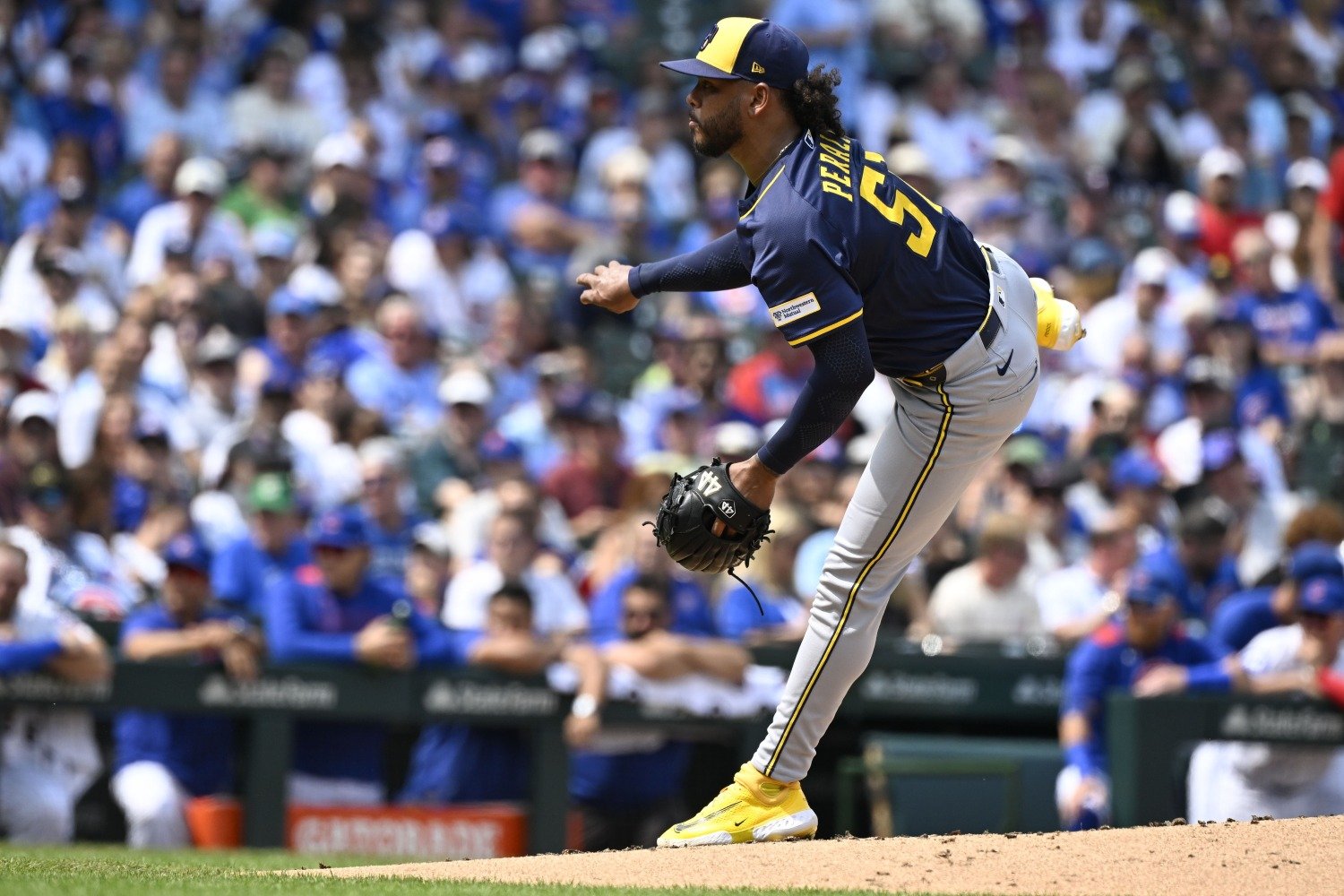 As the Brewers embarked on a five-game series at Wrigley Field against the Chicago Cubs amid a stretch of 19 games in 18 days, the second-longest-tenured member of their pitching staff kicked things off on the right note. Freddy Peralta logged six scoreless innings in the series opener on Monday afternoon. “Just the way he pitched, the way he started, the way he wasn’t willing to give in,” Pat Murphy said. “He just navigated.” The only real blemish in Peralta’s outing was a 30-pitch fourth inning in which he issued three straight walks to load the bases. Even as an eighth-year veteran, he has never consistently cleaned up the non-competitive misses and resulting inefficiency that have kept him from fully reaching his ceiling. His 17.36 pitches per inning this year is still the fifth-worst among qualified starters. However, focusing on that remaining flaw in Peralta’s game unfairly downplays how valuable he’s been. Since the start of 2023, he ranks 13th among 97 qualified pitchers in RA9-WAR. It also overlooks just how much he has evolved throughout his career to become the pitcher he is now. Heavily reliant on a deceptive fastball as a rookie, Peralta has since added over 4 mph of average velocity to his heater and used it less—while developing his secondary pitches. Perhaps the greatest testimony to Peralta’s arsenal development is his changeup. It was virtually nonexistent through his first three seasons. Since he became a full-time starter in 2021, it has gradually emerged as his most consistent secondary pitch. He’s added more consistent arm-side fade to it during that time, maxing out at an average of 16.6 inches this year. “I was going to say, ‘It's a lie. It's not going to be true,’” Peralta said when asked postgame on Monday whether he believed years ago that his changeup would become a linchpin of his pitch mix. “But, you know, it’s part of the game, part of the growth that I can have as a pitcher, and the learning.” Peralta threw his changeup a season-high 32% of the time on Monday, including in a key matchup against Cubs rookie Owen Caissie that helped him escape that fourth-inning jam. He threw five changeups in a seven-pitch at-bat. It induced three whiffs for a strikeout, after which Peralta coaxed an inning-ending lineout to escape the frame unscathed. “We only spoke a little bit about him, and then I just told [catcher Danny Jansen] that I want to be myself with him and read his swing and see what I have working, because I had no idea how I was going to feel facing him in the moment,” Peralta said. “But I told him the changeup and the fastball, the combination was working good.” It was not the first time Peralta had to feel things out in the moment, and developing a four-pitch mix has given him a greater capacity to do so. Instead of being forced to stick to a specific game plan, he has shown an ability to tweak his mix in real time based on scouting reports, the way his pitches are playing, and how his stuff feels out of his hand. His last two starts have exemplified it. Before going heavy on changeups on Monday, Peralta threw his slider 32% of the time in his previous outing, his highest rate in a start since April 25, 2024. That was a departure from using his curveball as his preferred breaking pitch, which had been the case for most of this year. “It’s way different,” he said, comparing his ability to feel his way through certain outings and situations to early in his career. “I'm not going to say that I can expect better results, but I know for sure that it’s way different whenever I'm in those situations. I feel that I have more tools. I feel that I have ways to go, and I don't have to think only of my fastball.” Peralta currently sports a career-low 2.78 ERA, but his peripherals (3.70 FIP, 3.83 SIERA) show that this is not the most dominant he has ever been. This is, however, the most mature and adaptable version of him yet. Deep counts and jams will always be part of the experience, but he is now weathering them with some extra veteran guile. He’s been available and effective, the two most important attributes of a starting pitcher. It's not out of the question that he could win 20 games this year, and while that statistic carries much less weight than it used to, it would be a fitting testament to the mutual importance of team and ace pitcher to one another. Peralta's maturation has mirrored the team's transcendence.
 -
Image courtesy of © Matt Marton-Imagn Images As the Brewers embarked on a five-game series at Wrigley Field against the Chicago Cubs amid a stretch of 19 games in 18 days, the second-longest-tenured member of their pitching staff kicked things off on the right note. Freddy Peralta logged six scoreless innings in the series opener on Monday afternoon. “Just the way he pitched, the way he started, the way he wasn’t willing to give in,” Pat Murphy said. “He just navigated.” The only real blemish in Peralta’s outing was a 30-pitch fourth inning in which he issued three straight walks to load the bases. Even as an eighth-year veteran, he has never consistently cleaned up the non-competitive misses and resulting inefficiency that have kept him from fully reaching his ceiling. His 17.36 pitches per inning this year is still the fifth-worst among qualified starters. However, focusing on that remaining flaw in Peralta’s game unfairly downplays how valuable he’s been. Since the start of 2023, he ranks 13th among 97 qualified pitchers in RA9-WAR. It also overlooks just how much he has evolved throughout his career to become the pitcher he is now. Heavily reliant on a deceptive fastball as a rookie, Peralta has since added over 4 mph of average velocity to his heater and used it less—while developing his secondary pitches. Perhaps the greatest testimony to Peralta’s arsenal development is his changeup. It was virtually nonexistent through his first three seasons. Since he became a full-time starter in 2021, it has gradually emerged as his most consistent secondary pitch. He’s added more consistent arm-side fade to it during that time, maxing out at an average of 16.6 inches this year. “I was going to say, ‘It's a lie. It's not going to be true,’” Peralta said when asked postgame on Monday whether he believed years ago that his changeup would become a linchpin of his pitch mix. “But, you know, it’s part of the game, part of the growth that I can have as a pitcher, and the learning.” Peralta threw his changeup a season-high 32% of the time on Monday, including in a key matchup against Cubs rookie Owen Caissie that helped him escape that fourth-inning jam. He threw five changeups in a seven-pitch at-bat. It induced three whiffs for a strikeout, after which Peralta coaxed an inning-ending lineout to escape the frame unscathed. “We only spoke a little bit about him, and then I just told [catcher Danny Jansen] that I want to be myself with him and read his swing and see what I have working, because I had no idea how I was going to feel facing him in the moment,” Peralta said. “But I told him the changeup and the fastball, the combination was working good.” It was not the first time Peralta had to feel things out in the moment, and developing a four-pitch mix has given him a greater capacity to do so. Instead of being forced to stick to a specific game plan, he has shown an ability to tweak his mix in real time based on scouting reports, the way his pitches are playing, and how his stuff feels out of his hand. His last two starts have exemplified it. Before going heavy on changeups on Monday, Peralta threw his slider 32% of the time in his previous outing, his highest rate in a start since April 25, 2024. That was a departure from using his curveball as his preferred breaking pitch, which had been the case for most of this year. “It’s way different,” he said, comparing his ability to feel his way through certain outings and situations to early in his career. “I'm not going to say that I can expect better results, but I know for sure that it’s way different whenever I'm in those situations. I feel that I have more tools. I feel that I have ways to go, and I don't have to think only of my fastball.” Peralta currently sports a career-low 2.78 ERA, but his peripherals (3.70 FIP, 3.83 SIERA) show that this is not the most dominant he has ever been. This is, however, the most mature and adaptable version of him yet. Deep counts and jams will always be part of the experience, but he is now weathering them with some extra veteran guile. He’s been available and effective, the two most important attributes of a starting pitcher. It's not out of the question that he could win 20 games this year, and while that statistic carries much less weight than it used to, it would be a fitting testament to the mutual importance of team and ace pitcher to one another. Peralta's maturation has mirrored the team's transcendence. View full article
-
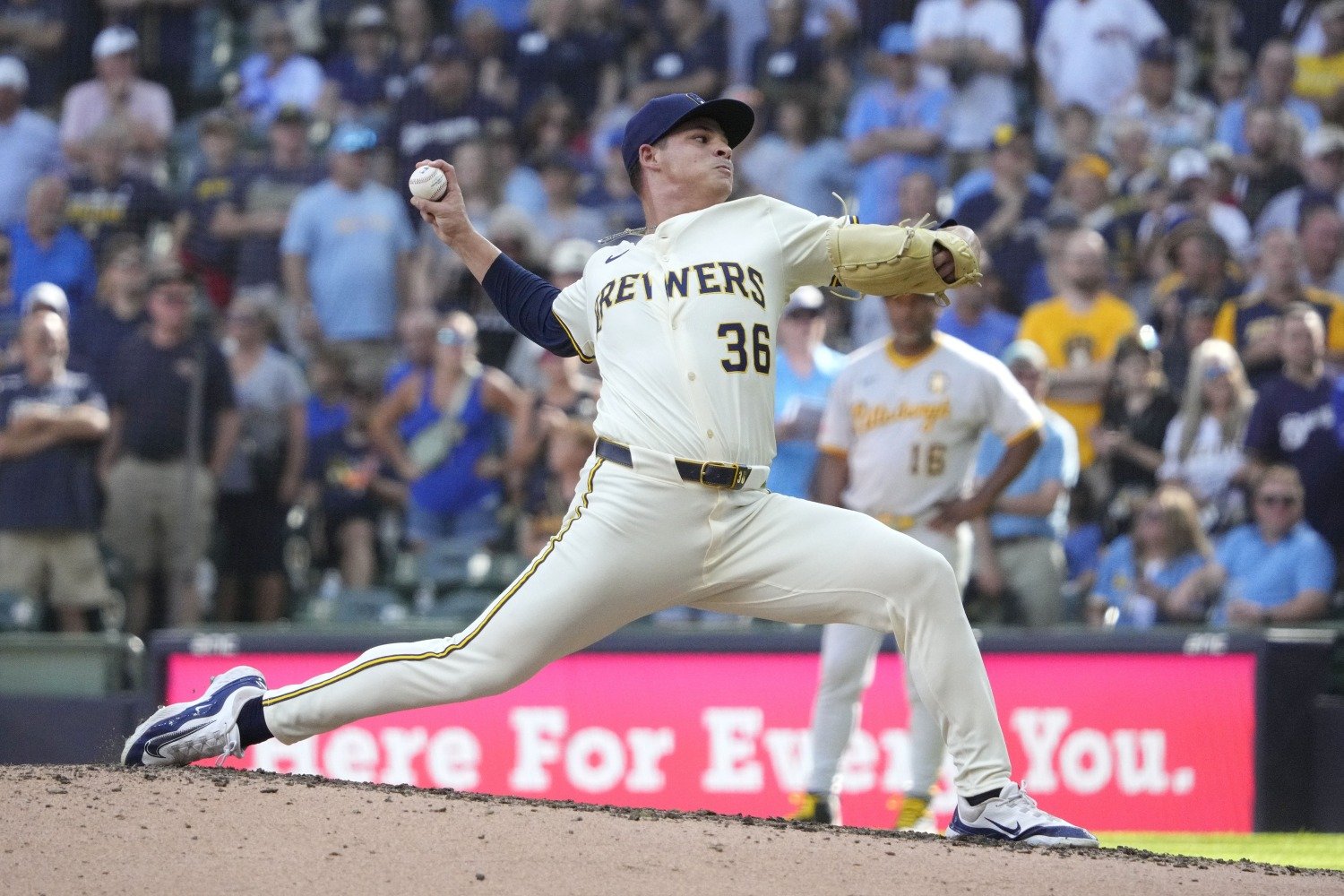 From the get-go, Tobias Myers found himself playing catch-up in his sophomore season. An oblique strain sidelined the right-hander in spring training; when he made his season debut in late April, he looked little like the pitcher who posted a 3.00 ERA in 138 innings with capable back-of-the-rotation peripherals a year ago, plus five scoreless innings in his postseason debut. In his first six games (five starts), Myers limped to a 4.95 ERA and 5.22 SIERA, with a 15.6% strikeout rate and 10.4% walk rate. "When the oblique happened in spring, and then I wanted to get back as quick as I can, I was just kind of fighting feel for pitches still at that point," he said. Myers was fighting the feel for his secondary pitches, in particular. When his cutter started backing up on him in camp instead of cutting slightly to the glove side, he began overcompensating with his release, adding more break but losing velocity. In 2024, his cutter averaged 89.2 mph, with 12.5 inches of induced vertical break and 3.3 inches of glove-side cut. In his first six outings of 2025, those figures were 87.2, 11.5, and 4.4, respectively. "I wasn't getting the right cut on it," Myers recalled. "So I was just in between throwing it like a heater and backspinning it, and then it's not cutting, and then I try to over-cut it, and then it's 86-87 [mph]." Just as impactful was the disappearance of Myers's changeup as a trusted weapon in his arsenal. It was a dominant pitch in his rookie season, holding opponents to a .163 wOBA while inducing whiffs on 44.4% of swings. He lost his feel for it this spring, though, and threw just 12 changeups throughout those first six appearances. When Pat Murphy pulled Myers after two ugly innings against the Chicago White Sox on April 30, part of his rationale was that he did not throw a single changeup and failed to mix speeds. Nothing changed in subsequent outings, though, because Myers was unable to throw his existing circle change grip with the same conviction as his fastball. "The goal is to have every pitch that I can just throw 100 percent [intensity], and I was always just in between with the circle change," he said. "It felt like when I put 100 percent, I'd spike it. Then I'd try to overcorrect that, and then I'm leaving my arm [behind], getting arm-side [misses], arm's late, body's moving too quick." The issues with his secondaries left Myers even more dependent on his fastball. Its usage rate jumped from 40.5% a year ago to 48.6% in those first handful of appearances. It was less effective with increased exposure, yielding a .384 wOBA in those first six games, compared to a .318 mark as a rookie. "When the cutter and the slider velo were down a little bit—when the slider was consistently like 83-ish, and the cutter was down to 87—when I'm in between there, I feel like I kind of have nothing to throw with up there other than a fastball," he explained. "And then at that time, I was still throwing the old changeup probably five percent [of the time]. It was kind of like just pitching with a fastball there." On May 18, the Brewers optioned Myers to Nashville for what became a nearly two-month stay in Triple-A. During that time in a lower-pressure environment, he experimented with new changeup grips to reincorporate more offspeed pitches into his outings. He tried a kick-changeup, a relatively new variant of the pitch that has recently gained traction throughout baseball, but it didn't take after some initial success. "The metrics were the same, but execution was like 11 out of 12 [success rate]," he said. "Then the next two weeks, it was gone. Like, I could not throw it." Myers then switched to a hybrid split-change grip. That was when things began progressing in the right direction. "I started playing with a splitter before my July 4 start, and it was like night and day the way it felt out of my hand," he said. "It just felt pretty much like a fastball, and then the location was coming out a lot better than the circle change." Myers returned to the big leagues after that outing, where pitching coach Chris Hook helped him tweak the grip to achieve more consistent arm-side fade. Trade deadline acquisition Shelby Miller, who revived his career two seasons ago by adding a splitter, has also become a sounding board as he fine-tunes the pitch. "I didn't want to go directly to a deep splitter and just rip that in the middle of the season, so I kind of wanted to start slow," Myers said of the grip. "So it's really not much of a split. I'm kind of running the index finger on one of the seams, and then the middle finger's right outside the other seam." When the Brewers recalled him for a spot start against the New York Mets last weekend, Myers leaned heavily on the split-change against a lineup stacked with left-handed hitters. He threw it 15 times, surpassing the number of changeups he had thrown in his previous outings combined. He threw eight more to close out the team's 12th straight win on Wednesday, including the pitch that notched a strikeout for the final out. screen-20250814-012437~2.mp4 "It just keeps feeling better and better every day," he said. "I keep feeling more comfortable with it, so I'm going to keep throwing it as much as I can." So far, the pitch's total break has been almost identical to Myers's old changeup, but it has flashed some late drop because it spins less (1576 rpm versus 1801) at a firmer velocity (83.6 mph versus 80.1). Myers is still tweaking it in hopes of adding more consistent depth, but most importantly, he trusts it and can throw it with the same conviction as his fastball. "I think just having the mentality of throwing everything like a heater is where I want to be, and I think the splitter definitely plays off of that," he said. "Like, just heater mentality. I just trust the grip, and I just throw it as hard as I can, like a heater." Myers thinks he and Hook have also made progress with the cutter, although his comfort level with that pitch has not yet matched the trust in his split-change. "I don't want to go up there using it like I was last year if I don't feel the same with it," he said. "So I think once I get that back and I'll be able to steal some strikes [to lefties] on the back half with the back-door cutter, and I got the splitter off that, [four-seam] up, I think we'll have a good amount of weapons to play with."
 -
Image courtesy of © Michael McLoone-Imagn Images From the get-go, Tobias Myers found himself playing catch-up in his sophomore season. An oblique strain sidelined the right-hander in spring training; when he made his season debut in late April, he looked little like the pitcher who posted a 3.00 ERA in 138 innings with capable back-of-the-rotation peripherals a year ago, plus five scoreless innings in his postseason debut. In his first six games (five starts), Myers limped to a 4.95 ERA and 5.22 SIERA, with a 15.6% strikeout rate and 10.4% walk rate. "When the oblique happened in spring, and then I wanted to get back as quick as I can, I was just kind of fighting feel for pitches still at that point," he said. Myers was fighting the feel for his secondary pitches, in particular. When his cutter started backing up on him in camp instead of cutting slightly to the glove side, he began overcompensating with his release, adding more break but losing velocity. In 2024, his cutter averaged 89.2 mph, with 12.5 inches of induced vertical break and 3.3 inches of glove-side cut. In his first six outings of 2025, those figures were 87.2, 11.5, and 4.4, respectively. "I wasn't getting the right cut on it," Myers recalled. "So I was just in between throwing it like a heater and backspinning it, and then it's not cutting, and then I try to over-cut it, and then it's 86-87 [mph]." Just as impactful was the disappearance of Myers's changeup as a trusted weapon in his arsenal. It was a dominant pitch in his rookie season, holding opponents to a .163 wOBA while inducing whiffs on 44.4% of swings. He lost his feel for it this spring, though, and threw just 12 changeups throughout those first six appearances. When Pat Murphy pulled Myers after two ugly innings against the Chicago White Sox on April 30, part of his rationale was that he did not throw a single changeup and failed to mix speeds. Nothing changed in subsequent outings, though, because Myers was unable to throw his existing circle change grip with the same conviction as his fastball. "The goal is to have every pitch that I can just throw 100 percent [intensity], and I was always just in between with the circle change," he said. "It felt like when I put 100 percent, I'd spike it. Then I'd try to overcorrect that, and then I'm leaving my arm [behind], getting arm-side [misses], arm's late, body's moving too quick." The issues with his secondaries left Myers even more dependent on his fastball. Its usage rate jumped from 40.5% a year ago to 48.6% in those first handful of appearances. It was less effective with increased exposure, yielding a .384 wOBA in those first six games, compared to a .318 mark as a rookie. "When the cutter and the slider velo were down a little bit—when the slider was consistently like 83-ish, and the cutter was down to 87—when I'm in between there, I feel like I kind of have nothing to throw with up there other than a fastball," he explained. "And then at that time, I was still throwing the old changeup probably five percent [of the time]. It was kind of like just pitching with a fastball there." On May 18, the Brewers optioned Myers to Nashville for what became a nearly two-month stay in Triple-A. During that time in a lower-pressure environment, he experimented with new changeup grips to reincorporate more offspeed pitches into his outings. He tried a kick-changeup, a relatively new variant of the pitch that has recently gained traction throughout baseball, but it didn't take after some initial success. "The metrics were the same, but execution was like 11 out of 12 [success rate]," he said. "Then the next two weeks, it was gone. Like, I could not throw it." Myers then switched to a hybrid split-change grip. That was when things began progressing in the right direction. "I started playing with a splitter before my July 4 start, and it was like night and day the way it felt out of my hand," he said. "It just felt pretty much like a fastball, and then the location was coming out a lot better than the circle change." Myers returned to the big leagues after that outing, where pitching coach Chris Hook helped him tweak the grip to achieve more consistent arm-side fade. Trade deadline acquisition Shelby Miller, who revived his career two seasons ago by adding a splitter, has also become a sounding board as he fine-tunes the pitch. "I didn't want to go directly to a deep splitter and just rip that in the middle of the season, so I kind of wanted to start slow," Myers said of the grip. "So it's really not much of a split. I'm kind of running the index finger on one of the seams, and then the middle finger's right outside the other seam." When the Brewers recalled him for a spot start against the New York Mets last weekend, Myers leaned heavily on the split-change against a lineup stacked with left-handed hitters. He threw it 15 times, surpassing the number of changeups he had thrown in his previous outings combined. He threw eight more to close out the team's 12th straight win on Wednesday, including the pitch that notched a strikeout for the final out. screen-20250814-012437~2.mp4 "It just keeps feeling better and better every day," he said. "I keep feeling more comfortable with it, so I'm going to keep throwing it as much as I can." So far, the pitch's total break has been almost identical to Myers's old changeup, but it has flashed some late drop because it spins less (1576 rpm versus 1801) at a firmer velocity (83.6 mph versus 80.1). Myers is still tweaking it in hopes of adding more consistent depth, but most importantly, he trusts it and can throw it with the same conviction as his fastball. "I think just having the mentality of throwing everything like a heater is where I want to be, and I think the splitter definitely plays off of that," he said. "Like, just heater mentality. I just trust the grip, and I just throw it as hard as I can, like a heater." Myers thinks he and Hook have also made progress with the cutter, although his comfort level with that pitch has not yet matched the trust in his split-change. "I don't want to go up there using it like I was last year if I don't feel the same with it," he said. "So I think once I get that back and I'll be able to steal some strikes [to lefties] on the back half with the back-door cutter, and I got the splitter off that, [four-seam] up, I think we'll have a good amount of weapons to play with." View full article
-
Image courtesy of © Benny Sieu-Imagn Images The Brewers look like an unstoppable machine right now. Winners of 11 straight – their second such streak this year, making them the 13th team all-time to do it multiple times in a season – Milwaukee owns the best record in baseball by 5 1/2 games and leads the NL Central by 7 1/2 games. They keep winning by doing so many things well. They pitch. They play defense. They reach base and then take extra bases on balls in play. The Brewers have allowed the second-fewest runs in baseball and rank fifth in fielding run value, third in on-base percentage, and first in baserunning runs above average. All of those attributes were on display as the Brewers clobbered the Pittsburgh Pirates in a 14-0 blowout on Tuesday night. So, too, was more pop than they had shown at arguably any point in the year – the offense combined to hit a season-high five home runs. If there's been a knock to make against an otherwise well-oiled unit, it's a lack of home run power. The Brewers are 20th in isolated power and 18th in home runs. That has changed this month, as the Crew have hit a league-leading 23 home runs in August. While not the leading reason for their string of offensive outbursts, putting more balls over the fence has played a role. The contributions have come throughout the lineup. Brice Turang and Sal Frelick have doubled their combined power output from a year ago. Andrew Vaughn and Christian Yelich are supplying thump in the middle of the order. With restored bat speed, William Contreras is scalding the ball again and has gone deep four times this month. While Turang acknowledged that he has made some adjustments to transfer his raw power into games, the Brewers maintain that, on the whole, the long ball is not a significant piece of their identity. "I don't think we're going to fool anybody with a bunch of slug, but usually homers are thrown," Pat Murphy said. "That's the way it is, you know? You don't create slug on balls on the edge or something like that. Homers are thrown, and it's taking advantage of it when [they are] thrown." "Homers are bonuses," Frelick said. "When we stick to our approach and put good at-bats together, that's when those home run pitches show up. So I think [the recent home runs are] a product of that." To their credit, the Brewers are doing more damage against home run pitches this month. Their slugging percentage and hard-hit rate on pitches labeled by Statcast as over the heart of the plate are higher in August than in any previous month this year. Month SLG HardHit% April .466 50.8% May .477 46.0% June .520 50.0% July .520 51.4% August .803 57.1% Even if the power surge is not by design, it's a development worth monitoring. While the Brewers' strengths in other areas mean they need not be an elite home run team to win, the reality remains that decent slugging ability is typically a prerequisite for making noise in October. In recent postseasons, teams that hit the most home runs in a game have boasted winning percentages approaching .800; only six of the last 25 World Series winners finished in the bottom half of the league in regular-season home runs, and none since the 2015 Royals. Winning requires scoring more runs than the opponent, and home runs are the most efficient means of scoring. They're also the only outcome that cannot be affected by defense or batted ball luck in a small sample. Given the profiles of most of their hitters, the Brewers should not be trying to hit home runs. Their existing approach is the most productive for the players they have. They do, however, need the ability to drive a mistake pitch when the opportunity presents itself. If they can do that on top of the many existing strengths that separate them from other teams, look out. View full article
