



Jake McKibbin
-
Posts
2,395 -
Joined
-
Last visited
-
Days Won
6
Content Type
Profiles
Forums
Blogs
Events
News
2026 Milwaukee Brewers Top Prospects Ranking
Milwaukee Brewers Videos
2022 Milwaukee Brewers Draft Picks
Milwaukee Brewers Free Agent & Trade Rumors, Notes, & Tidbits
Guides & Resources
2023 Milwaukee Brewers Draft Picks
2024 Milwaukee Brewers Draft Picks
The Milwaukee Brewers Players Project
2025 Milwaukee Brewers Draft Pick Tracker
2026 Milwaukee Brewers Draft Tracker: Picks & Bonuses
Store
Downloads
Gallery
Everything posted by Jake McKibbin
-
@Matthew TruebloodDo you think there's a part of this that comes down to over-tinkering from Contreras? it's difficult to find rhythm when you're out of sorts and continuously changing your set up, body position, stride even from one pitch to the next. Even last season seemed like a lot of moving parts
-
Image courtesy of © Benny Sieu-Imagn Images Pat Murphy has been treating every game like it's the postseason, even though the calendar just flipped to May. He's removed players mid-game for disciplinary and tactical reasons, used quick hooks for his starters, and been aggressive with his top bullpen arms. Last week, he pulled Tobias Myers after two innings of work, then pulled Tyler Alexander (who is stretched out) after just 26 pitches following Myers's short outing. He yanked Sal Frelick and Caleb Durbin for fielding errors and mistakes on the basepaths in St. Louis in the final weekend of April. Elvin Rodriguez was promoted to give length to the bullpen before the Cubs series, only to be used for a mere one inning while four runs behind. Murphy, instead, used his "A" bullpen of Grant Anderson, Nick Mears, and Abner Uribe whenever it counted. The skipper showcased the same managerial proclivities last season out of the gates, heavily using Bryan Hudson and taxing his bullpen in April. It gave the team a head start in last year's division race, although perhaps it had knock-on effects down the line—especially in the case of Hudson. It's a strategy that's drawn some criticism, and rightfully so, but Murphy may have a viable reason for managing in this manner. The simple fact is, this Brewers' roster didn't win 92 games based on the talent of the squad on paper. They won games by winning little battles, being faultless in the field, putting balls in play, and being effective with runners in scoring position. They were elite in close games, grinding out at-bats, causing chaos on the basepaths, and wearing down the opposition to create a moment they could capitalize on. Murphy repeated his mantra over and over: "Win tonight." He demanded that his players be engaged in the moment-by-moment, play-by-play occurrences on the field, with the sole focus of winning. They didn't throw the towel in. He wouldn't let them. They fought tooth-and-nail in all scenarios, never getting too high or too low. The problem in 2025 is that they haven't been able to match that standard. Perhaps they've missed the everyday presences and resilience shown by Willy Adames and William Contreras to begin last season; Adames set an excellent example of the sturdiness required in Major League Baseball. Perhaps they've struggled to regain that mindset. Perhaps it's a crisis of confidence. Either way, the Brewers don't seem to have that same spark. They're making errors in the field. They're passive at the plate. They're getting picked off. The big names haven't caught fire. The back end of the bullpen has been shaky. It's been the antithesis to their 2023 and 2024 performances so far, despite flashes of that form. So what does Murphy do? He leads from the front. If he's to demand the players focus on winning today, he has to do the same. Why did Murphy use his "A" bullpen down four runs against Chicago? Why did he pull a wayward Myers, and then use him in a between-starts relief stint? He wanted to win. he needed to win. Before all else, Murphy is a competitor. He thrives on competition, yearns for it. He knows what these players are capable of, and if he can get them focused back on the minutiae from one play to another (rather than the overall picture of how things aren't falling their way), then perhaps he can get the train back on track toward yet another successful season. He sees himself as a leader of this group, someone with enough wisdom to set the standards—and with enough gravitas that people will follow him. On both scores, he's correct, as best we can tell so far. It's also undoubtedly true that leading by example is far more effective than instructing people to "do what I say, not what I do." I'm not saying Murphy is entirely correct in doing so. Craig Counsell certainly managed things differently. However, there is some logic to his decision to manage so aggressively at times in the season. Whether this can be used to turn the Brewers' early fortunes around will go a long way toward assessing whether Murphy's tactics were correct or not. The line between madness and genius is oh-so thin. View full article
-
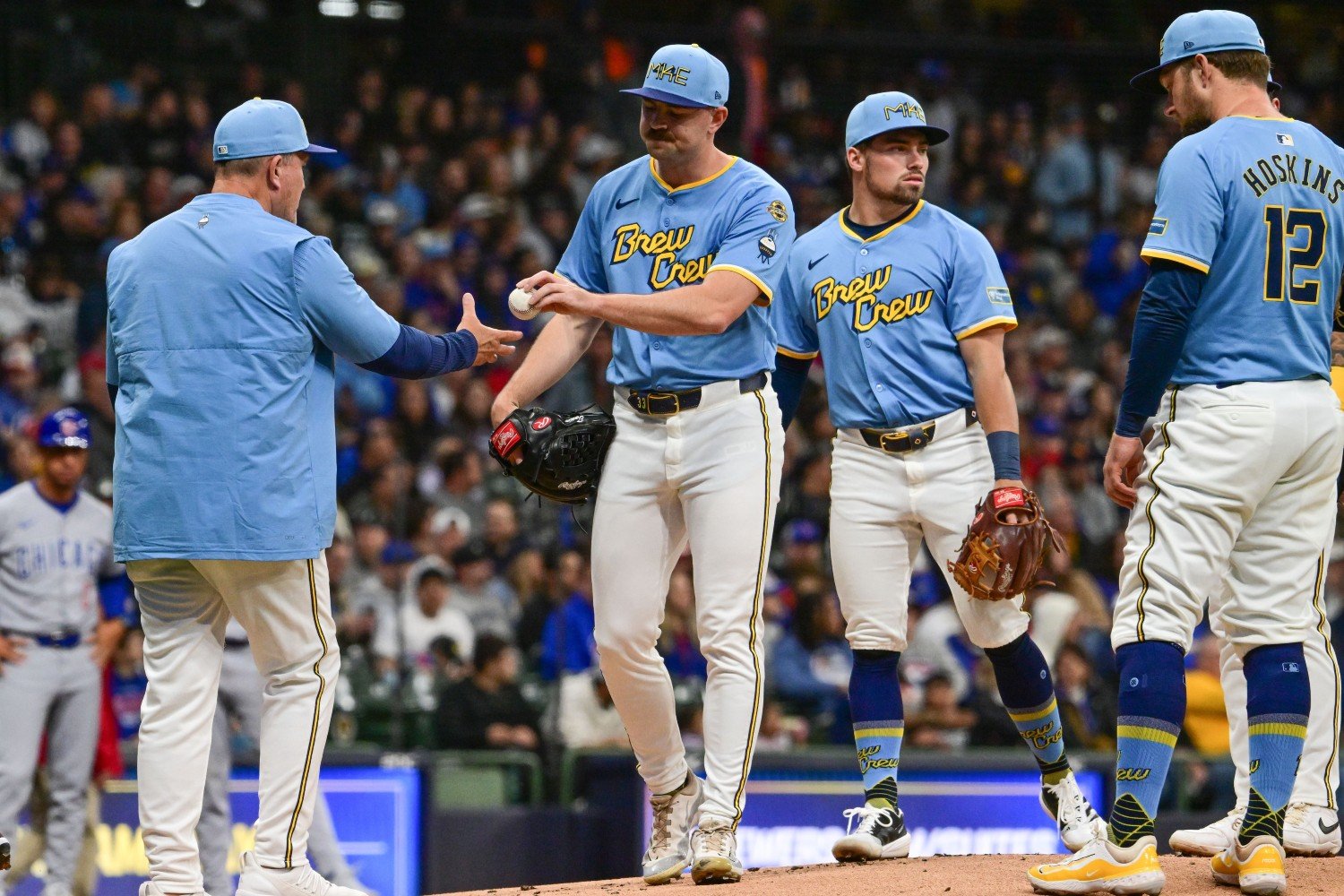 Pat Murphy has been treating every game like it's the postseason, even though the calendar just flipped to May. He's removed players mid-game for disciplinary and tactical reasons, used quick hooks for his starters, and been aggressive with his top bullpen arms. Last week, he pulled Tobias Myers after two innings of work, then pulled Tyler Alexander (who is stretched out) after just 26 pitches following Myers's short outing. He yanked Sal Frelick and Caleb Durbin for fielding errors and mistakes on the basepaths in St. Louis in the final weekend of April. Elvin Rodriguez was promoted to give length to the bullpen before the Cubs series, only to be used for a mere one inning while four runs behind. Murphy, instead, used his "A" bullpen of Grant Anderson, Nick Mears, and Abner Uribe whenever it counted. The skipper showcased the same managerial proclivities last season out of the gates, heavily using Bryan Hudson and taxing his bullpen in April. It gave the team a head start in last year's division race, although perhaps it had knock-on effects down the line—especially in the case of Hudson. It's a strategy that's drawn some criticism, and rightfully so, but Murphy may have a viable reason for managing in this manner. The simple fact is, this Brewers' roster didn't win 92 games based on the talent of the squad on paper. They won games by winning little battles, being faultless in the field, putting balls in play, and being effective with runners in scoring position. They were elite in close games, grinding out at-bats, causing chaos on the basepaths, and wearing down the opposition to create a moment they could capitalize on. Murphy repeated his mantra over and over: "Win tonight." He demanded that his players be engaged in the moment-by-moment, play-by-play occurrences on the field, with the sole focus of winning. They didn't throw the towel in. He wouldn't let them. They fought tooth-and-nail in all scenarios, never getting too high or too low. The problem in 2025 is that they haven't been able to match that standard. Perhaps they've missed the everyday presences and resilience shown by Willy Adames and William Contreras to begin last season; Adames set an excellent example of the sturdiness required in Major League Baseball. Perhaps they've struggled to regain that mindset. Perhaps it's a crisis of confidence. Either way, the Brewers don't seem to have that same spark. They're making errors in the field. They're passive at the plate. They're getting picked off. The big names haven't caught fire. The back end of the bullpen has been shaky. It's been the antithesis to their 2023 and 2024 performances so far, despite flashes of that form. So what does Murphy do? He leads from the front. If he's to demand the players focus on winning today, he has to do the same. Why did Murphy use his "A" bullpen down four runs against Chicago? Why did he pull a wayward Myers, and then use him in a between-starts relief stint? He wanted to win. he needed to win. Before all else, Murphy is a competitor. He thrives on competition, yearns for it. He knows what these players are capable of, and if he can get them focused back on the minutiae from one play to another (rather than the overall picture of how things aren't falling their way), then perhaps he can get the train back on track toward yet another successful season. He sees himself as a leader of this group, someone with enough wisdom to set the standards—and with enough gravitas that people will follow him. On both scores, he's correct, as best we can tell so far. It's also undoubtedly true that leading by example is far more effective than instructing people to "do what I say, not what I do." I'm not saying Murphy is entirely correct in doing so. Craig Counsell certainly managed things differently. However, there is some logic to his decision to manage so aggressively at times in the season. Whether this can be used to turn the Brewers' early fortunes around will go a long way toward assessing whether Murphy's tactics were correct or not. The line between madness and genius is oh-so thin.
 -
Image courtesy of © Tommy Gilligan-USA TODAY Sports The Brewers defied all expectations in 2024, with many fans coming into the year bemoaning the injuries to Brandon Woodruff and the loss of Corbin Burnes as key cogs of the machine that created four playoff appearances in five seasons. Yet somehow, through what we can only refer to as "the Pat Murphy effect", the Brewers managed to concentrate on the small details and excel in such a way that they could defy all such expectations offensively and defensively. Christian Yelich recently spoke about the Brewers' desire to create chaos on the base paths, to the point where even they don't always know what they're going to do. The Brewers had the highest baserunning value added per Fangraphs in 2024 (comfortably so), but since the turn of the year, they rank a little lower down in fourth, in large part due to players falling asleep on the bases. They haven't been taking good leads (on any of the bases), resulting in preventable outs at home and even more preventable pick-offs. Defensively, the contrast between seasons has been even more stark. Joey Ortiz and Brice Turang have been good, but not the elite defenders many would have hoped from a duo that could have been the best up-the-middle defense in MLB. Sal Frelick has been making poor reads. Easy drops have been made in the outfield, and missed catches have become a feature of first base, not a bug. It's been mistake after mistake. The problem is, this is the Brewers' bread and butter. Yes, they have a few hitters capable of going berserk, but that hasn't happened early in 2025. The starting pitching staff (held together by a thread) has performed outstandingly well, while the bullpen has seen notable regressions in performance from some key contributors in Joel Payamps and Trevor Megill. The defense hasn't bailed them out, and it just feels like the Brewers aren't locked in. They went all of 2024 without losing four consecutive games at any point. That might sound random, but the way the Brewers played, the relentlessness with which they attacked each and every pitch thrown, gave them the chance to win the many mini battles that can result in a win. They fought late in games, they tacked on runs when ahead, they did every little thing so well that the big things (like having a terrifying line-up or an ace on your staff that many outlets considered a requiem for success) failed to matter. The problem is, without that constantly clued-in relentlessness, wins are slipping between their fingers. This isn't the most talent-laden roster in MLB, and it wasn't built to be that way. It's built to win at the margins, and a drop off in the mentality that let them take advantage of those margins is a death blow to the Brewers' hopes. If they can't rediscover their joie de vivre, their niche, then this season will be over before it begins. However, the Brewers still have enough talent to make any trade deadline decision difficult. They may hover around that .500 record that can leave front offices in limbo through the summer. If they twist, the Brewers organization has some difficult decisions to make as contending teams come swooping in for their talent: If the Brewers are around .500 at the trade deadline, would they sell any of their pieces? If Brandon Woodruff doesn't want to extend his time in Milwaukee, would they trade him away (particularly if his stuff regains its former bite?). What value would they get for Rhys Hoskins and Jose Quintana, two players who will be free agents at the end of the season and are performing well enough to attract a raft of suitors? Do the bullpen arms (most controllable through at least 2026) attract some keen attention? The Milwaukee Brewers are by no means out of the running yet. It's only been a month. Yet, that month was not a positive one, and without that spark returning, they may struggle to replicate their recent successes. Perhaps it seems fitting that they're due for a down year — after all, this has been the most successful period of Brewers baseball in history in terms of wins and playoff appearances. It does appear that with a talented farm system, loaded particularly with infielders, that reinforcements are on the way eventually (though none of whom are likely to arrive in 2025). They have Cooper Pratt, Mike Boeve, Brock Wilken all around Double-A at this point, while further down the pipeline, the talent in Low-A and High-A is off the charts. Perhaps some new blood in the form of Jacob Misiorowski or Logan Henderson can add a spark of their own to the team. Maybe even a trade to bolster the middle-infield could shake things up in the right way. One thing's for sure: Something has to change if the Brewers want to remain in the thick of it come September and October, or a reset may be very much in the cards. View full article
-
The Brewers Are Showing A Disturbing Lack Of Relentlessness In 2025
Jake McKibbin posted an article in Brewers
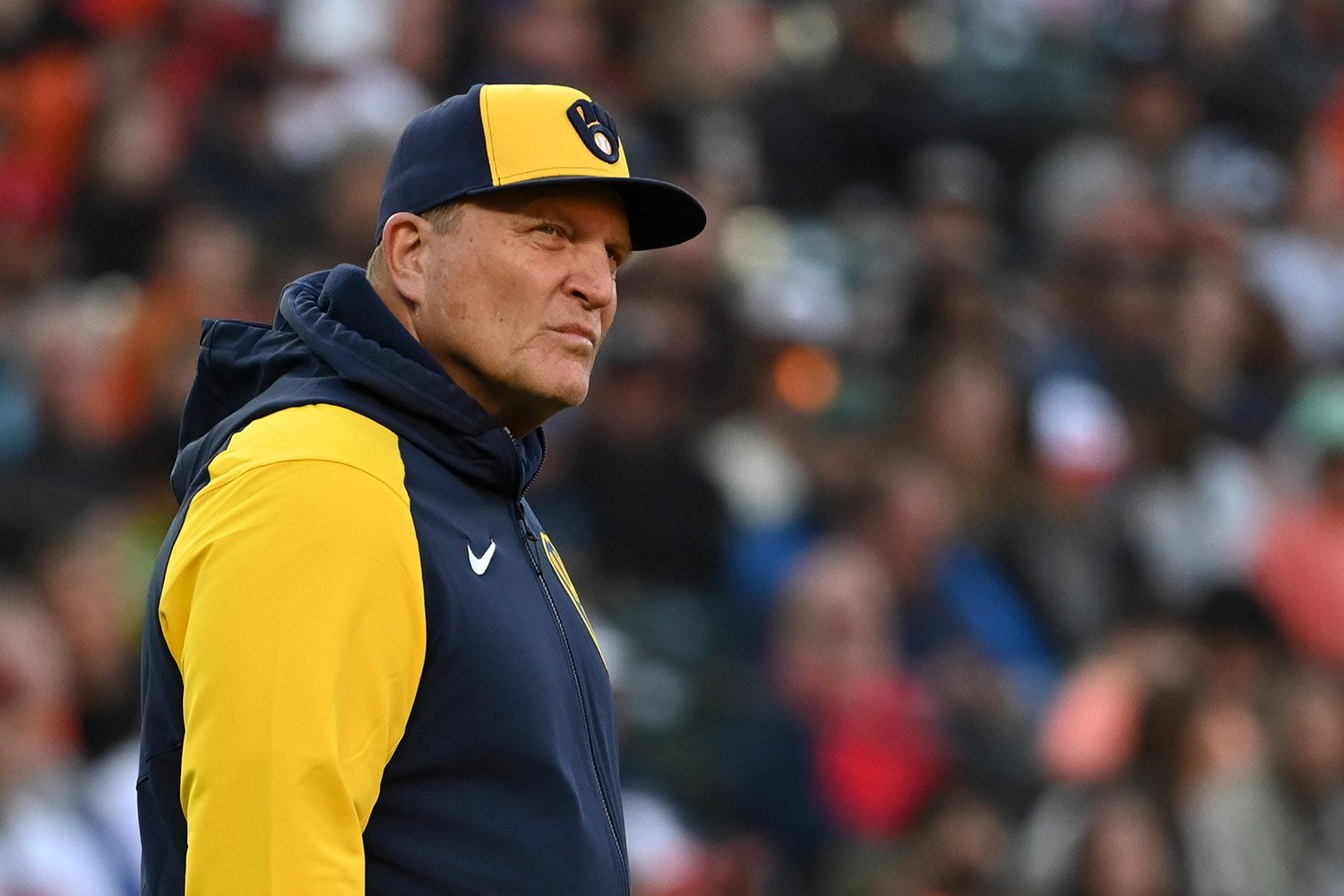 The Brewers defied all expectations in 2024, with many fans coming into the year bemoaning the injuries to Brandon Woodruff and the loss of Corbin Burnes as key cogs of the machine that created four playoff appearances in five seasons. Yet somehow, through what we can only refer to as "the Pat Murphy effect", the Brewers managed to concentrate on the small details and excel in such a way that they could defy all such expectations offensively and defensively. Christian Yelich recently spoke about the Brewers' desire to create chaos on the base paths, to the point where even they don't always know what they're going to do. The Brewers had the highest baserunning value added per Fangraphs in 2024 (comfortably so), but since the turn of the year, they rank a little lower down in fourth, in large part due to players falling asleep on the bases. They haven't been taking good leads (on any of the bases), resulting in preventable outs at home and even more preventable pick-offs. Defensively, the contrast between seasons has been even more stark. Joey Ortiz and Brice Turang have been good, but not the elite defenders many would have hoped from a duo that could have been the best up-the-middle defense in MLB. Sal Frelick has been making poor reads. Easy drops have been made in the outfield, and missed catches have become a feature of first base, not a bug. It's been mistake after mistake. The problem is, this is the Brewers' bread and butter. Yes, they have a few hitters capable of going berserk, but that hasn't happened early in 2025. The starting pitching staff (held together by a thread) has performed outstandingly well, while the bullpen has seen notable regressions in performance from some key contributors in Joel Payamps and Trevor Megill. The defense hasn't bailed them out, and it just feels like the Brewers aren't locked in. They went all of 2024 without losing four consecutive games at any point. That might sound random, but the way the Brewers played, the relentlessness with which they attacked each and every pitch thrown, gave them the chance to win the many mini battles that can result in a win. They fought late in games, they tacked on runs when ahead, they did every little thing so well that the big things (like having a terrifying line-up or an ace on your staff that many outlets considered a requiem for success) failed to matter. The problem is, without that constantly clued-in relentlessness, wins are slipping between their fingers. This isn't the most talent-laden roster in MLB, and it wasn't built to be that way. It's built to win at the margins, and a drop off in the mentality that let them take advantage of those margins is a death blow to the Brewers' hopes. If they can't rediscover their joie de vivre, their niche, then this season will be over before it begins. However, the Brewers still have enough talent to make any trade deadline decision difficult. They may hover around that .500 record that can leave front offices in limbo through the summer. If they twist, the Brewers organization has some difficult decisions to make as contending teams come swooping in for their talent: If the Brewers are around .500 at the trade deadline, would they sell any of their pieces? If Brandon Woodruff doesn't want to extend his time in Milwaukee, would they trade him away (particularly if his stuff regains its former bite?). What value would they get for Rhys Hoskins and Jose Quintana, two players who will be free agents at the end of the season and are performing well enough to attract a raft of suitors? Do the bullpen arms (most controllable through at least 2026) attract some keen attention? The Milwaukee Brewers are by no means out of the running yet. It's only been a month. Yet, that month was not a positive one, and without that spark returning, they may struggle to replicate their recent successes. Perhaps it seems fitting that they're due for a down year — after all, this has been the most successful period of Brewers baseball in history in terms of wins and playoff appearances. It does appear that with a talented farm system, loaded particularly with infielders, that reinforcements are on the way eventually (though none of whom are likely to arrive in 2025). They have Cooper Pratt, Mike Boeve, Brock Wilken all around Double-A at this point, while further down the pipeline, the talent in Low-A and High-A is off the charts. Perhaps some new blood in the form of Jacob Misiorowski or Logan Henderson can add a spark of their own to the team. Maybe even a trade to bolster the middle-infield could shake things up in the right way. One thing's for sure: Something has to change if the Brewers want to remain in the thick of it come September and October, or a reset may be very much in the cards.
 -
Haha yep, very much so but I like to use generalizing to emphasize the nature of how statistical probabilities work (especially for things involving averages). You're entirely right with all the dynamics at play, but due to the large sample size of league wide batted balls and the marked discrepancy between WOBA's of those batted balls. There are also a difference in ground balls and GROUND Balls, in the 0 to -5° range are inherently more dangerous than those at lower angles, but taking that aside we could say the same for line drives above 10°. I wish I could model something as such, unfortunately not quite in my wheelhouse like some of the coders I like to share, but it would be fascinating. I'm not wholeheartedly advocating for an entirely aerial offense. As mentioned before, Sal Frelick and Brice Turang are two examples of players who will do better keeping the ball on the ground than in fly balls, however the Brewers do need home run output from somewhere in their lineup and if two main potential contributors of that threat are just bashing it on the ground, they'll struggle to put up hose game breaking innings. Adames' plethora of three run bombs last season were invaluable and unlikely, and it's a lot of RBi's to replace this season. You're right, it probably is a market inefficiency the Brewers targeted (or more what they felt they could draft and develop well several years ago) , but there are weaknesses to this unless you can do what the Red Sox appear to have excelled in which is adding significant bat speed Loving the nerdy debate my friend! We may have to agree to disagree, but a very interesting dive into the topic!
- 10 replies
-
- 1
-

-
- christian yelich
- jackson chourio
- (and 3 more)
-
Absolutely! I think it's looking above market expectations for sure when the draft finished, especially with some of the premier fastballs the Brewers seem to have found and the teenagers popping their heads up. Lots of development since last summer.
- 4 replies
-
- 1
-
-
- braylon payne
- blake burke
- (and 2 more)
-
Jeferson QueroJesus MadeJacob MisiorowskiCooper PrattBraylon PayneLuis PenaLogan HendersonRobert GasserBishop LetsonJosh AdamczewskiJosh KnothLuis LaraEric BitontiMike BoeveBryce MeccageBrock WilkenTyson HardinMarco DingesErnesto MartinezJadher Areinamo
-
Jeferson QueroJesus MadeJacob MisiorowskiCooper PrattBraylon PayneLuis PenaLogan HendersonRobert GasserBishop LetsonJosh AdamczewskiJosh KnothLuis LaraEric BitontiMike BoeveBryce MeccageBrock WilkenTyson HardinMarco DingesErnesto MartinezJadher Areinamo
-
Image courtesy of © Max Correa / Milwaukee Journal Sentinel / USA TODAY NETWORK via Imagn Images The 2024 draft class for the Milwaukee Brewers received less fanfare than the host of names they managed to wrangle in 2023, but it's fair to say some of the names have emerged as pleasant surprises this spring. With plenty of teenage talent and roaring fastballs, let's see how their first month in the system has progressed; Braylon Payne, CF (Low A) - .275/.393/.449, 2 HR Payne was an unheralded, unexpected pick at No. 17 in last year's first round, renowned as a slap hitter with great speed in center field. Upon entering the system, Payne has debunked all of the tepid hitting projections, crushing multiple balls over 110 mph, including this home run: Payne is striking out a little more often of late, producing a contact rate of just 71% in the early going, but he also shows a patient approach at the plate. There's room to grow, but the month of April has been a startling display of the collection of raw tools this young man possesses. There can be a lot of ground balls, but he also hits a lot of fly balls, with 35.4% of batted balls of that variety in April. Clocking 70-grade times from home to first and showing outstanding center field coverage, this is turning out to be a very exciting pick as someone incredibly young for the level. Using Thomas Nestico's new model (which is based on estimations, and not 100% exact), Payne's swing decisions have improved since joining the Mudcats, with increased in-zone swings and reduced chases. The swing-and-miss is a concern, but the new swing path he's showing off (in an attempt to distance himself from the label as a slapster, and tap into his raw power) will certainly play a part in that, and it should come down as he grows more and more comfortable with it. Blake Burke, 1B (High A) - .275/.381/.391 Burke was advertised as a crushing slugger (with some swing-and-miss issues and poor defense at first base) when the Brewers picked him up with the 34th pick of the draft. Our own Joseph Zarr will immediately and vociferously tell you that the young man has hands and range at first base to dispel those defensive reports, while he's also posting a solid 78% contact rate overall. Burke has shown the elite exit velocities that get prospect watchers to sit up and take stock, including this 107-mph rocket courtesy of our own prospect guru: Burke's power hasn't quite shown up in his first month of pro ball, largely down to a lot of ground balls. He's got the highest ground ball rate in the Brewers system, at 57.1% so far—basically, Christian Yelich levels—but Burke has historically shown no issue with elevating the baseball, and will likely just be adjusting to the level. Once that power kicks in, I'm not sure he'll be in Wisconsin for long—despite the infield depth at Biloxi. You can see below using Thomas Nestico's new minor-league model how Burke took a little adjustment with pitch recognition. He's now both above average with in-zone swings, and significantly above-average with his chase rate, great signs for the powerful first baseman after below-average marks to begin the year. Bryce Meccage RHP (Low A) - 2.92 ERA, 28% whiff rate Meccage was the second-round pick for the Brewers, and may have the prettiest curveball in the system. Apart from one rough outing, he's looked the part on the mound, touching 96 mph on the fastball with wicked breaking pitches that have hitters flummoxed. To put it all together, Meccage has a big-moving "kick-change" that he's used occasionally and could develop into a strong fourth offering. The fastball looks to have a really nice rising effect to it, and have a look at the slider/curveball combination. The strikeout total isn't quite matching the whiff rates he's getting, as he's often putting hitters away quickly with weak contact. Command can escape him at times, but as a 19-year-old out of high school, he's showing more polish than you would expect. He's likely on an innings and pitch limit, but the stuff looks as good as advertised for the young hurler from New Jersey. When a pitcher has a strong ground ball rate of 45.5% and a swinging strike rate of 15% (per pitch thrown), that's a nice combination. It should help Meccage avoid the home run ball. Marco Dinges C (Low A) - .362/.500/.553, 190 WRC+ Yep, you read that right, Dinges is producing a .500 on-base percentage in Low-A Carolina. Dinges signed in the fourth round out of Florida State, where he endured some horrific health scares and mostly served as designated hitter in his final season. The Brewers saw something they liked in a player whose bat stood out and who hasn't caught that much even in his juco days. His line drive rate of 29.3% in April is behind only super-prospect Jesus Made in the Brewers system. Dinges is in Low A more because of his defense than his offense, but even that is showing up well. Recording some pop times below 1.90 and catching six base stealers in 22 attempts is nothing to sniff at, while his receiving is coming along. An athletic mover, Dinges looks like he could be a real prospect if he can stick behind the dish. John Holobetz RHP (Low A) - 2.89 ERA, 1.69 FIP Holobetz was a fifth-round pick out of Old Dominion, and his fastball has been his calling card so far. Boasting a 33.3% strikeout rate and a 3.8% walk rate, Holobetz has mown down hitters at Low-A Carolina. He's pounded the strike zone, giving up solid enough contact to opposing hitters and occasionally living dangerously over the heart of the plate, and his ground ball rate is quite low—only 32%. The four-seamer has been up another tick since his first start, and is definitely his calling card, jumping on hitters from a relatively low arm slot. He featured just a fastball/slider combo in college and has yet to show a developed third pitch for my eye, but it'll be a point of difference if he looks to continue starting for the Brewers as he moves up the levels. Chandler Welch RHP (High A) - 5.89 ERA, 4.07 FIP Welch hasn't had quite the start Holobetz has, but has had a more aggressive assignment to High-A Wisconsin—where he, too, has pounded the zone. Welch's best start came on April 13, when he went six innings, allowed one run and racked up seven strikeouts. His well-rounded arsenal has struggled to generate swings and misses in the early going. Armed with a cutter and slider that are probably his best offerings, Welch also has a changeup, curveball and four-seam fastball in his repertoire. Outside of that outing, Welch has conceded 11 runs in 12 1/3 innings of baseball with only five strikeouts in those games. He will need to find more swing-and-miss if he wants to progress through the system, but the cutter has looked a nice pitch so far in terms of movement. Sam Garcia - LHP (Low A) - 3.52 ERA, 25.4% K rate Garcia was the Brewers' eighth-round pick, with outlier four-seam fastball characteristics coming out of the draft. Garcia has struggled with walks early in his pro career, a 13% clip, but he's also shown some electric stuff. With a Chris Sale-esque release point, Garcia has a flat vertical approach angle on his fastball, giving it a rising effect, as well as a nice sweepy slider and a changeup. He doesn't throw hard, sitting around 89-90mph, but his release point has proved difficult for Low-A hitters to pick up, producing almost a 30% whiff rate on swings. If he can rein in the walks somewhat, he'll likely move to High A without too much trouble. He did have a breakthrough in this regard in his final college season, but he looks destined to be in the relief mold, unless he can find another few ticks in his arsenal. Tyson Hardin - RHP (High A) - 0.96 ERA, 28.6% K rate, 50% GB rate Perhaps the most exciting under-the-radar pitching prospect so far, Hardin was a 12th-rounder out of Mississippi State whose four-seam fastball (which I heard recently, I believe again from Spencer, that he didn't even throw in college) has been one of the best pitches in the minor leagues. With a low release height and high induced vertical break, Hardin has an approach angle of around -3.8 degrees, a number that would lead the majors by some margin. In other words, his fastball doesn't react the way our brains and eyes expect it to, and gets misses above a lot of bats. Hardin's cutter is one of his favorite offerings, more like a hard slider, and is a reason for the high ground ball rate, but he also throws a changeup, curveball and sinker to round out a five-pitch arsenal. The heavy fastball usage has been a common theme throughout his starts, and High-A hitters have had no answer. Hardin may need to continue refining his arsenal as he develops. Even that unique four-seamer can't handle the majors on its own. The cutter/hard slider looks tasty shape-wise, sitting around 88-89 mph, but Hardin came out of college as a two-pitch reliever, so this is already a major stride for him. Travis Smith RHP (Low A) - 2.25 ERA, 3.16 FIP, 14.3% K Rate, 2% BB rate Smith has started piggybacking starts with Sam Garcia, and together, they've been mightily effective, despite lacking the swing-and-miss and strikeout rates you might hope for. A 15th-round pick, Smith was considered inconsistent out of the draft, but with good potential, given his mid-90s fastball and high-spin curveball. He throws all three fastball variations and a changeup, fitting the Brewers' mold, He relies more on the sinker/cutter combo to attack down in the zone, one reason for the low swing and miss we've seen from him so far. Several other notables should be making appearances as we approach the start of the Arizona Summer League (ACL), with pitchers like Jaron DeBerry (recently assigned to Low-A Carolina Mudcats), Griffin Tobias, Ethan Dorchies and Tyler Renz all likely to see action down in the desert. Already, though, this draft class is an intriguing one. View full article
- 4 replies
-
- 3
-
-

-
- braylon payne
- blake burke
- (and 2 more)
-
How is the 2024 Milwaukee Brewers Draft Class Faring?
Jake McKibbin posted an article in Minor Leagues
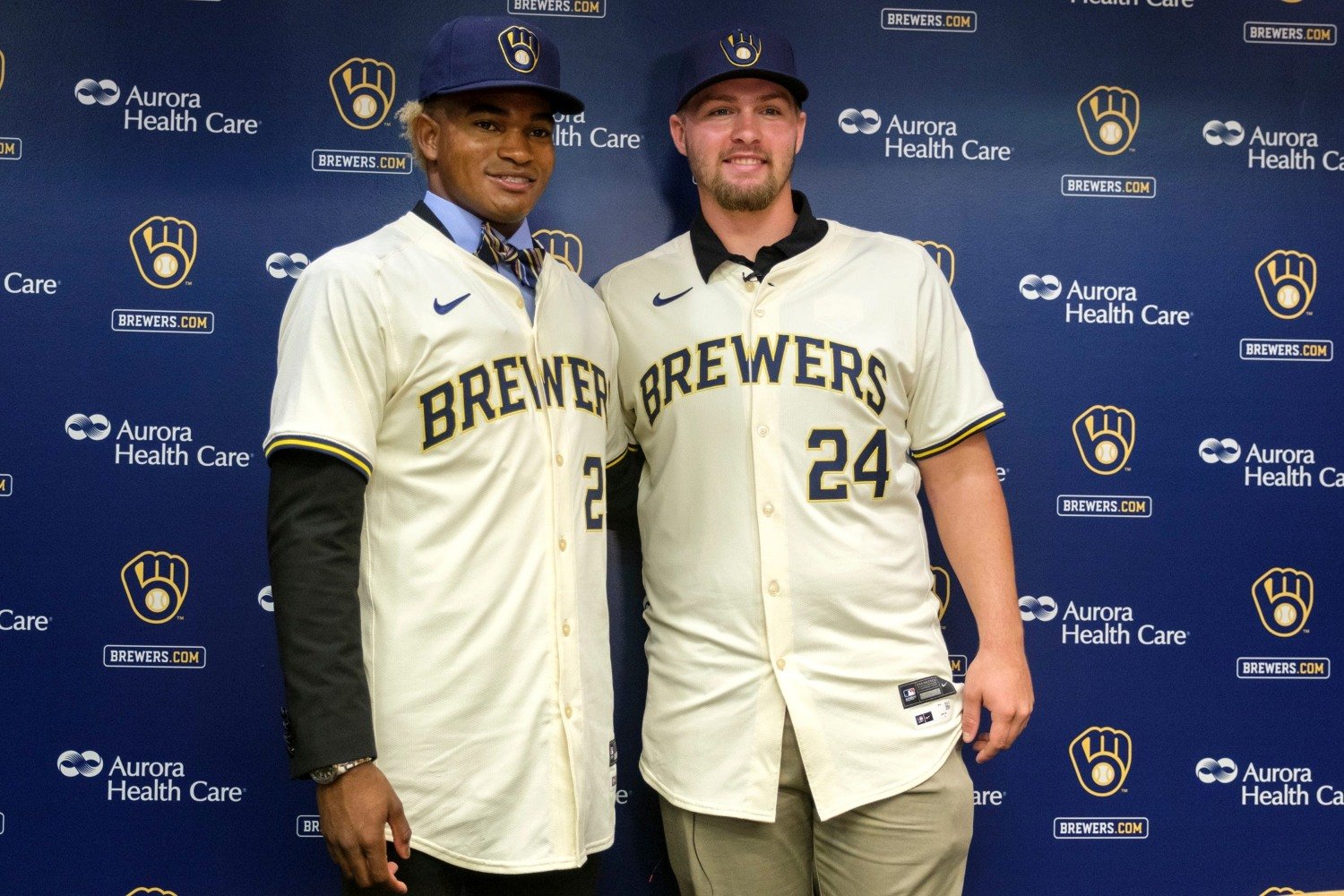 The 2024 draft class for the Milwaukee Brewers received less fanfare than the host of names they managed to wrangle in 2023, but it's fair to say some of the names have emerged as pleasant surprises this spring. With plenty of teenage talent and roaring fastballs, let's see how their first month in the system has progressed; Braylon Payne, CF (Low A) - .275/.393/.449, 2 HR Payne was an unheralded, unexpected pick at No. 17 in last year's first round, renowned as a slap hitter with great speed in center field. Upon entering the system, Payne has debunked all of the tepid hitting projections, crushing multiple balls over 110 mph, including this home run: Payne is striking out a little more often of late, producing a contact rate of just 71% in the early going, but he also shows a patient approach at the plate. There's room to grow, but the month of April has been a startling display of the collection of raw tools this young man possesses. There can be a lot of ground balls, but he also hits a lot of fly balls, with 35.4% of batted balls of that variety in April. Clocking 70-grade times from home to first and showing outstanding center field coverage, this is turning out to be a very exciting pick as someone incredibly young for the level. Using Thomas Nestico's new model (which is based on estimations, and not 100% exact), Payne's swing decisions have improved since joining the Mudcats, with increased in-zone swings and reduced chases. The swing-and-miss is a concern, but the new swing path he's showing off (in an attempt to distance himself from the label as a slapster, and tap into his raw power) will certainly play a part in that, and it should come down as he grows more and more comfortable with it. Blake Burke, 1B (High A) - .275/.381/.391 Burke was advertised as a crushing slugger (with some swing-and-miss issues and poor defense at first base) when the Brewers picked him up with the 34th pick of the draft. Our own Joseph Zarr will immediately and vociferously tell you that the young man has hands and range at first base to dispel those defensive reports, while he's also posting a solid 78% contact rate overall. Burke has shown the elite exit velocities that get prospect watchers to sit up and take stock, including this 107-mph rocket courtesy of our own prospect guru: Burke's power hasn't quite shown up in his first month of pro ball, largely down to a lot of ground balls. He's got the highest ground ball rate in the Brewers system, at 57.1% so far—basically, Christian Yelich levels—but Burke has historically shown no issue with elevating the baseball, and will likely just be adjusting to the level. Once that power kicks in, I'm not sure he'll be in Wisconsin for long—despite the infield depth at Biloxi. You can see below using Thomas Nestico's new minor-league model how Burke took a little adjustment with pitch recognition. He's now both above average with in-zone swings, and significantly above-average with his chase rate, great signs for the powerful first baseman after below-average marks to begin the year. Bryce Meccage RHP (Low A) - 2.92 ERA, 28% whiff rate Meccage was the second-round pick for the Brewers, and may have the prettiest curveball in the system. Apart from one rough outing, he's looked the part on the mound, touching 96 mph on the fastball with wicked breaking pitches that have hitters flummoxed. To put it all together, Meccage has a big-moving "kick-change" that he's used occasionally and could develop into a strong fourth offering. The fastball looks to have a really nice rising effect to it, and have a look at the slider/curveball combination. The strikeout total isn't quite matching the whiff rates he's getting, as he's often putting hitters away quickly with weak contact. Command can escape him at times, but as a 19-year-old out of high school, he's showing more polish than you would expect. He's likely on an innings and pitch limit, but the stuff looks as good as advertised for the young hurler from New Jersey. When a pitcher has a strong ground ball rate of 45.5% and a swinging strike rate of 15% (per pitch thrown), that's a nice combination. It should help Meccage avoid the home run ball. Marco Dinges C (Low A) - .362/.500/.553, 190 WRC+ Yep, you read that right, Dinges is producing a .500 on-base percentage in Low-A Carolina. Dinges signed in the fourth round out of Florida State, where he endured some horrific health scares and mostly served as designated hitter in his final season. The Brewers saw something they liked in a player whose bat stood out and who hasn't caught that much even in his juco days. His line drive rate of 29.3% in April is behind only super-prospect Jesus Made in the Brewers system. Dinges is in Low A more because of his defense than his offense, but even that is showing up well. Recording some pop times below 1.90 and catching six base stealers in 22 attempts is nothing to sniff at, while his receiving is coming along. An athletic mover, Dinges looks like he could be a real prospect if he can stick behind the dish. John Holobetz RHP (Low A) - 2.89 ERA, 1.69 FIP Holobetz was a fifth-round pick out of Old Dominion, and his fastball has been his calling card so far. Boasting a 33.3% strikeout rate and a 3.8% walk rate, Holobetz has mown down hitters at Low-A Carolina. He's pounded the strike zone, giving up solid enough contact to opposing hitters and occasionally living dangerously over the heart of the plate, and his ground ball rate is quite low—only 32%. The four-seamer has been up another tick since his first start, and is definitely his calling card, jumping on hitters from a relatively low arm slot. He featured just a fastball/slider combo in college and has yet to show a developed third pitch for my eye, but it'll be a point of difference if he looks to continue starting for the Brewers as he moves up the levels. Chandler Welch RHP (High A) - 5.89 ERA, 4.07 FIP Welch hasn't had quite the start Holobetz has, but has had a more aggressive assignment to High-A Wisconsin—where he, too, has pounded the zone. Welch's best start came on April 13, when he went six innings, allowed one run and racked up seven strikeouts. His well-rounded arsenal has struggled to generate swings and misses in the early going. Armed with a cutter and slider that are probably his best offerings, Welch also has a changeup, curveball and four-seam fastball in his repertoire. Outside of that outing, Welch has conceded 11 runs in 12 1/3 innings of baseball with only five strikeouts in those games. He will need to find more swing-and-miss if he wants to progress through the system, but the cutter has looked a nice pitch so far in terms of movement. Sam Garcia - LHP (Low A) - 3.52 ERA, 25.4% K rate Garcia was the Brewers' eighth-round pick, with outlier four-seam fastball characteristics coming out of the draft. Garcia has struggled with walks early in his pro career, a 13% clip, but he's also shown some electric stuff. With a Chris Sale-esque release point, Garcia has a flat vertical approach angle on his fastball, giving it a rising effect, as well as a nice sweepy slider and a changeup. He doesn't throw hard, sitting around 89-90mph, but his release point has proved difficult for Low-A hitters to pick up, producing almost a 30% whiff rate on swings. If he can rein in the walks somewhat, he'll likely move to High A without too much trouble. He did have a breakthrough in this regard in his final college season, but he looks destined to be in the relief mold, unless he can find another few ticks in his arsenal. Tyson Hardin - RHP (High A) - 0.96 ERA, 28.6% K rate, 50% GB rate Perhaps the most exciting under-the-radar pitching prospect so far, Hardin was a 12th-rounder out of Mississippi State whose four-seam fastball (which I heard recently, I believe again from Spencer, that he didn't even throw in college) has been one of the best pitches in the minor leagues. With a low release height and high induced vertical break, Hardin has an approach angle of around -3.8 degrees, a number that would lead the majors by some margin. In other words, his fastball doesn't react the way our brains and eyes expect it to, and gets misses above a lot of bats. Hardin's cutter is one of his favorite offerings, more like a hard slider, and is a reason for the high ground ball rate, but he also throws a changeup, curveball and sinker to round out a five-pitch arsenal. The heavy fastball usage has been a common theme throughout his starts, and High-A hitters have had no answer. Hardin may need to continue refining his arsenal as he develops. Even that unique four-seamer can't handle the majors on its own. The cutter/hard slider looks tasty shape-wise, sitting around 88-89 mph, but Hardin came out of college as a two-pitch reliever, so this is already a major stride for him. Travis Smith RHP (Low A) - 2.25 ERA, 3.16 FIP, 14.3% K Rate, 2% BB rate Smith has started piggybacking starts with Sam Garcia, and together, they've been mightily effective, despite lacking the swing-and-miss and strikeout rates you might hope for. A 15th-round pick, Smith was considered inconsistent out of the draft, but with good potential, given his mid-90s fastball and high-spin curveball. He throws all three fastball variations and a changeup, fitting the Brewers' mold, He relies more on the sinker/cutter combo to attack down in the zone, one reason for the low swing and miss we've seen from him so far. Several other notables should be making appearances as we approach the start of the Arizona Summer League (ACL), with pitchers like Jaron DeBerry (recently assigned to Low-A Carolina Mudcats), Griffin Tobias, Ethan Dorchies and Tyler Renz all likely to see action down in the desert. Already, though, this draft class is an intriguing one.
- 4 comments
-
- 3
-
-
-
- braylon payne
- blake burke
- (and 2 more)
-
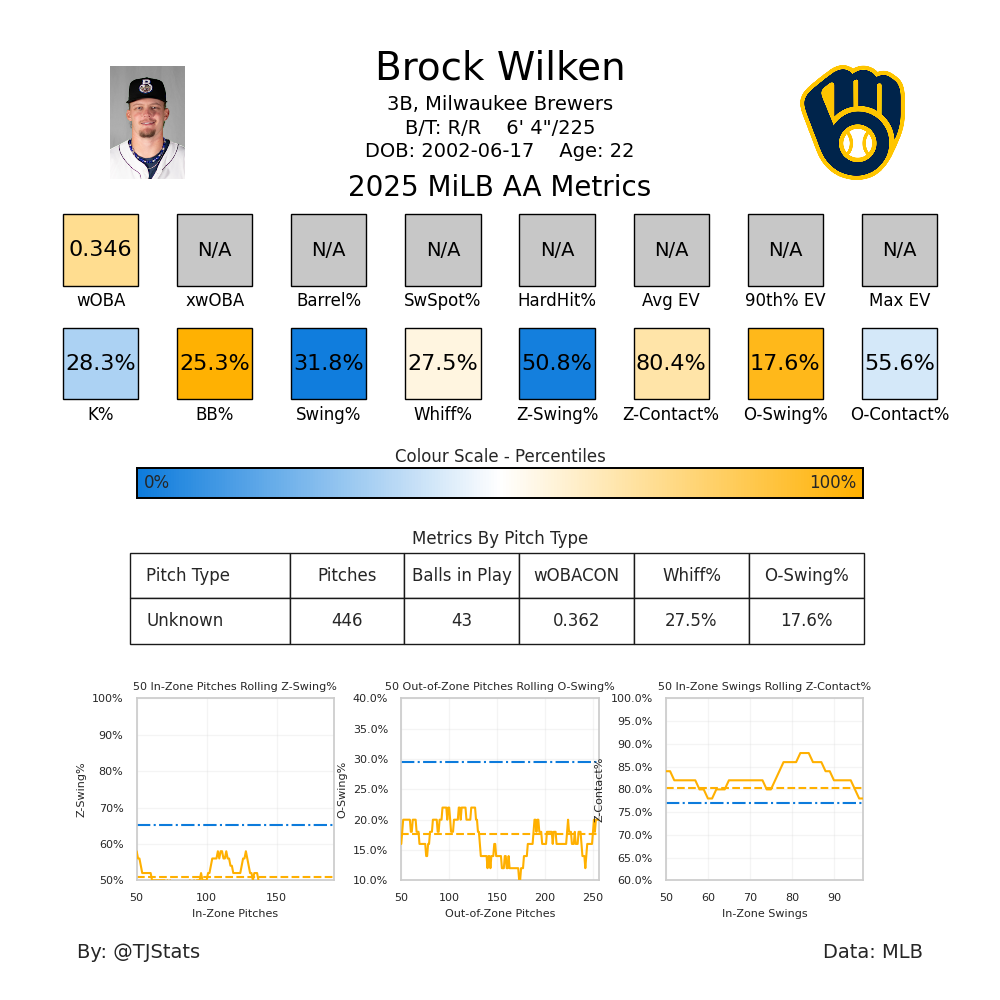
Very weird. Wilken chased too much last year, and evidently this season has decided to take the Luke Adams approach: If you don't swing, you won't chase. The graph in the bottom left is a rolling chart of Wilken's in zone swing rate. It's literally off the chart. Same for pitches outside the zone, and its an approach that's giving him a high overall contact rate north of 80%, but is limiting his ability to hit his way on base and access the raw power that we hoped would be his calling card
-
It does, however that would be quite a marginal change to factor in compared to a jump of almost.200 points between each category. Just to be clear, I'm not saying hard hit grounders are awful, more that the levels the Brewers are doing it at currently is not sustainable to be a productive offense, and especially not from players who they're heavily relying on providing that long ball threat (both of whom are hitting more ground balls than ever)
-
Oh Lordy... I thought the muddies were down and out after Jack seplings had two down and two strikes in the 11th before walking and hitting batters galore , a 2 RBI double and a 6-3 deficit for the cats bottom of the 11th... Walling single RBi Walker HBP Lameda single RBI + error Made roasts a ball to the opposite field high off the wall for what's likely a double/triple bar the circumstances on the first pitch. Mudcats walk it off! I think Made might be good guys
-
Statistically, it is less productive on the whole, and the more productive any outcome can be on a one to one basis, the less streaky it will be. For example, a hitter hitting .900 is less streaky because it's unlikely two outs follow simultaneously (10%×10%=1%) whereas a .200 hitter is more likely to miss 20 times in a row before that .900 hitter misses twice (80%×80%^20) As fly balls and line drives are statistically more productive, they are also less streaky. Line drives had a WoBA of .640, Fly balls of .420 and ground balls of .228 in 2024n I'll go back into my nerd cave 😂
-
Di Turi comes through, down to his last strike! Laces one to left field and Payne ties us up at 3-3
-
Bitonti rocketed a loner up the middle, right at the shortstop behind the bag and somehow Payne managed to avoid getting doubled off. Good IQ from the 1st rounder
-
Thankfully facing two struggling early hitters , Hodges has indeed clambered out of a jam! Top of the mudcats! Made on deck as lameda leads off the ninth
-
My first time seeing Caden Vire, that fastball has some LIFE! Falls off a little, you can see where the control issues come from, but the fastball looks tight
-
Make that seven strikeouts in four innings on 64 pitches. Some ground balls and bloops got through in the fourth inning as well as a walk in a full count, but another finishing move on the high heater closed out the inning with the bases load. It'll be interesting to see if he's allowed to go into the fifth (62 pitches in his last outing)
-
Meccage with his sixth strikeout on a high heater at 97 mph. Tasty for a 19 year old
-
Make that three innings on four K's. Since that first pitch, nothing has been hit hard and his command seems on point
-
Bryce Meccage is absolutely dealing. Bar a hanging slider on his first pitch, he's been comfortable throwing everything in any count. The fastball plays really, really nicely up in the One, and the curveball is getting all sorts of uncomfortable swings. Really professional looking approach to mixing pitches too, setting em up and putting them away quickly. More swing and miss than previous outings so far, 4 K's through the first two innings. Worth a watch!
-
True! My issue is less with the runs, and more the streakiness of them. Inherently that is part of baseball, and putting balls in play will help that in some regard. For example, I think it's probably a good thing Frelick is hitting more ground balls, he doesn't have the juice to make as much out of fly balls and we saw a lot of aerial shots pulling up shy of the warning track last season on good contact. For Yelich and Contreras however, increasing already high numbers, the effect is a real knock to the power that this offense is kind of relying on them for. The Brewers, as currently constructed, don't have a lot of sources to clear the fence, and so having Yelich, Contreras and Chourio with good seasons is going to be pivotal to their offensive output. The starting rotation has been pretty nails so far, especially considering the injuries, but the inconsistent nature of how they're pressuring opposing teams in the batters box and relying perhaps too heavily on small ball, infield singles and going base to base in this era (as happened with the white Sox last night) isn't sustainable long term. Funnily enough, when they have gotten under the ball, they've exploded for runs. Very feast or famine (and that's not exactly groundbreaking, it's the same for most teams, air = good) but some more consistency in that regard would be very helpful
-
The Milwaukee Brewers have the second-highest ground ball rate in the majors, a profile creating knock-on effects that reduce their consistency, limit their slugging and result in too many double plays. Can they succeed with this approach? Image courtesy of © Jeff Hanisch-Imagn Images In the first 30 games of the season, the Brewers have a ground ball rate (as a team) of over 50%. That's five percentage points higher than the one they had in 2024. Worse, a lot of those grounders are coming from the hitters in the heart of their order—the veterans most relied upon to produce runs. Almost everyone is seeing a bump in their ground ball rate, already at an elevated level in 2024, and it's killing the offense. Yes, William Contreras and Christian Yelich hit the ball hard enough that their BABIP (batting average on balls in play) is likely to improve, but even so, getting the ball off the ground will help. Through the first month of baseball, the Brewers have been feast-or-famine offensively, showcasing what they can manage when they do elevate the ball versus what happens when they can't—which is to say, getting stymied over and over again. Without elevating the ball, their offensive production will become streaky, dependent on batted-ball luck in all the wrong ways. The question is, without change, is some regression to the mean coming, or will the Brewers simply struggle to produce runs in 2025? Power Is King The Brewers don't have a lot of innate power within their lineup. They were looking to modest but plausible power increases from Christian Yelich, Sal Frelick, Garrett Mitchell and others to collectively replace the power lost due to Willy Adames's departure. The problem is that they can't do that unless these hitters can catch the ball out in front more often. Of the names above, only Mitchell has reduced his ground ball rate (admittedly, aided by being pummelled in the upper third of the strike zone). Four of the top five in the Brewers order on a regular basis are hitting more ground balls than ever. Hitting 60% of pitches on the ground is a recipe for disaster. Hard-hit ones will result in rally-killing double plays for Yelich and Contreras. Frelick's spike has paid off short-term with some batted-ball luck, but it's unlikely to fare so well as the season progresses. When you factor in Jackson Chourio and his swing-happy approach (which brings its own inconsistency), it's clear why the Brewers are struggling to produce pressure and runs from one game to the next. As a unit, the Brewers are over eight percentage points (or a 20% jump) from average in ground ball rate, a category in which they ranked third-highest in 2024 with 45.4%. Rhys Hoskins has arguably provided the highest-quality at-bats, with a high walk rate, low strikeout rate and hardly any ground balls. Can It Be Fixed? The biggest factor that will drive consistency is for one of the players in the heart of the Brewers order to resolve their current issues. The issue with that is that Yelich and Contreras are well-known ground-ball hitters over their careers. Whenever either can get their ground ball rate under 50%, they become a terrifying proposition, but it can be streaky for both of them. It's typically the last thing to come for Yelich when returning from injury, and he struggles to catch it in his sweet spot. Contreras demonstrated in 2024 how he can go from a black hole to a dominant slugger in the flash of an eye. Both have shown improvements so far from their early form, but that's been in the form of less swing-and-miss, rather than a better batted-ball distribution. Enter Chourio, who has chased more than anyone else in the league but Adolis García (min 100 PA)—and has somehow pushed that rate even higher over his recent sample of pitches faced. When pitchers are silly enough to attack Chourio in the strike zone, he's punishing them, but eventually, they'll begin to take the Javier Báez approach and give him nothing near the heart of the plate. Over his last 40 pitches, Chourio is chasing over 50% of the pitches he sees outside the strike zone, and appears to be guessing at the plate. The best quality Chourio has, however, is an ability to adjust and learn more quickly than almost any other player his age. He took two months to suss out pitching last year, and went on a tear beginning when the calendar flipped to June. He'll probably manage to do the same here. His chase rates decreased each year in the minors as he adapted to each level, which makes the current issues something of an anomaly—but not one that we should anticipate he won't overcome. He's never played at a level this long before. He's into rounds of adjustments he's never had to make. If Chourio can force pitchers into his wheelhouse through an improved eye at the plate, he's showing every other sign of a monstrous season. The Brewers need consistency from their big names in the lineup. Can they find it as the months start to warm up, or will a continued series of ground balls derail their offense? Let us know your thoughts in the comments below! View full article
- 10 replies
-
- 2
-
-
- christian yelich
- jackson chourio
- (and 3 more)

