



Jake McKibbin
-
Posts
2,395 -
Joined
-
Last visited
-
Days Won
6
Content Type
Profiles
Forums
Blogs
Events
News
2026 Milwaukee Brewers Top Prospects Ranking
Milwaukee Brewers Videos
2022 Milwaukee Brewers Draft Picks
Milwaukee Brewers Free Agent & Trade Rumors, Notes, & Tidbits
Guides & Resources
2023 Milwaukee Brewers Draft Picks
2024 Milwaukee Brewers Draft Picks
The Milwaukee Brewers Players Project
2025 Milwaukee Brewers Draft Pick Tracker
2026 Milwaukee Brewers Draft Tracker: Picks & Bonuses
Store
Downloads
Gallery
Everything posted by Jake McKibbin
-
Brandon Woodruff's first outing saw him throw 66 pitches of two-run ball, topping out at 95 mph, showcasing his final hurdles and how far he's come since spring training. Here's why you should begin to allow some optimism over Woodruff. Image courtesy of © Curt Hogg / USA TODAY NETWORK via Imagn Images It's a miracle that Brandon Woodruff is where he is at the moment. For most, an injury that can be career-ending, or at least trajectory-altering, has been handled with aplomb by both Woodruff and the medical staff with the Brewers. A revamped shoulder usually affects future mobility and strength within the joint, creating big concerns about whether he would regain the outlier life and carry on his fastballs or the same sharp movement of his breaking pitches again. Medical science has come a long way, but given Woodruff's age and historical shoulder duress, it was possible he would never surpass 94 mph again. He may have still learned how to pitch around that, but we would see a markedly different arm than the one that leads MLB in the 2020s (min 400 IP) for ERA at 2.68. Woodruff, at his best, was an MLB-leading ace. He's beginning to show signs that not only has he rediscovered the pitch shapes and pronation that eluded him in spring (see Jack Stern's excellent article here), but he's even beginning to command an entirely new pitch, one that he's desired since 2023. Let's have a look at the data to see where we should be impressed with Woodruff and where he still has room to grow before returning to the Major Leagues. The Pitch Shapes Before I go too deep, special thanks to Thomas Nestico at TJStats for giving me access to some amazing tools. These tools allowed me to customize Woodruff's pitches manually, which provides you with the insight below. During spring, Brandon Woodruff talked about feeling like his legs weren't always working as intended underneath him, creating an intriguing cut-ride fastball shape. It's not what he would have preferred, but it was something he could have worked with. It seems that the true Woody four-seamer has returned, though, with just a few iterations that cut amongst his 66 pitches. The other fascinating item was the sweeper, showing a strong horizontal movement profile to differentiate it from his slider and curveball, which have historically been very north/south. The sweeper returned a TJStuff+ grade 105, grading at almost 60 on the 20-80 scouting scale per TJStats models. Overall, Woodruff flashed a four-seam fastball that graded out as above average despite averaging just 92.4 mph, alongside a nice movement profile for his changeup, slider, and sweeper, as mentioned above. I cannot stress enough how remarkable that is at this stage of his recovery. The below doesn't include my manually adjusted pitch plots for Woodruff, but it does highlight how his fastball shape roughly coincides with that of his 2023 version. The only thing missing at this point is a couple of ticks of velocity on all of his offerings, and that's entirely to be expected at this stage of his recovery. Woodruff has spoken of how the final part of the rehabilitation process is the "snap," and it's something that just comes one day several months into a return to pitching. With this, we'll hopefully see those final few ticks of velocity across his arsenal while maintaining the same degree of movement across his arsenal; we just don't know when exactly that will be. One final reason for positivity is how Woodruff improved his fastball as the outing went on; his fastball was in the 90-92 mph range for the first half of his outing before finishing more regularly in the 93-94 mph range quite consistently on the four-seamer, and even touching 95 mph with his sinker on his fifth and final strikeout of the evening. Here's how his stuff played out on a rolling 5-pitch TJstuff+ basis in his outing (the four-seamer is in pink): With some further snap to come, this is very impressive from Woodruff and bodes very well for his continued rehab. The one element that will still require some adjustment is his command of his arsenal. Remember, Brandon Woodruff didn't pitch off a mound for almost 18 months. Finding that rhythm and timing in his delivery to enable him to be accurate in locating pitches will take time, and we can see that (from the cutter still appearing at times) his delivery isn't entirely in sync with where it could be. He did get hit relatively hard on Saturday evening to the tune of an Expected Weighted on Base Average on Contact (xWOBACON) of .712, and command was a large reason for that. It's nothing to be concerned about at this point, and with time on the mound continuing to replicate his delivery, that command will return, but for now, that and the "snap" are the only two things of concern for Woodruff. As a result, we can begin to be perhaps more optimistic that maybe, just maybe, Brandon Woodruff can lead this staff as a true rotation ace once more. What did you think of Woodruff's outing? Did you see signs of positivity? Or am I being too optimistic? Let me know your thoughts in the comments below! View full article
-
It's actually one of the best statistics out there in terms of how it correlates with damage and batting average. EMJ has a good launch angle, but he gets a little too far underneath the ball at times vs the optimal 10°-30° angles. Hasnt quite found that sweet spot yet in triple A, but if he does then the threat he poses is just monstrous. It is the main reason he hasn't had more than the one homer so far despite everything else within that profile
-
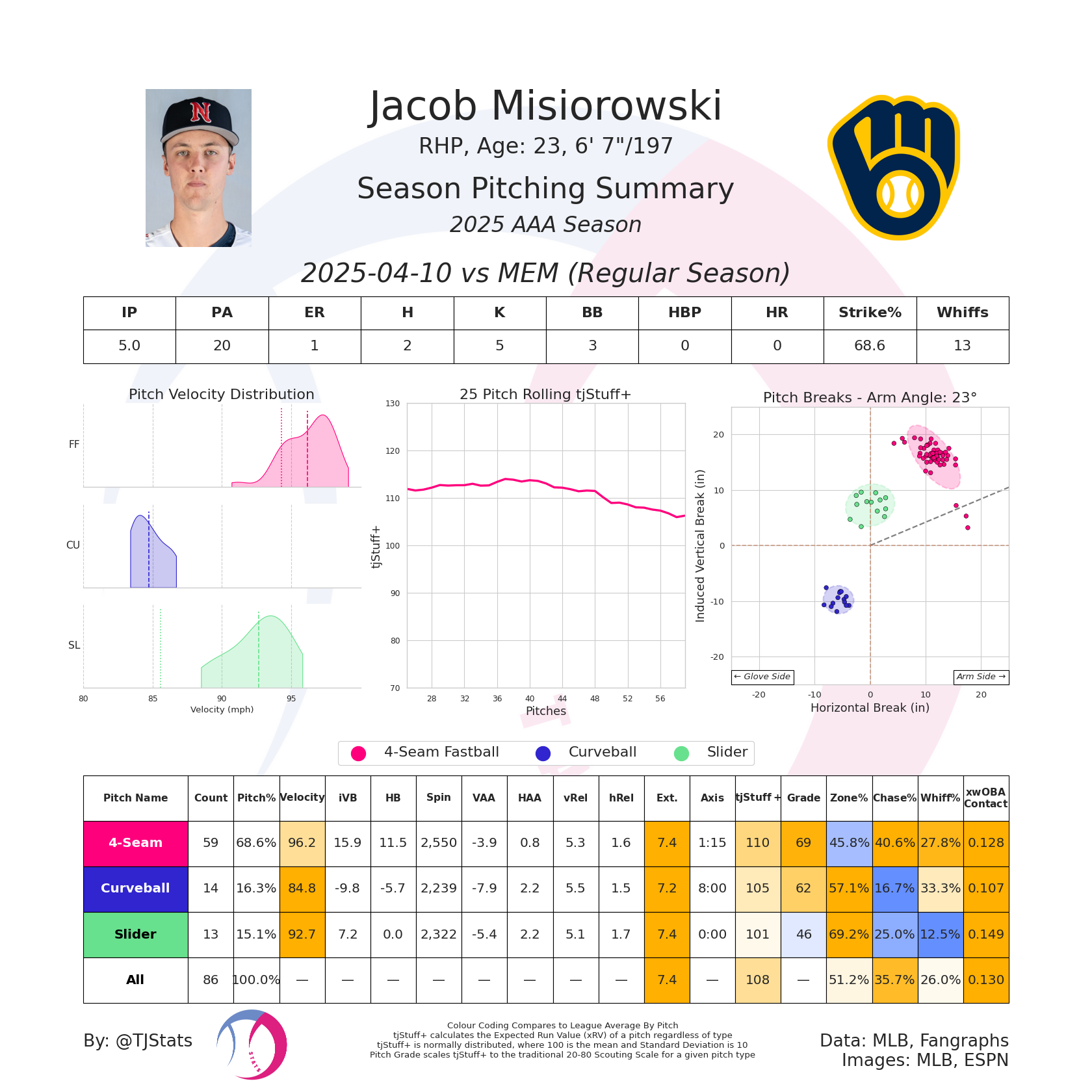
Some fascinating observations in Miz's latest start: That zone % is actually.. average? And he was landing the curveball and slider/cutter quite regularly within it, to minimal quality of contact all around. The changeups are miscategorized as fastballs or now, but even then the average fb velo was down a little but IVB and HB were up a tick. One of the last comments Murphy made about Misiorowski was that he could perhaps lower the velo if it gave him more control and I'm curious if that plays out this season. Regarding that changeup, it grades out very nicely from a stuff+ point of view I would maybe like to see a bigger mix of pitches in his next outing, being less fastball dominant and see if he can keep landing the breaker and cutter/slider for strikes. I feel a couple of the walks manifested from hitters staying on the four seam, and they couldn't square it up but they could foul it off and drag him into some deeper pitch counts. To the eye test, it is looking like a step forward from his 2024 iteration albeit with work still to do
-
It feels like this is just wrong on so many levels. It's just too easy... and he doesn't whiff?!?! EMJ may break my brain
-
The approval of Joseph Zarr is a momentous thing! I'm touched my friend! I very well might have added him if I was able to fight bat speed/ exit velo data for him but unfortunately that's still not available. Absolutely delightful to see him showing some more confidence though for sure!
- 8 replies
-
- 1
-

-
- luis pena
- braylon payne
- (and 1 more)
-
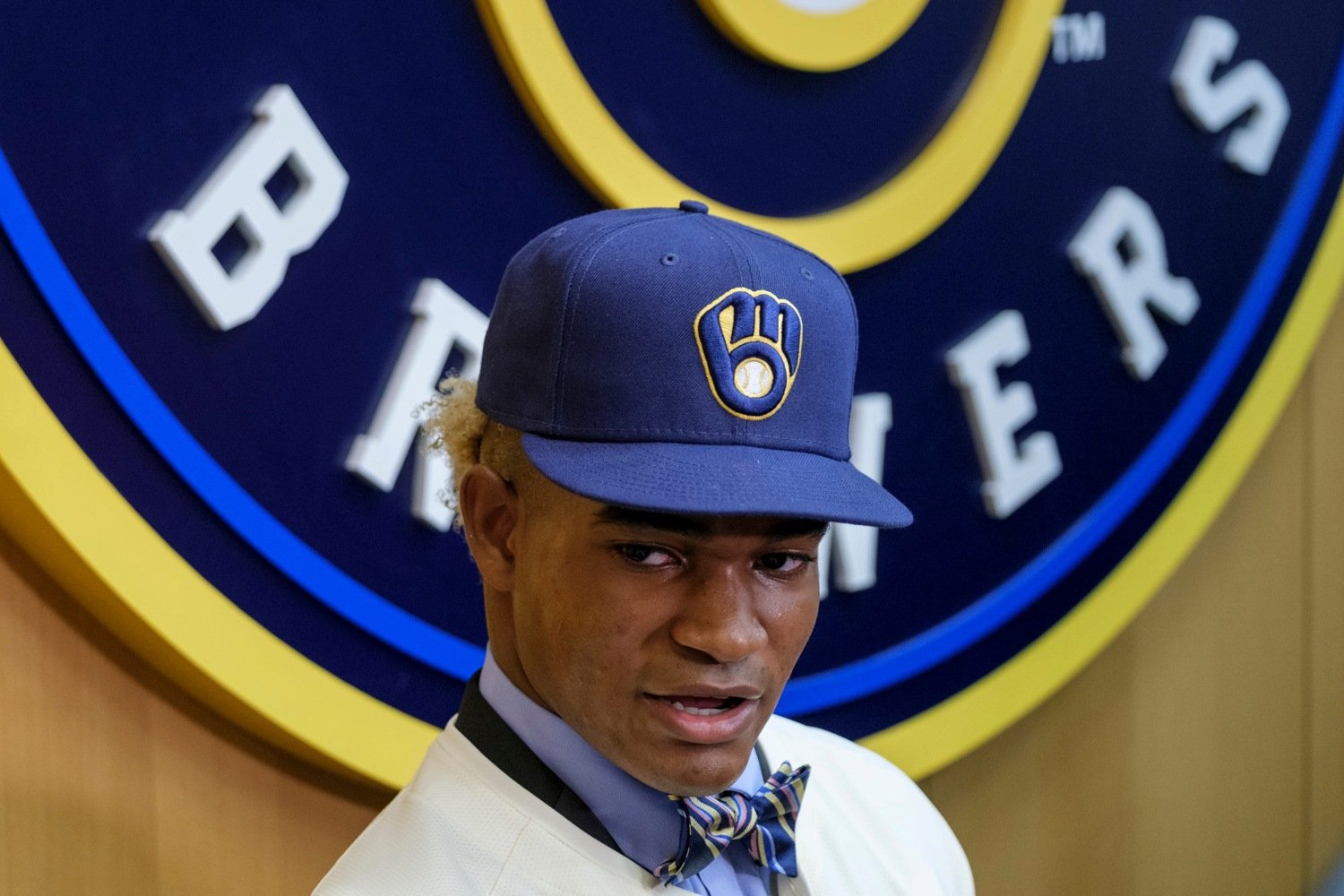 The Carolina Mudcats have one of the most interesting, stacked minor-league rosters going, featuring names like Jesús Made, Luis Peña, Braylon Payne, Eric Bitonti, Josh Adamczewski, Filippo Di Turi and Marco Dinges. All have considerable upside and definitive areas of their game to work on, but three names in particular have already shown considerable strides to begin the 2025 season: Luis Pena Luis Peña entered the season somewhat under the radar, despite being MLB Pipeline's 9th-ranked prospect in the Brewers organization. He actually outperformed Jesús Made in the final line from their rookie DSL seasons, but he showcased some flaws that scared scouts a little bit. The most common one was how regularly he chased pitches outside the strike zone, with one of the most swing-happy approaches in the DSL. Teaching an approach is one of the more difficult things in baseball, and while Peña's contact skills and speed (against weak DSL defenses) allowed him to get away with this approach, the pitching in a full-season affiliate was expected to produce a different challenge. Enter 2025, and Peña's approach is significantly more professional in just the first week of full-season Stateside baseball. Season Level Swing % Contact % 2024 DSL 66.3 78.0 2025 Lo A 41.8 92.9 In the DSL, Peña had a remarkably low 6% first-pitch strike rate, swinging at almost two-thirds of the pitches he saw and making contact 78% of the time. He swung early and often, avoiding striking out as a result—but also not walking a lot and limiting the damage he could do by keeping his swings inside the strike zone. This season, that swing rate has dropped to 41.8%, a much more professional number given the wildness he will see in the lower minor leagues, and his contact rate has soared as a result. A 93% contact rate is exceptional under any circumstances, and even more impressive given that Peña is just 18 years old, away from his family and living in America, with all that that entails. It's been a remarkable showing early on, and has manifested itself in some rocketed balls off the bat. He's yet to strike out for the Mudcats. If Peña can keep this up over the full season (or even maintain a portion of the improvement), they have another superstar to rival Made in their ranks. Josh Adamczewski Adamczewski's swing might be the prettiest in the Brewers system. A 2023 draft pickup in the 15th round, he's yet another graduate from the Ginger Poulson regime. His early showings in complex ball were impressive, but he struck out more than one would expect for his profile since joining the Brewers system. He's always prided himself on his eye at the plate and his ability to put the ball in play. Then, some easy-looking power began to show up at the end of 2024 and had a few sitting up and taking note. Now, Adamczewski has started 2025 with a bang that's showing off all the power and contact you dream of in a bat. Josh Adamczewski always showed a strong eye at the plate in his debut season, but was striking out at an 18% clip in the complex (rising to 24% in a brief sample at Carolina in 2024). There were concerns that the swing-and-miss reflected in his overall contact rate of 72.4% might become more prominent as he moved up the levels. He's dumping all over that so far, with that contact rate soaring up to 87.5% in his first week of 2025. He's wedded that with some impressive, powerful contact. Adamczewski has hit a booming home run, two triples, six singles and four walks in his first four games alone. Early on, because of sample size, contact rates are more useful (due to a larger sample, per swing or per pitch rather than per plate appearance) than strikeout rates, and as such, I'm less worried about the 19% strikeout rate so far. Adamczewski is making contact—hard contact—and still walking at a strong clip, with high-quality plate appearances. On top of that, his defense at second base has been sterling, with the full package leading him to Carolina League Player of the Week honors in their first set of games and setting the bar for some real excitement as 2025 progresses. Chris Clegg has also noticed some changes to his hand position and the overall strength in his frame, which seem to have helped him elevate the ball and be in a better position at the point of contact. It's too early in terms of batted-ball samples to use this as an indicator, but again, it's something to note going forward. Either way, enjoy some clips of Adamczewski mashing courtesy of Brewers Player Development! Braylon Payne The surprise pick of the first round in the 2024 MLB draft, Payne quickly showed that the Brewers knew more than most. Scouts talked about a choppy swing, high ground-ball rates and limited power (despite elite athleticism), which limited his ceiling. In a short four-game sample, however, he did showcase an exit velocity of up to 110 mph. Again, he showed some swing-and-miss in doing so, but he was 17 years old. At 18, he's showing not a single gap in his arsenal. The speed and defensive reads have been strong to start the season, and those will be his bread and butter going forward, but in week one, his bat has also been scorching hot. Payne is slugging .667, with just four swings and misses in 84 pitches (21 plate appearances), combining that with an 18.2% walk rate and just one strikeout. His contact rate, too, has jumped from the mid-70s to almost 89%. Payne hasn't looked overmatched at all. In fact, he's been bullying opposing pitchers. When you're showcasing that contact with this power, you truly have something on your hands. It is one week, but these look like some big steps forward from the incredibly talented teenagers in the Brewers system. I haven't even covered the power showcased by Eric Bitonti, while Made has been kept sidelined by a rolled ankle. The teenagers are one of the most exciting groups of players to follow in the minor leagues, and this type of early showcase should have you even more excited about what's to come for this talented trio. Such changes may not remain intact over a full season. This is a small sample. Yet, it's an exciting one, too. Even if there's some regression at later points in the year, overall, each of these players looks set up to have a big year in 2025. Do you have more confidence in these progressions? Or do you see it all reverting back to type by the end of April? Let us know your thoughts in the comments below!
- 8 comments
-
- 2
-

-
- luis pena
- braylon payne
- (and 1 more)
-
Luis Peña, Josh Adamczewski, and Braylon Payne all entered 2025 with big upside and a specific question to answer. So far, all three are blowing the doors off for the Carolina Mudcats, with considerable progress in the first week of action. Let's take a look at how each has lunged forward. Image courtesy of © Max Correa / The Milwaukee Journal Sentinel / USA TODAY NETWORK The Carolina Mudcats have one of the most interesting, stacked minor-league rosters going, featuring names like Jesús Made, Luis Peña, Braylon Payne, Eric Bitonti, Josh Adamczewski, Filippo Di Turi and Marco Dinges. All have considerable upside and definitive areas of their game to work on, but three names in particular have already shown considerable strides to begin the 2025 season: Luis Pena Luis Peña entered the season somewhat under the radar, despite being MLB Pipeline's 9th-ranked prospect in the Brewers organization. He actually outperformed Jesús Made in the final line from their rookie DSL seasons, but he showcased some flaws that scared scouts a little bit. The most common one was how regularly he chased pitches outside the strike zone, with one of the most swing-happy approaches in the DSL. Teaching an approach is one of the more difficult things in baseball, and while Peña's contact skills and speed (against weak DSL defenses) allowed him to get away with this approach, the pitching in a full-season affiliate was expected to produce a different challenge. Enter 2025, and Peña's approach is significantly more professional in just the first week of full-season Stateside baseball. Season Level Swing % Contact % 2024 DSL 66.3 78.0 2025 Lo A 41.8 92.9 In the DSL, Peña had a remarkably low 6% first-pitch strike rate, swinging at almost two-thirds of the pitches he saw and making contact 78% of the time. He swung early and often, avoiding striking out as a result—but also not walking a lot and limiting the damage he could do by keeping his swings inside the strike zone. This season, that swing rate has dropped to 41.8%, a much more professional number given the wildness he will see in the lower minor leagues, and his contact rate has soared as a result. A 93% contact rate is exceptional under any circumstances, and even more impressive given that Peña is just 18 years old, away from his family and living in America, with all that that entails. It's been a remarkable showing early on, and has manifested itself in some rocketed balls off the bat. He's yet to strike out for the Mudcats. If Peña can keep this up over the full season (or even maintain a portion of the improvement), they have another superstar to rival Made in their ranks. Josh Adamczewski Adamczewski's swing might be the prettiest in the Brewers system. A 2023 draft pickup in the 15th round, he's yet another graduate from the Ginger Poulson regime. His early showings in complex ball were impressive, but he struck out more than one would expect for his profile since joining the Brewers system. He's always prided himself on his eye at the plate and his ability to put the ball in play. Then, some easy-looking power began to show up at the end of 2024 and had a few sitting up and taking note. Now, Adamczewski has started 2025 with a bang that's showing off all the power and contact you dream of in a bat. Josh Adamczewski always showed a strong eye at the plate in his debut season, but was striking out at an 18% clip in the complex (rising to 24% in a brief sample at Carolina in 2024). There were concerns that the swing-and-miss reflected in his overall contact rate of 72.4% might become more prominent as he moved up the levels. He's dumping all over that so far, with that contact rate soaring up to 87.5% in his first week of 2025. He's wedded that with some impressive, powerful contact. Adamczewski has hit a booming home run, two triples, six singles and four walks in his first four games alone. Early on, because of sample size, contact rates are more useful (due to a larger sample, per swing or per pitch rather than per plate appearance) than strikeout rates, and as such, I'm less worried about the 19% strikeout rate so far. Adamczewski is making contact—hard contact—and still walking at a strong clip, with high-quality plate appearances. On top of that, his defense at second base has been sterling, with the full package leading him to Carolina League Player of the Week honors in their first set of games and setting the bar for some real excitement as 2025 progresses. Chris Clegg has also noticed some changes to his hand position and the overall strength in his frame, which seem to have helped him elevate the ball and be in a better position at the point of contact. It's too early in terms of batted-ball samples to use this as an indicator, but again, it's something to note going forward. Either way, enjoy some clips of Adamczewski mashing courtesy of Brewers Player Development! Braylon Payne The surprise pick of the first round in the 2024 MLB draft, Payne quickly showed that the Brewers knew more than most. Scouts talked about a choppy swing, high ground-ball rates and limited power (despite elite athleticism), which limited his ceiling. In a short four-game sample, however, he did showcase an exit velocity of up to 110 mph. Again, he showed some swing-and-miss in doing so, but he was 17 years old. At 18, he's showing not a single gap in his arsenal. The speed and defensive reads have been strong to start the season, and those will be his bread and butter going forward, but in week one, his bat has also been scorching hot. Payne is slugging .667, with just four swings and misses in 84 pitches (21 plate appearances), combining that with an 18.2% walk rate and just one strikeout. His contact rate, too, has jumped from the mid-70s to almost 89%. Payne hasn't looked overmatched at all. In fact, he's been bullying opposing pitchers. When you're showcasing that contact with this power, you truly have something on your hands. It is one week, but these look like some big steps forward from the incredibly talented teenagers in the Brewers system. I haven't even covered the power showcased by Eric Bitonti, while Made has been kept sidelined by a rolled ankle. The teenagers are one of the most exciting groups of players to follow in the minor leagues, and this type of early showcase should have you even more excited about what's to come for this talented trio. Such changes may not remain intact over a full season. This is a small sample. Yet, it's an exciting one, too. Even if there's some regression at later points in the year, overall, each of these players looks set up to have a big year in 2025. Do you have more confidence in these progressions? Or do you see it all reverting back to type by the end of April? Let us know your thoughts in the comments below! View full article
- 8 replies
-
- 5
-
-

-
- luis pena
- braylon payne
- (and 1 more)
-
EBJ with a roped line drive.. nice to see some hard contact off that bat
-
Brock Wilken just missed a bomb foul down the left field line, worked a nice walk in the end and a good AB
-
Ernesto Martinez Jr has an in zone contact rate of over 95%. And a hard hit rate of 60%. This is absurd I do think he generate more top spin that back spin on some of his batted balls, as well as getting underneath them a bit too much early doors but hot damn are the raw tools still LOUD
- 7 replies
-
- 2
-
-
-
- eric bitonti
- josh adamczewski
- (and 3 more)
-
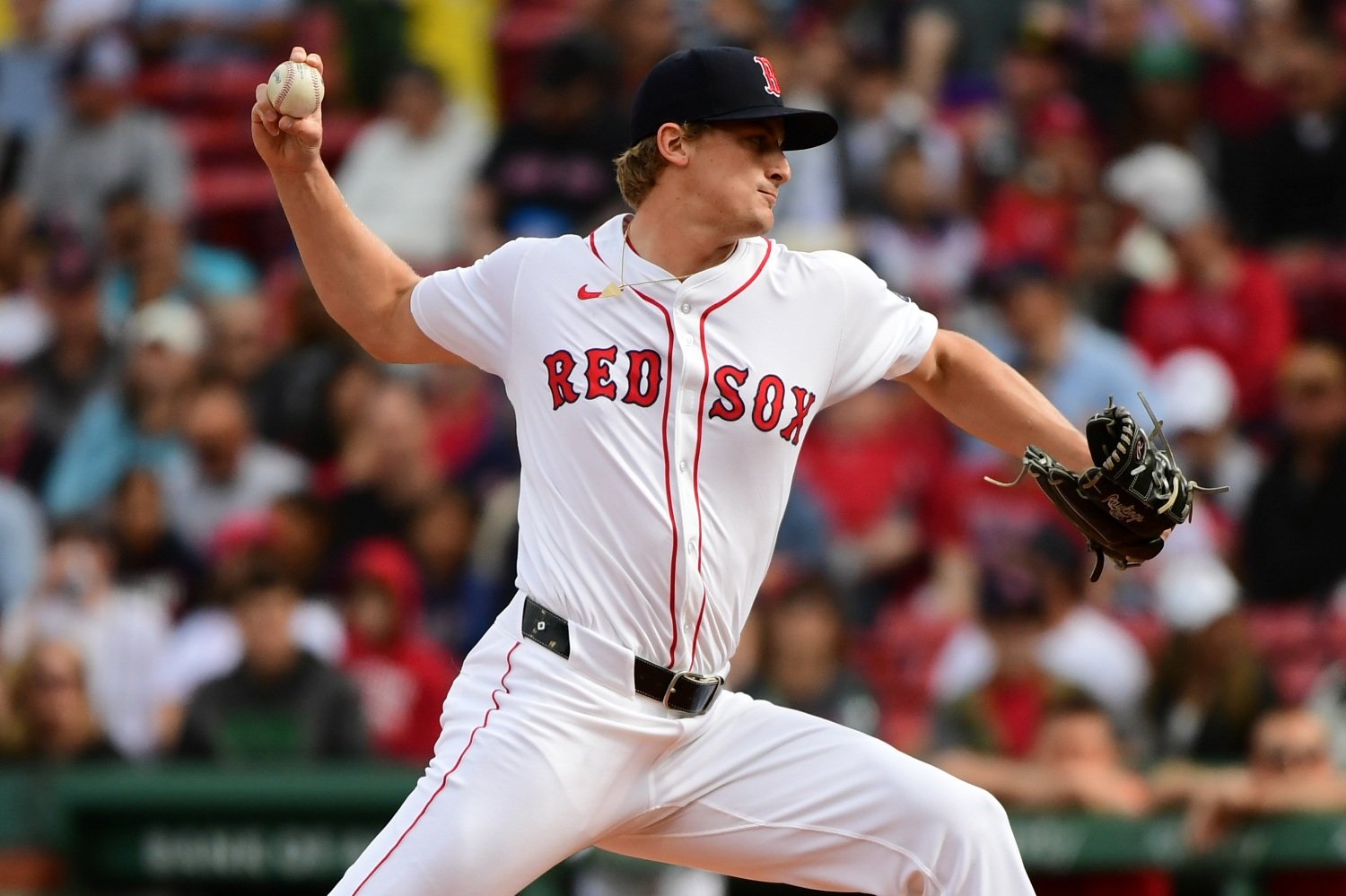 For an organization that prizes draft flexibility, this was a steep price to pay for an arm whom many remember as the struggling talent of the Pittsburgh Pirates. Quinn Priester has a career 6.23 ERA in the big leagues, with 69 strikeouts and 41 walks in 99 2/3 innings. None of those numbers are impressive. Priester hasn't struck out major-league hitters at the rate you want to see. He walks a lot of them, and regularly concedes runs. So why did the Brewers target him? Priester is a former top prospect (and the Brewers love some dusty prospect hype) who saw his arsenal change with the Red Sox after a trade last July. In Boston, they've become notorious for their devaluation of fastballs, particularly four-seamers. Instead, they use cutters and offspeed offerings more often. That's not the same thing as saying that they fail to see the value in throwing hard, though, and even as they've encouraged Priester to make a change in his fastball profile, he's increased his velocity under their watch. For a pitcher who used to sit 92-94 mph, he now averages 95 mph on the sinker and has been touching 97 consistently this spring. In fact, looking at his 2025 arsenal, his velocity is up on every one of his pitches but the changeup, which was already a firm offering at 90mph. The curveball has more speed and less drop, while the changeup and sinker have largely retained the same characteristics, despite the speed bump. However, I'm not sure even that is the value the Brewers see in Priester. Instead, it could be this: The above diagram is from Jeremy Maschino's Pitch Profiler, and considers how one pitch follows another. On the bottom row is the initial pitch, and then on the left is the pitch that follows, with a grade (in which 100 is average) to show how well those two pitches tunnel together in sequence. Maschino's models don't regard Priester as having even close to big-league stuff in his 2024 MLB appearances, However, the velocity improvements on all of his offerings will help that (as Thomas Nestico shows below). I'm also going to hazard a guess that the change in his curveball shape—to a heavier, later-breaking pitch—will help it blend much more effectively with the rest of his arsenal. I've not seen a pitch map like the above for anyone before. Usually, fastball offerings blend well, breaking pitches blend well, but the shape differentiation means that fastball/slider don't always "Match" nicely. Priester's entire arsenal blends together fantastically; it's one big reason why he consistently generates elite chase rates on all of his offerings: The above is Priester's first (and only) start of the season so far, showcasing that deadly sinker/slider combo he possesses, but most intriguing are the chase rates on his three most used pitches. It's a trend that has followed Priester in 2023 and 2024, and I believe the Brewers see something they can harness using the deception that Priester possesses. With the tweaks to his arsenal, he's capable of consistently inducing bad swing decisions. Yophery Rodriguez was the No. 10 prospect on Brewer Fanatic this offseason, with some loud tools and an advanced bat for his age. He performed admirably in Low-A Carolina last year, although some concern did arise on his chase rates. here's what our blurb had to say about him: Rodriguez is just 19 years old, having skipped the complex in Arizona to jump straight into Low-A, but there are concerns he may be a future corner outfielder (albeit a good one, defensively). Whether he can grow into enough power while continuing to control his chase rates as the pitching levels continue to improve is anyone's guess. He's still several years from the major leagues, whereas Priester is ready now, and controllable for six years. Priester for Rodriguez is a deal slightly skewed towards the Brewers, but the Competitive Balance Round A pick the Crew also had to include certainly swings things the other way. It's a big piece to give up, hampering their flexibility in the upcoming draft with how they use their bonus pool allocations. If you choose to think of transactions in these terms, it's fair to say the Red Sox won this trade. Then again, the Red Sox organization was rumored to be high on Priester, and proud of the developments they've overseen in him since he joined their ball club. Combining that with the intelligence of their front office and the desperation of the Brewers to fill their rotation immediately, it was always going to require an overpay. Hindsight could favor either side, as always, but if the Brewers can truly unlock Priester, this could look like a steal. If results continue at the major-league level for him as they have in the past, and Rodriguez goes from strength to strength, it could look like one of the worst Brewers trades in the last decade. Time will tell. What do you think of the Brewers trade? Did they give up too much? let us know your thoughts in the comments below!
 -
The Brewers made a surprise agreement with the Red Sox to bring former top prospect Quinn Priester into their pitching staff, but at a hefty price. Did they overpay, or are there reasons to believe Priester is worth the weight? Image courtesy of © Bob DeChiara-Imagn Images For an organization that prizes draft flexibility, this was a steep price to pay for an arm whom many remember as the struggling talent of the Pittsburgh Pirates. Quinn Priester has a career 6.23 ERA in the big leagues, with 69 strikeouts and 41 walks in 99 2/3 innings. None of those numbers are impressive. Priester hasn't struck out major-league hitters at the rate you want to see. He walks a lot of them, and regularly concedes runs. So why did the Brewers target him? Priester is a former top prospect (and the Brewers love some dusty prospect hype) who saw his arsenal change with the Red Sox after a trade last July. In Boston, they've become notorious for their devaluation of fastballs, particularly four-seamers. Instead, they use cutters and offspeed offerings more often. That's not the same thing as saying that they fail to see the value in throwing hard, though, and even as they've encouraged Priester to make a change in his fastball profile, he's increased his velocity under their watch. For a pitcher who used to sit 92-94 mph, he now averages 95 mph on the sinker and has been touching 97 consistently this spring. In fact, looking at his 2025 arsenal, his velocity is up on every one of his pitches but the changeup, which was already a firm offering at 90mph. The curveball has more speed and less drop, while the changeup and sinker have largely retained the same characteristics, despite the speed bump. However, I'm not sure even that is the value the Brewers see in Priester. Instead, it could be this: The above diagram is from Jeremy Maschino's Pitch Profiler, and considers how one pitch follows another. On the bottom row is the initial pitch, and then on the left is the pitch that follows, with a grade (in which 100 is average) to show how well those two pitches tunnel together in sequence. Maschino's models don't regard Priester as having even close to big-league stuff in his 2024 MLB appearances, However, the velocity improvements on all of his offerings will help that (as Thomas Nestico shows below). I'm also going to hazard a guess that the change in his curveball shape—to a heavier, later-breaking pitch—will help it blend much more effectively with the rest of his arsenal. I've not seen a pitch map like the above for anyone before. Usually, fastball offerings blend well, breaking pitches blend well, but the shape differentiation means that fastball/slider don't always "Match" nicely. Priester's entire arsenal blends together fantastically; it's one big reason why he consistently generates elite chase rates on all of his offerings: The above is Priester's first (and only) start of the season so far, showcasing that deadly sinker/slider combo he possesses, but most intriguing are the chase rates on his three most used pitches. It's a trend that has followed Priester in 2023 and 2024, and I believe the Brewers see something they can harness using the deception that Priester possesses. With the tweaks to his arsenal, he's capable of consistently inducing bad swing decisions. Yophery Rodriguez was the No. 10 prospect on Brewer Fanatic this offseason, with some loud tools and an advanced bat for his age. He performed admirably in Low-A Carolina last year, although some concern did arise on his chase rates. here's what our blurb had to say about him: Rodriguez is just 19 years old, having skipped the complex in Arizona to jump straight into Low-A, but there are concerns he may be a future corner outfielder (albeit a good one, defensively). Whether he can grow into enough power while continuing to control his chase rates as the pitching levels continue to improve is anyone's guess. He's still several years from the major leagues, whereas Priester is ready now, and controllable for six years. Priester for Rodriguez is a deal slightly skewed towards the Brewers, but the Competitive Balance Round A pick the Crew also had to include certainly swings things the other way. It's a big piece to give up, hampering their flexibility in the upcoming draft with how they use their bonus pool allocations. If you choose to think of transactions in these terms, it's fair to say the Red Sox won this trade. Then again, the Red Sox organization was rumored to be high on Priester, and proud of the developments they've overseen in him since he joined their ball club. Combining that with the intelligence of their front office and the desperation of the Brewers to fill their rotation immediately, it was always going to require an overpay. Hindsight could favor either side, as always, but if the Brewers can truly unlock Priester, this could look like a steal. If results continue at the major-league level for him as they have in the past, and Rodriguez goes from strength to strength, it could look like one of the worst Brewers trades in the last decade. Time will tell. What do you think of the Brewers trade? Did they give up too much? let us know your thoughts in the comments below! View full article
-
On the other hand, I was quite impressed with Bryce Meccage. The curveball had a ton of depth and he commanded everything in and around the strike zone beautifully. If that kicks changeup continues to develop he may be a real someone to watch! The command was super impressive given his age
-
 The Brewers are in an interesting position. They've managed to retain just enough top of the rotation upside since the Corbin Burnes, Brandon Woodruff, Freddy Peralta three-headed monster to remain competitive, leaning into deception to capture what they perceive as a market inefficiency. With the age of public stuff+ models (of which the teams will have their own internal, high spec models) we can classify better than ever just how "filthy" each individual pitch truly is. The Brewers have zigged while most others zag, prioritizing a pitchers entire arsenal and how their pitches play off each other over their raw "stuff". Nearly every acquisition in the last two years has been able to throw multiple fastball variations without any of these pitches grading out particularly highly on stuff+ models, with the reason being that these pitches can seem incredibly similar at the point of making a swing decision. The Brewers believe that tunneling (how similar pitches look at the same point a hitter) is distinctly more valuable than the sheer amount said pitch moves after release. Both are valuable in avoiding barrels, but perhaps the Brewers are beginning to go too far in favor of the former. The two biggest contributors to how a pitcher's stuff grades out are how far it moves, and how fast it's thrown. Sandy Alcantara is able to throw sinkers that break two feet horizontally at 99 mph, just one reason why he's so difficult to square up. The Brewers rank in the bottom 10 per FanGraphs for velocity on each of the three fastball variants from their starting pitchers (and consider that their four-seam fastballs average has been boosted by a second Freddy Peralta start), while also throwing significantly more of these pitches than any other team in baseball: So the organization, contrary to the quintessential essence of speed in a fastball, are veering away from this while using them more heavily than any other franchise, throwing them almost 25% more than their closest competitor in second. The Brewers do have some good movement on their offerings, with Peralta and Elvin Rodriguez generating strong induced vertical break (or rising effect) on their four-seamers. Nestor Cortes and Aaron Civale create positive stuff+ grades for their cutters per TJ Stats, but not to the point where you would say a pitcher could lean on that offering (and similar velocity pitches) almost 75% of the time. The plan from the Brewers is not to generate swings and misses, but to miss barrels by small deviations in pitch movement. With their defensive setup, it's almost as good as an out, and a side effect might be how it allows flamethrowers Abner Uribe and Trevor Megill to play up when they enter the game. That being said, staying crafty requires pinpoint execution, and the Brewers do not have the room to miss their spots with the same abandon that, say the Reds can. They already learned that the hard way on opening weekend. I do wonder as well if the Brewers as an organization are leaning too heavily into this setup. While it is advantageous in controlling the overall cost of your starting rotation, one area it shouldn't filter into too heavily is in the products coming through the farm system. Shane Smith was not the stuff+ darling he is now when the 2024 season finished, but he was understandably fatigued by the time he reached Nashville. 2024 was his first season in a starting rotation, something he built up to mid-season — it's to be expected that there may have been more in the tank. If we compare his 2024 season in Nasvhille with how Smith started the year for the White Sox, the improvement is evident: The fastball shape is still sub-par, but this is a pitcher who had shown results, year-on-year improvements and now possesses one of the best changeups in baseball (negative induced vertical break is crazy at 90 mph). They traded this for Connor Thomas, whose main pitch had a scouting grade (per the 20-80 grade for TJ Stats model) of 35. Thomas' main calling card is deception and he uses his entire arsenal to keep hitters off balance while barely averaging 90 mph on his fastball. It's a fair argument to say that the Brewers made this move to reinforce their 2025 bullpen in long relief, and were concerned about the fastball metrics Shane Smith produced. There is validity to this argument. The question is whether their approach to major league free agents is beginning to shift down through their system. I make this point not because I believe either player would have markedly affected the Brewers in 2025 (at least at the time of decision-making), but because the Brewers still need to prioritize swing and miss raw offerings in the farm system wherever possible. The high price of such arms is a deterrent on the free agent market, but they need to keep a steady stream of it flowing through their minor league system in order to retain/upgrade their rotation from the song and dance form it's currently in. For any shape concerns, Smith has shown he can generate swings and misses and also has the fastball velocity to get by on occasion. If Thomas leaves either fastball over the heart of the plate, it's immediate trouble. Simply put, velocity matters. To be a top of the rotation arm, you need that stuff that blows past hitters. Naming the top arms in the sport and you have Garrett Crochet, Paul Skenes, Spencer Strider, Jacob DeGrom, Corbin Burnes, all of whom can reach at least the mid-90s. None of the above Brewers' arms have even a 91 mph fastball offering on average. Jacob Misiorowski and Bishop Letson are two players with the types of fastball that you can build an arsenal around with strong extension off the mound, good rise and high velocity. The Brewers will need more in this mold coming through their system if they aspire to return to that truly dominant pitching staff of yesteryear.
- 3 comments
-
- 2
-
-
- shane smith
- connor thomas
- (and 1 more)
-
The Brewers have a habit of zigging while others zag, and are doing so again in how they target pitchers. It's been an admirable process that has surpassed expectations with lower payrolls, but have they begun to push their cause excessively? Image courtesy of © Thomas Shea-USA TODAY Sports The Brewers are in an interesting position. They've managed to retain just enough top of the rotation upside since the Corbin Burnes, Brandon Woodruff, Freddy Peralta three-headed monster to remain competitive, leaning into deception to capture what they perceive as a market inefficiency. With the age of public stuff+ models (of which the teams will have their own internal, high spec models) we can classify better than ever just how "filthy" each individual pitch truly is. The Brewers have zigged while most others zag, prioritizing a pitchers entire arsenal and how their pitches play off each other over their raw "stuff". Nearly every acquisition in the last two years has been able to throw multiple fastball variations without any of these pitches grading out particularly highly on stuff+ models, with the reason being that these pitches can seem incredibly similar at the point of making a swing decision. The Brewers believe that tunneling (how similar pitches look at the same point a hitter) is distinctly more valuable than the sheer amount said pitch moves after release. Both are valuable in avoiding barrels, but perhaps the Brewers are beginning to go too far in favor of the former. The two biggest contributors to how a pitcher's stuff grades out are how far it moves, and how fast it's thrown. Sandy Alcantara is able to throw sinkers that break two feet horizontally at 99 mph, just one reason why he's so difficult to square up. The Brewers rank in the bottom 10 per FanGraphs for velocity on each of the three fastball variants from their starting pitchers (and consider that their four-seam fastballs average has been boosted by a second Freddy Peralta start), while also throwing significantly more of these pitches than any other team in baseball: So the organization, contrary to the quintessential essence of speed in a fastball, are veering away from this while using them more heavily than any other franchise, throwing them almost 25% more than their closest competitor in second. The Brewers do have some good movement on their offerings, with Peralta and Elvin Rodriguez generating strong induced vertical break (or rising effect) on their four-seamers. Nestor Cortes and Aaron Civale create positive stuff+ grades for their cutters per TJ Stats, but not to the point where you would say a pitcher could lean on that offering (and similar velocity pitches) almost 75% of the time. The plan from the Brewers is not to generate swings and misses, but to miss barrels by small deviations in pitch movement. With their defensive setup, it's almost as good as an out, and a side effect might be how it allows flamethrowers Abner Uribe and Trevor Megill to play up when they enter the game. That being said, staying crafty requires pinpoint execution, and the Brewers do not have the room to miss their spots with the same abandon that, say the Reds can. They already learned that the hard way on opening weekend. I do wonder as well if the Brewers as an organization are leaning too heavily into this setup. While it is advantageous in controlling the overall cost of your starting rotation, one area it shouldn't filter into too heavily is in the products coming through the farm system. Shane Smith was not the stuff+ darling he is now when the 2024 season finished, but he was understandably fatigued by the time he reached Nashville. 2024 was his first season in a starting rotation, something he built up to mid-season — it's to be expected that there may have been more in the tank. If we compare his 2024 season in Nasvhille with how Smith started the year for the White Sox, the improvement is evident: The fastball shape is still sub-par, but this is a pitcher who had shown results, year-on-year improvements and now possesses one of the best changeups in baseball (negative induced vertical break is crazy at 90 mph). They traded this for Connor Thomas, whose main pitch had a scouting grade (per the 20-80 grade for TJ Stats model) of 35. Thomas' main calling card is deception and he uses his entire arsenal to keep hitters off balance while barely averaging 90 mph on his fastball. It's a fair argument to say that the Brewers made this move to reinforce their 2025 bullpen in long relief, and were concerned about the fastball metrics Shane Smith produced. There is validity to this argument. The question is whether their approach to major league free agents is beginning to shift down through their system. I make this point not because I believe either player would have markedly affected the Brewers in 2025 (at least at the time of decision-making), but because the Brewers still need to prioritize swing and miss raw offerings in the farm system wherever possible. The high price of such arms is a deterrent on the free agent market, but they need to keep a steady stream of it flowing through their minor league system in order to retain/upgrade their rotation from the song and dance form it's currently in. For any shape concerns, Smith has shown he can generate swings and misses and also has the fastball velocity to get by on occasion. If Thomas leaves either fastball over the heart of the plate, it's immediate trouble. Simply put, velocity matters. To be a top of the rotation arm, you need that stuff that blows past hitters. Naming the top arms in the sport and you have Garrett Crochet, Paul Skenes, Spencer Strider, Jacob DeGrom, Corbin Burnes, all of whom can reach at least the mid-90s. None of the above Brewers' arms have even a 91 mph fastball offering on average. Jacob Misiorowski and Bishop Letson are two players with the types of fastball that you can build an arsenal around with strong extension off the mound, good rise and high velocity. The Brewers will need more in this mold coming through their system if they aspire to return to that truly dominant pitching staff of yesteryear. View full article
-
Not quite the sports illustrated cover I aspired to create
-
I'd guess it's a simple version not accounting for arm angle. That being said, a lot more low release heights in MLB which has likely reduced the average VAA. It's also a stat that doesn't always work in isolation unless you check the location. Highly affected by where in the zone it's thrown
-
This is quit a difficult thing to measure though I think Jeremy Maschino uses it to calculate his prostuff+ algorithms, it varies a lot depending on the arm angle and release point for each pitcher
-
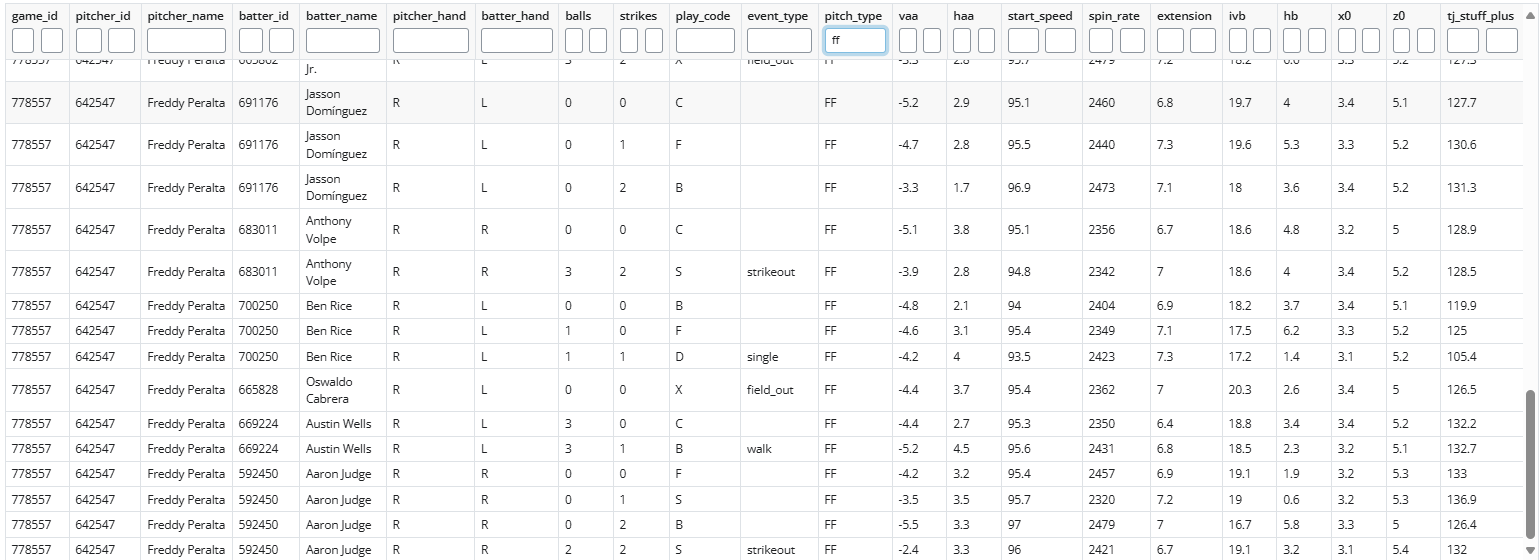
Another fascinating items is the metrics behind each of Peralta's fastballs to finish. To start his outing, he was 5.4-5.5 feet for the most part as a release height, to finish he was more 5-5.2 ft. Also that final fastball to Aaron Judge, just above the strike zone, had a VAA of 2.4. If it was wildly above the zone I'd expect that but its outrageous for that location, including 19"" of IVB That fastball, that's an offering that will do damage
-
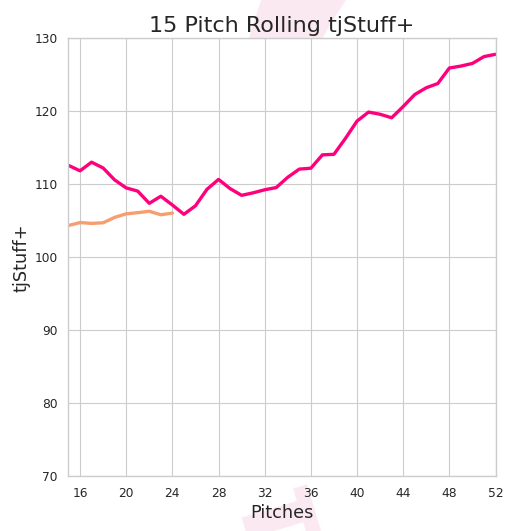
Awesome piece Jack! I hadn't considered the lower extension and its relation to his release height but it actually makes a lot of sense Also intriguing as you mentioned on the fastball is how it appeared to improve as hit outing progressed. Here's his 15 pitch rolling TJstuff+ in pink (orange is the changeup)
-
There's no denying Jackson Chourio has the potential to be a phenom with ludicrous bat speed, foot speed and an underrated hit tool that allow him to challenge for the highest individual award in baseball. Can he achieve such stardom in 2025? Image courtesy of © Mark J. Rebilas-Imagn Images Jackson Chourio lit up the National League as a fresh faced 20-year-old, particularly after his initial adjustment phase. Chourio hit .303/.358/.525 from June 1st on, for a 142 WRC+. He crushed 16 homers and stole 15 bases during that span, although he wasn't especially efficient in swiping bags. Those numbers were exceptional for so young a player. However, if we put Chourio up against the best the league has to offer and remove the age caveat, he shows up more as a "really good" player than a league-leading one. In other words, he's not an MVP contender just yet. So, how can he get there? What does the next step consist of? Pulling The Ball In The Air Chourio's bat speed and dynamite hands allow him to catch the ball deep in the hitting zone and still clear the fences. He can catch it late and hit laser line drives to right field, but that's not the best or most consistent source of his power. As is true of most hitters, Chourio finds most of his pop to the pull side, but he struggled to fully tap into that potential for most of the season. He ranked 235th out of 288 qualified players in elevating the ball to the pull side in 2024, and 55th-lowest for overall ground ball rate. He sent some booming home runs out to left-center field and even took a chunk out of Mark Attanasio's beautiful new scoreboard, but if he can't access that power with more regularity, he may not quite reach the MVP conversation. Chourio learns incredibly quickly, though. For a period of 2 and a half months he really started elevating the ball at a phenomenal rate: Chourio went nuts in July and August, before dropping off a little later in the season. It was his first 162-game season, after all. He showed that he can go off when he finds that elevation. In this two-month stretch, Chourio put the ball in the air almost 58% of the time, a figure that would have taken him from 233rd to 4th place in "Air percentage," had he maintained it over a full season. That's exactly what he's been doing during spring training. Chourio has put the ball in the air almost 60% of time and reaped a ton of extra-base hits as a reward. Most of this has been line-drive contract, something his swing plane is quite conducive to. It allows him to make strong contact with regularity, but he may not be the 40-home run threat many MVP's these days aspire to be. What he can do, instead, is reach some elite overall extra-base hit totals. Chourio has the talent to put up the type of numbers Freddie Freeman achieved in 2023, with 59 doubles and 29 home runs. He may not walk as much as Freeman did, but it would put him in that .950 OPS range that you almost have to be in to claim an award likely contested by Elly De La Cruz, Juan Soto, Shohei Ohtani, Mookie Betts, Corbin Carroll and more. Can He Rack Up Steals? Where Chourio may also have to improve is on the basepaths. Blessed with 97th-percentile speed, he wasn't as efficient or sharp in the stolen base department as one would expect. Chourio was anxious on base overall and seemed hesitant when generating leads. He averaged gaining just 2.6 feet from the base between the pitcher's first move and the pitch being released in all stolen-base opportunities, good for 404th out of 432 base runners. An area that's often defined by inches rather than entire feet, Chourio's actual base running attempts usually started around a foot slower than the likes of Brice Turang and Garrett Mitchell, and almost two feet behind Christian Yelich. With experience (and comfort at the big-league level), Chourio's reads should improve and allow him to be far more productive in the stolen base department. What End-of-Year Numbers Will Put Jackson Chourio In MVP Contention? On the assumption that Shohei Ohtani doesn't pitch to his usual form while maintaining the same offensive output he managed in 2024 (which would make all of this a moot point), I'd guess Chourio will need to have the following: .300 batting average .550 slugging percentage 30+ home runs 40+ doubles 40+ Steals If Chourio gets to spend significant time in center field and accrue WAR that way, he may not need to obtain quite such gaudy numbers, but assuming he stays in left field (and the direct comparison that would bring with Corbin Carroll and Juan Soto), he's going to require some outrageous production to stay in contention. If he can maintain his "elevated" air rates (see what I did there?), he just might manage it. Do you think this is achievable for Jackson Chourio this year? Let us know your thoughts in the comments below! View full article
-
 Jackson Chourio lit up the National League as a fresh faced 20-year-old, particularly after his initial adjustment phase. Chourio hit .303/.358/.525 from June 1st on, for a 142 WRC+. He crushed 16 homers and stole 15 bases during that span, although he wasn't especially efficient in swiping bags. Those numbers were exceptional for so young a player. However, if we put Chourio up against the best the league has to offer and remove the age caveat, he shows up more as a "really good" player than a league-leading one. In other words, he's not an MVP contender just yet. So, how can he get there? What does the next step consist of? Pulling The Ball In The Air Chourio's bat speed and dynamite hands allow him to catch the ball deep in the hitting zone and still clear the fences. He can catch it late and hit laser line drives to right field, but that's not the best or most consistent source of his power. As is true of most hitters, Chourio finds most of his pop to the pull side, but he struggled to fully tap into that potential for most of the season. He ranked 235th out of 288 qualified players in elevating the ball to the pull side in 2024, and 55th-lowest for overall ground ball rate. He sent some booming home runs out to left-center field and even took a chunk out of Mark Attanasio's beautiful new scoreboard, but if he can't access that power with more regularity, he may not quite reach the MVP conversation. Chourio learns incredibly quickly, though. For a period of 2 and a half months he really started elevating the ball at a phenomenal rate: Chourio went nuts in July and August, before dropping off a little later in the season. It was his first 162-game season, after all. He showed that he can go off when he finds that elevation. In this two-month stretch, Chourio put the ball in the air almost 58% of the time, a figure that would have taken him from 233rd to 4th place in "Air percentage," had he maintained it over a full season. That's exactly what he's been doing during spring training. Chourio has put the ball in the air almost 60% of time and reaped a ton of extra-base hits as a reward. Most of this has been line-drive contract, something his swing plane is quite conducive to. It allows him to make strong contact with regularity, but he may not be the 40-home run threat many MVP's these days aspire to be. What he can do, instead, is reach some elite overall extra-base hit totals. Chourio has the talent to put up the type of numbers Freddie Freeman achieved in 2023, with 59 doubles and 29 home runs. He may not walk as much as Freeman did, but it would put him in that .950 OPS range that you almost have to be in to claim an award likely contested by Elly De La Cruz, Juan Soto, Shohei Ohtani, Mookie Betts, Corbin Carroll and more. Can He Rack Up Steals? Where Chourio may also have to improve is on the basepaths. Blessed with 97th-percentile speed, he wasn't as efficient or sharp in the stolen base department as one would expect. Chourio was anxious on base overall and seemed hesitant when generating leads. He averaged gaining just 2.6 feet from the base between the pitcher's first move and the pitch being released in all stolen-base opportunities, good for 404th out of 432 base runners. An area that's often defined by inches rather than entire feet, Chourio's actual base running attempts usually started around a foot slower than the likes of Brice Turang and Garrett Mitchell, and almost two feet behind Christian Yelich. With experience (and comfort at the big-league level), Chourio's reads should improve and allow him to be far more productive in the stolen base department. What End-of-Year Numbers Will Put Jackson Chourio In MVP Contention? On the assumption that Shohei Ohtani doesn't pitch to his usual form while maintaining the same offensive output he managed in 2024 (which would make all of this a moot point), I'd guess Chourio will need to have the following: .300 batting average .550 slugging percentage 30+ home runs 40+ doubles 40+ Steals If Chourio gets to spend significant time in center field and accrue WAR that way, he may not need to obtain quite such gaudy numbers, but assuming he stays in left field (and the direct comparison that would bring with Corbin Carroll and Juan Soto), he's going to require some outrageous production to stay in contention. If he can maintain his "elevated" air rates (see what I did there?), he just might manage it. Do you think this is achievable for Jackson Chourio this year? Let us know your thoughts in the comments below!
 -
Does anyone pay more attention to where on the rubber a pitcher throws from than Matt?
-
He would have more in game power and shade more raw power of using the scouting grades I believe. Ortiz doesn't elevate all that well (and statistically it's easier to hit balls "hard" when pummeling them into the ground), BT if Orti can find a way to elevate more consistently there is pop there. Dunn on the other hand had real swing and miss issues but has shown last year and so far in ST that when he does connect, he's crushing balls. He has big time bat speed and has hit a number of balls 110+ so far this spring (and that's only using statcast data which isn't in many spring training grounds)


