



Jason Wang
-
Posts
955 -
Joined
-
Last visited
-
Days Won
1
Content Type
Profiles
Forums
Blogs
Events
News
2026 Milwaukee Brewers Top Prospects Ranking
Milwaukee Brewers Videos
2022 Milwaukee Brewers Draft Picks
Milwaukee Brewers Free Agent & Trade Rumors, Notes, & Tidbits
Guides & Resources
2023 Milwaukee Brewers Draft Picks
2024 Milwaukee Brewers Draft Picks
The Milwaukee Brewers Players Project
2025 Milwaukee Brewers Draft Pick Tracker
2026 Milwaukee Brewers Draft Tracker: Picks & Bonuses
Store
Downloads
Gallery
Everything posted by Jason Wang
-
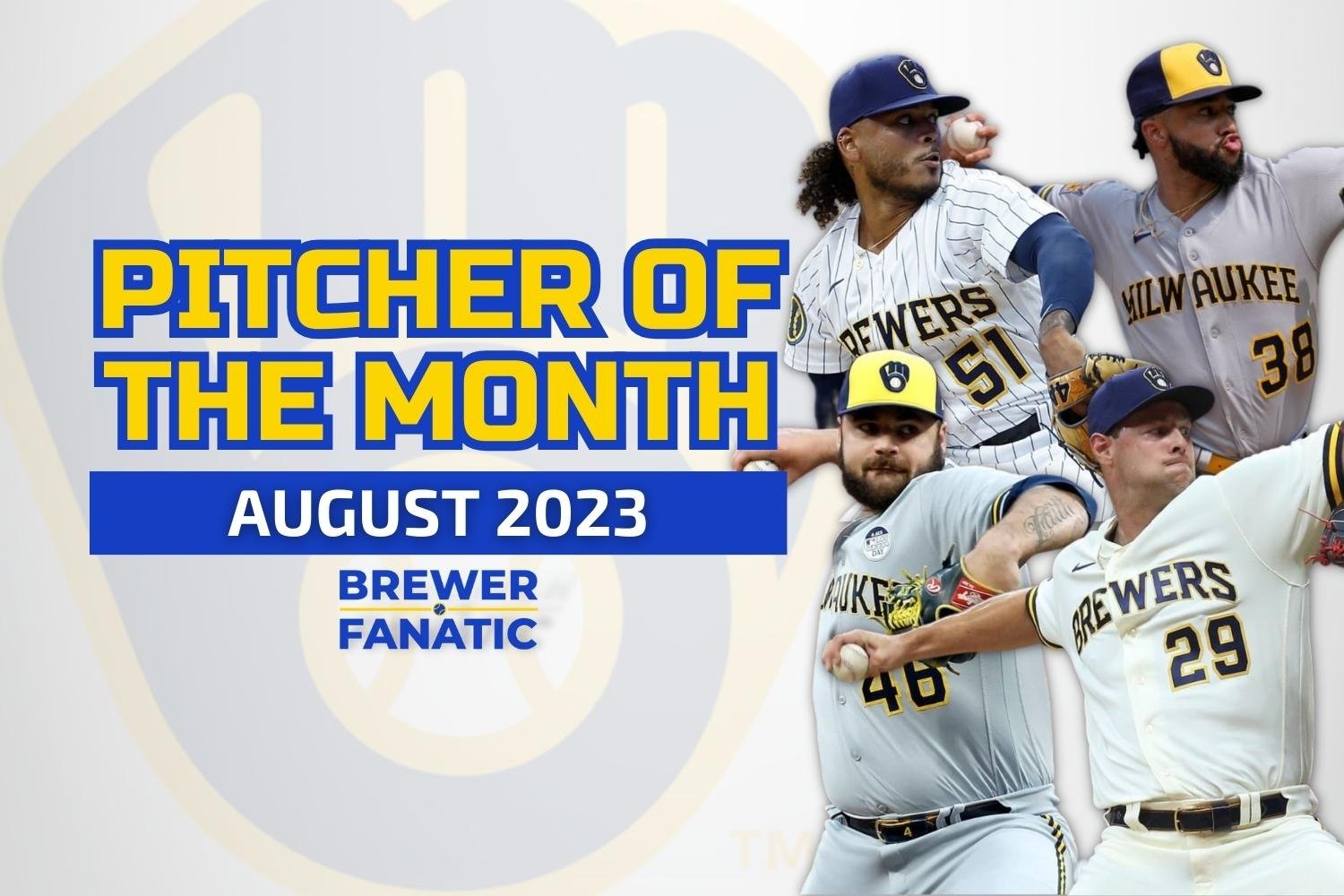 In the month of August, Milwaukee pitchers combined to post a team ERA of 3.36, third best in the big leagues. More impressively, they had the lowest opposing batting average of .206. That being said, some guys pulled their weight more than others. Andrew Chafin struggled immensely out of the bullpen after coming to the team in a trade deadline move and Adrian Houser posted a 5.01 ERA before once again heading to the IL . But enough negativity, who put the team on their back? Honorable Mention Abner Uribe - 14 G, 2.08 ERA, 1.00 WHIP, 13.0 IP, 7 H, 6 BB, 15 K In his second month of major league action, Abner Uribe continued to impress. One of the most exciting up and coming relievers, Uribe is another classic example of a live arm with some control issues. With an average fastball velocity of 99.5 mph and a slider that moves like magic, further development and time spent with the Brewers pitching lab could make him even more lethal than he already is. He also managed to throw the fastest pitch ever thrown by a Brewer in the Statcast era. August Pitchers of the Month #4. Bryse Wilson - 7 G, 1.35 ERA, 0.98 WHIP, 13.1 IP, 10 H, 3 BB, 11 K Bryse Wilson’s value as a long reliever continues to pay dividends for the Brewers, most notably in a game against the Padres on August 27th that saw him pitch four scoreless innings. In total, he made four relief appearances of two innings or more, giving up earned runs in only one of those games. After a rough end to July that saw him concede four runs in one inning against the Braves, this was a great way to bounce back. #3. Devin Williams - 11 G, 1.00 ERA, 0.67 WHIP, 9.0 IP, 3 H, 3 BB, 15 K It’s almost repetitive to continue lauding praise upon one of the best closers in professional baseball, but it’s important to recognize his contributions nonetheless. Along the way to giving up a single earned run all month, Williams recorded five saves and posted his best WHIP figure of his already superlative season. Still heavily dependent on his signature airbender, his opponent batting average on that pitch this season is a pitiful .106, but what do you expect when major-leaguers are struggling to make contact on bunts? #2. Trevor Megill - 6 G, 0.00 ERA, 0.682 WHIP, 7.1 IP, 5 H, 0 BB, 13 K In a surprising twist, Megill went from being optioned to AAA three times this season to having one of the most dominant months a relief pitcher can have. He’s always had intimidating power, averaging a blistering 99.0 mph on his four-seam fastball and sometimes getting into the triple digits, but better placement of his pitches within the zone was largely to credit for his improvement. Rather than dumping all of his pitches right into the heart of the zone like he did in 2021-22, he began to attack the edges of the zone, allowing him to cruise through August without giving up a single run. Matt Trueblood published a great analysis on the changes he made if you want to know more. #1. Freddy Peralta - 5 G, 2.10 ERA, 0.90 WHIP, 30.0 IP, 17 H, 10 BB, 46 K August was the month where we saw what Freddy Peralta is truly capable of. Reminiscent of his 2021 all-star season, Peralta performed spectacularly in his five starts, posting his highest cumulative K/9 and K/W figures of the season at 13.8 and 4.60 respectively. While his last two starts were a little shaky and didn’t see him go a full six-innings, he had three starts that saw him strike out more than nine batters on the way to going 5-0. While the rest of the rotation had somewhat inconsistent performances throughout the month, Freddy Peralta was an unmoving beacon of hope, anchoring the pitching staff every five days.
 -
 The Brewers had their best month since April, going 17-9. A lot of that success was due to the team’s excellent pitching staff, but who stood out in particular? The Brewers had their best month since April, going 17-9. A lot of that success was due to the team’s excellent pitching staff, but who stood out in particular? In the month of August, Milwaukee pitchers combined to post a team ERA of 3.36, third best in the big leagues. More impressively, they had the lowest opposing batting average of .206. That being said, some guys pulled their weight more than others. Andrew Chafin struggled immensely out of the bullpen after coming to the team in a trade deadline move and Adrian Houser posted a 5.01 ERA before once again heading to the IL . But enough negativity, who put the team on their back? Honorable Mention Abner Uribe - 14 G, 2.08 ERA, 1.00 WHIP, 13.0 IP, 7 H, 6 BB, 15 K In his second month of major league action, Abner Uribe continued to impress. One of the most exciting up and coming relievers, Uribe is another classic example of a live arm with some control issues. With an average fastball velocity of 99.5 mph and a slider that moves like magic, further development and time spent with the Brewers pitching lab could make him even more lethal than he already is. He also managed to throw the fastest pitch ever thrown by a Brewer in the Statcast era. August Pitchers of the Month #4. Bryse Wilson - 7 G, 1.35 ERA, 0.98 WHIP, 13.1 IP, 10 H, 3 BB, 11 K Bryse Wilson’s value as a long reliever continues to pay dividends for the Brewers, most notably in a game against the Padres on August 27th that saw him pitch four scoreless innings. In total, he made four relief appearances of two innings or more, giving up earned runs in only one of those games. After a rough end to July that saw him concede four runs in one inning against the Braves, this was a great way to bounce back. #3. Devin Williams - 11 G, 1.00 ERA, 0.67 WHIP, 9.0 IP, 3 H, 3 BB, 15 K It’s almost repetitive to continue lauding praise upon one of the best closers in professional baseball, but it’s important to recognize his contributions nonetheless. Along the way to giving up a single earned run all month, Williams recorded five saves and posted his best WHIP figure of his already superlative season. Still heavily dependent on his signature airbender, his opponent batting average on that pitch this season is a pitiful .106, but what do you expect when major-leaguers are struggling to make contact on bunts? #2. Trevor Megill - 6 G, 0.00 ERA, 0.682 WHIP, 7.1 IP, 5 H, 0 BB, 13 K In a surprising twist, Megill went from being optioned to AAA three times this season to having one of the most dominant months a relief pitcher can have. He’s always had intimidating power, averaging a blistering 99.0 mph on his four-seam fastball and sometimes getting into the triple digits, but better placement of his pitches within the zone was largely to credit for his improvement. Rather than dumping all of his pitches right into the heart of the zone like he did in 2021-22, he began to attack the edges of the zone, allowing him to cruise through August without giving up a single run. Matt Trueblood published a great analysis on the changes he made if you want to know more. #1. Freddy Peralta - 5 G, 2.10 ERA, 0.90 WHIP, 30.0 IP, 17 H, 10 BB, 46 K August was the month where we saw what Freddy Peralta is truly capable of. Reminiscent of his 2021 all-star season, Peralta performed spectacularly in his five starts, posting his highest cumulative K/9 and K/W figures of the season at 13.8 and 4.60 respectively. While his last two starts were a little shaky and didn’t see him go a full six-innings, he had three starts that saw him strike out more than nine batters on the way to going 5-0. While the rest of the rotation had somewhat inconsistent performances throughout the month, Freddy Peralta was an unmoving beacon of hope, anchoring the pitching staff every five days. View full article
- 2 replies
-
- 1
-

-
- freddy peralta
- trevor megill
- (and 3 more)
-
most reasonable yankees fan behavior
-
I think the closest thing to this was that his teammates didn't really have his back in the TA situation, publicly calling for him to apologize and never taking his side. That being said, there was never anything directly controversial that came up and it if it did it wasn't made super public.
-
Brewers Sign Josh Donaldson: Bringer of Rain or Bringer of Pain?
Jason Wang posted an article in Brewers
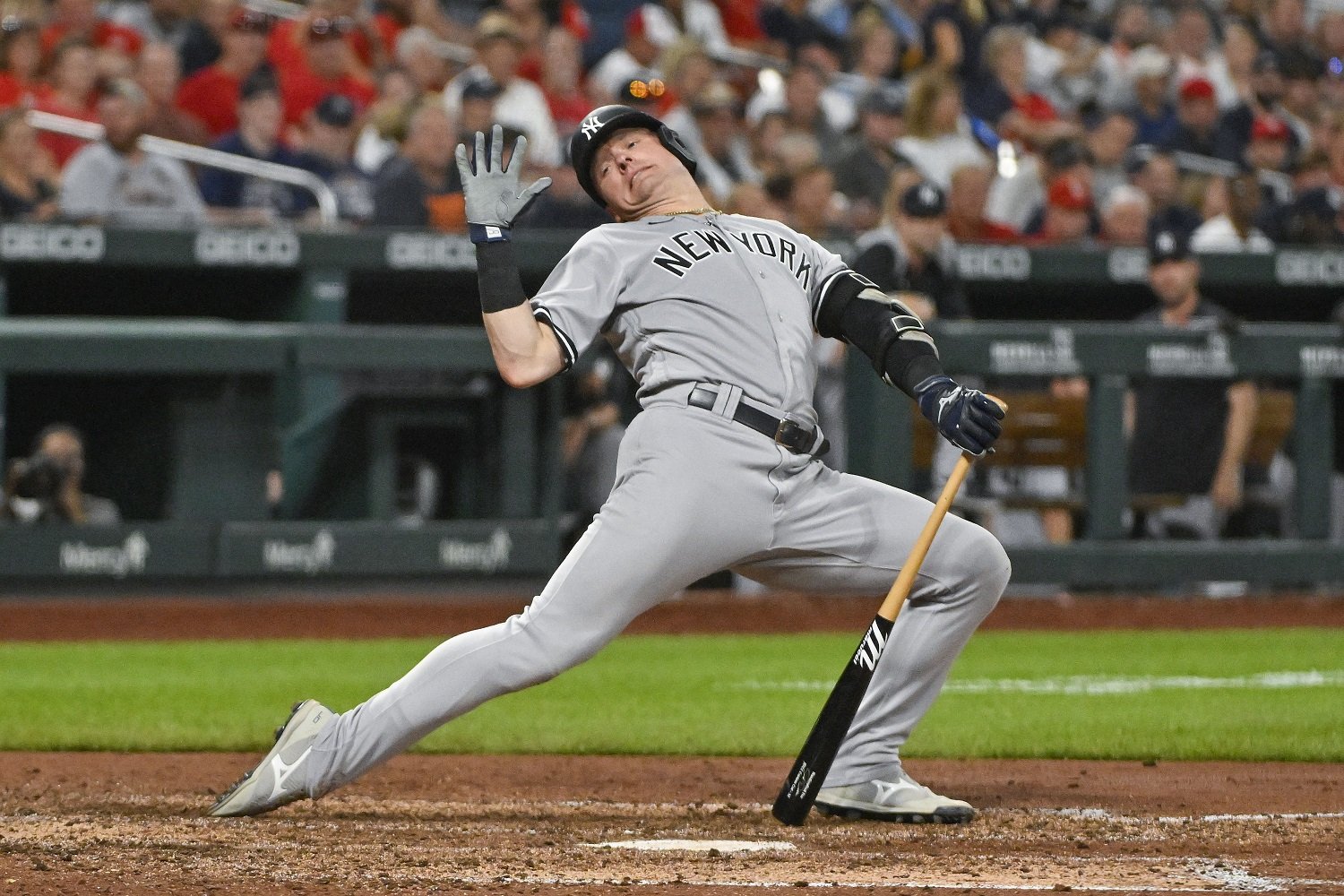 Donaldson of Days Past In the first half of the 2010s, Josh Donaldson was one of the best third basemen in baseball. From 2013-2017, he slashed .282/.377/.524, won three all-star nominations, two silver sluggers, and an MVP award. For his defensive efforts, he won a Fielding Bible award in 2014 and had a total of 17 defensive runs saved over the five-year period. He was one of the game’s most exciting players but he entered the league at a relative old age and was already an injury risk, resulting in him being traded to Cleveland in 2018. That season, he was sidelined by calf and shoulder issues and played in just 52 total games. Surprisingly, he had a career resurgence after joining the Atlanta Braves in 2019, putting up a .900 OPS and winning the NL Comeback Player of the Year award along with receiving some MVP votes. Leveraging this performance, he signed a four-year, $92mm contract with the Minnesota Twins. Two seasons, and a plethora in leg injuries later, he was part of a largely controversial trade to the New York Yankees. The Good If we take a look at purely his past two seasons in New York (he made just 120 plate appearances this season), there are still some positive qualities to speak of. Perhaps the two most standout characteristics of his game that still remain from the past are his exit velocity and defensive ability. In 2022, Donaldson had an average exit velocity of 90.7 mph, better than 81% of the league. This was helped by his 66th percentile barrel rate. While this was actually lower than his career average by about 3 mph, he was making quality contact more often than ever before, logging a career-high sweet-spot percentage of 34.8%. In 2022, Donaldson also had a Defensive Runs Saved (DRS) of 7 and an Outs Above Average (OAA) of 6, third in the American League for both statistics. While not quite as prolific as his National League counterparts, his fielding ability allowed him to make some flashy plays and was definitely better than his cumulative output at the plate. As an added bonus, he’s still walking at a rate of about 10.0%, better than league-average (72nd percentile in 2022). The Bad So if Donaldson hits the ball hard and plays great defense, why was he released by the Yankees? Well the key thing to remember is that Donaldson hit the ball hard, but only when he actually hit the ball, which he didn’t do most of the time. With an incredible 27.1% strikeout rate and a whopping 33.2% whiff rate, Donaldson was missing pitches over the plate so much it became quite the internet meme. He was also only slightly faster than Rowdy Tellez last season, leading to a seventh percentile baserunning run value of -3. This often led to some downright hilarious baserunning gaffes, unless you were a Yankees fan in which case they were immensely infuriating. To make matters worse, he seemed to lean into his feast-or-famine approach in his limited playing in 2023, batting a paltry .142 with just 15 total hits, 10 of which were home runs. So what do you get when you combine a much-too-high strikeout rate with lower exit velocity and snail-like sprint speed? To many in New York, they got a spectacular waste of almost $46mm in salary. The Ugly Outside of performance, Donaldson has been a controversial player since entering the league full-time in 2013. After numerous altercations with the likes of Manny Machado, John Gibbons, Joe Musgrove, and numerous umpires, things came to a head in 2022 when he caused the benches to clear in a game against the White Sox. After greeting Tim Anderson as “Jackie Robinson,” a title Anderson gave himself in a 2019 interview with Bleacher Report, Donaldson’s public perception took an absolute nosedive. Coupled with his underwhelming performance and cocky attitude of bat flipping flyouts and singles, he became one of the least-liked players in all of baseball. There were further reports about his negative presence in the locker room, most recently a report by Jeff Passan that stated that he did not get along with teammates in Minnesota very well at all. So Why Is He A Brewer Now? Third base has been a hole in the Brewers lineup all season. After a white-hot first few weeks, Brian Anderson quickly regressed into a .675 OPS, ceding his top spot in the depth chart to rookie Andruw Monasterio. While Monasterio isn’t necessarily performing criminally, his .685 OPS isn’t much of an improvement. There are a few considerations when looking at the signing of Donaldson. First, it’s a minor-league deal, so Donaldson will only be paid a prorated portion of the major-league minimum salary, significantly less than the $23mm he was receiving before. Second, this signing structure means that he won’t be immediately added to the 40-man roster. All in all, this is an experiment by the Brewers. If he can perform well in a couple of games at the AAA level and show signs of being a potential value-add to the team to bolster one of the weaker parts of their roster, then he will likely be an important part of their playoff push. If not, then they don’t lose much anyway so fans should be more curious than upset about this deal. Who knows, maybe he’ll find a way to help bring rain to the city of Milwaukee.
 -
After being released by the New York Yankees on August 29th, third baseman Josh Donaldson signed a minor-league deal with the Milwaukee Brewers. He’ll be eligible for the team’s postseason roster but why was he signed in the first place? Image courtesy of Jeff Curry-USA TODAY Sports After being released by the New York Yankees on August 29th, third baseman Josh Donaldson signed a minor-league deal with the Milwaukee Brewers. He’ll be eligible for the team’s postseason roster but why was he signed in the first place? Donaldson of Days Past In the first half of the 2010s, Josh Donaldson was one of the best third basemen in baseball. From 2013-2017, he slashed .282/.377/.524, won three all-star nominations, two silver sluggers, and an MVP award. For his defensive efforts, he won a Fielding Bible award in 2014 and had a total of 17 defensive runs saved over the five-year period. He was one of the game’s most exciting players but he entered the league at a relative old age and was already an injury risk, resulting in him being traded to Cleveland in 2018. That season, he was sidelined by calf and shoulder issues and played in just 52 total games. Surprisingly, he had a career resurgence after joining the Atlanta Braves in 2019, putting up a .900 OPS and winning the NL Comeback Player of the Year award along with receiving some MVP votes. Leveraging this performance, he signed a four-year, $92mm contract with the Minnesota Twins. Two seasons, and a plethora in leg injuries later, he was part of a largely controversial trade to the New York Yankees. The Good If we take a look at purely his past two seasons in New York (he made just 120 plate appearances this season), there are still some positive qualities to speak of. Perhaps the two most standout characteristics of his game that still remain from the past are his exit velocity and defensive ability. In 2022, Donaldson had an average exit velocity of 90.7 mph, better than 81% of the league. This was helped by his 66th percentile barrel rate. While this was actually lower than his career average by about 3 mph, he was making quality contact more often than ever before, logging a career-high sweet-spot percentage of 34.8%. In 2022, Donaldson also had a Defensive Runs Saved (DRS) of 7 and an Outs Above Average (OAA) of 6, third in the American League for both statistics. While not quite as prolific as his National League counterparts, his fielding ability allowed him to make some flashy plays and was definitely better than his cumulative output at the plate. As an added bonus, he’s still walking at a rate of about 10.0%, better than league-average (72nd percentile in 2022). The Bad So if Donaldson hits the ball hard and plays great defense, why was he released by the Yankees? Well the key thing to remember is that Donaldson hit the ball hard, but only when he actually hit the ball, which he didn’t do most of the time. With an incredible 27.1% strikeout rate and a whopping 33.2% whiff rate, Donaldson was missing pitches over the plate so much it became quite the internet meme. He was also only slightly faster than Rowdy Tellez last season, leading to a seventh percentile baserunning run value of -3. This often led to some downright hilarious baserunning gaffes, unless you were a Yankees fan in which case they were immensely infuriating. To make matters worse, he seemed to lean into his feast-or-famine approach in his limited playing in 2023, batting a paltry .142 with just 15 total hits, 10 of which were home runs. So what do you get when you combine a much-too-high strikeout rate with lower exit velocity and snail-like sprint speed? To many in New York, they got a spectacular waste of almost $46mm in salary. The Ugly Outside of performance, Donaldson has been a controversial player since entering the league full-time in 2013. After numerous altercations with the likes of Manny Machado, John Gibbons, Joe Musgrove, and numerous umpires, things came to a head in 2022 when he caused the benches to clear in a game against the White Sox. After greeting Tim Anderson as “Jackie Robinson,” a title Anderson gave himself in a 2019 interview with Bleacher Report, Donaldson’s public perception took an absolute nosedive. Coupled with his underwhelming performance and cocky attitude of bat flipping flyouts and singles, he became one of the least-liked players in all of baseball. There were further reports about his negative presence in the locker room, most recently a report by Jeff Passan that stated that he did not get along with teammates in Minnesota very well at all. So Why Is He A Brewer Now? Third base has been a hole in the Brewers lineup all season. After a white-hot first few weeks, Brian Anderson quickly regressed into a .675 OPS, ceding his top spot in the depth chart to rookie Andruw Monasterio. While Monasterio isn’t necessarily performing criminally, his .685 OPS isn’t much of an improvement. There are a few considerations when looking at the signing of Donaldson. First, it’s a minor-league deal, so Donaldson will only be paid a prorated portion of the major-league minimum salary, significantly less than the $23mm he was receiving before. Second, this signing structure means that he won’t be immediately added to the 40-man roster. All in all, this is an experiment by the Brewers. If he can perform well in a couple of games at the AAA level and show signs of being a potential value-add to the team to bolster one of the weaker parts of their roster, then he will likely be an important part of their playoff push. If not, then they don’t lose much anyway so fans should be more curious than upset about this deal. Who knows, maybe he’ll find a way to help bring rain to the city of Milwaukee. View full article
-
In another competitive game, some unfortunate luck in the eighth inning allowed the Cubs to take and maintain a one-run lead. Image courtesy of © Matt Marton-USA TODAY Sports In another competitive game, some unfortunate luck in the eighth inning allowed the Cubs to take and maintain a one-run lead. Box Score Starting Pitcher: Brandon Woodruff - 6.0- IP, 2 H, 2 ER, 1 BB, 8 K, 96 pitches, 64 strikes (66.7%) Home Runs: None Top 3 WPA: Mark Canha (.170), Brandon Woodruff (.066), William Contreras (.066) Bottom 3 WPA: Brice Turang (-.233), Joel Payamps (-.232), Christian Yelich (-.183) Win Probability Chart (via FanGraphs) Woodruff Gets Hit Up But Finishes Strong Similar to Corbin Burnes in the second game of the series, Woodruff made a few mistakes in the first inning to give up the only two earned runs of his start. After walking Mike Tauchman and hitting Nico Hoerner with a pitch, Ian Happ hit a one-run double, and Dansby Swanson hit a sacrifice fly to give the Cubs an early 2-0 lead. Aside from a single by Nico Hoerner and yet another hit by pitch against Ian Happ, both of which happened in the third inning, Brandon Woodruff finally warmed up and became unhittable. He retired his final 11 batters in a row before passing the ball to Elvis Peguero. He got a total of 19 swings and misses, seven from his changeup and eight from his four-seam fastball. He also got 20 called strikes, 11 of which were from his four-seam fastball. Brandon Woodruff has an exceptional 2.70 ERA and a 0.83 WHIP over 40 innings pitched. Brewers Battle Back Milwaukee could only score a single run in the game's first seven innings. After a single and an error put Christian Yelich into scoring position, William Contreras sent him home with a single of his own. Things started to heat up in the eighth inning after Mark Leiter Jr. was brought in to replace Julian Merryweather. After Carlos Santana hit a foul pop-up to record the second out, Sal Frelick started a rally by hitting a single and stealing second base. Following two walks by Willy Adames and Rowdy Tellez to load the bases, Mark Canha got hit by a pitch to send home the tying run. Payamps Has A Tough Eighth After Elvis Peguero had a perfect seventh inning and got three groundouts in a row, Joel Payamps was the next arm to come out of the bullpen. The first batter, Christopher Morel, reached on a fielding error by Willy Adames. Payamps walked the second batter, and a sacrifice bunt moved two Cubs into scoring position. Rowdy Tellez made a great defensive play to get Morel out at the plate. Still, an unfortunate single by Cody Bellinger was deflected off Payamps’ foot in a way that prevented the third out from being made, allowing Mike Tauchmann to score the go-ahead run and Bellinger to reach. Unable to score in the ninth inning, this run would allow the Cubs to win the series' final game. What’s Next? The Brewers will have an off-day before starting their series against the Philadelphia Phillies, where Freddy Peralta will pitch opposite Zack Wheeler. There is some uncertainty regarding the rotation, given Adrian Houser’s recent placement on the IL, so the starter of the second game is still to be determined. Milwaukee still holds a 3.0 game ahead of the Chicago Cubs and a 6.5-game lead over the Cincinnati Reds. Postgame Interviews Bullpen Usage Spreadsheet SAT SUN MON TUE WED TOT B Wilson 0 53 0 0 0 53 Payamps 15 0 16 0 17 48 Peguero 23 0 14 0 7 44 Uribe 0 18 0 17 0 35 Megill 0 32 0 0 0 32 Milner 0 13 18 0 0 31 Williams 14 0 0 0 0 14 Chafin 0 0 0 0 0 0 Tweet Highlight View full article
-
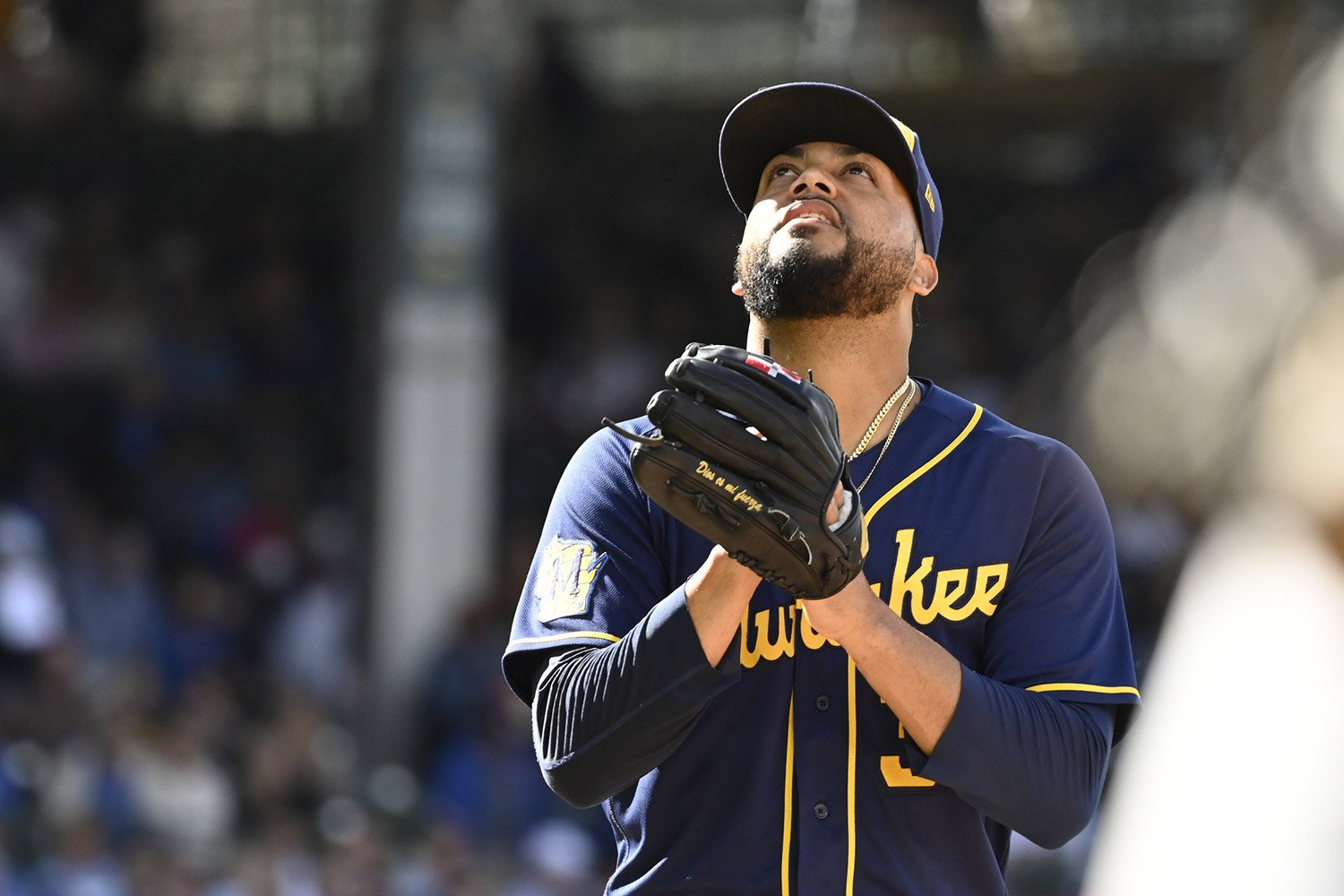 Box Score Starting Pitcher: Brandon Woodruff - 6.0- IP, 2 H, 2 ER, 1 BB, 8 K, 96 pitches, 64 strikes (66.7%) Home Runs: None Top 3 WPA: Mark Canha (.170), Brandon Woodruff (.066), William Contreras (.066) Bottom 3 WPA: Brice Turang (-.233), Joel Payamps (-.232), Christian Yelich (-.183) Win Probability Chart (via FanGraphs) Woodruff Gets Hit Up But Finishes Strong Similar to Corbin Burnes in the second game of the series, Woodruff made a few mistakes in the first inning to give up the only two earned runs of his start. After walking Mike Tauchman and hitting Nico Hoerner with a pitch, Ian Happ hit a one-run double, and Dansby Swanson hit a sacrifice fly to give the Cubs an early 2-0 lead. Aside from a single by Nico Hoerner and yet another hit by pitch against Ian Happ, both of which happened in the third inning, Brandon Woodruff finally warmed up and became unhittable. He retired his final 11 batters in a row before passing the ball to Elvis Peguero. He got a total of 19 swings and misses, seven from his changeup and eight from his four-seam fastball. He also got 20 called strikes, 11 of which were from his four-seam fastball. Brandon Woodruff has an exceptional 2.70 ERA and a 0.83 WHIP over 40 innings pitched. Brewers Battle Back Milwaukee could only score a single run in the game's first seven innings. After a single and an error put Christian Yelich into scoring position, William Contreras sent him home with a single of his own. Things started to heat up in the eighth inning after Mark Leiter Jr. was brought in to replace Julian Merryweather. After Carlos Santana hit a foul pop-up to record the second out, Sal Frelick started a rally by hitting a single and stealing second base. Following two walks by Willy Adames and Rowdy Tellez to load the bases, Mark Canha got hit by a pitch to send home the tying run. Payamps Has A Tough Eighth After Elvis Peguero had a perfect seventh inning and got three groundouts in a row, Joel Payamps was the next arm to come out of the bullpen. The first batter, Christopher Morel, reached on a fielding error by Willy Adames. Payamps walked the second batter, and a sacrifice bunt moved two Cubs into scoring position. Rowdy Tellez made a great defensive play to get Morel out at the plate. Still, an unfortunate single by Cody Bellinger was deflected off Payamps’ foot in a way that prevented the third out from being made, allowing Mike Tauchmann to score the go-ahead run and Bellinger to reach. Unable to score in the ninth inning, this run would allow the Cubs to win the series' final game. What’s Next? The Brewers will have an off-day before starting their series against the Philadelphia Phillies, where Freddy Peralta will pitch opposite Zack Wheeler. There is some uncertainty regarding the rotation, given Adrian Houser’s recent placement on the IL, so the starter of the second game is still to be determined. Milwaukee still holds a 3.0 game ahead of the Chicago Cubs and a 6.5-game lead over the Cincinnati Reds. Postgame Interviews Bullpen Usage Spreadsheet SAT SUN MON TUE WED TOT B Wilson 0 53 0 0 0 53 Payamps 15 0 16 0 17 48 Peguero 23 0 14 0 7 44 Uribe 0 18 0 17 0 35 Megill 0 32 0 0 0 32 Milner 0 13 18 0 0 31 Williams 14 0 0 0 0 14 Chafin 0 0 0 0 0 0 Tweet Highlight
 -
I'm just gonna say it. I'm not going to hide it anymore. Josh Donaldson is one of my favorite active players.
-
The Brewers' hot streak finally comes to a close in a hotly contested pitching matchup between two of the best pitchers in the National League. Image courtesy of © Kamil Krzaczynski-USA TODAY Sports The Brewers' hot streak finally comes to a close in a hotly contested pitching matchup between two of the best pitchers in the National League. Box Score Starting Pitcher: Corbin Burnes - 7.0 IP, 8 H, 1 ER, 2 BB, 7 K, 108 pitches, 70 strikes (64.8%) Home Runs: None Top 3 WPA: Corbin Burnes (.214), Abner Uribe (.031), Christian Yelich (.022) Bottom 3 WPA: Willy Adames (-.227), Tyrone Taylor (-.148), William Contreras (-.099) Win Probability Chart (via FanGraphs) Burnes Has A Bounceback Game After his last outing saw him give up eight hits and six earned runs to the Minnesota Twins, Corbin Burnes bounced back in a strong way. Although he still gave up eight hits, he was able to limit scoring to just one run. It came in the first inning after hitting Nico Hoerner with a pitch and a double by Ian Happ. A subsequent groundout by Cody Bellinger was enough to put the Cubs on the board. Burnes was able to cruise through six scoreless innings afterwards, giving up no more extra base hits and striking out seven. His curveball and cutter were especially effective, combining for 16 called strikes and ten swinging strikes. Burnes currently has a 3.55 ERA and a 1.09 WHIP over 165.0 innings pitched. No Extra Base Hits, No Runs Despite Corbin Burnes’ strong performance, Justin Steele was just a little better. Striking out eight, the Brewers struggled to put up any coordinated offense against the tricky lefty. There was a scoring opportunity in the first inning after a single by Mark Canha and a wild pitch put runners on second and third, but two quick outs would put an end to that. Other than that, the Brewers were simply outmatched. Mustering just one hit in the final three innings, it was just the second time in August that Milwaukee would be shutout. Uribe Steps In To Give The Everyone Else The Day Off Given the extended start by Corbin Burnes and low-scoring, only one inning of pitching relief was needed. Abner Uribe retired the heart of the Cubs lineup in order, striking out Seiya Suzuki along the way. On the bright side, the other relievers were able to get a much-needed day of rest as pitchers such as Bryse Wilson and Trevor Megill have had particularly hefty workloads recently. What’s Next? Brandon Woodruff will toe the slab against Kyle Hendricks in the third and final game of the series before the Brewers head home to host the Philadelphia Phillies in a three-game series. Milwaukee will face the Cubs one last time at the very end of the season. The Brewers currently hold a 4.0 game lead over the Chicago Cubs and a 7.0 game lead over the Cincinnati Reds. Postgame Interviews Bullpen Usage Spreadsheet FRI SAT SUN MON TUE TOT Uribe 19 0 18 0 17 54 B Wilson 0 0 53 0 0 53 Megill 14 0 32 0 0 46 Peguero 0 23 0 14 0 37 Payamps 0 15 0 16 0 31 Milner 0 0 13 18 0 31 Chafin 26 0 0 0 0 26 Williams 0 14 0 0 0 14 Tweet Highlight View full article
-
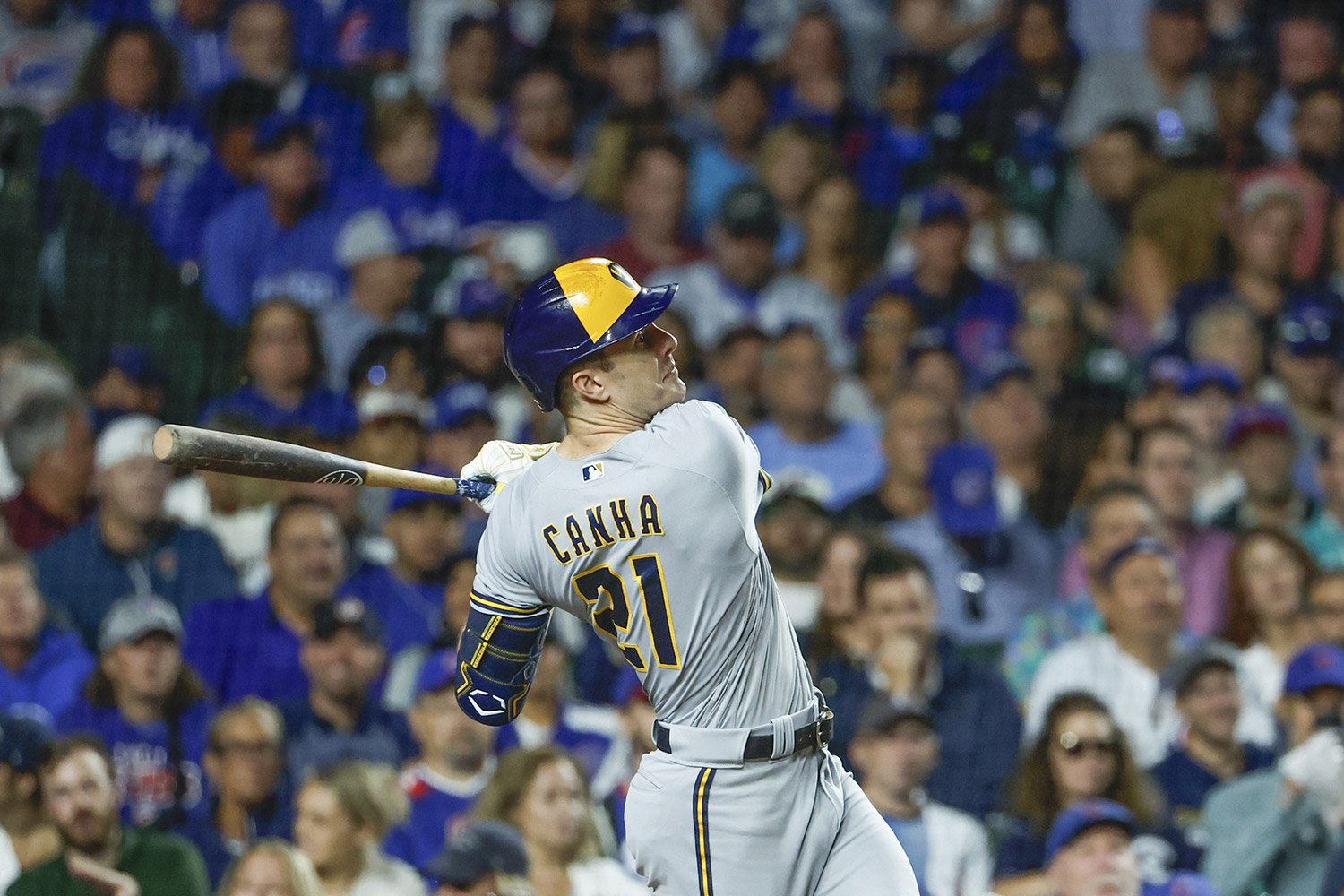 Box Score Starting Pitcher: Corbin Burnes - 7.0 IP, 8 H, 1 ER, 2 BB, 7 K, 108 pitches, 70 strikes (64.8%) Home Runs: None Top 3 WPA: Corbin Burnes (.214), Abner Uribe (.031), Christian Yelich (.022) Bottom 3 WPA: Willy Adames (-.227), Tyrone Taylor (-.148), William Contreras (-.099) Win Probability Chart (via FanGraphs) Burnes Has A Bounceback Game After his last outing saw him give up eight hits and six earned runs to the Minnesota Twins, Corbin Burnes bounced back in a strong way. Although he still gave up eight hits, he was able to limit scoring to just one run. It came in the first inning after hitting Nico Hoerner with a pitch and a double by Ian Happ. A subsequent groundout by Cody Bellinger was enough to put the Cubs on the board. Burnes was able to cruise through six scoreless innings afterwards, giving up no more extra base hits and striking out seven. His curveball and cutter were especially effective, combining for 16 called strikes and ten swinging strikes. Burnes currently has a 3.55 ERA and a 1.09 WHIP over 165.0 innings pitched. No Extra Base Hits, No Runs Despite Corbin Burnes’ strong performance, Justin Steele was just a little better. Striking out eight, the Brewers struggled to put up any coordinated offense against the tricky lefty. There was a scoring opportunity in the first inning after a single by Mark Canha and a wild pitch put runners on second and third, but two quick outs would put an end to that. Other than that, the Brewers were simply outmatched. Mustering just one hit in the final three innings, it was just the second time in August that Milwaukee would be shutout. Uribe Steps In To Give The Everyone Else The Day Off Given the extended start by Corbin Burnes and low-scoring, only one inning of pitching relief was needed. Abner Uribe retired the heart of the Cubs lineup in order, striking out Seiya Suzuki along the way. On the bright side, the other relievers were able to get a much-needed day of rest as pitchers such as Bryse Wilson and Trevor Megill have had particularly hefty workloads recently. What’s Next? Brandon Woodruff will toe the slab against Kyle Hendricks in the third and final game of the series before the Brewers head home to host the Philadelphia Phillies in a three-game series. Milwaukee will face the Cubs one last time at the very end of the season. The Brewers currently hold a 4.0 game lead over the Chicago Cubs and a 7.0 game lead over the Cincinnati Reds. Postgame Interviews Bullpen Usage Spreadsheet FRI SAT SUN MON TUE TOT Uribe 19 0 18 0 17 54 B Wilson 0 0 53 0 0 53 Megill 14 0 32 0 0 46 Peguero 0 23 0 14 0 37 Payamps 0 15 0 16 0 31 Milner 0 0 13 18 0 31 Chafin 26 0 0 0 0 26 Williams 0 14 0 0 0 14 Tweet Highlight
 -
@Matthew Trueblood seeing the Brewers get another win vs. seeing who it was against.

-
The Brewers seem unstoppable. They cruised into Wrigley Field and won their ninth game in a row Monday, making a statement in the process. Image courtesy of © David Banks-USA TODAY Sports The Brewers seem unstoppable. They cruised into Wrigley Field and won their ninth game in a row Monday, making a statement in the process. Box Score Starting Pitcher: Wade Miley - 6.0 IP, 4 H, 2 ER, 0 BB, 1 K, 82 pitches, 50 strikes (61.0%) Home Runs: Christian Yelich (17), Mark Canha (8) Top 3 WPA: Wade Miley (.128), Mark Canha (.108), Willy Adames (.102) Bottom 3 WPA: Tyrone Taylor (-.035), Brice Turang (-.032), Andruw Monasterio (-.006) Win Probability Chart (via FanGraphs) It’s Official - Wade Miley Is Good At Baseball Wade Miley might be your favorite pitcher’s favorite pitcher. He’s efficient, doesn’t use any fancy tricks, and is remarkably consistent. His strikeout rate of 5.8 per nine innings is a ways below the league average mark of 8.7, but his ability to pitch to contact is how he’s kept his ERA to a strong 3.17 over 93 2/3 innings. He put up a quality start against his old team, recording just one strikeout. He did manage to give up two home runs, one to Ian Happ and one to Patrick Wisdom, but these ended up being his only earned runs of the game. It was just his eighth start going six innings or more, an efficient 82-pitch workload allowing him to get there. He averages roughly 75 pitches per start, and at almost 37 years old, he continues to be an important contributor to the Brewers rotation. That being said, I wouldn’t expect him to repeat his 2021 no-hitter, nor would I expect him to have a Stephen Strasburg-type postseason performance anytime soon. Brewers Hit Big Right Off The Bat Milwaukee jumped out to 4-0 lead in the first inning, wasting no time establishing themselves against their division rival. Christian Yelich started things off with a leadoff home run, a 416-foot bomb to left center field. Did I mention this was on the third pitch of the game? After two singles and a sacrifice fly by Rowdy Tellez, Mark Canha took some time off from food blogging and hit a two-run home run to center field. No, Mark Canha is not usually known for his power. Yes, this home run traveled 436 feet and would’ve left the stadium in every ballpark in America. To tack on the team’s fifth run, William Contreras hit a single in the second inning to record his 63rd RBI of the season, just four fewer than team leader Christian Yelich. Finally, Willy Adames continued to tear things up by hitting an RBI double in the seventh inning. He’s slashing .333/.385/.625 over the last 14 days. Cubs Left Dazed And Confused At The Plate In the final three innings, Brewers relievers combined to allow just one walk and one hit. Joel Payamps and Hoby Milner continued to be two of the most underrated relievers in baseball, reducing their already low ERAs to 2.09 and 2.18, respectively. Payamps also had Willy Adames to thank for keeping his hit count to just one with this fancy defensive play. What’s Next? In the second game of the series, Corbin Burnes will face NL Cy Young contender Justin Steele. On the bright side, the Brewers have improved their ability to hit southpaws significantly since earlier in the season. Their team OPS stands at .717, 20th in MLB. Unfortunately, they’ll need all the luck they can get if they want to keep their winning streak alive. Steele is currently one of the best lefties in the sport, boasting a 2.80 ERA and a 1.17 WHIP. The Brewers have pulled five games ahead of the Chicago Cubs and seven games ahead of the Cincinnati Reds. Postgame Interviews Bullpen Usage Spreadsheet THU FRI SAT SUN MON TOT B Wilson 0 0 0 53 0 53 Megill 0 14 0 32 0 46 Uribe 0 19 0 18 0 37 Peguero 0 0 23 0 14 37 Payamps 0 0 15 0 16 31 Milner 0 0 0 13 18 31 Chafin 0 26 0 0 0 26 Williams 0 0 14 0 0 14 Tweet Highlight View full article
-
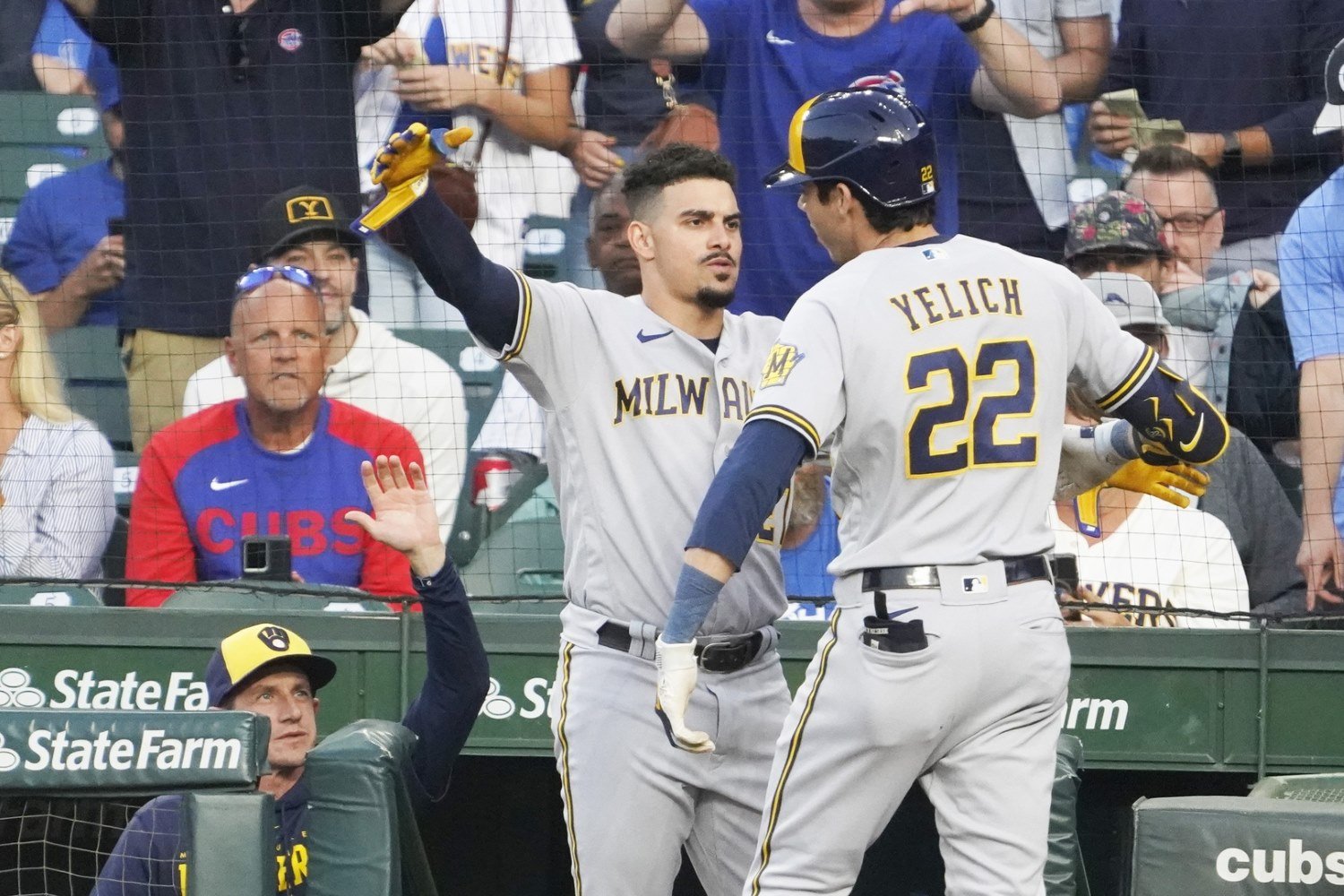 Box Score Starting Pitcher: Wade Miley - 6.0 IP, 4 H, 2 ER, 0 BB, 1 K, 82 pitches, 50 strikes (61.0%) Home Runs: Christian Yelich (17), Mark Canha (8) Top 3 WPA: Wade Miley (.128), Mark Canha (.108), Willy Adames (.102) Bottom 3 WPA: Tyrone Taylor (-.035), Brice Turang (-.032), Andruw Monasterio (-.006) Win Probability Chart (via FanGraphs) It’s Official - Wade Miley Is Good At Baseball Wade Miley might be your favorite pitcher’s favorite pitcher. He’s efficient, doesn’t use any fancy tricks, and is remarkably consistent. His strikeout rate of 5.8 per nine innings is a ways below the league average mark of 8.7, but his ability to pitch to contact is how he’s kept his ERA to a strong 3.17 over 93 2/3 innings. He put up a quality start against his old team, recording just one strikeout. He did manage to give up two home runs, one to Ian Happ and one to Patrick Wisdom, but these ended up being his only earned runs of the game. It was just his eighth start going six innings or more, an efficient 82-pitch workload allowing him to get there. He averages roughly 75 pitches per start, and at almost 37 years old, he continues to be an important contributor to the Brewers rotation. That being said, I wouldn’t expect him to repeat his 2021 no-hitter, nor would I expect him to have a Stephen Strasburg-type postseason performance anytime soon. Brewers Hit Big Right Off The Bat Milwaukee jumped out to 4-0 lead in the first inning, wasting no time establishing themselves against their division rival. Christian Yelich started things off with a leadoff home run, a 416-foot bomb to left center field. Did I mention this was on the third pitch of the game? After two singles and a sacrifice fly by Rowdy Tellez, Mark Canha took some time off from food blogging and hit a two-run home run to center field. No, Mark Canha is not usually known for his power. Yes, this home run traveled 436 feet and would’ve left the stadium in every ballpark in America. To tack on the team’s fifth run, William Contreras hit a single in the second inning to record his 63rd RBI of the season, just four fewer than team leader Christian Yelich. Finally, Willy Adames continued to tear things up by hitting an RBI double in the seventh inning. He’s slashing .333/.385/.625 over the last 14 days. Cubs Left Dazed And Confused At The Plate In the final three innings, Brewers relievers combined to allow just one walk and one hit. Joel Payamps and Hoby Milner continued to be two of the most underrated relievers in baseball, reducing their already low ERAs to 2.09 and 2.18, respectively. Payamps also had Willy Adames to thank for keeping his hit count to just one with this fancy defensive play. What’s Next? In the second game of the series, Corbin Burnes will face NL Cy Young contender Justin Steele. On the bright side, the Brewers have improved their ability to hit southpaws significantly since earlier in the season. Their team OPS stands at .717, 20th in MLB. Unfortunately, they’ll need all the luck they can get if they want to keep their winning streak alive. Steele is currently one of the best lefties in the sport, boasting a 2.80 ERA and a 1.17 WHIP. The Brewers have pulled five games ahead of the Chicago Cubs and seven games ahead of the Cincinnati Reds. Postgame Interviews Bullpen Usage Spreadsheet THU FRI SAT SUN MON TOT B Wilson 0 0 0 53 0 53 Megill 0 14 0 32 0 46 Uribe 0 19 0 18 0 37 Peguero 0 0 23 0 14 37 Payamps 0 0 15 0 16 31 Milner 0 0 0 13 18 31 Chafin 0 26 0 0 0 26 Williams 0 0 14 0 0 14 Tweet Highlight
 -
Rangers starters heading to the dugout after needing 100 pitches to get through four innings

- 1 reply
-
- 1
-

-
- sal frelick
- carlos santana
- (and 3 more)
-
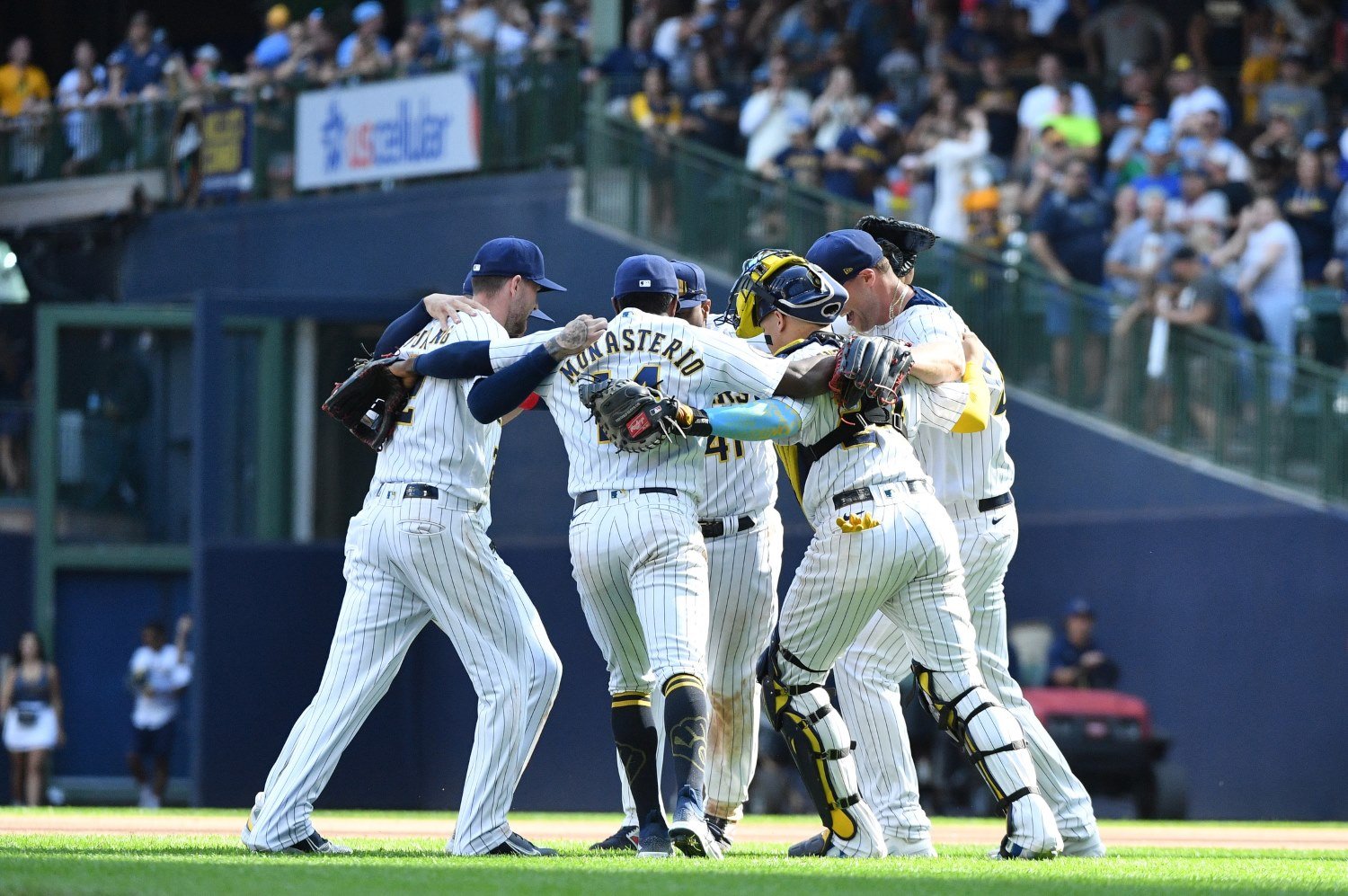 Box Score Starting Pitcher: Adrian Houser - 2.0 IP, 4 H, 4 ER, 1 BB, 2 K, 43 pitches, 29 strikes (67.4%) Home Runs: William Contreras (14) Top 3 WPA: Carlos Santana (.296), Rowdy Tellez (.283), Sal Frelick (.200) Bottom 3 WPA: Adrian Houser (-.303), Abner Uribe (-.218), Willy Adames (-.211) Win Probability Chart (via FanGraphs) Houser Makes It A Bullpen Day Adrian Houser didn’t have the greatest outing of his career. After giving up just one run in the first inning, he gave up three earned runs in the second inning, all of which came from the two home runs he gave up to Gary Sanchez and Matthew Batten. To make matters worse, he left the game early and passed the ball to Bryse Wilson in the third inning, later reporting swelling in his elbow. While it wasn’t in the area of the UCL, according to Craig Counsell, it's yet to be seen whether Houser will be making another trip to the IL this season. Milwaukee Is Here To Mash Heading into the bottom of the sixth inning, the Brewers were down 4-2 with just a 25.7% chance to win the game. Powered by the sheer might of the home crowd and the will to preserve their win streak, they went on a tear, scoring seven runs. After a single and two walks to load the bases, Rowdy Tellez hit a two-run double, his eighth of the year, to tie the game at 4-4. Following an intentional walk of Christian Yelich to again load the bases, Carlos Santana was walked unintentionally to score the go-ahead run. The Padres made a call to the bullpen, bringing in Nick Martinez, but it didn’t stop Sal Frelick from hitting a two-run double, nor Mark Canha from hitting a two-run single, his second hit of the inning. To add an insurance run, Contreras hit yet another double in the seventh inning to score the Brewers’ tenth run, but at this point any additional runs could’ve fairly been interpreted as bullying. Wilson Goes Deep, Uribe Gives Up Two Fulfilling his role as a truly long reliever, Bryse Wilson managed to pitch four shutout innings, giving up just two hits and one walk while striking out four. He threw 53 pitches, a herculean effort for a typical bullpen arm. Abner Uribe had a slightly tougher time, giving up no hits but three walks and two earned runs. He also hit Trent Grisham with a pitch and threw two wild pitches, all without recording a single out. Uribe clearly has a live arm but, like most young players who share the trait, evidently struggles with control from time to time. Hoby Milner and Trevor Megill combined for the final three innings of relief, with Megill striking out five and giving up just three hits. What’s Next? The Brewers are heading to Chicago to take on the division rival Cubs in a potential barn-burner of a series. Wade Miley will take on Jameson Taillon as the Cubs fight to regain ground in the still hotly-contested NL Central. The Brewers are 4.0 games ahead of the Cubs and 6.0 games ahead of the Cincinnati Reds. Postgame Interviews Bullpen Usage Spreadsheet WED THU FRI SAT SUN TOT B Wilson 0 0 0 0 53 53 Uribe 10 0 19 0 18 47 Megill 0 0 14 0 32 46 Payamps 15 0 0 15 0 30 Chafin 0 0 26 0 0 26 Peguero 0 0 0 23 0 23 Williams 0 0 0 14 0 14 Milner 0 0 0 0 13 13 Tweet Highlight
 -
The Brewers' miniature homestand turned into the culmination of a fantastic surge. It wasn't quite easy, but the Padres did give them plenty of chances to make it so. Image courtesy of © Michael McLoone-USA TODAY Sports The Brewers' miniature homestand turned into the culmination of a fantastic surge. It wasn't quite easy, but the Padres did give them plenty of chances to make it so. Box Score Starting Pitcher: Adrian Houser - 2.0 IP, 4 H, 4 ER, 1 BB, 2 K, 43 pitches, 29 strikes (67.4%) Home Runs: William Contreras (14) Top 3 WPA: Carlos Santana (.296), Rowdy Tellez (.283), Sal Frelick (.200) Bottom 3 WPA: Adrian Houser (-.303), Abner Uribe (-.218), Willy Adames (-.211) Win Probability Chart (via FanGraphs) Houser Makes It A Bullpen Day Adrian Houser didn’t have the greatest outing of his career. After giving up just one run in the first inning, he gave up three earned runs in the second inning, all of which came from the two home runs he gave up to Gary Sanchez and Matthew Batten. To make matters worse, he left the game early and passed the ball to Bryse Wilson in the third inning, later reporting swelling in his elbow. While it wasn’t in the area of the UCL, according to Craig Counsell, it's yet to be seen whether Houser will be making another trip to the IL this season. Milwaukee Is Here To Mash Heading into the bottom of the sixth inning, the Brewers were down 4-2 with just a 25.7% chance to win the game. Powered by the sheer might of the home crowd and the will to preserve their win streak, they went on a tear, scoring seven runs. After a single and two walks to load the bases, Rowdy Tellez hit a two-run double, his eighth of the year, to tie the game at 4-4. Following an intentional walk of Christian Yelich to again load the bases, Carlos Santana was walked unintentionally to score the go-ahead run. The Padres made a call to the bullpen, bringing in Nick Martinez, but it didn’t stop Sal Frelick from hitting a two-run double, nor Mark Canha from hitting a two-run single, his second hit of the inning. To add an insurance run, Contreras hit yet another double in the seventh inning to score the Brewers’ tenth run, but at this point any additional runs could’ve fairly been interpreted as bullying. Wilson Goes Deep, Uribe Gives Up Two Fulfilling his role as a truly long reliever, Bryse Wilson managed to pitch four shutout innings, giving up just two hits and one walk while striking out four. He threw 53 pitches, a herculean effort for a typical bullpen arm. Abner Uribe had a slightly tougher time, giving up no hits but three walks and two earned runs. He also hit Trent Grisham with a pitch and threw two wild pitches, all without recording a single out. Uribe clearly has a live arm but, like most young players who share the trait, evidently struggles with control from time to time. Hoby Milner and Trevor Megill combined for the final three innings of relief, with Megill striking out five and giving up just three hits. What’s Next? The Brewers are heading to Chicago to take on the division rival Cubs in a potential barn-burner of a series. Wade Miley will take on Jameson Taillon as the Cubs fight to regain ground in the still hotly-contested NL Central. The Brewers are 4.0 games ahead of the Cubs and 6.0 games ahead of the Cincinnati Reds. Postgame Interviews Bullpen Usage Spreadsheet WED THU FRI SAT SUN TOT B Wilson 0 0 0 0 53 53 Uribe 10 0 19 0 18 47 Megill 0 0 14 0 32 46 Payamps 15 0 0 15 0 30 Chafin 0 0 26 0 0 26 Peguero 0 0 0 23 0 23 Williams 0 0 0 14 0 14 Milner 0 0 0 0 13 13 Tweet Highlight View full article
-
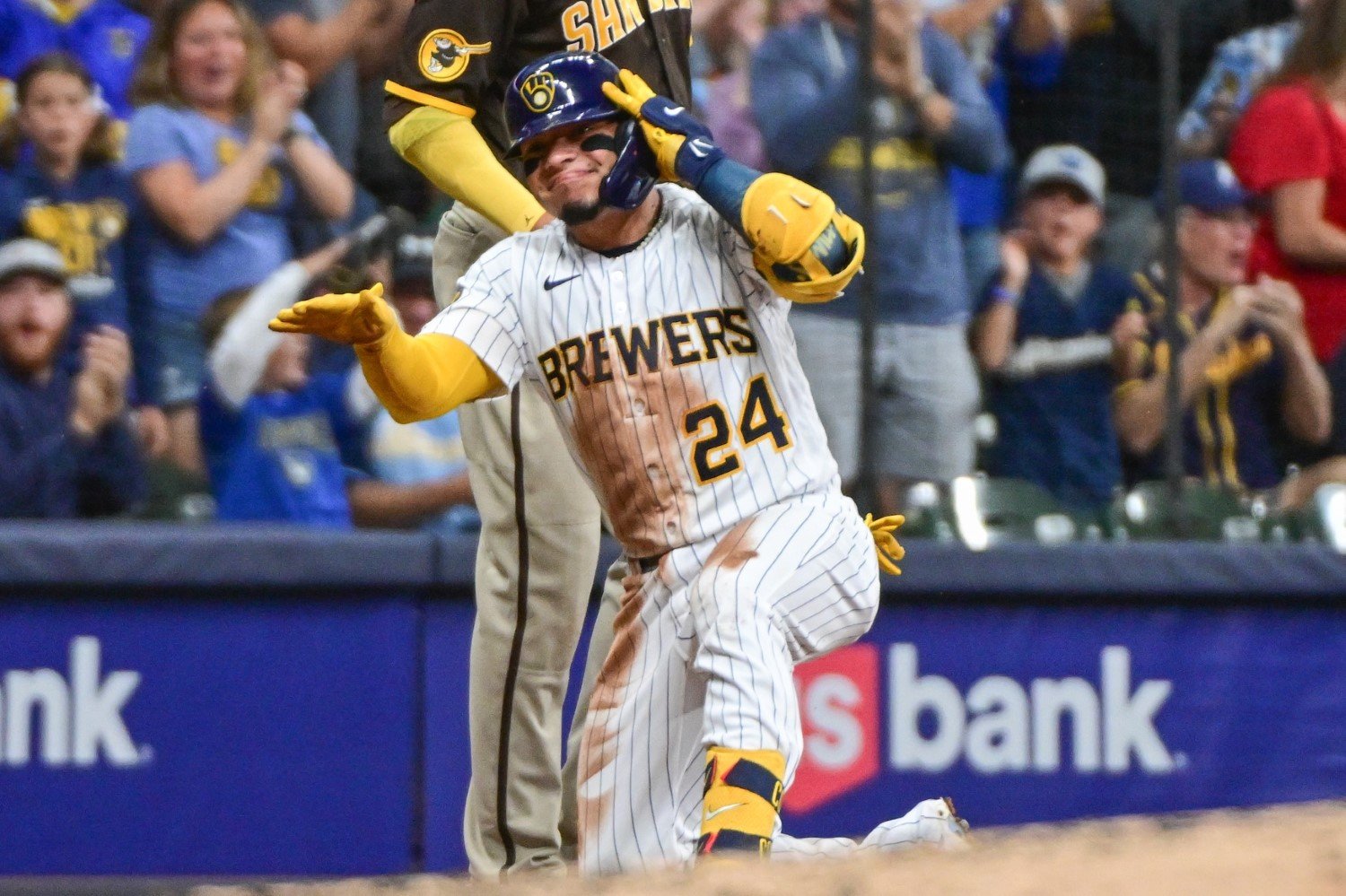 Box Score Starting Pitcher: Freddy Peralta - 5.1 IP, 2 H, 2 ER, 3 BB, 9 K, 94 pitches, 59 strikes (62.8%) Home Runs: None Top 3 WPA: Andruw Monasterio (.281), Devin Williams (.163), Freddy Peralta (.109) Bottom 3 WPA: Christian Yelich (-.138), Joel Payamps (-.062), Sal Frelick (-.054) Win Probability Chart (via FanGraphs) Freddy’s Flashiness Only Goes Five Everyone knows that Freddy Peralta is a strikeout pitcher. He’s got 17 more strikeouts than Corbin Burnes in 25 fewer innings, and twice as many as the next-closest pitcher on the Brewers (Colin Rea has 85). Aside from the somewhat concerning punchout numbers of the rest of the pitching staff, it’s clear that Peralta is the head honcho. Unfortunately, there are two downsides to this aggressive approach: high pitch counts and potentially giving up hard contact. Peralta suffered from both of these. While he recorded 17 swings and misses and nine strikeouts, his pitch count neared 100 before making it through the entire sixth inning, requiring him to be pulled. He also gave up a solo home run to Xander Bogaerts in the second inning. Nonetheless, it was another good day in the office for Peralta, and he continued his recent tear. In his last seven games, he’s sitting at an ERA of 2.85 and a WHIP of 0.98 over 41 innings pitched. Brewers Go For Five In The Fifth After being relatively quiet for the first four innings of the game, Milwaukee finally figured out Padres starter Pedro Avila. Andruw Monasterio hit the team’s third consecutive single of the inning to score Mark Canha and even the tally. Following a double steal by Monasterio and Tyrone Taylor that moved them to third and second bases, a throwing error by catcher Luis Campusano allowed Monasterio to score the team’s second run. Clearly shaken, Avila walked Christian Yelich and gave up a two-run double to William Contreras before departing the game. To make matters worse, a fielding error by Ben Gamel allowed Contreras to make it to third base. To continue the offensive rally, Carlos Santana hit an RBI double off Padres reliever Scott Barlow, who subsequently gave up two walks to load the bases. Due to this offensive outburst, the Brewers entered the sixth inning with a 5-1 lead. Payamps Helps Out The Padres Stepping in to pitch the eighth inning, Joel Payamps got off to a rough start, immediately giving up a single to Fernando Tatis Jr. and a two-run homer to Juan Soto. This brought the Padres within one run, but Payamps was able to retire the next three batters in order, preserving the team's narrow lead. With the game on the line, Devin Williams retired all three batters in the ninth inning and recorded his 31st save of the season, fifth in MLB and third in the NL. What’s Next? In the third and final game of the series, Adrian Houser will try to complete the sweep against Michael Wacha who will be making just his third start since returning from a month-long IL stint. The Brewers hold a 4.0 game lead over the Chicago Cubs and a 5.0 game lead over the Cincinnati Reds. Postgame Interviews Bullpen Usage Spreadsheet TUE WED THU FRI SAT TOT Payamps 0 15 0 0 15 30 Uribe 0 10 0 19 0 29 Chafin 0 0 0 26 0 26 B Wilson 25 0 0 0 0 25 Megill 9 0 0 14 0 23 Peguero 0 0 0 0 23 23 Williams 0 0 0 0 14 14 Milner 12 0 0 0 0 12 Tweet Highlight
 -
A fifth-inning rally and the latest Devin Williams heroics secured the Brewers' seventh straight win Saturday night, as they inch closer to a division title. Image courtesy of © Benny Sieu-USA TODAY Sports A fifth-inning rally and the latest Devin Williams heroics secured the Brewers' seventh straight win Saturday night, as they inch closer to a division title. Box Score Starting Pitcher: Freddy Peralta - 5.1 IP, 2 H, 2 ER, 3 BB, 9 K, 94 pitches, 59 strikes (62.8%) Home Runs: None Top 3 WPA: Andruw Monasterio (.281), Devin Williams (.163), Freddy Peralta (.109) Bottom 3 WPA: Christian Yelich (-.138), Joel Payamps (-.062), Sal Frelick (-.054) Win Probability Chart (via FanGraphs) Freddy’s Flashiness Only Goes Five Everyone knows that Freddy Peralta is a strikeout pitcher. He’s got 17 more strikeouts than Corbin Burnes in 25 fewer innings, and twice as many as the next-closest pitcher on the Brewers (Colin Rea has 85). Aside from the somewhat concerning punchout numbers of the rest of the pitching staff, it’s clear that Peralta is the head honcho. Unfortunately, there are two downsides to this aggressive approach: high pitch counts and potentially giving up hard contact. Peralta suffered from both of these. While he recorded 17 swings and misses and nine strikeouts, his pitch count neared 100 before making it through the entire sixth inning, requiring him to be pulled. He also gave up a solo home run to Xander Bogaerts in the second inning. Nonetheless, it was another good day in the office for Peralta, and he continued his recent tear. In his last seven games, he’s sitting at an ERA of 2.85 and a WHIP of 0.98 over 41 innings pitched. Brewers Go For Five In The Fifth After being relatively quiet for the first four innings of the game, Milwaukee finally figured out Padres starter Pedro Avila. Andruw Monasterio hit the team’s third consecutive single of the inning to score Mark Canha and even the tally. Following a double steal by Monasterio and Tyrone Taylor that moved them to third and second bases, a throwing error by catcher Luis Campusano allowed Monasterio to score the team’s second run. Clearly shaken, Avila walked Christian Yelich and gave up a two-run double to William Contreras before departing the game. To make matters worse, a fielding error by Ben Gamel allowed Contreras to make it to third base. To continue the offensive rally, Carlos Santana hit an RBI double off Padres reliever Scott Barlow, who subsequently gave up two walks to load the bases. Due to this offensive outburst, the Brewers entered the sixth inning with a 5-1 lead. Payamps Helps Out The Padres Stepping in to pitch the eighth inning, Joel Payamps got off to a rough start, immediately giving up a single to Fernando Tatis Jr. and a two-run homer to Juan Soto. This brought the Padres within one run, but Payamps was able to retire the next three batters in order, preserving the team's narrow lead. With the game on the line, Devin Williams retired all three batters in the ninth inning and recorded his 31st save of the season, fifth in MLB and third in the NL. What’s Next? In the third and final game of the series, Adrian Houser will try to complete the sweep against Michael Wacha who will be making just his third start since returning from a month-long IL stint. The Brewers hold a 4.0 game lead over the Chicago Cubs and a 5.0 game lead over the Cincinnati Reds. Postgame Interviews Bullpen Usage Spreadsheet TUE WED THU FRI SAT TOT Payamps 0 15 0 0 15 30 Uribe 0 10 0 19 0 29 Chafin 0 0 0 26 0 26 B Wilson 25 0 0 0 0 25 Megill 9 0 0 14 0 23 Peguero 0 0 0 0 23 23 Williams 0 0 0 0 14 14 Milner 12 0 0 0 0 12 Tweet Highlight View full article
-
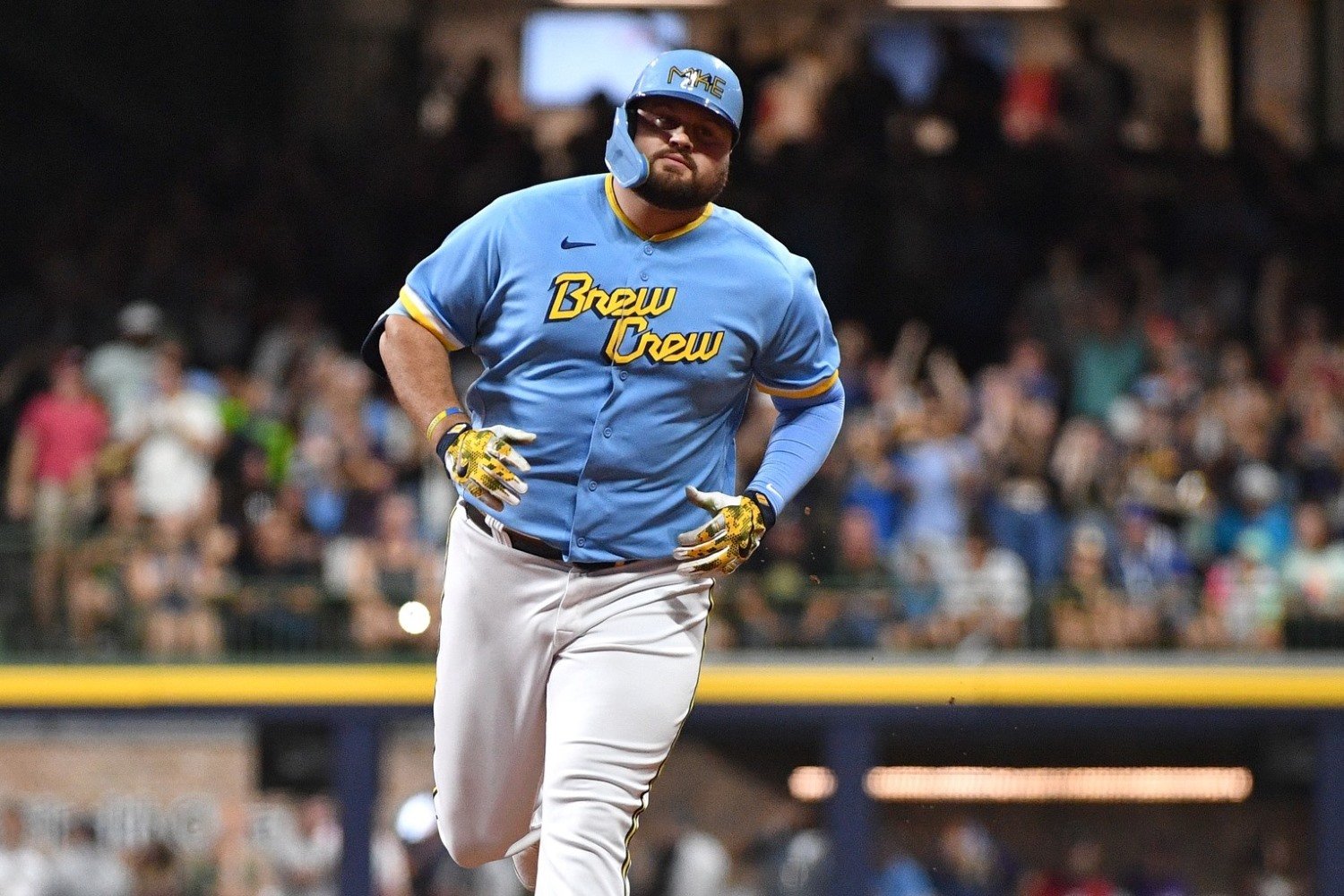 Box Score Starting Pitcher: Brandon Woodruff - 6.0 IP, 3 H, 1 ER, 3 BB, 11 K, 101 pitches, 71 strikes (70.3%) Home Runs: Rowdy Tellez (13) Top 3 WPA: Brandon Woodruff (.212), Rowdy Tellez (.120), Willy Adames (.087) Bottom 3 WPA: Carlos Santana (-.057), Andruw Monasterio (-.025), Andrew Chafin (.003) Win Probability Chart (via FanGraphs) Woodruff Wilds Out Like a diligent employee at your local casino, Brandon Woodruff absolutely dealt against the Padres, striking out 11 batters and giving up just one earned run. Topping out at 98.0 mph on his four-seam fastball, Woodruff simply left the Padres in the dust. His slider was also especially effective, garnering eight called strikes, one swinging strike, and five fouls. Other than a home run to Manny Machado, Woodruff was untouchable. This was his best performance since returning from the IL, and after a hefty 107-pitch workload, I think it’s safe to say that he’s reacclimated to the burdens of a big-league starter. Brewers Get Rowdy In The Third Milwaukee got the scoring started in a big way in the third inning. With two on, William Contreras singled, scoring Brice Turang and chasing Tyrone Taylor around to third base. Willy Adames followed up with a single of his own to score Taylor, continuing his hot hitting streak. To cap things off, Rowdy Tellez hit his first home run since returning from his IL stint, almost gifting a lucky fan with a new Toyota Sequoia. With this three-run homer, the Brewers pulled ahead to 5-0. In the seventh inning, Adames and Tellez would again hit back-to-back RBI singles to score the Brewers’ sixth and seventh runs, respectively. Uribe Continues To Dazzle - Chafin, Not So Much Despite giving up two singles to Jake Cronenworth and Garrett Cooper, Abner Uribe earned three strikeouts, flashing his incredible talent. With a sinker topping out at 100.9 mph and a slider with up to 37 inches of vertical break, is anyone really surprised? While he and Trevor Megill combined for five strikeouts and two scoreless relief innings, Andrew Chafin struggled in the ninth inning, hitting Jake Cronenworth with a pitch and promptly giving up a two-run home run to Gary Sanchez. Luckily he gave up just two earned runs which weren’t nearly enough to make up for the existing deficit, but his ERA and WHIP since joining the Brewers are 12.79 and 1.89 respectively. While pitching just 6 1/3 innings thus far, it’s not the rosiest picture, and he’ll likely be used in lower-leverage situations moving forward. What’s Next? Freddy Peralta will face Pedro Avila in the second game of the series. While Avila has an impressive ERA of just 1.17, he’s also made just one start and pitched a total of 23.0 innings. Peralta, on the other hand, is riding a hot streak of his own, posting a 2.38 ERA and 0.91 WHIP over his last seven games. The Milwaukee Brewers now have a 4.0 game lead over the Chicago Cubs and a 5.0 game lead over the Cincinnati Reds. Postgame Interviews Bullpen Usage Spreadsheet MON TUE WED THU FRI TOT Uribe 0 0 10 0 19 29 Chafin 0 0 0 0 26 26 B Wilson 0 25 0 0 0 25 Megill 0 9 0 0 14 23 Payamps 0 0 15 0 0 15 Milner 0 12 0 0 0 12 Peguero 0 0 0 0 0 0 Williams 0 0 0 0 0 0 Tweet Highlight
 -
Brandon Woodruff and Rowdy Tellez had their best performances since coming back from the injured list Friday night, as the Brewers hung a loss on a long-time nemesis and widened the NL Central lead. Image courtesy of © Michael McLoone-USA TODAY Sports Brandon Woodruff and Rowdy Tellez had their best performances since coming back from the injured list Friday night, as the Brewers hung a loss on a long-time nemesis and widened the NL Central lead. Box Score Starting Pitcher: Brandon Woodruff - 6.0 IP, 3 H, 1 ER, 3 BB, 11 K, 101 pitches, 71 strikes (70.3%) Home Runs: Rowdy Tellez (13) Top 3 WPA: Brandon Woodruff (.212), Rowdy Tellez (.120), Willy Adames (.087) Bottom 3 WPA: Carlos Santana (-.057), Andruw Monasterio (-.025), Andrew Chafin (.003) Win Probability Chart (via FanGraphs) Woodruff Wilds Out Like a diligent employee at your local casino, Brandon Woodruff absolutely dealt against the Padres, striking out 11 batters and giving up just one earned run. Topping out at 98.0 mph on his four-seam fastball, Woodruff simply left the Padres in the dust. His slider was also especially effective, garnering eight called strikes, one swinging strike, and five fouls. Other than a home run to Manny Machado, Woodruff was untouchable. This was his best performance since returning from the IL, and after a hefty 107-pitch workload, I think it’s safe to say that he’s reacclimated to the burdens of a big-league starter. Brewers Get Rowdy In The Third Milwaukee got the scoring started in a big way in the third inning. With two on, William Contreras singled, scoring Brice Turang and chasing Tyrone Taylor around to third base. Willy Adames followed up with a single of his own to score Taylor, continuing his hot hitting streak. To cap things off, Rowdy Tellez hit his first home run since returning from his IL stint, almost gifting a lucky fan with a new Toyota Sequoia. With this three-run homer, the Brewers pulled ahead to 5-0. In the seventh inning, Adames and Tellez would again hit back-to-back RBI singles to score the Brewers’ sixth and seventh runs, respectively. Uribe Continues To Dazzle - Chafin, Not So Much Despite giving up two singles to Jake Cronenworth and Garrett Cooper, Abner Uribe earned three strikeouts, flashing his incredible talent. With a sinker topping out at 100.9 mph and a slider with up to 37 inches of vertical break, is anyone really surprised? While he and Trevor Megill combined for five strikeouts and two scoreless relief innings, Andrew Chafin struggled in the ninth inning, hitting Jake Cronenworth with a pitch and promptly giving up a two-run home run to Gary Sanchez. Luckily he gave up just two earned runs which weren’t nearly enough to make up for the existing deficit, but his ERA and WHIP since joining the Brewers are 12.79 and 1.89 respectively. While pitching just 6 1/3 innings thus far, it’s not the rosiest picture, and he’ll likely be used in lower-leverage situations moving forward. What’s Next? Freddy Peralta will face Pedro Avila in the second game of the series. While Avila has an impressive ERA of just 1.17, he’s also made just one start and pitched a total of 23.0 innings. Peralta, on the other hand, is riding a hot streak of his own, posting a 2.38 ERA and 0.91 WHIP over his last seven games. The Milwaukee Brewers now have a 4.0 game lead over the Chicago Cubs and a 5.0 game lead over the Cincinnati Reds. Postgame Interviews Bullpen Usage Spreadsheet MON TUE WED THU FRI TOT Uribe 0 0 10 0 19 29 Chafin 0 0 0 0 26 26 B Wilson 0 25 0 0 0 25 Megill 0 9 0 0 14 23 Payamps 0 0 15 0 0 15 Milner 0 12 0 0 0 12 Peguero 0 0 0 0 0 0 Williams 0 0 0 0 0 0 Tweet Highlight View full article
-
What’s Eating Joey Wiemer?
Jason Wang replied to Jason Wang's topic in Brewer Fanatic Front Page News
sometimes u gotta zig while everyone else wants to zag -
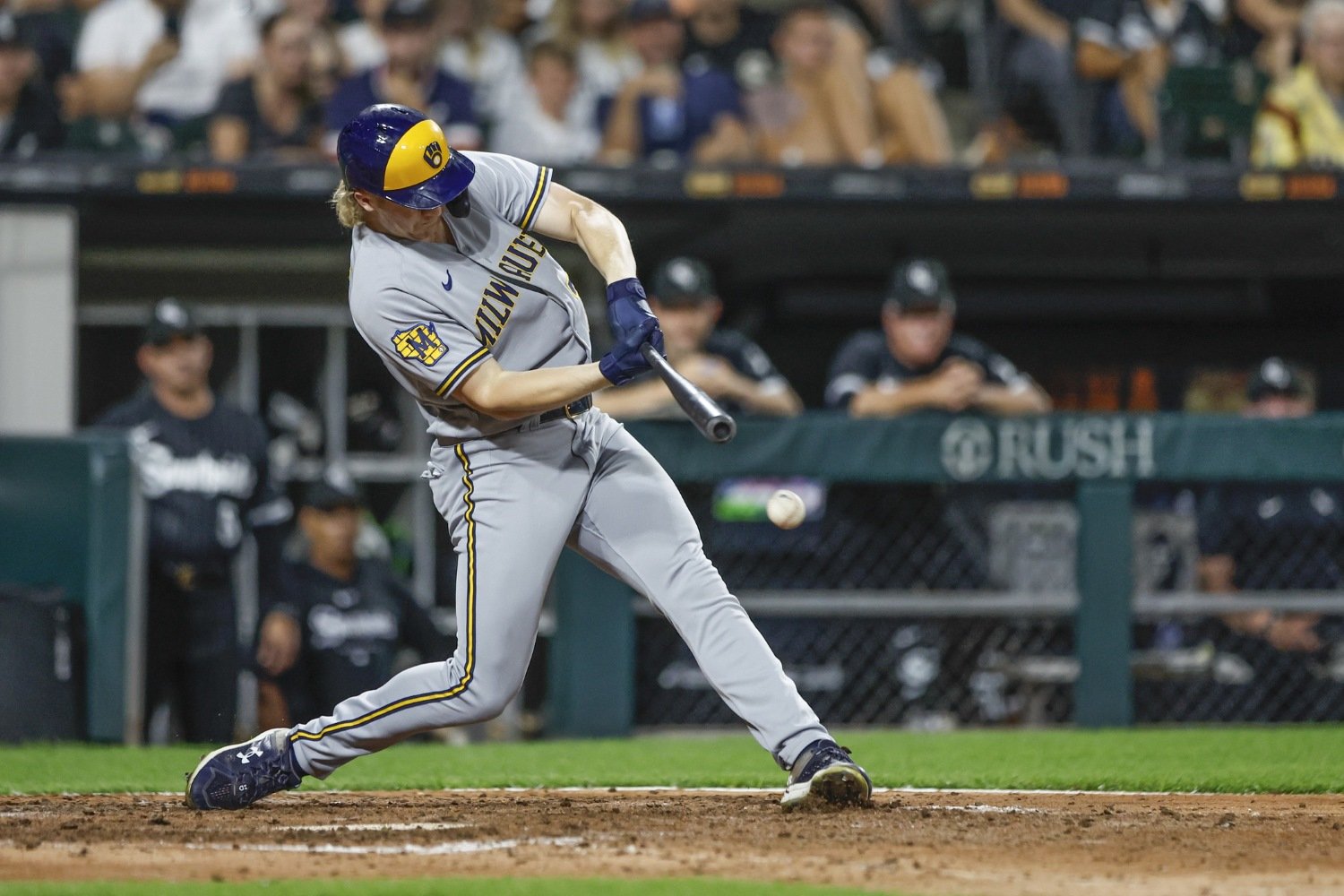 Ordinarily, a team wouldn't complain about 1.2 Wins Above Replacement (WAR) from a rookie center fielder, even if that value comes mostly from elite defense. The Brewers aren't good enough at the traditional offense-first positions to accept subpar production in center, though. They need Joey Wiemer to get right. So What, Exactly, Is The Problem? If you take a look at his slash line of .212/.289/.375, you’ll see a player with below-average hitting abilities. While that is certainly true (he has an OPS+ of 81), it doesn’t really tell the whole story. Only by looking at his Baseball Savant page can we begin to unpack the mystery at hand. When he’s able to make good contact, the ball is going places--often, places in the upper deck. Unfortunately, the ball doesn’t often go places other than the catcher’s glove. Wiemer has struggled immensely with swing-and-miss, preventing from putting more balls in play and making use of either his power or his considerable speed. He’s no Joey Gallo, but he still can’t seem to put his bat on pitches in the zone at a competitive rate. If you’ve watched him play this season, it’s pretty easy to see why. His swing is about as messy as the Chicago White Sox front office. There’s a lot going on here. While there are slight variations, his swing usually follows these general steps: He starts with the bat held high above his head, pretty typical stuff As the pitcher begins his windup, Wiemer often drops the bat to his shoulder. As the pitcher finishes his windup, Wiemer takes the bat off of his shoulder and drops it even lower, sometimes almost perpendicular to his body and below the beltline As the pitch comes to the plate, he loads up in his back leg, lifts his front leg, and raises his bat again, splitting the back of his head to prepare his follow-through. Within the span of roughly three seconds, Wiemer usually shifts his stance around four times and swings bat all over the place. This creates a lengthy, overly complex load. To his credit, despite the prolonged ritual, he’s been able to adjust his timing to create a positive run value against fastballs. However, this problem has gotten out of hand against breaking balls. Here are his statistics against the three breaking balls he’s seen most frequently this season. Run Value BA wOBA Whiff% K% Slider -8 .160 .221 37.4 28.3 Curveball -4 .217 .240 46.5 43.8 Sweeper -5 .083 .144 34.0 32.0 The numbers aren’t pretty, and they point to a clear issue. After seeming to figure things out in June and posting an .849 OPS for the month, he’s regressed significantly, and his August has been abysmal, featuring a .556 OPS over 38 at-bats. This is likely the result of more robust scouting reports on him, and the steady diet of breaking balls opposing pitchers have begun force-feeding him. How Did This Start? A quick perusal of his minor league highlights from 2022 shows a much calmer swing at the plate. While it’s still noisy compared to average, he moves much less than he does now at the major-league level. Most notably, he doesn’t seem to drop his bat as low. While we may never know for sure, one theory as to why he adopted this kooky practice could be that it was perceived as a necessary change to generate more power, leaning into his identity as a swing-first, ask-questions-later type of slugger. After clubbing six of his 13 homers in June, his hands seem to drop lower and lower to try and add more power, at the cost of more misses and more strikeouts. Is There Hope? The fact that this seemingly hasn’t been called out by the Brewers hitting staff as a possible issue is surprising, but it may be something the team is waiting to fix in the offseason. It’s a dramatic change, and with just a narrow lead over the rest of the NL Central, it’s admittedly risky to try to make any such tweaks now. On the bright side, there is one glimmer of hope that makes me optimistic. The parts of the strike zone that correspond to where he whiffs most are also where he makes some of his best contact. As a rookie, it's expected that his game is still unpolished. There's always room for improvement, and no one is perfect, but if Wiemer gets a little better at tracking breaking balls sooner and making contact in the middle part of the strike zone, he may just become one of the most dangerous hitters this side of the Mississippi.
 -
Joey Wiemer has shown off great defense and even greater hair thus far in his rookie year, but if he wants to continue adding value to the Brewers lineup, he’ll have to make some major adjustments at the plate. Image courtesy of © Kamil Krzaczynski-USA TODAY Sports Joey Wiemer has shown off great defense and even greater hair thus far in his rookie year, but if he wants to continue adding value to the Brewers lineup, he’ll have to make some major adjustments at the plate. Ordinarily, a team wouldn't complain about 1.2 Wins Above Replacement (WAR) from a rookie center fielder, even if that value comes mostly from elite defense. The Brewers aren't good enough at the traditional offense-first positions to accept subpar production in center, though. They need Joey Wiemer to get right. So What, Exactly, Is The Problem? If you take a look at his slash line of .212/.289/.375, you’ll see a player with below-average hitting abilities. While that is certainly true (he has an OPS+ of 81), it doesn’t really tell the whole story. Only by looking at his Baseball Savant page can we begin to unpack the mystery at hand. When he’s able to make good contact, the ball is going places--often, places in the upper deck. Unfortunately, the ball doesn’t often go places other than the catcher’s glove. Wiemer has struggled immensely with swing-and-miss, preventing from putting more balls in play and making use of either his power or his considerable speed. He’s no Joey Gallo, but he still can’t seem to put his bat on pitches in the zone at a competitive rate. If you’ve watched him play this season, it’s pretty easy to see why. His swing is about as messy as the Chicago White Sox front office. There’s a lot going on here. While there are slight variations, his swing usually follows these general steps: He starts with the bat held high above his head, pretty typical stuff As the pitcher begins his windup, Wiemer often drops the bat to his shoulder. As the pitcher finishes his windup, Wiemer takes the bat off of his shoulder and drops it even lower, sometimes almost perpendicular to his body and below the beltline As the pitch comes to the plate, he loads up in his back leg, lifts his front leg, and raises his bat again, splitting the back of his head to prepare his follow-through. Within the span of roughly three seconds, Wiemer usually shifts his stance around four times and swings bat all over the place. This creates a lengthy, overly complex load. To his credit, despite the prolonged ritual, he’s been able to adjust his timing to create a positive run value against fastballs. However, this problem has gotten out of hand against breaking balls. Here are his statistics against the three breaking balls he’s seen most frequently this season. Run Value BA wOBA Whiff% K% Slider -8 .160 .221 37.4 28.3 Curveball -4 .217 .240 46.5 43.8 Sweeper -5 .083 .144 34.0 32.0 The numbers aren’t pretty, and they point to a clear issue. After seeming to figure things out in June and posting an .849 OPS for the month, he’s regressed significantly, and his August has been abysmal, featuring a .556 OPS over 38 at-bats. This is likely the result of more robust scouting reports on him, and the steady diet of breaking balls opposing pitchers have begun force-feeding him. How Did This Start? A quick perusal of his minor league highlights from 2022 shows a much calmer swing at the plate. While it’s still noisy compared to average, he moves much less than he does now at the major-league level. Most notably, he doesn’t seem to drop his bat as low. While we may never know for sure, one theory as to why he adopted this kooky practice could be that it was perceived as a necessary change to generate more power, leaning into his identity as a swing-first, ask-questions-later type of slugger. After clubbing six of his 13 homers in June, his hands seem to drop lower and lower to try and add more power, at the cost of more misses and more strikeouts. Is There Hope? The fact that this seemingly hasn’t been called out by the Brewers hitting staff as a possible issue is surprising, but it may be something the team is waiting to fix in the offseason. It’s a dramatic change, and with just a narrow lead over the rest of the NL Central, it’s admittedly risky to try to make any such tweaks now. On the bright side, there is one glimmer of hope that makes me optimistic. The parts of the strike zone that correspond to where he whiffs most are also where he makes some of his best contact. As a rookie, it's expected that his game is still unpolished. There's always room for improvement, and no one is perfect, but if Wiemer gets a little better at tracking breaking balls sooner and making contact in the middle part of the strike zone, he may just become one of the most dangerous hitters this side of the Mississippi. View full article
-
Drama in extra innings and a speedy run to first base capped off a competitive two-game series against the Minnesota Twins. Image courtesy of Benny Sieu-USA TODAY Sports Drama in extra innings and a speedy run to first base capped off a competitive two-game series against the Minnesota Twins. Box Score Starting Pitcher: Corbin Burnes - 6.0 IP, 8 H, 6 ER, 1 BB, 5 K, 99 pitches, 59 strikes (59.6%) Home Runs: William Contreras (13), Willy Adames (21), Tyrone Taylor (5) Top 3 WPA: Willy Adames, (.572), Brice Turang (.337), Tyrone Taylor (.168) Bottom 3 WPA: Corbin Burnes (-.392), Elvis Peguero (-.299), Victor Caratini (-.126) Win Probability Chart (via FanGraphs) Corbin Gets Crushed In one of his rougher outings of the season, Burnes gave up runs in four different innings. He started the game by giving up three singles and a sacrifice fly, allowing the Twins to take a 1-0 lead. In the third inning, he gave up a two-run home run to Royce Lewis, his fifth of the season. The damage continued in the fifth inning when a double by Ryan Jeffers and a home run by Michael A. Taylor gave the Twins a 5-3 lead. To end his outing, Kyle Farmer hit a solo home run to score Minnesota’s sixth run of the game. So what happened? The main culprit was Burnes getting behind in counts. Often down 2-0, Burnes was forced to alter his pitch sequence to be more hitter-friendly, allowing a lot of hard contact and long balls. Corbin Burnes currently has a 3.65 ERA and 1.08 WHIP over 158.0 innings pitched. Homer For Homer While the first game was decided by putting balls in play and hitting for contact, this game was a little different. To match Minnesota’s mashing tendencies, the Brewers hit three home runs of their own. William Contreras got the party started with a solo home run to center field that just kept carrying until it hit the seats. In the sixth inning, Willy Adames hit a two-run homer to center field and continued his recent offensive onslaught. He’s slashed .379/.419/.724 over his last seven games. Finally, to tie the game at six runs a piece, Tyrone Taylor hit a solo home run to left center field. Bullpen (Almost) Blows It After two lockdown innings by Abner Uribe and Joel Payamps that saw them combine for one hit and three strikeouts, Devin Williams toed the slab in the ninth inning to give the Brewers a chance to walk it off. Things started off shaky, with Williams issuing a walk to Jorge Polanco and hitting Matt Wallner with a pitch to put two runners on base before recording a single out. Fortunately, Williams got two strikeouts and a flyout to escape the inning unscathed. In the tenth inning, Elvis Peguero conceded a go-ahead single that put the Twins on top, 7-6. With the game on the line, all eyes fell on the Brewers offense. Willy Adames led things off with a game-tying single. After two outs, it seemed like the game would go into the eleventh until Brice Turang’s walk off one-run single allowed the Brewers to complete the sweep. Just barely beating out the throw to first, his speed was on full display. What’s Next? The Brewers will get an off-day before hosting the San Diego Padres in a three-game series. Brandon Woodruff will make the first start and the Brewers will aim to maintain their lead in the division. They are currently 3.0 games ahead of the Chicago Cubs. Postgame Interviews Bullpen Usage Spreadsheet SAT SUN MON TUE WED TOT Megill 13 24 0 9 0 46 B Wilson 0 18 0 25 0 43 Milner 22 0 0 12 0 34 Peguero 0 29 0 0 0 29 Payamps 13 0 0 0 15 28 Uribe 4 0 0 0 10 14 Williams 0 3 0 0 0 3 Chafin 0 0 0 0 0 0 Tweet Highlight View full article

