


Matthew Trueblood
-
Posts
1,964 -
Joined
-
Last visited
-
Days Won
10
Content Type
Profiles
Forums
Blogs
Events
News
2026 Milwaukee Brewers Top Prospects Ranking
Milwaukee Brewers Videos
2022 Milwaukee Brewers Draft Picks
Milwaukee Brewers Free Agent & Trade Rumors, Notes, & Tidbits
Guides & Resources
2023 Milwaukee Brewers Draft Picks
2024 Milwaukee Brewers Draft Picks
The Milwaukee Brewers Players Project
2025 Milwaukee Brewers Draft Pick Tracker
2026 Milwaukee Brewers Draft Tracker: Picks & Bonuses
Store
Downloads
Gallery
Everything posted by Matthew Trueblood
-
Rhys Hoskins Has an Offensive Skill You Didn't Even Know Existed
Matthew Trueblood posted an article in Brewers
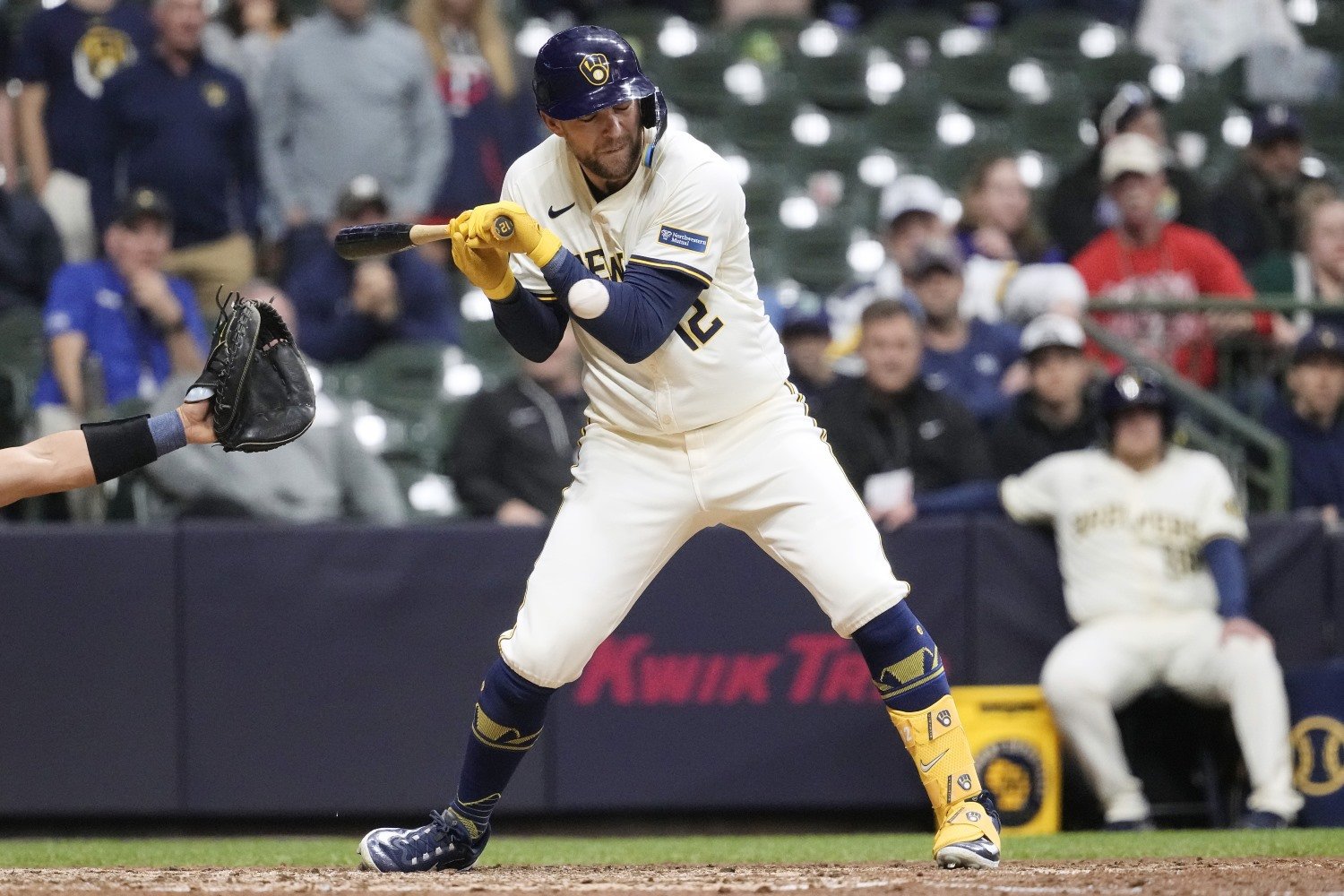 This statement will sound preposterous at first. Hear me out, though: Rhys Hoskins is one of the best pitch-framers among big-league hitters. For many fans, the very existence of pitch framing is anathema. The ability of some catchers to frame pitches and earn their batterymate more called strikes than others would has been part of the conversation about that position for 50 years, and the first efforts to loosely quantify it go back 35 or 40 years, but since it was first comprehensively quantified using PITCHf/x data almost 15 years ago, framing has become controversial. First, many fans were dubious that the skill existed. Some persist in that disbelief, even though the reality of the effects involved has now been exhaustively demonstrated. More common now, though, is the lament that framing is nothing more than evidence of the brokenness of the game--that deceiving umpires shouldn't be a valuable skill, and that we need to hurry up and automate the strike zone. I deeply and fundamentally disagree with those assertions. Principally, I would note that every other sport has situations in which the players involved are trying to make a play, and in which the judgment of the official is required to determine whether they were in bounds (physically or legislatively) or not. Catcher framing only comes into play when a hitter decides not to swing. Once that happens, it's not clear to me what's wrong with catchers doing their best to earn a called strike and take advantage of their opponent's passivity. This article isn't about that, though. It's about the other interactions that shape the strike zone within a plate appearance. About a decade ago, Baseball Prospectus (where some of the first and best catcher framing data appeared) rolled out research demonstrating that pitchers, too, play a role in earning extra strikes on the edges when a hitter doesn't swing, independent of their catchers. That's not that surprising, but it was interesting. Pitchers aim for the edges of the zone most of the time, anyway, but those who can hit their spots in a more accurate way (or whose delivery or pitch movement is especially funky or deceptive) can induce an umpire to stretch those edges a bit. Unskilled hurlers, like unskilled catchers, can lose a lot of should-be strikes, too. Hitters, however, never got the same treatment. That's strange, because the most influential decision-maker in shaping the zone isn't the pitcher, the catcher, or the umpire. It's the guy who decides when to swing, and thus, whether the catcher or umpire get any say in the matter at all. Obviously, we capture the value of those decisions in different ways, when we track and evaluate swing rates both inside and outside the zone. We see and value their strikeout rates, their walk rates, and their batted-ball profiles, all of which are influenced by their swing decisions. Those swing decisions do even more than all that, though. They (in combination, perhaps, with a few other things) exert an influence over the likelihood of a strike being called on the fringe of the zone. That has value to a hitter (be it positive or negative), just as it does to a pitcher and a catcher. The pertinent questions are whether the hitter's share of that value is significant, and whether or not there's an underlying skill driving that value in one direction or the other. To the first question, the answer is yes. Batters' framing value is pretty small; no batter is worth even 10 runs a year based on their "framing". It does exist, though, and it's non-negligible. Here are the guys who have gotten the most value from framing (using a count-sensitive framework, because unlike a hypothetical umpire who should be impartially calling every pitch like it's 0-0, a batter makes their swing decisions based heavily on the count) since the start of 2022. Player CSFRAA Player CSFRAA Ryan McMahon 14.9 Ian Happ 9.3 Ha-Seong Kim 10.2 Alex Verdugo 9.2 Ronald Acuña Jr. 9.7 Shohei Ohtani 8.6 For the very ends of the scale, then, "framing" can earn or cost a hitter five or six runs per season. As it turns out, the Brewers have a player who occupies that territory: Rhys Hoskins, who's 12th on the MLB leaderboard for "framing" runs since the start of 2022 despite missing all of 2023. Hoskins has earned 6.6 runs via batter framing effects. The answer to the second question also turns out to be yes, although as you'd expect, it's not a skill without noise or complicating factors. I first checked whether a player's first-half count-sensitive "framing" runs above average (CSFRAA) was any good at predicting their second-half number. There's certainly a relationship here, but it's not a strong correlation. I then turned to full-season samples, seeking to find out whether a player's 2022 CSFRAA would predict their 2023 figure with those larger samples and a bunch of changes taking place between the two seasons. Same song, different verse. The correlation between one year's CSFRAA at bat and the same number for the next year is about as strong as that between a player's fly-ball rate in one season and the same number the year after. It's a small effect, and there are certainly things a hitter controls more tightly, but the skill exists. The next, most interesting question is: How? With catchers, we can point to tangible movements--the mechanics they use to catch the ball--as important factors in gaining or losing strikes. With hitters, it's different. They don't avoid called strikes with good body language, or with some subtle move of their bat or body. They do it, mostly, through indirect means. Over the 20-plus years since QuesTec was installed to let the league objectively study and evaluate umpires, the strike zone has changed size, then shape. Quickly, that system proved that umpires weren't calling enough strikes, so the zone had to grow a bit in the first half of the first decade of this century. Back then, though, the zone was a shorter, wider thing than it is now. Even a decade ago, it had loose lateral edges. Pitchers and catchers were routinely able to move the ball off the plate and earn favorable calls, but umpires wary of calling the high strike often cut off the zone too low. Here's the league's strike zone, as of 2008. And here's the zone with which the league played in 2014. With each passing year, umpires get more accurate. That means a cleaner, more consistent zone, and it tends to mean a little bit more in the way of high and low strikes, and a little bit less wiggle room on the corners. So, how does a hitter best rack up framing value, given the modern zone? Firstly, they should have the ability to cover the zone from top to bottom well. The cold zones, where a pitcher might seek an advantage over the hitter, should be on the edges of the plate, with horizontal movement involved. A hitter who is disciplined and capable of owning the zone vertically forces a pitcher to work in a space where their catcher can't as readily increase their margin for error. A good hitter-framer should also protect the plate well. That means swinging at more pitches on the edges of the zone, when the situation demands it. It's not just about covering multiple pitch types in multiple areas of the zone; it's also about strike-zone judgment from inside the batter's box. There are both patient and aggressive hitters who rate well in "framing" runs, but guys like Hoskins (who doesn't swing much and is good at telling balls from strikes) have an edge. Power is also a factor. Pitchers will nibble when they face hitters who can punish them for letting the ball meander over the middle of the plate. When that happens, they'll miss further out of the zone, and the risk of getting a bad call against the batter drops. TruMedia has a model that estimates the probability of a given pitch being called a strike, based on its characteristics and location. This season, of the 257 batters with at least 80 plate appearances, only 15 have yet to have a true ball (with a called-strike probability under 25%) called a strike on them. Hoskins is one of those 15. Among that group, he's also the only player with 10 true strikes (called-strike probability over 75%) called a ball against him. That's the last way a hitter can rack up framing value. If (when the count allows one to do it without giving away an at-bat) a hitter lays off pitches just inside the zone, but which they know they won't be able to hit hard, they give themselves a chance to get a bad call in their own favor. Hoskins is good at that, as are hitters like Trent Grisham and Anthony Rizzo. Not swinging at strikes is rarely a good strategy, but just as a mishit single can reward the occasional flail by an undisciplined hitter on a ball in the dirt, a missed call can bail out a hitter whom a pitcher had beaten with an unexpected pitch in the zone. Hitter framing is a weird concept. Baseball is a weird sport. May we never get robot umpires; I want to see Hoskins continue to derive a small advantage over other hitters because of his ability to manipulate the strike zone.
 -
Tuesday night saw Milwaukee Brewers slugger Rhys Hoskins hit his seventh home run of the young season. That's the main reason why the team wanted the erstwhile Phillies first baseman, but he also derives considerable value from his plate discipline--even in a way you would never expect. Image courtesy of © Jeff Hanisch-USA TODAY Sports This statement will sound preposterous at first. Hear me out, though: Rhys Hoskins is one of the best pitch-framers among big-league hitters. For many fans, the very existence of pitch framing is anathema. The ability of some catchers to frame pitches and earn their batterymate more called strikes than others would has been part of the conversation about that position for 50 years, and the first efforts to loosely quantify it go back 35 or 40 years, but since it was first comprehensively quantified using PITCHf/x data almost 15 years ago, framing has become controversial. First, many fans were dubious that the skill existed. Some persist in that disbelief, even though the reality of the effects involved has now been exhaustively demonstrated. More common now, though, is the lament that framing is nothing more than evidence of the brokenness of the game--that deceiving umpires shouldn't be a valuable skill, and that we need to hurry up and automate the strike zone. I deeply and fundamentally disagree with those assertions. Principally, I would note that every other sport has situations in which the players involved are trying to make a play, and in which the judgment of the official is required to determine whether they were in bounds (physically or legislatively) or not. Catcher framing only comes into play when a hitter decides not to swing. Once that happens, it's not clear to me what's wrong with catchers doing their best to earn a called strike and take advantage of their opponent's passivity. This article isn't about that, though. It's about the other interactions that shape the strike zone within a plate appearance. About a decade ago, Baseball Prospectus (where some of the first and best catcher framing data appeared) rolled out research demonstrating that pitchers, too, play a role in earning extra strikes on the edges when a hitter doesn't swing, independent of their catchers. That's not that surprising, but it was interesting. Pitchers aim for the edges of the zone most of the time, anyway, but those who can hit their spots in a more accurate way (or whose delivery or pitch movement is especially funky or deceptive) can induce an umpire to stretch those edges a bit. Unskilled hurlers, like unskilled catchers, can lose a lot of should-be strikes, too. Hitters, however, never got the same treatment. That's strange, because the most influential decision-maker in shaping the zone isn't the pitcher, the catcher, or the umpire. It's the guy who decides when to swing, and thus, whether the catcher or umpire get any say in the matter at all. Obviously, we capture the value of those decisions in different ways, when we track and evaluate swing rates both inside and outside the zone. We see and value their strikeout rates, their walk rates, and their batted-ball profiles, all of which are influenced by their swing decisions. Those swing decisions do even more than all that, though. They (in combination, perhaps, with a few other things) exert an influence over the likelihood of a strike being called on the fringe of the zone. That has value to a hitter (be it positive or negative), just as it does to a pitcher and a catcher. The pertinent questions are whether the hitter's share of that value is significant, and whether or not there's an underlying skill driving that value in one direction or the other. To the first question, the answer is yes. Batters' framing value is pretty small; no batter is worth even 10 runs a year based on their "framing". It does exist, though, and it's non-negligible. Here are the guys who have gotten the most value from framing (using a count-sensitive framework, because unlike a hypothetical umpire who should be impartially calling every pitch like it's 0-0, a batter makes their swing decisions based heavily on the count) since the start of 2022. Player CSFRAA Player CSFRAA Ryan McMahon 14.9 Ian Happ 9.3 Ha-Seong Kim 10.2 Alex Verdugo 9.2 Ronald Acuña Jr. 9.7 Shohei Ohtani 8.6 For the very ends of the scale, then, "framing" can earn or cost a hitter five or six runs per season. As it turns out, the Brewers have a player who occupies that territory: Rhys Hoskins, who's 12th on the MLB leaderboard for "framing" runs since the start of 2022 despite missing all of 2023. Hoskins has earned 6.6 runs via batter framing effects. The answer to the second question also turns out to be yes, although as you'd expect, it's not a skill without noise or complicating factors. I first checked whether a player's first-half count-sensitive "framing" runs above average (CSFRAA) was any good at predicting their second-half number. There's certainly a relationship here, but it's not a strong correlation. I then turned to full-season samples, seeking to find out whether a player's 2022 CSFRAA would predict their 2023 figure with those larger samples and a bunch of changes taking place between the two seasons. Same song, different verse. The correlation between one year's CSFRAA at bat and the same number for the next year is about as strong as that between a player's fly-ball rate in one season and the same number the year after. It's a small effect, and there are certainly things a hitter controls more tightly, but the skill exists. The next, most interesting question is: How? With catchers, we can point to tangible movements--the mechanics they use to catch the ball--as important factors in gaining or losing strikes. With hitters, it's different. They don't avoid called strikes with good body language, or with some subtle move of their bat or body. They do it, mostly, through indirect means. Over the 20-plus years since QuesTec was installed to let the league objectively study and evaluate umpires, the strike zone has changed size, then shape. Quickly, that system proved that umpires weren't calling enough strikes, so the zone had to grow a bit in the first half of the first decade of this century. Back then, though, the zone was a shorter, wider thing than it is now. Even a decade ago, it had loose lateral edges. Pitchers and catchers were routinely able to move the ball off the plate and earn favorable calls, but umpires wary of calling the high strike often cut off the zone too low. Here's the league's strike zone, as of 2008. And here's the zone with which the league played in 2014. With each passing year, umpires get more accurate. That means a cleaner, more consistent zone, and it tends to mean a little bit more in the way of high and low strikes, and a little bit less wiggle room on the corners. So, how does a hitter best rack up framing value, given the modern zone? Firstly, they should have the ability to cover the zone from top to bottom well. The cold zones, where a pitcher might seek an advantage over the hitter, should be on the edges of the plate, with horizontal movement involved. A hitter who is disciplined and capable of owning the zone vertically forces a pitcher to work in a space where their catcher can't as readily increase their margin for error. A good hitter-framer should also protect the plate well. That means swinging at more pitches on the edges of the zone, when the situation demands it. It's not just about covering multiple pitch types in multiple areas of the zone; it's also about strike-zone judgment from inside the batter's box. There are both patient and aggressive hitters who rate well in "framing" runs, but guys like Hoskins (who doesn't swing much and is good at telling balls from strikes) have an edge. Power is also a factor. Pitchers will nibble when they face hitters who can punish them for letting the ball meander over the middle of the plate. When that happens, they'll miss further out of the zone, and the risk of getting a bad call against the batter drops. TruMedia has a model that estimates the probability of a given pitch being called a strike, based on its characteristics and location. This season, of the 257 batters with at least 80 plate appearances, only 15 have yet to have a true ball (with a called-strike probability under 25%) called a strike on them. Hoskins is one of those 15. Among that group, he's also the only player with 10 true strikes (called-strike probability over 75%) called a ball against him. That's the last way a hitter can rack up framing value. If (when the count allows one to do it without giving away an at-bat) a hitter lays off pitches just inside the zone, but which they know they won't be able to hit hard, they give themselves a chance to get a bad call in their own favor. Hoskins is good at that, as are hitters like Trent Grisham and Anthony Rizzo. Not swinging at strikes is rarely a good strategy, but just as a mishit single can reward the occasional flail by an undisciplined hitter on a ball in the dirt, a missed call can bail out a hitter whom a pitcher had beaten with an unexpected pitch in the zone. Hitter framing is a weird concept. Baseball is a weird sport. May we never get robot umpires; I want to see Hoskins continue to derive a small advantage over other hitters because of his ability to manipulate the strike zone. View full article
-
Blake Perkins is the Most Important Story in the Brewers Lineup
Matthew Trueblood posted an article in Brewers
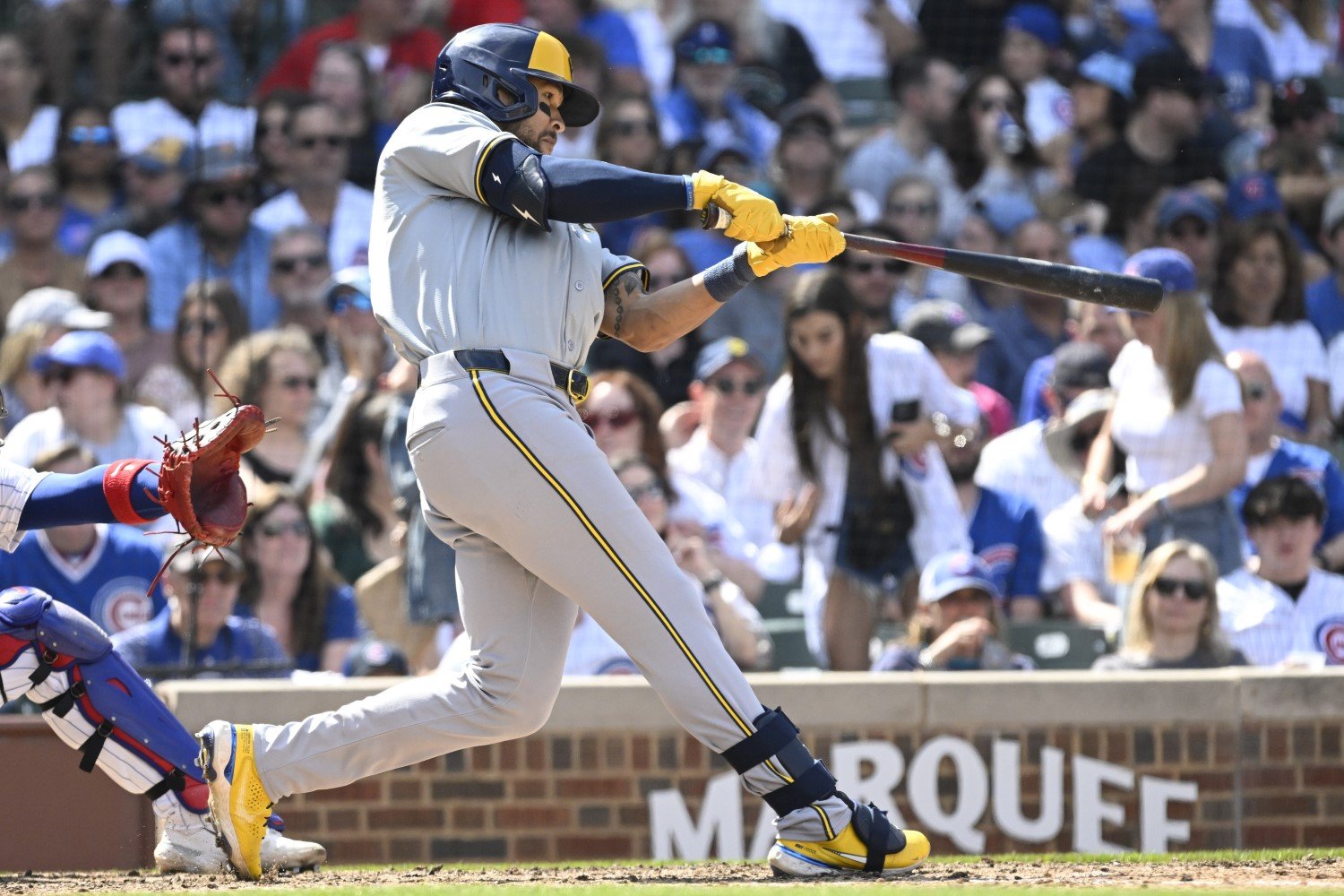 Last year, Blake Perkins was a pretty close outfield parallel to infielders Owen Miller, Brice Turang, and Andruw Monasterio. He had fine contact skills, and he didn't expand his strike zone. He played great defense, had excellent speed, and (unlike Turang, for instance), he even hit a good number of fly balls. Unfortunately, like all three of the Crew's spare infielders, he didn't hit the ball hard at all. Parkins's average exit velocity in 2023 was an unintimidating 83.8 miles per hour. He did get the ball off the ground, but not in a productive way. His Medium Trajectory rate (the percentage of his batted balls between 2 and 25 degrees of launch angle, the most valuable one-third slice league-wide) was just 22.2%. Despite making contact at a roughly average rate on a per-swing basis and drawing plenty of walks, Perkins struck out over 27 percent of the time. That's because pitchers poured the ball into the strike zone against him. Perkins struck no fear into hurlers, and as a result, he struggled to stay ahead of the balls and strikes curve. This year, everything is different. Perkins has traded some lift for more swing speed. He's hitting the ball, on average, 88.9 miles per hour, an exciting jump that has boosted his isolated power by 32 points. Though his average launch angle has gone down, his Medium Trajectory rate is up dramatically, to 33.8%. That helps explain an increase of almost 40 points in his BABIP. He's squaring the ball up much more often, which explains a substantial share of his improvement. Perkins is chasing outside the zone a bit more often this year, but that's part of a more aggressive overall approach. He's also increased his in-zone swing rate from 54.9% to 58.7%, and specifically, he's going after pitches in the lower half of the zone much more frequently. Last year, he was fixated on getting balls up in the zone, but that led to getting under the ball too often. It meant many mishits. Nearly 40 percent of his swings resulted in foul balls in 2023, and not enough of them led to hard contact in play. As he's resolved to cover more of the zone, he's traded some contact for more authority on contact, with the aforementioned exit velocity bump showing up especially clearly on stuff in the lower part of the zone. That tradeoff in contact is not to be ignored. Last year, Perkins made contact on 77.1% of his swings. That's down to 67.4% in 2024, and some of that decrease in contact rate comes inside the strike zone. Yet, he's actually striking out slightly less than in 2023, because pitchers are throwing him fewer strikes, and he's not bailing them out when they nibble at the corners. Don't throw a party yet, assuming Perkins has effected a permanent transformation into a star. He's hitting a robust .258/.363/.423, and if he can sustain that, his defense does make him star-caliber, but there are some reasons to wonder how sustainable these improvements are. Baseball Prospectus's DRC+, a holistic offensive value statistic, rates Perkins as a slightly below-average hitter this year (94, where 100 is average and higher is better). However, Prospectus also reports the standard deviation of its models' numbers, to give a sense of those models' certainty, and Perkins's STDEV on his DRC+ is currently 22. In other words, there's a 50-percent chance Perkins is better than 6% worse than league-average, and about a 16-percent chance that he's more than 14% better than average. Perkins is only 27 years old. Because his career arc looks so much different from those of Christian Yelich, Sal Frelick, Joey Wiemer, Garrett Mitchell, and Jackson Chourio, the impulse is to treat him as less promising or interesting than they are. At this point, though, he's clearly as important and as valuable as at least two of those five players--and, at any given moment, perhaps as many as four of them. The team knew they could count on hitters like Yelich, William Contreras, Willy Adames, and Rhys Hoskins, but Perkins is turning out to be another reliable bat in their lineup--and he could be a difference-maker for them throughout the year.
 -
When this season began, the Brewers seemed awash in outfield depth. That turns out to have been true, but amid all the attention lavished on top-flight prospects and a highly-paid former MVP, an unheralded extra has stepped forward to fit right in with them. Image courtesy of © Matt Marton-USA TODAY Sports Last year, Blake Perkins was a pretty close outfield parallel to infielders Owen Miller, Brice Turang, and Andruw Monasterio. He had fine contact skills, and he didn't expand his strike zone. He played great defense, had excellent speed, and (unlike Turang, for instance), he even hit a good number of fly balls. Unfortunately, like all three of the Crew's spare infielders, he didn't hit the ball hard at all. Parkins's average exit velocity in 2023 was an unintimidating 83.8 miles per hour. He did get the ball off the ground, but not in a productive way. His Medium Trajectory rate (the percentage of his batted balls between 2 and 25 degrees of launch angle, the most valuable one-third slice league-wide) was just 22.2%. Despite making contact at a roughly average rate on a per-swing basis and drawing plenty of walks, Perkins struck out over 27 percent of the time. That's because pitchers poured the ball into the strike zone against him. Perkins struck no fear into hurlers, and as a result, he struggled to stay ahead of the balls and strikes curve. This year, everything is different. Perkins has traded some lift for more swing speed. He's hitting the ball, on average, 88.9 miles per hour, an exciting jump that has boosted his isolated power by 32 points. Though his average launch angle has gone down, his Medium Trajectory rate is up dramatically, to 33.8%. That helps explain an increase of almost 40 points in his BABIP. He's squaring the ball up much more often, which explains a substantial share of his improvement. Perkins is chasing outside the zone a bit more often this year, but that's part of a more aggressive overall approach. He's also increased his in-zone swing rate from 54.9% to 58.7%, and specifically, he's going after pitches in the lower half of the zone much more frequently. Last year, he was fixated on getting balls up in the zone, but that led to getting under the ball too often. It meant many mishits. Nearly 40 percent of his swings resulted in foul balls in 2023, and not enough of them led to hard contact in play. As he's resolved to cover more of the zone, he's traded some contact for more authority on contact, with the aforementioned exit velocity bump showing up especially clearly on stuff in the lower part of the zone. That tradeoff in contact is not to be ignored. Last year, Perkins made contact on 77.1% of his swings. That's down to 67.4% in 2024, and some of that decrease in contact rate comes inside the strike zone. Yet, he's actually striking out slightly less than in 2023, because pitchers are throwing him fewer strikes, and he's not bailing them out when they nibble at the corners. Don't throw a party yet, assuming Perkins has effected a permanent transformation into a star. He's hitting a robust .258/.363/.423, and if he can sustain that, his defense does make him star-caliber, but there are some reasons to wonder how sustainable these improvements are. Baseball Prospectus's DRC+, a holistic offensive value statistic, rates Perkins as a slightly below-average hitter this year (94, where 100 is average and higher is better). However, Prospectus also reports the standard deviation of its models' numbers, to give a sense of those models' certainty, and Perkins's STDEV on his DRC+ is currently 22. In other words, there's a 50-percent chance Perkins is better than 6% worse than league-average, and about a 16-percent chance that he's more than 14% better than average. Perkins is only 27 years old. Because his career arc looks so much different from those of Christian Yelich, Sal Frelick, Joey Wiemer, Garrett Mitchell, and Jackson Chourio, the impulse is to treat him as less promising or interesting than they are. At this point, though, he's clearly as important and as valuable as at least two of those five players--and, at any given moment, perhaps as many as four of them. The team knew they could count on hitters like Yelich, William Contreras, Willy Adames, and Rhys Hoskins, but Perkins is turning out to be another reliable bat in their lineup--and he could be a difference-maker for them throughout the year. View full article
-
Week In Review: Inconsistent Everything
Matthew Trueblood replied to Kyle Ginsbach's topic in Brewer Fanatic Front Page News
I can answer that, even if I can't promise you'll like the answer. Murph isn't gonna bat righties straight through from 2-5 (or even 2-4) in his lineup. He said as much in spring training. He thinks breaking those guys up and forcing teams to consider at least one opposite-handed batter when weighing bringing on a given reliever is more important than the extra plate appearance per week from sliding Adames and Hoskins up. I think the recent lineup construction also tells us he doesn't agree with your assessment of Hoskins against right-handed pitching, but that's a separate issue. -
The Brewers' Superb Infield Defense Has One Unexpected Weakness
Matthew Trueblood posted an article in Brewers
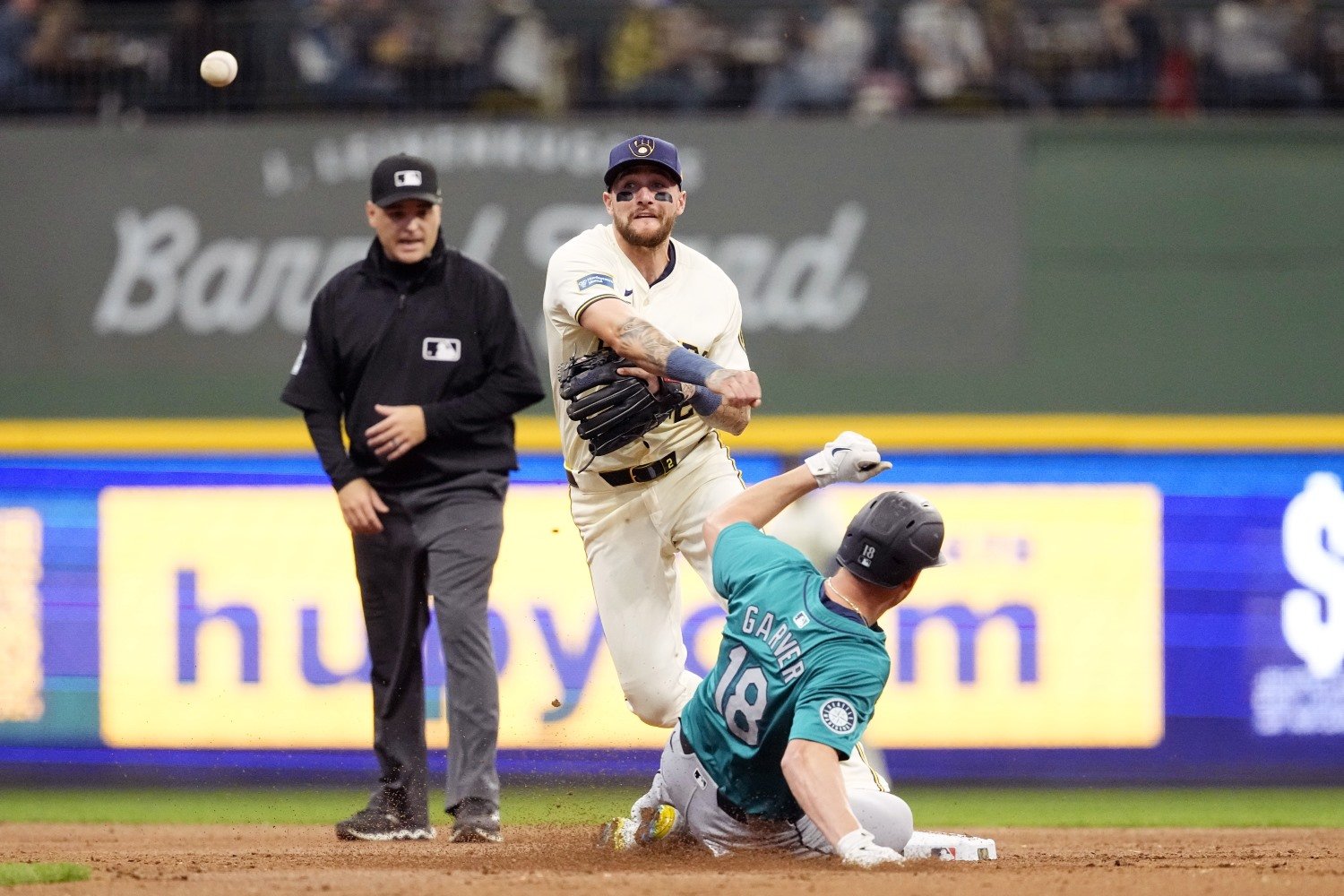 This season, Brewers pitchers have induced 38 ground balls that were fielded by an infielder, in a situation (runner on first base, zero or one out) in which a double play was possible. The Crew's deservedly vaunted defense, led by Willy Adames and Brice Turang, has converted 19 of those opportunities into actual double plays. That 50% success rate is good for just 18th-best in MLB. Given how good Adames and Turang both are (based both on defensive metrics and on the eye test), that's pretty surprising. Why aren't these stellar defenders reaping as many outs as their pitchers seem to be sowing? To be sure, the samples are quite small. We're barely over a month into the season. One play made or not can move a team up and down the rankings a little bit. Equally surprisingly, though, the Brewers were 16th in baseball in converting double play chances last year (54.1%), and 24th in 2022 (49.0%). So, let's treat this as real enough to talk about, even as we acknowledge the limitations of it. What is stopping Adames and Turang from delivering the double plays that would go a small but meaningful extra distance toward killing opponents' rallies? First of all, there's a problem with the ground balls their pitchers are getting. On grounders converted into any number of outs in double play situations this year, the Brewers have induced the slowest (81.1 miles per hour) and second-lowest (-18.1 degrees) batted balls, on average. It's hard to convert a weakly hit ball into a double play, and it's hard to convert one hit straight into the ground into a double play. The Brewers' hurlers are getting a lot of balls hit right into the dirt in front of home plate, which is a good thing most of the time, but if your objective is to turn two, paradoxically, it becomes a partially bad thing. Here, let's use an example. Maybe a Situational Layback.mp4 Padres rookie Jackson Merrill is a fast runner, anyway, so this was never going to be an easy play. If he only had to get one on it, though, Adames still would have made the play routinely, by charging it. The ball is hit straight down, and reaches him on two long, looping hops. With a good runner getting up the line, you can't get two on this ball if you wait back on it the way Adames did. In this situation, late in a game that wasn't especially close, Adames also had no reason to force the issue. Let's say he had had such a reason, though. What could he have done differently? If you come in and cut the ball off short on the second hop, it's a tougher play, with a greater risk of mishandling. Worse, your momentum carries you right past the base, so you have to flip it backward or turn and flip quickly to your pivot man to start the relay. It's a low-percentage play. Adames was right to stay back, but in so doing, he forfeited any real chance for the double play. The problem with that explanation is, there's no fixing it, and mostly, you wouldn't want to fix it even if you could. From a pure batted-ball data perspective, double play ground balls look more like hits than they do like regular groundouts. Here's the average exit velocity for the league since the start of 2022, in double play situations, for: Hits or errors; no outs recorded; Groundouts or fielder's choices, not including double plays; and Double plays Outcome Exit Vel. Launch Angle Hit or Error 91.8 -5.9 Groundout or FC 83.7 -15.3 Double Play 88.6 -9.3 If you ask a pitching staff to start trying to induce slightly faster, slightly flatter grounders, you're unlikely to be successful. They'll either fail to make that adjustment, or they'll make it, but give up a bunch of extra hits instead of keeping all the old outs and adding some new ones. While we're here, though, we could talk a bit about pitch selection in double play situations. Count and sequence and the batter's tendencies all matter, of course, but in a vacuum, what types of pitches make for the easiest conversions of grounders into double plays? This is a different question than, "What pitch is most likely to get you a ground ball?" It's about which pitches might be most likely to get a double play-friendly ground ball. Again, I used a three-year league-wide sample to ensure we were getting good data. I found the double play conversion rate on grounders hit in these situations, divvied up by pitch type. They're mostly what you'd expect. Pitch Type GDP Opp Conv. % Pitch Type GDP Opp. Conv. % Four-Seamer 54.9 Sweeper 51,2 Sinker 55.5 Curveball 49.1 Cutter 52.4 Changeup 51 Slider 52.7 Splitter 51 There is, at least, an interesting finding here. Remember, the denominator for these percentages is ground balls fielded by an infielder, so it's not wise to select a pitch based purely on them. However, say the bases are loaded with one out, and you can't have the run score from third base. A four-seamer might be the right pitch. Not only is that pitch more likely to get a whiff than a sinker, and not only is it more likely to get a pop-up or other weak fly ball than is a sinker, but it's almost as likely to yield a ground ball on which the infield can turn two to escape the frame as a sinker is, when we restrict the sample to playable grounders. Practically speaking, though, the Brewers are doing as much as they can for their fielders in this area. A lot of the balls hit straight into the ground in these situations this year have been on sinkers. The Crew just have harder, often heavier sinkers than most pitchers, so hitters get even more inaccurate with their barrel against them than against most. As you can see, offspeed pitches are the worst to induce a double play, but then, you already know that the Brewers throw few of those, anyway. Let's stop blaming the pitchers, then. What about coaches? A few times this year, the Brewers have been out of position for a double play, because they were playing such a shaded alignment against a batter. Here, look. Did Well to Get an Out, Pos. and Spin.mp4 This is one of those medium-speed, a bit higher grounders that are supposed to lend themselves to double plays, and Carlos Santana is slow. As it played out, though, Willy Adames had to almost pancake the ball to control it, and only took the out at first. Why? Part of it is that the ball stayed down with topspin after hopping just to the left of the mound, forcing Adames to get all the way down on it as he charged, but another part is that Adames was way over in the hole, and pretty deep. It happens against left-handed batters, too, in a couple of different ways. Second Hop Off Top of Mound, Heavy Shade On.mp4 Under more traditional double-play depth positioning, with both infielders slightly shallower and pinched toward the bag, this grounder would probably have led Turang right to the bag. Then again, given such positioning, this grounder would have had a better chance of getting through altogether than it did with the alignment they used. The second hop is off the top of the mound, and even Adames has to adjust his route to the ball a bit, giving more ground than he first wanted to. The Brewers' defensive positioning emphasizes getting an out in these situations, rather than pursuing the best possible chance for a double play. That's usually good math--for the same reason why an offense should rarely sacrifice bunt, a fielding unit should rarely eschew a likely out to chase a less likely pair of them. That's an interesting juxtaposition with the personalities of Adames and Turang, though, because they're about the greediest and most aggressive out-seekers among the league's middle infielders. Adames is famous for occasionally ranging all the way to the right-field foul line to be the relay man when one is needed. He's thrown to third base to cut down the automatic runner on grounders his way in extra innings as often as any shortstop in baseball. Adames is a central midfielder stuck on a baseball diamond instead of a soccer pitch. He wants to make plays from foul pole to foul pole. In fact, that's one place where the Brewers are losing a few double plays: Because he calls them off and because they're mostly young and inexperienced, Brewers third basemen are letting a few balls on which they should make the play and throw to Turang with their momentum going straight toward second base go to Adames instead. Ortiz Lets One Go.mp4 This used to be an issue between Nolan Arenado and Troy Tulowitzki, when they starred together on the left side of the Rockies infield. Tulowitzki was too insistent on taking anything he could get to, when Arenado might have been the better one to make it. We think about (and see) this more often in the outfield, but with the converted shortstop Joey Ortiz at third right now and Adames always in an attacking mode when there's a ball in his area code, it's very relevant for the Brewers right now. The position at which their conversion rate on double play chances is best--that is, the place where the highest rate of balls fielded have turned into twin killings, both in absolute terms and relative to the rest of the league--is the hot corner. Adames might need to learn to trust Ortiz and Oliver Dunn a bit more. Here's one more example of that, for our general edification. It's not the only other one; these are just the two clearest. This One's Fringier.mp4 Only two of the 10 balls Turang has fielded in double play situations have actually turned into double plays. For the most part, though, Turang looks great on the tape. There are a couple plays where a right-handed batter mishit a ball to the right side, and Turang had to make a play going away from second, because he'd been heavily shaded up the middle. That goes back to the positioning issue we discussed above, but we needn't revisit the question of whether those positioning decisions are right. Placed where he is at the start of those plays, Turang does all he can. He's very aggressive about taking the lead runner on balls hit to his left, even when he was already shaded toward the hole on the right side. No second baseman in baseball gets the man at second more consistently on such plays. In fact, on a couple such plays, it's Adames who's at fault for not getting two, not Turang; the shortstop just isn't as quick on the exchange and release when turning the double as Turang is when it's going the other way. Let me ask one slightly weird question, though: when a lefty does hit the ball toward the hole in these spots, should some second baseman (Turang would be a great candidate) actually go to first base to maximize the chances of a double play? It sounds counterintuitive, but watch with me. Should Turang Have Gone to 1B to create a DP.mp4 Yes, it's crazy, but taking the lead runner here was difficult and a bit risky in itself, and the chances of a double play were virtually nil. The first throw here is about 75 feet, after Turang fielded the ball and reverse spun toward the outfield. That just takes too long, unless the backup catcher is running and the starting catcher is getting a piggyback ride from him. If Turang had thrown to first base there, could the Crew have still gotten a double play, with a throw to second and attempted tag? Probably not, in this example, because Rhys Hoskins was playing first base. Imagine the same play--same pace on the grounder, same runners, same situation--but with Jake Bauers at first. Bauers has a good arm and the confidence to use it. Adames is an adept tagger. I think that would have given them a better chance at getting two on the play above, if that had been their focus. Maybe this is something more infields should practice and/or attempt. One more example of the same idea. Turang's Dancing Feet; Again maybe go to 1B.mp4 We're not in too much of a hurry here to stop and appreciate the balletic feet of Turang. What a charge, pick, spin, and throw. That was pretty. Now: should he have thrown to first base instead? It was the speedy Willi Castro heading for first (just as it was in the previous clip), so there was no chance at all of a 4-6-3 double play. I don't think Turang even thought about that, though. He only thinks about whether he can get the lead runner, and in this case, he could. Had he made the same charge but then a strong toss to first, though, they might have had a shot at the aged, plodding Carlos Santana at second, even needing to tag him to do it. These aren't criticisms of Turang's actual choices; they're in line with the Brewers' defensive philosophy and the conventional wisdom. They're better plays than about 10 second basemen would have made on each; below-average fielders would have taken only the out at first on each, allowing a runner to move up into scoring position. If the Brewers are hunting for places to steal an extra few outs in key situations, though, these are the places they might look. Slightly more aggressive positioning (based on potential payoffs, instead of purely on probabilities) is one step. Another could be slight changes in pitch selection, if the pitcher and batter are just the right fit for that. Most of all, Adames should continue thinking aggressively, but trust his teammates a bit more. He could also get quicker on the pivot, when his turns to do that come. Turang is already plenty good, and the chances to get two just haven't been there for him yet. The only window for some improvement from him lies in the radical notion of starting a double play by going to first and losing the force out. Double plays are just one small, situational aspect of good infield defense, and as we've seen, double-play grounders are only pitchers' best friends when things break just right. The Brewers can be a playoff-caliber defensive unit without getting any better at this small slice of their jobs. Since they rightfully take great pride in their infield defense, though, they might as well try to take this aspect of it from below average to above, and those improvements are possible.
 -
There might not be a better defensive middle infield than that of the Milwaukee Brewers. Both sides of the keystone feature an extremely athletic, polished, aggressive defender. Yet, they're a below-average team at turning double plays. Why? Image courtesy of © Jeff Hanisch-USA TODAY Sports This season, Brewers pitchers have induced 38 ground balls that were fielded by an infielder, in a situation (runner on first base, zero or one out) in which a double play was possible. The Crew's deservedly vaunted defense, led by Willy Adames and Brice Turang, has converted 19 of those opportunities into actual double plays. That 50% success rate is good for just 18th-best in MLB. Given how good Adames and Turang both are (based both on defensive metrics and on the eye test), that's pretty surprising. Why aren't these stellar defenders reaping as many outs as their pitchers seem to be sowing? To be sure, the samples are quite small. We're barely over a month into the season. One play made or not can move a team up and down the rankings a little bit. Equally surprisingly, though, the Brewers were 16th in baseball in converting double play chances last year (54.1%), and 24th in 2022 (49.0%). So, let's treat this as real enough to talk about, even as we acknowledge the limitations of it. What is stopping Adames and Turang from delivering the double plays that would go a small but meaningful extra distance toward killing opponents' rallies? First of all, there's a problem with the ground balls their pitchers are getting. On grounders converted into any number of outs in double play situations this year, the Brewers have induced the slowest (81.1 miles per hour) and second-lowest (-18.1 degrees) batted balls, on average. It's hard to convert a weakly hit ball into a double play, and it's hard to convert one hit straight into the ground into a double play. The Brewers' hurlers are getting a lot of balls hit right into the dirt in front of home plate, which is a good thing most of the time, but if your objective is to turn two, paradoxically, it becomes a partially bad thing. Here, let's use an example. Maybe a Situational Layback.mp4 Padres rookie Jackson Merrill is a fast runner, anyway, so this was never going to be an easy play. If he only had to get one on it, though, Adames still would have made the play routinely, by charging it. The ball is hit straight down, and reaches him on two long, looping hops. With a good runner getting up the line, you can't get two on this ball if you wait back on it the way Adames did. In this situation, late in a game that wasn't especially close, Adames also had no reason to force the issue. Let's say he had had such a reason, though. What could he have done differently? If you come in and cut the ball off short on the second hop, it's a tougher play, with a greater risk of mishandling. Worse, your momentum carries you right past the base, so you have to flip it backward or turn and flip quickly to your pivot man to start the relay. It's a low-percentage play. Adames was right to stay back, but in so doing, he forfeited any real chance for the double play. The problem with that explanation is, there's no fixing it, and mostly, you wouldn't want to fix it even if you could. From a pure batted-ball data perspective, double play ground balls look more like hits than they do like regular groundouts. Here's the average exit velocity for the league since the start of 2022, in double play situations, for: Hits or errors; no outs recorded; Groundouts or fielder's choices, not including double plays; and Double plays Outcome Exit Vel. Launch Angle Hit or Error 91.8 -5.9 Groundout or FC 83.7 -15.3 Double Play 88.6 -9.3 If you ask a pitching staff to start trying to induce slightly faster, slightly flatter grounders, you're unlikely to be successful. They'll either fail to make that adjustment, or they'll make it, but give up a bunch of extra hits instead of keeping all the old outs and adding some new ones. While we're here, though, we could talk a bit about pitch selection in double play situations. Count and sequence and the batter's tendencies all matter, of course, but in a vacuum, what types of pitches make for the easiest conversions of grounders into double plays? This is a different question than, "What pitch is most likely to get you a ground ball?" It's about which pitches might be most likely to get a double play-friendly ground ball. Again, I used a three-year league-wide sample to ensure we were getting good data. I found the double play conversion rate on grounders hit in these situations, divvied up by pitch type. They're mostly what you'd expect. Pitch Type GDP Opp Conv. % Pitch Type GDP Opp. Conv. % Four-Seamer 54.9 Sweeper 51,2 Sinker 55.5 Curveball 49.1 Cutter 52.4 Changeup 51 Slider 52.7 Splitter 51 There is, at least, an interesting finding here. Remember, the denominator for these percentages is ground balls fielded by an infielder, so it's not wise to select a pitch based purely on them. However, say the bases are loaded with one out, and you can't have the run score from third base. A four-seamer might be the right pitch. Not only is that pitch more likely to get a whiff than a sinker, and not only is it more likely to get a pop-up or other weak fly ball than is a sinker, but it's almost as likely to yield a ground ball on which the infield can turn two to escape the frame as a sinker is, when we restrict the sample to playable grounders. Practically speaking, though, the Brewers are doing as much as they can for their fielders in this area. A lot of the balls hit straight into the ground in these situations this year have been on sinkers. The Crew just have harder, often heavier sinkers than most pitchers, so hitters get even more inaccurate with their barrel against them than against most. As you can see, offspeed pitches are the worst to induce a double play, but then, you already know that the Brewers throw few of those, anyway. Let's stop blaming the pitchers, then. What about coaches? A few times this year, the Brewers have been out of position for a double play, because they were playing such a shaded alignment against a batter. Here, look. Did Well to Get an Out, Pos. and Spin.mp4 This is one of those medium-speed, a bit higher grounders that are supposed to lend themselves to double plays, and Carlos Santana is slow. As it played out, though, Willy Adames had to almost pancake the ball to control it, and only took the out at first. Why? Part of it is that the ball stayed down with topspin after hopping just to the left of the mound, forcing Adames to get all the way down on it as he charged, but another part is that Adames was way over in the hole, and pretty deep. It happens against left-handed batters, too, in a couple of different ways. Second Hop Off Top of Mound, Heavy Shade On.mp4 Under more traditional double-play depth positioning, with both infielders slightly shallower and pinched toward the bag, this grounder would probably have led Turang right to the bag. Then again, given such positioning, this grounder would have had a better chance of getting through altogether than it did with the alignment they used. The second hop is off the top of the mound, and even Adames has to adjust his route to the ball a bit, giving more ground than he first wanted to. The Brewers' defensive positioning emphasizes getting an out in these situations, rather than pursuing the best possible chance for a double play. That's usually good math--for the same reason why an offense should rarely sacrifice bunt, a fielding unit should rarely eschew a likely out to chase a less likely pair of them. That's an interesting juxtaposition with the personalities of Adames and Turang, though, because they're about the greediest and most aggressive out-seekers among the league's middle infielders. Adames is famous for occasionally ranging all the way to the right-field foul line to be the relay man when one is needed. He's thrown to third base to cut down the automatic runner on grounders his way in extra innings as often as any shortstop in baseball. Adames is a central midfielder stuck on a baseball diamond instead of a soccer pitch. He wants to make plays from foul pole to foul pole. In fact, that's one place where the Brewers are losing a few double plays: Because he calls them off and because they're mostly young and inexperienced, Brewers third basemen are letting a few balls on which they should make the play and throw to Turang with their momentum going straight toward second base go to Adames instead. Ortiz Lets One Go.mp4 This used to be an issue between Nolan Arenado and Troy Tulowitzki, when they starred together on the left side of the Rockies infield. Tulowitzki was too insistent on taking anything he could get to, when Arenado might have been the better one to make it. We think about (and see) this more often in the outfield, but with the converted shortstop Joey Ortiz at third right now and Adames always in an attacking mode when there's a ball in his area code, it's very relevant for the Brewers right now. The position at which their conversion rate on double play chances is best--that is, the place where the highest rate of balls fielded have turned into twin killings, both in absolute terms and relative to the rest of the league--is the hot corner. Adames might need to learn to trust Ortiz and Oliver Dunn a bit more. Here's one more example of that, for our general edification. It's not the only other one; these are just the two clearest. This One's Fringier.mp4 Only two of the 10 balls Turang has fielded in double play situations have actually turned into double plays. For the most part, though, Turang looks great on the tape. There are a couple plays where a right-handed batter mishit a ball to the right side, and Turang had to make a play going away from second, because he'd been heavily shaded up the middle. That goes back to the positioning issue we discussed above, but we needn't revisit the question of whether those positioning decisions are right. Placed where he is at the start of those plays, Turang does all he can. He's very aggressive about taking the lead runner on balls hit to his left, even when he was already shaded toward the hole on the right side. No second baseman in baseball gets the man at second more consistently on such plays. In fact, on a couple such plays, it's Adames who's at fault for not getting two, not Turang; the shortstop just isn't as quick on the exchange and release when turning the double as Turang is when it's going the other way. Let me ask one slightly weird question, though: when a lefty does hit the ball toward the hole in these spots, should some second baseman (Turang would be a great candidate) actually go to first base to maximize the chances of a double play? It sounds counterintuitive, but watch with me. Should Turang Have Gone to 1B to create a DP.mp4 Yes, it's crazy, but taking the lead runner here was difficult and a bit risky in itself, and the chances of a double play were virtually nil. The first throw here is about 75 feet, after Turang fielded the ball and reverse spun toward the outfield. That just takes too long, unless the backup catcher is running and the starting catcher is getting a piggyback ride from him. If Turang had thrown to first base there, could the Crew have still gotten a double play, with a throw to second and attempted tag? Probably not, in this example, because Rhys Hoskins was playing first base. Imagine the same play--same pace on the grounder, same runners, same situation--but with Jake Bauers at first. Bauers has a good arm and the confidence to use it. Adames is an adept tagger. I think that would have given them a better chance at getting two on the play above, if that had been their focus. Maybe this is something more infields should practice and/or attempt. One more example of the same idea. Turang's Dancing Feet; Again maybe go to 1B.mp4 We're not in too much of a hurry here to stop and appreciate the balletic feet of Turang. What a charge, pick, spin, and throw. That was pretty. Now: should he have thrown to first base instead? It was the speedy Willi Castro heading for first (just as it was in the previous clip), so there was no chance at all of a 4-6-3 double play. I don't think Turang even thought about that, though. He only thinks about whether he can get the lead runner, and in this case, he could. Had he made the same charge but then a strong toss to first, though, they might have had a shot at the aged, plodding Carlos Santana at second, even needing to tag him to do it. These aren't criticisms of Turang's actual choices; they're in line with the Brewers' defensive philosophy and the conventional wisdom. They're better plays than about 10 second basemen would have made on each; below-average fielders would have taken only the out at first on each, allowing a runner to move up into scoring position. If the Brewers are hunting for places to steal an extra few outs in key situations, though, these are the places they might look. Slightly more aggressive positioning (based on potential payoffs, instead of purely on probabilities) is one step. Another could be slight changes in pitch selection, if the pitcher and batter are just the right fit for that. Most of all, Adames should continue thinking aggressively, but trust his teammates a bit more. He could also get quicker on the pivot, when his turns to do that come. Turang is already plenty good, and the chances to get two just haven't been there for him yet. The only window for some improvement from him lies in the radical notion of starting a double play by going to first and losing the force out. Double plays are just one small, situational aspect of good infield defense, and as we've seen, double-play grounders are only pitchers' best friends when things break just right. The Brewers can be a playoff-caliber defensive unit without getting any better at this small slice of their jobs. Since they rightfully take great pride in their infield defense, though, they might as well try to take this aspect of it from below average to above, and those improvements are possible. View full article
-
On an exceptionally rare off day amid a long, grueling stretch in the early schedule, let's take a few minutes to check in on the Milwaukee Brewers and their playoff odds. Image courtesy of © Benny Sieu-USA TODAY Sports As chaotic and often frustrating as the last week has been, the Brewers hung in there, managing a .500 record on a homestand in which they hosted two of the best teams in the American League. As a result, despite the painful and inauspicious loss of Wade Miley, they still have a great shot at reaching the postseason, according to the top two outlets for such numbers, Baseball Prospectus and FanGraphs. Let's look at BP first. Both sites had the St. Louis Cardinals as favorites in the division when the season began, but as the multifaceted problems facing that organization have manifested themselves, both have backed off. That leaves only one team with an edge on the Crew in the projected standings, using Prospectus's PECOTA projection system. It's the one over whom, for the moment, Milwaukee holds the narrowest of possible leads in the real, current standings. These curves show the distribution of possible outcomes, as PECOTA sees them, so while the Cubs have a clear edge based on that system's estimates of each team's talent ant depth, there is (obviously) still a great chance for the Brewers to outperform them in the one real eventuality that emerges from this thicket of possible ones. Numerically, the above translates to a 27.0% chance of the Brewers winning the division. (Chicago is at 42.8%.) They're clear underdogs in that race, but they still have a viable path, and just as importantly, their strong start has given them a leg up on the struggling Diamondbacks, Giants, and Padres, who looked like favorites to claim at least one of the Wild Card berths in the NL (with the loser of the Phillies-Atlanta slugfest out East taking another). PECOTA gives the Crew a 50.7% overall chance to reach October, up from 44.8% one week ago. That's not bad, but it doesn't match the vibes of this team, which is afire with both talent and intensity, and which owns a record that would extrapolate to 95 or more wins in a full season. FanGraphs better reflects that feeling, even if there's no good way for us to say which system better mirrors the reality of the situation. The Cubs are the new favorites according to ZiPS (the preferred projection system at FanGraphs), too, but the margins here are much smaller. Accounting for the margin of error, ZiPS is calling this very much a two-horse race, but a neck-and-neck one, without a clear favorite. Both of the frontrunners have played great baseball lately, and while the Brewers got bad news about Miley and continue to scramble to cover innings, the Cubs have suffered their own injury problems, balancing things out nicely. The biggest news here might be the slow but sure descent of the Cardinals. That, too, matches the way it feels, here outside the computer simulations. The Brewers handled the Cardinals pretty easily even at Busch Stadium. That team doesn't seem to pose much of a threat. Turning our attention to overall playoff odds, FanGraphs is once again rosier than BP, believing both the Cubs and the Brewers to be robust even compared to the rest of the league. It's too early to sweat these numbers too much. Because so much can still change in terms of actual roster construction, and because players like Jackson Chourio are still in the process of huge sets of early adjustments, there's lots of uncertainty that systems like these can only loosely inform us about. These data aren't destiny. Still, they're interesting. Based on this, we can confidently dismiss the notion that the Brewers are just getting lucky, or that they're due to crater at some point in the next month or two. They're a good team, even if some of these same projection systems couldn't quite see that before the year began. We can see, too, that every addition and improvement will be pretty high-leverage, because they live so close to the edge of the flipping coin. A good move or two in July, or the further progress of their bevy of young players, could be the difference between missing the playoffs and making them. Start picking favorite trade targets now. How well do these numbers match your feelings about the Brewers' chances? What do you think either system is getting wrong? Weigh in with a comment below. View full article
-
 As chaotic and often frustrating as the last week has been, the Brewers hung in there, managing a .500 record on a homestand in which they hosted two of the best teams in the American League. As a result, despite the painful and inauspicious loss of Wade Miley, they still have a great shot at reaching the postseason, according to the top two outlets for such numbers, Baseball Prospectus and FanGraphs. Let's look at BP first. Both sites had the St. Louis Cardinals as favorites in the division when the season began, but as the multifaceted problems facing that organization have manifested themselves, both have backed off. That leaves only one team with an edge on the Crew in the projected standings, using Prospectus's PECOTA projection system. It's the one over whom, for the moment, Milwaukee holds the narrowest of possible leads in the real, current standings. These curves show the distribution of possible outcomes, as PECOTA sees them, so while the Cubs have a clear edge based on that system's estimates of each team's talent ant depth, there is (obviously) still a great chance for the Brewers to outperform them in the one real eventuality that emerges from this thicket of possible ones. Numerically, the above translates to a 27.0% chance of the Brewers winning the division. (Chicago is at 42.8%.) They're clear underdogs in that race, but they still have a viable path, and just as importantly, their strong start has given them a leg up on the struggling Diamondbacks, Giants, and Padres, who looked like favorites to claim at least one of the Wild Card berths in the NL (with the loser of the Phillies-Atlanta slugfest out East taking another). PECOTA gives the Crew a 50.7% overall chance to reach October, up from 44.8% one week ago. That's not bad, but it doesn't match the vibes of this team, which is afire with both talent and intensity, and which owns a record that would extrapolate to 95 or more wins in a full season. FanGraphs better reflects that feeling, even if there's no good way for us to say which system better mirrors the reality of the situation. The Cubs are the new favorites according to ZiPS (the preferred projection system at FanGraphs), too, but the margins here are much smaller. Accounting for the margin of error, ZiPS is calling this very much a two-horse race, but a neck-and-neck one, without a clear favorite. Both of the frontrunners have played great baseball lately, and while the Brewers got bad news about Miley and continue to scramble to cover innings, the Cubs have suffered their own injury problems, balancing things out nicely. The biggest news here might be the slow but sure descent of the Cardinals. That, too, matches the way it feels, here outside the computer simulations. The Brewers handled the Cardinals pretty easily even at Busch Stadium. That team doesn't seem to pose much of a threat. Turning our attention to overall playoff odds, FanGraphs is once again rosier than BP, believing both the Cubs and the Brewers to be robust even compared to the rest of the league. It's too early to sweat these numbers too much. Because so much can still change in terms of actual roster construction, and because players like Jackson Chourio are still in the process of huge sets of early adjustments, there's lots of uncertainty that systems like these can only loosely inform us about. These data aren't destiny. Still, they're interesting. Based on this, we can confidently dismiss the notion that the Brewers are just getting lucky, or that they're due to crater at some point in the next month or two. They're a good team, even if some of these same projection systems couldn't quite see that before the year began. We can see, too, that every addition and improvement will be pretty high-leverage, because they live so close to the edge of the flipping coin. A good move or two in July, or the further progress of their bevy of young players, could be the difference between missing the playoffs and making them. Start picking favorite trade targets now. How well do these numbers match your feelings about the Brewers' chances? What do you think either system is getting wrong? Weigh in with a comment below.
 -
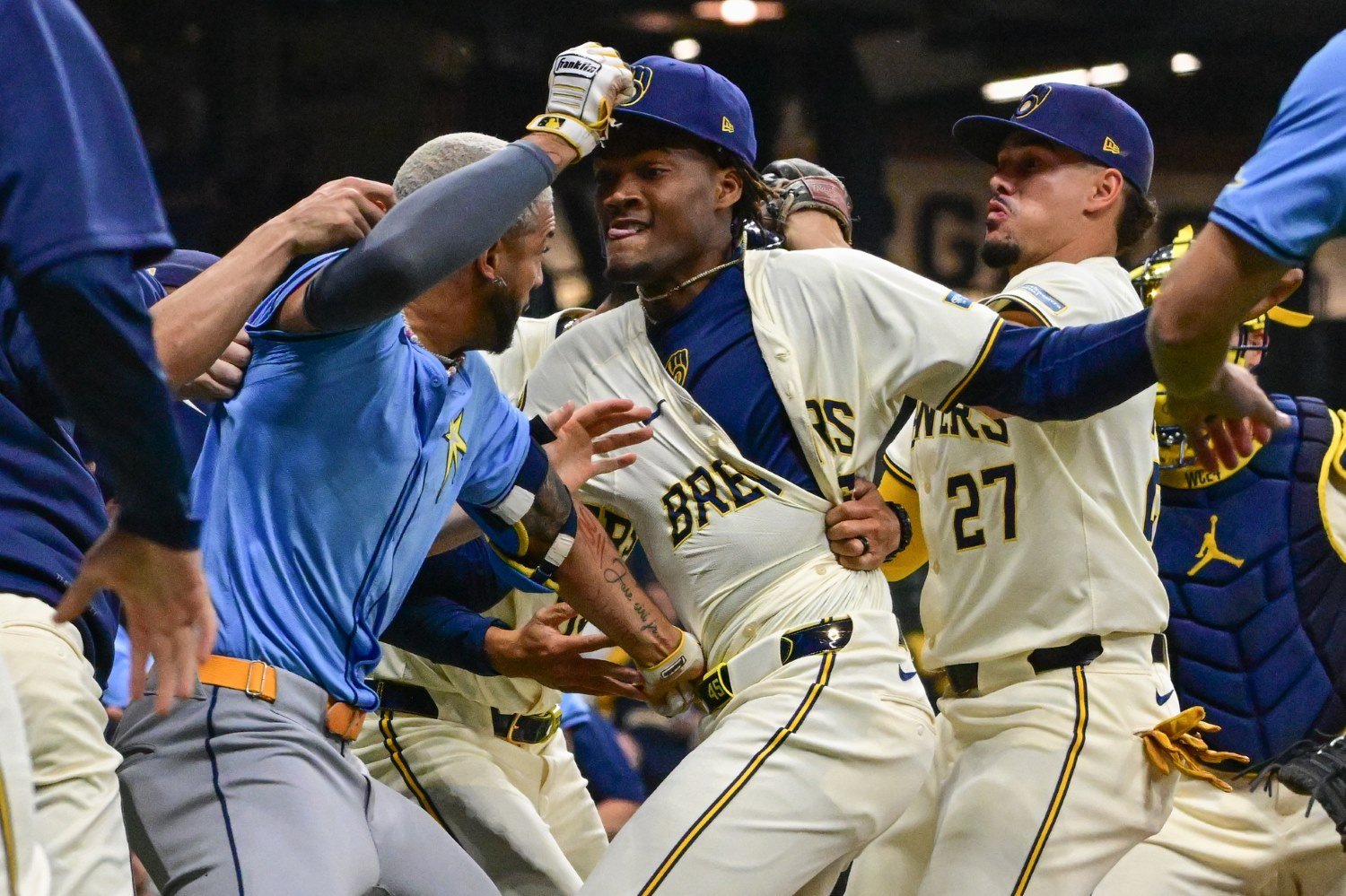 I have to lead with a disclaimer: I think the fights in which baseball players engage are childish and stupid. Only fairly massive, high-stakes personal conflicts ever need to be resolved with fists or grappling, and there's perhaps one conflict of that magnitude that plays out on a big-league diamond every five years. All the other instances of two (or 20) grown men squaring up and swinging at one another are unseemly, unintentionally hilarious displays of empty machismo. When they manage to contain real violence, rather than clumsy facsimiles of it, they only become more irresponsible and senseless. That's important to say, because I also have to say this: I love what happens to a baseball game once the tension between two teams gets pitched upward, the way it did when the frustrated, sub-.500 Rays fell behind 6-1 Tuesday night and then watched Freddy Peralta plunk Jose Siri with a 3-0 pitch. Siri had begun the ramp-up a few innings earlier, when he peacocked a bit on a home run, but there was little in that. There was nothing at all in Peralta hitting him; that was plainly unintentional. Because the Rays are playing lousy baseball, though, and because the Brewers were on a losing streak and had had beef with the umpires in two consecutive games before Tuesday's, those innocuous happenings stirred a bit of distemper. Then, the umpires foolishly blew the situation out of proportion, ejecting Peralta (and then manager Pat Murphy) based on a wildly inaccurate surmise about the Brewers ace's mindset. That put every person in each dugout on edge, in what could otherwise have been an easygoing, lopsided, slightly boring game. Once that happens, baseball gets rearranged in our brains a little bit. It unfolds, and we see some of the pressure points that easily hide from us most of the time. The field itself takes on a different character. I always find myself noticing and attending more closely to the (relatively few) spaces where players from opposing teams interact in close quarters, like the batter's box (the batter and the catcher), the bases (especially on double play turns and coverage by the pitcher at first), and the basepaths. Routine plays hum with a little bit of drama. I don't want to see that bubble over, but I like that it's there. Alas, Abner Uribe let the drama bubble over in a big way. Needlessly and childishly, he tried to bump and shrug past Siri after retiring him on a grounder to first, and then when Siri invited a confrontation, Uribe waded right into the quagmire. It was terrible baseball; the act of a goon. The Brewers, with their thin and innings-light rotation, had Peralta unfairly knocked out early by the dreadful judgment of Chris Guccione, and Uribe had been called upon to help cover the innings needed to finish off an easy win. It was selfish of him to let some vague desire to intimidate the unintentional instigator of the earlier trouble override his own judgment. Because he took the first swing (again, unintentionally hilarious: he was trying to deliver what looked like a three-quarters-hearted open-handed slap, whiffed, and ended up getting punched in the neck in the ensuing brouhaha) and then scrabbled with Siri pretty hard afterward, Uribe is almost certain to get suspended for those actions when the league reviews this mess this week. Guccione should have to serve a game's suspension for each one levied against the combatants, here, but that's not the main point. The main point is, with even a modicum of moderation, Uribe could have avoided putting extra pressure on his teammates, in the present and the future. He's been a disappointment on the mound so far this year, and this was the biggest letdown yet. Still, the team did finish off the Rays and recapture first place in the NL Central. They remain a good team with a lot going for them, especially in light of Tyler Black's encouraging debut. It's just been a weird and thorny three days, and after the manager righteously got thrown out in the sixth on Tuesday, the team cracked in a somewhat regrettable way. Hopefully, the actual unpleasantness is behind us, but the Brewers will have to suffer a couple more negative consequences because of this cycle of bad decisions made by both themselves and the umpiring crews who should be keeping things on the tracks.
 -
The Brewers got their first win in four games Tuesday night, in resounding and exciting fashion. It should have been a purely thrilling evening. Instead, it was marred by bad umpiring and an unnecessary conflict--one that will prove costly in the days ahead. Image courtesy of © Benny Sieu-USA TODAY Sports I have to lead with a disclaimer: I think the fights in which baseball players engage are childish and stupid. Only fairly massive, high-stakes personal conflicts ever need to be resolved with fists or grappling, and there's perhaps one conflict of that magnitude that plays out on a big-league diamond every five years. All the other instances of two (or 20) grown men squaring up and swinging at one another are unseemly, unintentionally hilarious displays of empty machismo. When they manage to contain real violence, rather than clumsy facsimiles of it, they only become more irresponsible and senseless. That's important to say, because I also have to say this: I love what happens to a baseball game once the tension between two teams gets pitched upward, the way it did when the frustrated, sub-.500 Rays fell behind 6-1 Tuesday night and then watched Freddy Peralta plunk Jose Siri with a 3-0 pitch. Siri had begun the ramp-up a few innings earlier, when he peacocked a bit on a home run, but there was little in that. There was nothing at all in Peralta hitting him; that was plainly unintentional. Because the Rays are playing lousy baseball, though, and because the Brewers were on a losing streak and had had beef with the umpires in two consecutive games before Tuesday's, those innocuous happenings stirred a bit of distemper. Then, the umpires foolishly blew the situation out of proportion, ejecting Peralta (and then manager Pat Murphy) based on a wildly inaccurate surmise about the Brewers ace's mindset. That put every person in each dugout on edge, in what could otherwise have been an easygoing, lopsided, slightly boring game. Once that happens, baseball gets rearranged in our brains a little bit. It unfolds, and we see some of the pressure points that easily hide from us most of the time. The field itself takes on a different character. I always find myself noticing and attending more closely to the (relatively few) spaces where players from opposing teams interact in close quarters, like the batter's box (the batter and the catcher), the bases (especially on double play turns and coverage by the pitcher at first), and the basepaths. Routine plays hum with a little bit of drama. I don't want to see that bubble over, but I like that it's there. Alas, Abner Uribe let the drama bubble over in a big way. Needlessly and childishly, he tried to bump and shrug past Siri after retiring him on a grounder to first, and then when Siri invited a confrontation, Uribe waded right into the quagmire. It was terrible baseball; the act of a goon. The Brewers, with their thin and innings-light rotation, had Peralta unfairly knocked out early by the dreadful judgment of Chris Guccione, and Uribe had been called upon to help cover the innings needed to finish off an easy win. It was selfish of him to let some vague desire to intimidate the unintentional instigator of the earlier trouble override his own judgment. Because he took the first swing (again, unintentionally hilarious: he was trying to deliver what looked like a three-quarters-hearted open-handed slap, whiffed, and ended up getting punched in the neck in the ensuing brouhaha) and then scrabbled with Siri pretty hard afterward, Uribe is almost certain to get suspended for those actions when the league reviews this mess this week. Guccione should have to serve a game's suspension for each one levied against the combatants, here, but that's not the main point. The main point is, with even a modicum of moderation, Uribe could have avoided putting extra pressure on his teammates, in the present and the future. He's been a disappointment on the mound so far this year, and this was the biggest letdown yet. Still, the team did finish off the Rays and recapture first place in the NL Central. They remain a good team with a lot going for them, especially in light of Tyler Black's encouraging debut. It's just been a weird and thorny three days, and after the manager righteously got thrown out in the sixth on Tuesday, the team cracked in a somewhat regrettable way. Hopefully, the actual unpleasantness is behind us, but the Brewers will have to suffer a couple more negative consequences because of this cycle of bad decisions made by both themselves and the umpiring crews who should be keeping things on the tracks. View full article
-
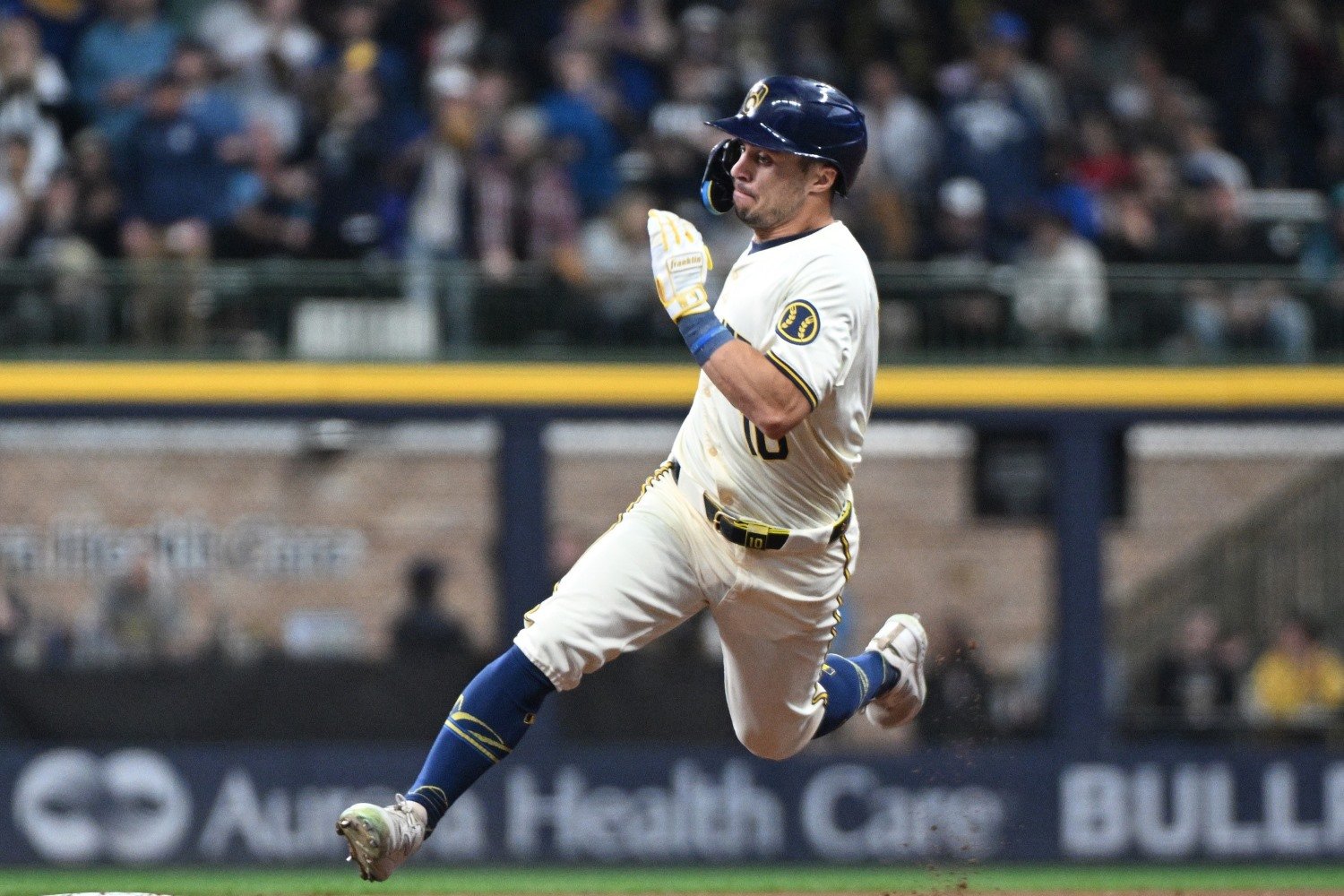 As I wrote recently, Tyler Black has made some important developmental progress in Triple-A this spring. He now joins a Brewers positional corps that went from surging to struggling almost overnight, and the team is hoping he can deliver a jolt of new life and dynamism to that group. He can, too. He won't hit for prototypical power for a defensively limited player, but he projects to have enough pop to supplement his excellent approach and loosely mimic the production of Brandon Nimmo, of the Mets. Nimmo, of course, is New York's leadoff hitter. So should Black be, for the Brewers. That's a tall order to place with a rookie right away, but that's what the situation demands. With Christian Yelich and Garrett Mitchell on the injured list and both Jackson Chourio and Sal Frelick struggling mightily at the plate, Pat Murphy needs Black to make an immediate impact. He's the hitter the Brewers need in front of William Contreras, to make the offense more functional again. Frelick isn't having a terrible season, from an OBP perspective. That's why he's been viable as the leadoff man, despite persistently feeble power output. His tenability in that slot depended on the guys right behind him hitting well, though, and the team doesn't have enough such players to keep putting up with Frelick as the guy who gets the most plate appearances in a given game. Obviously, power is not a traditional part of the leadoff hitter checklist. That's changed a great deal in recent seasons, though, and not only because of the success teams have had with leadoff men like Kyle Schwarber and Mookie Betts. It's about the changing math of the modern game. With strikeouts constantly rising and the global batting average down to one of its lowest levels ever, it's harder to chain together hits in order to score runs. If you want to consistently score with singles and doubles, you need your top five hitters to have an aggregate batting average of at least .270, and ideally, it would push toward .280. For much of baseball history, that's been the case for the top five hitters in lineups, so teams could focus almost solely on OBP from their leadoff hitters--even if, until about 20 years ago, they misunderstood the game and emphasized batting average, instead. Lately, though, the aggregate average of the top five hitters in teams' lineups is well under that breakeven point. First through fifth batters haven't collectively topped .265 in MLB since 2017, and they haven't been north of .275 since 2008. Individual teams can break that mold, of course, but the Brewers don't. Contreras and Yelich are fine hitters who generate plenty of singles and doubles to move runners around, but Willy Adames, Rhys Hoskins, and the rest of those who bat third, fourth, and fifth for this team are low-average hitters. The conversion rate on singles and walks from the leadoff spot is not going to be high enough for the Brewers to make a powerless leadoff man work. Powerless is the right word for Frelick, too. Entering Tuesday's action, he owned a .338 career slugging average, which is anemic. It's also too kind. He pounced on big-league pitching when he first came up, enjoying a power binge that lasted roughly until mid-August. Since last Aug. 16, Frelick is a .253/.325/.307 hitter, in 249 plate appearances. He last homered (if we don't count spring training) on Aug. 7, 2023. He's so ineffectual that pitchers are going right after him, and he's not even getting on base at an above-average rate. Yet, he's led off 11 of the team's last 14 games. Frelick did triple off the center-field wall Sunday against the Yankees. That was just the fourth batted ball of his career with an exit velocity over 100 miles per hour and a launch angle higher than 20 degrees, and the first since last Sept. 5--which, itself, was the last one in almost a month. Frelick has decent contact skills, fair plate discipline, and good speed, but he's not able to deliver even the modest punch the team needs at the top of its order right now. Black can be that guy, but even if Murphy isn't comfortable asking him to do so right away, the intermediate step should be demoting Frelick to eighth or ninth in the order and sliding Brice Turang up to the top. Turang doesn't have materially better batted-ball skills than Frelick does, but he's learned more in his big-league tenure about how to leverage the limited power he does have. He can find gaps, punish occasional mistakes, and work walks more effectively than can Frelick, because the latter hasn't figured out how to adapt to a league in which almost half the pitches thrown are something other than a fastball. It's strange to think of a hitter as disqualified from batting first by their dearth of power, but that's the situation for Frelick. He can still be very valuable at the bottom of the order, because in today's game, the role of the sixth through ninth guys has changed somewhat. Most such hitters now have more power than Frelick does, too, but that really doesn't matter. Now that averages have sunk to the point where offense can't be about chaining together hits from the stars in the top half of the lineup, the game is really about getting your best hitters up there for an extra few plate appearances. On-base skills are, perhaps counterintuitively, increasing in importance for players in the bottom third of the order. It's how a team can lengthen a game and create more opportunities for their best players to deliver a win. Avoiding outs by your worst hitters provides an important advantage, as long as your best ones have the pop to make their extra chances count. Let's take this from abstract to concrete. Until Yelich returns, when they face right-handed pitchers, the Brewers could trot out a lineup of: Black - 1b Contreras - c Adames - ss Hoskins - dh Blake Perkins - cf Turang - 2b Chourio - rf Frelick - lf Joey Ortiz - 3b If they're comfortable enough with it, they could get one extra left-handed bat into the lineup by sliding Hoskins to first base and Black to third, or by bringing Frelick in to play third and using Jake Bauers in left field. Once Yelich does come back, they could go: Black - 1b Contreras - c Yelich - lf Adames - ss Hoskins - dh Perkins - cf Turang - 2b Chourio - rf Frelick - 3b Alternatively, here, Ortiz (or even Oliver Dunn, though he's looked overmatched by big-league velocity) could replace Frelick and push him to the bench altogether. Based on everything he's done so far, Perkins looks more valuable than Frelick, and although Frelick remains worthy of some investment of playing time in the name of development, the team needs to focus on winning games, more than on trying to get Frelick back on track. In any event, Black is the right balance of batting average, OBP, and slugging upside to bat leadoff for the Brewers. If not right away, then he should be hitting there regularly within a month. There are no guarantees that he'll meet that challenge, but that's the role where he fits and where he can provide great value to the 2024 Brewers.
 -
Another in the Milwaukee Brewers' cavalcade of talented young hitters has reached the big leagues. That will force some changes to their lineup, and the most prominent of those should be making the new guy the leadoff hitter. Image courtesy of © Michael McLoone-USA TODAY Sports As I wrote recently, Tyler Black has made some important developmental progress in Triple-A this spring. He now joins a Brewers positional corps that went from surging to struggling almost overnight, and the team is hoping he can deliver a jolt of new life and dynamism to that group. He can, too. He won't hit for prototypical power for a defensively limited player, but he projects to have enough pop to supplement his excellent approach and loosely mimic the production of Brandon Nimmo, of the Mets. Nimmo, of course, is New York's leadoff hitter. So should Black be, for the Brewers. That's a tall order to place with a rookie right away, but that's what the situation demands. With Christian Yelich and Garrett Mitchell on the injured list and both Jackson Chourio and Sal Frelick struggling mightily at the plate, Pat Murphy needs Black to make an immediate impact. He's the hitter the Brewers need in front of William Contreras, to make the offense more functional again. Frelick isn't having a terrible season, from an OBP perspective. That's why he's been viable as the leadoff man, despite persistently feeble power output. His tenability in that slot depended on the guys right behind him hitting well, though, and the team doesn't have enough such players to keep putting up with Frelick as the guy who gets the most plate appearances in a given game. Obviously, power is not a traditional part of the leadoff hitter checklist. That's changed a great deal in recent seasons, though, and not only because of the success teams have had with leadoff men like Kyle Schwarber and Mookie Betts. It's about the changing math of the modern game. With strikeouts constantly rising and the global batting average down to one of its lowest levels ever, it's harder to chain together hits in order to score runs. If you want to consistently score with singles and doubles, you need your top five hitters to have an aggregate batting average of at least .270, and ideally, it would push toward .280. For much of baseball history, that's been the case for the top five hitters in lineups, so teams could focus almost solely on OBP from their leadoff hitters--even if, until about 20 years ago, they misunderstood the game and emphasized batting average, instead. Lately, though, the aggregate average of the top five hitters in teams' lineups is well under that breakeven point. First through fifth batters haven't collectively topped .265 in MLB since 2017, and they haven't been north of .275 since 2008. Individual teams can break that mold, of course, but the Brewers don't. Contreras and Yelich are fine hitters who generate plenty of singles and doubles to move runners around, but Willy Adames, Rhys Hoskins, and the rest of those who bat third, fourth, and fifth for this team are low-average hitters. The conversion rate on singles and walks from the leadoff spot is not going to be high enough for the Brewers to make a powerless leadoff man work. Powerless is the right word for Frelick, too. Entering Tuesday's action, he owned a .338 career slugging average, which is anemic. It's also too kind. He pounced on big-league pitching when he first came up, enjoying a power binge that lasted roughly until mid-August. Since last Aug. 16, Frelick is a .253/.325/.307 hitter, in 249 plate appearances. He last homered (if we don't count spring training) on Aug. 7, 2023. He's so ineffectual that pitchers are going right after him, and he's not even getting on base at an above-average rate. Yet, he's led off 11 of the team's last 14 games. Frelick did triple off the center-field wall Sunday against the Yankees. That was just the fourth batted ball of his career with an exit velocity over 100 miles per hour and a launch angle higher than 20 degrees, and the first since last Sept. 5--which, itself, was the last one in almost a month. Frelick has decent contact skills, fair plate discipline, and good speed, but he's not able to deliver even the modest punch the team needs at the top of its order right now. Black can be that guy, but even if Murphy isn't comfortable asking him to do so right away, the intermediate step should be demoting Frelick to eighth or ninth in the order and sliding Brice Turang up to the top. Turang doesn't have materially better batted-ball skills than Frelick does, but he's learned more in his big-league tenure about how to leverage the limited power he does have. He can find gaps, punish occasional mistakes, and work walks more effectively than can Frelick, because the latter hasn't figured out how to adapt to a league in which almost half the pitches thrown are something other than a fastball. It's strange to think of a hitter as disqualified from batting first by their dearth of power, but that's the situation for Frelick. He can still be very valuable at the bottom of the order, because in today's game, the role of the sixth through ninth guys has changed somewhat. Most such hitters now have more power than Frelick does, too, but that really doesn't matter. Now that averages have sunk to the point where offense can't be about chaining together hits from the stars in the top half of the lineup, the game is really about getting your best hitters up there for an extra few plate appearances. On-base skills are, perhaps counterintuitively, increasing in importance for players in the bottom third of the order. It's how a team can lengthen a game and create more opportunities for their best players to deliver a win. Avoiding outs by your worst hitters provides an important advantage, as long as your best ones have the pop to make their extra chances count. Let's take this from abstract to concrete. Until Yelich returns, when they face right-handed pitchers, the Brewers could trot out a lineup of: Black - 1b Contreras - c Adames - ss Hoskins - dh Blake Perkins - cf Turang - 2b Chourio - rf Frelick - lf Joey Ortiz - 3b If they're comfortable enough with it, they could get one extra left-handed bat into the lineup by sliding Hoskins to first base and Black to third, or by bringing Frelick in to play third and using Jake Bauers in left field. Once Yelich does come back, they could go: Black - 1b Contreras - c Yelich - lf Adames - ss Hoskins - dh Perkins - cf Turang - 2b Chourio - rf Frelick - 3b Alternatively, here, Ortiz (or even Oliver Dunn, though he's looked overmatched by big-league velocity) could replace Frelick and push him to the bench altogether. Based on everything he's done so far, Perkins looks more valuable than Frelick, and although Frelick remains worthy of some investment of playing time in the name of development, the team needs to focus on winning games, more than on trying to get Frelick back on track. In any event, Black is the right balance of batting average, OBP, and slugging upside to bat leadoff for the Brewers. If not right away, then he should be hitting there regularly within a month. There are no guarantees that he'll meet that challenge, but that's the role where he fits and where he can provide great value to the 2024 Brewers. View full article
-
The Milwaukee Brewers lost a heartbreaker Monday night, partially thanks to a controversial call in which the umpires enforced one section of the rules governing interference by the batter, instead of another. The whole thing (and a bevy of other unfortunate things, too) could be avoided, though, with one simple change to the playing field. Image courtesy of © Jeff Hanisch-USA TODAY Sports I love catcher interferences. I think they're one of the wonderful little oddities of baseball--a seemingly fluky but occasionally important part of the game, and an exposure of the ways in which the game is a little bit broken. It is with a heavy heart, therefore, that I tell you: we have to get rid of them. Or at the very least, we have to take action to mitigate them, and that action figures to virtually eliminate them. There have been 1,793 instances of catcher interference in MLB since 1912. Nearly a third of those, though, have come since the start of 2015. The league sets a new record for the number of times a batter reaches due to catcher interference nearly every year, anymore. In 2022, the new record was set at 74. Last season, there were 96 of them. Already, in 2024, there have been another 28 of them. We're hurtling toward a new record, by no smaller a margin than we saw last year. Without an enforced change, this will continue apace. We live in the era of pitch framing, and the best way to frame pitches is to get as close up behind the batter as possible. William Contreras has run into too many bats over the last year-plus, himself, but it's part and parcel with the very valuable progress he's made in stealing strikes. It's worth the still-small risk of collision and a base lost to interference, to improve the chances of getting outs via better counts for the pitcher and catcher. As the frequency of these plays increases, though, they begin to have a more distortionary effect on the game. By itself, that's fine by me. I like the way the interference rule and the value of framing push against each other, forcing catchers to decide how fine a line they're willing to walk and how far forward to come to catch a ball. I even like the fact that some hitters have gotten good at drawing catcher interference; it's a subtle but nifty skill, like defenders who excel at drawing charges in basketball. Alas, as we saw Monday night, increasing catcher interference is only one symptom of the problem. There's also going to be a steady increase in backswing interference calls, In fact, though these are harder to find and count, we've already seen that increase. This, too, is a product of the modern game. Batters are crowding to the back of their box, just as catchers are crowding up into the area right next to it, because pitchers throw harder than ever and hitters need more time to see the ball and hit it. They're also swinging harder than ever, because the game is more about power than ever. Combine all of that--more big swings, from hitters farther back toward catchers who are farther forward--and the collisions become inevitable. I won't delve deeply into it here, but these forces are also the driving factors pushing hit-by-pitch rates ever higher. The chaos this engenders is, at a certain point, bad for the game. Trying to tease out whether a standard batter interference rule or a backswing interference one should be applied--let alone whether the catcher's momentum into the batter's space should negate the interference altogether--isn't a fun way to spend our time at the ballpark. The solution is simple. Right now, there's no official front line on the catcher's box in professional baseball. The league should create one, and it should be a foot or so behind the back line of the batter's box. That would enforce a separation between batter and catcher, dramatically decreasing the chances of interference on the way to the ball or on a backswing. It would also create a clear boundary. If the catcher wasn't in his box when hit with a backswing, for instance, the batter wouldn't be culpable. There are some secondary things to consider before implementing and enforcing a front line for catchers. Firstly, it could lead to more balls in the dirt, and thus more wild pitches or passed balls. We're effectively forcing the catcher backward, here, and that does matter. It would also slightly increase the distance they would have to throw on stolen base attempts, further tilting that confrontation toward runners. On balance, though, it would be good for the game. Here's one last reason, unlike the others: creating more space between batter and catcher would also reduce injuries. Fewer catchers would be hit on backswings, which is very good; plenty of backstops have been concussed that way. More importantly, though, a few fewer foul tips would hit catchers, too. Think about the moment when a hitter hits a foul ball, deflecting it from its normal trajectory but not fully redirecting it. With the catcher so crowded up behind the hitter, there's marginally less time and space than there used to be, within which the ball can both decelerate and deviate from its previous path. In few cases will a foul tip hit under new rules enforcing a deeper catcher setup miss the player altogether, whereas it would have hit them under the current rules. Each such case would be valuable, though, because the balls that almost miss the catcher are often the ones that hit them, instead, in the top of the mask. More importantly, perhaps, the force of the collision would be slightly reduced by the extra moment of deceleration between contact with the bat and contact with the catcher (or umpire). This is a small thing, but baseball is made up almost exclusively of small things. The game would flow a little better and make a little more sense if we reversed the trend toward the catcher and batter being right on top of one another. We might also see a few fewer injuries, and Brewers fans might not have to develop a migraine wading through conflicting rules on key plays. This small change is a no-brainer. View full article
-
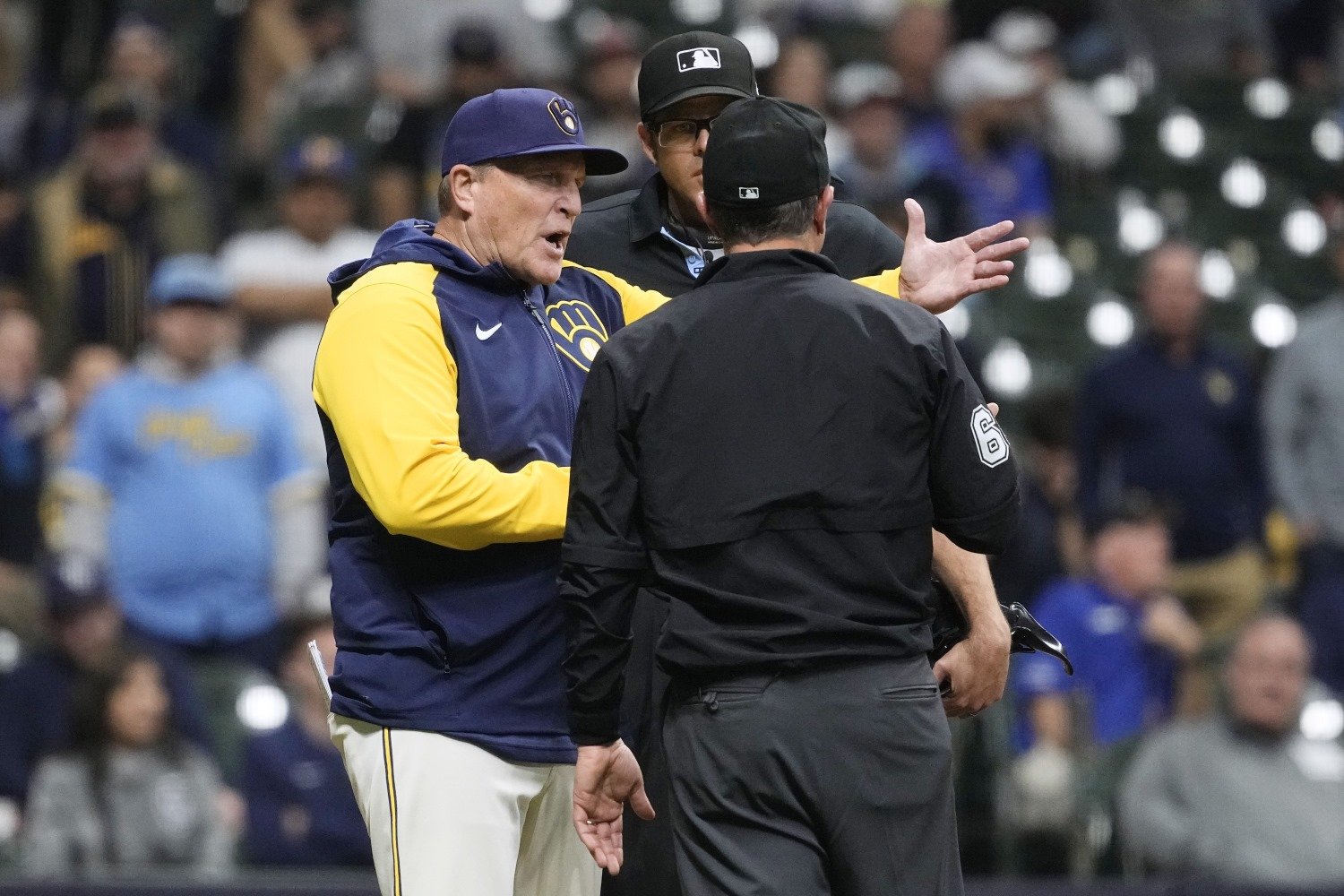 I love catcher interferences. I think they're one of the wonderful little oddities of baseball--a seemingly fluky but occasionally important part of the game, and an exposure of the ways in which the game is a little bit broken. It is with a heavy heart, therefore, that I tell you: we have to get rid of them. Or at the very least, we have to take action to mitigate them, and that action figures to virtually eliminate them. There have been 1,793 instances of catcher interference in MLB since 1912. Nearly a third of those, though, have come since the start of 2015. The league sets a new record for the number of times a batter reaches due to catcher interference nearly every year, anymore. In 2022, the new record was set at 74. Last season, there were 96 of them. Already, in 2024, there have been another 28 of them. We're hurtling toward a new record, by no smaller a margin than we saw last year. Without an enforced change, this will continue apace. We live in the era of pitch framing, and the best way to frame pitches is to get as close up behind the batter as possible. William Contreras has run into too many bats over the last year-plus, himself, but it's part and parcel with the very valuable progress he's made in stealing strikes. It's worth the still-small risk of collision and a base lost to interference, to improve the chances of getting outs via better counts for the pitcher and catcher. As the frequency of these plays increases, though, they begin to have a more distortionary effect on the game. By itself, that's fine by me. I like the way the interference rule and the value of framing push against each other, forcing catchers to decide how fine a line they're willing to walk and how far forward to come to catch a ball. I even like the fact that some hitters have gotten good at drawing catcher interference; it's a subtle but nifty skill, like defenders who excel at drawing charges in basketball. Alas, as we saw Monday night, increasing catcher interference is only one symptom of the problem. There's also going to be a steady increase in backswing interference calls, In fact, though these are harder to find and count, we've already seen that increase. This, too, is a product of the modern game. Batters are crowding to the back of their box, just as catchers are crowding up into the area right next to it, because pitchers throw harder than ever and hitters need more time to see the ball and hit it. They're also swinging harder than ever, because the game is more about power than ever. Combine all of that--more big swings, from hitters farther back toward catchers who are farther forward--and the collisions become inevitable. I won't delve deeply into it here, but these forces are also the driving factors pushing hit-by-pitch rates ever higher. The chaos this engenders is, at a certain point, bad for the game. Trying to tease out whether a standard batter interference rule or a backswing interference one should be applied--let alone whether the catcher's momentum into the batter's space should negate the interference altogether--isn't a fun way to spend our time at the ballpark. The solution is simple. Right now, there's no official front line on the catcher's box in professional baseball. The league should create one, and it should be a foot or so behind the back line of the batter's box. That would enforce a separation between batter and catcher, dramatically decreasing the chances of interference on the way to the ball or on a backswing. It would also create a clear boundary. If the catcher wasn't in his box when hit with a backswing, for instance, the batter wouldn't be culpable. There are some secondary things to consider before implementing and enforcing a front line for catchers. Firstly, it could lead to more balls in the dirt, and thus more wild pitches or passed balls. We're effectively forcing the catcher backward, here, and that does matter. It would also slightly increase the distance they would have to throw on stolen base attempts, further tilting that confrontation toward runners. On balance, though, it would be good for the game. Here's one last reason, unlike the others: creating more space between batter and catcher would also reduce injuries. Fewer catchers would be hit on backswings, which is very good; plenty of backstops have been concussed that way. More importantly, though, a few fewer foul tips would hit catchers, too. Think about the moment when a hitter hits a foul ball, deflecting it from its normal trajectory but not fully redirecting it. With the catcher so crowded up behind the hitter, there's marginally less time and space than there used to be, within which the ball can both decelerate and deviate from its previous path. In few cases will a foul tip hit under new rules enforcing a deeper catcher setup miss the player altogether, whereas it would have hit them under the current rules. Each such case would be valuable, though, because the balls that almost miss the catcher are often the ones that hit them, instead, in the top of the mask. More importantly, perhaps, the force of the collision would be slightly reduced by the extra moment of deceleration between contact with the bat and contact with the catcher (or umpire). This is a small thing, but baseball is made up almost exclusively of small things. The game would flow a little better and make a little more sense if we reversed the trend toward the catcher and batter being right on top of one another. We might also see a few fewer injuries, and Brewers fans might not have to develop a migraine wading through conflicting rules on key plays. This small change is a no-brainer.
 -
The Hunter: William Contreras's Fight to Control the Running Game
Matthew Trueblood posted an article in Brewers
 This isn't a new problem. It's been the increasingly evident "but" attached to all the well-earned praise of William Contreras's defense that has flowed forth since he joined the Brewers last spring and immediately became one of the best pitch framers in baseball. Despite his obvious athleticism and zeal for the effort, Contreras isn't even slowing down opposing basestealers, and hasn't done so since roughly the middle of last season. Go back to the middle of last August, and Contreras has thrown out just four of 37 runners stealing against him. This year, specifically, opponents are 16-for-18. Some of that struggle is down to the new rules that limit pitchers' pickoff attempts on runners who reach base. Some can be attributed to Brewers pitchers not doing enough to force those runners to pause, and some of it is situation-specific. Several times already this year, a runner has taken off from first with another on third, and Contreras has either faked a throw or held the ball, rather than throw through and risk a run coming home. At least one other time, he tried to earn his pitcher an inning-ending called third strike, rather than make a throw but lose the opportunity to frame that pitch. Still, there's a real problem here. Of the 43 catchers who have made at least five attempts on runners heading to second, Contreras ranks 28th in average velocity on his throws; 33rd in the time it takes him to get rid of the ball after receiving it; and (thanks to those two markedly below-average components) 39th in overall pop time. Under the current rule set, a pop time of over 2 seconds (where his average sits, so far) is not going to yield many outs. With a below-average arm and a below-average time to release the throw in the first place, only exceptional accuracy would allow Contreras to thwart a good runner. He hasn't had that so far in 2024. William, High and Wide.mp4 Now, that's not a great pitch on which to throw, and Contreras can hardly be faulted for not being precise with a throw from his knees. On the other hand, this isn't a good jump, and as you can see, there was time enough to get an out. Even a slightly later throw could have been good enough. It just needed to be on target. More than a few times, since the 2023 All-Star break, Contreras has thrown almost wildly, trying to do generate some extra oomph or release the ball a bit more quickly but losing his lock on the target. The problem goes farther upstream. Catchers have always been racing the clock when trying to nail runners, and as a result, they have to sacrifice their optimal throwing mechanics slightly. Most catchers find ways to shorten their stride. Most throw from a low arm slot, the same way a shortstop trying to get a fast runner at first base would. It's an exercise in economy of movement, and a short stride and a low three-quarters motion make for the best balance of quick release and strong, accurate throw. Here's Contreras not quite getting a runner, despite an accurate throw. Watch his movements closely. William Gotta Be Quicker.mp4 Again, the rules being what they are and with a runner as fast as Michael Siani going, the math was against Contreras all along. His feet are quick and his movements are smooth. The throw's on the mark. There's not much more he can do. Yet, notice, too, how high his arm slot is. That's the case just about every time Contreras throws. Maybe that's a conscious decision, because his raw arm strength isn't up to the challenge of throwing hard enough to get an out with a quicker motion. He also gains a lot of ground with his stride, which helps with arm strength and can be good for accuracy, but which makes it take longer to release the ball. Let's cut Contreras a break, and take a look at an instance in which he did get the out. William Gets One But Lucky.mp4 This is great action. He's quick, his throw is strong, and it's on a dime. It's also, effectively, a pitchout, though not by design. Joel Payamps missed his spot, but it benefited Contreras, taking him part of the way up into a good throwing position even as he caught the ball. It's a great play. It's also from last summer, before his slump really began, and it required some good luck, in the form of a high, arm-side miss from his pitcher. Contreras nabbed another runner, though, in a huge moment Friday night. Let's look at that one. William Gets Em.mp4 This is another fastball from his pitcher, high and wide of the zone to the arm side, but this one isn't an accident. Contreras called for a modified pitchout, in the way he set the target. He anticipated the steal attempt, and he got the drop on them. It's a brilliant move. In the cat-and-mouse game between a catcher and a runner, the roles can switch from one pitch to the next. Contreras made himself the cat and caught the mouse by laying a clever trap. It helped that there was a right-handed batter at the plate in this instance, because lately, Contreras needs the ball to be on that side of his body to set up and make an effective throw. Here's the plot of pitch locations on his four times catching runners stealing since August: Now, here's the same plot for all pitches on which runners successfully stole a base against him in the same period. Catching the ball slightly toward his backhand side helps Contreras carry his momentum straight through as he steps forward. It keeps him on line without hurting his ability to rotate and create power. Most catchers throw better on a ball in that area. Right now, what sets Contreras apart is that he needs that kind of pitch to make a sufficient throw. Things like modified pitchouts can still help blunt the opposing running game, though. So can another tactic, one Contreras has fervently embraced: pickoff attempts. Pitchers only get a couple of chances per plate appearance to hold a runner (or try to erase them) by throwing over, but catchers can add their own arms to the arsenal of deterrence, tax-free. This season, he's thrown behind runners 13 times: 10 at first base, and three at second. No other backstop in the league has made more than seven pickoff attempts in total. It might not be possible to fully fix this problem. That's fine. Contreras's pitch framing (though down in the early going this year) and his blocking of errant pitches (quite good, last year and this month) are more helpful than his inability to nail runners is harmful. It seems like he, the coaching staff, and the pitchers with whom he works have a plan to mitigate the damage of the latter, anyway. It's fun to watch Contreras try to fix it, anyway. His perfectionism is part of why he's an MVP candidate. His imperfections, in that light, can be forgiven.
 -
He's made big strides at the plate this season. He's one of the emotional centers of the Milwaukee Brewers, and their resident iron man. He's an MVP candidate. Right now, though, William Contreras is getting cooked. Image courtesy of © Charles LeClaire-USA TODAY Sports This isn't a new problem. It's been the increasingly evident "but" attached to all the well-earned praise of William Contreras's defense that has flowed forth since he joined the Brewers last spring and immediately became one of the best pitch framers in baseball. Despite his obvious athleticism and zeal for the effort, Contreras isn't even slowing down opposing basestealers, and hasn't done so since roughly the middle of last season. Go back to the middle of last August, and Contreras has thrown out just four of 37 runners stealing against him. This year, specifically, opponents are 16-for-18. Some of that struggle is down to the new rules that limit pitchers' pickoff attempts on runners who reach base. Some can be attributed to Brewers pitchers not doing enough to force those runners to pause, and some of it is situation-specific. Several times already this year, a runner has taken off from first with another on third, and Contreras has either faked a throw or held the ball, rather than throw through and risk a run coming home. At least one other time, he tried to earn his pitcher an inning-ending called third strike, rather than make a throw but lose the opportunity to frame that pitch. Still, there's a real problem here. Of the 43 catchers who have made at least five attempts on runners heading to second, Contreras ranks 28th in average velocity on his throws; 33rd in the time it takes him to get rid of the ball after receiving it; and (thanks to those two markedly below-average components) 39th in overall pop time. Under the current rule set, a pop time of over 2 seconds (where his average sits, so far) is not going to yield many outs. With a below-average arm and a below-average time to release the throw in the first place, only exceptional accuracy would allow Contreras to thwart a good runner. He hasn't had that so far in 2024. William, High and Wide.mp4 Now, that's not a great pitch on which to throw, and Contreras can hardly be faulted for not being precise with a throw from his knees. On the other hand, this isn't a good jump, and as you can see, there was time enough to get an out. Even a slightly later throw could have been good enough. It just needed to be on target. More than a few times, since the 2023 All-Star break, Contreras has thrown almost wildly, trying to do generate some extra oomph or release the ball a bit more quickly but losing his lock on the target. The problem goes farther upstream. Catchers have always been racing the clock when trying to nail runners, and as a result, they have to sacrifice their optimal throwing mechanics slightly. Most catchers find ways to shorten their stride. Most throw from a low arm slot, the same way a shortstop trying to get a fast runner at first base would. It's an exercise in economy of movement, and a short stride and a low three-quarters motion make for the best balance of quick release and strong, accurate throw. Here's Contreras not quite getting a runner, despite an accurate throw. Watch his movements closely. William Gotta Be Quicker.mp4 Again, the rules being what they are and with a runner as fast as Michael Siani going, the math was against Contreras all along. His feet are quick and his movements are smooth. The throw's on the mark. There's not much more he can do. Yet, notice, too, how high his arm slot is. That's the case just about every time Contreras throws. Maybe that's a conscious decision, because his raw arm strength isn't up to the challenge of throwing hard enough to get an out with a quicker motion. He also gains a lot of ground with his stride, which helps with arm strength and can be good for accuracy, but which makes it take longer to release the ball. Let's cut Contreras a break, and take a look at an instance in which he did get the out. William Gets One But Lucky.mp4 This is great action. He's quick, his throw is strong, and it's on a dime. It's also, effectively, a pitchout, though not by design. Joel Payamps missed his spot, but it benefited Contreras, taking him part of the way up into a good throwing position even as he caught the ball. It's a great play. It's also from last summer, before his slump really began, and it required some good luck, in the form of a high, arm-side miss from his pitcher. Contreras nabbed another runner, though, in a huge moment Friday night. Let's look at that one. William Gets Em.mp4 This is another fastball from his pitcher, high and wide of the zone to the arm side, but this one isn't an accident. Contreras called for a modified pitchout, in the way he set the target. He anticipated the steal attempt, and he got the drop on them. It's a brilliant move. In the cat-and-mouse game between a catcher and a runner, the roles can switch from one pitch to the next. Contreras made himself the cat and caught the mouse by laying a clever trap. It helped that there was a right-handed batter at the plate in this instance, because lately, Contreras needs the ball to be on that side of his body to set up and make an effective throw. Here's the plot of pitch locations on his four times catching runners stealing since August: Now, here's the same plot for all pitches on which runners successfully stole a base against him in the same period. Catching the ball slightly toward his backhand side helps Contreras carry his momentum straight through as he steps forward. It keeps him on line without hurting his ability to rotate and create power. Most catchers throw better on a ball in that area. Right now, what sets Contreras apart is that he needs that kind of pitch to make a sufficient throw. Things like modified pitchouts can still help blunt the opposing running game, though. So can another tactic, one Contreras has fervently embraced: pickoff attempts. Pitchers only get a couple of chances per plate appearance to hold a runner (or try to erase them) by throwing over, but catchers can add their own arms to the arsenal of deterrence, tax-free. This season, he's thrown behind runners 13 times: 10 at first base, and three at second. No other backstop in the league has made more than seven pickoff attempts in total. It might not be possible to fully fix this problem. That's fine. Contreras's pitch framing (though down in the early going this year) and his blocking of errant pitches (quite good, last year and this month) are more helpful than his inability to nail runners is harmful. It seems like he, the coaching staff, and the pitchers with whom he works have a plan to mitigate the damage of the latter, anyway. It's fun to watch Contreras try to fix it, anyway. His perfectionism is part of why he's an MVP candidate. His imperfections, in that light, can be forgiven. View full article
-
Though they neither overpower teams nor dominate with the strikeout, the Milwaukee Brewers still have one of baseball's best overall pitching staffs. The key to their success may be the incredible assortment of release points hitters have to deal with from them. Imagine that you're a lineup tasked with facing Freddy Peralta on a given day. In addition to the sheer nastiness of Peralta's stuff, you have some tough extra layers with which to contend. Peralta has an increasingly robust four-pitch mix, but he also has a unique release point, with terrific extension and a low slot. He releases the ball more than two and a half feet wide of the center of the rubber, and less than five feet above the ground, on a regular basis. Eventually, of course, Peralta comes out of the game. You might have the good fortune to chase him, as the Pirates did Thursday. More often, he twirls six or seven brilliant innings. Either way, though, as soon as you get into the bullpen, you have a very different (but equally uncomfortable) set of problems to try to solve. Imagine, for example, that Hoby Milner comes in to relieve Peralta, as he did Thursday. Milner has an even lower, even wider release point, with roughly equal extension, and it comes from the other side of the mound. Good luck. If Milner is down for the day, though, you're not getting any kind of reprieve. Bryan Hudson, despite being gigantic, throws from almost as low a point as Milner, and almost as far toward first base. He has even better extension than either Milner or Peralta, and throws harder than the former, with a four-seamer as his primary fastball instead of the sinker. Maybe you get extra unlucky, and see both Milner and Hudson, with Abner Uribe breaking them up. There's nothing especially unusual about Uribe's arm slot, but because he works from the first-base side of the rubber, his average release point is about two full feet farther toward first base than Peralta's. That, plus, he throws 100 miles per hour. So you get Peralta, then Milner, then Uribe, then Hudson. Did you extend the game long enough to make it matter who's next in line? Great. Congratulations. Now comes Trevor Megill, whose release point has migrated even farther toward first base this year, relative even to where he finished last year. His release point is almost perfectly in line with the center of the rubber, and it's about two and a half feet higher than those of Peralta, Milner, or Hudson. He throws 100, like Uribe, but the shape of that heat is drastically different than Uribe's. Uribe pairs his sinker with a big sweeper, but Megill's new innovation this year has just been to add an even harder, tighter breaking ball (a true slider) to the knuckle curve he used in concert with his rising four-seamer late in 2023. Without delving at all into the singularly heavy sinker of Elvis Peguero or the herky-jerky left-handed stuff of Jared Koenig, we've begun to capture why teams have such a hard time with the Brewers. The team doesn't have a corps with stuff any more intense, on average, than that of the rest of the league. They're not leading the way in strikeouts or showing the best control in baseball. They are, however, holding opposing offenses to some of the lowest average exit velocities in baseball, and getting plenty of grounders. They're doing it by forcing hitters to reset and recalibrate their eyes almost every time through the order. They're doing it with an extremely deep roster of guys who offer extreme looks. This is quantifiable, to some extent. There are five teams who haven't had a single pitch thrown this year more than 30 inches (in either direction) from the horizontal center of the rubber, and with a vertical release height south of five feet. There are three more who have thrown fewer than 10 such pitches as a team. The Brewers have thrown 307 such pitches, all by Peralta, Milner, and Hudson, which is easily the most in baseball. Meanwhile, only the White Sox and Rays have thrown more pitches from at least six and a half feet off the ground and within 10 inches of the center of the rubber than have the Brewers (with all theirs coming from Megill). It's harder to show numerically how having these hurlers as anchors of the pitching staff makes normal arm actions and release points (like those of Joel Payamps and Colin Rea) deceptive in their own right, but that's another aspect of the conversation. They just keep adding to pitchers' arsenals, and increasing the variety in the angles and shapes they show hitters. It's a tough way to dominate, but the Crew have proved they have a real and sustainable sense of how to do it. View full article
-
- 1
-

-
- trevor megill
- hoby milner
- (and 2 more)
-
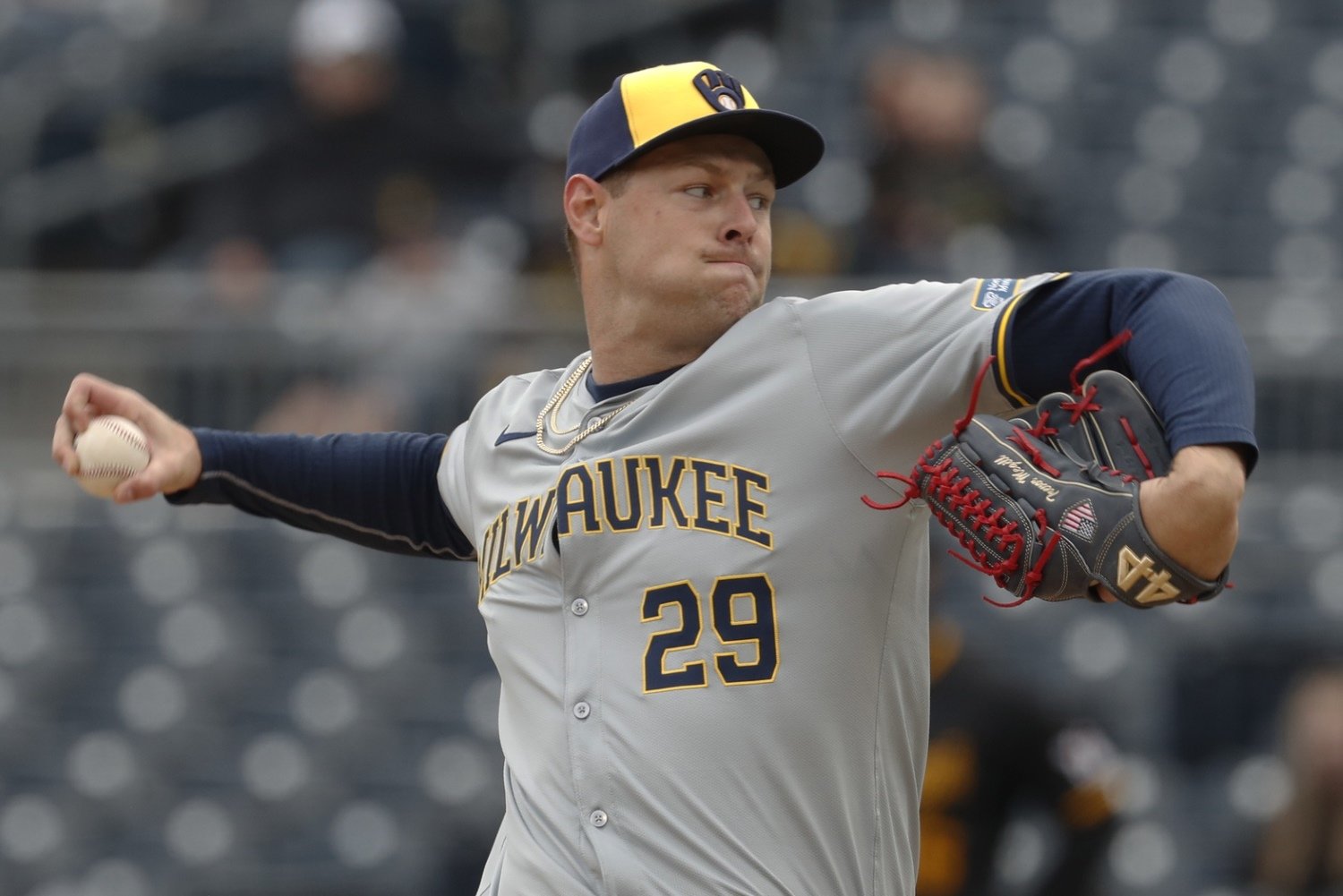 Imagine that you're a lineup tasked with facing Freddy Peralta on a given day. In addition to the sheer nastiness of Peralta's stuff, you have some tough extra layers with which to contend. Peralta has an increasingly robust four-pitch mix, but he also has a unique release point, with terrific extension and a low slot. He releases the ball more than two and a half feet wide of the center of the rubber, and less than five feet above the ground, on a regular basis. Eventually, of course, Peralta comes out of the game. You might have the good fortune to chase him, as the Pirates did Thursday. More often, he twirls six or seven brilliant innings. Either way, though, as soon as you get into the bullpen, you have a very different (but equally uncomfortable) set of problems to try to solve. Imagine, for example, that Hoby Milner comes in to relieve Peralta, as he did Thursday. Milner has an even lower, even wider release point, with roughly equal extension, and it comes from the other side of the mound. Good luck. If Milner is down for the day, though, you're not getting any kind of reprieve. Bryan Hudson, despite being gigantic, throws from almost as low a point as Milner, and almost as far toward first base. He has even better extension than either Milner or Peralta, and throws harder than the former, with a four-seamer as his primary fastball instead of the sinker. Maybe you get extra unlucky, and see both Milner and Hudson, with Abner Uribe breaking them up. There's nothing especially unusual about Uribe's arm slot, but because he works from the first-base side of the rubber, his average release point is about two full feet farther toward first base than Peralta's. That, plus, he throws 100 miles per hour. So you get Peralta, then Milner, then Uribe, then Hudson. Did you extend the game long enough to make it matter who's next in line? Great. Congratulations. Now comes Trevor Megill, whose release point has migrated even farther toward first base this year, relative even to where he finished last year. His release point is almost perfectly in line with the center of the rubber, and it's about two and a half feet higher than those of Peralta, Milner, or Hudson. He throws 100, like Uribe, but the shape of that heat is drastically different than Uribe's. Uribe pairs his sinker with a big sweeper, but Megill's new innovation this year has just been to add an even harder, tighter breaking ball (a true slider) to the knuckle curve he used in concert with his rising four-seamer late in 2023. Without delving at all into the singularly heavy sinker of Elvis Peguero or the herky-jerky left-handed stuff of Jared Koenig, we've begun to capture why teams have such a hard time with the Brewers. The team doesn't have a corps with stuff any more intense, on average, than that of the rest of the league. They're not leading the way in strikeouts or showing the best control in baseball. They are, however, holding opposing offenses to some of the lowest average exit velocities in baseball, and getting plenty of grounders. They're doing it by forcing hitters to reset and recalibrate their eyes almost every time through the order. They're doing it with an extremely deep roster of guys who offer extreme looks. This is quantifiable, to some extent. There are five teams who haven't had a single pitch thrown this year more than 30 inches (in either direction) from the horizontal center of the rubber, and with a vertical release height south of five feet. There are three more who have thrown fewer than 10 such pitches as a team. The Brewers have thrown 307 such pitches, all by Peralta, Milner, and Hudson, which is easily the most in baseball. Meanwhile, only the White Sox and Rays have thrown more pitches from at least six and a half feet off the ground and within 10 inches of the center of the rubber than have the Brewers (with all theirs coming from Megill). It's harder to show numerically how having these hurlers as anchors of the pitching staff makes normal arm actions and release points (like those of Joel Payamps and Colin Rea) deceptive in their own right, but that's another aspect of the conversation. They just keep adding to pitchers' arsenals, and increasing the variety in the angles and shapes they show hitters. It's a tough way to dominate, but the Crew have proved they have a real and sustainable sense of how to do it.
-
- 3
-
-
- trevor megill
- hoby milner
- (and 2 more)
-
With a Nashville hot streak, one of the Milwaukee Brewers' best prospects is garnering some attention and making a case for a promotion to the big leagues. It's not yet clear, though, whether he's actually ready to be a valuable hitter at the highest level. Image courtesy of © Joe Camporeale-USA TODAY Sports Back in December, I wrote about Tyler Black's batted-ball profile during a second-half promotion to Triple-A in 2023. The piece focused on the fact that Black can be a valuable contributor, but also highlighted the remaining deficiencies in his game--namely, a dearth of power. Black entered pro ball as a ground-ball hitter whose profile centered on his overall athleticism, including good speed. Last year, he tapped into more power by lifting the ball much more consistently, but he didn't truly turn the corner and break out. Some of that was about the difficulty of adjusting to Triple-A competition, rather than the Double-A variety, in the middle of the season. As the team looks ahead at its season and considers Black as a potential addition to the lineup before it's over, though, an even bigger adjustment looms for him. In order to be a credible candidate to help the Crew offensively, then, Black needs to show some real and major progress at Nashville, such that we can reasonably project him not to need a major overhaul in approach in order to find success if brought up to the parent club. On the surface, it looks like time to get excited. Black is batting .316/.423/.519 on the young season, with seven extra-base hits (including three homers), 13 walks, and just 13 strikeouts in 97 trips to the plate. He's also been hit by three pitches, stolen three bases in four tries, and avoided grounding into a double play. Last week on the Brewer Fanatic podcast, co-host Spencer Michaelis talked about his feeling that Black's bat is ready, and that the only thing holding him back (rightfully) from a big-league debut is his poor glove work at first base. In watching Nashville's games, it's easy to see what Spencer is seeing. Black looks exceptionally athletic and dangerous against Triple-A competition. Dig deeper into the data, though, and the signals are more mixed, even at the plate. That's not a euphemism for something worse; there really are both good and bad signs through which to sift. Let's consider a few of them. Firstly, the good news: In addition to those improved topline numbers, Black has made the requisite adjustments to bring along the loft in his profile that allowed him to surge so impressively last year at Double-A Biloxi. Black's average launch angle on batted balls is up about 6 degrees from where it stood during his time in Nashville in 2023, but just as importantly (and perhaps more so), the percentage of his batted balls clustered between 10 and 30 degrees--the most valuable range, where most extra-base hits live--has leaped from 23% to 39%. Last year, the average launch angle on Black's well-hit balls (95+ miles per hour) was 7 degrees. This year, it's 16. Admittedly, the samples here remain tiny, not only because we're still in late April but because Black has walked so often. Still, this is all good news. Black doesn't look likely to deliver enough defensive value to be a good player without significant power, and you can't hit for power until you get the ball off the ground. Now, alas, we need to talk about the negative indicators around Black's performance so far, and most of them center on that very aspect of his game: power. After running a tepid average exit velocity of 86.3 miles per hour last year with Nashville, Black is actually down one mile per hour this year. On the batted balls he hits in the most valuable launch-angle range, he's down all the way from a 92 MPH average to 87 MPH. His 90th-percentile and maximum exit velocities remain right in line with those of Sal Frelick and Brice Turang, who (as we've seen) struggle to generate much power at all. That doesn't mean there's no good news. Last year, Black was working so hard just to keep up with the changes he was being asked to make that his weighted Sweet Spot Exit Velocity (wSSEV, which I created for and introduced in this piece about Rhys Hoskins) was just under 83 miles per hour. This year, he's not just hitting the ball hard when he rolls over on it. His wSSEV is up to almost 88 MPH. For a hitter with such good control of the strike zone, that's not bad at all. It sits just outside the top quartile among Triple-A hitters. It still isn't a dazzling number, but this is how we can start to envision future success for Black in MLB. That wSSEV would be more like upper-tercile than upper-quartile in MLB, and that doesn't account for the fact that he'll see a decrease in that number when he again has to adjust to tougher pitchers. Still, it's the same one currently maintained by Brandon Nimmo, and if Black turns out to be a hitter similar to Nimmo, it will count as a huge win for the Brewers, even at first base. The team shouldn't be in any hurry to call up Black. He's not as ready for the jump as his surface-level numbers suggest. He is, however, making the right rounds of adjustments, and he still has a good chance to be part of the big-league team before this long season is over. View full article
-
How Close is Tyler Black to Being a Force at the Plate in MLB?
Matthew Trueblood posted an article in Brewers
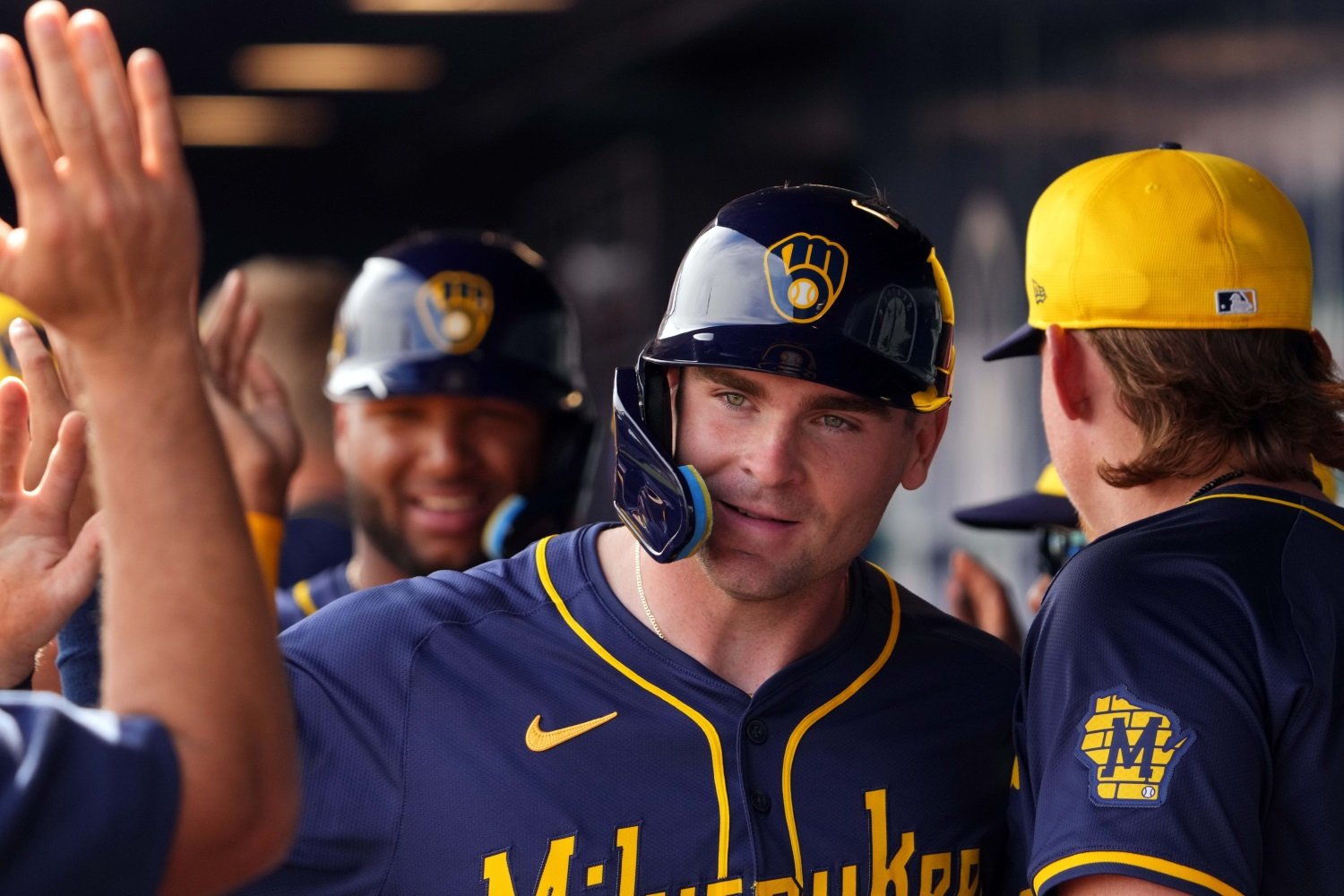 Back in December, I wrote about Tyler Black's batted-ball profile during a second-half promotion to Triple-A in 2023. The piece focused on the fact that Black can be a valuable contributor, but also highlighted the remaining deficiencies in his game--namely, a dearth of power. Black entered pro ball as a ground-ball hitter whose profile centered on his overall athleticism, including good speed. Last year, he tapped into more power by lifting the ball much more consistently, but he didn't truly turn the corner and break out. Some of that was about the difficulty of adjusting to Triple-A competition, rather than the Double-A variety, in the middle of the season. As the team looks ahead at its season and considers Black as a potential addition to the lineup before it's over, though, an even bigger adjustment looms for him. In order to be a credible candidate to help the Crew offensively, then, Black needs to show some real and major progress at Nashville, such that we can reasonably project him not to need a major overhaul in approach in order to find success if brought up to the parent club. On the surface, it looks like time to get excited. Black is batting .316/.423/.519 on the young season, with seven extra-base hits (including three homers), 13 walks, and just 13 strikeouts in 97 trips to the plate. He's also been hit by three pitches, stolen three bases in four tries, and avoided grounding into a double play. Last week on the Brewer Fanatic podcast, co-host Spencer Michaelis talked about his feeling that Black's bat is ready, and that the only thing holding him back (rightfully) from a big-league debut is his poor glove work at first base. In watching Nashville's games, it's easy to see what Spencer is seeing. Black looks exceptionally athletic and dangerous against Triple-A competition. Dig deeper into the data, though, and the signals are more mixed, even at the plate. That's not a euphemism for something worse; there really are both good and bad signs through which to sift. Let's consider a few of them. Firstly, the good news: In addition to those improved topline numbers, Black has made the requisite adjustments to bring along the loft in his profile that allowed him to surge so impressively last year at Double-A Biloxi. Black's average launch angle on batted balls is up about 6 degrees from where it stood during his time in Nashville in 2023, but just as importantly (and perhaps more so), the percentage of his batted balls clustered between 10 and 30 degrees--the most valuable range, where most extra-base hits live--has leaped from 23% to 39%. Last year, the average launch angle on Black's well-hit balls (95+ miles per hour) was 7 degrees. This year, it's 16. Admittedly, the samples here remain tiny, not only because we're still in late April but because Black has walked so often. Still, this is all good news. Black doesn't look likely to deliver enough defensive value to be a good player without significant power, and you can't hit for power until you get the ball off the ground. Now, alas, we need to talk about the negative indicators around Black's performance so far, and most of them center on that very aspect of his game: power. After running a tepid average exit velocity of 86.3 miles per hour last year with Nashville, Black is actually down one mile per hour this year. On the batted balls he hits in the most valuable launch-angle range, he's down all the way from a 92 MPH average to 87 MPH. His 90th-percentile and maximum exit velocities remain right in line with those of Sal Frelick and Brice Turang, who (as we've seen) struggle to generate much power at all. That doesn't mean there's no good news. Last year, Black was working so hard just to keep up with the changes he was being asked to make that his weighted Sweet Spot Exit Velocity (wSSEV, which I created for and introduced in this piece about Rhys Hoskins) was just under 83 miles per hour. This year, he's not just hitting the ball hard when he rolls over on it. His wSSEV is up to almost 88 MPH. For a hitter with such good control of the strike zone, that's not bad at all. It sits just outside the top quartile among Triple-A hitters. It still isn't a dazzling number, but this is how we can start to envision future success for Black in MLB. That wSSEV would be more like upper-tercile than upper-quartile in MLB, and that doesn't account for the fact that he'll see a decrease in that number when he again has to adjust to tougher pitchers. Still, it's the same one currently maintained by Brandon Nimmo, and if Black turns out to be a hitter similar to Nimmo, it will count as a huge win for the Brewers, even at first base. The team shouldn't be in any hurry to call up Black. He's not as ready for the jump as his surface-level numbers suggest. He is, however, making the right rounds of adjustments, and he still has a good chance to be part of the big-league team before this long season is over.
 -
New rules that took effect last season forced MLB teams to align their infields in relatively similar ways. The outfield remains an ungoverned frontier, though--or at least, the field itself confines teams' choices, rather than the rule book. Image courtesy of © Joe Puetz-USA TODAY Sports How does the shape of an outfield array affect the way the players who comprise it play? What determines where outfielders set up, and how they align themselves relative to one another? Do teams need to look for different essential skills in their outfielders based on the way they prefer to (or have to) set up their defenses? It's not something we tend to think about much, because defense in baseball is more about roughly equitable coverage of a large field than it is about funneling an offense toward a specific area or defending against favored positions. By the reckoning of most baseball people, hitters have relatively little control over where any given batted ball goes, so defensive alignments are about managing probability and situation. The psychological aspect--the anticipation and preemptive adjustments, and certainly most elements of surprise or disguise--that heavily influences defense in football, basketball, and soccer is largely absent in our game. Defensive positioning obviously matters a lot, though. That's why the league implemented rules forcing four infielders to stay on the dirt, and to divide themselves more evenly, with at least two players on each side of second base. It also matters in the outfield, and in our data-informed age, the average outfield alignment is changing rapidly. Look no further than the league's average starting depth for center fielders in each year of the Statcast Era to see evidence of this: 2015: 311 ft. 2016: 316 ft. 2017: 318 ft. 2018: 318 ft. 2019: 322 ft. 2020: 323 ft. 2021: 322 ft. 2022: 322 ft. 2023: 323 ft. It's been a few years since we saw a large jump in this area; the league has come much closer to what everyone understands to be the optimal depth. Still, there's a persistent trend. Outfields are playing ever deeper, to counteract hitters who are hitting more, harder line drives and fly balls. Outfielders are constrained in where they can play not by the rules (they're even welcome to come in and form five-man infields, if a team is sufficiently convinced of the need for an old-fashioned shift), but by the very walls behind them, and by the limits of their own and their teammates' talent. Famously, center fielders of yore (and ones as recent as Andruw Jones and Jim Edmonds) took pride in playing exceptionally shallow, where they could take away would-be bloop singles more often. They felt they could always go back and catch deep flies, using their singular speed and ball-tracking ability. The reality of the situation was probably always that they were giving up more value than they were saving, allowing an extra double or triple for every one or two singles they took away. Now, in a league much more densely populated with guys who can hit for power, there's no question of the folly of playing shallow, especially as we all gather more data about just how much harder it is to go back on the ball than to come in on it. By and large, then, outfielders play as deep as they can, with the limits being: The dimensions of the park; The range of their fellow outfielders; and The risk of a single through those newly tightened infields, and the need to come in and collect them quickly, to prevent runners from taking extra bases. The first factor is the most important. Teams whose home parks have very shallow corners and very deep center fields (think Yankee Stadium, Minute Maid Park, Angel Stadium) tend to play outfields that look more like a triangle (albeit a flat one). Teams with deeper-than-average corners and cozy power alleys and center fields, by contrast, play something closer to a straight line or flat arc across the grassy expanse. The best three examples in baseball, perhaps, are Busch Stadium, Wrigley Field, and Miller Park. And hey, look at this: The Brewers use, perhaps, the flattest outfield shape in MLB. That's not a coincidence. It's a factor of where they play, but also of the skill sets of their players at those positions. Christian Yelich plays a deep left field, not only because the left-field foul pole in Milwaukee is 342 feet from home plate, but because neither he nor the team wants him going back on the ball any more than is absolutely necessary. Meanwhile, Jackson Chourio is playing most of the time in right field for the Crew, and he's still fairly inexperienced there, so erring on the side of playing deep is wise. It's already paid off a couple of times for the team, as Chourio has taken imperfect routes on deep balls but still gotten under the ball in time. Just so, the fact that the Crew's center fielders play shallower than most is about more than the fairly tight dimensions across the middle of the diamond at home. It's also because both Yelich and Chourio (or whoever occupies the corners) have to cheat a bit toward those deep corners, especially with runners on. The center fielder has more responsibility for the gaps in Milwaukee than elsewhere. For that reason, there's one more interesting idiosyncrasy of the Brewers' outfield alignment: they change it more than most based on the handedness of opposing hitters. Here's the Royals' defensive alignment heat map for this young season, as a baseline to which to compare. Now, here's the Cubs, another team whose outfield alignment is flattened and affected by the parks in which they play. This is what we'd expect to see if only the park were shaping how the Brewers position their outfielders. Here, though, is the actual way the Brewers set themselves. (All of these are for road games only, which is the best way we can try to strip out the distortionary effects of home parks.) Pat Murphy, Andrew Fox, and the rest of the Crew's defensive positioning decision-makers clearly want their center fielder (most often Sal Frelick) shaded more heavily toward the direction in which the opponent is likely to hit the ball than most teams do. They're trying to facilitate cutting off a ball toward the corner or the gap toward which the ball is more likely to be hit, by having Frelick (or Blake Perkins, or whomever they put out there that day) cheat toward the corner under greater threat, so that that corner guy can cheat that way by a few steps, too. It pulls the off corner man more toward center than most teams play them, in case a ball does get hit the "wrong" way, but the team is trying to manage probabilities and maximize their chances to make good plays. So far, it's hard to argue with their choices. Only the Red Sox (5) have more Defensive Runs Saved (DRS) based on outfield positioning than the Brewers (3) do, according to Sports Info Solutions. They've benefited from having some very gifted athletes and skilled defenders in the outfield, but they've also had to weather the difficulties of having a rookie starting in one spot; a player who took most of his spring reps on the infield at another; and an aging veteran with a poor defensive reputation at the third. That they still catch the ball well and have saved runs (despite a net 0 DRS from their outfielders based on range and arm) out there so far is a testament to the wisdom of this approach. It's another small way in which the Crew are staying ahead of the curve, sometimes under difficult circumstances. View full article
- 1 reply
-
- 1
-
-
- jackson chourio
- blake perkins
- (and 2 more)
-
The Brewers' Outfield Defense Takes an Unusual Shape. Why?
Matthew Trueblood posted an article in Brewers
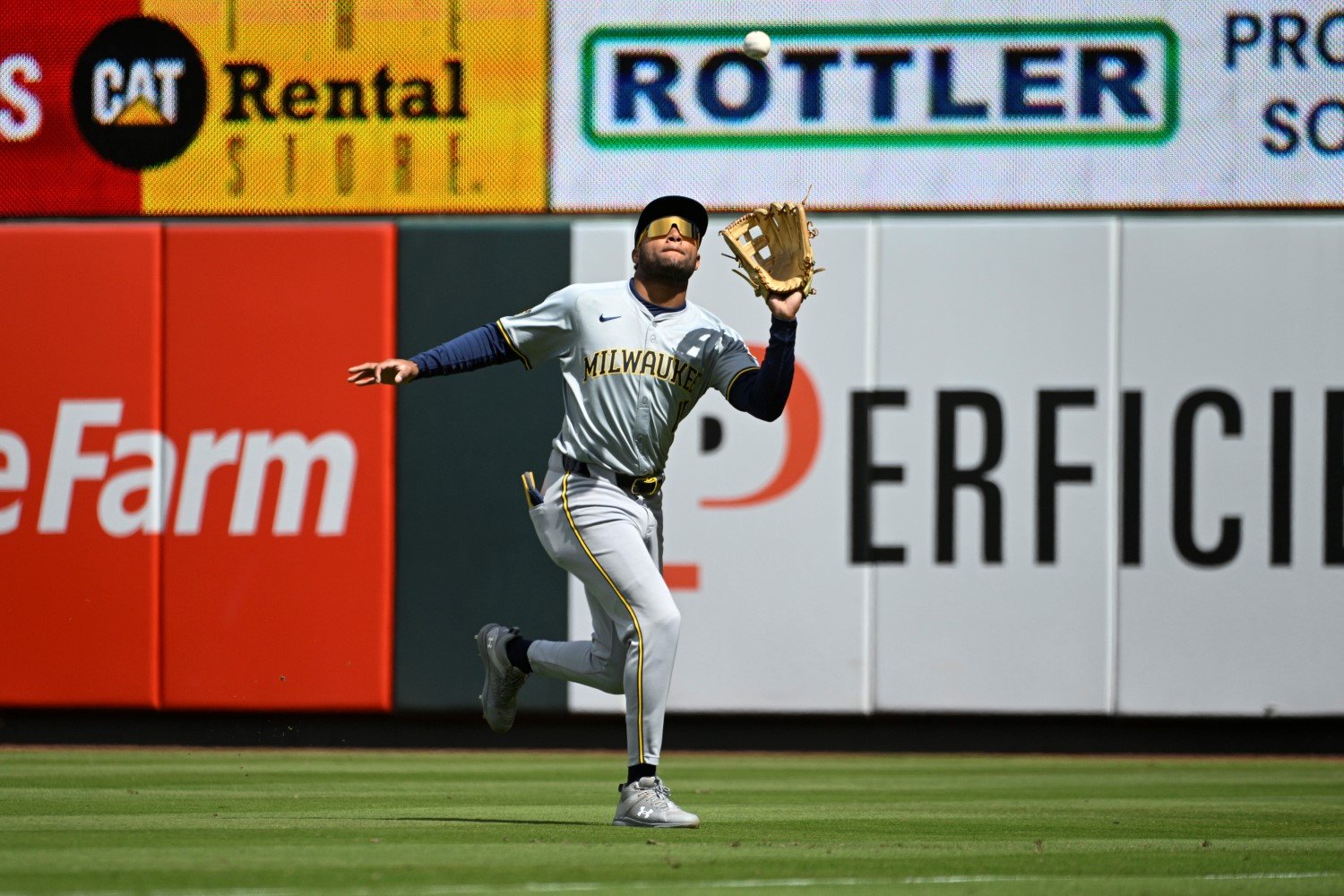 How does the shape of an outfield array affect the way the players who comprise it play? What determines where outfielders set up, and how they align themselves relative to one another? Do teams need to look for different essential skills in their outfielders based on the way they prefer to (or have to) set up their defenses? It's not something we tend to think about much, because defense in baseball is more about roughly equitable coverage of a large field than it is about funneling an offense toward a specific area or defending against favored positions. By the reckoning of most baseball people, hitters have relatively little control over where any given batted ball goes, so defensive alignments are about managing probability and situation. The psychological aspect--the anticipation and preemptive adjustments, and certainly most elements of surprise or disguise--that heavily influences defense in football, basketball, and soccer is largely absent in our game. Defensive positioning obviously matters a lot, though. That's why the league implemented rules forcing four infielders to stay on the dirt, and to divide themselves more evenly, with at least two players on each side of second base. It also matters in the outfield, and in our data-informed age, the average outfield alignment is changing rapidly. Look no further than the league's average starting depth for center fielders in each year of the Statcast Era to see evidence of this: 2015: 311 ft. 2016: 316 ft. 2017: 318 ft. 2018: 318 ft. 2019: 322 ft. 2020: 323 ft. 2021: 322 ft. 2022: 322 ft. 2023: 323 ft. It's been a few years since we saw a large jump in this area; the league has come much closer to what everyone understands to be the optimal depth. Still, there's a persistent trend. Outfields are playing ever deeper, to counteract hitters who are hitting more, harder line drives and fly balls. Outfielders are constrained in where they can play not by the rules (they're even welcome to come in and form five-man infields, if a team is sufficiently convinced of the need for an old-fashioned shift), but by the very walls behind them, and by the limits of their own and their teammates' talent. Famously, center fielders of yore (and ones as recent as Andruw Jones and Jim Edmonds) took pride in playing exceptionally shallow, where they could take away would-be bloop singles more often. They felt they could always go back and catch deep flies, using their singular speed and ball-tracking ability. The reality of the situation was probably always that they were giving up more value than they were saving, allowing an extra double or triple for every one or two singles they took away. Now, in a league much more densely populated with guys who can hit for power, there's no question of the folly of playing shallow, especially as we all gather more data about just how much harder it is to go back on the ball than to come in on it. By and large, then, outfielders play as deep as they can, with the limits being: The dimensions of the park; The range of their fellow outfielders; and The risk of a single through those newly tightened infields, and the need to come in and collect them quickly, to prevent runners from taking extra bases. The first factor is the most important. Teams whose home parks have very shallow corners and very deep center fields (think Yankee Stadium, Minute Maid Park, Angel Stadium) tend to play outfields that look more like a triangle (albeit a flat one). Teams with deeper-than-average corners and cozy power alleys and center fields, by contrast, play something closer to a straight line or flat arc across the grassy expanse. The best three examples in baseball, perhaps, are Busch Stadium, Wrigley Field, and Miller Park. And hey, look at this: The Brewers use, perhaps, the flattest outfield shape in MLB. That's not a coincidence. It's a factor of where they play, but also of the skill sets of their players at those positions. Christian Yelich plays a deep left field, not only because the left-field foul pole in Milwaukee is 342 feet from home plate, but because neither he nor the team wants him going back on the ball any more than is absolutely necessary. Meanwhile, Jackson Chourio is playing most of the time in right field for the Crew, and he's still fairly inexperienced there, so erring on the side of playing deep is wise. It's already paid off a couple of times for the team, as Chourio has taken imperfect routes on deep balls but still gotten under the ball in time. Just so, the fact that the Crew's center fielders play shallower than most is about more than the fairly tight dimensions across the middle of the diamond at home. It's also because both Yelich and Chourio (or whoever occupies the corners) have to cheat a bit toward those deep corners, especially with runners on. The center fielder has more responsibility for the gaps in Milwaukee than elsewhere. For that reason, there's one more interesting idiosyncrasy of the Brewers' outfield alignment: they change it more than most based on the handedness of opposing hitters. Here's the Royals' defensive alignment heat map for this young season, as a baseline to which to compare. Now, here's the Cubs, another team whose outfield alignment is flattened and affected by the parks in which they play. This is what we'd expect to see if only the park were shaping how the Brewers position their outfielders. Here, though, is the actual way the Brewers set themselves. (All of these are for road games only, which is the best way we can try to strip out the distortionary effects of home parks.) Pat Murphy, Andrew Fox, and the rest of the Crew's defensive positioning decision-makers clearly want their center fielder (most often Sal Frelick) shaded more heavily toward the direction in which the opponent is likely to hit the ball than most teams do. They're trying to facilitate cutting off a ball toward the corner or the gap toward which the ball is more likely to be hit, by having Frelick (or Blake Perkins, or whomever they put out there that day) cheat toward the corner under greater threat, so that that corner guy can cheat that way by a few steps, too. It pulls the off corner man more toward center than most teams play them, in case a ball does get hit the "wrong" way, but the team is trying to manage probabilities and maximize their chances to make good plays. So far, it's hard to argue with their choices. Only the Red Sox (5) have more Defensive Runs Saved (DRS) based on outfield positioning than the Brewers (3) do, according to Sports Info Solutions. They've benefited from having some very gifted athletes and skilled defenders in the outfield, but they've also had to weather the difficulties of having a rookie starting in one spot; a player who took most of his spring reps on the infield at another; and an aging veteran with a poor defensive reputation at the third. That they still catch the ball well and have saved runs (despite a net 0 DRS from their outfielders based on range and arm) out there so far is a testament to the wisdom of this approach. It's another small way in which the Crew are staying ahead of the curve, sometimes under difficult circumstances.
- 1 comment
-
- 1
-
-
- jackson chourio
- blake perkins
- (and 2 more)
-
After what some viewed as a problematically early hook Monday night in Pittsburgh, the Milwaukee Brewers' manager explained his thinking about the change in his veteran starter's stuff. Do the facts back him up? Murphy and the Brewers coaching staff believed they saw Ross's stuff flattening out, and with left-handed batters Rowdy Tellez and Jack Suwinski due to see him for a third time in the game, they didn't want to press their luck. Murphy knew the Pirates might counter with a pinch-hitter for Tellez if he brought in Milner (which they did), but felt that was still a preferable matchup to Ross against Tellez and Suwinski. As he also said in the above exchange, though, part of that thinking was that the team knows Ross and his tendencies. Were they seeing something that wasn't there, because they expected it to be? And separately, is what they think they know about his stuff and the inflection points within a game when it changes for the worse true? Happily, this has never been more testable. We can see most of what the team can see about Ross's performance, last night and across the season. Let's turn to the data. First of all, yes, Ross's sinker was flattening out as the game moved along on Monday night. That's not unusual, especially for a pitcher his age, but it's the most important of Murphy's claims, and it's accurate. Here's his horizontal movement on the pitch throughout the start. Though 'two-seamer' has lost the fight with 'sinker' for terminological primacy in pitching, horizontal movement is really about as important as vertical movement is. The 'sink' on a pitch that fools and frustrates a same-handed batter is just as often horizontal run as it is heavy dropping action, and Ross's pitch is more run than sink regardless of when he's throwing it within an outing. Now, you'll notice that he had an earlier cluster of sinkers within the outing with even less armside run than the last handful he threw, before coming out of the game. Why didn't those concern the staff as much? Partially, it's because they were thrown considerably harder. Again, it's not at all unusual--especially for a pitcher who missed most of the last three seasons with various injuries--to lose velocity as the game wears on, but that's also one big reason why pitchers lose effectiveness within a game. Ross began dipping below 94 MPH (and even down under 93) at the end of his appearance; the line where a sinker goes from theoretically above-average to almost unavoidably below-average in the modern game is right around the 93-MPH threshold. Combine the falling velocity with the straightening-out process happening in terms of movement, and you have a whole different pitch from the first two innings to the sixth. Any of the newfangled stuff metrics on the market would grade the two very differently. Zooming back a bit, though, let's talk about the average change in Ross's stuff within a game, on the sinker and in general. To do so, here's the movement plot for his first 35 pitches of each appearance this year. Here's the same chart for pitches 36-70. And finally, here's how his stuff moves after pitch No. 70 in an outing. Ross's slider movement doesn't change much at all over the course of a start. He does, however, lose some run on the sinker, and he throws fewer four-seam fastballs as outings progress. That could be because the pitch is just meant to nestle itself in the heads of opposing hitters and set up his other stuff for the rest of the contest, but in watching him, it feels more like the four-seamer costs him something. He throws it hard, but his command of it seems effortful and inconsistent, and he might not feel he can return to the pitch once he starts to tire. The deterioration pattern of his sinker as a game goes on also drags it toward the same movement range as his four-seamer, so he might be trying to avoid throwing two different pitches that have basically the same effect but could interfere with one another in terms of his command of them. Ross loses about one mile per hour on each offering from the first stage of an outing to the second, but not from the second to the third. He still sits around 94 (touching higher) after pitch 70. His release point doesn't change. His extension holds steady. His stuff certainly softens a bit, but no more than (for instance) Freddy Peralta's does, if you break down his starts similarly. So, why are the Brewers so much more anxious to get Ross out of there? Firstly, of course, there are health considerations, but Ross said he felt good Monday night and was surprised when Murphy lifted him. The team doesn't want him to get hurt, but nor are they so invested in him that they're likely to treat him with kid gloves at any point. If they were confident he could have gotten the last two outs of the sixth inning last night, they'd have stuck with him. The much bigger issue, then, is that stuff isn't just what comes out of a pitcher's hand. It's also what a batter sees, and because batters learn and adjust within a game, that changes, too. Check out Ross's pitch chart for pitches 1-35 in each appearance this year, broken down by the outcome of the pitch. He's in the zone a lot, but hitters aren't consistently putting the ball in play when he is. With his lively stuff and the opponents still trying to find their cues against him, Ross gets plenty of foul balls and whiffs even on theoretically hittable offerings, early on. Now, here's pitches 36-70. I've broken out these pitch bins because they best allow us to analyze the specific decisions Murphy talked about after Monday's game, but break them down into bins of 20 or 40, instead, and you'll still see much of the same. Here, it's Ross going through a mid-game phase in which (having set hitters up by being aggressive in the zone with his best stuff the first time through) he mostly stays out of the heart of the zone, or at least the upper half thereof. He's keeping hitters from locking in on him by changing things up from the previous encounters. Now, here he is from pitch 71 onward. It's back to the heart of the zone, now, because hitters are wise to him and not expanding the zone as much when he needs them to. That's trouble, because when he is in the zone, they're not missing as often. They've seen what he has, and they can handle it, especially as he loses a tick or two and a few inches of wiggle on the sinker. By no coincidence, 35 pitches is as good a proxy as you could choose for 'one time through the batting order'. Though we're not looking at this data through the lens of times through the order, we almost are. The league is averaging 3.90 pitches per plate appearance in 2024, so nine batters faced takes about 35.1 pitches. The Brewers lifted Ross after 21 batters faced Monday night because he was set to face two left-handed batters for a third time, and his recent track record says that he's not well-suited to do that. After pitch 51 this season, opponents are batting .371 against Ross, and he's struck out just four of 38 batters. The third time through, hitters have a .353 average. It's not nearly as simple as saying that a pitcher's stuff gets worse later in games. Everyone's does. It's also not solely about batters seeing a hurler a third time. For starters like Ross, though, it's about the collision between those two dynamics. His stuff isn't far enough above the dividing line between success and failure to land him on the right side of it once it starts to decline. It would still be viable, although only just, but for the fact that hitters also get more familiar with him and anticipate him better right when his stuff is worsening. Murphy was right to pull Ross in that instance. He's taken flak for his bullpen management this year, and he was in a tough spot because of the likely brevity of at least two or three starts in the next turn, but the Brewers are trying to win 90 games this season. Already at 14, they'd covered more of the ground (15.5% of the win total needed) than the calendar (12.3% of all scheduled games played) would suggest. Because of the construction of this roster, Murphy knows there's adversity ahead. Every win right now is precious, because it cushions the eventual fall and eases their recovery therefrom. A 15th win Monday night would have been worth the extra few outs on Milner's arm. Milner couldn't get the outs he needed, due partly to poor defense, but the decision-making by the team's dugout staff was sound. View full article
-
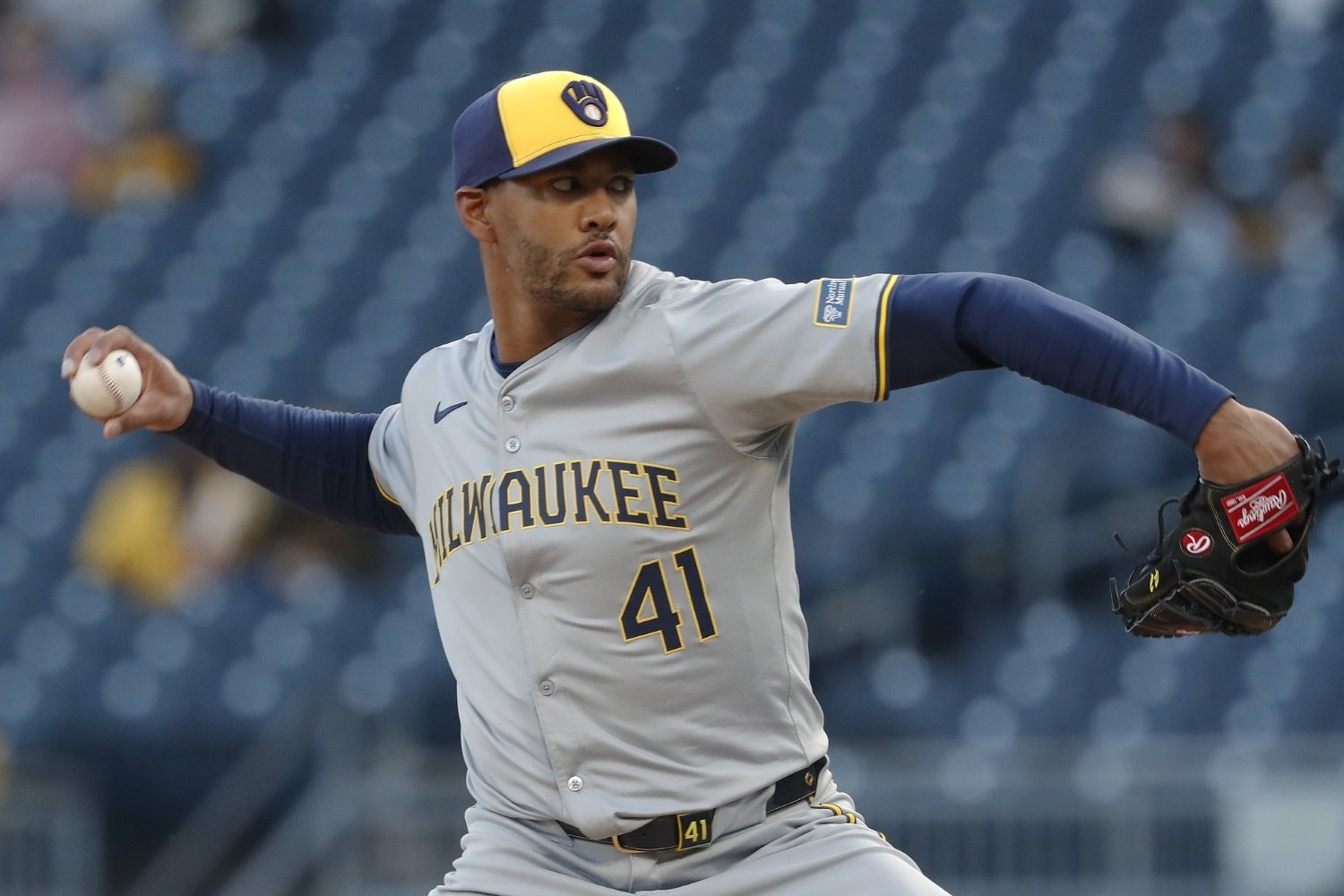 It wasn't the decisive moment of Monday night's loss, but it was the one that had the most Brewers fans talking afterward. With one on and one out in the sixth inning and the game tied at 1-1, Pat Murphy went to reliever Hoby Milner, lifting starter Joe Ross after just 79 pitches. Milner struggled, and a crucial error by Jake Bauers exacerbated the problem. The home nine not only brought around the runner Ross bequeathed to Milner, but scored twice more, and the game would end 4-2. Afterward, there were questions for Murphy about taking down Ross so proactively. Early in spring training, Ross was one of the first pitchers to earn Murphy's full vote of confidence as a part of the starting rotation, and with injuries mounting, the next three days look to be fairly bullpen-heavy. Removing Ross, therefore, required the skipper to think there was significant trouble lurking just around the corner for him. Why did he feel that way? Murphy and the Brewers coaching staff believed they saw Ross's stuff flattening out, and with left-handed batters Rowdy Tellez and Jack Suwinski due to see him for a third time in the game, they didn't want to press their luck. Murphy knew the Pirates might counter with a pinch-hitter for Tellez if he brought in Milner (which they did), but felt that was still a preferable matchup to Ross against Tellez and Suwinski. As he also said in the above exchange, though, part of that thinking was that the team knows Ross and his tendencies. Were they seeing something that wasn't there, because they expected it to be? And separately, is what they think they know about his stuff and the inflection points within a game when it changes for the worse true? Happily, this has never been more testable. We can see most of what the team can see about Ross's performance, last night and across the season. Let's turn to the data. First of all, yes, Ross's sinker was flattening out as the game moved along on Monday night. That's not unusual, especially for a pitcher his age, but it's the most important of Murphy's claims, and it's accurate. Here's his horizontal movement on the pitch throughout the start. Though 'two-seamer' has lost the fight with 'sinker' for terminological primacy in pitching, horizontal movement is really about as important as vertical movement is. The 'sink' on a pitch that fools and frustrates a same-handed batter is just as often horizontal run as it is heavy dropping action, and Ross's pitch is more run than sink regardless of when he's throwing it within an outing. Now, you'll notice that he had an earlier cluster of sinkers within the outing with even less armside run than the last handful he threw, before coming out of the game. Why didn't those concern the staff as much? Partially, it's because they were thrown considerably harder. Again, it's not at all unusual--especially for a pitcher who missed most of the last three seasons with various injuries--to lose velocity as the game wears on, but that's also one big reason why pitchers lose effectiveness within a game. Ross began dipping below 94 MPH (and even down under 93) at the end of his appearance; the line where a sinker goes from theoretically above-average to almost unavoidably below-average in the modern game is right around the 93-MPH threshold. Combine the falling velocity with the straightening-out process happening in terms of movement, and you have a whole different pitch from the first two innings to the sixth. Any of the newfangled stuff metrics on the market would grade the two very differently. Zooming back a bit, though, let's talk about the average change in Ross's stuff within a game, on the sinker and in general. To do so, here's the movement plot for his first 35 pitches of each appearance this year. Here's the same chart for pitches 36-70. And finally, here's how his stuff moves after pitch No. 70 in an outing. Ross's slider movement doesn't change much at all over the course of a start. He does, however, lose some run on the sinker, and he throws fewer four-seam fastballs as outings progress. That could be because the pitch is just meant to nestle itself in the heads of opposing hitters and set up his other stuff for the rest of the contest, but in watching him, it feels more like the four-seamer costs him something. He throws it hard, but his command of it seems effortful and inconsistent, and he might not feel he can return to the pitch once he starts to tire. The deterioration pattern of his sinker as a game goes on also drags it toward the same movement range as his four-seamer, so he might be trying to avoid throwing two different pitches that have basically the same effect but could interfere with one another in terms of his command of them. Ross loses about one mile per hour on each offering from the first stage of an outing to the second, but not from the second to the third. He still sits around 94 (touching higher) after pitch 70. His release point doesn't change. His extension holds steady. His stuff certainly softens a bit, but no more than (for instance) Freddy Peralta's does, if you break down his starts similarly. So, why are the Brewers so much more anxious to get Ross out of there? Firstly, of course, there are health considerations, but Ross said he felt good Monday night and was surprised when Murphy lifted him. The team doesn't want him to get hurt, but nor are they so invested in him that they're likely to treat him with kid gloves at any point. If they were confident he could have gotten the last two outs of the sixth inning last night, they'd have stuck with him. The much bigger issue, then, is that stuff isn't just what comes out of a pitcher's hand. It's also what a batter sees, and because batters learn and adjust within a game, that changes, too. Check out Ross's pitch chart for pitches 1-35 in each appearance this year, broken down by the outcome of the pitch. He's in the zone a lot, but hitters aren't consistently putting the ball in play when he is. With his lively stuff and the opponents still trying to find their cues against him, Ross gets plenty of foul balls and whiffs even on theoretically hittable offerings, early on. Now, here's pitches 36-70. I've broken out these pitch bins because they best allow us to analyze the specific decisions Murphy talked about after Monday's game, but break them down into bins of 20 or 40, instead, and you'll still see much of the same. Here, it's Ross going through a mid-game phase in which (having set hitters up by being aggressive in the zone with his best stuff the first time through) he mostly stays out of the heart of the zone, or at least the upper half thereof. He's keeping hitters from locking in on him by changing things up from the previous encounters. Now, here he is from pitch 71 onward. It's back to the heart of the zone, now, because hitters are wise to him and not expanding the zone as much when he needs them to. That's trouble, because when he is in the zone, they're not missing as often. They've seen what he has, and they can handle it, especially as he loses a tick or two and a few inches of wiggle on the sinker. By no coincidence, 35 pitches is as good a proxy as you could choose for 'one time through the batting order'. Though we're not looking at this data through the lens of times through the order, we almost are. The league is averaging 3.90 pitches per plate appearance in 2024, so nine batters faced takes about 35.1 pitches. The Brewers lifted Ross after 21 batters faced Monday night because he was set to face two left-handed batters for a third time, and his recent track record says that he's not well-suited to do that. After pitch 51 this season, opponents are batting .371 against Ross, and he's struck out just four of 38 batters. The third time through, hitters have a .353 average. It's not nearly as simple as saying that a pitcher's stuff gets worse later in games. Everyone's does. It's also not solely about batters seeing a hurler a third time. For starters like Ross, though, it's about the collision between those two dynamics. His stuff isn't far enough above the dividing line between success and failure to land him on the right side of it once it starts to decline. It would still be viable, although only just, but for the fact that hitters also get more familiar with him and anticipate him better right when his stuff is worsening. Murphy was right to pull Ross in that instance. He's taken flak for his bullpen management this year, and he was in a tough spot because of the likely brevity of at least two or three starts in the next turn, but the Brewers are trying to win 90 games this season. Already at 14, they'd covered more of the ground (15.5% of the win total needed) than the calendar (12.3% of all scheduled games played) would suggest. Because of the construction of this roster, Murphy knows there's adversity ahead. Every win right now is precious, because it cushions the eventual fall and eases their recovery therefrom. A 15th win Monday night would have been worth the extra few outs on Milner's arm. Milner couldn't get the outs he needed, due partly to poor defense, but the decision-making by the team's dugout staff was sound.

