


Matthew Trueblood
-
Posts
1,964 -
Joined
-
Last visited
-
Days Won
10
Content Type
Profiles
Forums
Blogs
Events
News
2026 Milwaukee Brewers Top Prospects Ranking
Milwaukee Brewers Videos
2022 Milwaukee Brewers Draft Picks
Milwaukee Brewers Free Agent & Trade Rumors, Notes, & Tidbits
Guides & Resources
2023 Milwaukee Brewers Draft Picks
2024 Milwaukee Brewers Draft Picks
The Milwaukee Brewers Players Project
2025 Milwaukee Brewers Draft Pick Tracker
2026 Milwaukee Brewers Draft Tracker: Picks & Bonuses
Store
Downloads
Gallery
Everything posted by Matthew Trueblood
-
FWIW, while 'extreme' is in the eye of the beholder, I would say they do plan to scale back payroll for 2024, especially because of the uncertainty around their TV rights even within (and especially beyond) this season. I'm not RULING OUT Hoskins or Belt, but I don't think either is very likely. Cooper, the most expensive of this group, feels like it better hits the likely sweet spot for the Crew.
- 16 replies
-
- 2
-

-
- mike ford
- dominic smith
- (and 1 more)
-
Once reports of the discussions between the two sides surfaced, it felt like just a matter of time. The time has come. The Brewers have secured their rights to the services of their best prospect in two decades for the entirety of the next one. In his first tweet about it, Heyman disclosed that the deal is for eight guaranteed seasons, but also that there are two club options attached to the end. That's not unexpected, but it's a delightful bonus to news that was already thrilling. Chourio can still hit free agency before his 30th birthday, but the Brewers now have firm control of his 20s, if they want it. Jake McKibbin sketched a possible Chourio deal on the site earlier this morning, and this is right in the range he discussed. In fact, it comes in slightly below those projections, which is another cherry on top of the sundae. This is an unprecedented combination of substantial commitment and lack of certainty, but the upside this deal captures exceeds even those of Julio Rodriguez's pact with the Mariners or Corbin Carroll's with the Diamondbacks. The Brewers are going to get a bargain on a player they hope is a superstar, for the next several years. Earlier this week, in response to the initial reports about this possibility, I dug into what it might mean for the alignment (in the near and long term) of the Brewers' crowded outfield. I also immediately talked about the uncertainty around which direction this kind of deal would prompt the team to move in for the balance of the winter. We don't know the answers to those questions yet, but we can take the conversations out of the theoretical realm and into the very real, urgent one. One way or another, we should now expect Matt Arnold and company to get pretty active at next week's Winter Meetings. This is the kind of first step that makes the next few especially interesting. Let's hear from you. Do you feel any trepidation about this move? How much will this shape the future for the Brewers? View full article
-
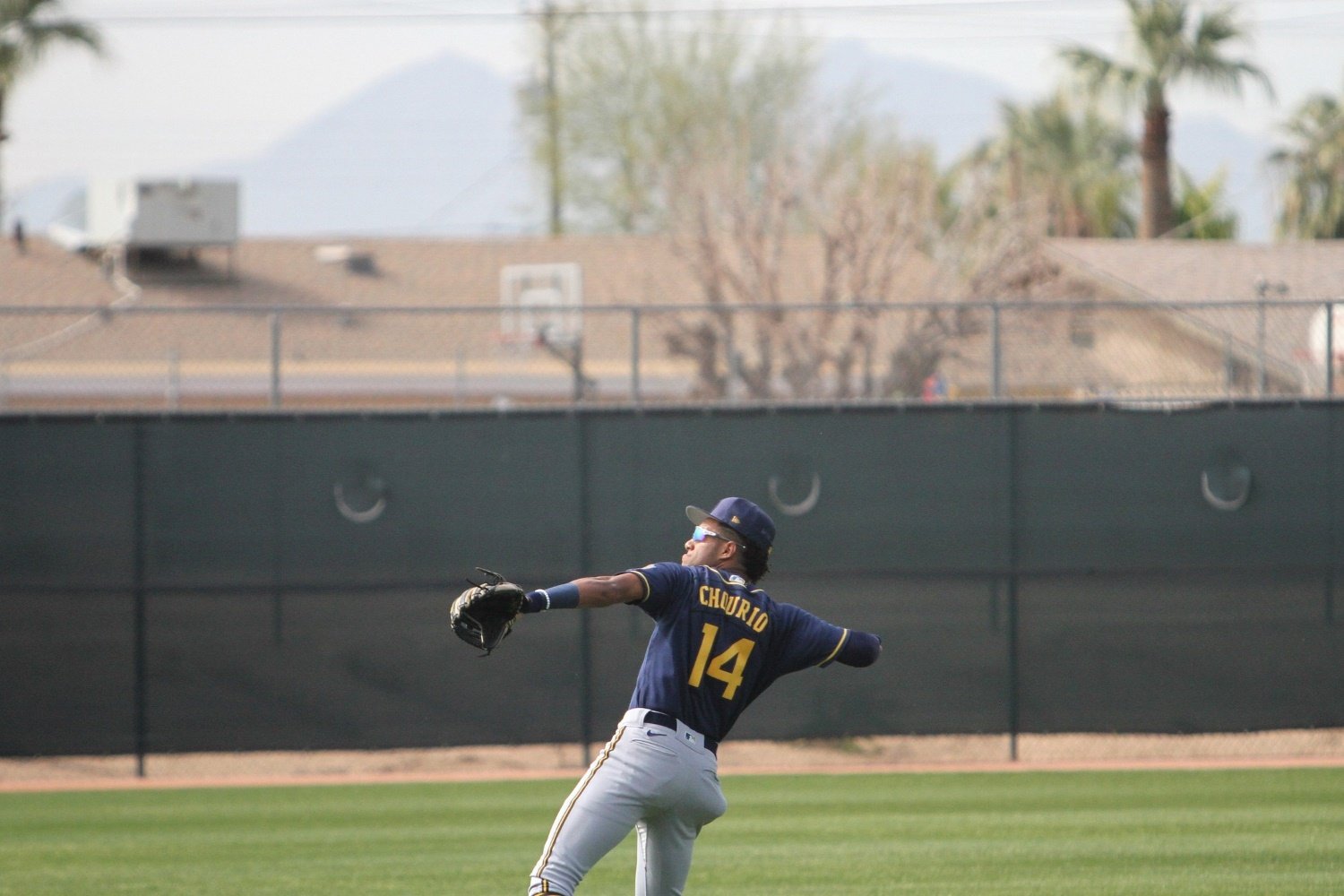 After reporting earlier this week that negotiations were progressing, Ken Rosenthal updated with a tweet Thursday morning to say that the deal is close. Almost simultaneously, Jon Heyman swooped in with confirmation, and more details. In his first tweet about it, Heyman disclosed that the deal is for eight guaranteed seasons, but also that there are two club options attached to the end. That's not unexpected, but it's a delightful bonus to news that was already thrilling. Chourio can still hit free agency before his 30th birthday, but the Brewers now have firm control of his 20s, if they want it. Jake McKibbin sketched a possible Chourio deal on the site earlier this morning, and this is right in the range he discussed. In fact, it comes in slightly below those projections, which is another cherry on top of the sundae. This is an unprecedented combination of substantial commitment and lack of certainty, but the upside this deal captures exceeds even those of Julio Rodriguez's pact with the Mariners or Corbin Carroll's with the Diamondbacks. The Brewers are going to get a bargain on a player they hope is a superstar, for the next several years. Earlier this week, in response to the initial reports about this possibility, I dug into what it might mean for the alignment (in the near and long term) of the Brewers' crowded outfield. I also immediately talked about the uncertainty around which direction this kind of deal would prompt the team to move in for the balance of the winter. We don't know the answers to those questions yet, but we can take the conversations out of the theoretical realm and into the very real, urgent one. One way or another, we should now expect Matt Arnold and company to get pretty active at next week's Winter Meetings. This is the kind of first step that makes the next few especially interesting. Let's hear from you. Do you feel any trepidation about this move? How much will this shape the future for the Brewers?
 -
I'm comfortable with him, too, but if they trade Burnes, they really need to add two more starters to compensate. Peralta-X-Houser-Gasser-Rea just isn't good enough, in my opinion. It's gotta be Peralta-X-X-Houser-Gasser-Rea, with the option to either use a six-man rotation or flex each of the back three into the bullpen when needed. You've gotta have depth.
-
We Should Talk About Colin Rea's Outlook in the Brewers Rotation
Matthew Trueblood posted an article in Brewers
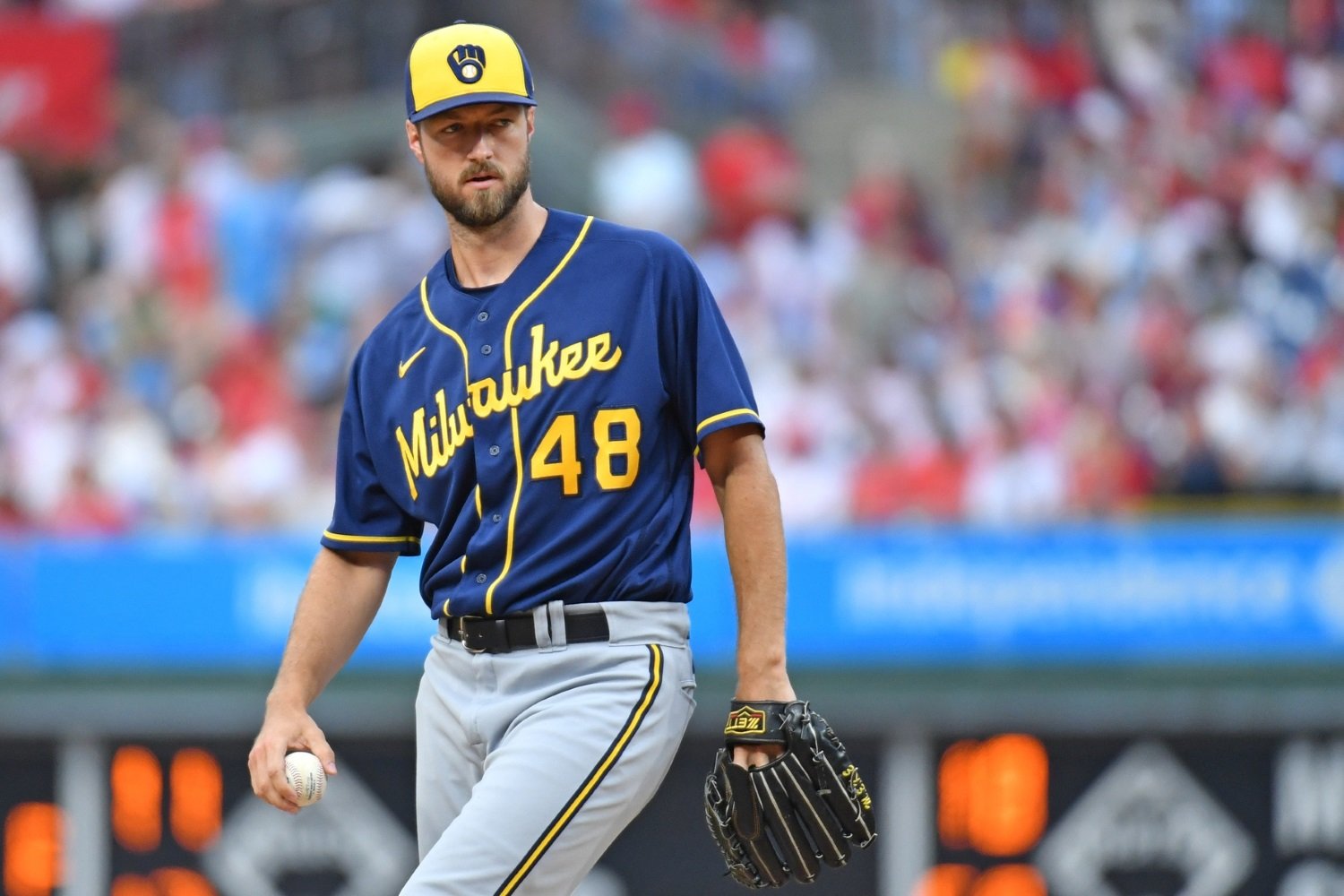 Now out of minor-league options and with a guaranteed contract worth $4.5 million, Colin Rea looks likely to be the 2024 equivalent of 2023 Wade Miley. Rea is likely to begin the season as the fifth starter in the rotation, though at the moment, he's fourth on the depth chart. After a season in which he gave the Brewers 125 innings of league-average work on the mound, that's a well-earned opportunity, but it's worth studying how Rea effected that success and to what extent he can sustain it. Rea will turn 34 next July, but he threw as hard in 2023 as he ever has, at least at the big-league level. That was one in a series of improvements he brought back with him after a year with the Fukuoka Softbank Hawks of Nippon Professional Baseball, but each of them was quite small. He didn't transform into a different pitcher. He just made some incremental improvements. For one thing, Rea got a bit more vertical depth on both his curveball and his splitter. Those are his least-used pitches, but they're important complementary pieces in what remains a kitchen-sink approach. The most important change he made, however, was adding a sweeper, which gave him a bit more of a weapon against right-handed batters than he'd had before. Lefties crushed him, to the tune of a .251/.314/.502 batting line, with 15 home runs in fewer than 247 batters faced. Against righties, though, he was quite good. They batted just .220/.279/.371 against him. The sweeper missed bats, and his cutter was much more effective running away from righties (playing off both his sinker and his sweeper) than it was against lefties. One obvious adjustment option presents itself. Rea really didn't use the cutter effectively against lefties last year. It was the pitch he used most against them, but he didn't seem comfortable doing so, except in an effort (often an unsuccessful one) to steal called strikes by throwing it through the back door--from off the outside edge of the plate onto it. That's not a very physically natural way to use a cutter, though, and as you can see, Rea just found too much of the plate with the pitch too often. Instead of throwing it there over and over, he might consider throwing the pitch to lefties more like he did to righties. It's likely that left-handed hitters' eyes will still light up when they see Rea's cutter, if he throws it starting in the middle of the plate and moving in on them. Given his generally fine command, though, he can probably find a way to get them hitting the ball weakly against it, off the handle of the bat. It could require a mental tweak, or a mechanical one, or both. It might even be that Rea and William Contreras need to communicate better about how to use the cutter to lefties. Whatever the case, this seems like a fixable problem, and if he does fix it, Rea can be an average or better big-league starter--even without dominant stuff, and even if his luck regresses a bit in 2024. How comfortable are you with Rea at the back end of the Brewers' rotation? What's your level of urgency to push him further down the depth chart? Drop a comment and let us know whether you buy into the feasibility of these small changes.
 -
The Brewers could not have won the NL Central as handily or as impressively in 2023 without the help of a couple of journeymen who stepped up to fill holes in their starting rotation. Since they elected to bring one back on a permanent basis, let's take a moment to analyze him. Image courtesy of © Eric Hartline-USA TODAY Sports Now out of minor-league options and with a guaranteed contract worth $4.5 million, Colin Rea looks likely to be the 2024 equivalent of 2023 Wade Miley. Rea is likely to begin the season as the fifth starter in the rotation, though at the moment, he's fourth on the depth chart. After a season in which he gave the Brewers 125 innings of league-average work on the mound, that's a well-earned opportunity, but it's worth studying how Rea effected that success and to what extent he can sustain it. Rea will turn 34 next July, but he threw as hard in 2023 as he ever has, at least at the big-league level. That was one in a series of improvements he brought back with him after a year with the Fukuoka Softbank Hawks of Nippon Professional Baseball, but each of them was quite small. He didn't transform into a different pitcher. He just made some incremental improvements. For one thing, Rea got a bit more vertical depth on both his curveball and his splitter. Those are his least-used pitches, but they're important complementary pieces in what remains a kitchen-sink approach. The most important change he made, however, was adding a sweeper, which gave him a bit more of a weapon against right-handed batters than he'd had before. Lefties crushed him, to the tune of a .251/.314/.502 batting line, with 15 home runs in fewer than 247 batters faced. Against righties, though, he was quite good. They batted just .220/.279/.371 against him. The sweeper missed bats, and his cutter was much more effective running away from righties (playing off both his sinker and his sweeper) than it was against lefties. One obvious adjustment option presents itself. Rea really didn't use the cutter effectively against lefties last year. It was the pitch he used most against them, but he didn't seem comfortable doing so, except in an effort (often an unsuccessful one) to steal called strikes by throwing it through the back door--from off the outside edge of the plate onto it. That's not a very physically natural way to use a cutter, though, and as you can see, Rea just found too much of the plate with the pitch too often. Instead of throwing it there over and over, he might consider throwing the pitch to lefties more like he did to righties. It's likely that left-handed hitters' eyes will still light up when they see Rea's cutter, if he throws it starting in the middle of the plate and moving in on them. Given his generally fine command, though, he can probably find a way to get them hitting the ball weakly against it, off the handle of the bat. It could require a mental tweak, or a mechanical one, or both. It might even be that Rea and William Contreras need to communicate better about how to use the cutter to lefties. Whatever the case, this seems like a fixable problem, and if he does fix it, Rea can be an average or better big-league starter--even without dominant stuff, and even if his luck regresses a bit in 2024. How comfortable are you with Rea at the back end of the Brewers' rotation? What's your level of urgency to push him further down the depth chart? Drop a comment and let us know whether you buy into the feasibility of these small changes. View full article
-
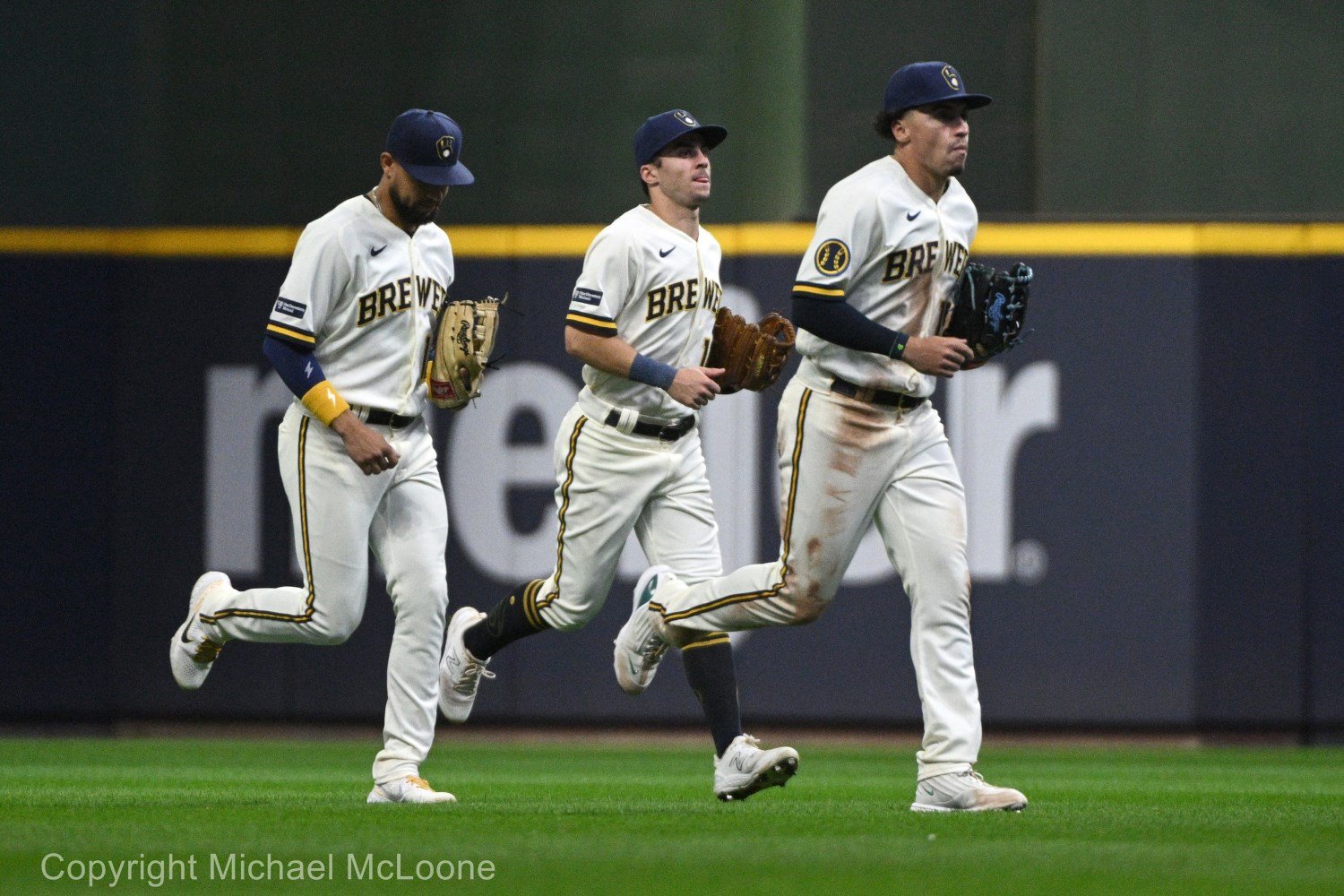 Optimistic though we have all been about Jackson Chourio for over a year, the notion that he would be with the Brewers all season in 2024 previously felt a bit far-fetched. As well as he's adjusted at each level with which he's been challenged, and as prodigious as his talent is, the man will not turn 20 until March 11. He's a true five-tool guy, and the most important and multifarious of those--the hit tool--came along gorgeously in 2023. Still, there are skills (distinct from tools) that any player this young can stand to polish in the minor leagues. Until Tuesday, it felt safe to assume that the Brewers would have Chourio do some of that polishing to open 2024. If, instead, he's on the Opening Day roster, several things change at once. Chourio can't be on the roster but out of the lineup, so someone in the outfield mix gets bumped to the bench (or back to Triple-A Nashville) by his arrival--perhaps two or three months ahead of schedule. The most direct and seemingly unavoidable result of this contract extension would be that the Brewers would then trade a young outfielder this winter, because otherwise, they'd end up with a logjam--a real and somewhat unwelcome one. One partial solution to the pressure would be moving Christian Yelich to first base or designated hitter in a permanent way, but for the moment, let's set that option aside. It comes with several countervailing complications, and it feels premature. Thus, we can pencil Yelich into left field for the sake of this conversation. That leaves Chourio to fit in alongside some mixture of Sal Frelick, Joey Wiemer, Garrett Mitchell, Tyrone Taylor, Blake Perkins, and Chris Roller. The big question is how he would do so. In that group, the best defensive center fielder is probably Mitchell. He blends top-end speed with a good arm and good instincts in a way the others can't quite match. If Chourio is going to be the team's cornerstone for the next decade, though, he's the one they should place in center. It could make sense to move him to right field in a couple of years, just as fellow Venezuelan phenom Ronald Acuña, Jr. made that move at a very young age, but he should start in center because it encourages and rewards the athleticism that makes both players so special. While Julio Rodríguez might move to right field as soon as his mid-20s, he set up shop in center field as a rookie and stayed there upon signing his own megadeal. With Yelich and Chourio lined up to play left and center, then, we're shopping for the best deployment of the others in right field, as fourth and fifth outfielders, and as trade bait. That gets complicated, because trade value is so unknowable and none of these players is an ideal fit for an everyday corner outfield role. Right now, it feels like Frelick has the highest trade value, and like he's only marginally ahead of the others in projected on-field value for the short term--if ahead of them at all. That inclines me toward trading him, and letting Wiemer and Mitchell take up residence as a platoon in right field. Taylor, too, seems like a trade candidate. He hasn't been durable or consistent enough to be a regular, and while he's still a solid fourth outfielder, his utility to this particular team dwindles once you write in Chourio. There are too many other, more versatile, optionable players in the mix. Even after dealing him and Frelick, the team would have Wiemer and Mitchell as co-starters with the ability to spell Yelich and/or Chourio as needed; Perkins as a defensive specialist in a pure bench role, with whom you'd be comfortable if injuries forced him to start a fistful of times; and Roller, who just got added to the 40-man roster and can be comfortably kept in Nashville unless and until a need arises. The offensive upside of both Wiemer and Mitchell is an open question, but platooning would benefit each, and they have the raw tools to have significant value out there. Once you mentally convert Chourio from prospect to lineup fixture, the anxiety that arises from our shared uncertainty about those two and about Frelick begins to dissipate. The Brewers are in an enviable spot with their outfield, now more than ever. A Chourio extension would be the first in what would figure to be a series of quick steps toward clarifying and capturing the value of their depth. Who would you trade if Chourio does sign this exciting potential deal? Would you have the rookie start in right field or center? Let's kick around the many possibilities.
 -
In Tuesday afternoon's report that the Brewers are discussing a long-term contract extension with Jackson Chourio, the real thunderbolt was the news that signing it would assure Chourio's place in the Opening Day lineup. That would shake up several things. Image courtesy of © Michael McLoone-USA TODAY Sports Optimistic though we have all been about Jackson Chourio for over a year, the notion that he would be with the Brewers all season in 2024 previously felt a bit far-fetched. As well as he's adjusted at each level with which he's been challenged, and as prodigious as his talent is, the man will not turn 20 until March 11. He's a true five-tool guy, and the most important and multifarious of those--the hit tool--came along gorgeously in 2023. Still, there are skills (distinct from tools) that any player this young can stand to polish in the minor leagues. Until Tuesday, it felt safe to assume that the Brewers would have Chourio do some of that polishing to open 2024. If, instead, he's on the Opening Day roster, several things change at once. Chourio can't be on the roster but out of the lineup, so someone in the outfield mix gets bumped to the bench (or back to Triple-A Nashville) by his arrival--perhaps two or three months ahead of schedule. The most direct and seemingly unavoidable result of this contract extension would be that the Brewers would then trade a young outfielder this winter, because otherwise, they'd end up with a logjam--a real and somewhat unwelcome one. One partial solution to the pressure would be moving Christian Yelich to first base or designated hitter in a permanent way, but for the moment, let's set that option aside. It comes with several countervailing complications, and it feels premature. Thus, we can pencil Yelich into left field for the sake of this conversation. That leaves Chourio to fit in alongside some mixture of Sal Frelick, Joey Wiemer, Garrett Mitchell, Tyrone Taylor, Blake Perkins, and Chris Roller. The big question is how he would do so. In that group, the best defensive center fielder is probably Mitchell. He blends top-end speed with a good arm and good instincts in a way the others can't quite match. If Chourio is going to be the team's cornerstone for the next decade, though, he's the one they should place in center. It could make sense to move him to right field in a couple of years, just as fellow Venezuelan phenom Ronald Acuña, Jr. made that move at a very young age, but he should start in center because it encourages and rewards the athleticism that makes both players so special. While Julio Rodríguez might move to right field as soon as his mid-20s, he set up shop in center field as a rookie and stayed there upon signing his own megadeal. With Yelich and Chourio lined up to play left and center, then, we're shopping for the best deployment of the others in right field, as fourth and fifth outfielders, and as trade bait. That gets complicated, because trade value is so unknowable and none of these players is an ideal fit for an everyday corner outfield role. Right now, it feels like Frelick has the highest trade value, and like he's only marginally ahead of the others in projected on-field value for the short term--if ahead of them at all. That inclines me toward trading him, and letting Wiemer and Mitchell take up residence as a platoon in right field. Taylor, too, seems like a trade candidate. He hasn't been durable or consistent enough to be a regular, and while he's still a solid fourth outfielder, his utility to this particular team dwindles once you write in Chourio. There are too many other, more versatile, optionable players in the mix. Even after dealing him and Frelick, the team would have Wiemer and Mitchell as co-starters with the ability to spell Yelich and/or Chourio as needed; Perkins as a defensive specialist in a pure bench role, with whom you'd be comfortable if injuries forced him to start a fistful of times; and Roller, who just got added to the 40-man roster and can be comfortably kept in Nashville unless and until a need arises. The offensive upside of both Wiemer and Mitchell is an open question, but platooning would benefit each, and they have the raw tools to have significant value out there. Once you mentally convert Chourio from prospect to lineup fixture, the anxiety that arises from our shared uncertainty about those two and about Frelick begins to dissipate. The Brewers are in an enviable spot with their outfield, now more than ever. A Chourio extension would be the first in what would figure to be a series of quick steps toward clarifying and capturing the value of their depth. Who would you trade if Chourio does sign this exciting potential deal? Would you have the rookie start in right field or center? Let's kick around the many possibilities. View full article
- 9 replies
-
- 1
-
-
- jackson chourio
- tyrone taylor
- (and 5 more)
-
REPORT: Jackson Chourio, Brewers Discussing Record-Setting Extension
Matthew Trueblood posted an article in Brewers
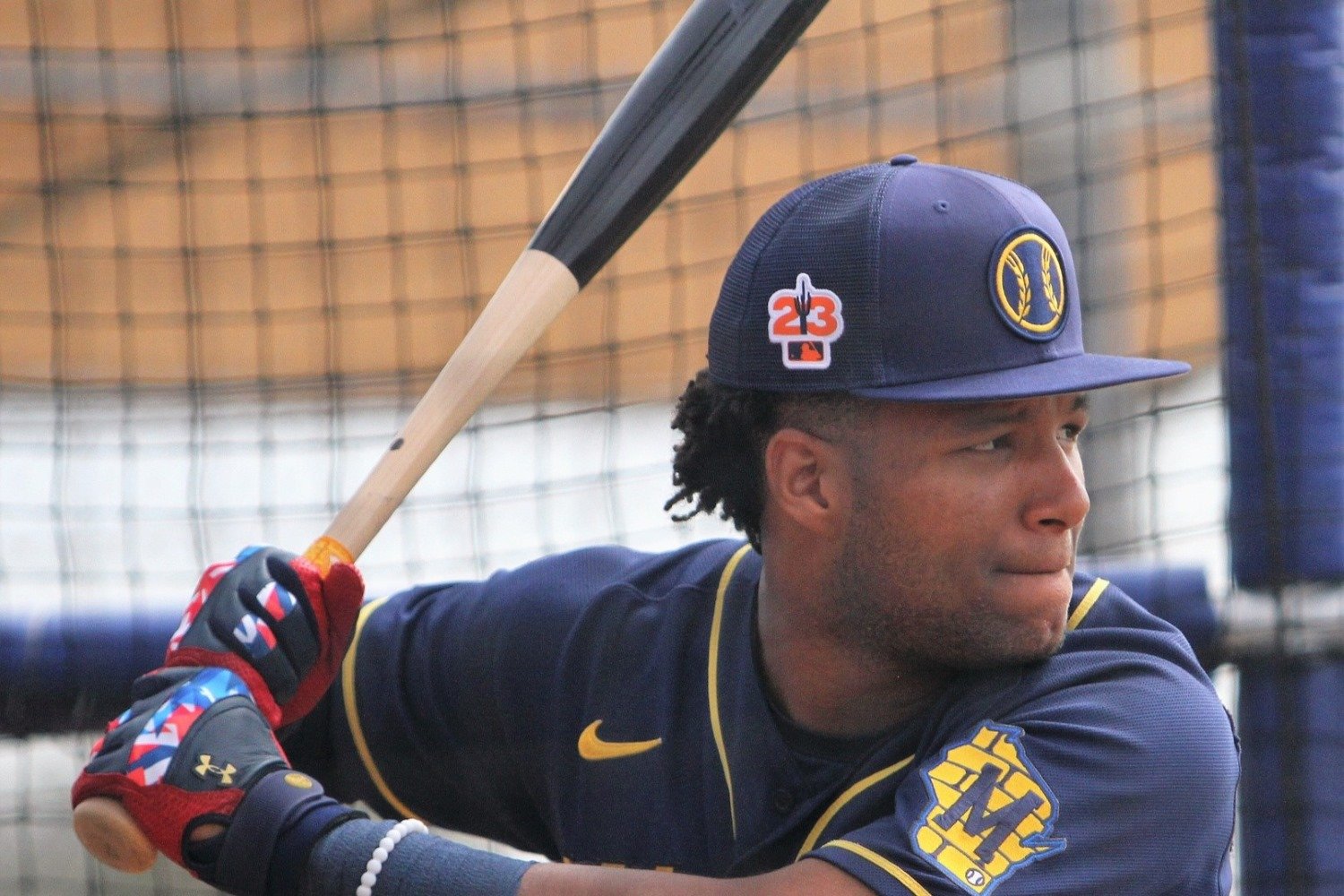 According to Ken Rosenthal of The Athletic, Jackson Chourio and the Brewers are in discussions about a contract extension that would run longer and pay Chourio more money than any player has ever received before making their big-league debut. Chourio, 19, is the linchpin of whatever comes next for the Brewers. This deal, if it gets completed, would just lend greater clarity to that standing. While Rosenthal speculates about the two courses the Brewers could follow in the wake of this kind of move, he's noncommittal about them, and it's not clear to me which direction it would push them to pursue. Obviously, signing Chourio to a deal lasting more than six years and fixing his position at the center of their competitive universe would influence the team's decisions about Corbin Burnes and Willy Adames, who are trade candidates this winter. Less obvious is whether it would give them greater conviction and the goodwill with the fan base to pull the trigger on deals involving one or both, or whether it would represent the kind of investment on which Mark Attanasio would want to maximize the immediate return. I know which way I lean. Burnes and Adames are guys worth keeping if the team wants to maximize their chances of winning the NL Central in 2024, but signing Chourio to a deal like this would indicate a commitment to the direction we already know Attanasio and Matt Arnold to prefer: steady, consistent, conservative competitiveness. In that case, as soon as Chourio's name is on the dotted line, the move is to get the best possible offers for Burnes and Adames. There's no mandate to trade them, but presumably, Arnold would find pretty good talent available in exchange for players of that quality. If so, he should move them. The team can probably acquire at least one player who can help them (albeit less) right away in that process, but locking Chourio into one outfield spot for most of the next decade would also give them the flexibility to trade more fearlessly from the stockpile of young outfielders around them. The guy in that group with the highest trade value is Sal Frelick. In this scenario, I would be looking to get a controllable mid-rotation starter in exchange for Frelick, letting Chourio take over center field for the next few years and filling right field with whatever amalgam of the myriad others on hand works best. The best version of this plan, pending further details on the offer and (of course) its actual execution, involves a quarter-step back for 2024, with an eye toward regaining a firm footing on the top of the NL Central hill from 2025 onward. Rosenthal doesn't report things like this without real fire fueling the smoke. There will be further news about this soon. In the meantime, it's fun to debate and to wonder: How long, and on what team-friendly terms, will Chourio be a Brewer? And what will the next step be?
 -
It's much too soon to guess what it means, or even whether it will come to fruition, but the Brewers are talking to their top prospect about a contract that would change the course of the franchise in the short and long term. While Rosenthal speculates about the two courses the Brewers could follow in the wake of this kind of move, he's noncommittal about them, and it's not clear to me which direction it would push them to pursue. Obviously, signing Chourio to a deal lasting more than six years and fixing his position at the center of their competitive universe would influence the team's decisions about Corbin Burnes and Willy Adames, who are trade candidates this winter. Less obvious is whether it would give them greater conviction and the goodwill with the fan base to pull the trigger on deals involving one or both, or whether it would represent the kind of investment on which Mark Attanasio would want to maximize the immediate return. I know which way I lean. Burnes and Adames are guys worth keeping if the team wants to maximize their chances of winning the NL Central in 2024, but signing Chourio to a deal like this would indicate a commitment to the direction we already know Attanasio and Matt Arnold to prefer: steady, consistent, conservative competitiveness. In that case, as soon as Chourio's name is on the dotted line, the move is to get the best possible offers for Burnes and Adames. There's no mandate to trade them, but presumably, Arnold would find pretty good talent available in exchange for players of that quality. If so, he should move them. The team can probably acquire at least one player who can help them (albeit less) right away in that process, but locking Chourio into one outfield spot for most of the next decade would also give them the flexibility to trade more fearlessly from the stockpile of young outfielders around them. The guy in that group with the highest trade value is Sal Frelick. In this scenario, I would be looking to get a controllable mid-rotation starter in exchange for Frelick, letting Chourio take over center field for the next few years and filling right field with whatever amalgam of the myriad others on hand works best. The best version of this plan, pending further details on the offer and (of course) its actual execution, involves a quarter-step back for 2024, with an eye toward regaining a firm footing on the top of the NL Central hill from 2025 onward. Rosenthal doesn't report things like this without real fire fueling the smoke. There will be further news about this soon. In the meantime, it's fun to debate and to wonder: How long, and on what team-friendly terms, will Chourio be a Brewer? And what will the next step be? View full article
-
The Brewers installed the highest-paid player in team history as their leadoff hitter in June 2022. He's stayed there most of the time since, and based on one site's advanced baserunning metrics, he ought to remain there for some time to come. Image courtesy of © Kamil Krzaczynski-USA TODAY Sports It's not just that Christian Yelich's offensive skill set leans heavily toward on-base skills, rather than power, at this stage of his career. Yelich also had the second-best Baserunning Runs (BRR) number in MLB in 2023, according to Baseball Prospectus. That system of valuing baserunning breaks out and measures stolen bases, advancements on hits and on outs, and on balls hit in the air and on the ground, as well as moving up on errant pitches. It captures both aggressiveness and efficiency. By this rigorously-designed model's estimation, only Corbin Carroll (the Diamondbacks' dynamic star and the unanimous NL Rookie of the Year) was worth more on the bases this season than Yelich, and then only by a hair. Carroll amassed 7.8 BRR, to Yelich's 7.7. While Carroll was a more valuable (and much more voluminous) basestealer and added more value by taking the extra base on hits, Yelich closed the gap by being excellent at advancing on outs. Value accrued on the bases can be subtle and easy to miss, but Yelich occasionally made the difference in a game with his intelligence and speed. In the Brewers' memorable July 3 win over the Cubs at home, it was Yelich who (as the trailing runner in a first-and-third, no-out situation, with the game tied 6-6) stole second base, advanced to third (but wisely held there) on a single through the right side, then came home with an insurance run on a sacrifice fly. Without that steal, Willy Adames's single might instead have been a double play, and the Brewers only would have scored once in the inning. If Yelich had tried to score on that hit instead of stopping, it might have ended up a 7-6 game with more momentum flowing toward the Cubs. That's just one example. To take another that stands out, recall April 13, when the Crew was in San Diego. Yelich was the automatic runner to begin the top of the 10th inning, and after an Adames walk, he was the lead runner in a double-steal. Rowdy Tellez managed a sacrifice fly to bring Yelich home, and the Brewers held on by their fingernails for a clutch win on the road. It seemed like, especially under the new rules forcing pitchers to work in rhythm and limiting their use of pickoff throws, Yelich thrived. Tough decisions lie ahead for Milwaukee. Sal Frelick feels more like a leadoff hitter (if he be a valuable hitter at all) than anything else, after hitting for so little power as a rookie. The team has on-base threats and guys who can run, but they lack the high-end power Yelich still looked capable of delivering when he signed the massive contract on which so much time remains. Still, new skipper Pat Murphy should keep things simple going into 2024. Whatever he might be missing, he has an elite leadoff man, thanks to a good hit tool, a solid approach, and some of the best baserunning savvy in the league. View full article
-
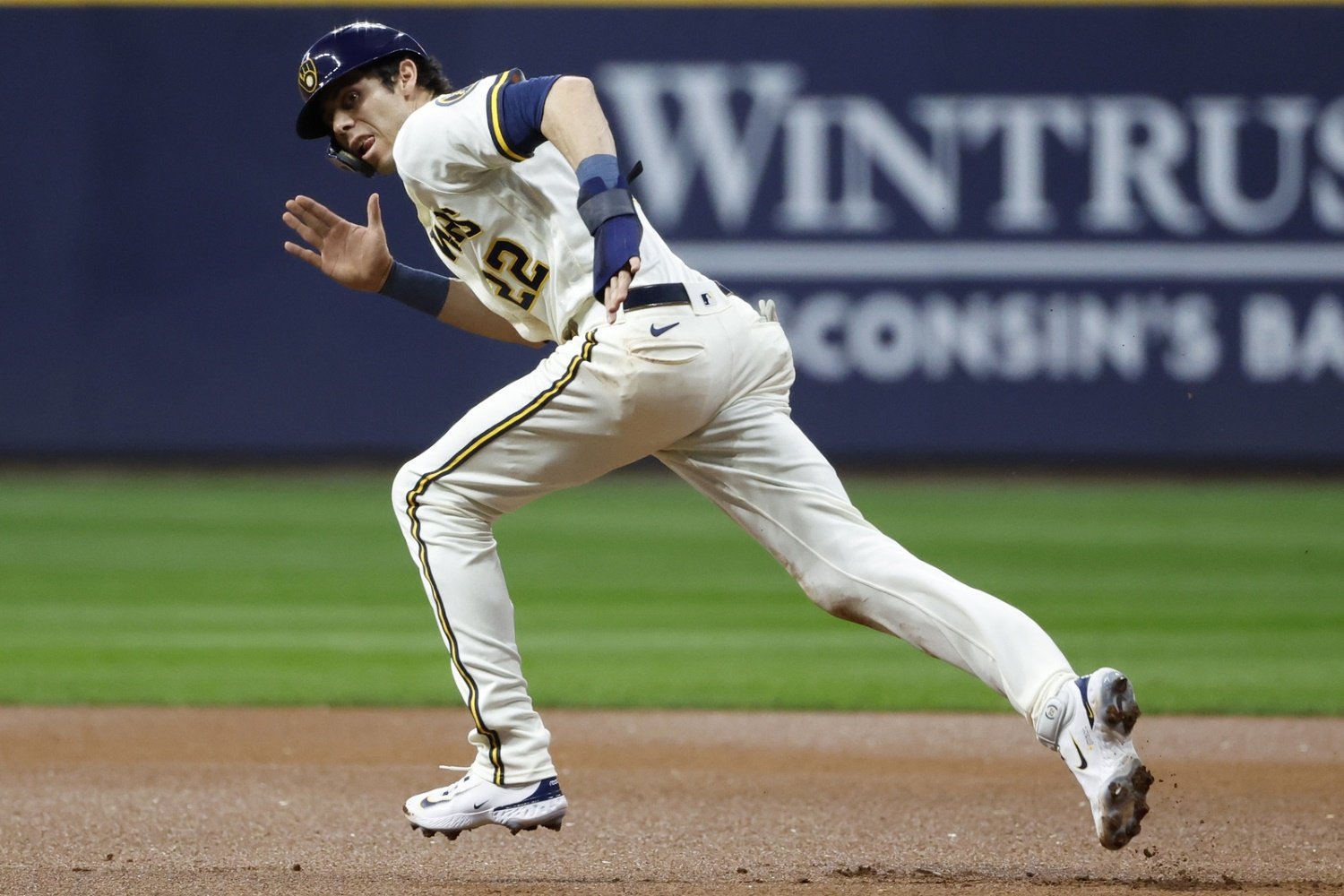 It's not just that Christian Yelich's offensive skill set leans heavily toward on-base skills, rather than power, at this stage of his career. Yelich also had the second-best Baserunning Runs (BRR) number in MLB in 2023, according to Baseball Prospectus. That system of valuing baserunning breaks out and measures stolen bases, advancements on hits and on outs, and on balls hit in the air and on the ground, as well as moving up on errant pitches. It captures both aggressiveness and efficiency. By this rigorously-designed model's estimation, only Corbin Carroll (the Diamondbacks' dynamic star and the unanimous NL Rookie of the Year) was worth more on the bases this season than Yelich, and then only by a hair. Carroll amassed 7.8 BRR, to Yelich's 7.7. While Carroll was a more valuable (and much more voluminous) basestealer and added more value by taking the extra base on hits, Yelich closed the gap by being excellent at advancing on outs. Value accrued on the bases can be subtle and easy to miss, but Yelich occasionally made the difference in a game with his intelligence and speed. In the Brewers' memorable July 3 win over the Cubs at home, it was Yelich who (as the trailing runner in a first-and-third, no-out situation, with the game tied 6-6) stole second base, advanced to third (but wisely held there) on a single through the right side, then came home with an insurance run on a sacrifice fly. Without that steal, Willy Adames's single might instead have been a double play, and the Brewers only would have scored once in the inning. If Yelich had tried to score on that hit instead of stopping, it might have ended up a 7-6 game with more momentum flowing toward the Cubs. That's just one example. To take another that stands out, recall April 13, when the Crew was in San Diego. Yelich was the automatic runner to begin the top of the 10th inning, and after an Adames walk, he was the lead runner in a double-steal. Rowdy Tellez managed a sacrifice fly to bring Yelich home, and the Brewers held on by their fingernails for a clutch win on the road. It seemed like, especially under the new rules forcing pitchers to work in rhythm and limiting their use of pickoff throws, Yelich thrived. Tough decisions lie ahead for Milwaukee. Sal Frelick feels more like a leadoff hitter (if he be a valuable hitter at all) than anything else, after hitting for so little power as a rookie. The team has on-base threats and guys who can run, but they lack the high-end power Yelich still looked capable of delivering when he signed the massive contract on which so much time remains. Still, new skipper Pat Murphy should keep things simple going into 2024. Whatever he might be missing, he has an elite leadoff man, thanks to a good hit tool, a solid approach, and some of the best baserunning savvy in the league.
 -
No question, that risk is real. But I wonder if we're all slightly underestimating the extent to which Burnes's value is dented a bit at the moment by his inconsistency in 2023. If he has a 2021ish start to 2024, he could be worth more even without the potential for a pick coming back than he is right now with one.
-
According to ESPN insider Buster Olney and a rival executive who served as his source, the Brewers might prefer to wait and see with their top two trade chips. The idea is that Burnes, especially, might not have significantly lower value in July (if trading him still seems like a prudent course) than he has right now. That might be true of Burnes, because of the premium teams pay for starting pitching when a playoff race looms. Then again, by then, the Brewers might be in a playoff race themselves, at which point dealing Burnes would feel unsettlingly like the trade that sent Josh Hader to San Diego in 2022. Nor is the loss of a potential compensatory pick (value that evaporates if Burnes is still on the team come Opening Day) as negligible as Olney seems to imply. With Adames, the gulf in likely value between now and July is pretty wide. He could have such a resurgent 2024 that he's an elite target by then, but even in that case, his value would be limited by the fact that only teams in need of a shortstop (or infielder, at least) would have much interest. Rental position players just don't fetch nearly what short-term pitchers can at the trade deadline. Incorporating Adames into this report reads mostly as a means to juice it for greater attention. It still feels unlikely that the Brewers would hold onto both of these guys, except in the case that they decide to make other, proactive additions and push hard for the playoffs in a go-for-it final season with both players in the fold. This report is a good reminder, though, that the direction of the offseason is far from being set in concrete at this early stage. View full rumor
-
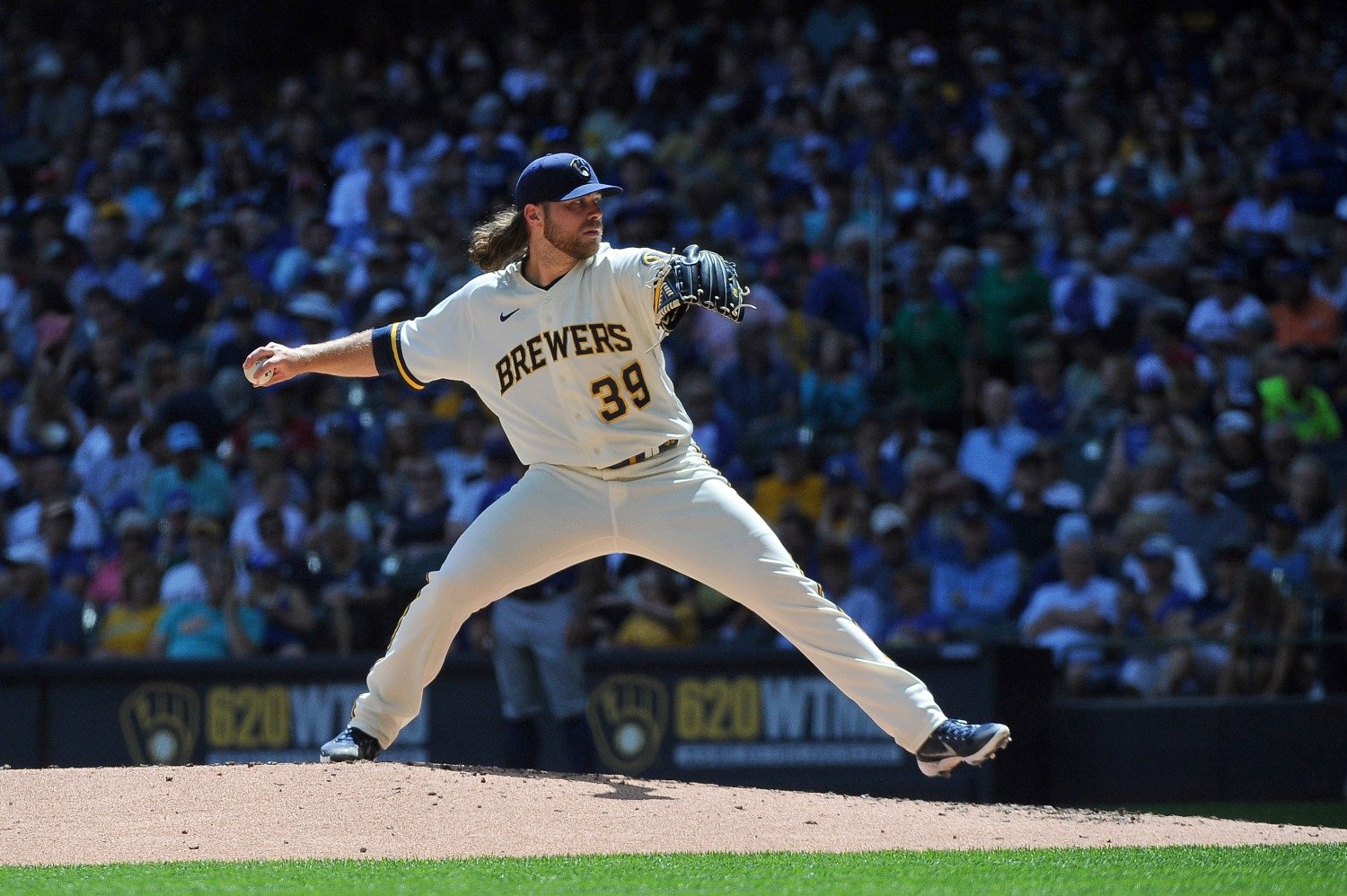 According to ESPN insider Buster Olney and a rival executive who served as his source, the Brewers might prefer to wait and see with their top two trade chips. The idea is that Burnes, especially, might not have significantly lower value in July (if trading him still seems like a prudent course) than he has right now. That might be true of Burnes, because of the premium teams pay for starting pitching when a playoff race looms. Then again, by then, the Brewers might be in a playoff race themselves, at which point dealing Burnes would feel unsettlingly like the trade that sent Josh Hader to San Diego in 2022. Nor is the loss of a potential compensatory pick (value that evaporates if Burnes is still on the team come Opening Day) as negligible as Olney seems to imply. With Adames, the gulf in likely value between now and July is pretty wide. He could have such a resurgent 2024 that he's an elite target by then, but even in that case, his value would be limited by the fact that only teams in need of a shortstop (or infielder, at least) would have much interest. Rental position players just don't fetch nearly what short-term pitchers can at the trade deadline. Incorporating Adames into this report reads mostly as a means to juice it for greater attention. It still feels unlikely that the Brewers would hold onto both of these guys, except in the case that they decide to make other, proactive additions and push hard for the playoffs in a go-for-it final season with both players in the fold. This report is a good reminder, though, that the direction of the offseason is far from being set in concrete at this early stage.
 -
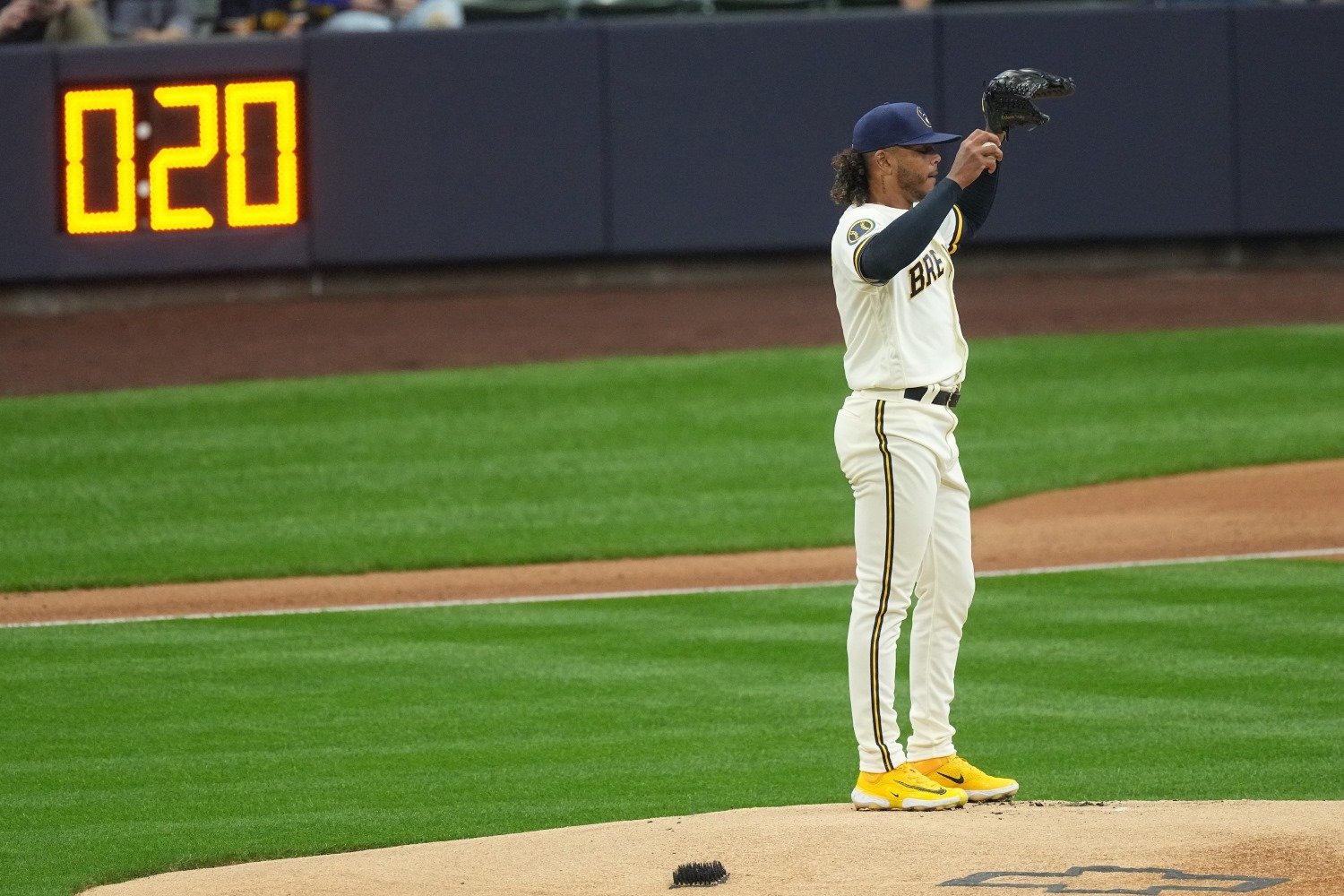 If adopted, the new pitch timer would force a pitcher to begin their delivery within 18 seconds of getting the ball back with runners on base. In 2023, that interval was 20 seconds. According to ESPN's Jeff Passan, who wrote up the proposed changes, the league is doing this in response to some upward creep in the average length of games, from 2 hours, 37 minutes in the early months to 2 hours, 44 minutes in September. I don't care about time of game. In fact, since I believe competitive late-season games probably ought to run a bit longer than those played in April and May (by fresher players, often in cold weather and in front of sparser crowds), I tend to see that creep more as a feature than as a bug. Nonetheless, I heartily support this change, because the most interesting areas in which the pitch clock made an impact weren't anything as boring as the average length of contests. Putting a timer on the showdown between batter and pitcher changes the dynamic of that interaction. When runners reach base, the tension and compression created by that ticking clock get even greater. I love that tension; I love that compression. I want to see the pitcher sweat when they're trying to work out of a jam. I want to see hitters trying almost (but not quite) frantically to reset their muscles after a swing and miss, refocus their eyes, regain their breath, take a sign from the third-base coach, and then lock in on the pitcher. I want to see the minds of the catcher, pitcher, and hitter race as the battery tries to outguess and outfox the batsman. When the option to deflate that balloon of stress and cogitation by simply disengaging is there, it's hard to trace that mental volley. When everyone is locked in, it shows up, in body language and then in results. I anticipate some unforeseen consequences with this. Those are always present, when a change is made, especially in something as complex and as misunderstood as baseball. The timer itself was an underrated driver of the increase in stolen bases in 2023, and tightening the screws on pitchers by taking the clock down from 20 seconds to 18 is going to increase runners' newfound advantage. The pitcher will still be entitled to two disengagements within each at-bat, but using them proved to be a surefire way to give runners extra information and greater courage, so hurlers will keep trying not to step off or throw over except when necessary. The pressure of runner-on-base situations is going to keep rising, and that's going to be a joy to watch. Pitchers are very worried about this, because they believe that the pitch timer caused an increase in injuries this past season. Max Scherzer voiced those concerns on a baseball web show Tuesday. For now, though, the data on that is insufficient to establish causation, and the surgeons supposedly talking about it are engaging in the same informed but essentially idle chitchat as pitchers themselves or tangentially-connected analysts (like me!). Even if solid science were to show that pitchers have gotten hurt more often (or more severely) while working under the pitch timer, though, I wouldn't want to see it altered. Yes, another element of this is that pitching will be more difficult and more aerobically demanding. Again, I'll use the software terminology: that's a feature, not a bug. For far too long, pitchers have been incentivized and even coached to empty the tank fast. They throw at too high an effort level on each pitch. They emphasize velocity, spin, and movement, at the expense of intellect and command. Modern pitchers squawk and cluck at the implication that they're not craftsmen of the same material as their forebears, and they're half-right. They're more talented than those guys were. They're better, in a brutalist sort of way. But they're more machine than man, half the time, and it's their own fault, and it's hurting baseball. Over and over, during the slow march toward the implementation of the pitch timer, Rob Manfred said that he wanted to change the pace of action in MLB, more than the lengths of games. I think he was mostly making a mealy-mouthed public statement aimed at gaining the widest possible support for a fundamentally capitalist measure, but when he said that, he fell bass-ackward into the truth. The league needs to shave strikeouts more than it needs to shave seconds, but right now, shaving more seconds is the right way to try to shave strikeouts. If pitchers keep trying to pitch the way they've pitched for the last decade under these evolving rules, they're going to keep getting hurt. The solution is simple, salubrious, and downright beautiful: they should pitch differently, instead. For the old, the stubborn, and the frauds who never would have made the majors if not for the obsession with 95 and a slider, that will sound harsh. Let them adapt, or let them fade away into independent ball. I want the showdown. I want the pitcher and the batter in nuanced and glorious confrontation, and I would love it to more often be a starter working a third time through the order or a closer with 12 years' experience on the mound, instead of so often being an anonymous one-inning guy bused in for the day from Triple A. It's an oblique approach to the problem, but it's also the best one. Shorten the pitch timer until pitchers learn to pitch differently. Hitters will feel their own rush, anyway, and we'll all profit from the anxiety of each.
 -
Last week, MLB's Competition Committee proposed some tweaks to the new and evolving rules around pitch timers and mound visits. I don't care overmuch about the length of games, but these adjustments still got me excited. For now, though, the data on that is insufficient to establish causation, and the surgeons supposedly talking about it are engaging in the same informed but essentially idle chitchat as pitchers themselves or tangentially-connected analysts (like me!). Even if solid science were to show that pitchers have gotten hurt more often (or more severely) while working under the pitch timer, though, I wouldn't want to see it altered. Yes, another element of this is that pitching will be more difficult and more aerobically demanding. Again, I'll use the software terminology: that's a feature, not a bug. For far too long, pitchers have been incentivized and even coached to empty the tank fast. They throw at too high an effort level on each pitch. They emphasize velocity, spin, and movement, at the expense of intellect and command. Modern pitchers squawk and cluck at the implication that they're not craftsmen of the same material as their forebears, and they're half-right. They're more talented than those guys were. They're better, in a brutalist sort of way. But they're more machine than man, half the time, and it's their own fault, and it's hurting baseball. Over and over, during the slow march toward the implementation of the pitch timer, Rob Manfred said that he wanted to change the pace of action in MLB, more than the lengths of games. I think he was mostly making a mealy-mouthed public statement aimed at gaining the widest possible support for a fundamentally capitalist measure, but when he said that, he fell bass-ackward into the truth. The league needs to shave strikeouts more than it needs to shave seconds, but right now, shaving more seconds is the right way to try to shave strikeouts. If pitchers keep trying to pitch the way they've pitched for the last decade under these evolving rules, they're going to keep getting hurt. The solution is simple, salubrious, and downright beautiful: they should pitch differently, instead. For the old, the stubborn, and the frauds who never would have made the majors if not for the obsession with 95 and a slider, that will sound harsh. Let them adapt, or let them fade away into independent ball. I want the showdown. I want the pitcher and the batter in nuanced and glorious confrontation, and I would love it to more often be a starter working a third time through the order or a closer with 12 years' experience on the mound, instead of so often being an anonymous one-inning guy bused in for the day from Triple A. It's an oblique approach to the problem, but it's also the best one. Shorten the pitch timer until pitchers learn to pitch differently. Hitters will feel their own rush, anyway, and we'll all profit from the anxiety of each. View full article
-
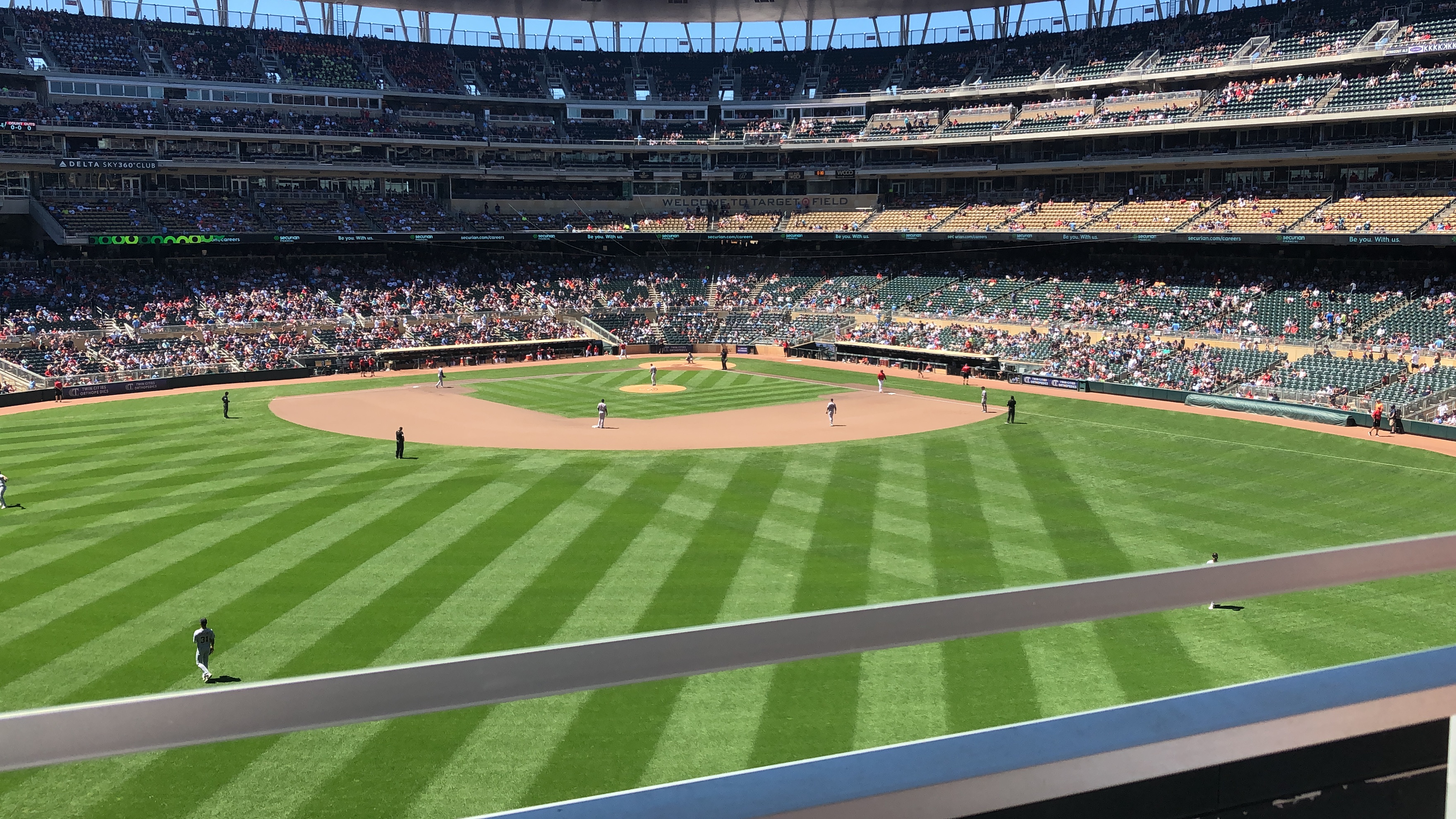
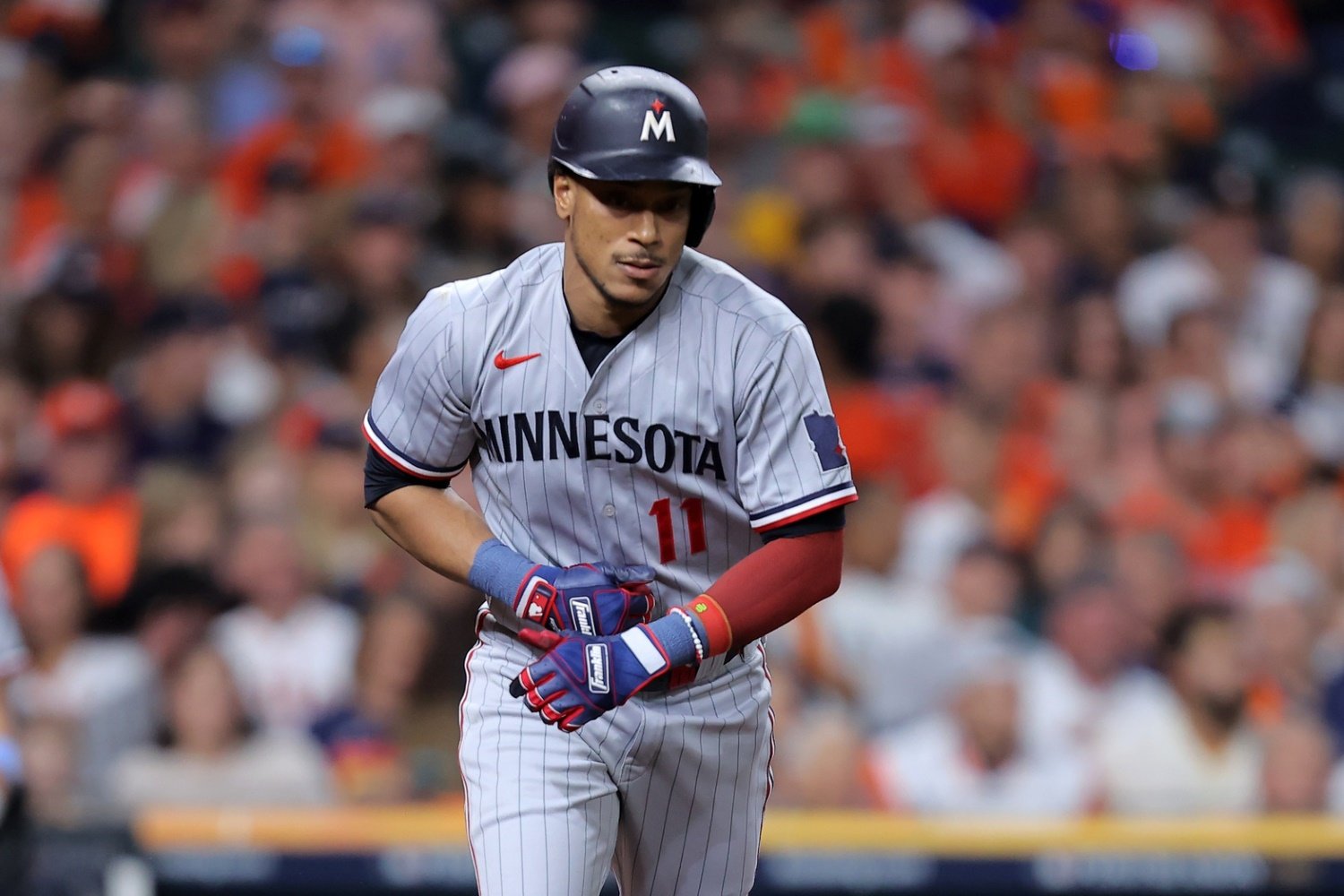 Throughout the month of November, Brewer Fanatic releases its Offseason Handbook. This publication is funded by Brewer Fanatic Caretakers and is only available to Caretakers, who also receive ad-free browsing across Brewer Fanatic. During the publish period of the handbook, we are offering 25% off all Caretaker packages using the coupon code HANDBOOK. To become a supporter of Brewer Fanatic, click here. 100% of Caretaker funds are reinvested into the content creators of Brewer Fanatic. Please consider supporting the Brewers coverage we provide every day, 365 days a year. The Minnesota Twins are in an interesting predicament. They exercised their club option on Jorge Polanco for 2024 earlier this month, but Polanco is no longer an ideal fit for their roster and their payroll. With a transitional year ahead for the team's broadcast rights and with Edouard Julien and Kyle Farmer around to man second base, Polanco's eight-figure salary has become a luxury the team can't necessarily afford. As (first) Luis Arraez and (this season) Julien have nudged him away from second base, Polanco has taken some reps at third recently. He played just over 100 innings there in the 2023 regular season, and also started there during the playoffs. He's versatile at the plate, too, a switch-hitter who can generate some power from each side of the plate and has a feel for altering his approach to suit various situations. He batted .255/.335/.454 in 2023, in a season somewhat disrupted by injury. If the Brewers believe greatly in Tyler Black as a defensive third baseman, then Polanco would merely be insurance at that spot, and the primary reason to acquire him would be to unseat incumbent Brice Turang--an exchange that would be a downgrade defensively, but a bigger upgrade at the plate. Turang, in that case, would slide into a utility role, where his sparkling defense on the middle infield could help the team and his weak bat couldn't hurt it as much. Black's defense really isn't sufficient at the hot corner right now, though. His bat is big-league-ready, but his glove is not, at least at third. The better course for the Crew, then, might be to acquire Polanco, insert him at third, and mix in Black gradually (if at all). The rookie could, instead, play first base most of the time. Polanco is most valuable, in a vacuum, at second base, but his versatility is what makes him an especially interesting trade target for Matt Arnold. Since the Twins picked up his 2024 option, Polanco is also under team control (if whatever team he plays for wants him) for 2025. After earning $10.5 million in 2024, he'll be in line for $12 million in 2025. That's not an insignificant investment, but it's below the market rate for a player with Polanco's consistent offensive track record. The fact that it's an option will also appeal to trade suitors who knock on the Twins' door. Flexibility has a certain monetary value, in itself. Most importantly, there's a dearth of good infield options available in free agency this winter--a constraint on supply that will increase demand for Polanco if the Twins do dangle him. The Brewers would still have some leverage in these negotiations. While Milwaukee isn't positioned to spend especially aggressively this winter, it's the Twins who are truly cornering themselves with a self-imposed budget cutback. That increases the urgency, for them, in offloading a big salary like those owed to Polanco or to part-time catcher Christian Vázquez. There's a deal to be made; it just requires the Brewers to be open to what the Twins would want. What the Twins would want is a center fielder. Many reports have the team looking to assemble packages of their controllable position players to reinforce their starting rotation, and those are well-founded, but when it comes to this trade fit, the guys the Twins would want to talk about are Garrett Mitchell, Joey Wiemer, Tyrone Taylor, and Sal Frelick. Last season, Byron Buxton didn't appear in a single game as the Twins' center fielder. He was a full-time DH, a limitation born of a nagging knee injury. It's unlikely that he'll play even half the games in center field in a season ever again, and with stopgap veteran replacement Michael A. Taylor now a free agent, the Twins need to find a longer-term solution for the problem posed by Buxton's unavailability. With the Brewers overloaded with good-not-great center field options who cost very little and the Twins needing both to fill that spot and to do it cheaply, the fit here seems serendipitous. Obviously, no two potential deals involving the players above would look exactly the same. Although he's a very inexpensive option, Taylor wouldn't be enough to get Polanco, by himself. Any of the other three probably would, but the Brewers are unlikely to trade Frelick in a straight-up swap for a player so much less exciting and so much more expensive, even if he is a better fit for their needs than Frelick. In my opinion, Wiemer is the sweet spot. The Twins lean left-handed in their positional corps (Max Kepler, Alex Kirilloff, Matt Wallner, Julien, Trevor Larnach, to name a few) and would most love to fill that spot with a righty. Wiemer has a high ceiling, but he's a long way from reaching it, and the presence of Taylor, Blake Perkins, and Chris Roller on the 40-man roster makes Wiemer a little redundant in Milwaukee. What do you think? Should the Brewers trade Wiemer for Polanco? Would you trade for Polanco at all, and if so, what modifications to this proposed deal would you like to see? Let us know.
 -
The Brewers' priorities this winter will be finding good options for the corner infield spots, and to solidify their projected production from the designated hitter spot. They could also use some help at second base, though, and one available player could check multiple boxes for them. Image courtesy of © Erik Williams-USA TODAY Sports Throughout the month of November, Brewer Fanatic releases its Offseason Handbook. This publication is funded by Brewer Fanatic Caretakers and is only available to Caretakers, who also receive ad-free browsing across Brewer Fanatic. During the publish period of the handbook, we are offering 25% off all Caretaker packages using the coupon code HANDBOOK. To become a supporter of Brewer Fanatic, click here. 100% of Caretaker funds are reinvested into the content creators of Brewer Fanatic. Please consider supporting the Brewers coverage we provide every day, 365 days a year. The Minnesota Twins are in an interesting predicament. They exercised their club option on Jorge Polanco for 2024 earlier this month, but Polanco is no longer an ideal fit for their roster and their payroll. With a transitional year ahead for the team's broadcast rights and with Edouard Julien and Kyle Farmer around to man second base, Polanco's eight-figure salary has become a luxury the team can't necessarily afford. As (first) Luis Arraez and (this season) Julien have nudged him away from second base, Polanco has taken some reps at third recently. He played just over 100 innings there in the 2023 regular season, and also started there during the playoffs. He's versatile at the plate, too, a switch-hitter who can generate some power from each side of the plate and has a feel for altering his approach to suit various situations. He batted .255/.335/.454 in 2023, in a season somewhat disrupted by injury. If the Brewers believe greatly in Tyler Black as a defensive third baseman, then Polanco would merely be insurance at that spot, and the primary reason to acquire him would be to unseat incumbent Brice Turang--an exchange that would be a downgrade defensively, but a bigger upgrade at the plate. Turang, in that case, would slide into a utility role, where his sparkling defense on the middle infield could help the team and his weak bat couldn't hurt it as much. Black's defense really isn't sufficient at the hot corner right now, though. His bat is big-league-ready, but his glove is not, at least at third. The better course for the Crew, then, might be to acquire Polanco, insert him at third, and mix in Black gradually (if at all). The rookie could, instead, play first base most of the time. Polanco is most valuable, in a vacuum, at second base, but his versatility is what makes him an especially interesting trade target for Matt Arnold. Since the Twins picked up his 2024 option, Polanco is also under team control (if whatever team he plays for wants him) for 2025. After earning $10.5 million in 2024, he'll be in line for $12 million in 2025. That's not an insignificant investment, but it's below the market rate for a player with Polanco's consistent offensive track record. The fact that it's an option will also appeal to trade suitors who knock on the Twins' door. Flexibility has a certain monetary value, in itself. Most importantly, there's a dearth of good infield options available in free agency this winter--a constraint on supply that will increase demand for Polanco if the Twins do dangle him. The Brewers would still have some leverage in these negotiations. While Milwaukee isn't positioned to spend especially aggressively this winter, it's the Twins who are truly cornering themselves with a self-imposed budget cutback. That increases the urgency, for them, in offloading a big salary like those owed to Polanco or to part-time catcher Christian Vázquez. There's a deal to be made; it just requires the Brewers to be open to what the Twins would want. What the Twins would want is a center fielder. Many reports have the team looking to assemble packages of their controllable position players to reinforce their starting rotation, and those are well-founded, but when it comes to this trade fit, the guys the Twins would want to talk about are Garrett Mitchell, Joey Wiemer, Tyrone Taylor, and Sal Frelick. Last season, Byron Buxton didn't appear in a single game as the Twins' center fielder. He was a full-time DH, a limitation born of a nagging knee injury. It's unlikely that he'll play even half the games in center field in a season ever again, and with stopgap veteran replacement Michael A. Taylor now a free agent, the Twins need to find a longer-term solution for the problem posed by Buxton's unavailability. With the Brewers overloaded with good-not-great center field options who cost very little and the Twins needing both to fill that spot and to do it cheaply, the fit here seems serendipitous. Obviously, no two potential deals involving the players above would look exactly the same. Although he's a very inexpensive option, Taylor wouldn't be enough to get Polanco, by himself. Any of the other three probably would, but the Brewers are unlikely to trade Frelick in a straight-up swap for a player so much less exciting and so much more expensive, even if he is a better fit for their needs than Frelick. In my opinion, Wiemer is the sweet spot. The Twins lean left-handed in their positional corps (Max Kepler, Alex Kirilloff, Matt Wallner, Julien, Trevor Larnach, to name a few) and would most love to fill that spot with a righty. Wiemer has a high ceiling, but he's a long way from reaching it, and the presence of Taylor, Blake Perkins, and Chris Roller on the 40-man roster makes Wiemer a little redundant in Milwaukee. What do you think? Should the Brewers trade Wiemer for Polanco? Would you trade for Polanco at all, and if so, what modifications to this proposed deal would you like to see? Let us know. View full article
-
At every time during which the Brewers have been competitive and relevant, trades have been a major driver of their growth and maintenance. They occupy one of baseball’s smallest markets, which limits their ability to build via free agency. Drafting and developing talent is a vital task for teams in this position, but the only truly, fully homegrown teams are terrible ones. To be good, you have to supplement good homegrown talent by bringing in talent from outside the walls of the organization, and in the Brewers’ case, that usually means trades. Image courtesy of Brewer Fanatic & Brock Beauchamp This is an excerpt from the 2024 Brewer Fanatic Offseason Handbook, you can find a link to download the entirety of Week Two of the handbook at the bottom of the article. This publication is funded by Brewer Fanatic Caretakers and full entries are available exclusively to Caretakers. During the publish period of the handbook, we are offering 25% off all Caretaker packages using the coupon code HANDBOOK. To become a supporter of Brewer Fanatic, click here. Another perk of Caretaking is ad-free browsing across all of Brewer Fanatic. We’ve seen this version of the Brewers acquire (among many, many others) Josh Hader, Freddy Peralta, Christian Yelich, Willy Adames, and William Contreras. They get more of their difference-making talent that way than by growing them internally. Acquiring good players requires a willingness and an ability to give up good players, though. To even dream of trades that can make the Brewers better, we have to grapple with the reality that they will have to trade away valuable people in the process. We know they’re willing to do just that. Let’s discuss the ways they might do it this winter. The following is a list of the 10 most valuable trade candidates in the organization right now. The operative word there is “candidates”. You won’t find Jackson Chourio on this list, because while the team could get considerably more for Chourio than for anyone else in their employ, they seem extremely unlikely to trade him. I’ve also left off Freddy Peralta (with his extremely team-friendly contract) and William Contreras (still under cost control, four years from free agency, and one of the team’s best three or four players). Rather, this list ranks the players for whom they might get the most value, but whom the Matt Arnold-led front office genuinely might surrender. Let’s dive in. 1. Devin Williams, RP It says something strange (and not altogether good) about a franchise when their best potential trade chip is a relief pitcher. In this case, though, that’s only because the Brewers have three great pieces who are effectively untouchable. Williams, by contrast, is very much in play, if the right type of deal comes along. He’s one of the five best relievers in baseball, and he still has two seasons of team control remaining. However, now that he’s the closer, those seasons will be fairly expensive ones. Nor is he immune to the variance inherent to being a reliever–especially since he relies on a screwball, and has previously fallen victim to the shoulder trouble that usually catches up to purveyors of that pitch, at some point. None of that would stop him from being immensely valuable on the trade market. The only true comp in recent memory–the only time a team traded a reliever this dominant in the offseason before his penultimate campaign under cost control–is Billy Wagner, whom the Astros dealt to the Phillies 20 years ago this month. In exchange, Houston got three pitchers: Brandon Duckworth (a promising but not thriving swingman with four years of team control attached), Taylor Buchholz (whom Baseball America would rank 50th in their Top 100 Prospects list the following spring) and Ezequiel Astacio (who would land 80th on BA’s list prior to 2005). A controllable big-league arm and two legitimate prospects would be a huge haul, but not an unreasonable one. If the Brewers do deal Williams, as they did with Josh Hader at almost (but not quite) the same juncture, it will be with an eye toward restocking the farm system for another year or two, while still yielding some value at the MLB level. 2. Corbin Burnes, SP Yes, Burnes will be a free agent after 2024, but until the season starts, any team who acquires him can still console themselves with the reminder that he can be tendered a qualifying offer on the way out the door. That would allow his new, stopover team to regain some long-term value after wringing out significant short-term value from him. That’s one reason why the Brewers can still expect top-echelon talent in return for Burnes. The other is that he remains one of the game’s best starting pitchers. It’s been frustrating to watch Burnes at times since the 2022 All-Star break, but he’s piled up innings and strikeouts even during some periods of struggle. He’s not at the elite level he attained in 2020 and 2021, but every team in baseball would love to use him as a starter at some point in a playoff series. For many clubs, he would still be a Game 1 or Game 2 starter. That makes for good trade value, even if Burnes’s projected salary and the well-publicized friction between the player and the organization slightly compromise Milwaukee’s leverage. 3. Sal Frelick, OF Entering this season, the hope was that Frelick would end up in the category Chourio, Contreras, and Peralta now occupy. Ideally, he’d have come up for at least half the season, demonstrated the considerable value of his well-rounded skill set, and secured a long-term role on this team.... View full article
-
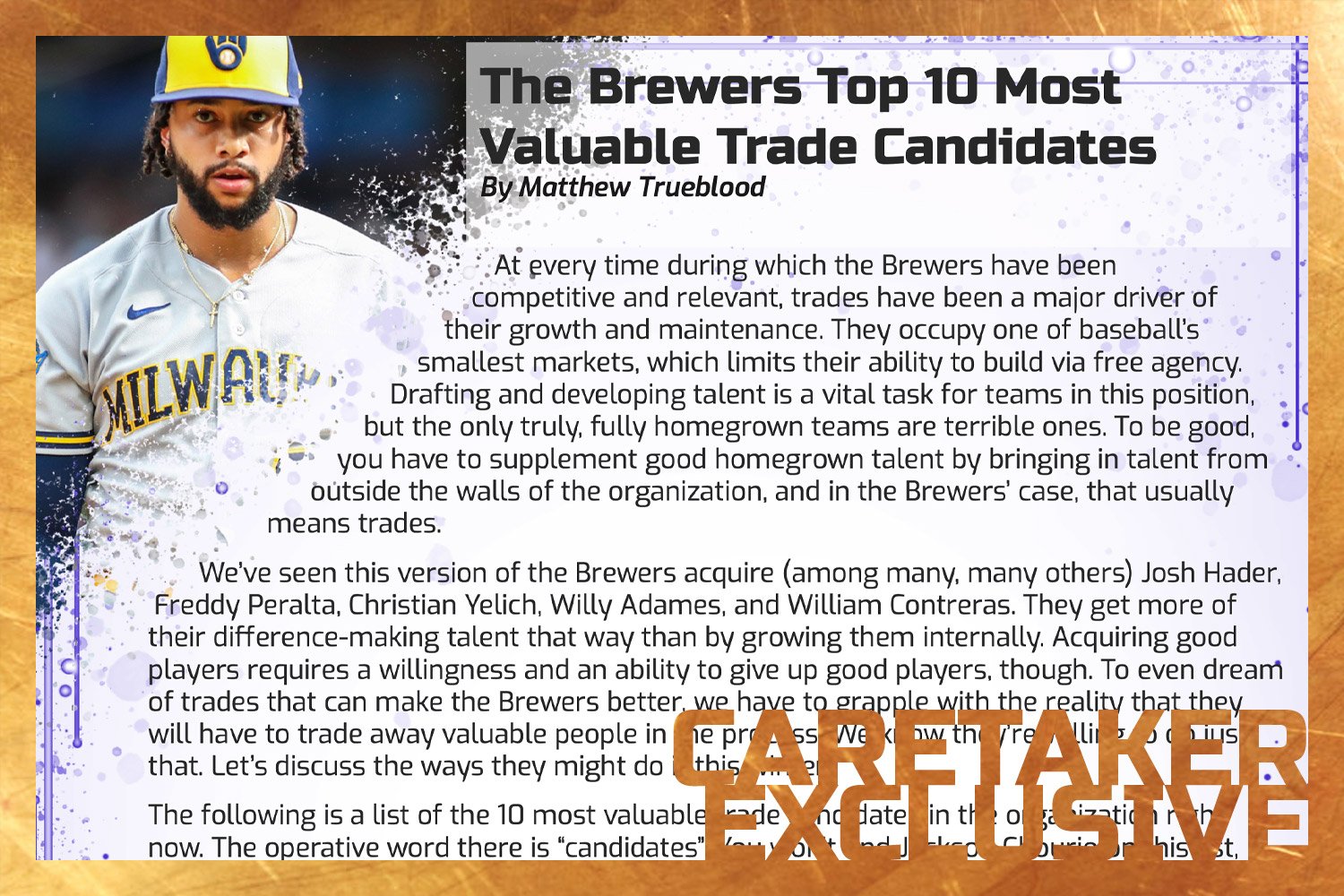 This is an excerpt from the 2024 Brewer Fanatic Offseason Handbook, you can find a link to download the entirety of Week Two of the handbook at the bottom of the article. This publication is funded by Brewer Fanatic Caretakers and full entries are available exclusively to Caretakers. During the publish period of the handbook, we are offering 25% off all Caretaker packages using the coupon code HANDBOOK. To become a supporter of Brewer Fanatic, click here. Another perk of Caretaking is ad-free browsing across all of Brewer Fanatic. We’ve seen this version of the Brewers acquire (among many, many others) Josh Hader, Freddy Peralta, Christian Yelich, Willy Adames, and William Contreras. They get more of their difference-making talent that way than by growing them internally. Acquiring good players requires a willingness and an ability to give up good players, though. To even dream of trades that can make the Brewers better, we have to grapple with the reality that they will have to trade away valuable people in the process. We know they’re willing to do just that. Let’s discuss the ways they might do it this winter. The following is a list of the 10 most valuable trade candidates in the organization right now. The operative word there is “candidates”. You won’t find Jackson Chourio on this list, because while the team could get considerably more for Chourio than for anyone else in their employ, they seem extremely unlikely to trade him. I’ve also left off Freddy Peralta (with his extremely team-friendly contract) and William Contreras (still under cost control, four years from free agency, and one of the team’s best three or four players). Rather, this list ranks the players for whom they might get the most value, but whom the Matt Arnold-led front office genuinely might surrender. Let’s dive in. 1. Devin Williams, RP It says something strange (and not altogether good) about a franchise when their best potential trade chip is a relief pitcher. In this case, though, that’s only because the Brewers have three great pieces who are effectively untouchable. Williams, by contrast, is very much in play, if the right type of deal comes along. He’s one of the five best relievers in baseball, and he still has two seasons of team control remaining. However, now that he’s the closer, those seasons will be fairly expensive ones. Nor is he immune to the variance inherent to being a reliever–especially since he relies on a screwball, and has previously fallen victim to the shoulder trouble that usually catches up to purveyors of that pitch, at some point. None of that would stop him from being immensely valuable on the trade market. The only true comp in recent memory–the only time a team traded a reliever this dominant in the offseason before his penultimate campaign under cost control–is Billy Wagner, whom the Astros dealt to the Phillies 20 years ago this month. In exchange, Houston got three pitchers: Brandon Duckworth (a promising but not thriving swingman with four years of team control attached), Taylor Buchholz (whom Baseball America would rank 50th in their Top 100 Prospects list the following spring) and Ezequiel Astacio (who would land 80th on BA’s list prior to 2005). A controllable big-league arm and two legitimate prospects would be a huge haul, but not an unreasonable one. If the Brewers do deal Williams, as they did with Josh Hader at almost (but not quite) the same juncture, it will be with an eye toward restocking the farm system for another year or two, while still yielding some value at the MLB level. 2. Corbin Burnes, SP Yes, Burnes will be a free agent after 2024, but until the season starts, any team who acquires him can still console themselves with the reminder that he can be tendered a qualifying offer on the way out the door. That would allow his new, stopover team to regain some long-term value after wringing out significant short-term value from him. That’s one reason why the Brewers can still expect top-echelon talent in return for Burnes. The other is that he remains one of the game’s best starting pitchers. It’s been frustrating to watch Burnes at times since the 2022 All-Star break, but he’s piled up innings and strikeouts even during some periods of struggle. He’s not at the elite level he attained in 2020 and 2021, but every team in baseball would love to use him as a starter at some point in a playoff series. For many clubs, he would still be a Game 1 or Game 2 starter. That makes for good trade value, even if Burnes’s projected salary and the well-publicized friction between the player and the organization slightly compromise Milwaukee’s leverage. 3. Sal Frelick, OF Entering this season, the hope was that Frelick would end up in the category Chourio, Contreras, and Peralta now occupy. Ideally, he’d have come up for at least half the season, demonstrated the considerable value of his well-rounded skill set, and secured a long-term role on this team....
 -
First base. I don't think he's a third baseman anyway. I like Black, but more as someone like Spencer Steer or Jake Cronenworth than as either a true defensive stud or a star so valuable that you eschew chances to sign proven stars in deference to them.
-
I agree that 6/150 feels high. 5/120 feels much more manageable, and if it creeps down even from there (toward, say, 5/110), that's what I'm dreaming on by ranking him at the top. He's the kind of high-upside move I want to see them take a chance on, but there's a real risk that the price tag gets crazy. We'll see how the other top names shake out. I'm hoping a few of his would-be suitors get the even bigger fish they're chasing (the Jays land Yamamoto, for instance) and the money dries up a little.
-
Top 50 Fits for the Brewers in MLB Free Agency: Nos. 5-1
Matthew Trueblood posted an article in Brewers
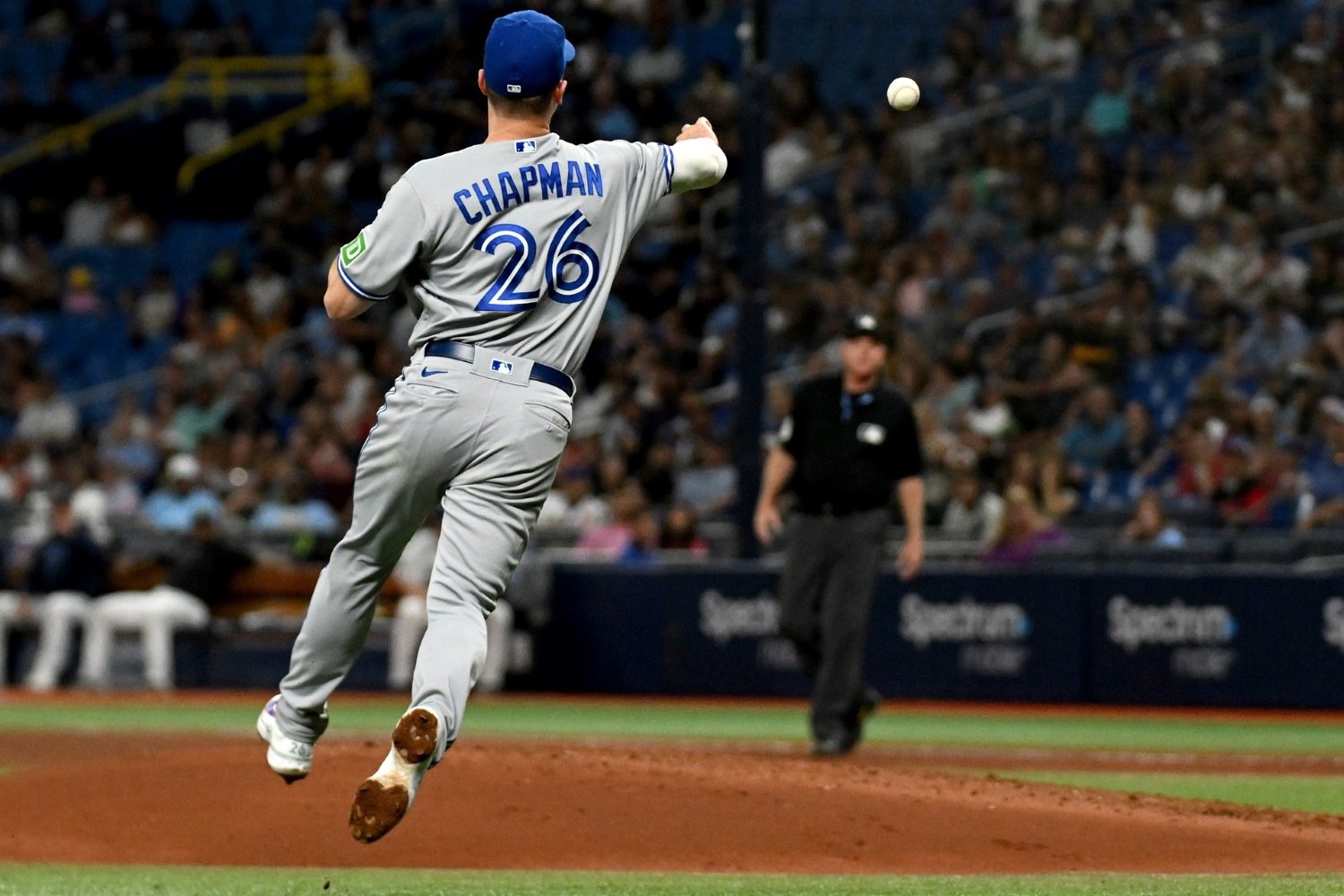 We've already broken down the talents and the fit for 45 MLB free agents. If you've missed all of those, feel free to go back and check them out, and to weigh in on the placement of any of them. Nos. 41-50 Nos. 31-40 Nos. 21-30 Nos. 11-20 Nos. 6-10 Now, let's turn our attention to the biggest fish in the sea. 5. Eduardo Rodríguez, LHP After opting out of the final three years of what was a five-year agreement with the Tigers, Rodríguez hits the market looking for a fourth or even fifth year, again. If the bidding goes much beyond what he got from Detroit in the first place ($77 million over those five seasons), he might be out of the Brewers' price range. I don't expect that. If anything, I can imagine Rodríguez coming in slightly below that last deal, and at that level, he'd be an excellent piece for the middle of the rotation. Rodríguez has a deep arsenal, and it works in some unexpected ways. He can attack both sides of the plate with a cutter that sets up pretty much everything else he throws. He has a sinker that he likes to steer inside on right-handed hitters and away from lefties, which is the opposite of the way most pitchers use that offering. While his strikeout stuff is more good than great, and while his command fluctuates (just as every pitcher's does), Rodríguez is a solid starter who can work deep into games. There's also a good chance that Chris Hook would help Rodríguez put together some of the pieces that haven't quite coalesced into a top-of-the-rotation whole since 2019. 4. Marcus Stroman, RHP The second half of the season got away from Stroman. He suffered a hip injury, tried to pitch through it, and seemingly aggravated it while on the injured list. Before July, though, he was on track to compete for the Cy Young Award. Stroman's success is even more dependent on command than is that of Rodríguez; he doesn't have great velocity or a single pitch that dominates opposing hitters. Often, though, he's able to pinpoint his sinker so well that it sets hitters up for everything else, and he induces a series of weak ground balls. Tinkering is a bit of a problem for Stroman. His self-confidence is so complete that he sometimes lets the perfect become the enemy of the good, chasing the tweak that will make him fully and lastingly unhittable rather than embracing a simpler, more repeatable approach to opposing lineups. Still, when he's healthy, he's a solid second option in any rotation, and he and Freddy Peralta would grow and learn together well. 3. Seth Lugo, RHP Moving from the bullpen to the rotation is much less common than the opposite conversion, but Lugo managed it deftly in 2023. He's always sported an impressive combination of high-spin fastballs and curves, but he finally found an adjustment to his changeup that made it more consistently effective. With an overhand arm slot, Lugo has always had the opportunity to build an offspeed pitch that works vertically, rather than fading to the arm side, but he'd never tapped into that potential until this past season. Lugo is less of a brand name than Stroman or Rodríguez, but he's almost equally good, and his price tag figures to be much lower. This is the kind of move that would sneakily move the Brewers forward, by giving them depth and a bridge to the pitching prospects they hope are the future of the organization. Lugo could help them compete in the short term, and getting good value from him could ensure that the team remains competitive in the long term. 2. Rhys Hoskins, 1B/DH With Brandon Woodruff hurt and no longer a part of the organization, starting pitching is an area of need for the Crew. Hence the names above. Their more urgent and major need, though, is for help at the infield corners, and Hoskins is the ideal fit for one half of that. Coming off a season lost to a torn ACL, the erstwhile Phillies slugger not only seems not to have a place in the lineup with his long-time team, but didn't get a qualifying offer from them on the way out the door. That's because they knew he would take it, and they prefer to play Bryce Harper at first base in 2024. Now that Hoskins is on the market, though, it's not quite as clear that he's looking for a one-year deal as some might assume. Sure, he would be able to rebuild his value after the injury took away what he hoped would be his platform season, but he would also subject himself to the qualifying offer next winter, since he didn't receive this one. Instead of doing that, he could be open to something more like the deal Michael Conforto signed with the Giants last winter: two years, with the player having a right to opt out after the first one. Hoskins has tremendous power, and his patient approach yields a consistently strong on-base percentage. The injury makes it hard to project him, because hitters do need their lower half to generate the drive on which big power depends. His defense might also not be everything it was before he got hurt. Still, he's solidly above-average at the plate, with 30 home runs as the baseline of his profile. He'd be an excellent cleanup hitter. 1. Matt Chapman, 3B If you think Hoskins is unpredictable in the batter's box, get a load of Chapman. He had a 1.152 OPS in April, and it looked like he was on track for a $200-million contract. From May 1 on, though, he batted .205/.298/.361--production the Brewers could get from Brian Anderson, if they could just wipe his memory of 2023 and get a fresh start with him. In 2018 and 2019, he was well above average, but since then, he's been essentially average. He flashes very good power, and he's not without a hit tool or some plate discipline, but the puzzle pieces haven't fit together over a full season in quite some time. The saving grace with Chapman, and the reason why he's still a premium free agent after five months of offensive struggles, is his defense. If he's not the best defender at the hot corner in MLB, he's in the top three. He'll turn 31 next spring, but third basemen often age well with the glove. Last season, the Brewers' success depended greatly on their defense, which was one of the best in baseball. Adding Chapman to the infield phalanx would lock in that team strength for the longer term. In franchise history, the only megadeals the Brewers have signed have been with guys who were already members of the organization, like Christian Yelich and Ryan Braun. Chapman's value took a hit when he slumped at the plate for such a long time, but he could still earn a nine-figure deal. That's the big hurdle here. If the Brewers want to lock in an important piece of the batting order and the infield defense for the long term, though, they'll have to go a bit outside their comfort zone. Chapman is the sweet spot, and the Brewers should stay engaged until he signs. That's the end of this long countdown. Let's discuss it. Who's too low on the list? Who's too high? Very soon, we'll start to see guys like this sign, and find out whether the Brewers agree with this rough relative valuation or not.
 -
At long last, we've reached the top of the mountain. These are the five players whom I believe the Brewers would be wisest to pursue and sign this winter, based on team needs, realistic price tags, and the payroll outlook for the team. Image courtesy of © Jonathan Dyer-USA TODAY Sports We've already broken down the talents and the fit for 45 MLB free agents. If you've missed all of those, feel free to go back and check them out, and to weigh in on the placement of any of them. Nos. 41-50 Nos. 31-40 Nos. 21-30 Nos. 11-20 Nos. 6-10 Now, let's turn our attention to the biggest fish in the sea. 5. Eduardo Rodríguez, LHP After opting out of the final three years of what was a five-year agreement with the Tigers, Rodríguez hits the market looking for a fourth or even fifth year, again. If the bidding goes much beyond what he got from Detroit in the first place ($77 million over those five seasons), he might be out of the Brewers' price range. I don't expect that. If anything, I can imagine Rodríguez coming in slightly below that last deal, and at that level, he'd be an excellent piece for the middle of the rotation. Rodríguez has a deep arsenal, and it works in some unexpected ways. He can attack both sides of the plate with a cutter that sets up pretty much everything else he throws. He has a sinker that he likes to steer inside on right-handed hitters and away from lefties, which is the opposite of the way most pitchers use that offering. While his strikeout stuff is more good than great, and while his command fluctuates (just as every pitcher's does), Rodríguez is a solid starter who can work deep into games. There's also a good chance that Chris Hook would help Rodríguez put together some of the pieces that haven't quite coalesced into a top-of-the-rotation whole since 2019. 4. Marcus Stroman, RHP The second half of the season got away from Stroman. He suffered a hip injury, tried to pitch through it, and seemingly aggravated it while on the injured list. Before July, though, he was on track to compete for the Cy Young Award. Stroman's success is even more dependent on command than is that of Rodríguez; he doesn't have great velocity or a single pitch that dominates opposing hitters. Often, though, he's able to pinpoint his sinker so well that it sets hitters up for everything else, and he induces a series of weak ground balls. Tinkering is a bit of a problem for Stroman. His self-confidence is so complete that he sometimes lets the perfect become the enemy of the good, chasing the tweak that will make him fully and lastingly unhittable rather than embracing a simpler, more repeatable approach to opposing lineups. Still, when he's healthy, he's a solid second option in any rotation, and he and Freddy Peralta would grow and learn together well. 3. Seth Lugo, RHP Moving from the bullpen to the rotation is much less common than the opposite conversion, but Lugo managed it deftly in 2023. He's always sported an impressive combination of high-spin fastballs and curves, but he finally found an adjustment to his changeup that made it more consistently effective. With an overhand arm slot, Lugo has always had the opportunity to build an offspeed pitch that works vertically, rather than fading to the arm side, but he'd never tapped into that potential until this past season. Lugo is less of a brand name than Stroman or Rodríguez, but he's almost equally good, and his price tag figures to be much lower. This is the kind of move that would sneakily move the Brewers forward, by giving them depth and a bridge to the pitching prospects they hope are the future of the organization. Lugo could help them compete in the short term, and getting good value from him could ensure that the team remains competitive in the long term. 2. Rhys Hoskins, 1B/DH With Brandon Woodruff hurt and no longer a part of the organization, starting pitching is an area of need for the Crew. Hence the names above. Their more urgent and major need, though, is for help at the infield corners, and Hoskins is the ideal fit for one half of that. Coming off a season lost to a torn ACL, the erstwhile Phillies slugger not only seems not to have a place in the lineup with his long-time team, but didn't get a qualifying offer from them on the way out the door. That's because they knew he would take it, and they prefer to play Bryce Harper at first base in 2024. Now that Hoskins is on the market, though, it's not quite as clear that he's looking for a one-year deal as some might assume. Sure, he would be able to rebuild his value after the injury took away what he hoped would be his platform season, but he would also subject himself to the qualifying offer next winter, since he didn't receive this one. Instead of doing that, he could be open to something more like the deal Michael Conforto signed with the Giants last winter: two years, with the player having a right to opt out after the first one. Hoskins has tremendous power, and his patient approach yields a consistently strong on-base percentage. The injury makes it hard to project him, because hitters do need their lower half to generate the drive on which big power depends. His defense might also not be everything it was before he got hurt. Still, he's solidly above-average at the plate, with 30 home runs as the baseline of his profile. He'd be an excellent cleanup hitter. 1. Matt Chapman, 3B If you think Hoskins is unpredictable in the batter's box, get a load of Chapman. He had a 1.152 OPS in April, and it looked like he was on track for a $200-million contract. From May 1 on, though, he batted .205/.298/.361--production the Brewers could get from Brian Anderson, if they could just wipe his memory of 2023 and get a fresh start with him. In 2018 and 2019, he was well above average, but since then, he's been essentially average. He flashes very good power, and he's not without a hit tool or some plate discipline, but the puzzle pieces haven't fit together over a full season in quite some time. The saving grace with Chapman, and the reason why he's still a premium free agent after five months of offensive struggles, is his defense. If he's not the best defender at the hot corner in MLB, he's in the top three. He'll turn 31 next spring, but third basemen often age well with the glove. Last season, the Brewers' success depended greatly on their defense, which was one of the best in baseball. Adding Chapman to the infield phalanx would lock in that team strength for the longer term. In franchise history, the only megadeals the Brewers have signed have been with guys who were already members of the organization, like Christian Yelich and Ryan Braun. Chapman's value took a hit when he slumped at the plate for such a long time, but he could still earn a nine-figure deal. That's the big hurdle here. If the Brewers want to lock in an important piece of the batting order and the infield defense for the long term, though, they'll have to go a bit outside their comfort zone. Chapman is the sweet spot, and the Brewers should stay engaged until he signs. That's the end of this long countdown. Let's discuss it. Who's too low on the list? Who's too high? Very soon, we'll start to see guys like this sign, and find out whether the Brewers agree with this rough relative valuation or not. View full article
